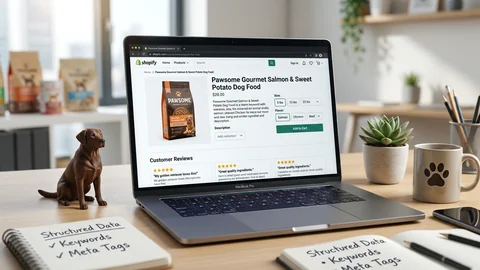
Seasonal and Event-Driven Pet SEO: A 12-Month Calendar for Retailers

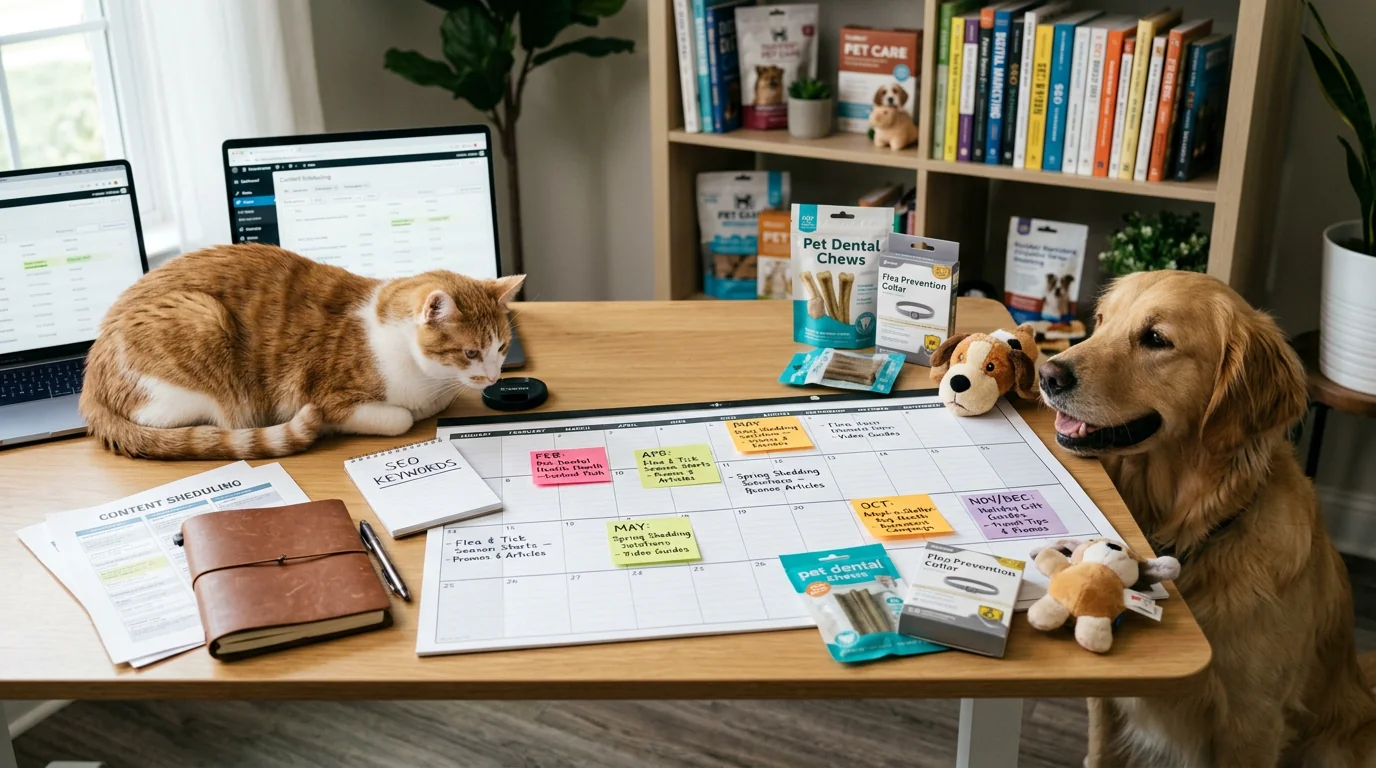
Table of Contents +
- What this 12-month calendar solves (one use case)
- The 12-month pet SEO calendar with lead times
- Quick decision guide: if X, then Y
- Templates and on-page elements for seasonal intent
- Monitoring: what to check after 7-14 days and 4-8 weeks
- Practical safety boundaries
- Evidence status: what’s well-supported vs. emerging
- Workflow: turning the calendar into weekly sprints
- How this supports the cluster
- Frequently Asked Questions
- Conclusion
- References
Plan pet SEO for seasons and events. Map lead times, promos, and content to monthly spikes like flea season, shedding, holidays, and adoption events.
Seasonal demand drives sharp spikes in searches and sales. Retailers who plan ahead capture those moments. Seasonal pet SEO turns timing into an advantage.
This matters because rankings and inventory both need lead time. Search engines may take weeks to index updates. You need content, promos, and stock synchronized. This guide shows when to publish, what to promote, and how to monitor.
Sidebar navigation
Breadcrumbs: complete Pet Store SEO hub › Seasonal calendar
- Q1: Resolutions, Dental Health, Early Shedding
- Q2: Flea/Tick, Travel Prep, Allergies
- Q3: Heat Safety, Routines, Late Shedding
- Q4: Halloween, Holidays, Travel, New Year
What this 12-month calendar solves (one use case)
Scenario: Aligning content to predictable pet demand spikes
Use this pet retail seasonal calendar to plan pages, bundles, and promos around predictable spikes. Evidence shows a large share of product queries are seasonal, so timing the launch may be decisive.[3]
Scope: North America/UK seasonality with notes for DACH
Dates reflect North America and UK. DACH tends to experience similar patterns, with colder starts and later spring peaks. Adjust publish dates by one to three weeks based on local climate and holidays.
Petbase automates SEO content for pet stores - publishing 10 optimized articles monthly so you can focus on running your shop - start your free trial.
The 12-month pet SEO calendar with lead times
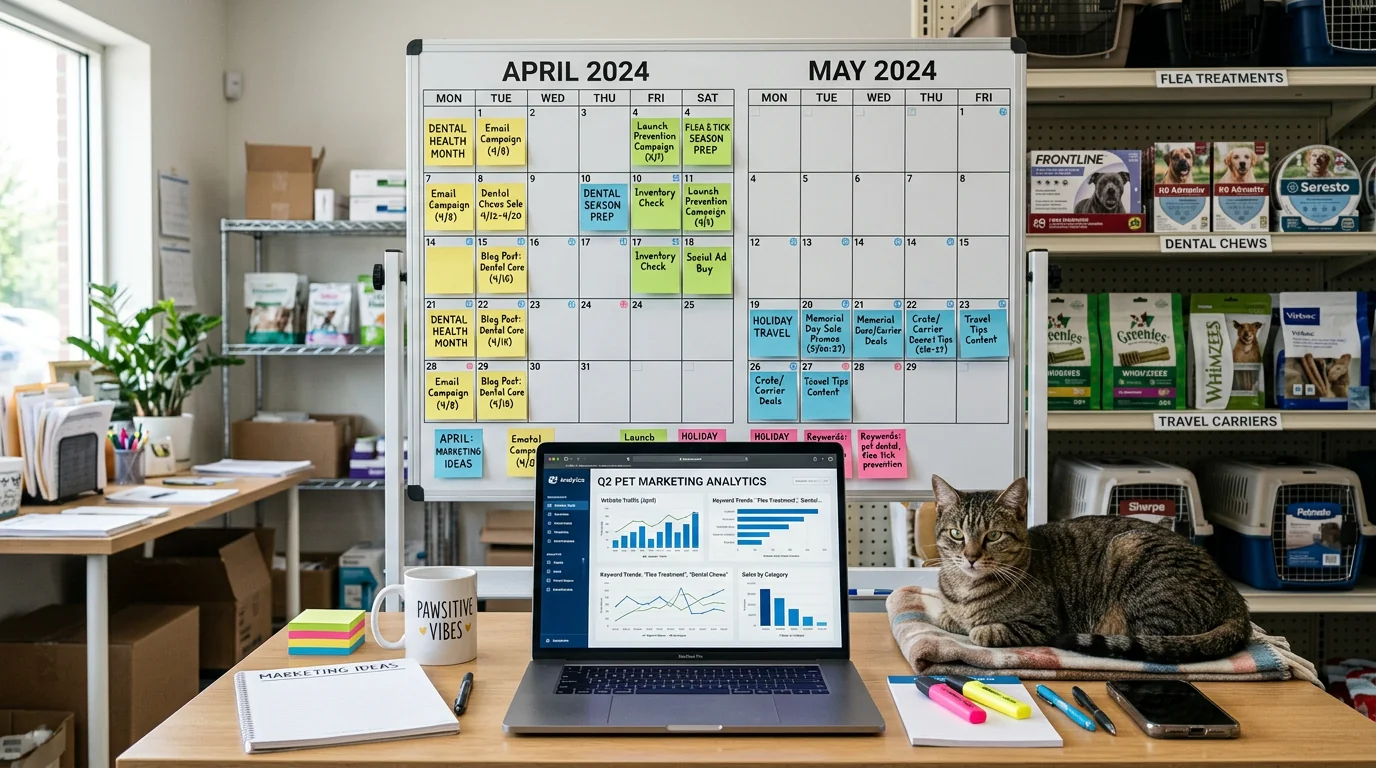
Q1 (Jan-Mar): Resolutions, Dental Health Month, early shedding
Publish resolution checklists by late December. Post National Pet Dental Health Month content four to six weeks early, with dental bundles. Refresh shedding guides by February for early shedders and grooming category pages.
Q2 (Apr-Jun): Flea/tick peaks, travel prep, allergy season
Begin flea and tick season SEO in late March. Evidence suggests seasonal keywords ramp quickly, favoring already-indexed pages.[2] Launch travel kits by May and create allergy-safe cleaning and grooming pages.
Q3 (Jul-Sep): Heat safety, back-to-school routines, late shedding
Release heat-safety guides in June with hydration, cooling, and paw-care collections. Shift to routine-friendly products in August. Update late-shedding content and brushes, pairing care tips with relevant category navigation.
Q4 (Oct-Dec): Halloween, holiday gifting, travel, New Year setup
Schedule Halloween safety posts in early September. Holiday SEO for pet retailers benefits from gift guides in October. Promote travel essentials by November and queue New Year habit content before mid-December.[4]
Quick decision guide: if X, then Y
Inventory ready vs. delayed
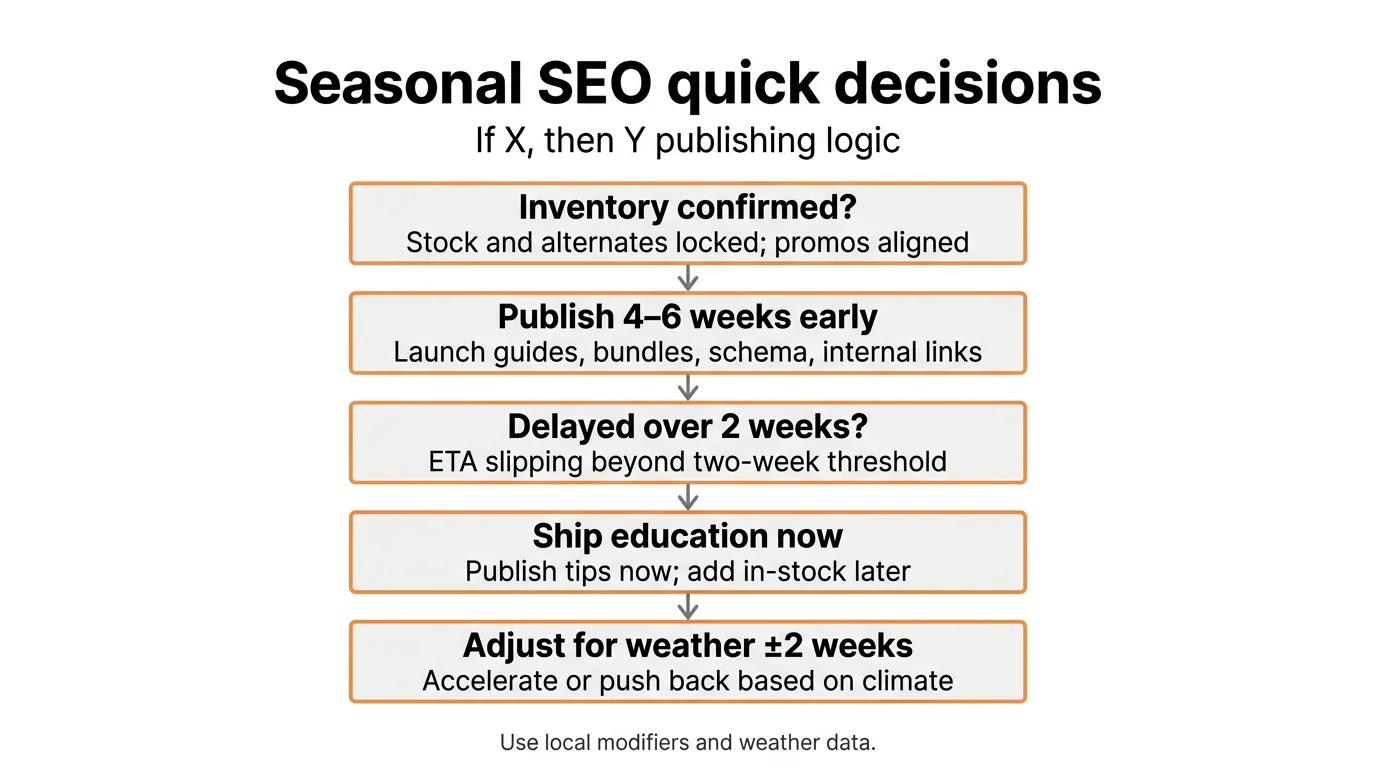
If inventory is confirmed, publish four to six weeks before peak. If delayed beyond two weeks, ship educational content now, then add “in-stock” modules and buy-boxes once availability is verified.
Local climate early/late seasons
If warm spring arrives early, accelerate flea/tick and allergy content by two weeks. If winter lingers, shift dates later. Use local modifiers and weather alerts to adjust paid and organic focuses.
Promo window length
If promos run shorter than seven days, add urgency CTAs and countdown timers. If promos run longer than 21 days, rotate hero products weekly to prevent ad-like fatigue and maintain on-page freshness.
New vs. existing content
If a page ranks on page two or better, refresh that URL. If the topic is net-new, build a distinct intent page, internally link from hubs, and set a recurring refresh two weeks pre-peak.
Limited bandwidth
If resources are tight, prioritize highest-margin seasonal categories. Repurpose last year’s URL and swap hero modules, updated FAQs, and bundles. Defer net-new content until after core peaks stabilize.
Multi-location retailers
If regions peak at different times, deploy a core template and clone localized variants with city/state in H1 and meta. Stagger publication dates, and monitor each market’s demand lag separately.
International rollout
If rolling out to the UK or DACH, localize dates, spellings, regulations, and shipping cutoffs. Publish three to six weeks before local peaks to allow crawl and indexing before demand surges.[2]
Templates and on-page elements for seasonal intent
Title/meta patterns that reflect time-sensitivity
Use time-boxed templates: “Best Flea Control for Spring 2026,” “Holiday Travel Checklist for Pets,” and “Dental Month Deals.” Add month/season in meta descriptions to signal immediacy and improve relevance.
Schema, FAQs, and internal link blocks
Product, Local Business, and FAQ schema may support rich results and trust. Build an “In-Season Guides” internal link block to distribute authority and aid event-driven SEO discovery.Schema for Pet Stores
Promo modules and stock-aware widgets
Insert above-the-fold promo bars with valid-through dates. Add stock-aware widgets that switch CTAs when items sell out, and include alternative recommendations to maintain conversion paths throughout peaks.
Monitoring: what to check after 7-14 days and 4-8 weeks
Early signals (impressions, crawl, indexation)
Within 7-14 days, review impressions, crawl stats, and indexation for new or refreshed URLs. Early traction suggests adequate lead time; lack of crawl indicates structural or internal linking gaps.[1]
Mid-cycle signals (rank movement, CTR, assisted revenue)
By 4-8 weeks, track rank shifts on core seasonal terms, CTR by query, internal click-through to product pages, and assisted revenue. Build dashboards to compare YoY peaks and promo windows.SEO analytics for pet retailers
Practical safety boundaries
Medical guidance wording for health topics
Avoid prescriptive medical claims. Use language like “may support comfort” or “check with a veterinarian.” Provide general care tips and disclaimers, and avoid implying diagnosis, treatment, or guaranteed outcomes.
Date freshness and expired promos
Ensure titles, H1s, and hero modules reflect the current year or season. Remove expired codes and badges quickly. Add an editor’s note when a page is updated to maintain clarity and trust.
Geographic and species accuracy
Check product legality, shipping constraints, and regional season offsets. Validate guidance for species and sizes. Avoid over-generalizing. Include localized shipping cutoffs and regional return policies where relevant.
Evidence status: what’s well-supported vs. emerging
Historical seasonality and search interest
Large portions of commerce queries display seasonal relevance; planning around predictable cycles is substantiated by search behavior at scale.[3] Retailers may benefit from aligning content with those recurrent peaks.
Promo timing and conversion lift
Publishing and optimizing ahead of holiday peaks is prudent. Algorithm volatility around major retail seasons has historical precedent, supporting earlier preparation to mitigate risk and capitalize on demand.[4]
Event alignment and local modifiers
Seasonal keywords and trending topics may rise rapidly, favoring pages already indexed. Adding city/state modifiers often improves relevance for local intent, particularly in staggered climate regions.[2]
Workflow: turning the calendar into weekly sprints
Backlog grooming and handshake with merchandising
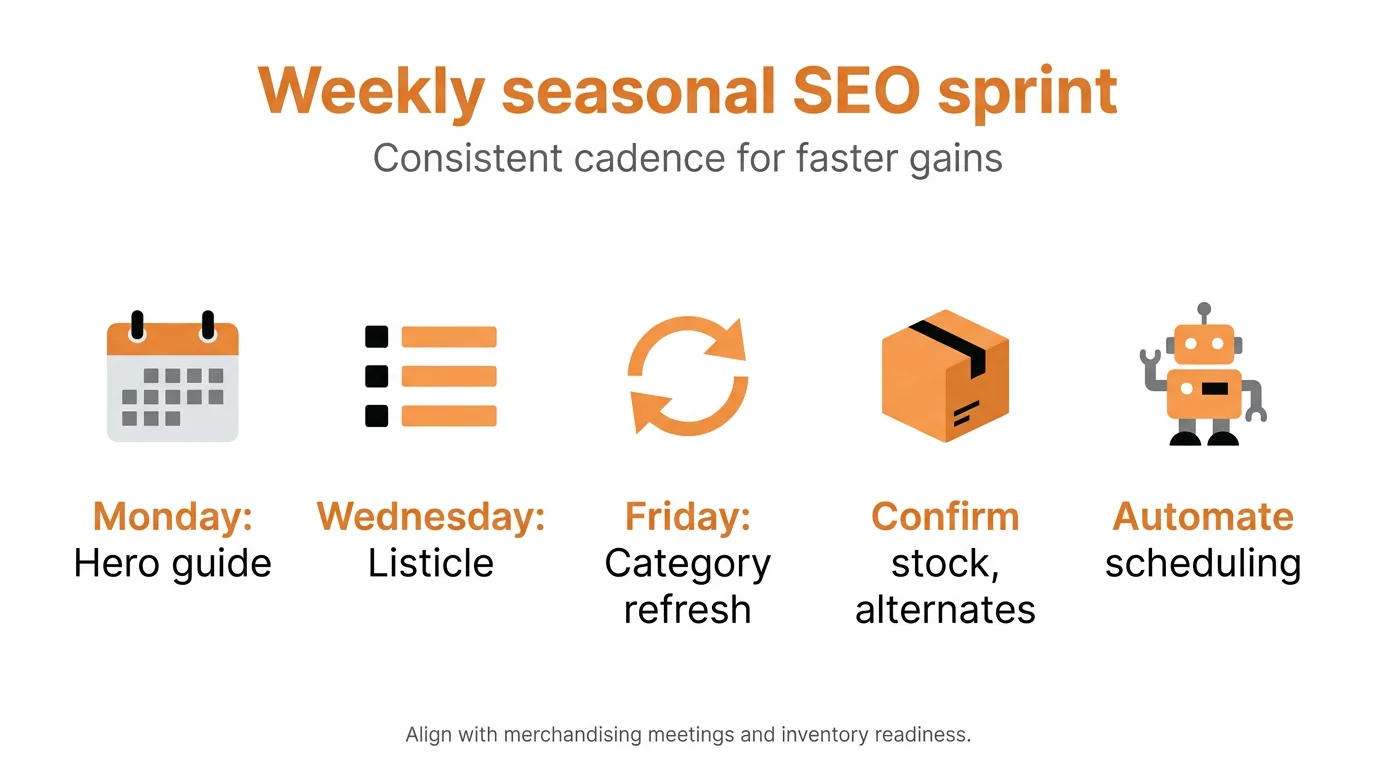
Create a 12-month backlog with themes, lead times, core SKUs, and promos. Align grooming with merchandising meetings. Confirm stock, alternates, and margin priorities, then freeze content briefs two sprints before publish.
Publishing cadence and internal linking
Adopt a weekly cadence: publish hero guide Monday, supporting listicle Wednesday, and category refresh Friday. Automate scheduling when possible with tools like Petbase AI to maintain cadence during peaks.
Localization and translation checkpoints
Localize spellings, regulations, and holidays. Add local modifiers to titles and H1s. Validate hreflang and avoid cannibalization by differentiating intent and examples.Multilingual SEO for pet stores
How this supports the cluster
Where to link from and to within Pet Store SEO content
Link seasonal hubs from your navigation and cornerstone pages within pet store SEO. From evergreen grooming, health, and travel guides, point to in-season pages, then link back to hubs to consolidate authority.
Connecting seasonal posts to evergreen product pages
Use on-page “Shop the bundle” modules to connect tips to categories and products. Add breadcrumbs and contextual links from seasonal posts to evergreen product pages to sustain equity after the peak fades.
Frequently Asked Questions
How far in advance should pet retailers publish seasonal content?
Evidence suggests publishing 4-6 weeks before peak searches may support ranking and discovery. For competitive topics like flea and tick, consider 6-8 weeks with internal links and refreshes.
Do seasonal pet SEO pages need to be rebuilt every year?
You can update a stable URL annually to preserve equity and add the new year in the H1 and meta title. Refresh product links, dates, and FAQs, and add a short 2026 update note.
What KPIs indicate a seasonal post is on track?
Within 7-14 days, look for impressions and indexing. By 4-8 weeks, monitor rank movement for core terms, CTR, internal click-through to product pages, and assisted revenue or add-to-cart rate.
How do climate differences affect the pet SEO calendar?
Regional variables shift peaks. Use local modifiers (city/state) and first-party demand signals to move publish dates earlier or later, and duplicate pages with localized details when relevant.
What on-page elements help event-driven pet SEO?
Time-boxed titles, event FAQs, product bundles, breadcrumbs, and Product/FAQ/HowTo schema may aid relevance. Internal links from evergreen hubs help topical context.
Conclusion
Seasonal pet SEO rewards teams that ship early, align promos with demand, and monitor rigorously. Use this calendar to plan lead times, balance inventory, and protect safety boundaries. Prioritize high-margin categories, localize intelligently, and refresh proven URLs. With disciplined sprints and clear KPIs, your event-driven SEO and holiday campaigns can compound gains quarter after quarter. Treat each peak as a cycle to test, learn, and roll improvements into the next season.
References
- P Kontio (2025). Improving organic search engine visibility under time constraints of seasonality: case: Fluwel. 2025 - theseus.fi. View article
- F Alfiana et al. (2023). Apply the search engine optimization (seo) method to determine website ranking on search engines. … Journal of Cyber …. View article
- H Yang et al. (2021). Seasonal relevance in e-commerce search. Proceedings of the 30th …. View article
- A Shahzad et al. (2020). The new trend for search engine optimization, tools and techniques. Indonesian Journal …. View article