Multilingual SEO for Pet Stores: US, UK, and DACH Localization Without Cannibalization

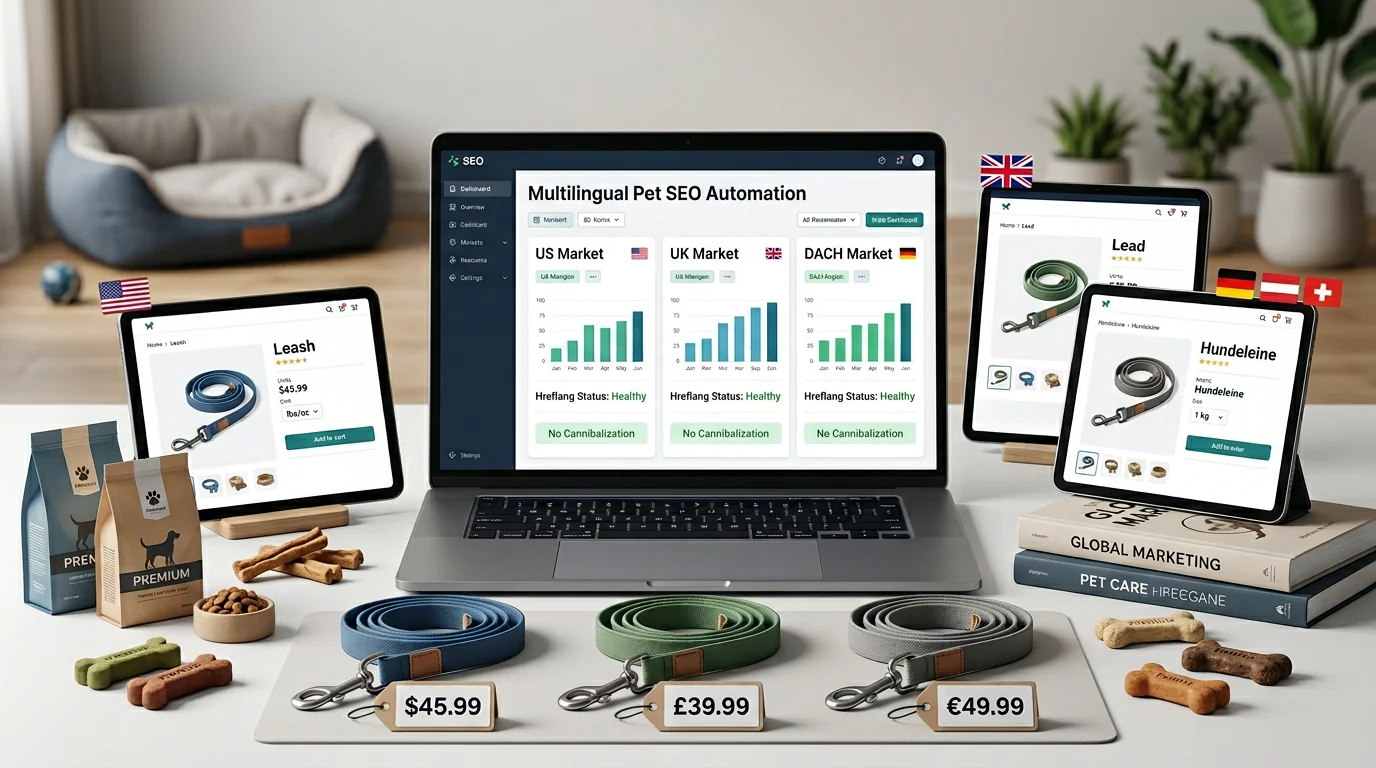
Table of Contents +
- Context: One catalog, three markets, zero cannibalization
- Decision focus: How to structure US, UK, and DACH variants
- Quick decision guide
- Implementation blueprint: Localization without cannibalization
- Monitoring: What to observe after 7-14 days and 4-8 weeks
- Practical safety boundaries
- Evidence status: What current best practices suggest
- Example localization patterns for pet taxonomy
- Measurement framework and diagnostics
- Frequently Asked Questions
- Conclusion
- References
Localize for US, UK, and DACH with hreflang, currency, and terminology while avoiding cannibalization. Keep product data and reviews consistent across markets.
Expanding into new English and German-speaking markets can grow revenue fast. Done poorly, it may also confuse search engines and split demand across duplicates. The risk is real and avoidable.
This matters because identical catalogs across locales can trigger duplicate clustering and intent mixing. You need localization without fragmenting product data or reviews. You will learn how to deploy hreflang, terminology, currency, and units correctly while keeping product and review parity.
Context: One catalog, three markets, zero cannibalization
The core problem: market localization vs. duplicate clustering
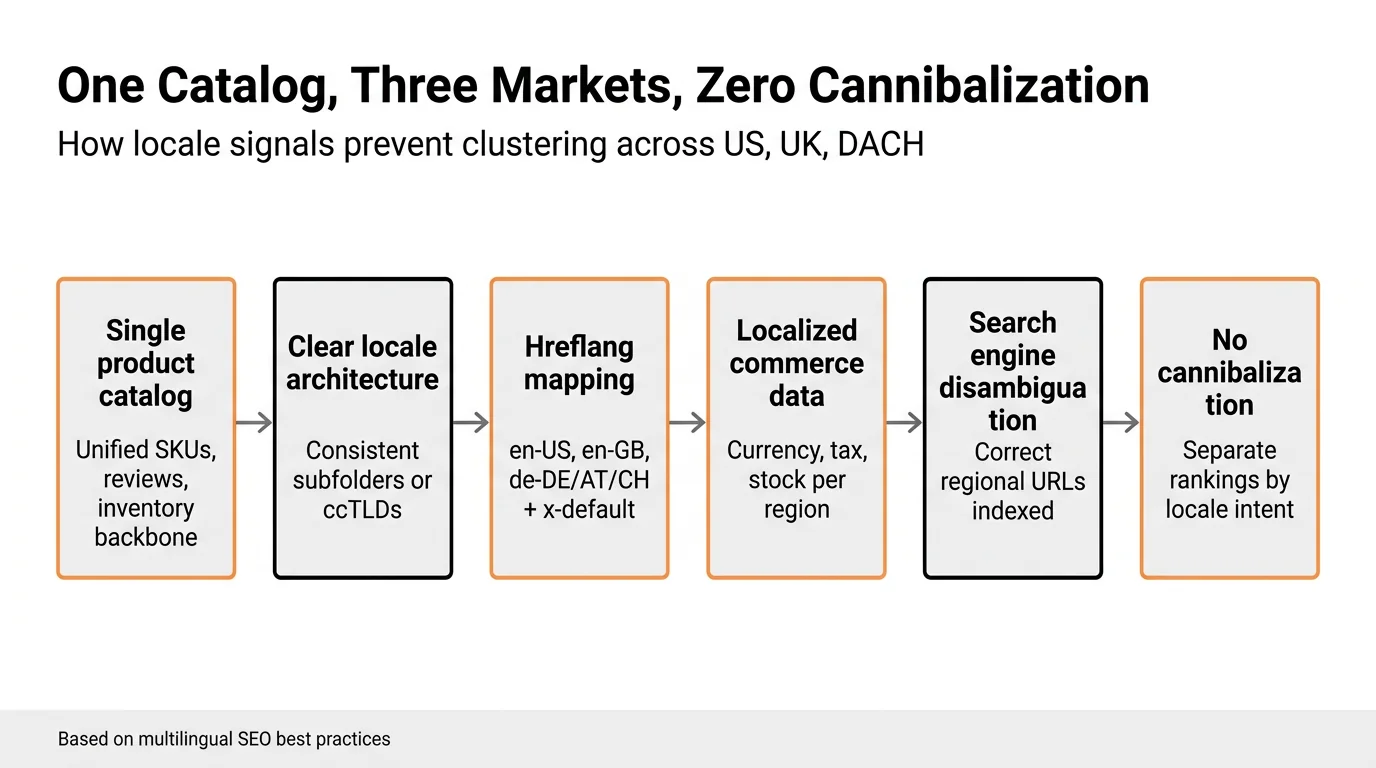
Your catalog remains constant, but search intent shifts by market and language. Without clear locale signals, pages may cluster together. That causes cannibalization, reduced rankings, and unstable snippets across markets.
Constraints: platform, feeds, and review parity
Most platforms require one product source of truth. Feeds must respect localized pricing, tax, and stock. Reviews should remain unified and portable to protect trust while complying with each locale’s disclosure norms and regulations.[4]
Petbase automates SEO content for pet stores - publishing 10 optimized articles monthly so you can focus on running your shop - start your free trial.
Decision focus: How to structure US, UK, and DACH variants
URL strategy: ccTLDs, subfolders, or subdomains
Pick one architecture and stay consistent. ccTLDs offer clear geo-signals but divide authority. Subfolders centralize equity. Subdomains may work when platforms enforce separation. Each option requires clean hreflang and self-canonicals.
Language and region codes that search engines understand
Use ISO language-region pairs: en-US, en-GB, de-DE, de-AT, de-CH. Include an x-default pointing to a selector or global page. Precision supports international SEO for pet retailers and aids duplicate content avoidance.[1]
Quick decision guide
If primary market is US with expanding UK/DACH, then use subfolders
Prefer example.com/us/, /uk/, and /de/ to consolidate authority. This approach often accelerates early rankings and simplifies governance. It also reduces overhead compared with maintaining multiple top-level domains.
If legal/commercial separation per country, then use ccTLDs
Choose example.co.uk and example.de when corporate entities, taxes, or logistics differ materially. This supports compliance and regional trust. Expect higher operational complexity and distinct analytics per market.
If platform requires separate stores, then align with subdomains plus canonical rules
Use us.example.com, uk.example.com, and de.example.com when the platform enforces store splits. Enforce self-canonicals per locale, plus a complete hreflang lattice. Maintain shared product identifiers across stores.
If content is same language but regional (en-US vs en-GB), then separate pages with hreflang alternates
Create dedicated pages for en-US and en-GB even if descriptions are similar. Apply hreflang alternates to prevent clustering. Adapt spelling and terminology to match UK vs US pet terminology.
If currency and units differ, then render server-side per locale
Provide USD, GBP, or EUR and lb/kg, in/cm server-side. Avoid client-side swaps for indexable content. Server rendering helps search engines see stable, localized values and prices at crawl time.
If product taxonomy varies, then localize category names while preserving canonical slugs
Translate display names and breadcrumbs. Keep canonical slugs stable to retain link equity. Map equivalents through internal linking and structured data to maintain discoverability while preventing fragmentation.
If reviews must be shared, then sync via aggregateRating with consistent product identifiers
Use a shared review corpus keyed to global product IDs. Localize review excerpts and star markup. AggregateRating should reflect locale-appropriate Offer data and currency for accurate snippets.
Implementation blueprint: Localization without cannibalization
Hreflang map: required pairs, x-default, and language-region specificity
Implement reciprocal hreflang for every locale pair: en-US, en-GB, de-DE, de-AT, de-CH. Include x-default to a selector page. Use sitemaps for scalable hreflang for ecommerce at catalog size.[1]
Canonical rules: self-canonicals only, never cross-locale
Each locale URL self-canonicalizes. Do not point canonicals across languages or regions. Rely on hreflang to connect alternates. This approach may reduce accidental duplicate signals and preserve market separation.
Terminology layer: “lead” vs “leash”, “biscuits” vs “treats”
Standardize a terminology dictionary per locale. Apply en-GB spellings and idioms, and DACH SEO localization nuances. Maintain a mapping sheet for writers and translators to prevent drift and inconsistencies.
Currency, VAT/Tax, and units: USD/GBP/EUR; lb vs kg; inches vs cm
Localize currency symbols and decimal separators server-side. Reflect VAT-inclusive or exclusive pricing based on norms. Show primary units per market and optionally provide secondary conversions to improve clarity and reduce returns.
Structured data: Product, Offer, AggregateRating with locale fields
Use Product with Offer scoped to market currency and availability. Maintain AggregateRating with consistent ratingValue and reviewCount. Validate markup regularly to stabilize snippets; see Schema for Product and rating markup for specifics.
Navigation and facet hygiene: prevent thin duplicates
Block or noindex thin facets and sort parameters. Consolidate pagination and filter paths. Optimize crawl efficiency to avoid duplicate clusters across locales and preserve budget for priority pages.[1]
Review portability: preserving trust signals across locales
Share reviews across markets by stable product IDs. Localize snippet language and display date and price formats per locale. Multi-lingual sentiment insights may inform merchandising and messaging optimizations.[3]
Monitoring: What to observe after 7-14 days and 4-8 weeks
7-14 days: indexing, hreflang coverage, and duplication warnings
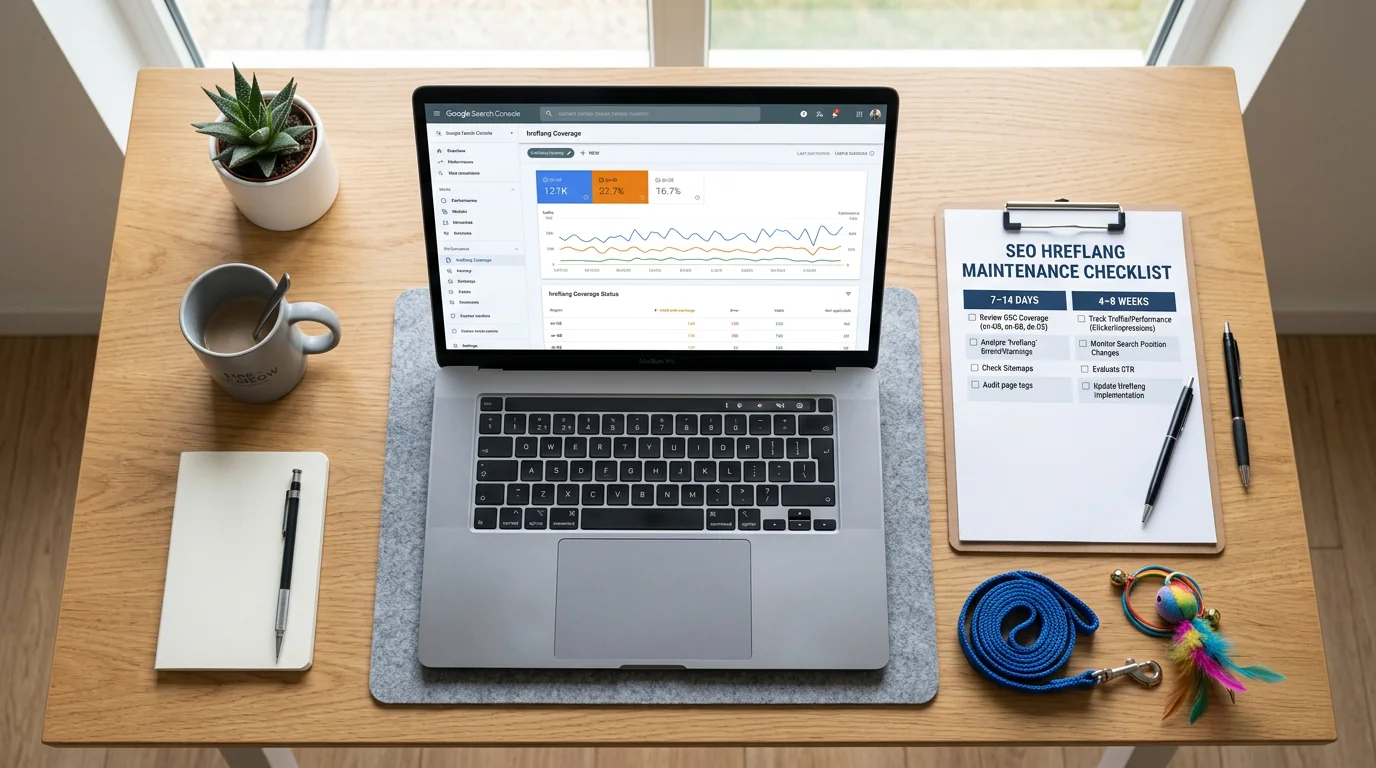
Check Search Console for hreflang coverage, index status, and canonical selection. Look for mismatched alternates and unexpected canonicalization. Track impressions by locale landing pages. Compare crawl logs for new locale sitemap fetches.
4-8 weeks: ranking separation, CTR lift, and product snippet stability
Assess whether en-US, en-GB, and de-DE pages separate in rankings. Monitor CTR by locale queries. Validate price, currency, and rating snippet stability. Attribute revenue by locale; use analytics and ROI dashboards to confirm lift.
Practical safety boundaries
Do not auto-redirect by IP without a visible language switcher
Respect user choice with a persistent switcher. If using soft prompts, provide a clear override. Search engines may crawl from unexpected regions, so ensure discoverability of all locales.
Do not translate SKU IDs or variant handles
Keep product identifiers universal for feeds, reviews, and inventory. Translate only display names. This preserves cross-locale reconciliation in analytics and avoids broken connections in structured data.
Do not mix currencies on the same URL
One URL, one currency. Mixing creates snippet instability and trust issues. Instead, create separate locale URLs with server-rendered currency, tax display, and shipping availability.
Avoid parameter-based locales for indexable pages
Do not use ?lang=en or ?currency=EUR for canonical pages. Parameters complicate hreflang mapping and indexing. Use subfolders, subdomains, or ccTLDs with clean, static equivalents.
Cap thin locale pages; localize at least 20-30% on-page
Localize headings, terminology, units, shipping, returns, and legal copy. Evidence suggests a meaningful portion reduces duplication risks and improves engagement metrics that support rankings.
Evidence status: What current best practices suggest
What search engine documentation indicates
Documentation emphasizes accurate hreflang, self-canonicals, and static localized content. Research on multilingual crawl efficiency underscores clear architecture to prevent cross-instance duplication and wasted budget.[1]
What industry case studies and audits suggest
Audits of global brands show that unified content platforms can streamline localization while maintaining governance. Proper prelocalization and distribution processes correlate with fewer duplication issues and faster rollout cycles.[2][4]
Example localization patterns for pet taxonomy
US vs UK product naming examples
Localize naming: “leash” to “lead,” “treats” to “biscuits,” “litter box” to “litter tray,” and “grooming clipper” to “grooming trimmer.” Maintain canonical slugs. Reflect changes in titles, breadcrumbs, and filters.
DACH terminology and unit conventions
Apply German nouns and compounds consistently. Use commas for decimals and space as thousand separators. Prefer kilograms and centimeters. Respect country nuances in Germany, Austria, and Switzerland for shipping, tax, and payment methods.
Measurement framework and diagnostics
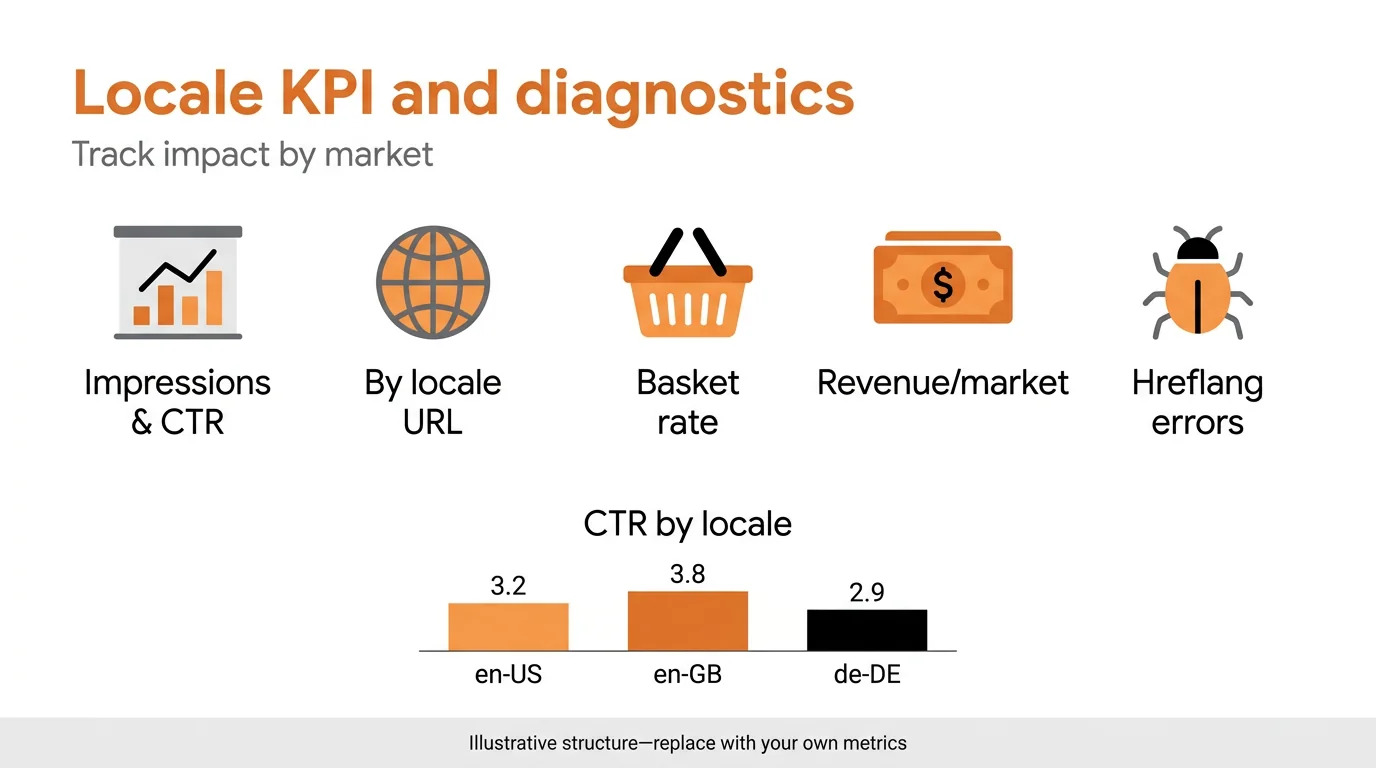
Core KPIs: locale-level impressions, CTR, and revenue
Segment KPIs by locale URL patterns. Track impressions, CTR, average position, session-to-basket rate, and revenue per market. Attribute changes to localization adjustments rather than seasonality using controlled rollout windows.
Diagnostic queries and Search Console segmenting
Filter by “site:example.com/us/ leash” versus “site:example.com/uk/ lead” to confirm vocabulary alignment. Compare hreflang errors over time. For scalable content updates, many teams use Petbase AI to coordinate publishing calendars.
Frequently Asked Questions
Should US and UK English have separate URLs for pet store SEO?
Yes, evidence suggests en-US and en-GB content performs best on distinct URLs with correct hreflang alternates. This may help prevent clustering and intent mixing.
Do I need x-default for my multilingual pet store?
Including x-default may help direct users to a language selector or global page when no specific locale fits. It also clarifies alternates to search engines.
Can I reuse the same product descriptions across locales without duplication issues?
You can reuse core data, but localize terminology, units, and pricing. Self-canonical per locale with proper hreflang may reduce duplicate risks.
How should I handle reviews across markets?
Keep a single review corpus tied to stable product identifiers and render localized snippets. Structured data should reflect locale-appropriate Offer details.
Are subfolders better than subdomains for international SEO?
Subfolders often consolidate authority and may simplify management. Subdomains can work if technically required, but consistent hreflang and internal linking are key.
Conclusion
International expansion demands precision. Separate US, UK, and DACH pages, apply correct hreflang, and localize vocabulary, currency, taxes, and units. Keep product identifiers and reviews unified. Validate structured data, and monitor indexation and ranking separation. When in doubt, revisit fundamentals in the Pet Store SEO orientation hub, maintain rigorous crawl hygiene, and iterate based on locale-level analytics. This focused approach may protect equity while unlocking sustainable growth across markets.
Further reading: Explore taxonomy governance in building a category taxonomy, structured markup in schema for pet stores, and reporting practices in SEO analytics and ROI tracking.
References
- N Mojahed et al. (2022). Technical SEO Migration Methodology in the Life Sciences Sector: A Multilingual Framework for YMYL Digital Initiatives. 2022 - seotransformer.com. View article
- I Okonkwo et al. (2023). Localization and global marketing: Adapting digital strategies for diverse audiences. Journal of Digital …. View article
- P Biswas et al. (2024). The Importance of Multi-Lingual Sentiment Analysis in Digital Marketing. 2024 11th International …. View article
- M Shokookohifar (2024). Evaluation of Localization in Samsung's Website. Translation and Interpreting Research.