Schema for Pet Stores: Product, Local Business, Service, and FAQ Markup

Table of Contents +
- Why this matters now: one stack to earn rich results
- Quick decision guide: if X, then add Y
- Implementation blueprints by page type
- Practical safety boundaries to avoid penalties
- Monitoring plan: what to check after 7-14 days and 4-8 weeks
- Evidence status: what current guidance suggests
- Appendix: minimal required properties by type
- Frequently Asked Questions
- Next step: prioritize your markup rollout
- References
Which schema to add to pet store sites: Product, LocalBusiness, Service, and FAQ. Examples, do’s, safety checks, and monitoring to earn rich results.
Rich results are not luck. They are the output of deliberate structured data aligned to page intent. Pet retailers who choose wisely earn visibility.
This matters because Google surfaces eligible entities faster when markup is accurate and consistent. You will learn which schema to deploy on product, location, service, and FAQ pages. You will also see guardrails, monitoring steps, and quick decisions.
Why this matters now: one stack to earn rich results
The focused decision: which schema on which pages
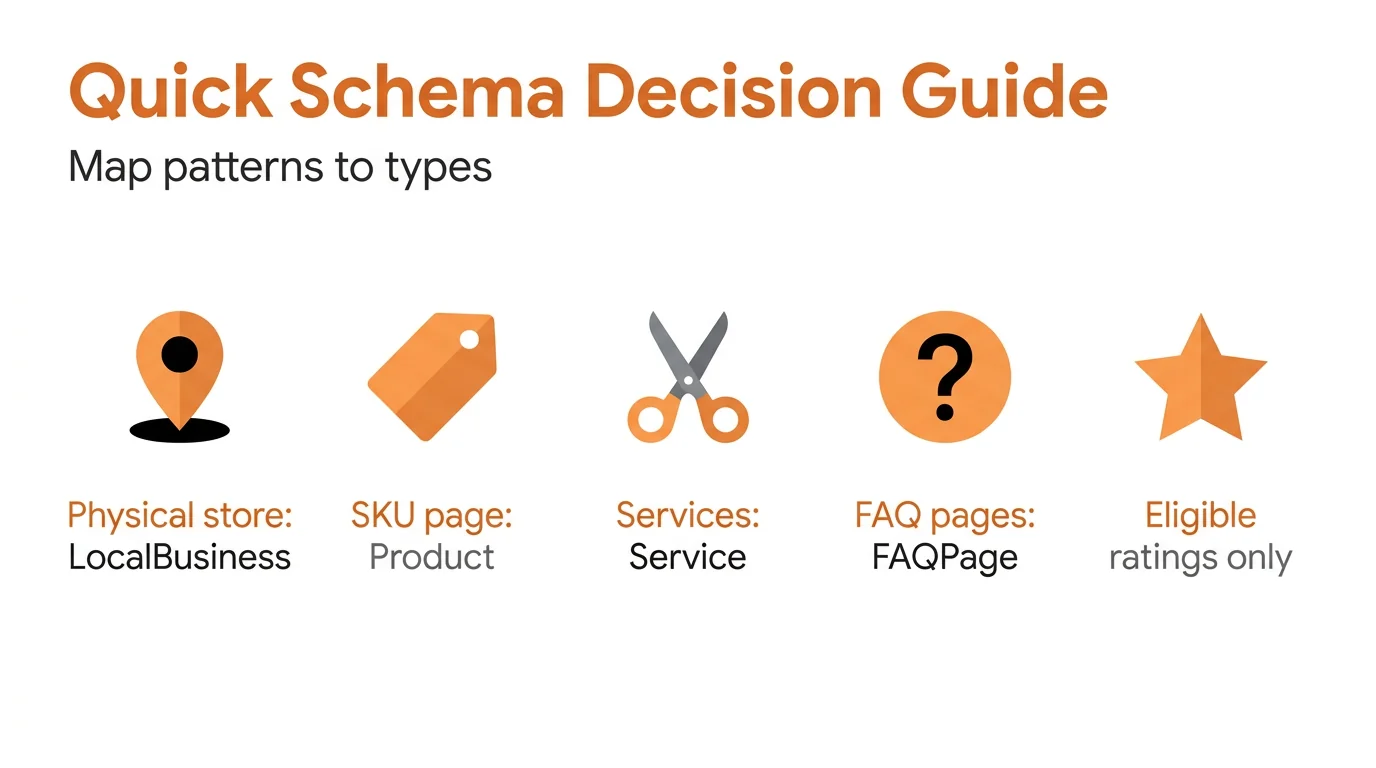
Use Product schema on shoppable product detail pages. Use LocalBusiness schema on each location page. Use Service schema on grooming and training pages. Use FAQPage only where visible Q&A exists. This stack maps cleanly to pet retail site architecture.
How this supports visibility and trust signals
Accurate structured data helps search engines align on-page content with entity types, improving eligibility for rich results and knowledge graph association[1]. Consistent markup also feeds broader knowledge systems that integrate business, product, and service facts[2]. For structured data for pet eCommerce, this combination strengthens relevance and consumer trust.
Petbase automates SEO content for pet stores - publishing 10 optimized articles monthly so you can focus on running your shop - start your free trial.
Quick decision guide: if X, then add Y
Storefront and locations
If you have a physical store, add LocalBusiness schema to every location page with NAP, hours, geo, and sameAs links. Reinforce identity via store locator links and consistent citations.
Shoppable products
If a page sells a specific SKU, add Product with Offer and availability. Include sku, brand, image, and price. Add AggregateRating only when eligible on-page reviews exist.
Services (grooming, training, boarding)
If the page promotes a service, add Service with provider as your LocalBusiness, areaServed, and priceRange or priceSpecification. Clarify appointment or walk-in details for grooming and training.
Q&A and policies
If you present visible, page-specific questions and answers, add FAQPage. Avoid sitewide boilerplate. Link service pages to policy and FAQ content to concentrate relevance.
Sitewide essentials
If you manage multiple formats, include Organization data in the header only once. Avoid Organization AggregateRating to meet self-serving review policies. Prioritize page-level entities first.
Edge cases (variants, marketplaces)
If variants share one URL, model one Product with multiple Offers. If variants have unique URLs and content, split into multiple Products. For marketplaces, avoid marking items not directly sold by you.
Implementation blueprints by page type
Product detail pages: Product + Offer + Review
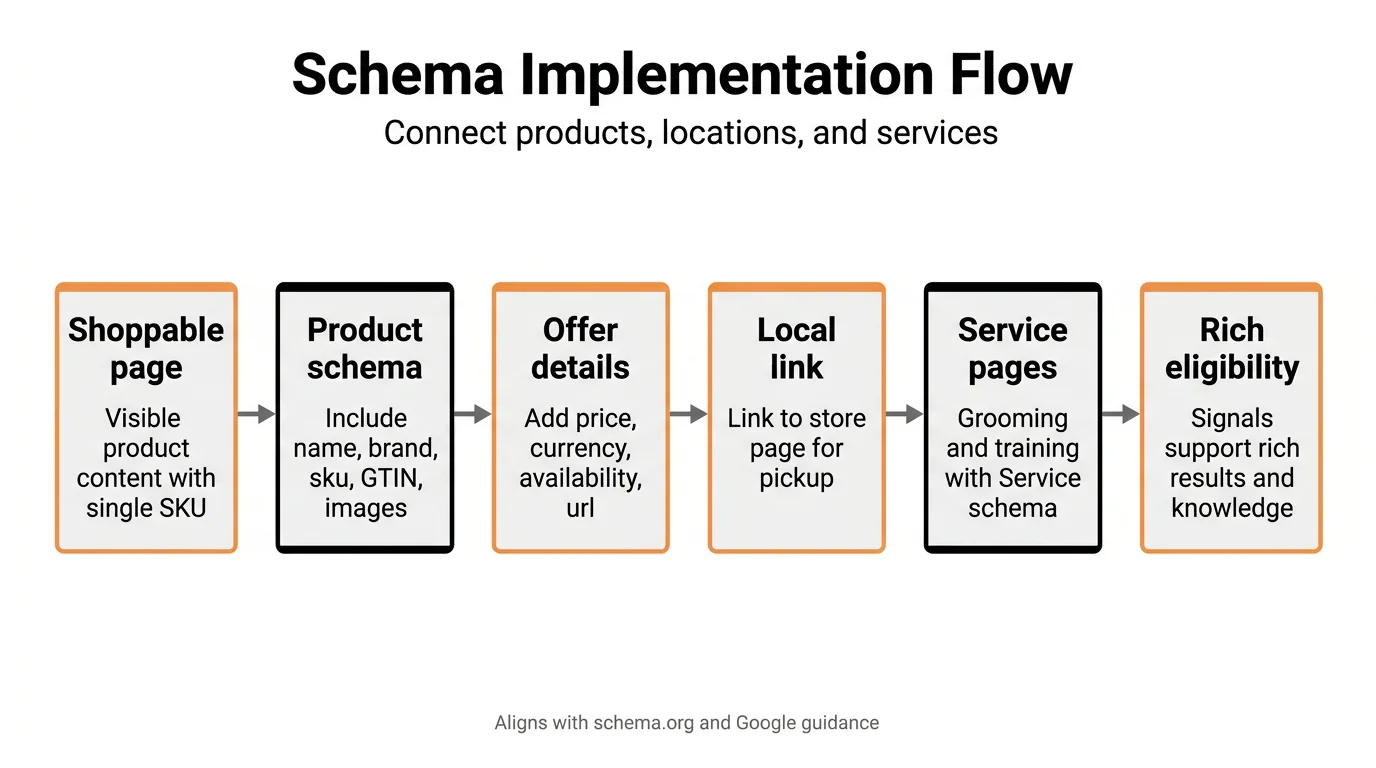
Implement Product schema for shoppable pages. Include name, description, sku, brand, images, GTIN where available, and a single Offer with priceCurrency, price, availability, and url. Add AggregateRating and Review only if reviews are displayed.
Connect Product to LocalBusiness context with internal links such as “In-store pickup at [City].” This supports omnichannel signals and improves user pathways. For Shopify-specific patterns, see Shopify Product Page SEO for Pet Retailers.
Location pages: LocalBusiness + geodata + hours
Use LocalBusiness schema on each store page. Include name, address, telephone, openingHoursSpecification, geo, and sameAs profiles. Add hasMap where available. Reinforce the page with locator links and NAP consistency, guided by Local SEO for Pet Stores.
Service pages: Service + provider + areaServed
Apply Service schema to grooming, training, or boarding pages. Include serviceType, description, provider as your LocalBusiness, areaServed, priceRange or priceSpecification, and hours where relevant. This clarity may support rich result eligibility for services.
FAQ sections: FAQPage scoped to one page
Mark visible, unique questions and answers with FAQPage. Constrain to the page section, not sitewide. Link from service pages to related FAQs and policy pages to prevent duplication, supported by Internal Linking Blueprints for Pet Retailers.
Practical safety boundaries to avoid penalties
Eligibility vs. over-markup
Only mark up what users can see and buy or book. Avoid category pages with Product schema unless a definitive Product is the primary topic. Over-markup may reduce trust and visibility[3].
Review and rating safeguards
Limit AggregateRating to products or services with on-page reviews. Do not place ratings on Organization. Ensure data matches visible counts and averages. Evidence indicates accuracy is fundamental to reliable extraction[1].
Stock, price, and availability integrity
Ensure Offer price and availability mirror the page in real time. Prefer automated updates from your platform. Inconsistent markup can be downgraded by systems designed to infer missing or noisy values[3].
Local data consistency and identity
Keep NAP, hours, and geo consistent across your location pages, Google Business Profile, and citations. Consistent structured data contributes to durable entity recognition across knowledge bases[4].
Monitoring plan: what to check after 7-14 days and 4-8 weeks
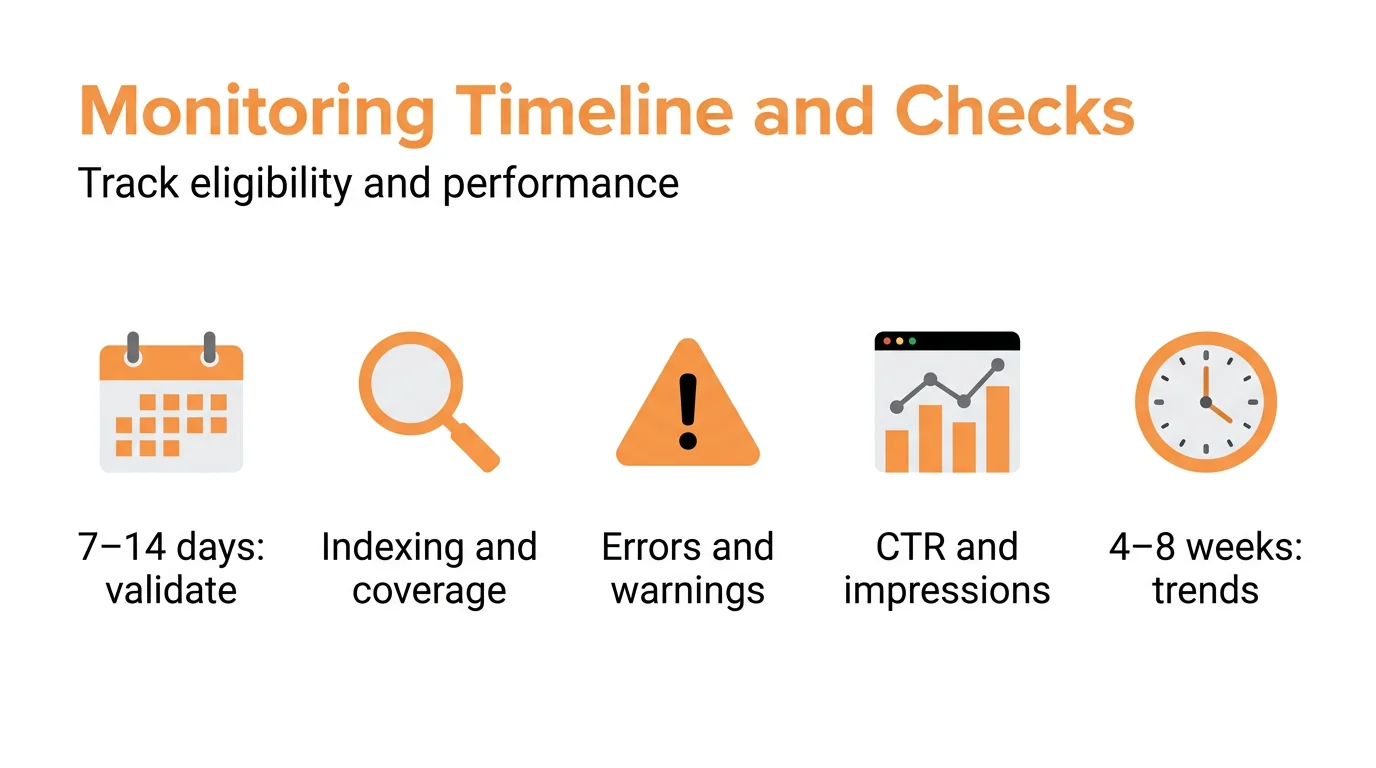
7-14 days: validation and indexing cues
Validate pages in Rich Results Test and Search Console. Confirm no critical errors or “Page not eligible” flags. Monitor indexing of updated URLs and watch for initial enhancements appearing in reports.
4-8 weeks: performance and SERP features
Assess impressions, CTR, and enhancement coverage in Search Console. Compare product rich result rates and local pack interactions. Tie outcomes to revenue using dashboards from SEO Analytics and ROI Tracking for Pet Retailers.
Debugging patterns if results lag
Check for mismatches between on-page content and markup. Reduce duplication across FAQs. Clarify primary entities on pages. Reconsider internal linking from editorial content to service pages for stronger topical signals.
For small teams, consider using Petbase AI to generate product pages and editorial content consistently, keeping on-page details aligned with your structured data at scale.
Evidence status: what current guidance suggests
Where evidence is stronger
Clear alignment between visible content and schema helps parsers and increases eligibility for enhancements[1]. Structured markup contributes to knowledge graph construction and cross-source reconciliation for entities[2].
Where results vary by implementation
Review snippets and FAQ features can fluctuate by site section and duplication levels. Sparse or noisy markup may be ignored or inferred differently across systems[3].
Standards and references to track
Monitor schema.org changes for Product, LocalBusiness, and Service. Watch Google’s Search Central updates on reviews, FAQ visibility, and eCommerce eligibility. Academic work shows ongoing augmentation from web markup[4].
Appendix: minimal required properties by type
Product essentials
Required baseline: name, description, image, sku or gtin, brand, and a single Offer with priceCurrency, price, availability, and url. Add aggregateRating and review only when on-page content supports them.
LocalBusiness essentials
Include name, address (PostalAddress fields), telephone, openingHoursSpecification, geo, sameAs, and url. Where relevant, add department or parentOrganization for in-store clinics or attached services.
Service essentials
Include serviceType, description, provider (LocalBusiness), areaServed, priceRange or priceSpecification, and offers url. Add hours for appointment windows and terms where bookings require deposits or cancellation fees.
FAQPage essentials
Include a mainEntity list of Question items with acceptedAnswer text. Ensure every Q&A is visible on the page. Avoid duplicate questions repeated across multiple URLs to preserve distinct value.
Frequently Asked Questions
Should pet stores use Product or LocalBusiness schema first?
If you have a physical storefront, evidence suggests starting with LocalBusiness on each location page to support local visibility. Pure eCommerce stores may start with Product on top-selling SKUs to target product rich results.
Can I add FAQ schema to product pages?
Yes, if the questions are specific to that product and visible on the page. Avoid generic FAQs duplicated across many pages, which may dilute value and create duplication risks.
How do I handle variants like size or flavor?
Keep one canonical Product with Offers reflecting variant price and availability. Only split into multiple Product entities if each variant has a unique URL and distinct content.
Are third-party review widgets eligible for Review schema?
They may be, if reviews are about the specific product and adhere to self-serving review policies. Avoid adding AggregateRating on your Organization to prevent policy conflicts.
Does Service schema help for grooming and training pages?
It may support clearer intent for Google and surfaces in rich results when combined with LocalBusiness data, detailed service descriptions, pricing cues, and service areas.
Next step: prioritize your markup rollout
Sequencing for multi-location retailers
Start with LocalBusiness on each location, then implement Service schema on grooming and training. Next, deploy Product schema on top SKUs. Finish by adding targeted FAQs to reduce phone calls and clarify policies.
Sequencing for eCommerce-first stores
Begin with Product schema on bestsellers, then expand to the full catalog. Layer in service pages if you offer add-ons. Add page-specific FAQs to reduce friction. For broader planning, see our core Pet Store SEO guide.
As you roll out markup, align internal links from editorial content to service pages, and from products to the nearest location for pickup. For seasonal relevance, coordinate with Seasonal and Event-Driven Pet SEO to time updates for maximum impact.
References
- M Edgar (2023). Schema and structured data markup. Tech SEO Guide: A Reference Guide for Developers …. View article
- V Ryen et al. (2022). Building semantic knowledge graphs from (semi-) structured data: a review. Future Internet. View article
- N Tempelmeier et al. (2018). Inferring missing categorical information in noisy and sparse web markup. … of the 2018 World Wide Web …. View article
- R Yu et al. (2018). KnowMore-knowledge base augmentation with structured web markup. Semantic …. View article