On-Page SEO for Grooming Websites: Titles, Schema, and Internal Links

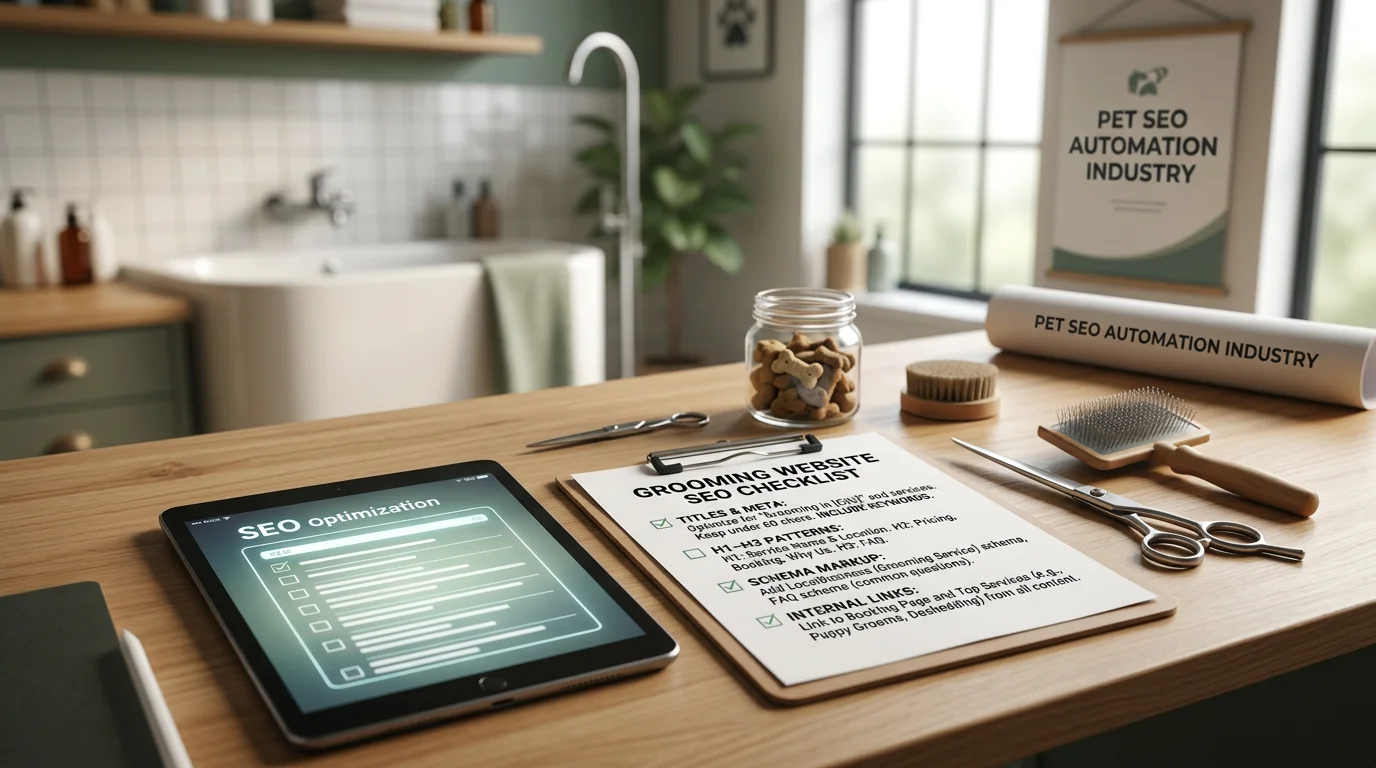
Table of Contents +
- Why thin grooming pages underperform (and the one scenario we fix)
- Title and meta checklist for grooming services
- H1-H3 structure that clarifies services and location
- Schema to add: Service, LocalBusiness, and FAQ
- Internal links that move visitors to booking and top services
- Quick decision guide: if X, then Y
- Monitoring: what to check at 7-14 days and 4-8 weeks
- Practical safety boundaries
- Evidence status and uncertainty
- Implementation examples (copy-paste templates)
- How this fits your broader grooming SEO strategy
- Frequently Asked Questions
- References
A focused checklist for grooming site on-page SEO: titles/meta, H1-H3 patterns, service and FAQ schema, and internal links to booking and top services.
Thin service pages lose bookings. Searchers hesitate when pages look generic, vague, or hard to navigate. Clear titles, structured content, and decisive links reduce friction and build trust quickly.
This matters because local intent is urgent and competitive. Precise on-page signals help search engines and visitors understand relevance fast. You will learn a focused grooming SEO checklist for titles, headings, grooming service schema, FAQ schema, and internal links that move people to booking.
Why thin grooming pages underperform (and the one scenario we fix)
Thin pages typically lack unique titles, descriptive headings, and clear booking paths. They also miss structured data and contextual links. These gaps weaken intent alignment and lower conversions. Foundational on-page elements strongly influence crawlability and relevance scoring in search systems.[2]
Symptoms to spot on a grooming service page
Generic titles, repeated meta descriptions, and H1s that fail to mention location are red flags. Missing pricing cues and weak call-to-action placement reduce confidence. Sparse copy and no related links often increase bounce rates.
What success may look like after fixes
Expect titles and H1s that match local queries, concise copy describing benefits and policies, and prominent booking paths. Structured data may enrich snippets. Internal links guide visitors from service to booking without dead ends.
Petbase builds this SEO foundation automatically for pet businesses - 10 optimized articles published every month - start your free trial.
Title and meta checklist for grooming services
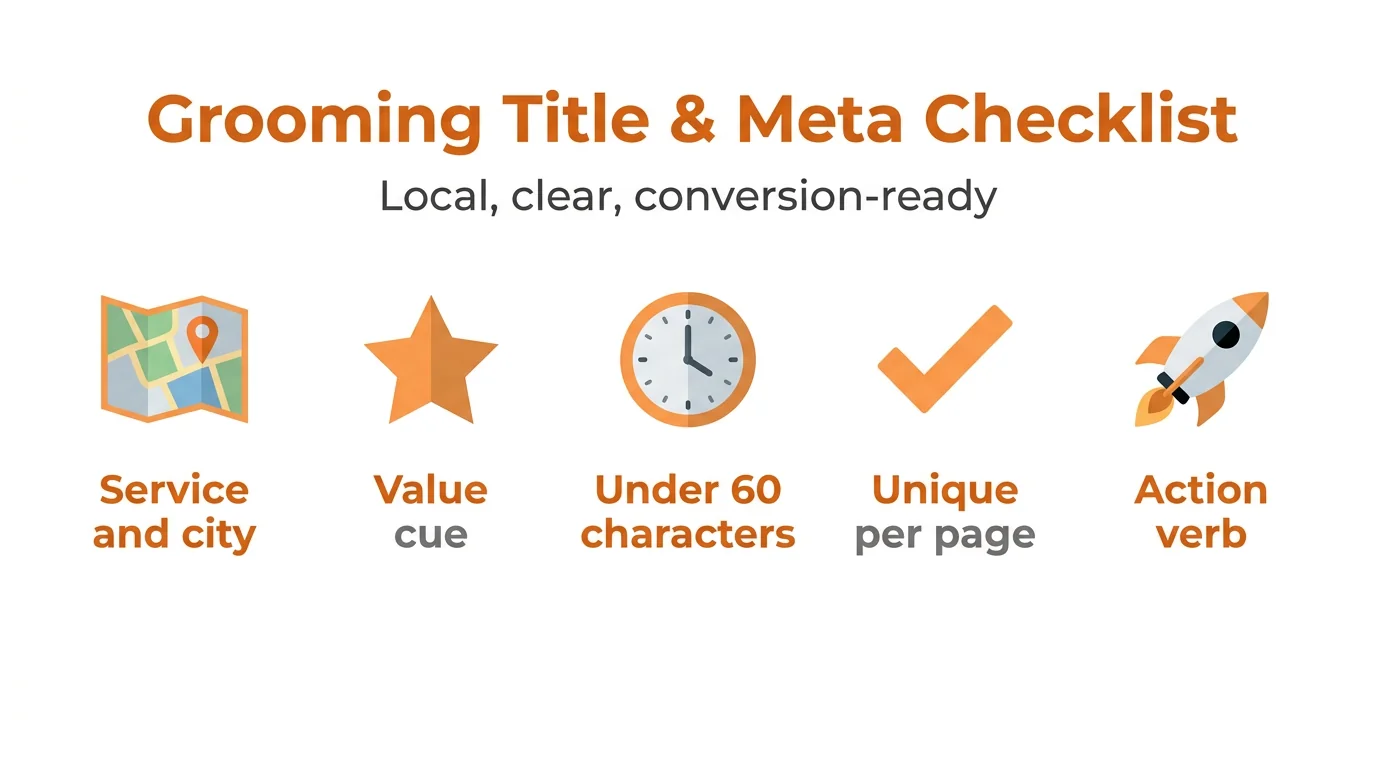
Use this grooming SEO checklist to align page-level intent with booking goals. Keep titles specific, local, and benefit-oriented. Write meta descriptions that set expectations on availability, service scope, and starting price. Maintain uniqueness across all pages.
Page title patterns that fit local intent
Combine core service, city or area, and a value cue. Keep under ~60 characters when possible. Examples: “Dog Grooming in Austin | Same-Day Appointments” or “Nail Trimming in Denver | Gentle, Fast Care.” Align titles with H1s for consistency.
Meta description patterns that set expectations
Lead with outcome and trust signals. Add availability and a booking nudge. Example: “Professional grooming in Austin with gentle handling. Transparent pricing. Book online in minutes.” Meta descriptions do not rank directly, but influence click-through behavior.[2]
H1-H3 structure that clarifies services and location
Searchers scan headings first. Use H1-H3 to confirm they are in the right place, list what is included, and explain process and policies. Keep headers scannable and location-aware.
Sample outline for a main grooming page
H1: Dog Grooming in [City]. H2: What’s Included and Add-Ons. H2: Pricing and Session Length. H2: Safety and Care Standards. H2: How Booking Works. H3: Same-Day Openings. H3: What to Bring. H3: Aftercare Tips. Provide brief, benefit-led paragraphs beneath.
Sample outline for a niche service page (e.g., deshedding)
H1: Deshedding Treatment in [City]. H2: Who Benefits and Results Timeline. H2: What’s Included. H2: Session Steps. H2: Pricing and Bundles. H3: Seasonal Shed Plans. H3: Maintenance Between Appointments. Add a short FAQ that mirrors on-page content.
Schema to add: Service, LocalBusiness, and FAQ
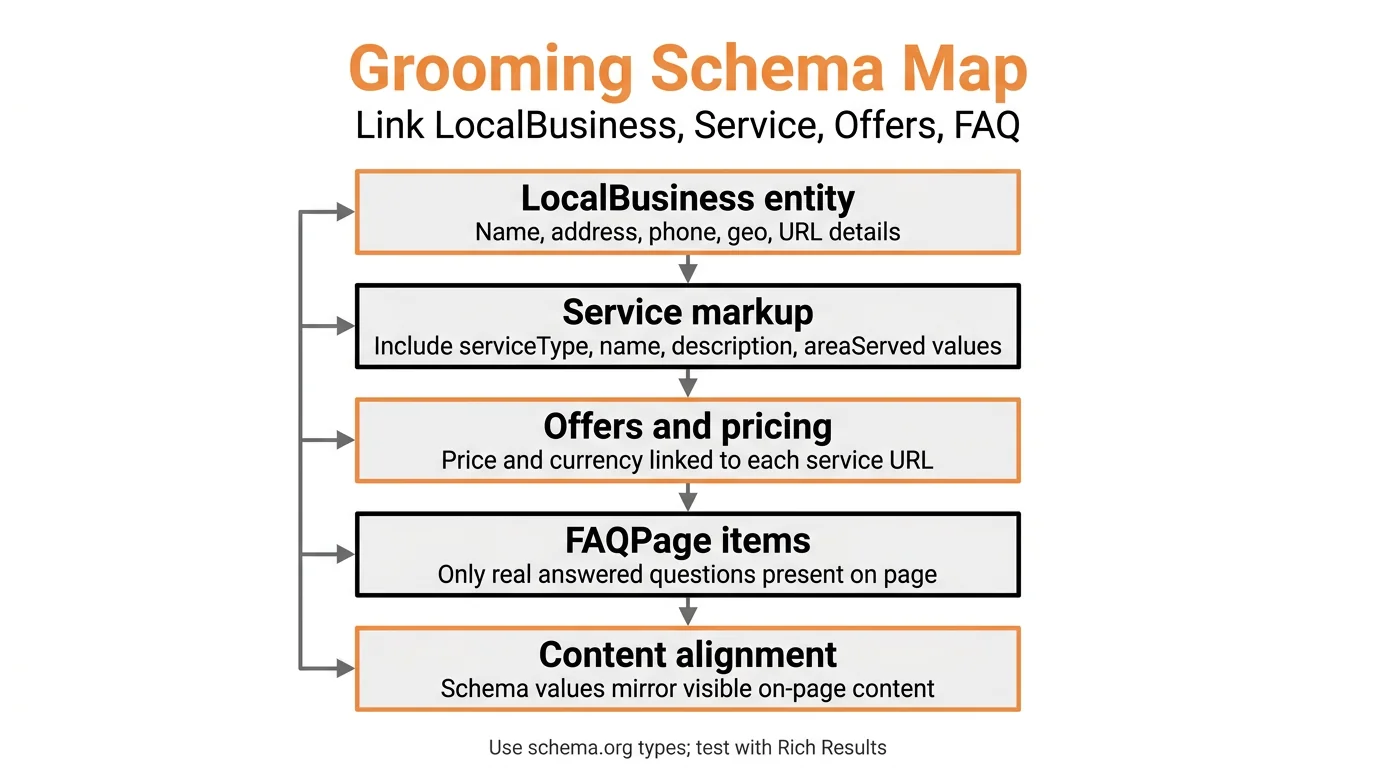
Structured data helps search engines interpret page meaning. Use LocalBusiness at the business or location level. Mark each service page with Service schema. Add FAQ schema only for questions that the page answers directly.[2]
Core properties for Grooming service schema
Include name, serviceType, areaServed, provider, description, offers with price and currency, and url. Align values with visible content. Accurate grooming service schema may support richer search features, provided it matches user-facing details.
FAQ schema patterns that match owner questions
Choose two to five top questions about timing, policies, and what’s included. Keep answers concise and consistent with on-page copy. Evidence suggests FAQs can clarify expectations and reduce pre-booking friction when implemented responsibly.[3]
Internal links that move visitors to booking and top services
Internal linking for groomers should guide visitors toward booking with minimal detours. It also helps search engines understand relationships among services, policies, and locations. Automation may scale linking patterns across templates efficiently.[1]
Primary paths: service → booking → confirmation
Within the first 150 words, link to booking with anchors like “Book dog grooming in [City]” or “Check availability.” Place a second booking link mid-page and one near the end. Use breadcrumbs with schema for hierarchy clarity.
Secondary paths: related services and seasonal bundles
After each procedure description, link to 1-2 related services using precise anchors, such as “Nail trim” or “De-shedding.” On confirmation pages, add links to seasonal bundles or maintenance plans to reinforce relevance and retention.
To align local signals, consider building dedicated location pages that connect to services with consistent anchors. See practical approaches in Local landing pages for groomers.
Quick decision guide: if X, then Y
Use this compact guide to move quickly from symptom to action.
5-7 situations and recommended actions in one glance
- If titles are duplicated, rewrite using “Service + City + Value cue.” Keep under ~60 characters.
- If H1 omits location, add the city or service area immediately.
- If click-through is low, tighten meta descriptions with availability and price cues.
- If time-on-page is weak, add H2s listing inclusions, safety, and session length.
- If bookings stall, insert two more descriptive booking links with clear anchors.
- If pages lack trust, add LocalBusiness and Service schema with accurate offers.
- If users exit early, link to related services and clarify cancellation policies.
Monitoring: what to check at 7-14 days and 4-8 weeks
Track early crawl and behavior signals, then compare mid-term ranking and conversion metrics. SEO measurement should connect changes to outcomes across multiple touchpoints.[2]
Early signals to watch
Within 7-14 days, watch index coverage, impressions for target queries, and CTR changes on updated titles. Review click paths to booking from service pages. Automation can shorten iteration loops by standardizing metadata at scale.[3]
Mid-term metrics to compare
Over 4-8 weeks, compare ranking movement for “service + city,” booking conversion rates, and assisted conversions from related links. Evaluate internal link flow and session depth. AI-driven workflows may support faster optimization cycles.[4]
For KPI selection and attribution techniques, see SEO KPIs for grooming shops.
Practical safety boundaries
Use safe implementation ranges to avoid volatility and maintain trust. Prioritize accuracy in all structured data and avoid manipulative patterns. Align content depth with searcher expectations and service complexity.
When not to over-optimize
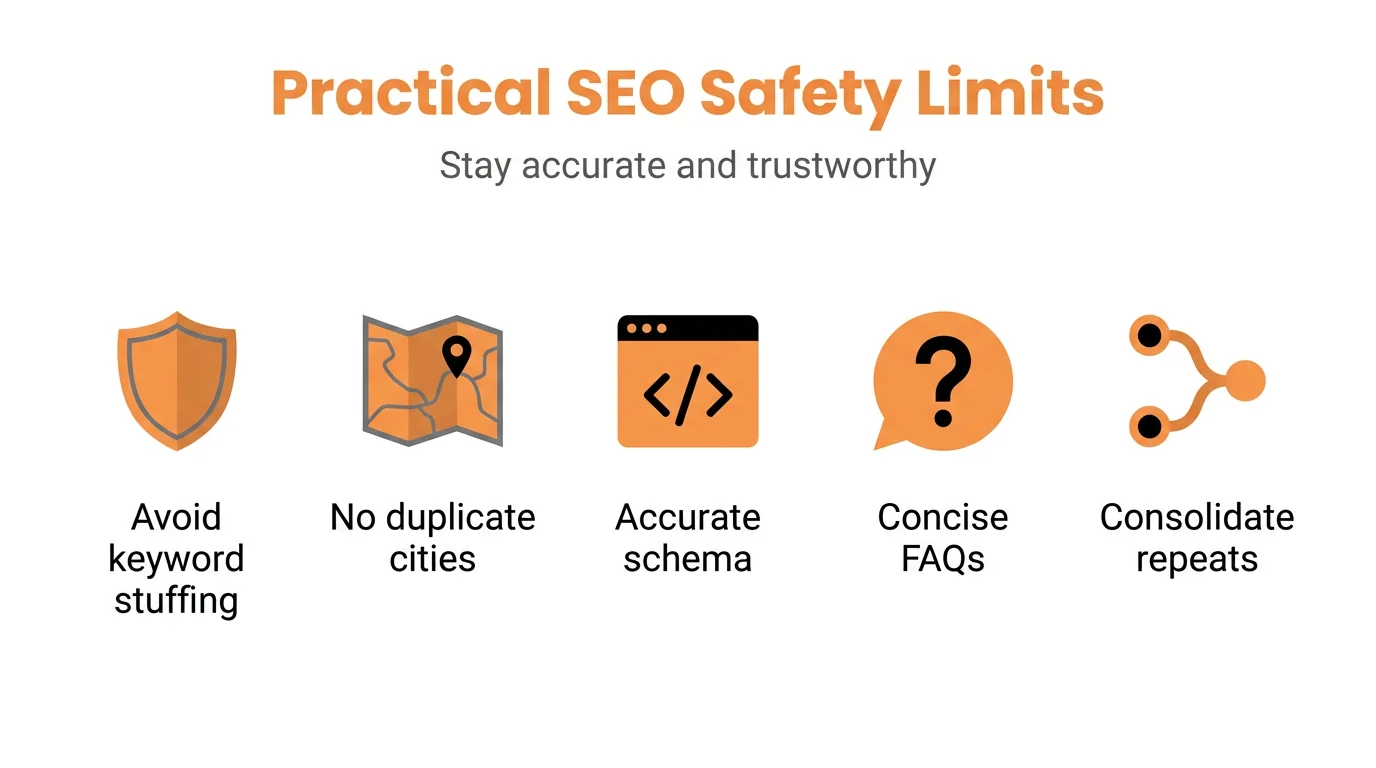
Avoid keyword stuffing in titles or headings. Do not duplicate city names across multiple H2s. Keep FAQs concise. If content becomes repetitive, consolidate pages and reinforce primary services with canonical URLs.
How to avoid misleading structured data
Only mark up FAQs that appear on the page. Ensure prices in offers match visible pricing. Keep business hours and phone numbers consistent with location pages and profiles. Mismatches may reduce trust and visibility.
Evidence status and uncertainty
Industry literature supports disciplined on-page SEO and structured data for clarity, with internal linking aiding discovery and relevance propagation.[2][1]
What industry data suggests
Research indicates that consistent metadata and content structure support discoverability and user comprehension. Automated generation can maintain standardization and scale pragmatic tests across pages while preserving editorial intent.[3]
Where results may vary for groomers
Performance can vary by market density, brand strength, review profile, and crawl frequency. Seasonality and pricing transparency also influence outcomes. Expect staggered improvements across impressions, clicks, and bookings as changes settle.
Implementation examples (copy-paste templates)
Use these templates to stand up fixes efficiently. Adapt values to your services, areas, and offers. Keep anchors descriptive and consistent with H1s and pricing language across the site.
Title/meta templates for main and niche pages
<!-- Main service page -->
Title: Dog Grooming in [City] | Same-Day Appointments
Meta: Professional grooming with gentle handling in [City]. Transparent pricing and fast online booking. See availability and reserve a spot today.

<!-- Niche service page (Deshedding) -->
Title: Deshedding Treatment in [City] | Reduce Shedding Fast
Meta: Targeted deshedding for healthier coats. Session includes bath, blowout, and brush-out. Book online in minutes. Seasonal bundles available.

<!-- Pricing cue variant -->
Title: Nail Trimming in [City] | Starting at $[Price]
Meta: Quick, careful nail trims with safety first. Clear pricing and flexible scheduling. Book now for a smooth visit.
JSON-LD snippets for Service and FAQ
<script type="application/ld+json">
{
  "@context": "https://schema.org",
  "@type": "Service",
  "name": "Dog Grooming",
  "serviceType": "Full Groom",
  "areaServed": {
    "@type": "City",
    "name": "[City]"
  },
  "provider": {
    "@type": "LocalBusiness",
    "name": "[Brand Name]"
  },
  "description": "Full grooming session including bath, haircut, nail trim, and ear cleaning.",
  "offers": {
    "@type": "Offer",
    "price": "[StartingPrice]",
    "priceCurrency": "USD",
    "availability": "https://schema.org/InStock",
    "url": "[CanonicalServiceURL]"
  },
  "url": "[CanonicalServiceURL]"
}
</script>

<script type="application/ld+json">
{
  "@context": "https://schema.org",
  "@type": "FAQPage",
  "mainEntity": [{
    "@type": "Question",
    "name": "How long does a full groom take?",
    "acceptedAnswer": {
      "@type": "Answer",
      "text": "Sessions typically run 60-120 minutes depending on coat and service level. We confirm timing at booking."
    }
  },{
    "@type": "Question",
    "name": "What is included in a deshedding service?",
    "acceptedAnswer": {
      "@type": "Answer",
      "text": "A bath, blowout, and targeted brush-out to release undercoat. We recommend seasonal plans for lasting results."
    }
  }]
}
</script>
To scale titles, metas, H1s, and schema across locations without manual repetition, many teams use Petbase AI to standardize patterns and publish updates efficiently.
For deeper page architecture and copy blocks, review patterns in high-intent grooming service pages.
How this fits your broader grooming SEO strategy
On-page precision strengthens every other local signal. Clean titles, structured headings, thoughtful grooming service schema, and decisive linking to booking create a predictable path from query to confirmation.
Tie this work to location pages, pricing clarity, and reputation. Coordinate with consistent NAP data and review management across profiles. For a strategic overview, see Grooming Business SEO: The Complete Orientation Hub for Local Growth.
Frequently Asked Questions
What should a grooming service page title include?
Include the core service, city/area, and a value cue. Example: Dog Grooming in Austin | Same-Day Appointments. Keep it under ~60 characters and unique per page.
Do groomers need FAQ schema on service pages?
FAQ schema may help enhance visibility for common questions and clarify policies. Add only questions that are answered on the page and reflect actual customer queries.
Which schema is best for grooming services?
Use LocalBusiness (or PetStore/AnimalShelter if appropriate) on the homepage or location page and a Service schema for each core service. Ensure name, areaServed, and offers are accurate.
How many internal links should a grooming page have?
Aim for 2-3 prominent links to booking and 2-4 contextual links to related services. Ensure anchor text is descriptive and avoid excessive repetition.
How long until on-page SEO changes show impact?
Early crawling and impressions may shift within 1-2 weeks. More stable ranking and conversion signals often need 4-8 weeks, depending on crawl frequency and competition.
Final takeaways: Start with precise titles and meta, then structure H1-H3 for fast comprehension. Add reliable Service and FAQ schema, and build internal paths straight to booking. Monitor early crawl signals and mid-term conversions, then iterate carefully and consistently.
References
- T Suresh (2025). Natural language processing for internal link optimisation: Automating content relationships for better search engine optimisation. Journal of Digital & Social Media Marketing.
- S Das (2021). Search engine optimization and marketing: A recipe for success in digital marketing. 2021 - api.taylorfrancis.com. View article
- M Reisenbichler et al. (2022). Frontiers: Supporting content marketing with natural language generation. Marketing …. View article
- D Dumitriu et al. (2020). Artificial intelligence solutions for digital marketing. Procedia Manufacturing. View article