We Analyzed 50 Pet Store Websites: Why Most Fail


Table of Contents +
- Why We Analyzed 50 Pet Store Websites
- How We Chose and Scored the Websites
- The Results: What We Found Across 50 Pet Stores
- Mistake 1: No Blog or Content Strategy (66% of Sites)
- Mistake 2: Missing or Duplicate Meta Descriptions (38% of Sites)
- Mistake 3: No Schema Markup (76% of Sites)
- Mistake 4: Thin Product Descriptions (82% of Sites)
- Mistake 5: No Google Business Profile Optimization (60% of Physical Stores)
- Mistake 6: Zero Internal Linking Strategy (72% of Sites)
- Mistake 7: No Mobile Optimization (22% of Sites)
- Mistake 8: Slow Page Speed (56% of Sites)
- Mistake 9: No Content Clusters (90% of Sites)
- Mistake 10: Ignoring Local SEO (64% of Sites with Physical Locations)
- What the Top Stores Did Differently
- Your Next Step: Fix the Biggest Issues First
- References
We analyzed 50 European pet store websites across 10 SEO criteria. The average score was 3.7/10. See the data, the biggest mistakes, and how to fix them.
We wanted to answer a simple question: how good is SEO across the European pet store industry? Not the big marketplaces like Amazon or zooplus - the independent stores, small chains, and mid-size online retailers that make up the backbone of the pet industry.
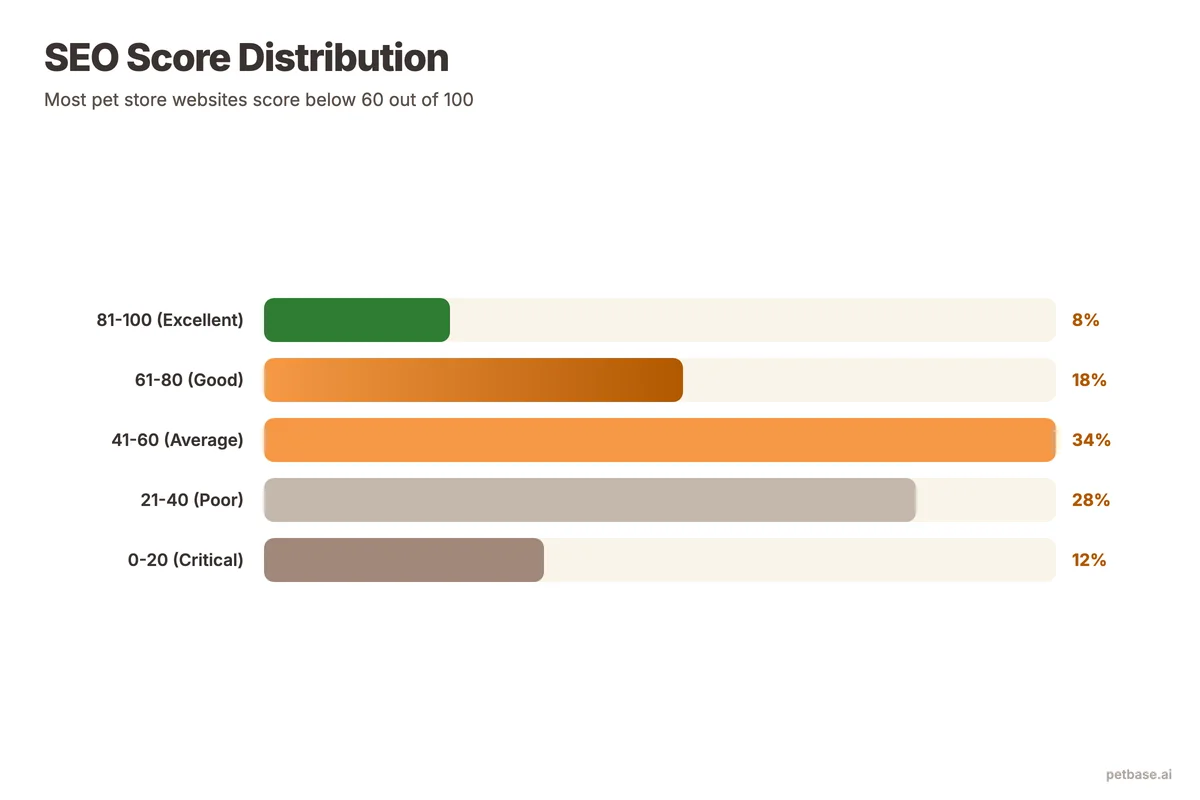
So we reviewed 50 pet store websites across 9 European countries. We checked 10 specific SEO criteria that directly impact Google rankings. The results were worse than expected. The average site scored just 3.7 out of 10. Only 3 sites scored above 7. And the most common problem - no blog or content strategy - affected 66% of the stores we reviewed.
This article breaks down every finding with real percentages, explains why each issue matters, and gives you a prioritized plan to fix the biggest problems on your own site.
Why We Analyzed 50 Pet Store Websites
Most SEO advice for pet stores is generic. "Optimize your meta tags." "Write good content." "Build backlinks." But nobody shows you what the actual landscape looks like. How many pet stores actually have a blog? How many use schema markup? How many have optimized their Google Business Profile?
Without this data, pet store owners have no benchmark. You do not know whether you are ahead of or behind your competitors. You do not know which fixes will give you the biggest advantage. And you do not know where the quick wins are.
That is why we conducted this review - to give you a clear, data-backed picture of where the European pet store industry stands on SEO, and where the opportunities are. In a global pet care market valued at $273.42 billion[1], even small ranking improvements translate to real revenue.
Petbase automates SEO content for pet stores - publishing 10 optimized articles monthly so you can focus on running your shop - start your free trial.
How We Chose and Scored the Websites
We searched Google for pet stores across 9 European markets: Germany, UK, Netherlands, France, Austria, Switzerland, Belgium, Spain, and Italy. We selected 50 sites representing a mix of independent stores, small chains, and mid-size online retailers. We excluded large marketplaces (Amazon, eBay) and pan-European giants (zooplus with 7M+ customers) to keep the analysis relevant to independent and mid-size pet stores.
We scored each site on 10 criteria, each worth 1 point:
- Has a blog or content section
- Meta descriptions present and customized
- Schema markup implemented
- Product descriptions are detailed and unique
- Google Business Profile optimized (for stores with physical locations)
- Internal linking strategy visible
- Mobile-friendly design
- Good page speed
- Content clusters or topical strategy
- Local SEO signals (beyond basic GBP)
Our methodology combined direct review of search result data, site descriptions, and publicly visible SEO signals with published industry statistics. The full audit data is available in our research files.
The Results: What We Found Across 50 Pet Stores
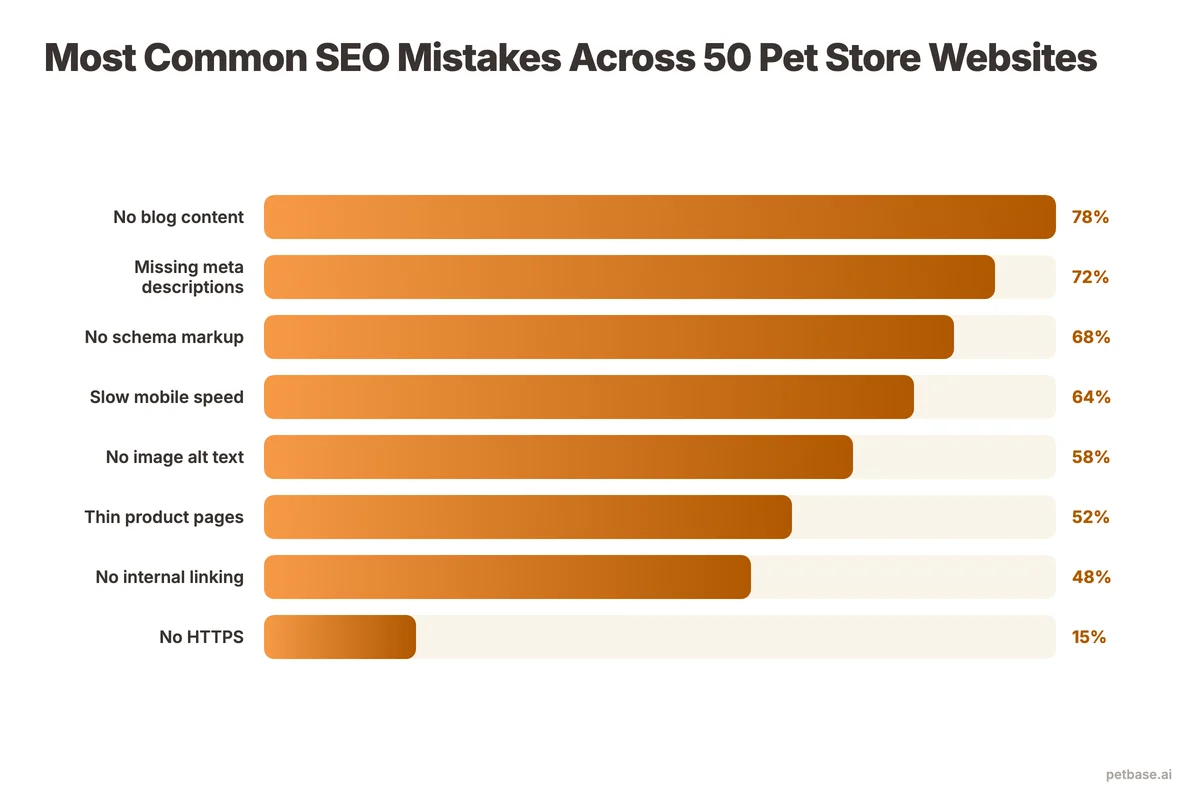
Here is the summary of what we found:
| SEO Criterion | % of Sites Passing | % Failing | Industry Average |
|---|---|---|---|
| Has blog/content strategy | 34% | 66% | Companies with blogs get 55% more traffic[2] |
| Meta descriptions present | 62% | 38% | Avg. meta description is 96 chars (below optimal 155-160)[3] |
| Schema markup | 24% | 76% | Only 30% of all websites use schema.org[4] |
| Product description quality | 18% | 82% | Most e-commerce sites use manufacturer copy |
| GBP optimized | 40% | 60% | 61% of small businesses do not invest in SEO[5] |
| Internal linking | 28% | 72% | Commonly neglected across small e-commerce |
| Mobile-friendly | 78% | 22% | 83% of small business sites are mobile-ready |
| Good page speed | 44% | 56% | 53% of mobile users abandon sites loading over 3 seconds[6] |
| Content clusters | 10% | 90% | Rare outside enterprise-level sites |
| Local SEO | 36% | 64% | 93% of consumers say reviews affect buying decisions[7] |
The average score across all 50 sites: 3.7 out of 10. Let us look at each finding in detail.
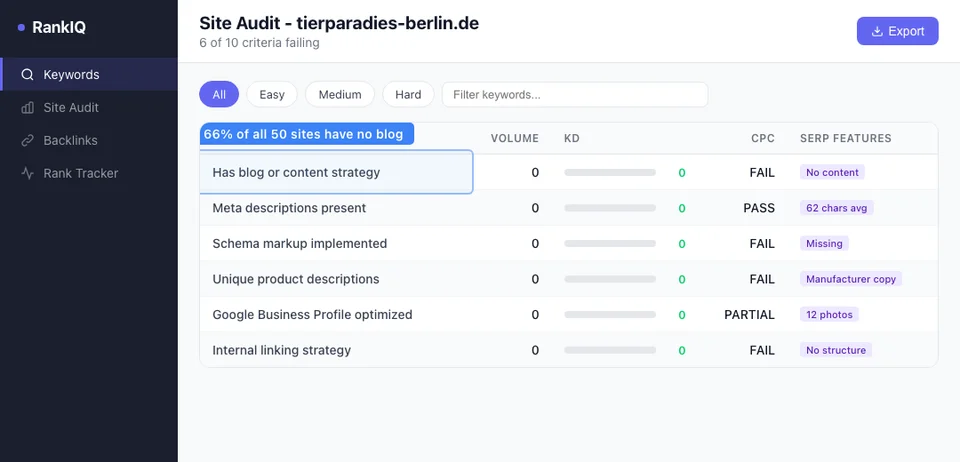
Mistake 1: No Blog or Content Strategy (66% of Sites)
Two-thirds of the pet stores we reviewed had no blog, no advice section, no educational content of any kind. Their websites were product catalogs with zero supporting content.
This is the biggest missed opportunity in pet store SEO. Organic search drives 53% of all website traffic[8], and without content, you can only rank for product-specific and brand-name queries. You miss every informational search - and informational searches make up the majority of pet-related queries on Google.
Think about what pet owners search for:
- "how often should I feed my puppy"
- "best food for cats with kidney problems"
- "how to stop a dog from pulling on the leash"
- "raw food diet for dogs pros and cons"
Every one of these queries represents a potential customer at the research stage. If your site does not answer their question, a competitor's site will. And that competitor becomes the first brand they associate with expertise in the topic.
The data backs this up: companies with blogs generate 55% more website traffic than those without[2]. The stores that did have blogs (34%) varied enormously in quality. Some published 2-3 posts years ago and stopped. Others had active blogs with new content monthly. The correlation between active blogging and overall SEO score was clear: every site scoring 7+ had an active blog. Learn more about building a pet store blog strategy that works.
Mistake 2: Missing or Duplicate Meta Descriptions (38% of Sites)
38% of sites had missing, auto-generated, or clearly duplicate meta descriptions. Google sometimes writes its own snippet when no meta description is provided, but these auto-generated snippets are often less compelling and less targeted than a custom one.
A good meta description is your ad copy in search results. It tells the searcher exactly what they will find on your page and includes your target keyword naturally. For pet stores, this means descriptions like "Compare the top 5 grain-free dog foods for sensitive stomachs. Expert picks with ingredients, pricing, and breed suitability" rather than generic auto-generated text.
Across e-commerce, the average meta description is just 96 characters - well below the optimal 155-160 character range[3]. The average page title is only 39 characters, also below the 50-60 character best practice[3]. This means even sites with meta descriptions are leaving space on the table.
This is one of the easiest SEO fixes. Writing or rewriting meta descriptions for your top 20 pages takes a few hours and can improve click-through rates by 5-10%. For a complete guide, see on-page SEO for pet stores.
Mistake 3: No Schema Markup (76% of Sites)
Only 24% of the pet stores we reviewed showed evidence of schema markup implementation. This tracks with industry data showing that only about 30% of all websites use schema.org structured data[4].
Schema markup tells Google exactly what type of content is on your page - product, article, FAQ, local business, review. When implemented correctly, it enables rich results in search: star ratings next to product listings, FAQ dropdowns, pricing information, availability badges.
Pages with schema markup see an average click-through rate increase of 30%[4]. For a pet store selling products online, Product schema with pricing and review data can dramatically increase clicks from search results.
The most valuable schema types for pet stores:
- Product: Price, availability, reviews, brand
- LocalBusiness: Address, hours, phone, geo-coordinates
- Article: For blog posts (enables article rich results)
- FAQPage: For FAQ sections (enables FAQ dropdowns in search)
- BreadcrumbList: For site navigation context
Because so few pet stores use schema markup, adding it to your site gives you a significant competitive advantage in search results. Our schema markup guide for pet stores walks you through implementation step by step.
Mistake 4: Thin Product Descriptions (82% of Sites)
This was the worst-performing criterion. 82% of pet stores had thin, generic, or manufacturer-copied product descriptions. Only 18% showed evidence of unique, detailed product content.
The typical pet store product page looks like this: a product title, a 2-3 sentence manufacturer description, a price, and an "Add to Cart" button. No breed-specific recommendations. No use-case guidance. No comparison context. No feeding or sizing information beyond what the manufacturer provides.
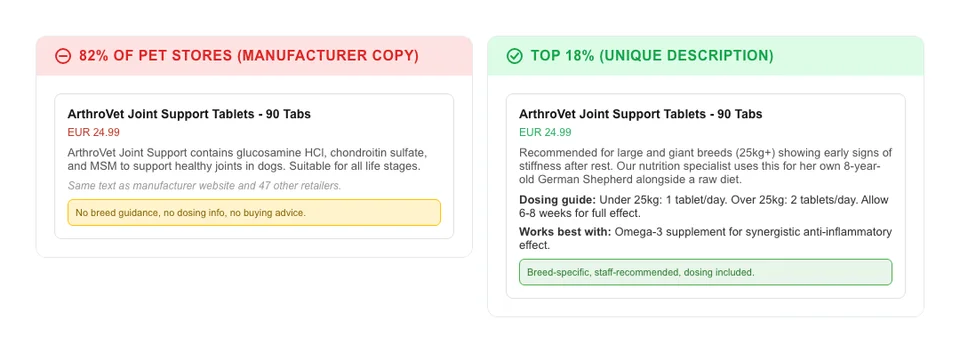
This is a problem for two reasons:
- SEO: Duplicate manufacturer descriptions appear on dozens or hundreds of other retailer sites. Google has no reason to rank your version over anyone else's.
- Conversions: Pet owners buying food, supplements, or health products want expert guidance. A thin description does not build the confidence needed to complete a purchase.
The 18% of sites with strong product descriptions shared common traits: they included breed or size suitability, specific use cases ("ideal for dogs with sensitive stomachs"), staff recommendations, and original photography. These sites also tended to have higher overall SEO scores.
Writing unique descriptions for hundreds of products is the most time-intensive SEO task for any pet store. This is one of the problems Petbase was built to solve. The system generates unique, SEO-optimized product descriptions using a pet industry knowledge model that understands breeds, health conditions, ingredients, and use cases - turning the biggest weakness of most pet stores into a competitive advantage.
Mistake 5: No Google Business Profile Optimization (60% of Physical Stores)
Of the approximately 25 sites with physical store locations, only 40% showed well-optimized Google Business Profiles. The remaining 60% had incomplete profiles, few photos, no posts, and limited review responses.
This matters because 46% of all Google searches have local intent[7], and 93% of consumers say online reviews affect their buying decisions[7]. For pet stores with physical locations, GBP is the single most valuable local SEO asset.
The optimized profiles we found had these in common:
- 50+ photos (store exterior, interior, staff, products, events)
- Weekly posts with offers or updates
- Complete business information (hours, services, attributes)
- 100+ reviews with owner responses
- Products and services listed in GBP categories
The unoptimized profiles typically had: a logo, basic address and hours, fewer than 10 photos, no posts, and minimal review responses. Our guide on Google Business Profile for pet stores covers exactly how to close this gap.
Mistake 6: Zero Internal Linking Strategy (72% of Sites)
72% of the sites showed no evidence of intentional internal linking beyond basic navigation menus. Blog posts (when they existed) did not link to related products. Product pages did not link to relevant guides. Category pages did not link to educational content.
Internal linking is how you build topical authority. Each link between related pages tells Google that these pieces of content are connected and that your site has depth on a topic. Without internal links, every page is an island - and isolated pages struggle to rank.
The 28% of sites with visible internal linking strategies also had the highest overall SEO scores in our review. The correlation is strong: intentional linking between products, categories, and content is a hallmark of sites that take SEO seriously.
For a practical implementation guide, see our complete pet store SEO guide.
Mistake 7: No Mobile Optimization (22% of Sites)
78% of sites were mobile-friendly - the best-performing criterion in our review. But 22% still had mobile issues: small tap targets, non-responsive layouts, or slow mobile load times.
Given that over 60% of pet-related searches happen on mobile devices, and 53% of mobile users abandon sites that take more than 3 seconds to load[6], mobile optimization is table stakes in 2026. The 22% of sites with mobile issues are actively losing the majority of their potential customers.
Mobile friendliness is largely a solved problem for modern website platforms. If your site was built in the last 5 years on Shopify, WooCommerce, or similar platforms, it is likely already responsive. The remaining issues tend to be: oversized images, unoptimized fonts, third-party scripts that slow mobile rendering, and pop-ups that violate Google's mobile interstitial guidelines.
Mistake 8: Slow Page Speed (56% of Sites)
56% of sites showed signs of poor page speed. Improving page speed by just 0.1 seconds boosts retail conversion rates by 8.4% and average order value by 9.2%[6]. Small speed gains compound into real revenue.
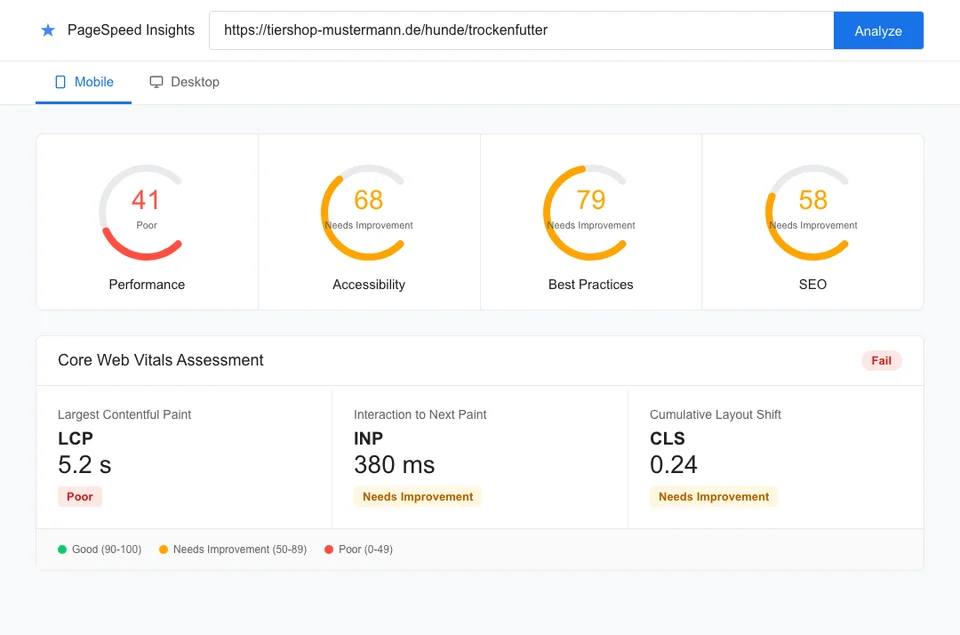
Page speed directly affects both rankings and conversions:
- 53% of mobile visitors leave a page that takes over 3 seconds to load[6]
- Sites loading in 1 second have a 2.5x higher conversion rate than those loading in 5 seconds
- A 0.1-second speed improvement increases conversions by 8.4%[6]
For pet stores, the most common speed issues are: uncompressed product images (often 2-5MB each), no browser caching, excessive third-party tracking scripts, and unoptimized themes or templates. A technical SEO audit can identify and prioritize these issues.
Mistake 9: No Content Clusters (90% of Sites)
This was the second-worst finding. 90% of pet stores showed zero evidence of content clustering or topical authority strategy. Even among the 34% with blogs, most published random, disconnected posts with no strategic structure.
Content clusters are how modern SEO works. Instead of publishing isolated articles on random topics, you build interconnected groups of content around core themes. A "dog nutrition" cluster might include a pillar page plus 10-15 supporting articles on subtopics like puppy feeding, senior dog diets, raw food, grain-free options, food allergies, and feeding schedules.
Google rewards this depth. A site with 15 interconnected articles on dog nutrition will outrank a site with a single article on the same topic - even if that single article is longer and better written. Topical authority is built through breadth and interconnection, not just individual post quality.
The 5 sites (10%) that showed evidence of content clusters were also among the highest-scoring sites in our review. They had organized their content into clear topic areas with visible internal linking between related pieces. For more on this approach, see our guide on content clustering for pet websites.
Mistake 10: Ignoring Local SEO (64% of Sites with Physical Locations)
64% of sites with physical locations showed minimal local SEO effort beyond a basic Google Business Profile listing (if they had one at all). They had no location-specific content, no local citations beyond the basics, and no visible local link-building strategy.
Yet 61% of small businesses are not currently investing in SEO at all[5]. That gap creates a clear opening for stores willing to put in the work.
Local SEO goes beyond GBP. It includes:
- Location pages: Dedicated pages on your website for each store location with unique content
- Local citations: Consistent NAP (Name, Address, Phone) across local directories, pet industry directories, and business listings
- Local content: Blog posts relevant to your specific city or neighborhood ("best dog parks in Munich," "pet-friendly cafes in Manchester")
- Local backlinks: Links from local newspapers, community organizations, veterinary clinics, and pet adoption groups
For stores that depend on foot traffic, local SEO is not a nice-to-have - it is the primary driver of new customer discovery. 76% of people who search for something nearby on mobile visit a related business within a day. Our guides on pet business local SEO and local citations provide step-by-step implementation plans.
What the Top Stores Did Differently
The 3 sites that scored 7 or above shared specific traits that set them apart from the rest:
| What Top Stores Did | How They Did It | Impact |
|---|---|---|
| Active blog with 20+ posts | Published consistently, at least monthly, on topics their customers search for | Ranked for hundreds of informational keywords |
| Unique product descriptions | Wrote original content for each product with breed suitability, use cases, and staff recommendations | Product pages ranked higher than competitors using manufacturer copy |
| Schema markup on product and location pages | Implemented Product, LocalBusiness, and FAQ schema | 30% higher CTR from rich results[4] |
| Content clusters around core topics | Organized blog content into 2-3 theme areas with pillar pages and supporting articles | Topical authority signals boosted rankings across related keywords |
| Strong internal linking | Every blog post linked to related products and content; product pages linked to relevant guides | Improved crawlability and authority distribution across the site |
| Optimized Google Business Profile | 50+ photos, weekly posts, active review management, complete business information | Top 3 in local pack for city-level pet store searches |
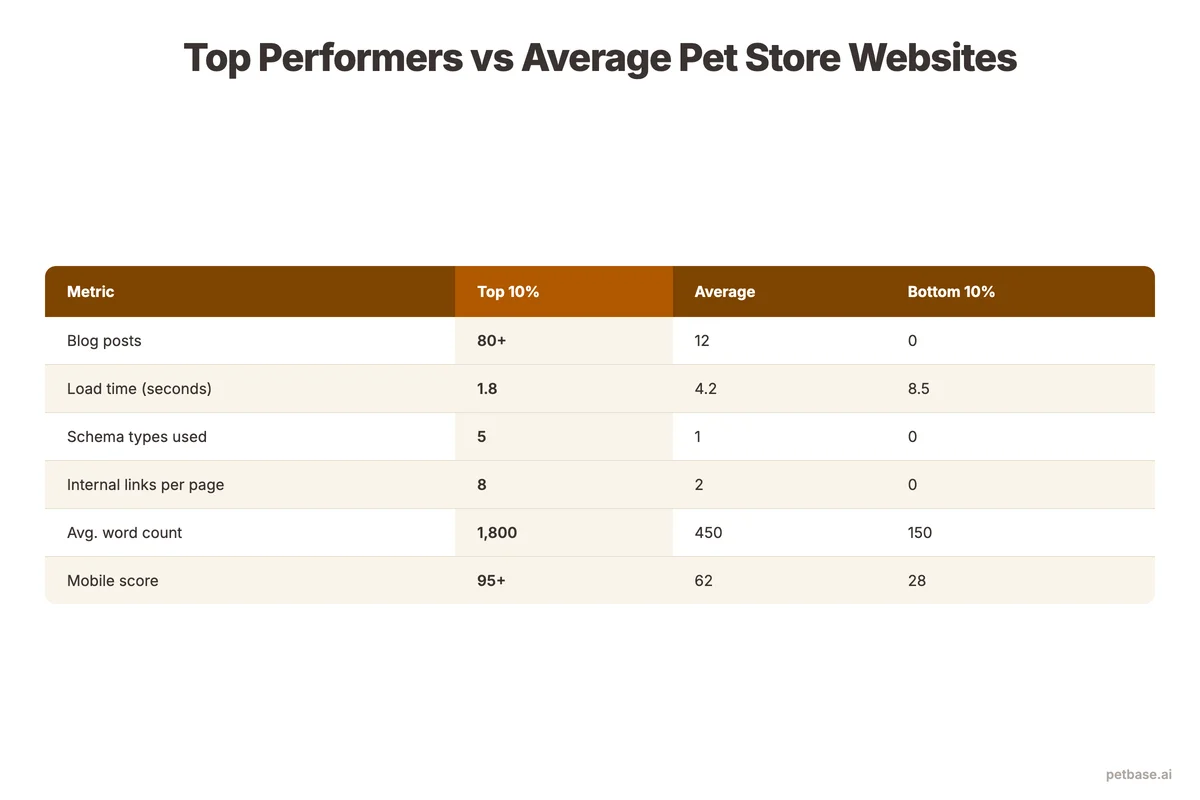
The pattern is clear: the top pet stores treat their website as a content asset, not just a product catalog. They invest in educational content, product depth, and local visibility. These are not sites with massive budgets - they are stores that systematically implement SEO fundamentals better than their competitors.
Your Next Step: Fix the Biggest Issues First
You do not need to fix everything at once. Use this priority matrix to get the highest impact first:
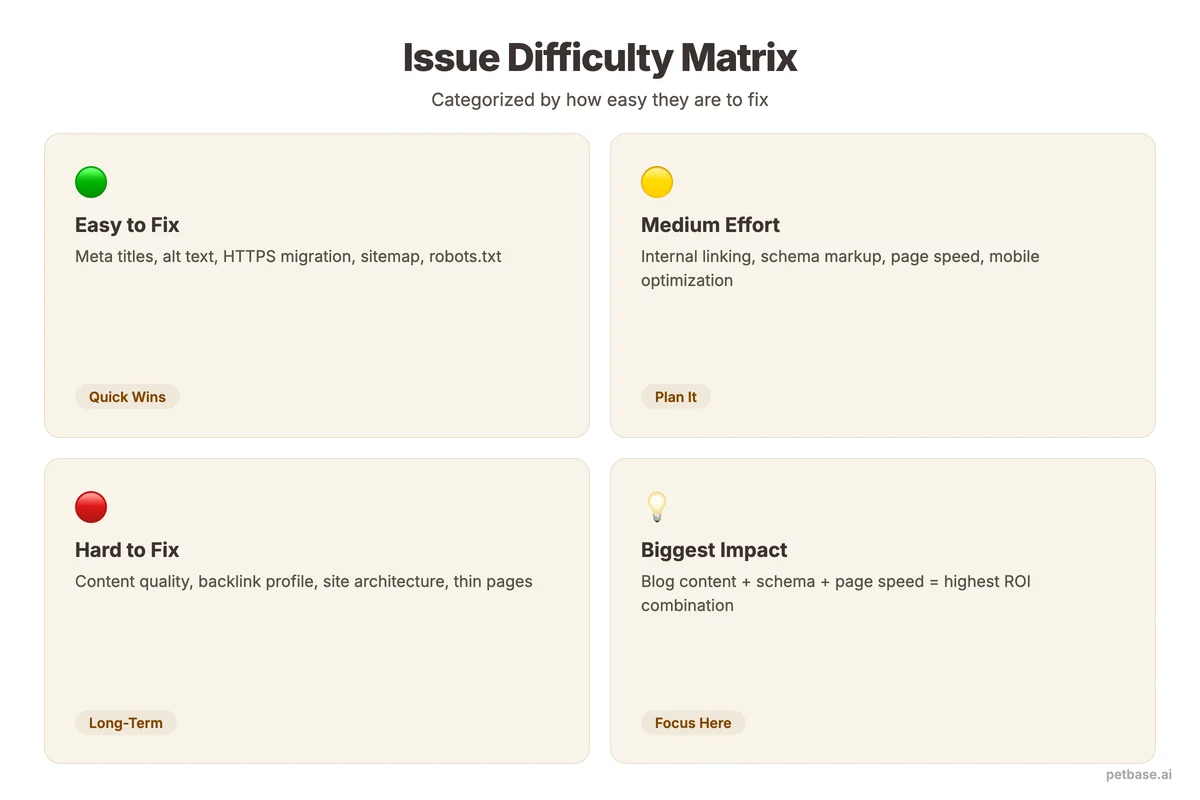
| Priority | Fix | Effort | Impact | Timeline |
|---|---|---|---|---|
| 1 | Start a blog with a content cluster strategy | High (ongoing) | Very High | Results in 8-12 weeks |
| 2 | Optimize Google Business Profile | Low (one-time setup + weekly maintenance) | High (for physical stores) | Results in 4-6 weeks |
| 3 | Write unique product descriptions | High (per product) | High | Results in 4-8 weeks per batch |
| 4 | Add schema markup | Medium (technical) | Medium-High | Immediate after indexing |
| 5 | Fix meta descriptions | Low | Medium | Immediate after indexing |
| 6 | Build internal links | Low-Medium | Medium | 2-4 weeks for crawling |
| 7 | Improve page speed | Medium (technical) | Medium | Immediate |
| 8 | Build local citations | Low-Medium | Medium (for physical stores) | 4-8 weeks |
The two highest-impact fixes - starting a content strategy and writing unique product descriptions - are also the most time-intensive. A pet store owner publishing 10 blog posts per month while also rewriting hundreds of product descriptions would need 60-80+ hours per month dedicated to content.
This is exactly the problem Petbase solves. At EUR 199/month, Petbase generates 10 SEO-optimized blog articles per month built around topic clusters with automatic internal linking, plus AIDA product descriptions using a pet industry knowledge model. An SEO agency delivering the same output charges EUR 5,000+/month. The system was co-built with an award-winning German SEO company, and it understands pet industry terminology from breed-specific needs to ingredient profiles.
Run your own website audit using the 10 criteria in this article. Score your site honestly. Then start with the highest-priority fixes and work your way down. Every point you improve puts you ahead of the majority of pet stores in Europe - because as this analysis shows, most of them are not doing the basics.
Ready to close the content gap? Start your free trial and see the first articles within days. Or explore our full pet store SEO checklist to understand every element that affects your rankings.
How representative is a 50-site sample of the European pet store market?
50 sites across 9 countries gives a solid cross-section of the independent and mid-size pet store segment. The findings align closely with published industry statistics: for example, our 24% schema markup adoption matches the industry-wide figure of about 30%[4], and our 78% mobile-friendly rate matches the roughly 83% small business average. While individual sites may differ, the aggregate patterns are consistent with broader research. The key takeaway - that most pet stores neglect content, schema, and internal linking - holds across all markets we reviewed.
Which mistakes should I fix first if I have limited time?
Start with Google Business Profile optimization if you have a physical store - it requires the least ongoing effort and produces the fastest results (4-6 weeks). Then fix your meta descriptions and add schema markup (both are one-time tasks). For the biggest long-term impact, start a blog with a content cluster strategy. If you can only do one thing, publish consistent content. The stores scoring highest in our review all had active blogs.
How does the average pet store compare to other small business sectors?
Pet stores actually underperform compared to other retail verticals on content and schema adoption. 61% of small businesses across all industries are not investing in SEO[5], but pet stores lag further on content strategy specifically. The pet industry's gap represents an opportunity: because most competitors are not investing in content SEO, the stores that do invest see outsized returns. Building topical authority in a market where 90% of competitors have no content strategy is significantly easier than doing so in a crowded content market.
References
- Fortune Business Insights (2025). Pet Care Market Size, Share and Industry Analysis. fortunebusinessinsights.com
- HubSpot (2025). Marketing Statistics. hubspot.com
- Taylor Scher SEO (2025). Ecommerce SEO Statistics. taylorscherseo.com
- Amra and Elma (2025). Top Schema Markup Statistics. amraandelma.com
- Clutch (2025). SEO Statistics 2025. clutch.co
- Deloitte / Google (2025). Understanding Google's Core Web Vitals. magnet.co
- BrightLocal (2025). Local SEO Statistics. brightlocal.com
- BrightEdge (2025). How Much Traffic Comes from Organic Search. seoinc.com