E-E-A-T for Pet and Veterinary Content: Sources, Disclaimers, and Med Schema


Table of Contents +
- Why E-E-A-T Matters for Pet and Veterinary Content
- Evidence and Citation Standards for Pet Health and Training
- Expert Review Workflow: Vet and Trainer Oversight
- Disclaimers, Safety Notices, and Scope of Advice
- Author Bios, Byline Policy, and Contributor Pages
- Structured Data: Medical and Product Schema for Pet Sites
- AI Drafts With Human QA: Risk Controls That Scale
- Designing Pages for Trust: UX Patterns That Surface E-E-A-T
- Frequently Asked Questions
- Conclusion
- References
Best practices to build trust in pet and veterinary content: expert review, citations, disclaimers, author bios, medical/product schema, and safe AI governance.
Trust is earned long before a reader finishes a paragraph. For pet health and training topics, the stakes are high, and credibility cannot be improvised. This guide drills into practical, repeatable steps to make your pages reliably accurate, safe, and compliant.
If you are building a program around veterinary E-E-A-T, this focused playbook complements our broader pet content writing guide. We cover expert review, citations, disclaimers, structured data, and AI risk controls-so your content informs responsibly and converts without compromising welfare.
Why E-E-A-T Matters for Pet and Veterinary Content
Search engines and readers scrutinize pet health and training advice because errors can cause harm. Clear sourcing, accountable reviewers, and safety context are the foundation. Treat each page as a reference work with consumer-friendly packaging, not just marketing copy.
Risk categories: health, behavior, and product safety
Map risks before drafting. Health claims, behavior protocols, and product guidance can impact welfare, dosing, and ingestion risk. Classify each page by potential harm, then set review depth, disclaimers, and update cadence accordingly to prevent preventable incidents.
Signals search engines use for trust in pet niches
Engines favor transparent sourcing, expert oversight, and consistent updates. Pages with identifiable authors, visible review stamps, and authoritative citations reduce ambiguity. Quality markers help mitigate the noise problem common to health information online.[1]
Petbase automates SEO content for veterinary clinics - so you can focus on patients, not blog posts - start your free trial.
Evidence and Citation Standards for Pet Health and Training
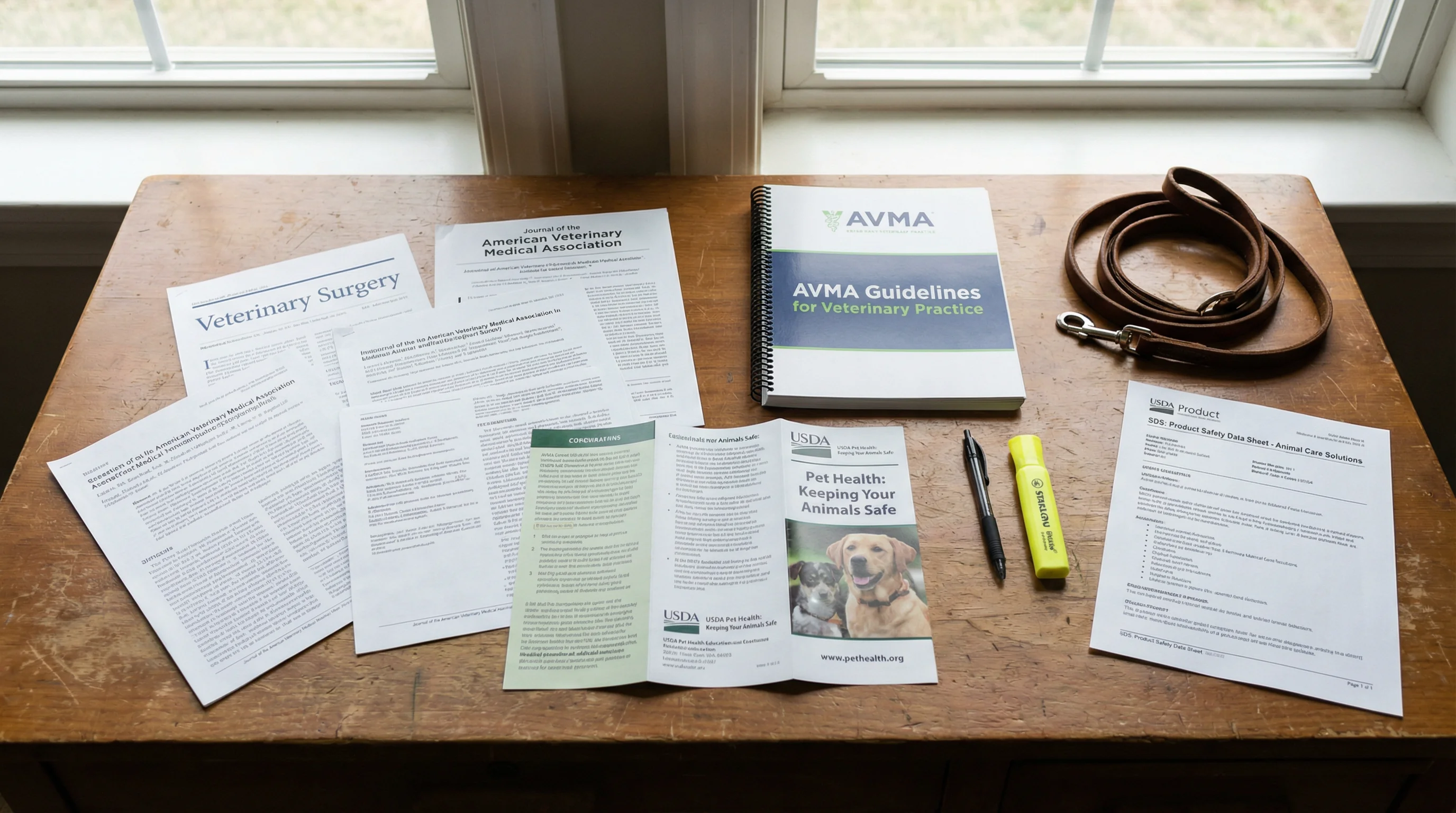
Evidence hierarchy and meticulous citation practice underpin veterinary E-E-A-T. Use primary literature for medical assertions, professional standards for welfare, and manufacturer data for product specifics. Standardize terminology and version control across teams.
Source hierarchy: peer-reviewed vet science to manufacturer data
Prioritize peer-reviewed journals, clinical guidelines, and recognized textbooks. Use manufacturer SDS, labels, and technical sheets for product specs. A controlled vocabulary improves clarity and reduces ambiguity in clinical descriptions.[2]
How to cite guidelines, studies, and product specs correctly
Include authors, year, title, and stable URL or DOI. Quote dosage, contraindication, or toxicity data verbatim with context. Capture label version or revision date for products. Date every citation and note the access date for web resources.
Managing conflicting sources and updating stale claims
When studies conflict, present both with brief synthesis and a “weight of evidence” note. If guidance changes, update within defined SLAs and annotate the revision. Veterinary teams guiding clients toward quality sources improves outcomes.[4]
Suggested source priority and refresh cadence:
| Source Type | Use Case | Citation Notes | Refresh Cadence |
|---|---|---|---|
| Peer-reviewed veterinary journals | Medical claims, dosing | Include DOI; summarize methods | 6-12 months |
| Professional guidelines (AVMA/WSAVA) | Standards of care | Version and date required | Quarterly |
| Textbooks/handbooks | Background definitions | Edition and page/section | Annually |
| Manufacturer SDS/labels | Product safety/ingredients | Exact label version | On release |
| Regulatory databases | Recalls/alerts | Link to advisory | Monthly |
Expert Review Workflow: Vet and Trainer Oversight
Embed subject matter review into drafting, not after publishing. Define reviewer qualifications, scope, and accountability. Maintain a repeatable paper trail: who checked what, when, and why.
Reviewer roles, credentials, and conflict disclosures
Assign licensed veterinarians for medical pages and certified trainers/behaviorists for welfare guidance. Publish degrees, license numbers, and affiliations. Disclose sponsorships or product ties, and separate advisory relationships from content approval authority for integrity.[4]
Review checklists for medical accuracy and behavior advice
Use checklist items for indications, contraindications, emergency thresholds, humane methods, and welfare risks. Require “what not to do” notes. Verify units, ranges, and age/weight adjustments; flag any aversive techniques with alternative evidence-based options.
Versioning, sign-off logs, and visible review stamps
Maintain a change log with timestamps, reviewer, and rationale. Stamp pages with “Reviewed by” and date. For high-risk pages, add an audit badge linking to a public revision history that clarifies what changed.
- Draft with sources.
- SME review with checklist.
- Legal/compliance pass.
- Final sign-off and stamp.
- Schedule next review date.
Trust compounds when readers can see who reviewed the advice, when it was checked, and how to contact the team with concerns.

Disclaimers, Safety Notices, and Scope of Advice
Disclaimers are not afterthoughts; they are risk controls. Place concise, high-salience notices near claims that could influence care, training decisions, or product use.
When to use emergency and toxicity warnings
Trigger warnings for ingestion risks, severe symptoms, respiratory distress, or anaphylaxis indicators. For behavior content, warn against techniques that may increase fear or harm. Reference local emergency care routes where relevant to the reader’s region.
Model disclaimer templates for health, training, and product use
Medical disclaimer for pet content: “This information is educational and not a substitute for veterinary diagnosis. If symptoms are acute or worsening, contact emergency care immediately.” Add dosing and toxicity cautions near drug, supplement, or pesticide mentions.
Localizing disclaimers for US, UK, and DACH audiences
Localize emergency numbers, regulatory agencies, and spelling. Map poison control resources and triage guidance per region. Align tone and legal phrasing with local norms and regulations to avoid ambiguity or misleading directives.
Author Bios, Byline Policy, and Contributor Pages
Author and reviewer visibility communicates accountability. Demonstrate author expertise for pet blogs with verifiable credentials, publications, and scope statements. Readers and algorithms weigh this context when assessing trust.
Structuring bios to highlight credentials and experience
Include degrees, certifications, clinical or training experience, and specialties. Add a clear scope: “Focus on dermatology and preventive care” or “Force-free behavior protocols.” Keep bios succinct but evidence-rich and updated.
Linking to professional profiles, licenses, and publications
Use outbound links to licensing boards, professional bodies, PubMed profiles, and conference talks. Add ORCID or ResearchGate where available. These external signals validate expertise and reduce uncertainty for readers and crawlers.
Maintaining a transparent editorial policy page
Publish your editorial methodology, reviewer standards, and correction policy. Tie this to brand voice and style consistency guidelines so tone never undermines clinical accuracy. Provide a contact path for corrections and conflicts of interest.
Structured Data: Medical and Product Schema for Pet Sites
Schema communicates expertise and safety metadata to search engines. Implement medical schema for pets thoughtfully and avoid over-claiming. Align JSON-LD with on-page evidence and disclosures.
When to use MedicalEntity, MedicalWebPage, and Condition
For clinical topics, include MedicalWebPage plus MedicalEntity or Condition when discussing symptoms, diagnostics, or treatments. Ensure definitions are lay-friendly but precise, aligning terms to controlled vocabularies for clarity and consistency.[2]
Marking vet reviewers with Person, sameAs, and credentials
Use Person for author and reviewer, with “reviewedBy,” degrees, and license numbers. Add sameAs links to professional profiles. This supports vet-reviewed articles schema patterns that reinforce accountability and reviewer provenance.
Product schema for safety specs, recalls, and ingestion risks
Extend Product with safety warnings, ingredient lists, recalls (Offer/IsRelatedTo), and age/weight suitability. Link to advisories where applicable. For product-content strategy and interlinking, see Product-Led Pet Content: From Blog to Basket With Internal Linking.

AI Drafts With Human QA: Risk Controls That Scale
AI accelerates production, but it must be governed. Pair source-grounded prompts with rigorous human review and rollback plans. This preserves accuracy while scaling output responsibly.
Source-grounded prompts and citation enforcement
Constrain prompts to approved sources, require inline citations, and block publication without references. This reduces hallucinations and aligns with evidence standards for sensitive topics in health and training.[1]
Red-flag detection for dosages, contraindications, and toxicity
Automate checks for units, max dose by weight, drug interactions, and toxic ingredients. Verify all pharmacology against a trusted formulary before publishing to prevent harmful errors.[3]
Editorial SLAs and rollback plans for high-risk updates
Set SLAs by risk tier. Build “unpublish and notify” playbooks for corrections, with version rollback and reader notes. For operational safety, detail AI workflows with human QA before scaling to new topic clusters.
Teams seeking repeatable automation often add lightly supervised generation for lower-risk topics; in these cases, many find Start Now helpful to map research and draft product-linked articles while preserving editorial gates.
Designing Pages for Trust: UX Patterns That Surface E-E-A-T
Trust is also visual. Present credibility signals early, summarize risks clearly, and keep reading effortless. Design choices should reinforce-not distract from-clinical precision and humane training principles.
Above-the-fold trust blocks: byline, review badge, last updated
Place author byline, reviewer badge, and last updated date near the headline. Add a short “Fact-checked by” tooltip. For critical topics, include an alert banner linking to emergency guidance or recall notices.
Inline source callouts, summary boxes, and risk highlights
Use summary boxes to surface key actions and “Do/Don’t” lists. Inline callouts next to claims guide scanning. This blends readability and rigor, especially when non-experts need safe, immediate direction.[4]
Accessibility and readability for pet parent audiences
Use large, legible type, alt text, and ARIA labels. Keep sentences concise, define jargon, and provide pronunciations for medical terms. Align microcopy with brand voice and style consistency to ensure clarity without losing authority.
Frequently Asked Questions
What sources should pet health articles cite to meet E-E-A-T standards?
Prioritize peer-reviewed veterinary journals, professional bodies (AVMA, WSAVA), and government resources. Supplement with manufacturer data sheets and reputable textbooks. Date all citations, capture versions, and use DOIs or permanent links to maintain verifiability over time.
Do I need a vet to review every pet health article?
Any page involving medical, safety, or ingestion risk should be vet-reviewed. Training and behavior content benefits from certified trainer oversight, especially where welfare or aversive methods are discussed, ensuring humane, evidence-based guidance and risk-aware recommendations.
What disclaimers are essential for veterinary content?
Include a general medical disclaimer, emergency guidance, and scope limits (no individualized diagnosis). Add toxicity and dosing cautions where relevant. Localize poison control contacts and after-hours care information by region for practical, immediate actionability.
Which schema should I use for veterinary topics?
Use MedicalWebPage or Article plus MedicalEntity/Condition where appropriate. Mark reviewers with Person, credentials, and sameAs profiles. For products, include Product with safety attributes, ingredient warnings, and recall links to surface critical consumer protections.
How can AI-generated drafts remain compliant and accurate?
Enforce source-grounded prompts, require inline citations, and route drafts to qualified human reviewers. Add red-flag checks for dosage, contraindications, and toxic ingredients. Maintain rollback procedures and review SLAs for high-risk content updates.
Conclusion
Trustworthy pet health and training content is built on disciplined sourcing, qualified review, clear disclaimers, structured data, and resilient editorial controls. Prioritize reader safety, show your work, and design for clarity. Apply these patterns systematically across pages and product lines to compound authority over time. When your methods are visible and your updates predictable, both pet parents and search engines will reward your reliability-and your content will do the good it is meant to do.
References
- E Afful-Dadzie et al. (2023). Social media in health communication: A literature review of information quality. Health Information …. View article
- VP Studdert et al. (2020). Saunders comprehensive veterinary dictionary. 2020 - books.google.com. View article
- DC Plumb (2018). Plumb's veterinary drug handbook: desk. 2018 - books.google.com. View article
- N Solhjoo et al. (2019). Veterinarians' information prescription and clients' ehealth literacy. Journal of the …. View article