Multilingual Pet Content: Localizing for US, UK, and DACH


Table of Contents +
- Why Multilingual Pet Content Matters for US, UK, and DACH
- Localized Keyword Research: Mapping US, UK, and DACH Demand
- Terminology and Style: Getting the Pet Vocabulary Right
- Technical SEO for Multiregional Sites
- Product Availability, Compliance, and Claims by Region
- Maintaining Brand Voice Across Languages
- Content Operations and Automation
- Measurement: Proving Impact in Each Locale
- Frequently Asked Questions
- Conclusion
- References
Learn how to localize pet content for US, UK, and DACH: keyword mapping, terminology, hreflang, product rules, and brand voice for consistent organic growth.
Your English and German audiences may search for similar solutions-but they do not use the same words, rules, or expectations. Winning organic traffic across US, UK, and DACH requires deliberate planning, precise terminology, and disciplined technical execution.
This guide drills into how to plan and localize pet content for English and German markets. You will learn how to adapt keywords, terminology, hreflang, product availability and claims, and brand voice-without diluting performance or compliance.
Why Multilingual Pet Content Matters for US, UK, and DACH
US, UK, and DACH share many pet care needs, yet their search behavior, regulatory boundaries, and terminology differ meaningfully.
Market sizes, search behavior, and seasonality differences
Search demand peaks at different times: US holiday gifting, UK summer travel, and DACH winter care all shift intent. Weather, retail calendars, and public holidays alter when people browse training gear, nutrition, and insurance, affecting content calendars and SKU prioritization.
How language nuance impacts pet intent and conversions
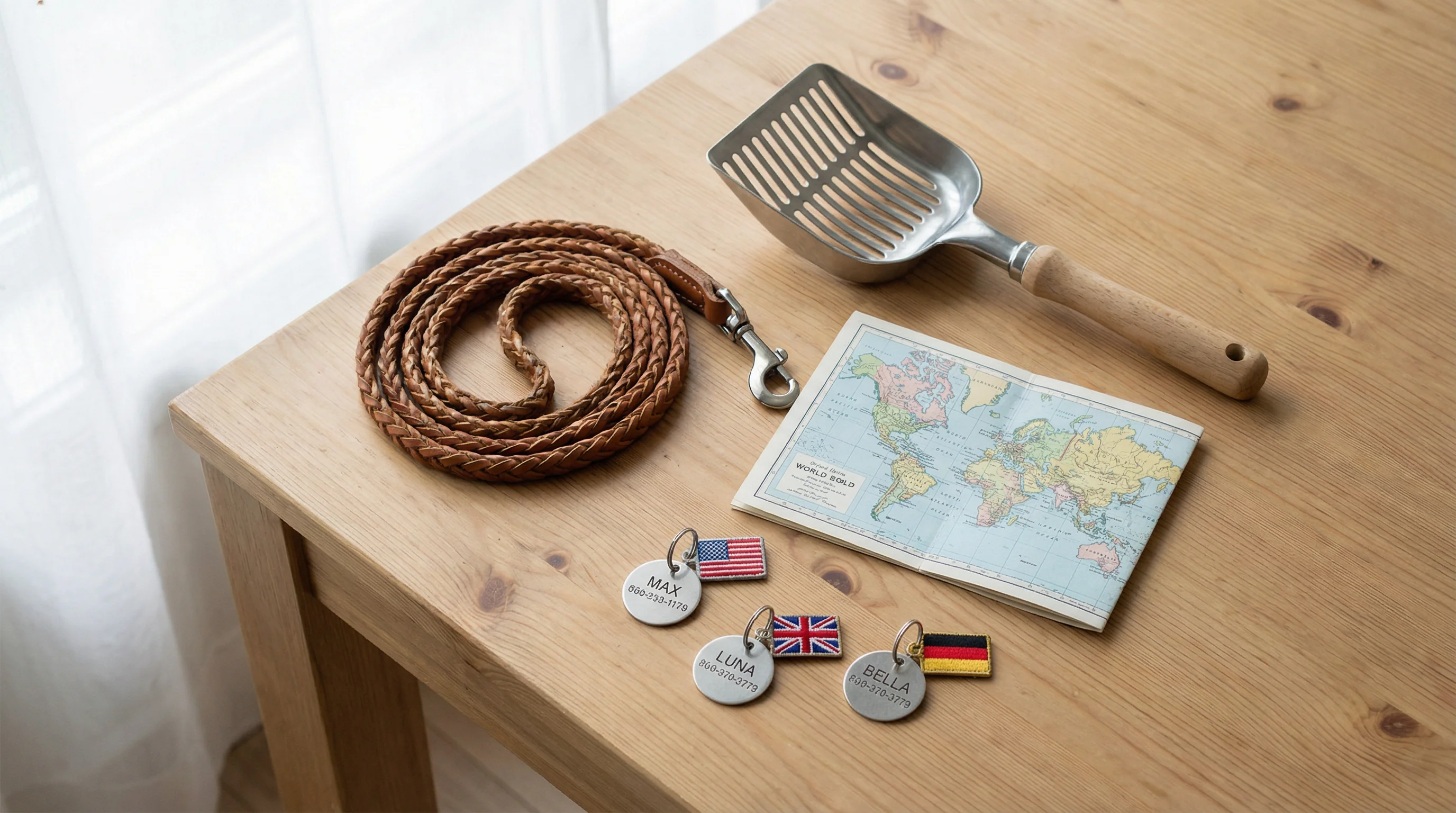
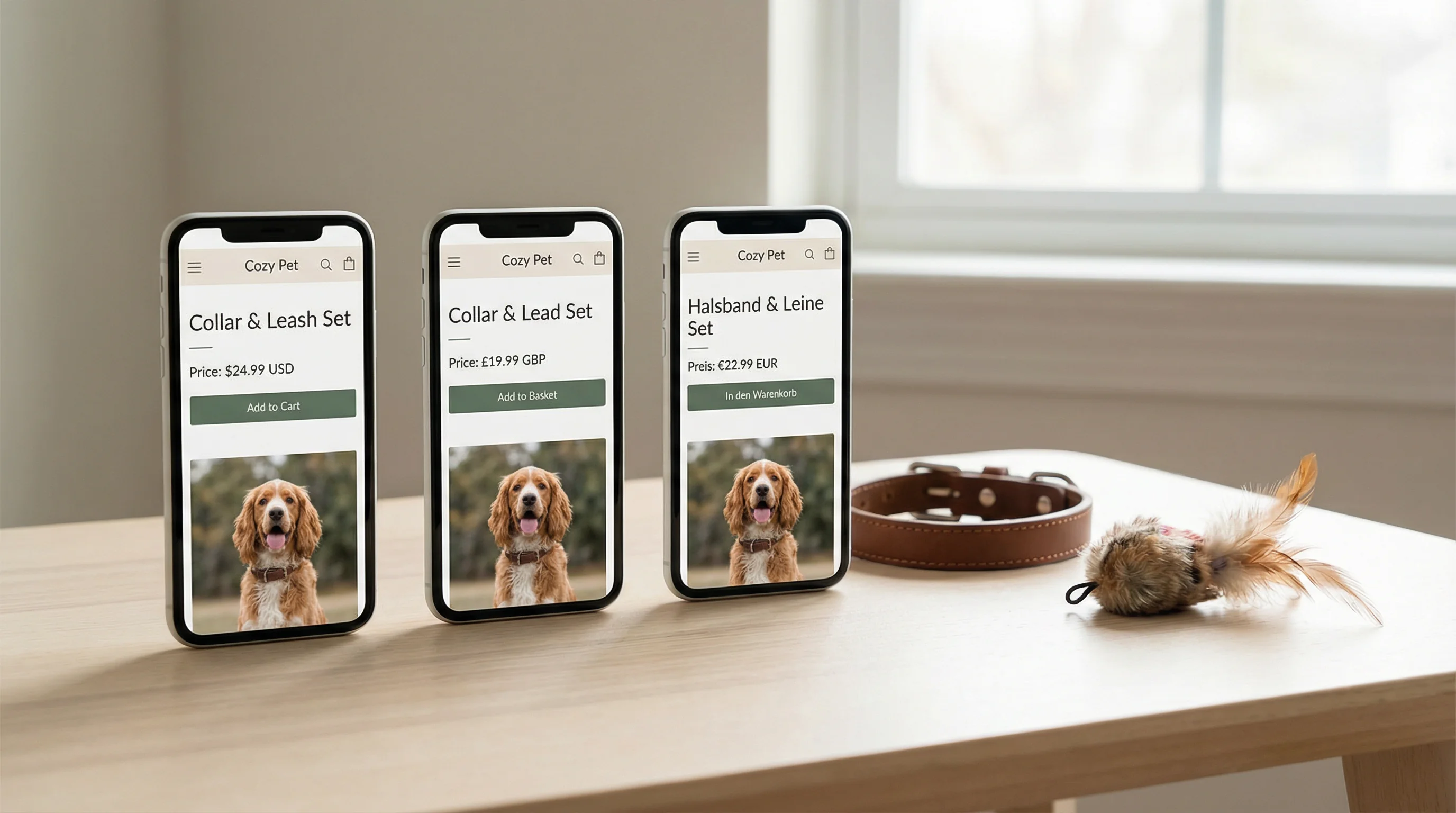
Word choices shape intent: “leash” vs. “lead” vs. “Leine” can pull different SERP mixes and conversion paths. Localization research confirms that meaning-level adaptation-not word swaps-improves comprehension and persuasion, driving higher conversions across locales.[2] For foundational guidance, see our pet content writing guide.
Petbase handles this entire content workflow automatically - 10 SEO articles published to your blog every month - start your free trial.
Localized Keyword Research: Mapping US, UK, and DACH Demand
Start with a unified process that pairs market-specific language with intent-led clustering. Build your maps via rigorous localized keyword research to align terms to real SERP behavior, not assumptions.
Building seed lists and regional variants (leash vs. lead; cat litter vs. Katzenstreu)
Draft seed lists per market: “leash,” “lead,” “harness,” and “Katzenstreu,” “Streu,” “Katzentoilette.” Include spelling, plural, and compound forms (e.g., “no-pull harness,” “Anti-Zug Geschirr”). Validate with autocomplete, related searches, and category page nomenclature in each locale.
SERP feature audits and intent matching by market
Audit SERPs in en-US, en-GB, and de-DE/AT/CH. Note People Also Ask, shopping carousels, and review snippets, then match content to dominant intents. Cross-lingual analysis benefits from embeddings to compare topic proximity across languages.[3]
Using topic clustering to cover breed, life stage, and size modifiers
Cluster pillars with modifiers: breed (e.g., herding vs. toy), life stage (puppy/“Welpe”), and size (small/large). Implement:
- Primary page targeting the head term.
- Supporting posts for modifiers and comparisons.
- Internal links to localized product/category pages.
Terminology and Style: Getting the Pet Vocabulary Right
Terminology precision reduces bounce and increases trust. Build a multilingual term base and enforce consistent, compliant phrasing across locales.
Common term differences (US vs. UK vs. DE/AT/CH)
Map high-impact differences to avoid mismatched SERPs and confusion. Examples:
| Concept | US (en-US) | UK (en-GB) | DE/AT/CH (de-DE/AT/CH) |
|---|---|---|---|
| Walking aid | Leash | Lead | Leine |
| Waste bags | Poop bags | Poo bags | Kotbeutel |
| Dry food | Kibble | Dry dog food | Trockenfutter |
| Cat litter | Cat litter | Cat litter | Katzenstreu |
| Vet | Veterinarian | Vet | Tierarzt/Tierärztin |
| Treats | Treats | Treats | Leckerlis |
Medical, regulatory, and ingredient naming conventions
Ingredient and claim phrasing differs: “probiotics” vs. “Milchsäurebakterien,” “grain-free” vs. “getreidefrei.” Regulatory-friendly wording varies across FDA/FTC, CAP/ASA, and EU/DE frameworks; choose conservative phrasing and document approved synonyms.[4]
Creating a multilingual term base and editorial style notes
Build a glossary for pet content localization and German pet terminology. Include:
- Approved terms, disallowed terms, and market notes.
- Measurement standards (lb/kg, in/cm), punctuation, and tone.
- Sample headlines and meta patterns per locale for consistency.
Technical SEO for Multiregional Sites
Technical infrastructure signals relevance and prevents cannibalization. Centralize rules in your technical SEO hub and document change control.
Hreflang architecture for en-US, en-GB, de-DE, de-AT, de-CH
Use hreflang for pet sites to map regional variants. Each URL should reference its alternates with reciprocal tags and x-default. Keep language-region codes consistent with site sections and navigation.
URL patterns, canonicalization, and language selectors
Adopt clean patterns: /en-us/, /en-gb/, /de-de/, /de-at/, /de-ch/. Use self-referencing canonicals and avoid parameter-only localization. Offer a visible language selector, defaulting by user preference rather than IP when possible.
Structured data: Product, FAQ, Organization, and LocalBusiness
Implement localized schema to enhance US UK DACH SEO:
- Product: currency, availability, GTIN, and regional price.
- FAQ: localized questions/answers mirror on-page content.
- Organization and LocalBusiness: addresses, phone formats, opening hours.
Product Availability, Compliance, and Claims by Region
Localize availability and messages before you translate. Align stock, shipping, pricing, and claims to each market’s expectations and regulations.
Stock, shipping, and pricing localization (VAT, currency cues)
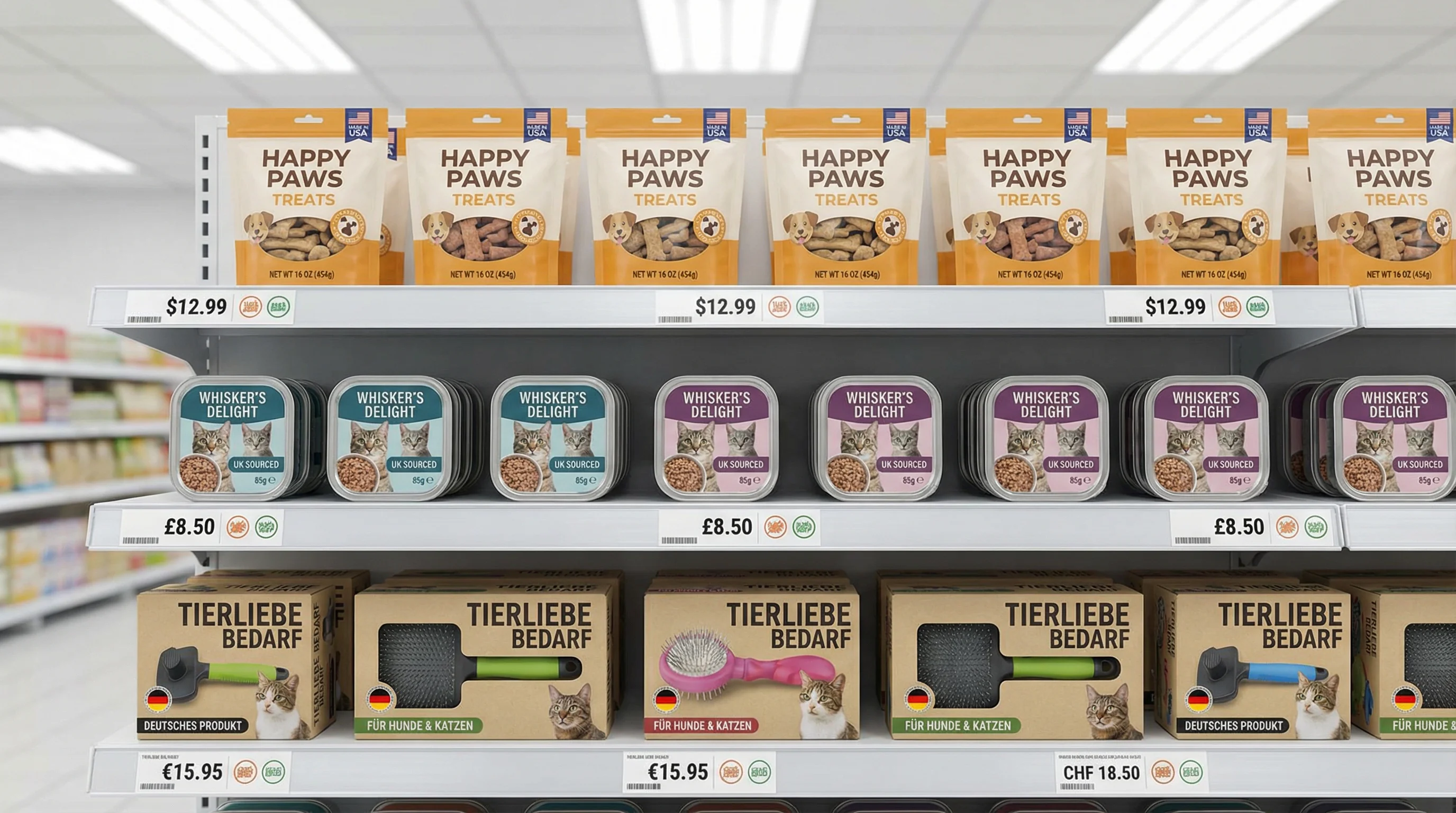
Reflect regional inventory, shipping cutoffs, and delivery windows. Display currency cues (USD, GBP, EUR/CHF) and VAT handling. Note packaging variations, bundle offers, and subscription options by locale, especially for replenishment categories.
Claims compliance: FDA/FTC (US), CAP/ASA (UK), LMIV/UZV/Heilmittelwerbegesetz (DACH)
Standardize claims ranges and disclaimers per region. Avoid disease-treatment claims without evidence and approvals. Build a pre-publication legal review workflow, and maintain a living claims library with permissible phrasing and prohibited triggers.
Pet safety standards and certification mentions
Show relevant standards and certifications where they exist. Reference test methods, materials, and safety warnings consistently. Mirror labeling expectations (e.g., DE recycling icons) and ensure imagery aligns with regional norms and regulations.
Only publish claims and safety language that you can substantiate in each locale-compliance failure can negate SEO gains with penalties or takedowns.
Maintaining Brand Voice Across Languages
Consistency builds trust. Define voice, tone, and compliance boundaries that travel across languages, supported by voice and style guardrails your teams can apply at speed.
Voice and tone guardrails for pet-parent audiences
Document persona traits, empathy boundaries, and reading levels. Specify sentence length targets, active voice, and benefit-led headings. Calibrate warmth and authority differently for guidance, product pages, and safety advisories across markets.
Transcreation vs. translation: when to adapt examples and idioms
Choose transcreation for headlines, CTAs, humor, and idioms. Replace culture-bound references and convert measurements. Localization literature shows that adapting at discourse level improves reception and intent satisfaction beyond literal translation.[2]
Editorial QA workflows and linguistic QA checks
Implement dual-pass QA: editorial compliance review, then linguistic QA for hyphenation, compounds, and locale variants. Track recurrent issues in a ticketed system and add them to your term base to prevent rework and drift.
Content Operations and Automation
Operational maturity turns plans into publish-ready content. Standardize reusable briefs and templates, such as those in Pet Blog Templates and Briefs, and define publishing SLAs per locale.
Topic calendars aligned to seasonal pet needs and retail peaks
Plot quarterly calendars against weather-driven needs and retail spikes by market. Pace educational posts ahead of peaks, then follow with product-led content. Capture early interest with evergreen FAQs localized to each region.
Reusable templates for breeds, life stages, and problem-solution posts
Create templates with slot-in modifiers (breed, size, age), localized CTAs, and links to regional categories. Add schema blocks by default. Encourage editors to localize examples, measurements, and guidance notes per template.
Automation guardrails: human-in-the-loop and feedback loops
Use automation to scale drafts and internal links, then require human review for pet keyword localization, compliance, and tone. Platforms can orchestrate multilingual content in one interface, improving governance and speed.[1] For production efficiency, consider Start Now for product-linked, research-backed posts.
Measurement: Proving Impact in Each Locale
Localization should accelerate rankings and revenue, not just translation velocity. Mature programs track end-to-end impact with dashboards and attribution tuned to locale differences.
Locale-specific KPIs: impressions, SERP features, and CVR
Monitor impressions and CTR for localized terms, FAQ and Product snippet wins, engagement by country, and CVR to localized PDPs. Segment reporting by en-US, en-GB, de-DE/AT/CH and compare against non-localized baselines.
Attribution for product-led internal linking
Measure blog-to-basket performance with click-path analysis and UTM taxonomies. Follow internal linking guidance in Product-Led Pet Content and ensure links resolve to the correct locale’s categories and products for accurate revenue credit.
Experiment design: A/B copy tests by market
Test headline variants (“best lead” vs. “best leash”), CTA tone, and schema FAQ phrasing. Run locale-isolated tests for fair readouts. Iterate your glossary and templates based on gains observed in each market’s SERPs.
Frequently Asked Questions
What is the difference between localization and translation for pet content?
Translation converts words; localization adapts keywords, terminology, measurements, regulations, and examples for each market. For pet content, this ensures breed terms, product names, and health claims align with local intent and compliance.
How should I implement hreflang for US, UK, and DACH?
Create dedicated URLs per locale (e.g., /en-us, /en-gb, /de-de, /de-at, /de-ch) and add reciprocal hreflang tags with a self-referencing canonical. Include an x-default for a global chooser where applicable.
Do I need different keywords for US and UK pet content?
Yes. Many terms differ (e.g., leash vs. lead, kibble vs. dry dog food), and SERP intent can shift. Build market-specific keyword maps and validate with local SERP reviews.
How do I handle regulatory claims across regions?
Use conservative, evidence-based language. Align to FDA/FTC guidance in the US, CAP/ASA in the UK, and EU/DE rules like LMIV and Heilmittelwerbegesetz in DACH. Maintain a claims review checklist per locale.
What metrics show localization is working?
Track locale-level impressions, CTR, ranking for localized terms, engagement by region, and conversion to localized product pages. Monitor SERP feature wins like FAQs and product snippets per locale.
Conclusion
Effective multilingual pet content is strategic localization, not literal translation. Map US, UK, and DACH demand with market-specific keywords, enforce precise terminology, implement correct hreflang and schema, and respect availability and claims rules. Maintain a consistent brand voice, but transcreate where idioms and measurement systems differ. Finally, operationalize templates, automation, and QA to publish at scale-and prove impact with locale-level KPIs and attribution. Execute this playbook consistently, and your international content will compound authority and revenue across English and German markets.
References
- I Okonkwo et al. (2023). Localization and global marketing: Adapting digital strategies for diverse audiences. Journal of Digital …. View article
- MA Jiménez-Crespo (2024). Localization in translation. 2024 - taylorfrancis.com. View article
- H Licht et al. (2023). Going cross-lingual: A guide to multilingual text analysis. Computational Communication Research. View article
- Y Jin (2025). Localization in translation. Miguel A. Jiménez-Crespo. 2025 - academic.oup.com. View article