Veterinary SEO: The Complete Strategy Guide for Clinics and Mobile Vets


Table of Contents +
- Why veterinary SEO matters now for clinics and mobile practices
- What to prioritize first: the veterinary SEO order of operations
- Core site architecture for vets: pages that win searches and reduce calls
- Local visibility for clinics and mobile vets: accuracy over volume
- Site quality and technical signals: speed, structure, and appropriate schema
- Authority and content: educate first, then expand
- Measure what matters: operations-aligned SEO metrics
- Frequently Asked Questions
- Common mistakes and misconceptions
- Local visibility for clinics and mobile vets: accuracy over volume
- Site quality and technical signals: speed, structure, and appropriate schema
- References
Learn veterinary SEO fundamentals, what to prioritize first, and how clinics and mobile vets should plan local, content, and technical SEO-without deep tactics.
Most pet owners start their care journey in search. Your next appointment likely begins with a query, not a phone call.
Veterinary SEO turns that moment into measurable growth. This guide explains how clinics and mobile practices earn visibility, reduce call friction, and convert searchers into loyal clients. You will learn what to prioritize, how to structure your site, and how to align local, medical, and content SEO with real operations.
Why veterinary SEO matters now for clinics and mobile practices
How search drives new clients, urgent visits, and repeat care
Search captures intent across the care lifecycle. Prospects look for nearby help, urgent availability, and clear pricing and policies before calling.
Digital touchpoints such as a professional website and review platforms are now standard expectations, not extras. Clinics using these channels strategically reduce costs and improve performance[2].
Different paths to visibility: local, medical, and content SEO
Local SEO for veterinarians earns map and near-me visibility. It depends on accurate profiles, categories, and consistent data.
Medical and service SEO clarifies expertise and procedures. It helps convert when symptoms or treatments drive the query.
Content SEO expands reach by answering educational questions. It builds trust and keeps clients engaged between visits[3].
Petbase automates SEO content for veterinary clinics - so you can focus on patients, not blog posts - start your free trial.
What to prioritize first: the veterinary SEO order of operations
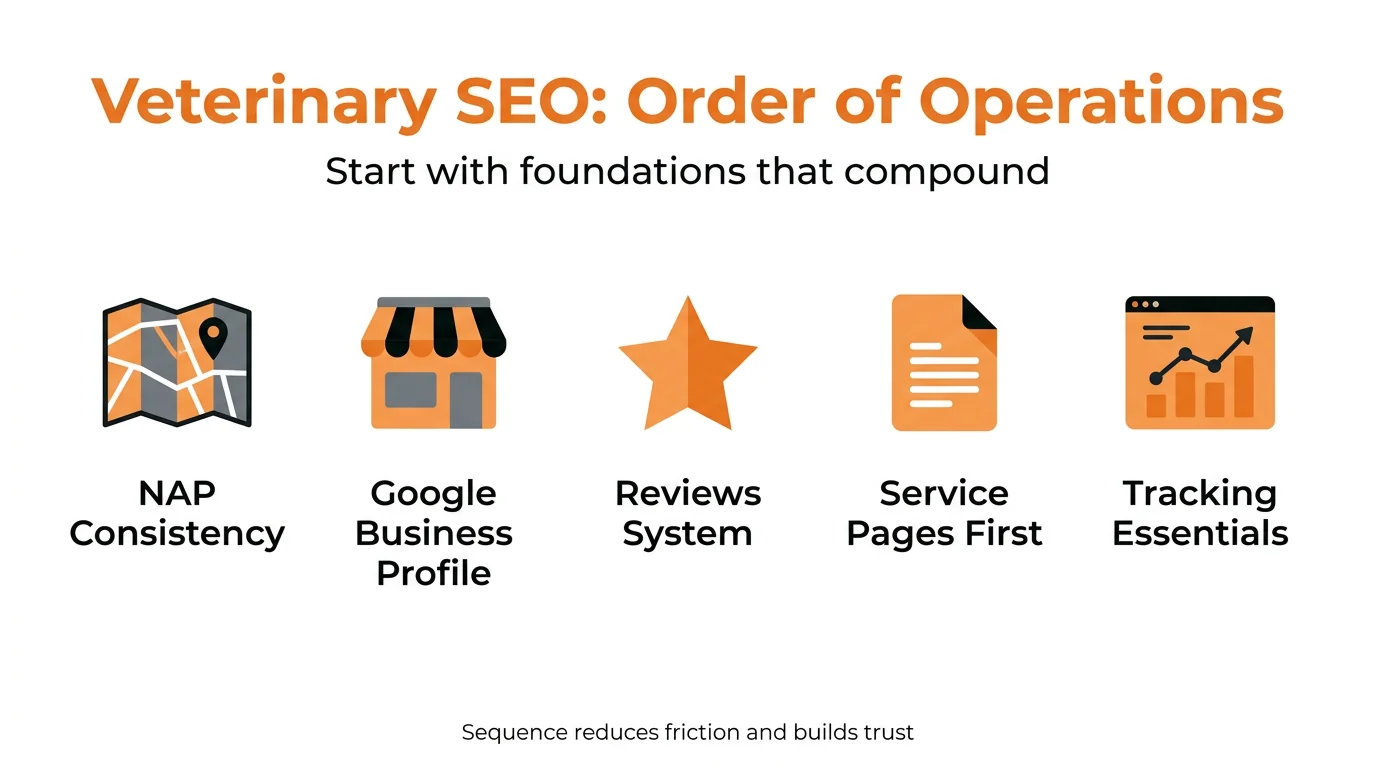
Management basics: consistent NAP, GBP, and reviews
Start with non-negotiables. Ensure consistent name, address, and phone (NAP) across your site and major directories. Optimize Google Business Profile for vets with correct categories, services, hours, and photos.
Systematize reviews with ethical requests and timely responses. Engagement signals influence discoverability and trust in healthcare contexts[3]. For a detailed setup process, see Set up Google Business Profile for a veterinary clinic the right way.
Forage: core pages that answer client intent before blogs
Build essential pages before expanding content. Cover services, locations or service areas, credentials, pricing and policies, and contact pathways.
These assets qualify you for local and service queries. They also reduce repetitive administrative calls by addressing expectations directly.
Top 3 actions to take this week
- Lock NAP consistency and fully optimize Google Business Profile with accurate categories and services.
- Launch clear service and location/service-area pages with calls to action.
- Implement a review workflow to request, respond, and showcase feedback.
Core site architecture for vets: pages that win searches and reduce calls
Essential service pages for clinics and mobile areas
Successful vet clinic SEO and mobile vet SEO start with focused service pages. Each page should match a single, high-intent service and its local context.
Align page structure to decision-making: who it is for, symptoms or indications, what happens during the visit, preparation and aftercare expectations, and pricing transparency where policy allows. Use clear CTAs.
For a deeper blueprint, see Create veterinary service pages that rank and convert.
FAQ and policy content that preempts phone questions
Publish appointment logistics, cancellation and medication refill policies, and intake instructions. Add concise FAQs for each common procedure and visit type.
Reducing uncertainty elevates client experience and signals quality to searchers. Well-structured FAQs also enhance eligibility for rich results when marked up properly.
Local visibility for clinics and mobile vets: accuracy over volume
GBP categories, services, and photos that reflect real operations
Accurate categorization determines which searches trigger your profile. Add services that mirror real offerings, not aspirational lists.
Photos should represent your facility, team, vehicles for mobile practices, and real equipment. Authenticity improves conversion and supports trust.
Citations and multi-location data hygiene
Distribute consistent NAP to major aggregators and local directories. Avoid address mixing for mobile areas-use service areas and a compliant base as required.
Consolidate duplicates and resolve conflicts. If you suspect data collisions, use Fix duplicate clinic NAP data and local listing conflicts to triage issues quickly.
Site quality and technical signals: speed, structure, and appropriate schema
Performance and UX signals that affect discovery and trust
Fast, stable pages improve engagement and reduce abandonment. Clear navigation, visible CTAs, and accessible forms support booking behavior.
Operational reliability matters: clinics that adopt effective digital systems tend to improve client experience and efficiency, reinforcing online performance[4].
Schema to clarify services, location, and medical expertise
Structured data helps search engines understand your organization, services, FAQs, and local details. Use it to reinforce accuracy, not to overstate credentials.
Medical schema should be applied with care to avoid misleading claims. For implementation guardrails, read Use medical and local schema for vets without triggering YMYL issues.
Authority and content: educate first, then expand
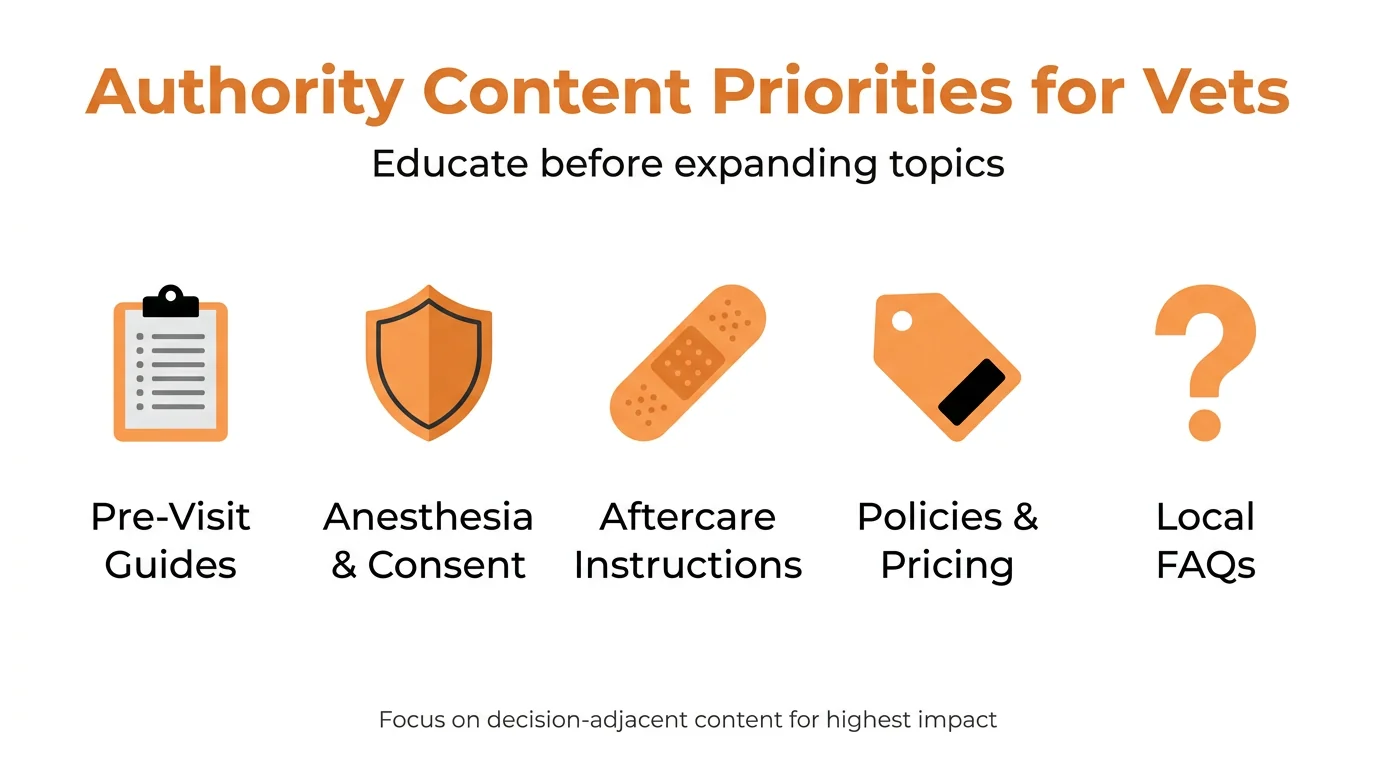
Service-adjacent education that supports conversions
Build a veterinary content strategy around questions that appear before and after a booking decision. Prioritize pre-visit preparation, anesthesia considerations, recovery expectations, and preventive care education.
As digital self-service grows, pet owners increasingly accept technology-mediated guidance. This strengthens the case for accessible, trustworthy educational content[1]. For scalable planning and publication, tools like Petbase AI can streamline pet-specific topic research and drafting.
Community partnerships and local PR for trust signals
Partner with shelters, trainers, and local events. Collaborative content, sponsorships, and media mentions create natural authority signals.
In healthcare marketing, meaningful engagement strengthens relationships and influences long-term loyalty[3]. Prioritize genuine contributions that deserve coverage, not link exchanges.
Measure what matters: operations-aligned SEO metrics
Track booked appointments, calls, and form quality
Connect SEO to outcomes that matter operationally. Track booked appointments, high-intent calls, and qualified forms, not just traffic.
Attribute conversions to pages and queries that reflect real demand, such as service and policy content. Align reporting cadences to leadership and front-desk needs.
Use reviews and reputation as ongoing quality signals
Monitor review volume, recency, and response rates. Map feedback themes to content updates and operational improvements.
ICT innovation research underscores the impact of online reviews and platforms on practice performance and client acquisition[2].
Frequently Asked Questions
What is the biggest SEO win for a veterinary clinic starting from scratch?
Complete and optimize your Google Business Profile, ensure NAP consistency, and launch clear service and location pages. This establishes local eligibility and converts searchers.
How is mobile vet SEO different from a clinic’s?
Mobile vets rely more on accurate service areas, clear service definitions, and consistent citations without mixed addresses. Content should reflect travel zones and availability.
Do veterinarians need medical schema?
Use schema to clarify services, organization, and local details. Apply medical schema carefully to avoid over-claiming and align with trust and content quality requirements.
How long until veterinary SEO shows results?
Timelines vary, but establishing accurate profiles and core pages can lift visibility sooner than broader content campaigns. Sustain improvements with reviews and ongoing content.
Which pages should a vet site build before blogging?
Home, about/credentials, contact, location or service areas, individual service pages, pricing/policies overview, and targeted FAQs that address common appointment questions.
Common mistakes and misconceptions
Blog-first approaches without service pages. Prioritize core service and location content before educational posts. Visibility without conversion intent wastes effort.
Overbroad service lists and misaligned categories. Only list what you actually provide. Incorrect categories and inflated claims harm trust and local eligibility.
Ignoring data hygiene. Duplicate or conflicting NAP details can dilute rankings and confuse clients. Centralize ownership of listings and enforce change control.
Chasing vanity metrics. Traffic without calls or bookings is not success. Measure outcomes tied to front-desk reality.
Underestimating UX and speed. Slow pages and unclear navigation suppress conversions. Performance is a trust signal as much as a technical one.
Local visibility for clinics and mobile vets: accuracy over volume
GBP categories, services, and photos that reflect real operations
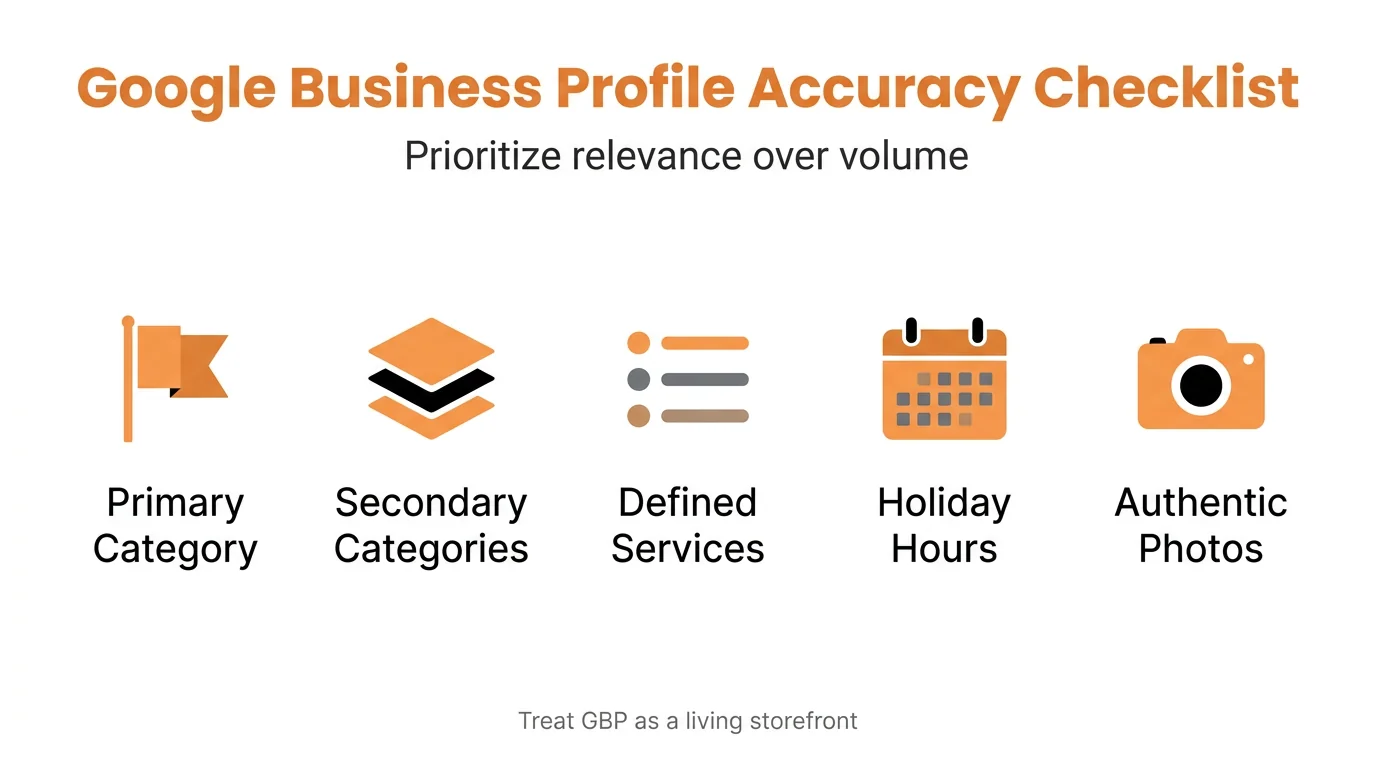
Select primary and secondary categories that mirror current services. Keep holiday hours updated, and use photo updates to reinforce recency and activity.
For advanced setup guidance, see Set up Google Business Profile for a veterinary clinic the right way. Treat GBP like a living storefront, not a one-time form.
Citations and multi-location data hygiene
Standardize formatting for names, suites, and phone routing. For multi-location networks, separate profiles and avoid cross-contamination of data.
If conflicts emerge across directories, consult Fix duplicate clinic NAP data and local listing conflicts to protect local signals and client clarity.
Site quality and technical signals: speed, structure, and appropriate schema
Performance and UX signals that affect discovery and trust
Minimize layout shifts, compress images, and remove unstable pop-ups. Build clear paths to booking and calling from every page.
AI-enabled operations can amplify patient experience by improving scheduling and communication efficiency, reinforcing your brand’s reliability online[4].
Schema to clarify services, location, and medical expertise
Use LocalBusiness, Organization, Service, and FAQ markup to clarify meaning. Reserve medical types for content with appropriate expertise and oversight.
Follow best-practice boundaries in Use medical and local schema for vets without triggering YMYL issues to avoid compliance and trust pitfalls.
References
- DH Huang et al. (2021). Chatbot usage intention analysis: Veterinary consultation. Journal of Innovation & Knowledge. View article
- B Karolina (2023). Unlocking the potential of ICT innovation in veterinary healthcare: The pathway to improve practices and business model. Procedia Computer Science. View article
- Y Fitriani (2025). Customer Engagement in Human and Veterinary Healthcare Marketing: A Systematic Literature Review. … on Business, Education, Economics, Accounting, and ….
- K Beyer et al. (2025). THE ROLE OF ARTIFICIAL INTELLIGENCE AND ICT IN VETERINARY BUSINESS: A LITERATURE REVIEW. Intelligent Management and …. View article
Related Reading

Pet Page SEO Optimization: The Complete Orientation Guide for Pet Brands, Retailers, and Services

Pet Content Automation: The Complete Orientation Guide for Pet Brands, Retailers, and Clinics

Pet SEO: The Complete Guide to AI-Powered Growth for Pet Brands, Retailers, and Services