Duplicate NAP Nightmares: Fixing Conflicting Veterinary Citations Across Maps and Directories

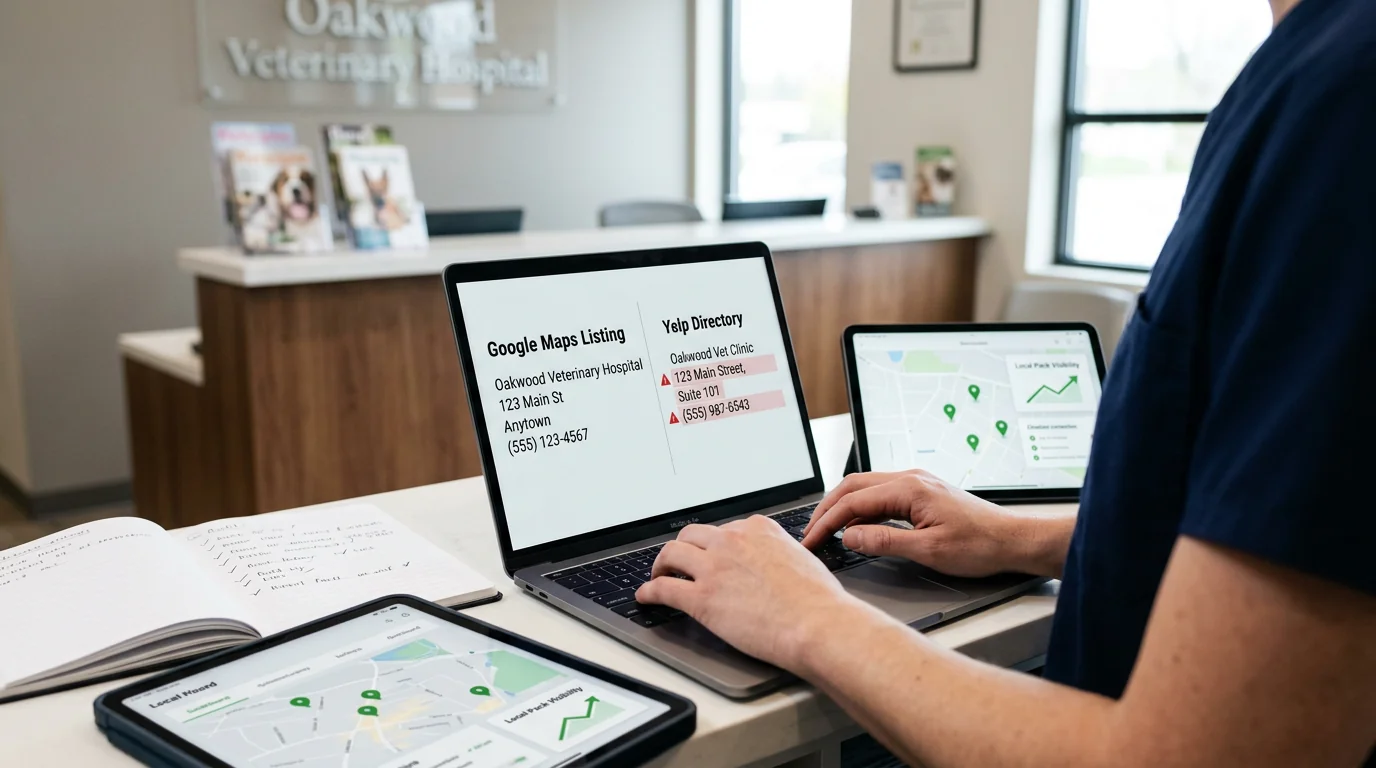
Table of Contents +
- Why duplicate NAPs derail veterinary local visibility
- The focused scenario: single or multi-location vet with conflicting citations
- Step-by-step remediation workflow
- Quick decision guide
- Platform-specific actions and examples
- Monitoring and validation
- Practical safety boundaries
- Evidence status and what the data suggests
- Documentation templates and SOPs you can adapt
- Connect this fix to broader veterinary SEO priorities
- Frequently Asked Questions
- Conclusion
- References
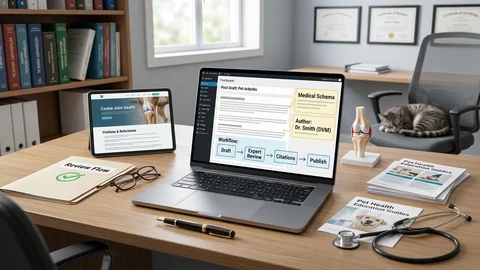
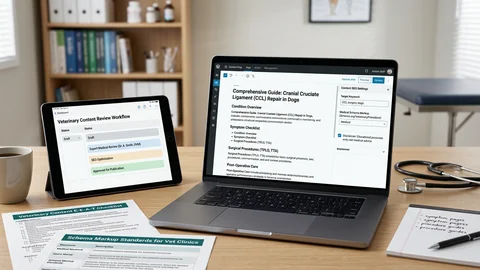
Step-by-step plan to audit, fix, and monitor duplicate NAP for veterinary practices across maps and directories to regain local pack visibility.
Duplicate NAP issues quietly drain local visibility. Conflicting Name/Address/Phone signals make algorithms second-guess your clinic’s real-world identity. That hesitation shows up as disappearing pins, split reviews, and lost appointment calls.
This matters because veterinary local SEO relies on clear, consistent location data. Inconsistent citations can fragment authority across copies and outdated listings. You will learn how to audit, resolve, and monitor NAP conflicts step by step for single and multi-location practices.
Why duplicate NAPs derail veterinary local visibility
How conflicting Name/Address/Phone signals confuse algorithms
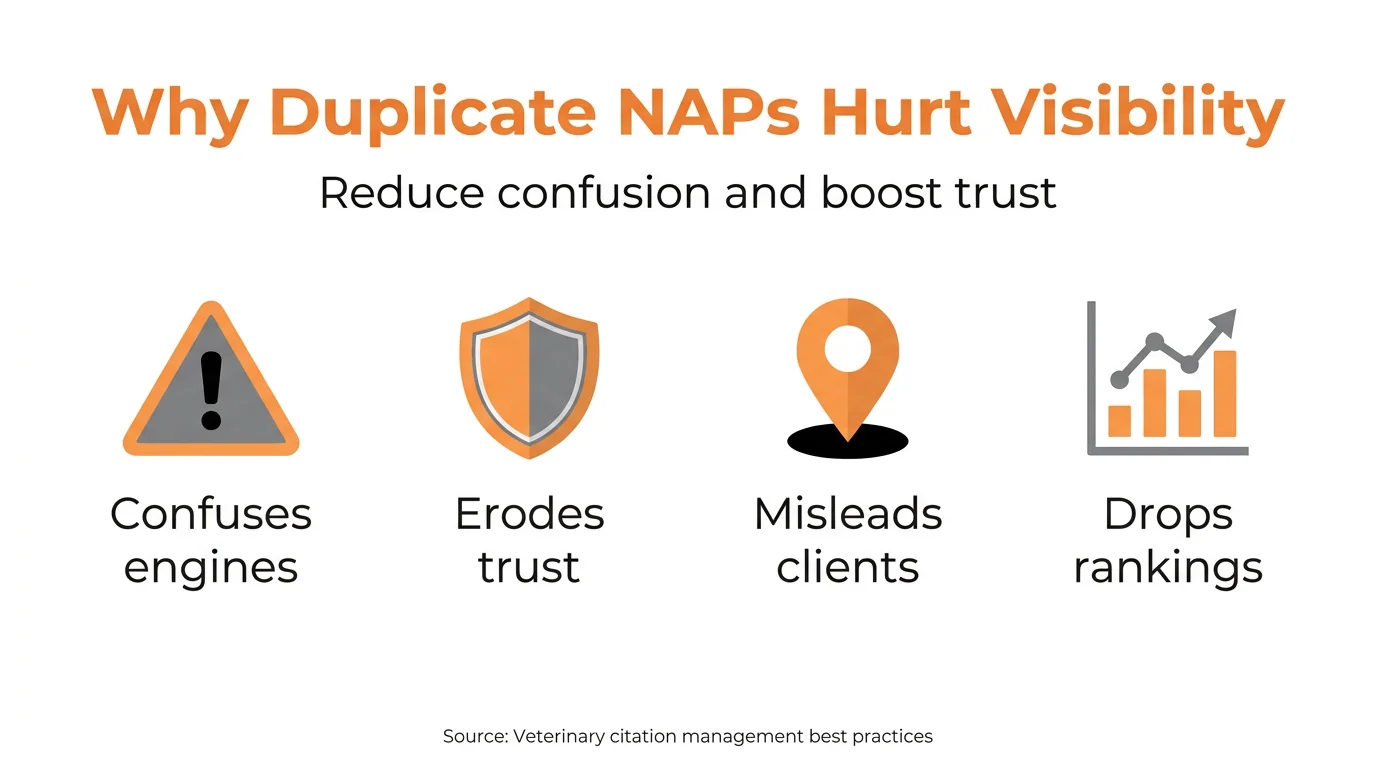
Search engines triangulate business identity using repeated Name, Address, and Phone data across the web. Duplicate or mismatched entries introduce uncertainty. That uncertainty weakens confidence in proximity, relevance, and prominence calculations.
A disciplined NAP consistency program complements your broader veterinary SEO overview. Research in veterinary business performance highlights that strong, coherent digital presence supports measurable operational outcomes, reinforcing the value of accurate location data[1].
Impact on Google Business Profile, map pins, and reviews routing
Conflicts may spawn Google Business Profile duplicates, scatter reviews, and misroute directions. Review fragmentation reduces social proof density. That may depress local pack visibility, even when clinical reputation is strong. Accurate contact data also underpins access models, including telemedicine workflows, making reliability vital[2].
Petbase automates SEO content for veterinary clinics - so you can focus on patients, not blog posts - start your free trial.
The focused scenario: single or multi-location vet with conflicting citations
Common root causes: rebrands, moves, tracking numbers, franchise overlap
Most duplicate NAP veterinary citations trace to predictable shifts. Moves leave old addresses active. Rebrands alter naming conventions inconsistently. Tracking numbers proliferate uncontrolled. Franchises overlap brand elements, mixing locations. Practitioner-only profiles can outrank clinics and confuse users.
Each scenario demands different corrective actions, but the logic remains consistent. Establish a canonical NAP per location. Then remove or merge anything that contradicts it. Handle practitioners as affiliated, while preserving primary clinic authority.
Step-by-step remediation workflow
1) Baseline audit: extract, dedupe, and verify the canonical NAP
Start with the clinic’s legal name, customer-facing brand name, physical address standardized to postal format, and a single primary phone number. Confirm hours and categories, plus practitioner affiliations where applicable.
2) Find conflicts: scan core maps, data aggregators, and niche vet sites
Check Google, Apple, Bing, Yelp, Facebook, and Waze. Audit Data Axle, Neustar/Localeze, and Foursquare. Include niche sources like VetRatingz and local chambers. Build a list of variants and duplicates per location.
3) Prioritize: fix source-of-truth first, then high-authority listings
Update the clinic website and Google Business Profile first. Next, address Apple, Bing, Yelp, and Facebook. Then correct aggregators. Finish with niche directories and residual inconsistent profiles.
4) Suppress/merge: handle duplicates vs. rogue listings by platform
Request merges where policies allow. Suppress or mark moved listings when appropriate. Remove rogue practitioner duplicates if they violate guidelines, or affiliate them correctly to consolidate relevance.
5) Standardize formats: NAP, hours, categories, and services
Use uniform abbreviations and a single canonical phone number per location. Align hours and holiday schedules. Ensure category accuracy and consistent service descriptors across pages and profiles. For content synchronization on location pages, consider Petbase AI to maintain consistent on-site updates.
6) Document and timestamp each change for later verification
Record before/after screenshots, URLs, request IDs, and submission dates. This audit trail enables later validation and accelerates support escalations. Use a shared sheet to centralize status across locations.
Quick decision guide
If the duplicate is an old address but same name → request merge
Where supported, request a merge to the active listing. If not supported, mark the old location as moved to the current address. Avoid “permanently closed” unless operations ceased.
If different phone numbers exist for same location → keep main line, remove tracking
Retire legacy tracking numbers. Select one canonical phone and propagate it. If tracking is required, use a single tracking number as canonical across major listings to preserve consistency.
If franchise name variations exist → enforce brand naming standard
Adopt a standard naming structure, including brand and city. Correct deviations on authority platforms first. Document the rule, then roll it out consistently across directories and practitioner profiles.
If practitioner-only listings outrank clinic → add practitioner-as-affiliated, keep clinic primary
Maintain the clinic as the primary entity. Keep practitioner profiles as affiliated using appropriate categories. This approach preserves practitioner reputation while reducing cannibalization within the local results.
If there are seasonal hours mismatches → align hours across top 10 directories
Set seasonal schedules well ahead of holidays. Update Google, Apple, Bing, Yelp, Facebook, and aggregators. Confirm cache refreshes. Consistency reduces user confusion and supports accurate directions and call timing.
If multi-location data is mixed → create distinct place IDs and unique NAP per site page
Ensure each location has a discrete Google place ID, unique phone number, and distinct location page. Use consistent naming rules to separate city references. Update aggregators with the segmented records.
If a GBP is owner-verified elsewhere → request ownership transfer, then consolidate
Initiate ownership transfer using Google’s process. Once verified, remove unintended duplicates or merge appropriately. Finalize by standardizing categories, services, and hours to match the canonical set.
Platform-specific actions and examples
Google Business Profile: merge vs. remove vs. mark closed
Use “Suggest an edit” or support tickets for merges. For moved clinics, use “Moved to” rather than “Permanently closed.” Align categories and services with your clinical offerings. For deeper optimization practices, review Google Business Profile for vets.
Apple Business Connect, Yelp, Bing: duplicate handling nuances
Apple favors accurate, verified entries and may require documentation for merges. Yelp allows duplicate reports and will prioritize active listings. Bing Places syncs with aggregators, so upstream fixes can propagate changes efficiently.
Data aggregators (Data Axle, Neustar/Localeze, Foursquare): feed hygiene
Submit canonical records to aggregators first. Suppress obsolete entries rather than deleting. Aggregator hygiene helps downstream directories resolve conflicts faster, though latencies may vary across partner networks.
Monitoring and validation
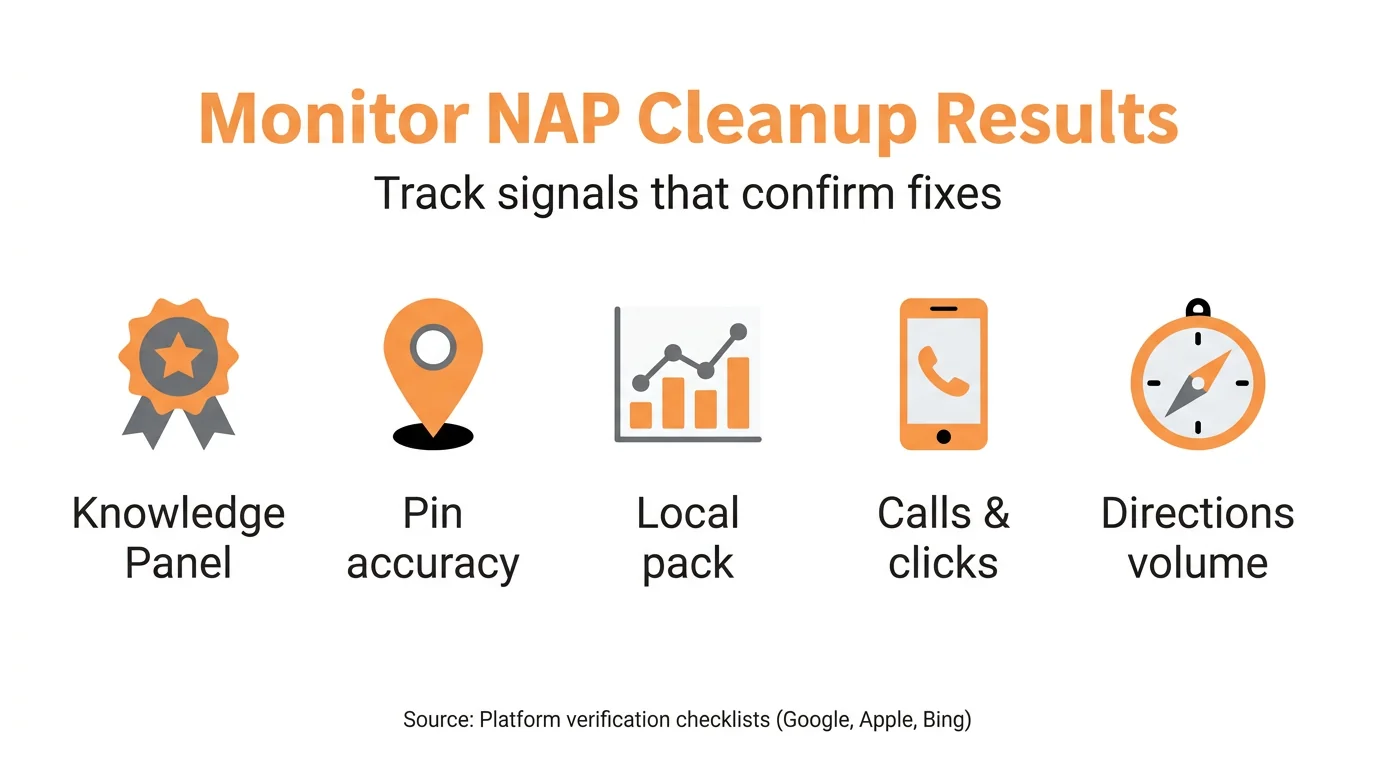
After 7-14 days: index checks, Knowledge Panel stability, pin placement
Verify the Knowledge Panel shows the correct NAP and hours. Validate map pin placement and driving directions. Search brand plus city to check whether duplicates still surface prominently. Watch for review routing consolidation.
After 4-8 weeks: local pack trends, direction requests, phone call logs
Assess local pack visibility trends and category-level rankings. Review call logs and direction requests for lifts aligned with clean data. Benchmarks may improve gradually as directories refresh. Consider frameworks in measuring veterinary SEO.
Cross-checks: brand SERP, citation cache refreshes, and review attribution
Search brand queries to ensure a single, coherent identity. Confirm citation cache updates on major directories. Validate that new reviews attach to the primary listing. For response strategies, see reviews and reputation guidance.
Practical safety boundaries
When not to mark a listing as permanently closed
Use “Permanently closed” only when the business ceased operations. For moves or rebrands, request merges or “Moved to” designations. Inaccurate closure tags may depress visibility and confuse clients searching for care.
Avoiding NAP changes during peak season or active suspension appeals
Major NAP changes during peak periods can introduce volatility. Stagger updates outside critical appointment windows. Avoid edits during active suspensions, as added changes may complicate support resolutions and extend downtime.
Maintaining a single canonical phone number per location
Adopt one canonical phone number per location across all platforms. Consistency supports trust and machine reconciliation. Communication clarity also influences client satisfaction and access to care pathways[3].
Evidence status and what the data suggests
What multiple studies and case series indicate about NAP consistency
Evidence suggests that cohesive, accurate digital presence correlates with improved business outcomes. Veterinary studies emphasize digital maturity as a driver of performance, supporting disciplined NAP management as part of operational readiness[1].
Where evidence is mixed: aggregator influence and update latency
Practitioners report variable timelines for aggregator propagation and directory cache refreshes. Update latency differs by platform and region. Given workload constraints, process automation may mitigate staff stress and burnout risk[4].
Documentation templates and SOPs you can adapt
Change log fields to capture (before/after, URL, proof, date)
Record the listing URL, platform, screenshot proof, before/after NAP, categories, hours, submitter, and submission date. Add ticket numbers and expected resolution windows. Track verification milestones and reviewer comments for escalations.
Standard naming convention: brand + city + descriptor
Adopt a pattern like “Brand Name - City Veterinary Clinic” or “Brand Name City Animal Hospital.” Apply it to GBP, Apple, Bing, and the website. Consistency helps reconcile entities across platforms.
Location schema and UTM parameters for ongoing clarity
Use LocalBusiness schema per location with identical NAP and coordinates. Append UTM parameters to GBP and Apple links to attribute traffic. Centralized SOPs reduce rework and support repeatable results across expansions.
Connect this fix to broader veterinary SEO priorities
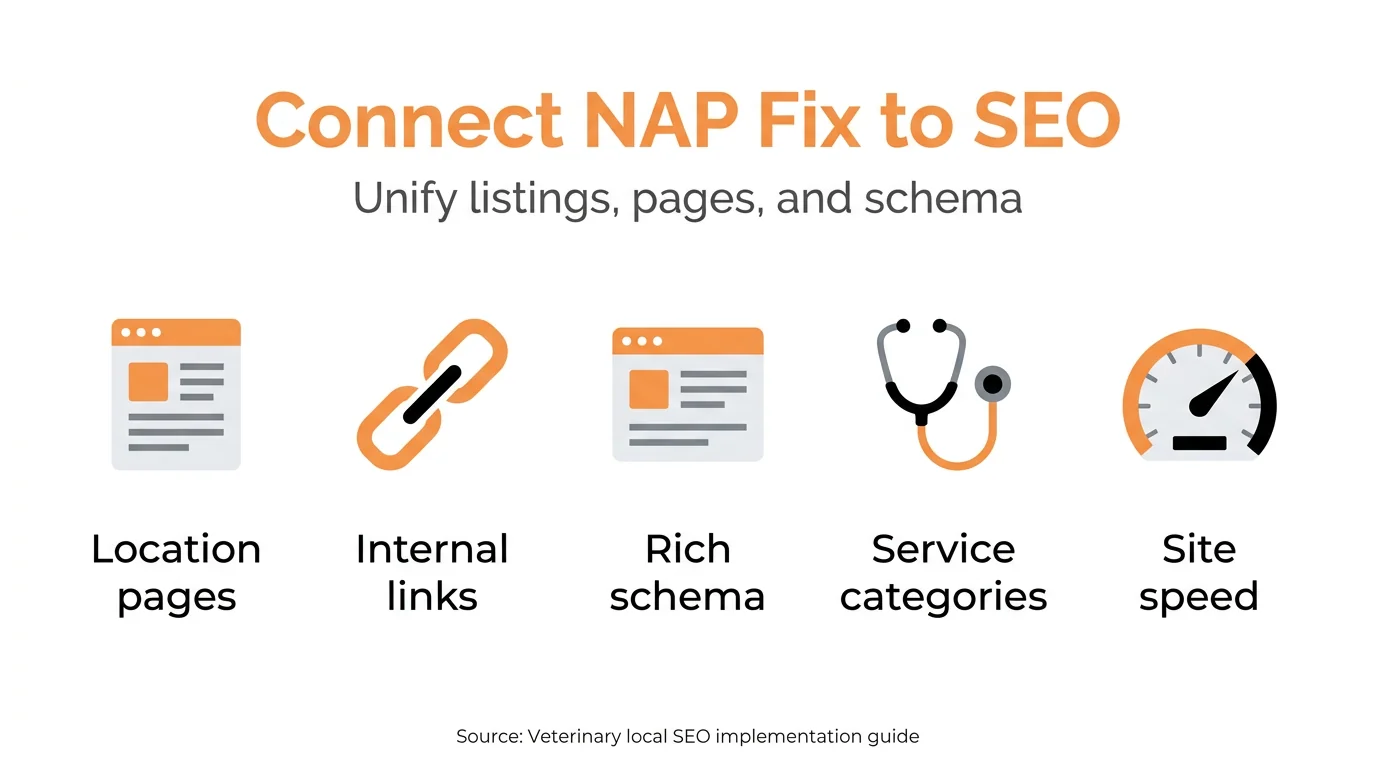
Local landing page hygiene and internal linking to location pages
Each location needs a fast, distinct page with embedded NAP, map, categories, and services. Internal links should reinforce geographic relevance and reduce ambiguity. Tie location content into broader optimization efforts.
Service-level categories and medical schema alignment
Align GBP and on-site categories with actual services. Use medical and LocalBusiness schema to clarify offerings. Structured clarity may support discovery for specific procedures and stabilize brand SERPs across markets.
Frequently Asked Questions
How long does it take for duplicate NAP fixes to affect local rankings?
Early signals may appear within one to two weeks on Google. Full effects across directories often require four to eight weeks, or longer. Aggregator update cycles and cache refresh intervals can extend timelines.
Should veterinary practices use call tracking numbers?
Use a single call tracking number as the canonical phone across major listings. Keep it consistent everywhere. Evidence suggests consistency typically outweighs dynamic swapping for NAP in reconciling business identity.
What is the best way to handle an old address listing?
Request a merge into the active listing where supported. Otherwise, mark the outdated profile as moved to the current address. Avoid “permanently closed” unless the clinic ended operations completely.
Do practitioner listings compete with the clinic’s listing?
They can compete in local results. Mark practitioner profiles as affiliated with the clinic and use different categories. This approach reduces cannibalization while preserving practitioner reputation and review signals.
Which directories matter most for vets?
Prioritize Google, Apple, Bing, Yelp, Facebook, Data Axle, Neustar/Localeze, and Foursquare. Include niche directories like VetRatingz and local chambers. Directory authority and data accuracy may influence impact and propagation speed.
Conclusion
Duplicate NAP veterinary citations undermine algorithmic confidence and frustrate clients. A structured workflow-baseline, find, prioritize, suppress, standardize, and document-can restore local pack visibility predictably. Monitor early signs within two weeks and trendlines by two months. Use disciplined SOPs, platform-specific actions, and careful timing to reduce risk. Where possible, automate repeatable tasks to protect staff focus and patient care quality. Tie every fix back to accurate on-site content and clear location pages, and your veterinary local SEO foundation will remain stable as you grow. For ongoing optimization beyond citations, expand into categories, schema, and measurement to keep improvements compounding over time.
References
- N Fejzić et al. (2023). The impact of digital presence and use of information technology on business performance of veterinary practices: a case study of Bosnia and Herzegovina. Frontiers in Veterinary …. View article
- SM Smith et al. (2022). Opportunities for expanding access to veterinary care: lessons from COVID-19. Frontiers in Veterinary …. View article
- JKH Pun (2020). An integrated review of the role of communication in veterinary clinical practice. BMC veterinary research. View article
- CL Neill et al. (2022). The economic cost of burnout in veterinary medicine. Frontiers in veterinary science. View article