Schema for Veterinary Clinics: Medical, LocalBusiness, and FAQ Markup Without Risk


Table of Contents +
- Why schema for veterinary clinics must balance visibility and compliance
- Quick decision guide: if this is your setup, use this markup
- How to structure entities: nesting Organization, LocalBusiness, Medical, and FAQ
- Practical safety boundaries for veterinary structured data
- Evidence status: where claims may be strong and where caution is wiser
- Monitoring and validation: what to check after 7-14 days and 4-8 weeks
- Common markup patterns and examples to replicate safely
- Frequently Asked Questions
- Conclusion
- References
Learn safe, compliant schema for veterinary clinics: how to nest Medical and LocalBusiness data and add FAQ markup without risky medical claims.
Accurate schema helps veterinary clinics show the right details in search without overstepping on medical claims. The stakes are higher for healthcare businesses.
This guide clarifies which schema to use on service and location pages. It also explains safe nesting and claim boundaries. Schema supports technical priorities in your broader veterinary SEO strategy hub. You will learn precise markup choices, entity relationships, and validation steps.
Why schema for veterinary clinics must balance visibility and compliance
The single scenario we solve: accurate, low-risk markup for service pages and locations
This article addresses one core need: production-grade, low-risk schema for veterinary service pages and location pages. The goal is clear communication to crawlers using Vet clinic structured data that matches on-page content. For locations, use Organization for the parent entity and VeterinaryCare as the LocalBusiness type for each branch. For services, choose between MedicalProcedure, MedicalTherapy, MedicalTest, or Service based on the page’s scope. Strong markup consistency improves machine readability and interoperability across systems, which supports reliable downstream analysis in veterinary contexts[3].
Risk patterns to avoid: implied medical outcomes and unsubstantiated claims
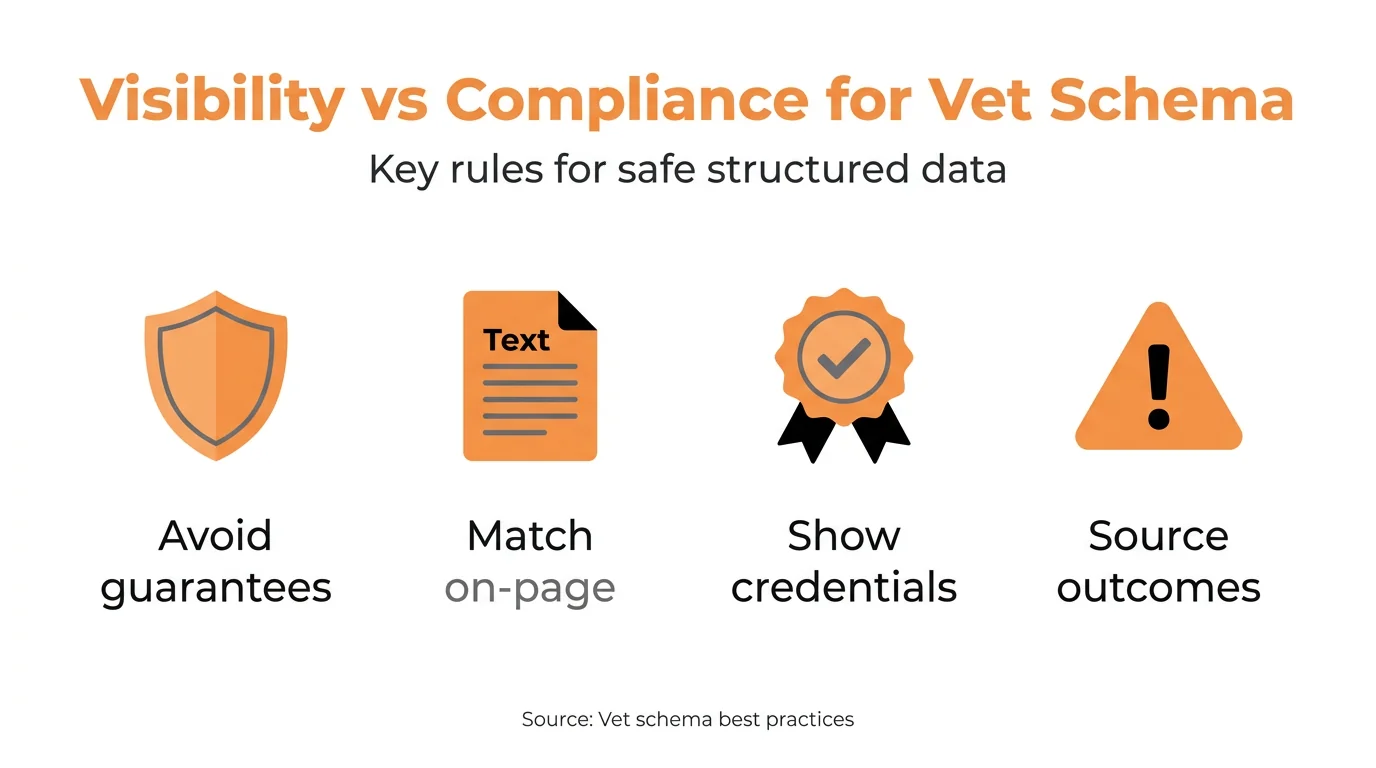
Veterinary schema markup must never imply guaranteed cures, success rates, or outcomes without robust sourcing. Avoid medical superlatives and phrases that promise results. Do not insert diseases or treatment claims into schema that the page does not substantiate. Automation may hallucinate properties or claims, so enforce content-schema parity via reviews and spot-checks[1]. Keep copy and structured data aligned to reduce misinterpretation risk.
Petbase automates SEO content for veterinary clinics - so you can focus on patients, not blog posts - start your free trial.
Quick decision guide: if this is your setup, use this markup
5-7 common clinic setups and the recommended schema actions
- Single-location general practice: Use Organization for the parent, plus LocalBusiness schema for vets via VeterinaryCare. Include NAP, geo, opening hours, and sameAs links. Add Service entries for routine care pages.
- Multi-location brand: Create one Organization entity. Model each location as VeterinaryCare with unique @id and URL. Connect with parentOrganization or branchOf. Include hasOfferCatalog to reference shared services.
- Mobile veterinary service: Use VeterinaryCare with areaServed or serviceArea (GeoShape). Provide booking methods and description. Avoid a precise street address if not staffed for public visits; include service radius.
- Specialty surgical center: On procedure pages, use MedicalProcedure with provider set to the relevant location entity. Add preparation, howPerformed, and risks where described. Include surgeon credentials on-page and as Person where appropriate.
- Diagnostic imaging page: Prefer MedicalTest for ultrasound, radiography, CT, or MRI pages. Include usesDevice where appropriate and provider pointing to the location entity.
- Rehabilitation/oncology therapies: Use MedicalTherapy when the page focuses on an ongoing treatment modality. Add contraindications and adverseOutcome only if documented on-page.
- Telehealth consults: Use Service with availableChannel and offers. Avoid MedicalCondition or implied diagnoses. Clarify geographic eligibility and hours.
For GBP and category alignment, coordinate LocalBusiness details with profile updates; see Google Business Profile for Vets: category, services, and photos for consistent taxonomy decisions.
How to structure entities: nesting Organization, LocalBusiness, Medical, and FAQ
One organization, many locations: @id, sameAs, and hasOfferCatalog
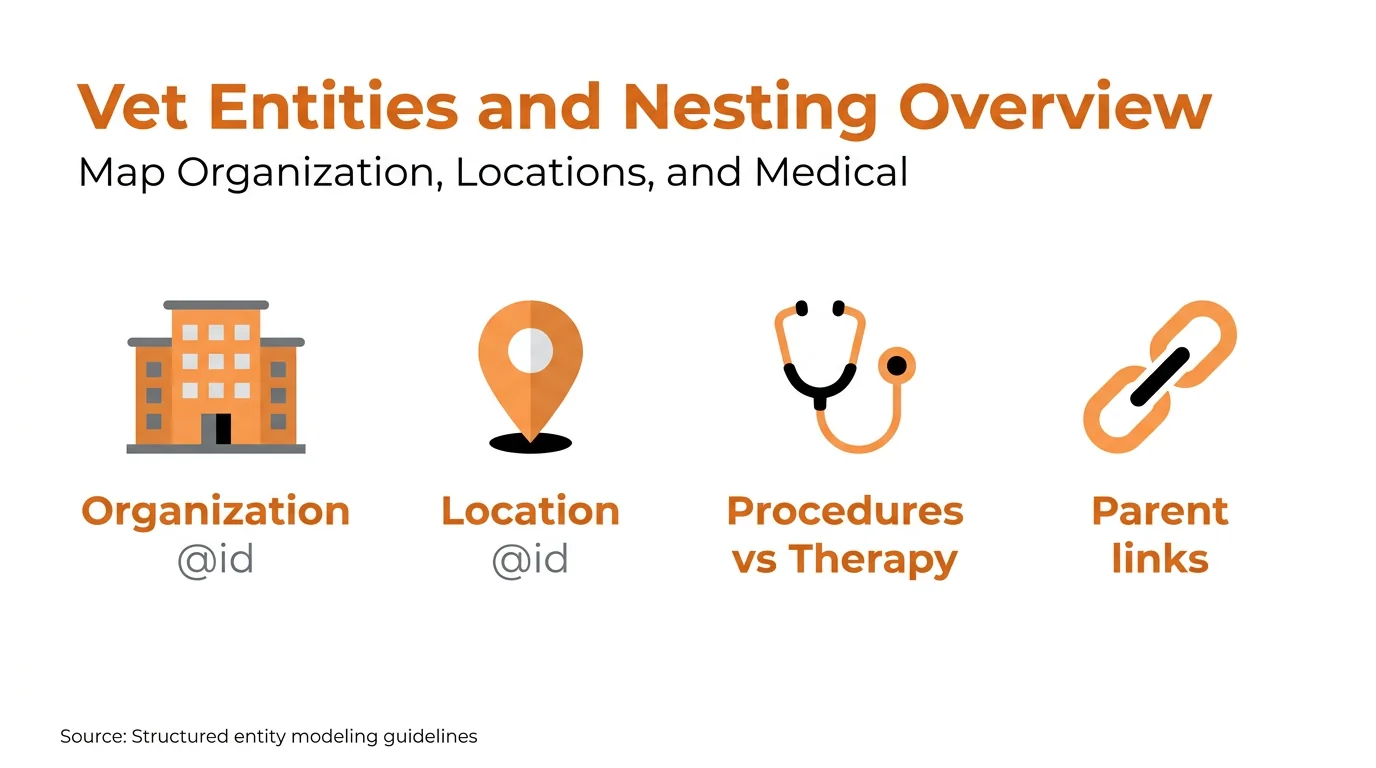
Assign an @id to the Organization on the homepage, e.g., https://example.com/#org. Each location gets a unique URL and @id, such as https://example.com/locations/sometown/#vetcare. Use branchOf or parentOrganization to connect each location to the parent. Add sameAs links for each location’s GBP, Facebook, and directories to support entity reconciliation. For scalable service modeling, attach a hasOfferCatalog at the Organization level and reference it from each location’s makesOffer list. Maintain consistent properties across markets, including multi-language content creation that mirrors labels and descriptions across locales.
Service pages: MedicalProcedure vs. MedicalTherapy vs. Service
Choose MedicalProcedure for discrete interventions such as spay/neuter, mass removal, or dental prophylaxis. Use MedicalTherapy for ongoing interventions such as chemotherapy protocols or physical rehabilitation. Use MedicalTest for diagnostics, including radiography and fecal testing. Reserve Service for general, non-medical offerings or telehealth consult logistics. Whichever you choose, set provider to the appropriate location entity and add offers only if prices or ranges appear on-page. When in doubt, default to Service to avoid overstating medical specificity.
FAQ: eligible questions and answer sourcing
FAQPage markup is suitable when the page contains a curated list of questions and answers that match user intent. Prioritize logistics, preparation, timelines, and aftercare basics over diagnostic decisions. Attribute medical statements to recognized sources where applicable and include lastReviewed by a credentialed veterinarian on-page. For editorial patterns that align with patient concerns, see Procedure FAQs that patients actually search. Use FAQ schema veterinary selectively to avoid over-fragmenting search results.
Practical safety boundaries for veterinary structured data
Claims, credentials, and review usage
Use cautious phrasing for outcomes, and avoid success percentages unless sourced and present on-page. Display clinician credentials visibly and consider Person entities for key staff. Only use Review and AggregateRating when reviews are collected on-site and explicitly about the marked entity. Do not mark up third-party testimonials or star ratings you do not host. For review governance and response strategy, consult Reviews and Reputation for Vets. Standardized, high-quality data improves downstream interpretability and reduces ambiguity[3].
Content-schema parity and YMYL caution
Ensure schema never over-claims compared to the page text. Avoid adding conditions, benefits, or devices that are not described on-page. Automated generators may produce fields that look plausible but misrepresent care details; human verification is essential[1]. In YMYL contexts, keep medical statements conservative, cite sources sparingly and accurately, and include review or lastReviewed dates to show recency. Data extraction pipelines struggle when formats diverge from expected schemas, which argues for a stable, minimal approach[2].
Evidence status: where claims may be strong and where caution is wiser
Common veterinary procedures with established guidance
Spay/neuter, core vaccinations, radiography, and routine dental cleaning follow widely accepted protocols. On these pages, you may include MedicalProcedure or MedicalTest with neutral descriptions, preparation notes, typical timelines, and known risks stated without guarantees. Use references on-page when summarizing benefits, and consider linking to guidelines rather than asserting outcomes. Consistent, structured descriptions may support clearer interpretation across record systems and analytics[3].
Areas with evolving or mixed evidence
Stem cell therapy, certain nutraceutical protocols, novel oncology treatments, and emerging diagnostics warrant measured language. Prefer “may support” and “evidence suggests” over outcome claims. Factual statements should be attributed on-page and mirrored cautiously in schema properties. Veterinary research vocabularies and registries continue evolving, which reinforces conservative phrasing and frequent content reviews[4]. When uncertainty exists, default to Service with minimal medical claims to maintain compliance.
Monitoring and validation: what to check after 7-14 days and 4-8 weeks
Early checks (7-14 days): coverage, errors, and parity
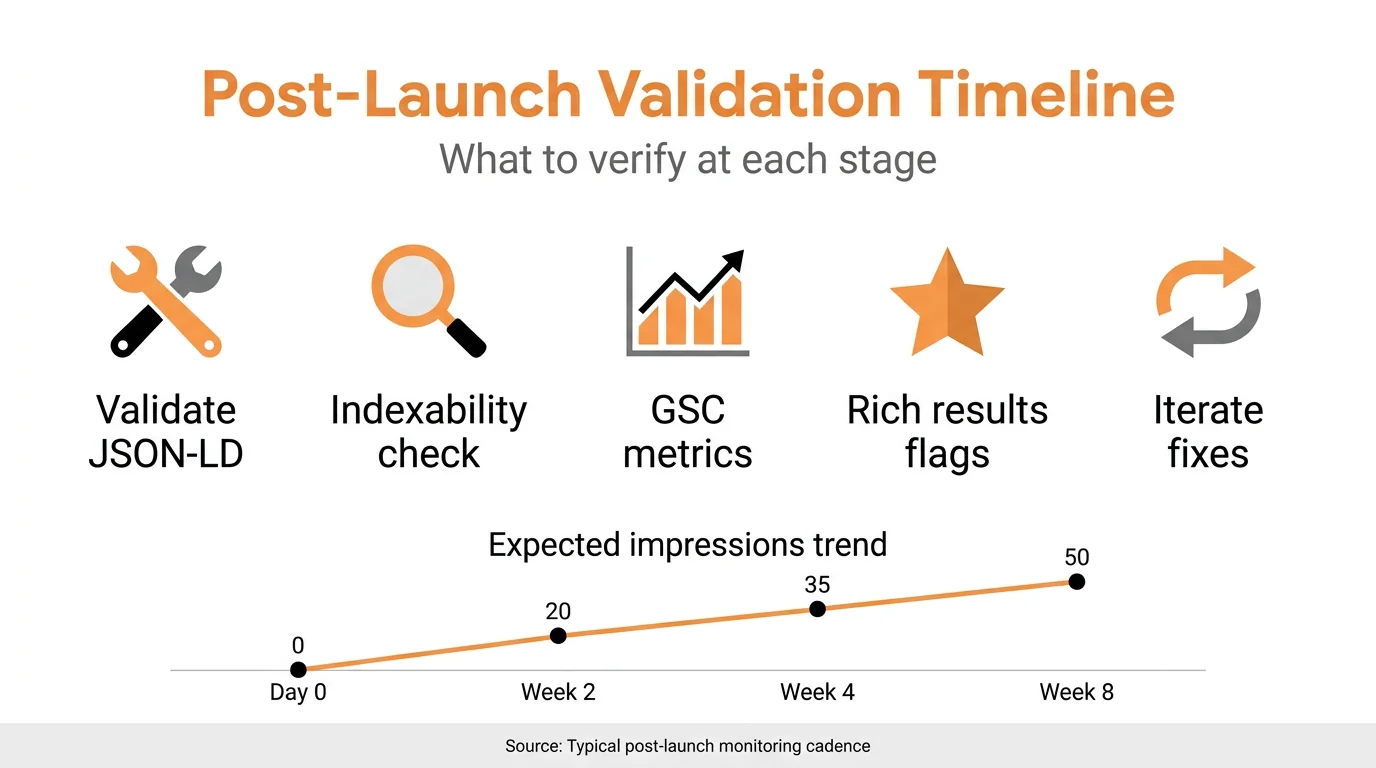
Validate JSON-LD using Schema.org Validator and Rich Results Test. Confirm each location page is indexable and returns unique @id, NAP, and geo. Check Google Search Console for structured data coverage and error-free parses. Complete a parity audit: confirm each property reflects visible content, including credentials and review dates. For topic expansion alignment, connect your monitoring to a topical authority explorer to plan safe, related procedures. Many clinics streamline multi-location updates using Petbase AI to keep content and schema synchronized at scale.
Later checks (4-8 weeks): enhancements and impression trends
Assess impressions and clicks for location pages and procedure pages. Look for eligibility flags for FAQ rich results and LocalBusiness knowledge panels. Verify GBP category alignment with LocalBusiness properties for naming consistency. If impressions grow but clicks lag, refine titles, meta descriptions, and the first paragraph for clarity. Monitor query mapping for procedure intent to see whether MedicalProcedure or Service performed better. For a wider strategy on page structures and conversion signals, see Service Pages That Rank.
Common markup patterns and examples to replicate safely
Clinic homepage/location page essentials
Use separate entities with stable @id values. Keep properties minimal, factual, and mirrored on-page. Example skeletons:
{
  "@context": "https://schema.org",
  "@type": "Organization",
  "@id": "https://example.com/#org",
  "name": "Example Veterinary Group",
  "url": "https://example.com",
  "sameAs": [
    "https://www.facebook.com/examplevetgroup"
  ]
}
{
  "@context": "https://schema.org",
  "@type": "VeterinaryCare",
  "@id": "https://example.com/locations/sometown/#vetcare",
  "name": "Example Veterinary Group - Sometown",
  "url": "https://example.com/locations/sometown/",
  "telephone": "+1-555-0100",
  "address": {
    "@type": "PostalAddress",
    "streetAddress": "123 Oak Street",
    "addressLocality": "Sometown",
    "addressRegion": "CA",
    "postalCode": "90000",
    "addressCountry": "US"
  },
  "geo": { "@type": "GeoCoordinates", "latitude": 34.0001, "longitude": -118.0001 },
  "openingHoursSpecification": [{
    "@type": "OpeningHoursSpecification",
    "dayOfWeek": ["Monday","Tuesday","Wednesday","Thursday","Friday"],
    "opens": "08:00",
    "closes": "18:00"
  }],
  "branchOf": { "@id": "https://example.com/#org" },
  "sameAs": [
    "https://g.page/r/examplegbp"
  ]
}
For broader SEO context on location authority and operations, review Veterinary SEO: The Complete Strategy Guide.
Service page essentials (procedure/therapy/diagnostic)
Choose the medical type that accurately reflects the page and include only information present on-page. Example for a spay procedure:
{
  "@context": "https://schema.org",
  "@type": "MedicalProcedure",
  "name": "Ovariohysterectomy (Spay)",
  "url": "https://example.com/services/spay/",
  "description": "A routine surgical procedure performed under general anesthesia. This page explains preparation, risks, and typical recovery timelines.",
  "howPerformed": "Performed under sterile conditions with inhalant anesthesia and monitoring.",
  "possibleComplication": "Surgical site infection; anesthetic risk; bleeding.",
  "preparation": "Pre-anesthetic exam and fasting as directed.",
  "procedureType": "Surgical",
  "provider": { "@id": "https://example.com/locations/sometown/#vetcare" },
  "offers": {
    "@type": "Offer",
    "availability": "https://schema.org/InStock",
    "priceSpecification": {
      "@type": "UnitPriceSpecification",
      "priceCurrency": "USD",
      "price": "Range available on request"
    }
  }
}
For non-procedural consults or logistics-only pages, use Service with provider and offers. Keep claims conservative and aligned with on-page text. This approach reflects best practices for veterinary schema markup without overstating medical certainty.
Frequently Asked Questions
Should a veterinary clinic use both Organization and LocalBusiness schema?
Yes. Mark the parent clinic as an Organization and each physical location as a LocalBusiness (e.g., VeterinaryCare). Link them with parentOrganization and branchOf to clarify relationships.
Can vets use MedicalProcedure or MedicalTherapy on service pages?
Yes, if the page content actually describes the procedure or therapy. Keep claims cautious, cite sources, and avoid outcome guarantees or cure language.
Is FAQ schema safe for vet sites?
It can be, when questions match on-page content and answers avoid strong medical promises. Prefer general care information and clinic logistics over diagnoses.
How do I prevent misleading medical claims in schema?
Mirror page text, attribute statements to recognized sources, avoid superlatives, and include veterinarian credentials and review dates where relevant.
What should multi-location clinics do with NAP and @id?
Give each location a unique URL, @id, and consistent NAP. Reference the parent Organization with branchOf and include sameAs links to location-specific profiles.
Conclusion
Safe, effective schema for veterinary clinics relies on accurate entity modeling, conservative medical language, and strict content-schema parity. Use Organization and VeterinaryCare for brand and locations, then apply MedicalProcedure, MedicalTherapy, MedicalTest, or Service to match page intent. Validate systematically and iterate on conservative enhancements that protect compliance and trust.
References
- MH Dang et al. (2025). LLM4Schema. org: Generating Schema. org Markups with Large Language Models. … Web. View article
- M Jaberi-Douraki et al. (2021). Large-scale data mining of rapid residue detection assay data from html and pdf documents: improving data access and visualization for veterinarians. Frontiers in veterinary …. View article
- M Kwong et al. (2019). Optimization of electronic medical records for data mining using a common data model. Topics in companion animal …. View article
- C Palmieri et al. (2026). Development and implementation of a data parsing protocol for companion animal cancer data. Veterinary …. View article