Procedure FAQs That Patients Actually Search for Veterinary SEO


Table of Contents +
- Focus: Turn real patient queries into compliant procedure FAQ pages
- Build the FAQ template: From anesthesia risks to recovery timelines
- Quick decision guide: If X query appears, then apply Y content pattern
- Monitoring guidance: What to watch at 7-14 days and 4-8 weeks
- Practical safety boundaries for veterinary FAQ content
- Evidence status: Where consensus is strong and where it varies
- On-page SEO and schema setup for procedure FAQs
- Examples: Template snippets for common procedures
- Frequently Asked Questions
- Connect to your broader veterinary SEO plan
- References
Turn real patient queries into compliant vet procedure FAQs. Map anesthesia risks to recovery timelines with SEO templates that reduce front-desk load.
Procedure FAQs should reduce phone anxiety and increase booked appointments. They should also rank for the everyday questions clients actually type.
This matters because clear answers build trust and free your team for clinical care. You will learn a repeatable vet FAQ template, compliant language patterns, and monitoring steps that capture real search demand.
Focus: Turn real patient queries into compliant procedure FAQ pages
Define one procedure per page and goal of the FAQ
Choose a single procedure per page. Keep the intent narrow. Aim to reassure, set expectations, and route to care. Align each answer to one step in the patient journey. That includes risk awareness, day-of logistics, recovery expectations, and when to call. Evidence suggests clients value structured information and shared decision support in clinical contexts, so concise clarity here may improve satisfaction and reduce callbacks.[1]
Source real-world queries: call logs, EMR notes, GSC, forums
Mine receptionist call sheets, intake forms, and EMR free-text for phrases. Pull Google Search Console queries and filter by procedure terms and question words. Scan reputable forums and social posts for wording clients actually use. Studies indicate owners actively seek online health information, so mapping that language into your veterinary procedure FAQs can meet them where they search.[2]
Petbase builds this SEO foundation automatically for pet businesses - 10 optimized articles published every month - start your free trial.
Build the FAQ template: From anesthesia risks to recovery timelines
Standard question blocks vets can safely answer
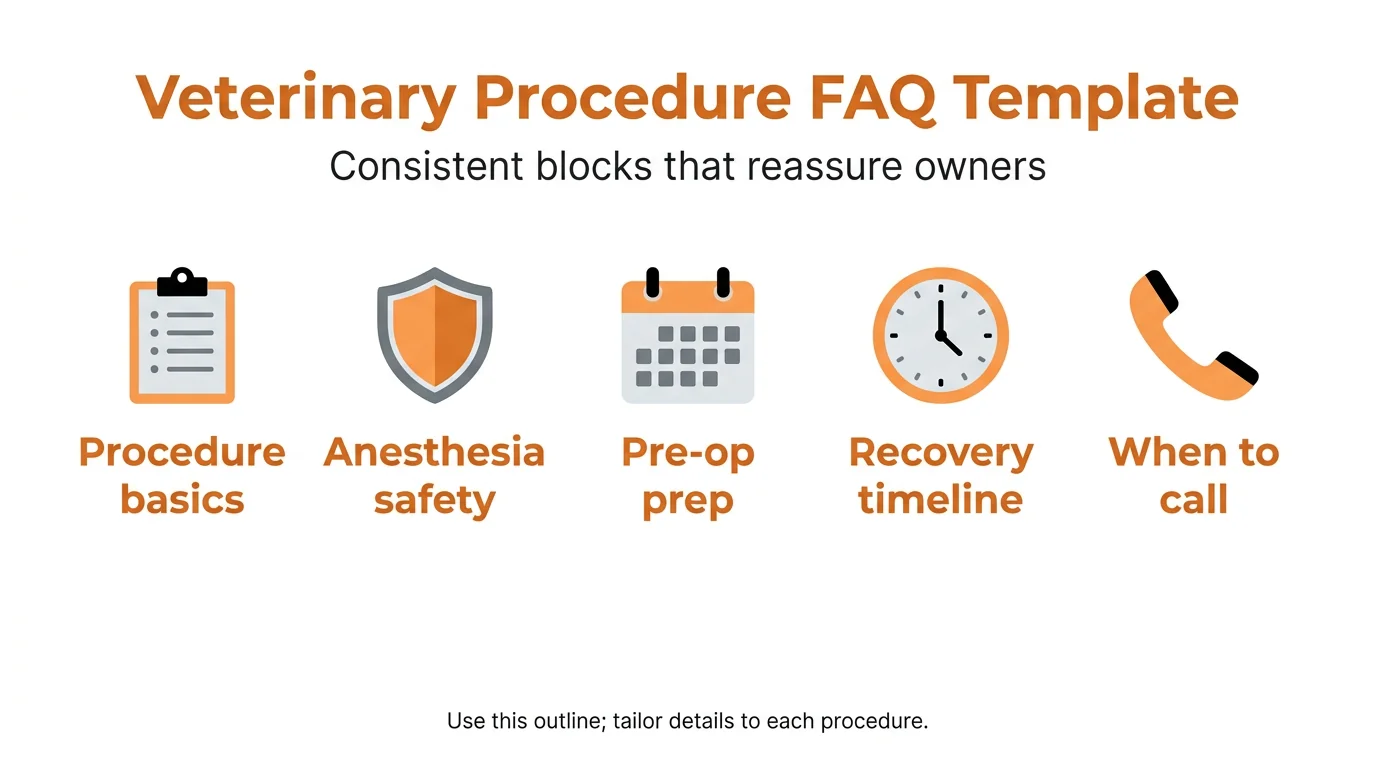
Use a consistent vet FAQ template. Recommended blocks include: what the procedure involves, anesthesia risks for pets and monitoring steps, pre-op fasting guidance, day-of drop-off and discharge expectations, pet surgery recovery timeline ranges, pain control and feeding, activity restrictions, complications to watch for, and when to call. This standardized structure may reduce front-desk load while improving message consistency.
Cautious language and scope limits to avoid medical claims
Prefer phrasing like “may vary by age, breed, and medical history.” Avoid absolutes. Distinguish between general education and case-specific advice. Remind readers that final recommendations come from their clinician who knows the record. Research on veterinarian-client communication underscores the need to align information with owner expectations while keeping decisions clinician-led.[3]
Quick decision guide: If X query appears, then apply Y content pattern
5-7 common situations and how to structure answers
- If the query is “Is anesthesia safe for [breed/age]?”, lead with risk factors plus monitoring safeguards. Provide typical screening steps and note individualized protocols. Add gentle reassurance grounded in process.
- If the query is “How long is recovery?”, present a pet surgery recovery timeline by phase. Offer day-by-day or 24-72 hours, 7-14 days, and 4-8 weeks ranges. Clarify activity restrictions and recheck timing.
- If the query is “When can they eat?”, give a simple reintroduction plan. Specify water timing, soft food windows, and exceptions for extractions or GI sensitivities. Emphasize following clinic-specific discharge notes.
- If the query is “Will it hurt?”, outline multimodal pain control. Describe expected behavior changes versus red flags. Provide what to do if medications seem insufficient and reinforce after-hours contact options.
- If the query is “How much does it cost?”, summarize fee ranges and factors. Suggest pre-op exam confirms estimate. Offer financing or package notes. Avoid quoting without examination.
- If the query is “When should we worry?”, provide a bulleted symptom list. Include swelling, discharge, lethargy, appetite loss, vomiting, diarrhea, or breathing issues. Urgent items should be clearly labeled.
- If the query is “Can we do it sooner/later?”, address scheduling safety windows and vaccines or lab timing. Note when delays may be prudent and when sooner action may reduce risk or pain.
Monitoring guidance: What to watch at 7-14 days and 4-8 weeks
Query capture, CTR, dwell signals
At days 7-14, confirm impressions and clicks gained for target long-tail queries. Review search terms mapped to each question. Compare click-through rate to baseline and refine titles and meta descriptions. At 4-8 weeks, examine dwell time and return visits to see if your veterinary SEO FAQs answer intent quickly. Use cohorts of landing pages to benchmark performance. For deeper attribution and reporting, see the workflows discussed in measuring veterinary SEO and outcomes, including using Google Search Console reports.
Edits from clinical team and patient feedback loops
Schedule clinician review at two weeks for accuracy and tone. Embed a one-click “Was this helpful?” widget. Aggregate questions from post-op calls to add or rephrase content. Evidence suggests owners often seek online validation after visits, so routing those behaviors into vetted pages may reduce misinterpretation and callbacks.[2][4]
Practical safety boundaries for veterinary FAQ content
What to include, defer, or generalize
Include process steps, typical monitoring, comfort strategies, and timing ranges. Defer dosing, case-specific contraindications, and emergency triage beyond “call now.” Generalize cost ranges and vaccine prerequisites. This approach respects clinical nuance while answering common questions efficiently and safely.
When to add disclaimers and local care directions
Add a brief educational disclaimer on every page. Include after-hours instructions and geographic care notes if you serve multiple locations. Evidence from veterinarian-client studies indicates clarity about decision roles helps align expectations and supports better outcomes.[1]
Evidence status: Where consensus is strong and where it varies
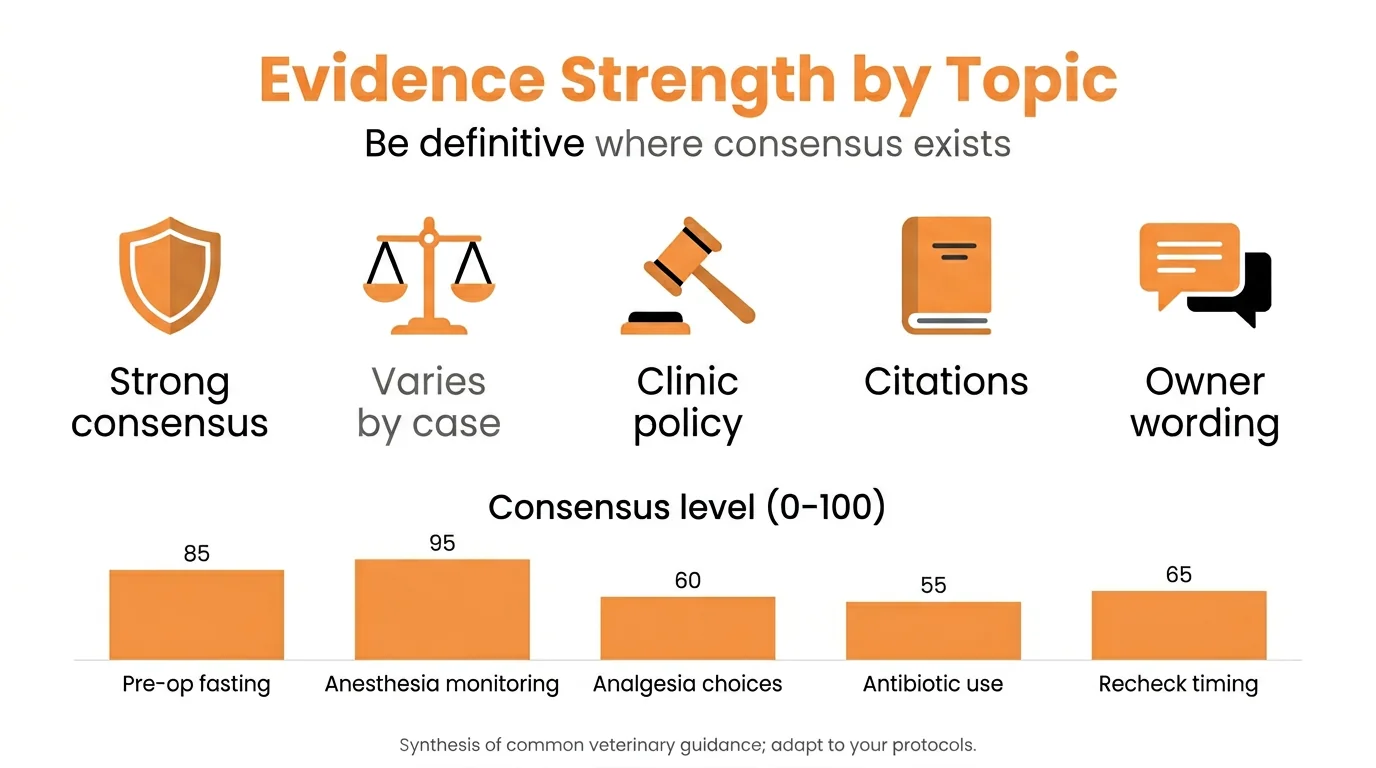
Pre-op fasting, anesthesia monitoring, typical recovery windows
Consensus is relatively strong on pre-op fasting with exceptions for young or special-risk patients, continuous monitoring during anesthesia, and broad recovery windows by procedure type. Owner communication research highlights the value of transparent expectations to aid decision-making and reduce uncertainty around anesthesia risks for pets and recovery timelines.[3]
Areas with clinic-specific protocols
Variability often includes fasting cutoffs by age or comorbidities, analgesia choices, antibiotic stewardship, and recheck timing. These differences reflect clinician judgment and hospital resources. Research on clinic interactions suggests aligning information with each practice’s workflow improves client satisfaction and adherence to instructions.[1]
On-page SEO and schema setup for procedure FAQs
Entity alignment, internal links, and FAQPage markup
Use precise entities for conditions, procedures, and medications. Mirror client wording in H2/H3 questions while mapping to clinical terminology in body text. Add FAQPage and appropriate LocalBusiness schema cautiously. Maintain internal anchor text that reflects intent. Petbase automates FAQ extraction, schema insertion, and internal linking at scale, reducing manual workload while preserving review controls: Petbase AI features.
Measuring impact and iterating
Set a baseline for impressions, queries, CTR, and calls. After publishing, annotate dates and compare 4-8 week windows. Merge call disposition tags with page-level traffic to track fewer “quick question” calls and more booked exams. Iterate question phrasing to close intent gaps.
Examples: Template snippets for common procedures
Spay/neuter anesthesia and recovery
Is anesthesia safe? Modern monitoring and pre-op screening reduce risk for healthy patients. Risk may vary by age and comorbidities. Your veterinarian tailors protocols accordingly. Recovery timeline: Rest 24-72 hours, leash walks only 10-14 days, then gradual return to normal. For structure beyond this snippet, review our service page framework for procedure pages.
Dental cleaning pain control and feeding timelines
Pain control: Multimodal analgesia and local blocks may be used. Mild grogginess is common the first day. Contact your clinic for persistent pain signs. Feeding: Offer small water first, then soft food for 24-48 hours, longer with extractions. See real-world messaging refinements in our patient story and reviews playbook.
Frequently Asked Questions
What anesthesia risks should pet owners be aware of?
Most healthy pets tolerate modern anesthesia well with pre-op screening and monitoring. Risks may increase with age, specific conditions, or certain breeds; your vet tailors protocols to reduce these risks.
How long is the typical recovery after spay/neuter?
Many pets are comfortable within 24-72 hours with restricted activity for 10-14 days. Healing timelines can vary by age, size, and whether sutures are internal or external.
When can my pet eat and drink after dental cleaning?
Small amounts of water are usually allowed the day of discharge, with soft food often recommended for 24-48 hours. Your clinic’s instructions should guide timing based on medications and any extractions.
How do I know if post-op pain is controlled?
Mild restlessness or reduced activity can be expected, but persistent whining, panting at rest, or refusal to eat may indicate discomfort. Contact your clinic if signs do not ease with prescribed medications.
When should I call the vet during recovery?
Call if you see swelling, discharge, fever, odor at the incision, vomiting, diarrhea, or lethargy beyond the first day. Sudden worsening or breathing issues should be treated as urgent.
Connect to your broader veterinary SEO plan
Tie procedure FAQs into topical authority clusters
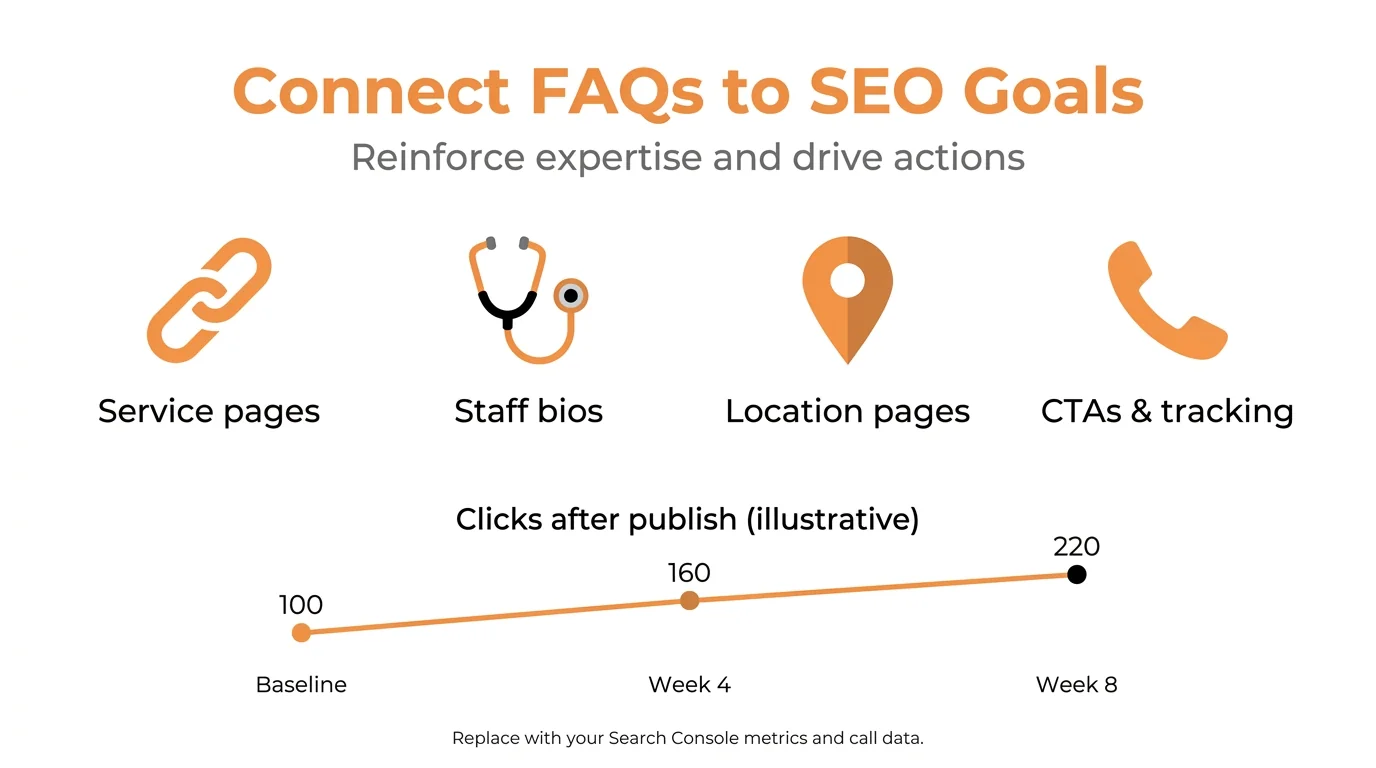
Map each procedure FAQ to its related service page, staff bios, and location pages to reinforce expertise and proximity. Align calls-to-action with scheduling capacity. As you scale, unify schema, NAP, and internal linking patterns to protect consistency. For a complete plan across content, reputation, and measurement, see our veterinary SEO master guide. Build trust with clear, cautious answers, then let your analytics confirm fewer repetitive calls and more confident bookings.
References
- N Janke et al. (2021). Pet owners' and veterinarians' perceptions of information exchange and clinical decision-making in companion animal practice. PLoS One. View article
- N Solhjoo et al. (2018). Interventions to assist pet owners in online health information seeking behaviour: a qualitative content analysis literature review and proposed model. Health Information & …. View article
- N Janke (2021). An exploration of information exchange and decision-making within veterinarian-client-patient interactions during companion animal visits. 2021 - atrium.lib.uoguelph.ca. View article
- L Haase et al. (2025). Horse owners seeking online health information: a mixed-methods study. Frontiers in veterinary …. View article