Measuring Veterinary SEO: Track Calls, Bookings, and Assisted Revenue Without Guesswork

Table of Contents +
- The scenario: One clinic, multiple booking paths, and unclear revenue
- Step-by-step setup: Calls, forms, bookings, and GBP actions without guesswork
- Quick decision guide: If this, then do that
- Monitoring guidance: What to check after 7-14 days and 4-8 weeks
- Practical safety boundaries for compliant, reliable data
- Evidence status: What the data and platforms suggest
- KPI framework and roll-up dashboard for veterinary SEO
- Frequently Asked Questions
- Conclusion
- References
Set up accurate tracking for vet calls, forms, bookings, and assisted revenue. Learn attribution for third-party tools and Google Business Profile actions.
Your clinic’s phones ring, forms submit, and bookings happen across tools. Yet the revenue picture stays fuzzy. You deserve clearer answers without rebuilding your tech stack.
This guide narrows your focus to what matters. It explains an analytics setup for tracking phone calls, forms, appointment requests, and Google Business Profile actions. You will learn practical attribution tactics for third-party schedulers, and how to link sessions to revenue directionally.
The scenario: One clinic, multiple booking paths, and unclear revenue
What causes data gaps in veterinary SEO measurement
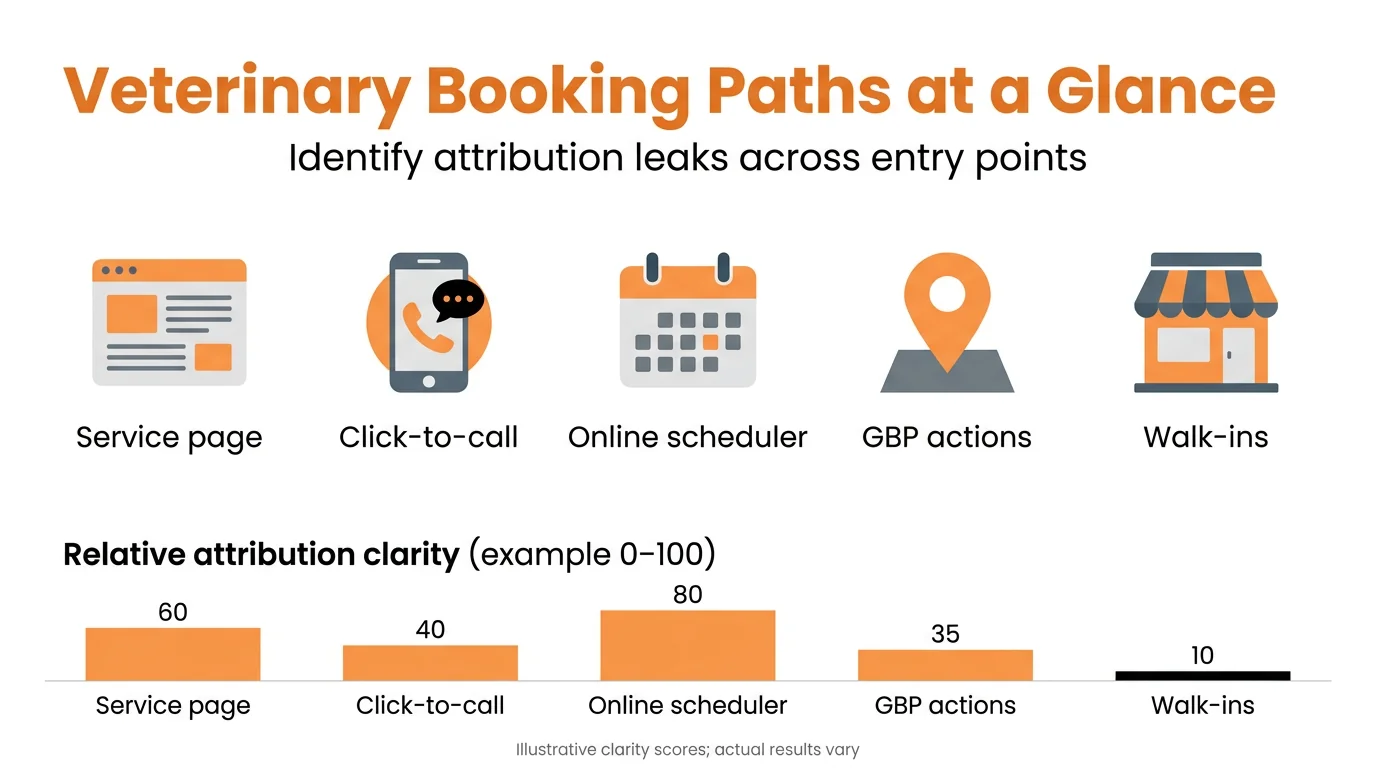
Veterinary websites rarely convert through a single path. A prospective client may view a service page, click to call, leave, then book via a scheduler days later. Third-party booking tools often run on separate domains, so cookies and session data break by default. Phone calls convert offline, which means standard analytics do not capture outcomes or sources without additional plumbing.
In addition, Google Business Profile (GBP) can drive phone calls and website visits that appear as “Direct” without UTM discipline. Multiple numbers across locations, postcards, and legacy citations further fragment attribution. Evidence from real-world veterinary data initiatives suggests structured, interoperable data flows may substantially improve decision support, but they require deliberate design and governance to work effectively at clinic level[3].
What “good enough” accuracy looks like for clinics
Perfection is impractical when phones and walk-ins dominate. Aim for directional accuracy with consistent rules. Most clinics find a reliable baseline includes: dynamic call tracking for vets, tagged form and booking submissions, GBP UTM hygiene, and a simple revenue linkage model. Accept that a portion of conversions will remain unattributed. The objective is repeatable measurement that improves decisions.
In practice, “good enough” means 80-90% of measurable conversions carry a valid source/medium, with fewer than 10% duplicated events. Appointment booking attribution should reduce “Direct” inflation and clarify organic search impact to a reasonable degree.
Petbase automates SEO content for veterinary clinics - so you can focus on patients, not blog posts - start your free trial.
Step-by-step setup: Calls, forms, bookings, and GBP actions without guesswork
Phone calls: dynamic number insertion and GA4 events
Implement dynamic number insertion (DNI) on key landing pages to power veterinary SEO tracking for calls. Use a pool sized to peak concurrent sessions; most single-location clinics work with 4-8 numbers. Fire GA4 events for click-to-call and for connected calls captured by your call tracking tool. Map call outcomes-new client, appointment booked, voicemail-to GA4 via Measurement Protocol or a connector. Record call duration buckets as event parameters to approximate quality. This may support lead scoring and reduce over-counting.
Configure spam filtering rules and test routing for after-hours. Maintain a permanent, static main number in the site footer to protect NAP consistency across citations. This balance supports both attribution and local search stability.
Forms and appointment requests: tag, validate, deduplicate
Fire GA4 events on server-side or thank-you page loads for contact forms and appointment requests. Prefer server-side tagging or a data layer push to avoid ad-block interference. Include parameters: form_type, service, and location. Build deduplication using a hidden UUID per submission or a 30-minute suppression rule by IP and email hash. Validate events by reconciling GA4 counts against CRM or inbox receipts weekly.
When a form is an “appointment request,” set a secondary event for “request_received” and promote to “booking_confirmed” when your staff schedules the visit. This two-stage logic prevents inflated conversion rates and aligns with real operational outcomes.
Google Business Profile: UTM hygiene and action mapping
Add UTM parameters to the GBP website link and appointment link. Use source=google, medium=organic, campaign=gbp, and content variations for website, appointments, and menu. Map GBP Insights to analytics: calls, direction requests, and website visits. For structured local SEO practices, align categories and services with your site’s architecture and on-page schema; see guidance in our comprehensive strategy guide for clinics and mobile vets and the focused playbook on Google Business Profile for Vets.
Mirror key actions in GA4 by tagging clicks on the GBP appointment and call buttons that lead to your site. Evidence indicates that disciplined UTM usage may reduce channel confusion and improve organic attribution visibility[4].
Third-party booking tools: cross-domain, UTMs, and webhooks
Enable cross-domain measurement if your scheduler supports it. Configure cookie forwarding and include the booking domain in GA4’s allowed referral list. When cross-domain is not possible, rely on strict UTM consistency in links from your site and GBP. Append gclid/cid when feasible.
Use webhooks or middleware like Zapier to push confirmed bookings back to GA4 and your CRM. Include the GA4 client_id, booking_id, service_type, and appointment_date. This closes the loop for appointment booking attribution and limits “Direct” inflation from return visits to the scheduler.
Assisted revenue: tying invoices or POS to sessions
Pure eCommerce tracking rarely applies in clinics. Instead, calculate assisted revenue analytics by linking booked appointments or invoices to sessions. Export daily PMS/POS data with appointment_type, invoice_total, and a client or session identifier. Join against GA4 user_pseudo_id or a custom cid captured at form or booking time.
Where exact linkage is not possible, apply modelled values per appointment type and multiply by confirmed bookings. Centralized practice data studies show that harmonized, routinely collected records enable meaningful analytics at scale, even when individual-level precision varies[2]. Keep your model simple and transparent so stakeholders trust trends over time.
Quick decision guide: If this, then do that
5-7 decision rules to resolve common clinic tracking conflicts
- If many “Direct” bookings appear after SEO visits, enforce UTM parameters on all scheduler links and enable cross-domain measurement where supported.
- If call volume spikes but booked appointments do not, import call disposition and exclude missed or under-15-second calls from primary conversion counts.
- If forms double-count, implement a submission UUID and suppress duplicate events within 30 minutes for the same email hash.
- If GBP traffic looks inflated, separate website_link and appointment_link with distinct utm_content values, and verify action counts against GBP Insights.
- If scheduler blocks client_id capture, place a short hashed identifier in the booking URL and pass it via webhook to GA4 and CRM.
- If revenue looks volatile, switch to weekly cohort reporting by first touch and last non-direct touch to smooth appointment timing lag.
Monitoring guidance: What to check after 7-14 days and 4-8 weeks
Early checks (7-14 days): event integrity and attribution sanity
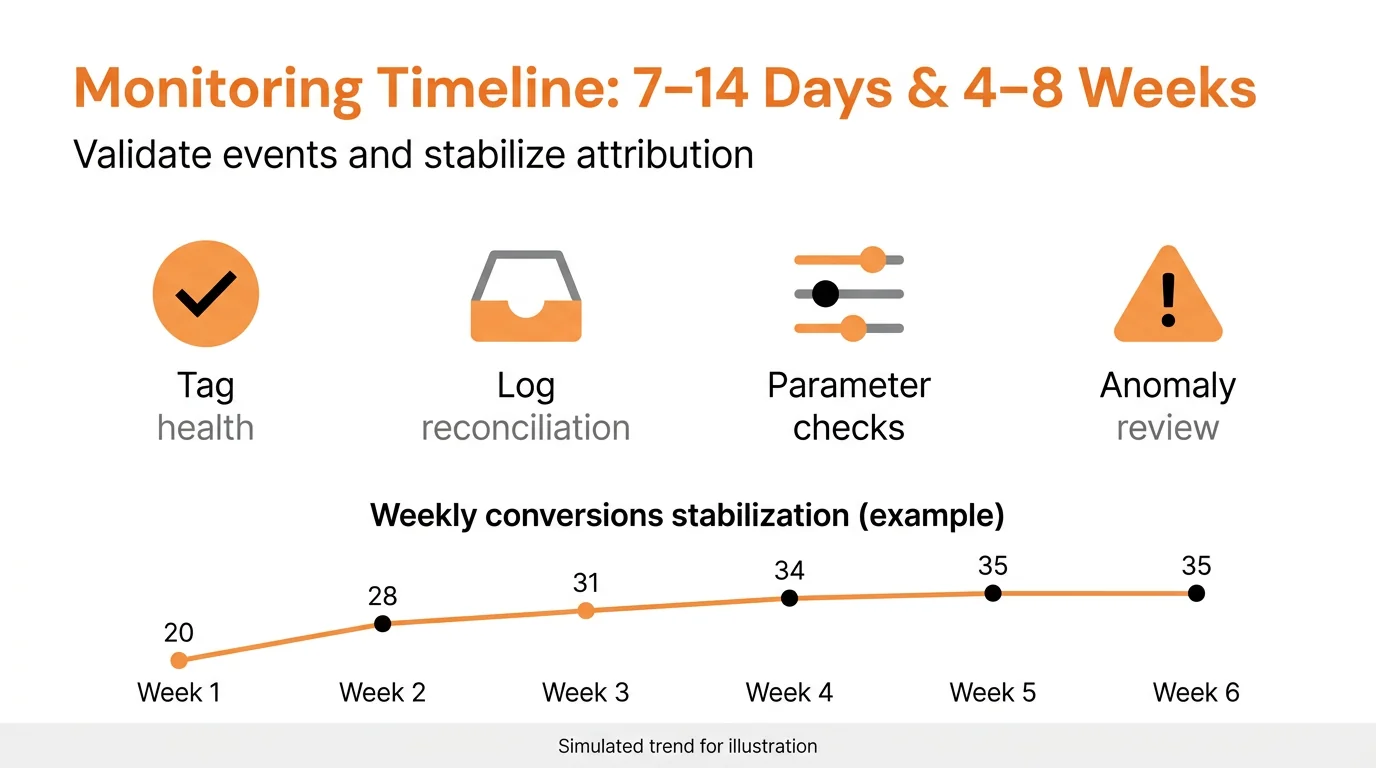
Confirm every key event fires once, with parameters populated. Reconcile GA4 counts with call system logs, form inbox totals, and booking confirmations; aim for variance under 10%. Review source/medium for calls, forms, and bookings. Organic and GBP should appear distinctly when UTM hygiene is correct. Validate that scheduler visits are not misclassified as referrals. Ensure no PII is present in URLs or event parameters.
Real-world veterinary data efforts underscore the importance of short feedback loops to validate data quality before scaling analysis[3]. Apply this principle to your first two weeks.
Stability checks (4-8 weeks): conversion lag and seasonality
Assess time-to-book from first visit. Many clinics observe a 3-14-day lag for non-urgent services. Compare conversion rates by landing page and service type. Examine call duration and appointment show rates as quality signals. Watch for seasonal swings tied to procedures and local events. Reconcile assisted conversions across models: last non-direct, position-based, and data-driven if available. Deviations between models over 20% may indicate persistent tracking gaps that warrant investigation.
Practical safety boundaries for compliant, reliable data
PHI/PII minimization and consent
Do not send names, emails, phone numbers, or medical details to GA4. Hash unavoidable identifiers client-side before transmission. Avoid putting PII in URLs, especially query strings from schedulers. Display a clear consent banner covering analytics and call recording where applicable. Restrict retention periods and apply IP anonymization. Review form fields and tag configurations quarterly for privacy drift. For additional implementation guidance, see secure handling patterns in site speed and privacy best practices for clinics.
Attribution caveats when phones and walk-ins dominate
SEO’s contribution will be understated when many conversions arrive by untracked calls or walk-ins. Weight organic influence qualitatively for branded searches and map listings. Use call tracking filters to exclude returning clients if you only want net-new demand. Keep leadership aligned on the limits of deterministic attribution. Evidence from practice analytics suggests that blended, pragmatic models often guide decisions better than overly complex systems in small clinical settings[1].
Evidence status: What the data and platforms suggest
Where evidence is strong, mixed, or emerging
Strong: UTM discipline on GBP and scheduler links improves attribution clarity. Consistent tagging and deduplication reduce noise and stabilize conversion reporting. These practices align with broader digital engagement research showing measurable gains from structured analytics approaches[4].
Mixed: Connecting offline calls and POS revenue to web sessions varies by stack. Data availability and clinic workflow can limit match rates. However, operational analytics in veterinary contexts indicate meaningful performance insights are achievable with modest data quality, if models are transparent[1].
Emerging: Real-world evidence frameworks for veterinary practices may enable standardized, privacy-conscious analytics that tie outcomes to digital journeys more reliably over time[3]. Clinics should adopt flexible schemas and interoperable identifiers now to future-proof their measurement.
KPI framework and roll-up dashboard for veterinary SEO
Core KPIs and benchmarks clinics can use today
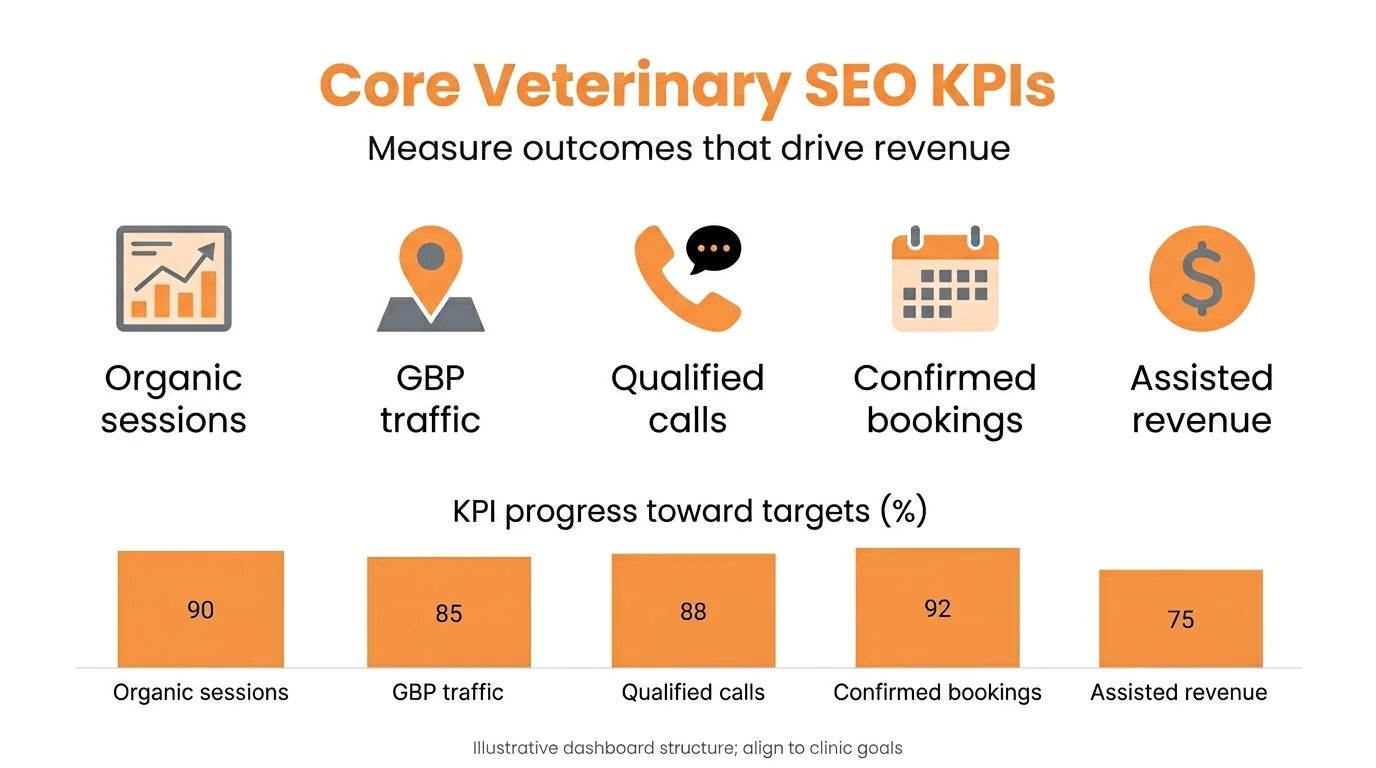
Track sessions by channel with separate lines for Organic Search and GBP. Monitor phone calls by source, with connected calls over 30 seconds as a quality proxy. Measure form submissions and confirmed bookings by service. Report show rate, cancellation rate, and average revenue by appointment type. Add a directional assisted revenue figure using confirmed bookings multiplied by modelled values. Include GBP insights for clinics-calls, direction requests, and website visits-alongside site metrics. For structured content signals that influence conversions, review markup health as outlined in schema implementation guidance for clinics.
Content performance should roll up by service cluster and landing page. This lets teams prioritize updates that lift conversion quality, not just traffic volume.
How this links to veterinary SEO fundamentals
Measurement is a multiplier when foundations exist. Solid technical SEO, accurate NAP, and clear service pages set conversion opportunities in motion. For an overview of those fundamentals, see the complete strategy guide for clinics and mobile vets. After those foundations, your roll-up dashboard translates progress into bookings and calls. For broader context on veterinary SEO fundamentals, treat measurement as the bridge between visibility and patient care. Content planning tools such as Petbase AI may support consistent publishing cadence, which your tracking framework can evaluate with clarity.
Frequently Asked Questions
How can a veterinary clinic track phone call conversions from organic search?
Use dynamic number insertion on landing pages, tag click-to-call and DNI calls as GA4 events, and connect call outcome data from your call tracking tool. Evidence suggests matching call duration or disposition may support lead quality signals.
What is the best way to attribute bookings made in a third-party scheduler?
Append consistent UTM parameters, enable cross-domain measurement when possible, and use webhooks or Zapier to send booking confirmations back to GA4/CRM with a client ID. This may reduce unattributed or direct traffic inflation.
Can Google Business Profile actions be included in SEO reporting?
Yes. Add UTM parameters to your website link and appointment link, and export GBP Insights for calls, direction requests, and website visits. Evidence indicates UTM hygiene may improve channel attribution in GA4.
How do clinics estimate assisted revenue from SEO without eCommerce?
Link booked appointments or invoices in the PMS/POS to sessions via client or session IDs and use modelled values for appointment types. While estimates vary, this approach may support directional revenue impact analysis.
What should be monitored after implementing new tracking?
Within 7-14 days, validate event firing, deduplication, and source/medium accuracy. After 4-8 weeks, compare conversion rates, call quality, and booking show rates to identify drift or attribution bias.
Conclusion
Veterinary SEO measurement does not require guesswork. A practical, privacy-aware stack can connect organic visits to calls, bookings, and directional revenue. Prioritize DNI, disciplined UTMs, scheduler feedback loops, and a transparent revenue model. Validate early, monitor stability, and communicate caveats when phones and walk-ins dominate. With these steps, clinics gain dependable visibility into what drives appointments-and where to optimize next.
References
- MP Buot et al. (2019). Data analytics for veterinary clinic using predictive analysis technique and segmentation algorithm. Proceedings of the 2nd …. View article
- BA Hur et al. (2020). Describing the antimicrobial usage patterns of companion animal veterinary practices; free text analysis of more than 4.4 million consultation records. Plos one. View article
- AK WRIGHT et al. (2026). Utilizing Real World Data and Real World Evidence in Veterinary Medicine: Current Practices and Future Potentials. Frontiers in Veterinary Science - frontiersin.org. View article
- I Agrawal et al. (2026). approach, Preventive Veterinary Medicine,(2025). researchgate.net. View article