Pet eCommerce SEO: A Practical Roadmap for Brands, Retailers, and Services


Table of Contents +
- Start here: how pet eCommerce SEO differs and what to do first
- Technical foundations for pet stores and catalogs
- Information architecture for breeds, sizes, and life stages
- Programmatic SEO without cannibalization
- Content that moves shoppers from questions to product pages
- Structured data, reviews, and regional growth
- Measurement, pitfalls, and how we built this roadmap
- Frequently Asked Questions
- References
Learn what makes pet eCommerce SEO unique and how to sequence priorities using Petbase. See common pitfalls and next steps for growth.
Search in the pet industry behaves differently. Shoppers refine queries by breed, size, age, and conditions. Algorithms reward sites that reflect these modifiers clearly and consistently.
This matters because the right structure turns intent into sales, not just traffic. In this guide, you will learn what to prioritize, what to avoid early, and how to route work into focused wins across pet SEO.
Start here: how pet eCommerce SEO differs and what to do first
Understand: breed, life-stage, and condition modifiers drive search
Pet queries are layered by modifiers. Users rarely search for a generic “food.” They search for solutions tied to life stage, size, sensitivities, or goals. Strong pet retailer SEO reflects these modifiers in categories and content.
Pet brand SEO should map product benefits to these modifiers with clear naming, on-page context, and predictable internal linking. This approach aligns with how engines infer relevance and how shoppers compare options.
Do not implement yet: large-scale templates or faceted pages
Avoid opening hundreds of faceted combinations before you validate intent and differentiation. Indexable filters without unique value create cannibalization, crawl waste, and thin pages that undercut authority.
Route: Run a zero-to-90-day pet SEO action plan
Focus first on high-intent modifiers present in demand. Validate with search volume, product coverage, and margin impact. Align structure, internal links, and product availability before scaling any programmatic pattern.
- Map the top modifier patterns (breed, size, life stage, conditions) to categories and core pages.
- Consolidate duplicate and thin product variants before scaling content or filters.
- Design internal links from educational content to SKUs using consistent, descriptive anchors.

Petbase automates SEO content for pet stores - publishing 10 optimized articles monthly so you can focus on running your shop - start your free trial.
Technical foundations for pet stores and catalogs
Understand: crawl control, duplicate handling, and variant logic
Technical hygiene underpins pet SEO. Control crawl on parameters, session IDs, and non-value filters. Resolve duplicates from color, pack-size, or region variants with canonical, indexing, and feed logic designed for product catalogs.[2][3]
On Shopify pet SEO, avoid duplicate product detail pages created by tags or collections. Standardize variant attributes and ensure one indexable URL per primary purchasable option for clean pet product page optimization.
Do not implement yet: mass redirects or canonical rewrites without audit
Do not blanket-redirect or rewrite canonicals across catalogs. Audit logs, sitemaps, and templates first. Validate revenue paths, structured data, and internal links before consolidating pages that rank or convert.
Route: Fix duplicate and thin pet product pages at scale
Use a repeatable decision tree for variants, out-of-stock logic, and discontinued items. Keep the canonical, indexable URL stable. Deindex utility parameters and soft-404 fragments that fragment demand.
Information architecture for breeds, sizes, and life stages
Understand: map intent to categories, filters, and editorial hubs
Organize navigation around how pet owners choose. Define parent categories by function, then attach modifier-specific subcategories and filters. Editorial hubs support complex intent like comparisons and “best for” needs.
Your taxonomy should minimize overlap between filters and subcategories. Each indexable page must answer a distinct query pattern with unique value and internal links that reinforce its role.[2]
Do not implement yet: opening every filter as an indexable page
Most filters should remain non-indexable. Only promote those with sustained demand, strong product depth, and clear differentiation. This approach protects authority and clarifies ranking signals.
Route: Map search intent to pet categories and filters
Evaluate each modifier by demand, margin, and inventory coverage. Promote the top patterns to indexable collections or hubs. Connect long-form guides to these hubs using consistent anchors and breadcrumb patterns.
Programmatic SEO without cannibalization
Understand: safe patterns for breed- and life-stage templates
Programmatic pet SEO succeeds when templates add unique context per modifier. Include benefit language, compatible sizes, and care nuances that change meaningfully across breeds and life stages.[1]
Automation can scale coverage, but only when guardrails ensure distinct copy, matched inventory, and coherent internal links. Teams often see gains when templates integrate high-signal attributes and reviews.
Do not implement yet: auto-generate near-duplicate pages at scale
Avoid thin spins of copy across dozens of modifiers. Near-duplicates dilute relevance and cause cannibalization. Launch only after templates demonstrate incremental rankings and conversions in controlled tests.
Route: Create breed- and life-stage product templates safely
Roll out in tiers. Validate uniqueness, query targeting, and conversion by modifier group. For best results, consider using Petbase AI which is designed for this purpose.

Content that moves shoppers from questions to product pages
Understand: comparison, “best for”, and care guides that link to SKUs
High-intent content formats shorten the path to purchase. Comparison matrices, “best for” roundups, and care guides can point directly to SKUs, bundles, and relevant categories when crafted with clear anchors and schema.[4]
Use consistent section-level link patterns that mirror query language. This consistency helps engines and shoppers connect education with product selection.
Do not implement yet: overlong buying guides with thin product context
Avoid encyclopedic content that never resolves into product choices. Each guide should clarify use-cases, present SKU recommendations, and explain why the product fits the modifier.
Route: Turn comparison and “best for” posts into revenue
Structure articles with scannable summaries, decision criteria, and links to collections and SKUs. Reinforce with breadcrumbs, related links, and callouts for size, life stage, and condition compatibility.
Structured data, reviews, and regional growth
Understand: product, review, and local schema basics for trust
Product and review structured data strengthen how engines understand items and reputation. For services tied to stores, local and medical-relevant schema build proximity, expertise, and credibility signals.[2]
Do not implement yet: multi-language rollouts without canonicals
When expanding internationally, control duplication with hreflang and regional canonicals. Ensure pricing, availability, and compliance details are accurate per locale before scaling language variants.
Route: Implement product and review schema for pet catalogs; Local SEO playbook for groomers, trainers, and vets; Scale multilingual pet SEO for US, UK, and DACH
Operationalize markup and growth in phases using dedicated playbooks. See Implement product and review schema for pet catalogs, Local SEO playbook for groomers, trainers, and vets, and Scale multilingual pet SEO for US, UK, and DACH for structured, QA-driven approaches.
Measurement, pitfalls, and how we built this roadmap
Understand: track content-to-cart and avoid common mistakes
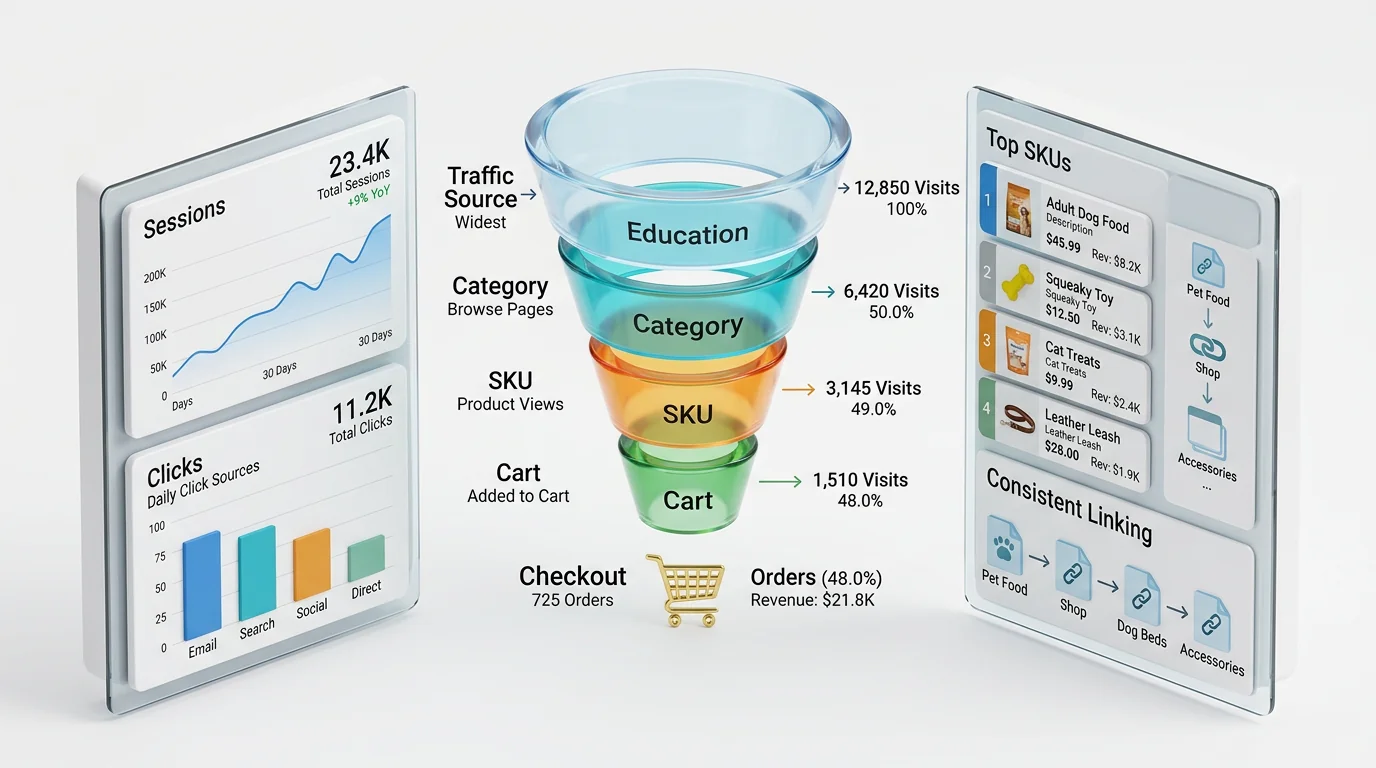
Measure how educational content feeds category and SKU clicks, then carts. Build dashboards around modifier-led journeys, not just sessions. Practitioners stress cross-functional alignment to make SEO insights actionable.[4]
Do not implement yet: custom attribution models before basics
Advanced attribution can obscure immediate fixes. First confirm clean tracking, consistent anchor patterns, and SKU-level revenue attribution from content. Then refine models to evaluate long consideration paths.
Route: Measure content-to-cart with internal linking blueprints
Adopt a standard internal linking schema that tags anchors by modifier and funnel stage. Monitor click-through and assisted revenue to iterate content formats and category structures efficiently.[2]
Common mistakes and misconceptions
- “Index all filters for coverage.” Most filters lack distinct value and create duplication.
- “Templates equal scale.” Only differentiated templates win; thin spins cause cannibalization.[1]
- “Traffic first, structure later.” Architecture and crawl control determine durable growth, not isolated articles.[3]
Frequently Asked Questions
What makes pet eCommerce SEO different from generic SEO?
Pet search behavior is highly modifier-driven, including breed, size, age, and conditions, and spans products and services. Successful structures align categories, filters, and content to these modifiers with clear intent mapping.
Should I index filters like breed or size?
Only when the filter represents a stable, high-intent query pattern and you can provide unique value. Most filters should remain non-indexable to prevent cannibalization, crawl waste, and diluted relevance.
How do I connect educational content to product pages?
Use clear section-level links from use-cases and comparisons to relevant SKUs or categories. Support with product schema and consistent anchor text patterns to signal intent and improve conversion paths.
When is programmatic SEO appropriate for pet stores?
After technical hygiene, intent mapping, and a tested template that adds unique value for each modifier. Launch in tiers and verify no duplication, cannibalization, or thinness emerges before scaling.
Do reviews and structured data still matter?
Yes. Product and review markup improve understanding and trust signals. For services, local and medical-relevant schema strengthen visibility and credibility for nearby customers and regulated information needs.
References
- M Reisenbichler et al. (2022). Frontiers: Supporting content marketing with natural language generation. Marketing …. View article
- S Das (2021). Search engine optimization and marketing: A recipe for success in digital marketing. 2021 - api.taylorfrancis.com. View article
- S Neelakandan et al. (2022). An automated word embedding with parameter tuned model for web crawling. … Automation & Soft …. View article
- S Schultheiß et al. (2021). “Outside the industry, nobody knows what we do” SEO as seen by search engine optimizers and content providers. Journal of Documentation. View article
Related Reading

Pet Store SEO: The Complete Orientation Hub for Retailers, eCommerce, and Local Services

Pet Page SEO Optimization: The Complete Orientation Guide for Pet Brands, Retailers, and Services

Pet SEO: The Complete Guide to AI-Powered Growth for Pet Brands, Retailers, and Services