AI Blog Writer for Pet Stores: What Works and What Does Not


Table of Contents +
- Why Are Pet Store Owners Turning to AI Blog Writers?
- Does AI Content Actually Rank on Google?
- When Does AI Blog Writing Fail?
- Why Does Generic AI Struggle With Pet Content?
- What Is the Difference Between Generic AI and Vertical AI?
- What Should Pet Store Owners Look for in an AI Blog Writer?
- How Does AI Blog Writing Compare to Other Options?
- Frequently Asked Questions
- References
AI blog writers can rank for pet stores - but generic AI fails on breed details and health claims. Compare generic vs pet-specific AI with real data and costs.
Running a pet store means juggling inventory, customers, suppliers, and marketing - all at the same time. Content marketing is the one channel that compounds over time, but 39% of businesses cite resource constraints as their biggest content challenge[1]. You know you need blog content. You do not have 40 hours a month to write it. AI blog writers promise to solve that problem. But do they actually work for pet stores?
The short answer: it depends entirely on the type of AI tool you use.
TL;DR
AI blog writers can match human content in search rankings when combined with domain expertise. But generic AI fails in specialized niches like pet stores - fabrication rates double on specialized topics. The key is niche-specific AI that understands breeds, health claims, and seasonal trends.
Why Are Pet Store Owners Turning to AI Blog Writers?
The math behind pet store content marketing is straightforward. Businesses with active blogs generate 55% more website traffic[2]. Every blog post is a new page that Google can index, a new keyword you can rank for, and a new entry point for potential customers.
But producing that content takes serious time. The average blog post takes 3 hours and 55 minutes to write[3]. For a pet store publishing 10 articles per month, that is nearly 40 hours of writing alone - before editing, formatting, or publishing. Pet store owners already work 50-60 hour weeks. Those 40 hours simply do not exist.
This is why 87% of marketers now use AI tools for content creation[4]. The AI writing tools market has reached $1.9 billion[5] and continues to grow as businesses of every size look for ways to produce more content without hiring more people.
For pet stores specifically, the appeal is clear: AI handles the writing so you can focus on running your store, advising customers, and managing inventory. But not all AI writing tools deliver the same results - especially in a specialized niche like pet retail.
Petbase automates SEO content for pet stores - publishing 10 optimized articles monthly so you can focus on running your shop - start your free trial.
Does AI Content Actually Rank on Google?
This is the question every pet store owner asks first. The data provides a clear answer: yes, AI content ranks.
A comprehensive Semrush study found that AI-generated content reaches the top 10 at a rate of 57%, compared to 58% for human-written content[6]. The difference is statistically negligible. Separate research from Ahrefs shows that 86.5% of top-performing pages now contain some AI-generated content[7].
Even more telling: websites that use AI for content creation grow organic traffic 5% faster than those that do not[8]. Google has stated explicitly that it evaluates content quality, not the method of production[9]. If AI content demonstrates expertise, provides value, and satisfies the searcher's intent, it ranks.
However, there is a critical nuance. Not all AI content performs equally. Pure AI content without human oversight or domain expertise collapses in rankings after approximately 3 months[10]. The content that continues to rank long-term is AI content that has been enhanced with genuine expertise and first-hand experience - exactly what Google's E-E-A-T (Experience, Expertise, Authoritativeness, Trustworthiness) framework rewards.
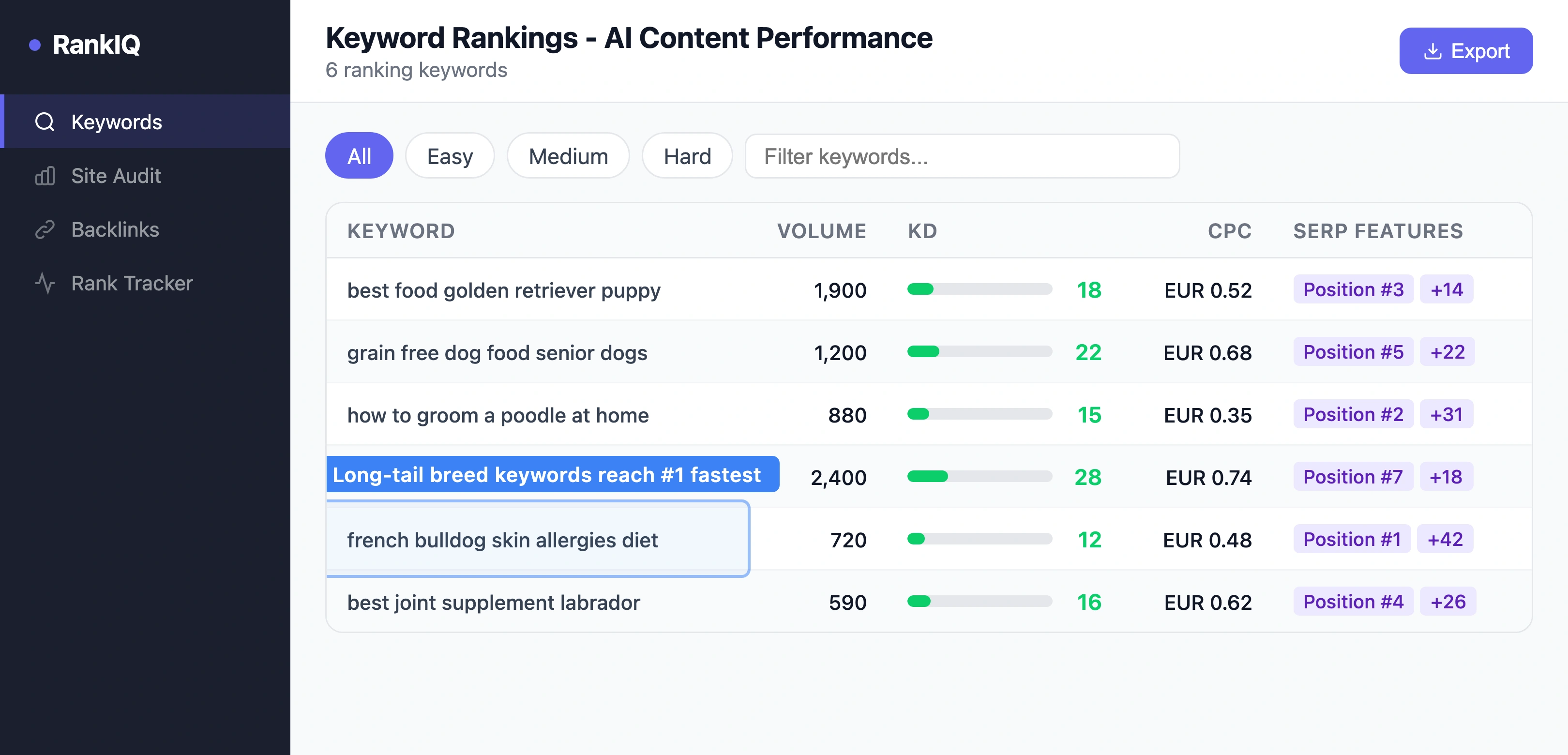
Content that demonstrates E-E-A-T outperforms generic content by 40% in search rankings[11]. For pet stores, this means AI content that includes breed-specific knowledge, accurate health information, and real product insights ranks significantly better than content that simply targets keywords.
When Does AI Blog Writing Fail?
AI blog writing fails in predictable ways - and understanding those failure modes is essential before investing in any tool.
The biggest problem is errors. 47% of marketers encounter factual errors in AI-generated content on a weekly basis[12]. These are not minor style issues. They are factual claims that are simply wrong - incorrect nutritional data, fabricated statistics, or inaccurate breed information.
The error rate gets worse in specialized domains. Research from PsyPost found that AI fabrication rates reach 46% on specialized topics[13] - nearly double the rate on general topics. Pet nutrition, breed-specific health conditions, and veterinary advice all qualify as specialized topics where generic AI tools make the most mistakes.
A study published in Frontiers in Veterinary Science raised specific concerns about AI accuracy in veterinary and pet health content[14]. The researchers found that while AI could produce grammatically correct, well-structured articles, the factual accuracy on veterinary topics was inconsistent - sometimes dangerously so.
For a pet store, publishing inaccurate health advice is not just an SEO problem. It is a trust problem. A blog post that recommends the wrong dosage of a supplement, misidentifies a toxic ingredient, or gives incorrect breed-specific feeding advice can damage your reputation and potentially harm an animal.
Why Does Generic AI Struggle With Pet Content?
Generic AI tools like ChatGPT, Jasper, and Copy.ai are trained on broad internet data. They know a little about everything but lack deep knowledge in any specialized domain. This creates specific problems for pet content:
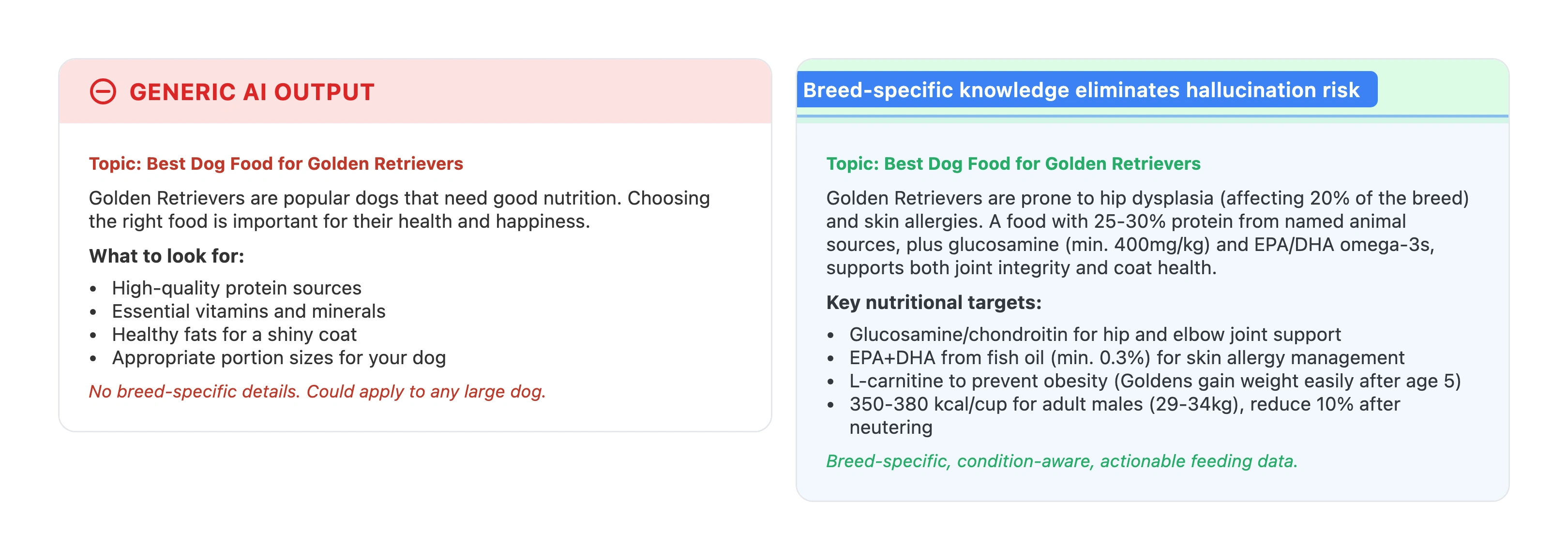
- Breed knowledge gaps: Generic AI often confuses breed-specific nutritional needs, exercise requirements, and health predispositions. A Persian cat has completely different grooming and respiratory needs than a Maine Coon, but generic AI frequently produces generic "cat care" content that ignores these distinctions.
- Health claim inaccuracies: Pet health is a regulated space. Generic AI does not understand which health claims require veterinary backing, which ingredients have contraindications, or how EU pet food regulations (FEDIAF standards) differ from US regulations.
- Life stage confusion: Puppy, adult, and senior pets have fundamentally different nutritional needs. Generic AI often blends these into generic advice that applies to no specific life stage well.
- Seasonal blindness: Pet stores operate on seasonal cycles - flea and tick season, holiday travel, winter coat care, allergy season. Generic AI does not plan content around these cycles because it does not understand the pet retail calendar.
- Product knowledge: Generic AI cannot compare specific pet food brands, supplement formulations, or equipment features because it lacks current product data from the pet industry.
The result is content that sounds plausible but lacks the specific, accurate detail that pet owners are searching for - and that Google's algorithms increasingly reward through E-E-A-T signals.
What Is the Difference Between Generic AI and Vertical AI?
This distinction is critical. Generic AI tools are general-purpose writing assistants. Vertical AI tools are built for a specific industry and trained on domain-specific data.
Research from AIMultiple found that vertical AI solutions achieve 25-50% accuracy improvement over generic AI tools, compared to generic AI's 1-5% improvement over baseline[15]. The difference is not incremental - it is transformational.
| Capability | Generic AI (ChatGPT, Jasper) | Pet-Specific AI (Petbase) |
|---|---|---|
| Breed-specific knowledge | Surface-level, often inaccurate | Detailed breed data across 400+ breeds |
| Life stage nutrition | Generic advice, blends life stages | Specific by life stage and breed size |
| Health claim accuracy | Unverified, often fabricated | Sourced from veterinary guidelines |
| Seasonal content planning | No awareness of pet retail calendar | Built-in seasonal content scheduling |
| Product comparisons | Generic, outdated product data | Current pet industry product knowledge |
| Topical authority building | Random disconnected articles | Structured content clusters with internal linking |
| Local SEO integration | No local awareness | Location-specific content optimization |
A vertical AI tool like Petbase is not just a better writer - it is a better strategist. It understands which topics matter for pet stores, how those topics connect to form content clusters, and which keywords drive qualified traffic from pet owners who are ready to buy.
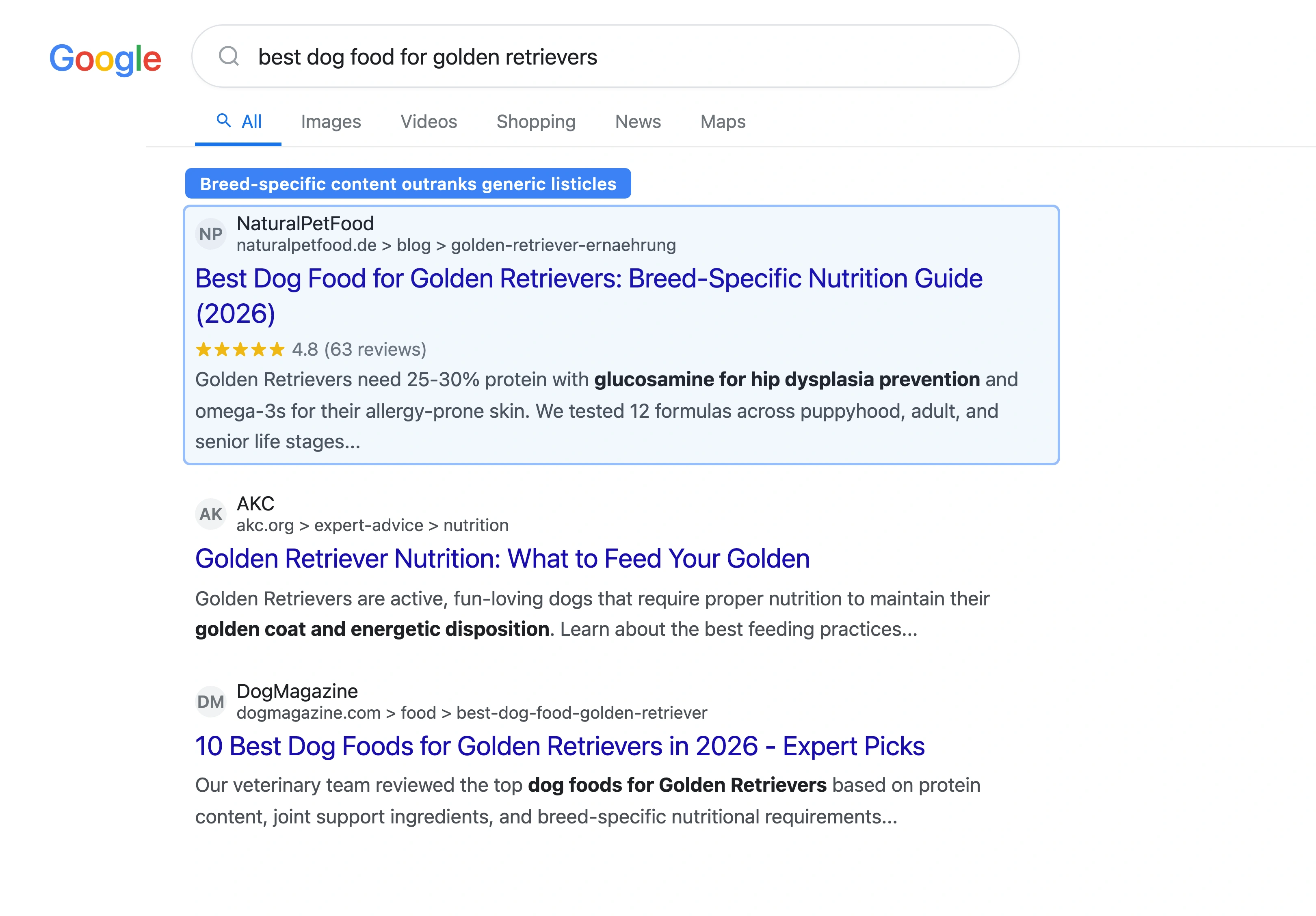
For a deeper comparison of AI tools versus traditional SEO approaches, read our SEO agencies vs. AI tools guide.
What Should Pet Store Owners Look for in an AI Blog Writer?
Not every AI writing tool is the same. Here are the specific capabilities that separate tools that work for pet stores from tools that do not:
1. Domain-specific training. The tool should understand pet industry terminology, breed characteristics, nutritional science, and health conditions. Ask the tool to write about a specific breed's dietary needs - if the output is generic, the tool lacks domain depth.
2. Content clustering. Individual blog posts have limited SEO impact. A tool that plans and connects content into topical authority clusters delivers compounding results. After 10 connected articles on dog nutrition, the 11th article ranks faster because Google already trusts your site on that topic.
3. Factual accuracy controls. The tool should have mechanisms to prevent fabrication - not just generate text. This is especially important for pet health content where inaccurate information can be harmful.
4. SEO optimization. Beyond writing, the tool should handle keyword targeting, meta descriptions, internal linking, heading structure, and content length optimization. These technical elements determine whether content ranks.
5. Publishing integration. Writing content is only half the job. A tool that publishes directly to your website's CMS eliminates the manual copy-paste-format cycle that eats hours every week.
6. Scalability. Can the tool produce 10 articles per month consistently? One-off article generation is not a content strategy. You need sustained output to build topical authority and compete in search results.
For guidance on developing a complete blog strategy, see our keyword research guide for pet businesses.
How Does AI Blog Writing Compare to Other Options?
AI is not the only way to produce pet store blog content. Here is how the four main approaches compare across cost, quality, and practicality:
| Factor | Write Yourself | Freelance Writer | SEO Agency | Pet-Specific AI |
|---|---|---|---|---|
| Monthly cost | EUR 0 (+ 40 hrs) | EUR 2,000-4,000 | EUR 3,000-5,000+ | EUR 199 |
| Articles per month | 2-4 | 4-8 | 4-8 | 10 |
| Pet industry expertise | Your own (high) | Low (generalist writers) | Low (generalist teams) | Built-in knowledge model |
| SEO optimization | Requires learning | Varies widely | Professional | Automatic |
| Content clustering | Manual planning | Not included | Included (usually) | Automatic |
| Time investment | 40-60 hrs/month | 5-10 hrs (briefing/review) | 2-4 hrs (review only) | 3-5 hrs (review only) |
| Consistency | Drops during busy periods | Writer availability varies | Contract-guaranteed | Automatic every month |
| 12-month cost | EUR 0 (+ 480 hrs) | EUR 24,000-48,000 | EUR 36,000-60,000 | EUR 2,388 |
The best approach depends on your budget and time availability. For most independent pet stores, the highest-ROI option is a pet-specific AI tool combined with your own review and expertise. You bring the product knowledge and customer understanding; the AI handles the time-consuming writing and SEO optimization.
Content marketing returns $7.65 for every dollar spent, compared to $1.80 for paid ads[4]. The key is consistent output, and that is where AI tools outperform every other option for small teams.
Frequently Asked Questions
Will Google penalize my pet store for using AI-generated content?
No. Google has stated explicitly that it evaluates content quality, not the method of production[9]. AI content that provides genuine value, demonstrates expertise, and satisfies search intent ranks just as well as human-written content. What Google penalizes is low-quality, spammy content regardless of whether a human or AI wrote it. The key is using AI as a tool to produce expert-level content, not as a shortcut to generate thin, keyword-stuffed pages.
Can I just use ChatGPT to write my pet store blog posts?
You can, but expect to spend significant time fact-checking and editing. ChatGPT is a general-purpose tool with no specialized pet industry knowledge. It will produce grammatically correct articles that often contain breed-specific inaccuracies, fabricated statistics, and generic advice. For every hour ChatGPT saves in writing, you may spend 30-45 minutes correcting errors and adding the specific detail that makes content rank. A pet-specific AI tool eliminates most of this editing overhead because domain expertise is built into the system.
How many blog posts does my pet store need per month?
Research shows that businesses publishing 16 or more posts per month get 3.5x more traffic than those publishing four or fewer[2]. For most pet stores, 8-12 posts per month is the practical sweet spot - enough to build topical authority within 2-3 clusters, without sacrificing quality for volume. Consistency matters more than quantity. Ten posts every month for a year (120 total) outperforms 30 posts in one month followed by silence.
How long until AI blog content starts ranking?
Expect 8-12 weeks before new content reaches page 1 for targeted keywords. This timeline applies whether content is human-written or AI-generated - Google needs time to discover, crawl, index, and evaluate new pages. The advantage of AI is volume: while each individual post takes 8-12 weeks, publishing 10 posts per month means you have content at various stages of the ranking pipeline at all times. By month 3, your earliest posts are reaching page 1 while newer posts are climbing.
References
- Content Marketing Institute (2024). Content Marketing Statistics. contentmarketinginstitute.com
- HubSpot (2024). Marketing Statistics. hubspot.com
- Orbit Media (2024). Blogging Statistics. orbitmedia.com
- Ahrefs (2024). AI Content Statistics. ahrefs.com
- RTDS (2024). AI Content Statistics. rtds.co
- Semrush (2024). AI Content Rankings Study. semrush.com
- Ahrefs (2024). AI Content Study. ahrefs.com
- Ahrefs (2024). AI Content Growth. ahrefs.com
- Google (2023). Google Search and AI Content. developers.google.com
- SE Ranking (2024). AI Content Ranking Study. seranking.com
- Semrush (2024). E-E-A-T and Google Rankings. semrush.com
- NP Digital (2024). AI Content Statistics. npdigital.com
- PsyPost (2024). AI Fabrication on Specialized Topics. psypost.org
- Frontiers in Veterinary Science (2024). AI Accuracy in Veterinary Content. frontiersin.org
- AIMultiple (2024). Vertical AI. aimultiple.com