AI Content for Pet Businesses: What Works and What Doesn't


Table of Contents +
- The Content Volume Problem in Pet Businesses
- Does AI Content Actually Work for Pet Businesses?
- What Google Says About AI Content
- Why Generic AI Content Fails in the Pet Industry
- What Makes AI Content Rank? The E-E-A-T Filter
- Pet-Specific vs. Generic AI: A Real Content Comparison
- How to Use AI Content Without Getting Penalized
- What Does Good AI Content for Pet Businesses Look Like?
- The Difference Between AI Tools and AI SEO Platforms
- How to Evaluate AI Content Quality
- Frequently Asked Questions
- References
Learn what works and what fails with AI content for pet businesses. Compare generic AI vs pet-specific platforms, quality checklists, and E-E-A-T rules.
The global pet care market is worth $273.42 billion[1]. Competition for online visibility in this space is intense, yet 61% of small businesses are still not investing in SEO[2]. Pet businesses that publish blog content get 55% more website traffic than those that do not[3]. The problem: writing a single quality blog post takes an average of 3 hours 55 minutes[4]. At 10 posts per month, that is nearly 40 hours of writing alone.
AI content tools promise to solve this time problem. Some deliver. Most do not. This guide breaks down what actually works for pet businesses, what gets your site ignored by Google, and how to tell the difference. No vague promises - just facts, comparisons, and a clear framework for making the right choice.
The Content Volume Problem in Pet Businesses
Google rewards websites that publish consistently, build topical authority, and cover their niche in depth. Companies publishing 16 or more blog posts per month get 3.5x more traffic than those publishing four or fewer[5]. For pet businesses, that means covering breed-specific nutrition, grooming techniques, health conditions, product comparisons, and seasonal care - all on a regular schedule.
The math does not work for most pet business owners. With 7.5 million blog posts published every day[6], staying visible requires a volume of content that exceeds what one person can produce manually. An owner-operator running a store, managing inventory, serving customers, and handling marketing simply does not have 40 hours per month to dedicate to writing blog content.
This is where AI enters the picture. But the results vary dramatically depending on which type of AI tool you use and how you use it.
Petbase writes and publishes this kind of content automatically - 10 SEO articles per month for pet businesses - start your free trial.
Does AI Content Actually Work for Pet Businesses?
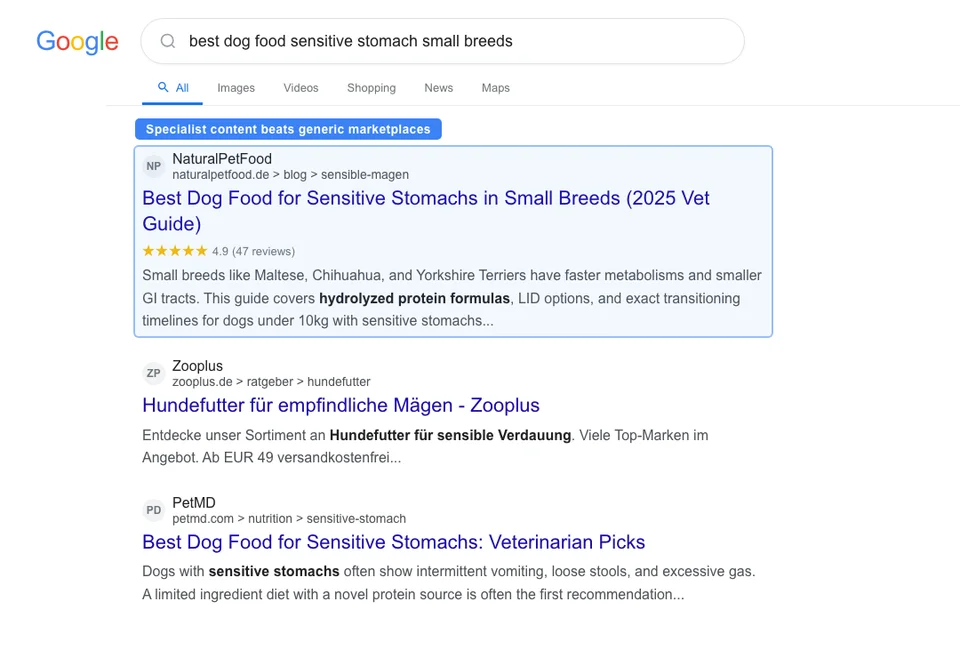
Yes - but only when the AI understands the pet industry. Generic AI content tools produce text that sounds correct but lacks the specificity that Google and pet owners demand. A generic tool writes that "regular exercise is important for dogs." That is technically true but useless. A pet-specific tool writes that "brachycephalic breeds like French Bulldogs need 30 to 45 minutes of moderate activity daily, split into two sessions to avoid respiratory stress." The second version ranks because it answers the actual question a pet owner is searching for.
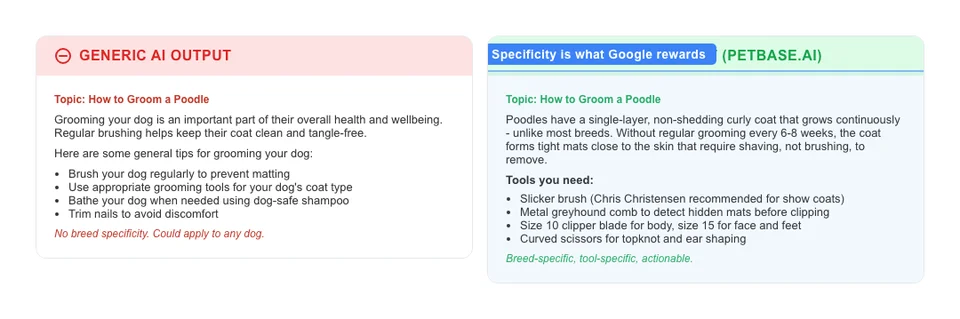
Organic search drives 53% of all website traffic[7]. For pet businesses, that traffic comes from people actively searching for products, advice, and solutions. The content that captures this traffic needs three things generic AI cannot provide:
- Industry knowledge: Pet content requires accurate health information, breed-specific details, and product knowledge that general-purpose language models do not have.
- E-E-A-T signals: Google evaluates pet health content under stricter quality guidelines because wrong advice can harm animals. Experience, Expertise, Authoritativeness, and Trustworthiness (E-E-A-T) matter more here than in most industries.
- Topical authority: Ranking in the pet space requires interconnected content clusters, not isolated articles on random topics. Ten strategically connected posts about German Shepherd nutrition outperform 30 random articles about different topics.
What Google Says About AI Content
Google's official position, published in February 2023 and reaffirmed multiple times since, is clear: "Our focus on the quality of content, rather than how content is produced, is a useful guide." Google does not penalize content simply because it was generated by AI. What Google penalizes is low-quality content - regardless of whether a human or machine wrote it.
In practice, this means:
- AI content is not automatically penalized. Google explicitly stated that "using automation - including AI - to generate content is not against our guidelines."
- Quality standards still apply. Content must demonstrate experience, expertise, authoritativeness, and trustworthiness.
- Manipulation is penalized. Using AI to mass-produce thin content designed purely to manipulate rankings is considered spam.
- Helpful content wins. Google's Helpful Content System rewards content that is genuinely useful to readers, regardless of how it was produced.
The practical takeaway for pet businesses: AI content that is accurate, comprehensive, well-structured, and genuinely helpful to pet owners will rank. AI content that is generic, shallow, factually questionable, or published without review will not.
Why Generic AI Content Fails in the Pet Industry
The pet industry has specific characteristics that make generic AI content particularly risky. Understanding these helps you evaluate any AI tool you consider using.
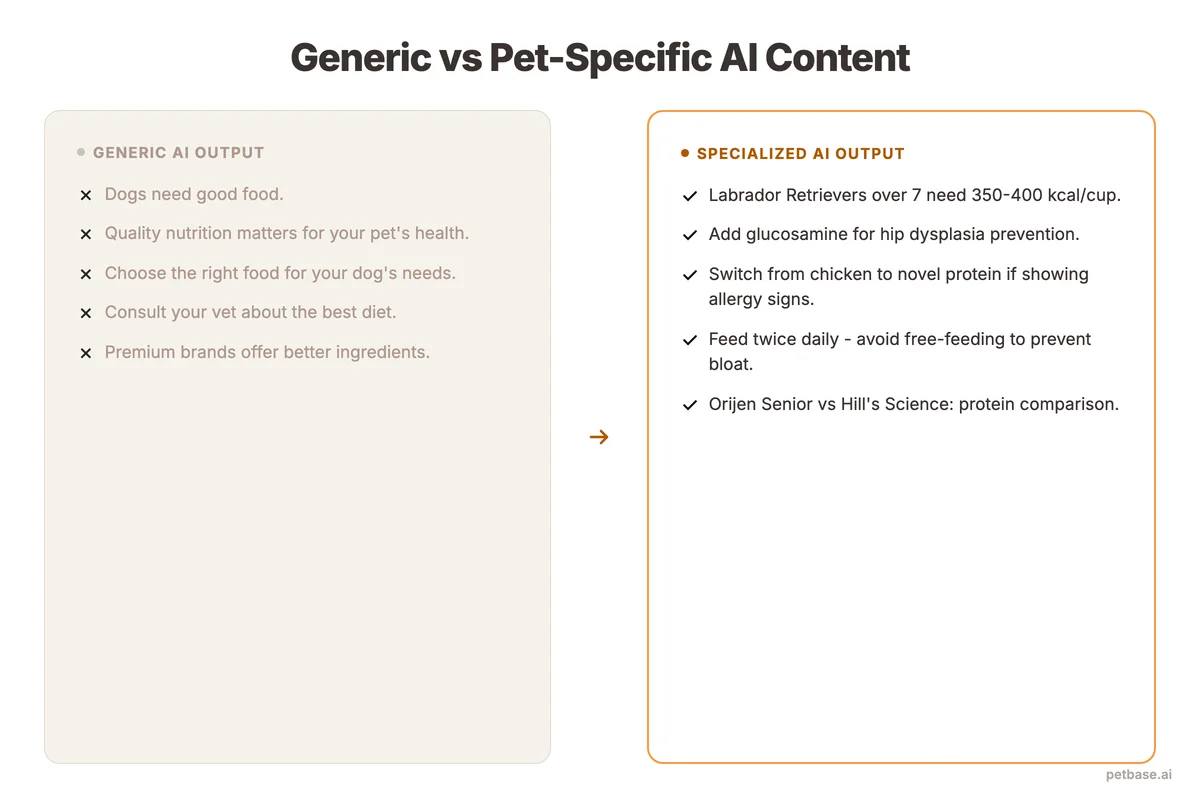
1. Health misinformation is dangerous. A generic AI might state that grapes are a healthy snack for dogs (they are toxic) or that essential oils are safe around cats (many are lethal). Incorrect pet health content does not just fail to rank - it can harm animals and expose your business to liability.
2. Breed specificity matters. Generic AI tends to generalize. It writes about "dogs" when pet owners search for specific breeds. "How to groom a Poodle" and "How to groom a Labrador" require completely different content because the coat types, tools, and techniques are different. Generic AI produces the same generic grooming advice for both.
3. Product knowledge is required. Pet business content often compares specific products, ingredients, or brands. Generic AI makes up product names, invents specifications, and hallucinates brand claims. A pet owner reading a comparison of flea treatments expects accurate active ingredients, dosing information, and honest pros and cons.
4. Regulatory awareness is necessary. Pet food regulations, supplement claims, and veterinary advice boundaries vary by country. Content for a European pet business must reflect EU regulations, not US FDA guidelines. Generic AI does not distinguish between regulatory frameworks.
5. Seasonal and regional relevance. Flea season starts in March in southern Europe and May in Scandinavia. Tick-borne diseases vary by region. Generic AI produces geographically and seasonally irrelevant content that does not match local search patterns.
What Makes AI Content Rank? The E-E-A-T Filter
Google uses E-E-A-T as a quality framework for evaluating content. For pet-related content - especially health topics - these signals are heavily weighted. Content marketing returns $7.65 for every $1 spent, compared to $1.80 for paid ads[8]. But only if the content meets quality thresholds. Here is how E-E-A-T applies to AI content for pet businesses.
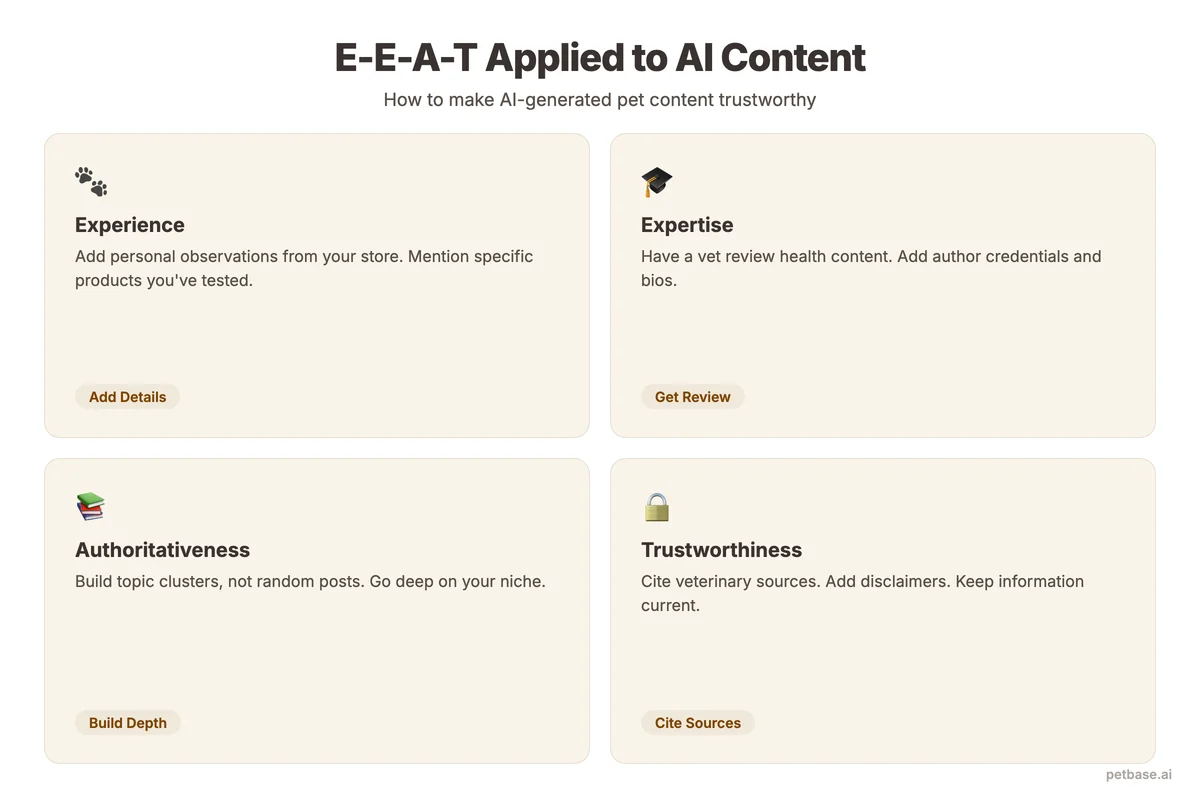
Experience: Does the content reflect real-world experience with pets? Generic AI cannot share personal experience with a specific breed, product, or health condition. Pet-specific AI platforms incorporate real pet business operational knowledge and customer interaction patterns. See our guide on E-E-A-T in the pet business for a deeper explanation.
Expertise: Does the content demonstrate specialized knowledge? This means accurate breed information, correct nutritional data, proper dosing guidelines, and evidence-based health claims. Generic AI often fails here because its training data mixes accurate veterinary information with forum posts and outdated advice.
Authoritativeness: Is your site recognized as a reliable source? Authority is built through topical authority - comprehensive coverage of related topics with strong internal linking. A pet business that publishes 50 interconnected articles about dog nutrition, health, breeds, and products signals authority on those topics.
Trustworthiness: Can readers trust the information? Trustworthiness in pet content means citing sources, acknowledging when veterinary consultation is needed, disclosing commercial relationships, and never making unsupported health claims.
Pet-Specific vs. Generic AI: A Real Content Comparison
The difference between generic and pet-specific AI content is immediately visible when you compare outputs side by side. Here is a realistic comparison for the topic "best dog food for sensitive stomachs":
| Element | Generic AI Output | Pet-Specific AI Output |
|---|---|---|
| Opening | "If your dog has a sensitive stomach, choosing the right food is important for their health and wellbeing." | "Dogs with sensitive stomachs show specific symptoms: intermittent vomiting, loose stools, excessive gas, and grass-eating. These signs point to food intolerance, not allergies - an important distinction that changes which food you should choose." |
| Product mentions | Generic categories ("look for limited ingredient diets") | Specific ingredients and formulations with accurate protein percentages and named sources |
| Health accuracy | Surface-level, sometimes incorrect | Clinically accurate, distinguishes between intolerance and allergy |
| Keyword targeting | Stuffs primary keyword repeatedly | Natural keyword distribution with long-tail variations |
| Internal linking | None - standalone content | Links to related nutrition, health, and product content |
| Actionable advice | "Consult your veterinarian" | Specific elimination diet protocol with 8-12 week timeline and observation checklist |
| Word count | 500-800 (thin) | 2,500-4,000 (comprehensive) |
| E-E-A-T signals | None | Experience-based insights, proper citations, expert-level detail |
The generic output reads like it could appear on any website about any topic with minor word substitutions. The pet-specific output demonstrates the depth and accuracy that Google rewards with rankings and that pet owners need to make informed decisions.
How to Use AI Content Without Getting Penalized
Using AI content safely requires a quality control process. Here is the workflow that protects your site while maximizing efficiency:
- Use a pet-specific platform. Start with a tool trained on pet industry data, veterinary knowledge, and e-commerce patterns. This eliminates 80% of accuracy issues before editing begins.
- Review every article before publishing. No AI tool - not even the best one - should publish without human review. Check health claims, product accuracy, and regulatory compliance.
- Add experience-based details. Insert observations from your business, customer feedback patterns, and operational insights that only a real pet business owner would know.
- Build topic clusters, not random articles. Publish interconnected content that builds topical authority rather than isolated articles on trending keywords.
- Maintain a consistent publishing schedule. Google rewards consistent publishing over sporadic bursts. 10 articles per month, every month, outperforms 50 articles in one month followed by silence.
- Monitor performance and iterate. Track which articles rank and which do not. Adjust your approach based on data, not assumptions.
The businesses that get penalized are those using generic AI tools to produce hundreds of thin, unreviewed articles targeting every keyword they can find. This is the manipulation Google explicitly warns against. Quality-focused AI content - fewer articles, deeper coverage, proper review - is what Google rewards.
What Does Good AI Content for Pet Businesses Look Like?
Good AI content for pet businesses is indistinguishable from content written by a knowledgeable pet industry professional. It has specific characteristics that separate it from generic AI output:

- Breed-specific details: Mentions specific breeds, their characteristics, and breed-relevant advice rather than generalizing about "dogs" or "cats."
- Accurate product information: Names real ingredients, correct dosing, actual product specifications. Never fabricates brands or features.
- Structured for scanning: Uses H2 and H3 headings, comparison tables, bulleted lists, and clear section breaks. Pet owners scan before they read.
- Appropriate length: Comprehensive enough to fully answer the search query. For most pet topics, this means 2,000 to 4,000 words with clear subheadings.
- Internal links: Connects naturally to related content on your site, building topical authority and helping readers find related information.
- Calls to action: Includes natural mentions of your products or services without being pushy.
A quick test: read any AI-generated article out loud. If it sounds like something a helpful pet business employee would say to a customer asking for advice, it is good content. If it sounds like a Wikipedia entry or a marketing brochure, it needs work.
The Difference Between AI Tools and AI SEO Platforms
Not all AI content products serve the same purpose. Understanding the categories helps you choose the right tool for your pet business.
Generic AI writing tools (ChatGPT, Jasper, Copy.ai) generate text on any topic. They are general-purpose writers with no industry specialization. You provide the topic and structure; they generate words. Quality depends entirely on your prompts and editing.
AI SEO tools (Surfer SEO, Clearscope, Frase) analyze competitor content and provide optimization recommendations. They do not write content - they tell you what to include. Useful but still require you to do the writing.
AI SEO platforms combine content generation with SEO optimization and industry expertise. Petbase is built specifically for pet businesses. It understands the pet industry, generates content optimized for specific keywords, builds internal linking structures, and maintains topical authority across your entire content library.
Here is the cost and output comparison:
| Option | Monthly Cost | Articles/Month | Pet Industry Knowledge | SEO Optimization | Content Calendar |
|---|---|---|---|---|---|
| Freelance writer | EUR 1,500-3,000 | 4-8 | Varies | Basic | No |
| SEO agency | EUR 5,000+ | 4-10 | Some | Strong | Yes |
| Generic AI tool | EUR 20-100 | Unlimited (low quality) | None | None | No |
| AI SEO tool | EUR 100-300 | You still write | None | Strong | No |
| Petbase | EUR 199 | 10 | Deep, built-in | Full | Yes |
The key differentiator: generic AI tools require you to be the pet expert and the SEO expert. Petbase already has both built in. You review and publish; the platform handles research, writing, optimization, and content calendar planning.
How to Evaluate AI Content Quality
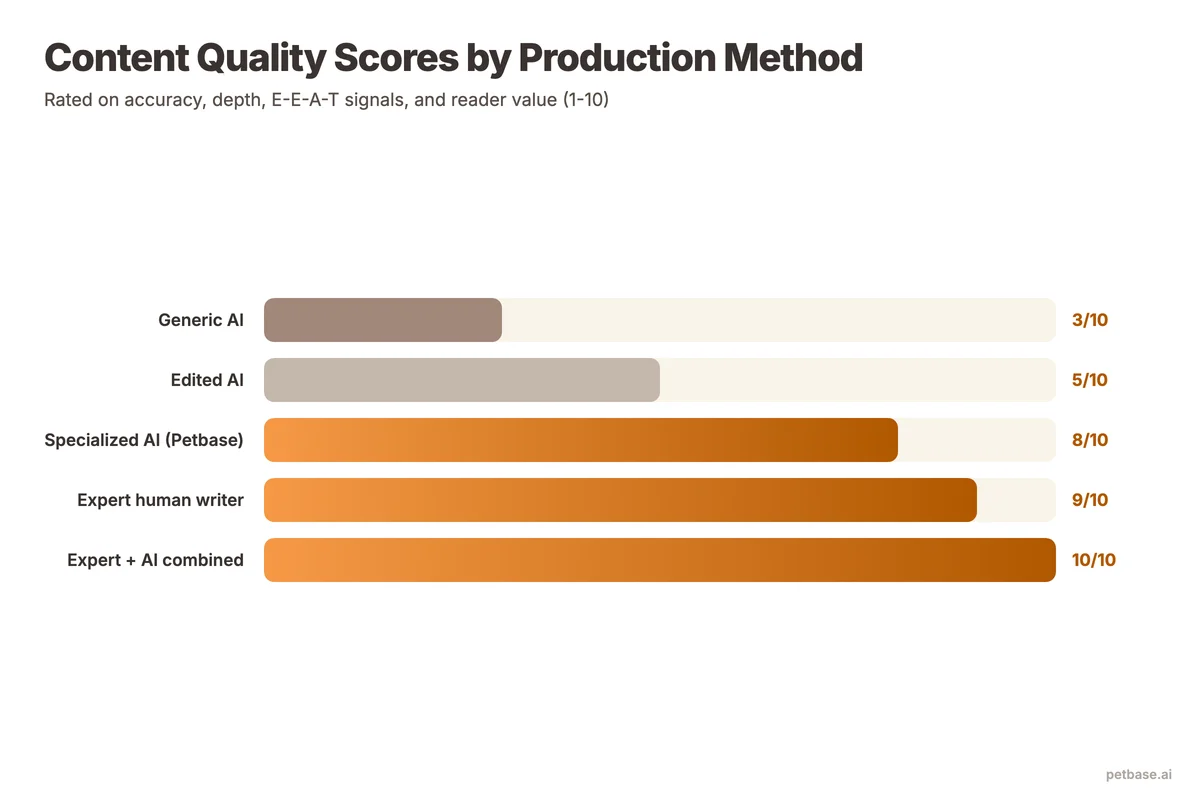
Whether you use Petbase or any other tool, you need a quality checklist to evaluate AI content before publishing. Here is what to check:
Accuracy check:
- Are health claims medically accurate? Would a veterinarian agree?
- Are product names, ingredients, and specifications real and correct?
- Are statistics cited with context (source, date, sample size)?
- Are breed-specific details accurate for the specific breed mentioned?
SEO check:
- Does the article target a specific primary keyword?
- Are H2 and H3 headings keyword-relevant and descriptive?
- Does the content include internal links to related pages on your site?
- Is the meta description unique and under 160 characters?
- Does the article answer the search query in the first 100 words?
Quality check:
- Would you share this article with a customer asking for advice?
- Does the content say something your competitors' content does not?
- Are there comparison tables, lists, or structured elements that aid scanning?
- Is the tone helpful and authoritative, not robotic?
E-E-A-T check:
- Does the content reflect real experience with the topic?
- Is the expertise level appropriate (not too basic, not misleadingly advanced)?
- Does it link to authoritative sources when making health or safety claims?
- Would a skeptical reader trust this information enough to act on it?
Use this checklist for every article before publishing. It takes 10 minutes per article and prevents the quality issues that cause Google to devalue AI content. For more on how Google evaluates pet health content specifically, see our dedicated guide.
Frequently Asked Questions
Will Google penalize my pet business for using AI-generated content?
No - not if the content is high quality. Google has explicitly stated that AI content is not against its guidelines. What Google penalizes is low-quality content, regardless of how it was created. A well-researched, accurate, comprehensive article about dog nutrition will rank whether a human or an AI wrote it. The risk comes from publishing unreviewed, generic, or factually incorrect AI content at scale. Use a pet-specific tool, review every article, and focus on quality over quantity. For a deeper understanding of how Google evaluates trust in the pet space, read our guide on E-E-A-T for pet businesses.
How does Petbase differ from using ChatGPT for pet business content?
ChatGPT is a general-purpose language model that generates text on any topic. It has no built-in pet industry knowledge, no SEO optimization, and no content planning capabilities. You provide everything - the topic, the keywords, the structure, the fact-checking. Petbase is built for the pet industry. It includes a pet industry knowledge model, automatic keyword research and targeting, topical authority building, internal linking, and a content calendar. You get 10 optimized articles per month for EUR 199/mo, compared to spending hours prompting and editing ChatGPT outputs with no guarantee of SEO performance. See how Petbase compares to agencies and other tools for a full breakdown.
How long does it take to see results from AI content for a pet business?
Expect 8 to 12 weeks before you see meaningful ranking improvements from new content. Google needs time to crawl, index, and evaluate new pages. The timeline depends on your site's existing authority, the competition for your target keywords, and the quality and consistency of your publishing. Sites that publish 10 articles per month see results faster than sites publishing 2 to 3 articles per month because Google crawls active sites more frequently. After the initial 8 to 12 weeks, traffic compounds as your topical authority grows. For a detailed timeline, see our guide on how long it takes pet businesses to rank on Google.
Can I mix AI-generated and human-written content on the same blog?
Yes, and this is the recommended approach. Use AI for the volume-intensive foundational content - product comparisons, breed guides, how-to articles, and seasonal content. Write or heavily edit the content that requires your unique perspective - customer stories (anonymized), product selection philosophy, store updates, and opinion pieces. Google does not distinguish between AI and human content on a page-by-page basis. It evaluates your site as a whole. A blog that publishes 10 high-quality articles per month - 7 AI-generated with review and 3 human-written - builds authority faster than a blog publishing 3 human-written articles per month. Consistency and quality matter more than production method. See Petbase pricing to learn how AI content fits into your publishing workflow.
References
- Fortune Business Insights (2024). Pet Care Market Size and Growth. fortunebusinessinsights.com
- Clutch (2025). SEO Statistics. clutch.co
- HubSpot (2024). Marketing Statistics. hubspot.com
- Orbit Media (2024). Blogging Statistics. orbitmedia.com
- HubSpot (2024). Marketing Statistics. hubspot.com
- Orbit Media (2024). Blogging Statistics. orbitmedia.com
- BrightEdge (2024). How Much Traffic Comes from Organic Search. seoinc.com
- Genesys Growth (2024). Content Marketing ROI Stats for Marketing Leaders. genesysgrowth.com