AIDA Funnel in the Pet Business: Why Is It Important?

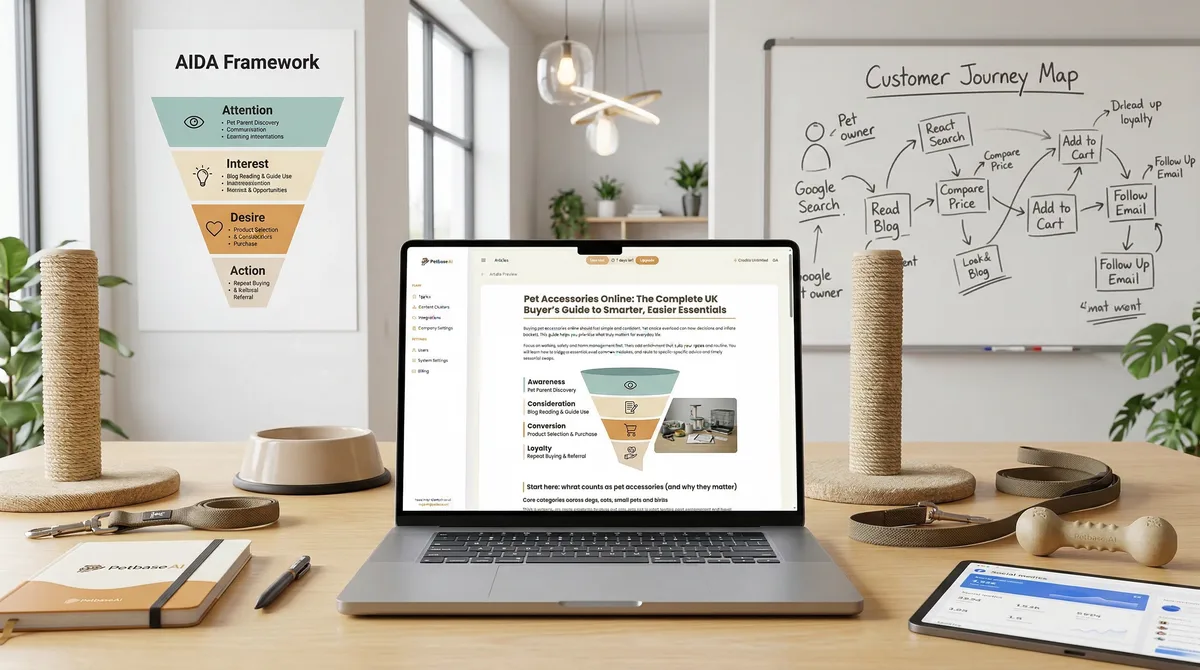
Table of Contents +
- What Is the AIDA Funnel?
- Why AIDA Matters for Pet Businesses
- Attention: How Pet Businesses Get Found
- Interest: Engaging Pet Owners With Useful Content
- Desire: Making Pet Owners Want Your Product
- Action: Converting Browsers Into Buyers
- Applying AIDA Across Different Pet Business Types
- How Content Drives Every AIDA Stage
- Building Your AIDA Funnel With Petbase
- Frequently Asked Questions
- References
Why the AIDA funnel is vital for pet businesses. Learn how attention, interest, desire and action improve your marketing.
The global pet e-commerce market is worth $94.89 billion[1]. Yet most pet businesses market without a framework. They post on social media, run occasional ads, and hope for the best. The AIDA funnel - Attention, Interest, Desire, Action - gives you a repeatable structure that moves pet owners from first click to checkout.
This guide breaks down each stage of the AIDA funnel with data-backed tactics built for pet businesses. Whether you run an online pet store, grooming salon, or veterinary clinic, AIDA helps you stop guessing and start converting.
What Is the AIDA Funnel?
AIDA stands for four stages every customer passes through before buying:
- Attention - The customer discovers your business.
- Interest - They engage with your content and learn more.
- Desire - They want what you offer.
- Action - They buy, book, or subscribe.
The model dates back to 1898, when advertising pioneer Elias St. Elmo Lewis outlined the psychological steps of a sale. More than a century later, the framework still holds - it has simply moved from print ads to search results, email sequences, and product pages.
For pet businesses, AIDA is especially effective. Pet owners are emotionally invested, research-heavy buyers. They compare brands, read ingredient lists, and check reviews before spending money on their animals. A structured funnel meets them at every step of that process.
Petbase writes and publishes this kind of content automatically - 10 SEO articles per month for pet businesses - start your free trial.
Why AIDA Matters for Pet Businesses
Pet businesses compete for attention with major retailers, marketplaces, and hundreds of niche brands. Without a system, marketing becomes scattered - you attract visitors but do not convert them, or you convert one-time buyers who never return.
AIDA solves this by giving each marketing activity a clear purpose. Every blog post, product page, email, and social media post maps to a specific funnel stage. The result is less wasted effort and more predictable growth.
The numbers support a structured approach. Organic search drives 53% of all website traffic[2], and businesses with active blogs generate 55% more traffic and 67% more leads[3]. Content marketing costs 62% less than outbound marketing and produces 3x more leads per dollar[4]. AIDA tells you exactly what content to create at each stage so those numbers work for your business.
Attention: How Pet Businesses Get Found
The attention stage is about visibility. Pet owners cannot buy from you if they do not know you exist. Your job is to appear where they are already looking - primarily in search results.
Organic Search and Content
With 53% of web traffic starting in a search engine[2], SEO-driven content is the most reliable attention channel for pet businesses. Blog posts targeting questions pet owners already ask - "best food for senior dogs," "how to groom a poodle at home," "signs of food allergies in cats" - bring the right visitors to your site.
Long-tail keywords are particularly valuable at this stage. They account for 70% of all search queries[5] and attract visitors with specific intent. A pet store ranking for "grain-free food for Labradors with sensitive stomachs" reaches a more motivated buyer than one ranking for "dog food."
For a step-by-step approach to finding these keywords, read our keyword research guide for pet businesses.
Social Media and Paid Channels
Social media works well for top-of-funnel awareness. Pet content performs strongly on visual platforms - before-and-after grooming photos, short videos of dogs reacting to new toys, and educational reels about pet health all attract engagement. Paid ads on Facebook and Instagram let you target specific demographics: dog owners in your city, cat owners aged 25-45, or recent pet adopters.
The key is that attention alone does not generate revenue. Every piece of attention-stage content should guide the visitor toward the next stage - interest.
Interest: Engaging Pet Owners With Useful Content
Once a pet owner lands on your site or follows your page, the interest stage keeps them engaged. This is where you prove your expertise and give them a reason to stay.
Educational Content That Builds Trust
Pet owners are research-oriented. They want to understand ingredients, compare options, and learn how to care for their animals properly. Content that answers their questions - without pushing a sale - earns their trust.
Effective interest-stage content for pet businesses includes:
- Breed-specific care guides (e.g., "Complete Nutrition Guide for German Shepherds")
- How-to articles (e.g., "How to Switch Your Cat to Raw Food Safely")
- Product comparisons (e.g., "Freeze-Dried vs. Air-Dried Dog Treats: What is the Difference?")
- Seasonal guides (e.g., "Spring Flea and Tick Prevention: What Every Dog Owner Needs to Know")
Topic clusters - groups of related articles linked together - build topical authority faster than isolated posts. When Google sees your site covers dog nutrition from every angle (ingredients, allergies, life stages, breed needs), it ranks all your content higher. Learn more in our content clustering guide for pet websites.
Reviews and Social Proof
93% of consumers read online reviews before making a purchase[6]. For pet businesses, reviews carry extra weight because pet owners feel responsible for their animal's wellbeing. A product with 200 reviews and a 4.7-star rating converts far better than one with no reviews, regardless of price.
Display customer reviews on product pages, feature photo testimonials of happy pets, and encourage buyers to share their experience. This social proof bridges the gap between interest and desire.
Desire: Making Pet Owners Want Your Product
At the desire stage, the customer knows who you are and trusts your expertise. Now they need a reason to choose you over competitors. Desire is about making your specific product or service feel like the right answer.
Product Pages That Convert
Strong product pages are the engine of the desire stage. Generic descriptions copied from manufacturers do not create desire. Original descriptions that connect features to pet-specific benefits do.
Instead of "premium dog food with high protein content," write "This formula delivers 38% protein from deboned chicken and wild salmon - the exact amino acid profile working dogs need for muscle recovery after long hikes."
For a complete approach to writing product descriptions that rank and convert, see our guide to pet product descriptions.
Structured Data for Visibility
Schema markup helps search engines understand your product pages and display rich results - star ratings, prices, and availability directly in search results. Pages with structured data can see click-through rates increase by up to 30%[7]. For pet stores, Product and Review schema on your key pages makes them stand out against competitors in search results. Our schema markup guide for pet stores covers implementation step by step.
Scarcity and Urgency
Limited availability and time-sensitive offers accelerate desire. "Only 12 left in stock" or "Free shipping ends Sunday" give the customer a reason to act now instead of bookmarking and forgetting. Use these honestly - false scarcity damages trust, and pet owners share bad experiences in online communities quickly.
Action: Converting Browsers Into Buyers
The action stage is where revenue happens. A pet owner has found you, engaged with your content, and decided they want your product. Your job is to remove every obstacle between that decision and the completed purchase.
Reducing Cart Abandonment
The average online cart abandonment rate is 70%[8]. That means 7 out of 10 pet owners who add a product to their cart leave without buying. The most common reasons are unexpected shipping costs, a complicated checkout process, and required account creation.
To reduce abandonment:
- Show shipping costs early - do not surprise customers at checkout.
- Offer guest checkout. Forced account creation loses sales.
- Support multiple payment methods (credit card, PayPal, local options).
- Optimize for mobile. Many pet owners browse and buy on their phones.
- Send cart recovery emails within 1-2 hours with a direct link back to the cart.
Clear Calls to Action
Every page should have one primary call to action. On product pages, that is "Add to Cart." On blog posts, it is a link to a related product or service page. On your homepage, it is "Shop Now" or "Book an Appointment."
Avoid generic buttons like "Submit" or "Learn More." Use action-specific language: "Start My Free Trial," "Book a Grooming Session," "Shop Dog Supplements." The more specific the CTA, the higher the conversion rate.
Post-Purchase Retention
AIDA does not end at the first sale. The most profitable pet businesses loop customers back into the funnel. Pet products - food, treats, supplements, grooming supplies - are consumable. A customer who buys once should buy again every 4-8 weeks.
Build retention with:
- Follow-up emails with feeding guides or care tips for the product they bought.
- Subscription options for recurring purchases at a small discount.
- Loyalty programs that reward repeat orders.
- "Reorder" reminders timed to when the product runs out.
Applying AIDA Across Different Pet Business Types
The AIDA framework adapts to any pet business model. Here is how each stage maps to different verticals:
Online Pet Stores
- Attention: SEO-optimized blog content targeting pet care questions.
- Interest: Buying guides, ingredient comparisons, and breed-specific recommendations.
- Desire: Product pages with original descriptions, customer photos, and review sections.
- Action: Streamlined checkout, cart recovery emails, and subscription options.
Grooming Salons
- Attention: Before-and-after photos on Instagram, Google Business Profile optimization.
- Interest: Blog posts on coat care by breed, grooming frequency guides.
- Desire: Client testimonials with pet photos, "first visit" offers.
- Action: Online booking with one-click confirmation.
Veterinary Clinics
- Attention: Local SEO content targeting "vet near me" and common symptom searches.
- Interest: Educational articles on preventive care, vaccination schedules, and nutrition.
- Desire: Staff bios with credentials, patient success stories, facility tour videos.
- Action: Online appointment scheduling, new patient forms available digitally.
For more on local visibility strategies, read our local SEO guide for pet businesses.
How Content Drives Every AIDA Stage
Content is the fuel that powers the AIDA funnel. Without it, each stage depends on paid advertising - and the moment you stop paying, the funnel stops working.
With a content-driven AIDA funnel:
- Attention comes from blog posts ranking in Google for the questions pet owners search every day.
- Interest builds through topic clusters that demonstrate deep expertise.
- Desire grows from product pages that connect features to pet-specific benefits.
- Action converts through clear calls to action, trust signals, and a frictionless checkout.
Long-tail keywords play a critical role across all four stages. They represent 70% of searches and convert at 36%[5] - far higher than broad keywords. A pet store publishing 10 targeted articles per month builds a library of entry points that feed the top of the funnel continuously.
For a broader view of how content marketing works for pet businesses, see our complete content marketing guide.
Building Your AIDA Funnel With Petbase
Petbase automates the content side of your AIDA funnel. For EUR 199/mo, you get 10 SEO-optimized articles per month - each one built around your niche, your products, and the keywords your customers search for.
Here is how Petbase maps to each AIDA stage:
- Attention: Automated keyword research finds the searches your target customers use. Articles publish directly to your CMS every month.
- Interest: Content is organized into topic clusters that build topical authority. Each article links to related posts, creating depth that Google rewards.
- Desire: AIDA-structured product descriptions connect features to benefits in language pet owners understand.
- Action: Smart internal linking guides readers from blog content to your product and service pages.
Petbase is built specifically for pet businesses. The platform understands breeds, health conditions, seasonal trends, and product categories - context that generic content tools miss entirely.
Ready to build your AIDA funnel? See Petbase pricing or start your free trial.
Frequently Asked Questions
Does the AIDA funnel work for small pet businesses with limited budgets?
Yes. Content marketing costs 62% less than outbound marketing[4], making it the most cost-effective way to build a funnel. A small grooming salon can start with one blog post per week and a consistent Google Business Profile - no paid ads required.
How long does it take to see results from an AIDA content strategy?
Expect 8-12 weeks before blog content starts ranking and driving consistent traffic. The attention stage takes the longest to build because organic search results require time to index and rank. Interest, desire, and action stages can show results faster because they optimize pages and processes you already have.
Which AIDA stage do most pet businesses struggle with?
Attention. Most pet businesses have decent products and service, but they do not appear where customers are searching. With 53% of traffic coming from organic search[2], the businesses that invest in SEO content have a structural advantage over those relying only on social media or word of mouth.
Can I use AIDA for email marketing in my pet business?
Absolutely. A welcome email sequence maps directly to AIDA: the first email grabs attention with a discount or useful tip, the second builds interest with educational content, the third creates desire with a product recommendation or customer story, and the fourth drives action with a clear CTA and deadline.
How does AIDA differ from other marketing funnels?
AIDA focuses specifically on the psychological stages of a buying decision. Other models like TOFU/MOFU/BOFU describe the same general flow but in broader terms. AIDA is more prescriptive - it tells you exactly what emotion to target at each stage, which makes it easier to create content with a clear purpose.
References
- Grand View Research (2024). Pet Care E-Commerce Market Size and Growth. grandviewresearch.com
- BrightEdge (2024). How Much Traffic Comes from Organic Search. seoinc.com
- HubSpot (2024). Marketing Statistics. hubspot.com
- Siege Media (2024). Content Marketing Statistics. siegemedia.com
- Embryo (2024). 30 Statistics About Long-Tail Keywords. embryo.com
- BrightLocal (2024). Local SEO Statistics. brightlocal.com
- Amra & Elma (2025). Top Schema Markup Statistics. amraandelma.com
- Smart Insights (2024). E-Commerce Conversion Rates. smartinsights.com