Aquarium Store SEO: Beat Amazon Locally

Table of Contents +
- Why Do Aquarium Stores Need SEO Now?
- How Do Aquarium Hobbyists Search?
- What Makes an Aquarium Store Rank on Google?
- How Do You Optimize Google Business Profile for Aquarium Stores?
- What Aquarium Content Builds SEO Authority?
- Which Marketing Channels Work Best for Aquarium Stores?
- How Do You Beat Amazon on Niche Fish and Coral Searches?
- How Do Aquarium Events and Community Improve SEO?
- What Is the 90-Day Aquarium Store SEO Sprint?
- How Does Petbase Help Aquarium Stores Scale Content?
- Frequently Asked Questions
- References
SEO guide for aquarium and fish stores. Rank for 'aquarium store near me,' beat Amazon on species searches, and build niche authority.
The global ornamental fish market is valued at $6.41 billion in 2024 and projected to reach $12.61 billion by 2033 at a 7.8% CAGR[1]. The US market alone is growing even faster - $1.68 billion in 2024, projected to reach $2.83 billion by 2030 at 9.1% CAGR[2]. The hobby is rebounding, hobbyist spend per household is rising, and millennials are driving the renewed interest in planted tanks, reef aquariums, and aquascaping. Yet most independent fish stores are invisible on Google.
This guide covers exactly how aquarium and fish stores rank on Google, compete against Amazon on species searches, and turn hobbyist research into in-store visits and online sales - backed by industry data at every step.
TL;DR
The aquarium hobby is growing at 7.8% to 9.1% per year, but most independent fish stores lose hobbyists to Amazon and chain retailers. Aquarium SEO works because species care guides, aquascaping tutorials, and reef-keeping content capture thousands of long-tail queries Amazon cannot match. Combined with local live-animal authority, this guide shows the exact content hub, GBP, and niche authority playbook that beats generic e-commerce competitors.
Why Do Aquarium Stores Need SEO Now?
Aquarium keeping is a research-heavy hobby. Before buying a single fish, customers read care guides, watch setup tutorials, search for tank-mate compatibility, and troubleshoot water parameter problems. Every one of those research queries is a chance for a local fish store to build trust, rank on Google, and convert the reader into a customer.
The market context makes this urgent. The ornamental fish market is growing 7.8% globally[1], and the global aquarium market reached $4.00 billion in 2025 with 37.78% in North America[3]. Hobbyists are spending more per setup, but they are also doing more research online before spending.
Trust starts with discovery. 46% of all Google searches have local intent[4], and queries like "aquarium store near me," "reef shop [city]," or "freshwater fish store [city]" are how hobbyists find local stores. Live animals are one of the few pet retail categories where local beats online for a reason hobbyists care about: they want to inspect the tank conditions and the fish before they buy.
For broader local strategy fundamentals, see our pet business local SEO guide.
Petbase builds this SEO foundation automatically for pet businesses - 10 optimized articles published every month - start your free trial.
How Do Aquarium Hobbyists Search?
Aquarium searches break into four distinct intent patterns:
- Store discovery searches - "aquarium store near me," "fish store [city]," "reef shop [city]." High conversion intent.
- Species searches - "where to buy clownfish [city]," "endlers for sale," "quality discus near me." High intent and very specific.
- Care and setup searches - "how to cycle a saltwater tank," "best substrate for planted aquarium," "neon tetra care." Largest volume, research-stage.
- Troubleshooting searches - "ich treatment," "cloudy aquarium water," "algae in planted tank." High urgency, tank-owner-in-crisis.
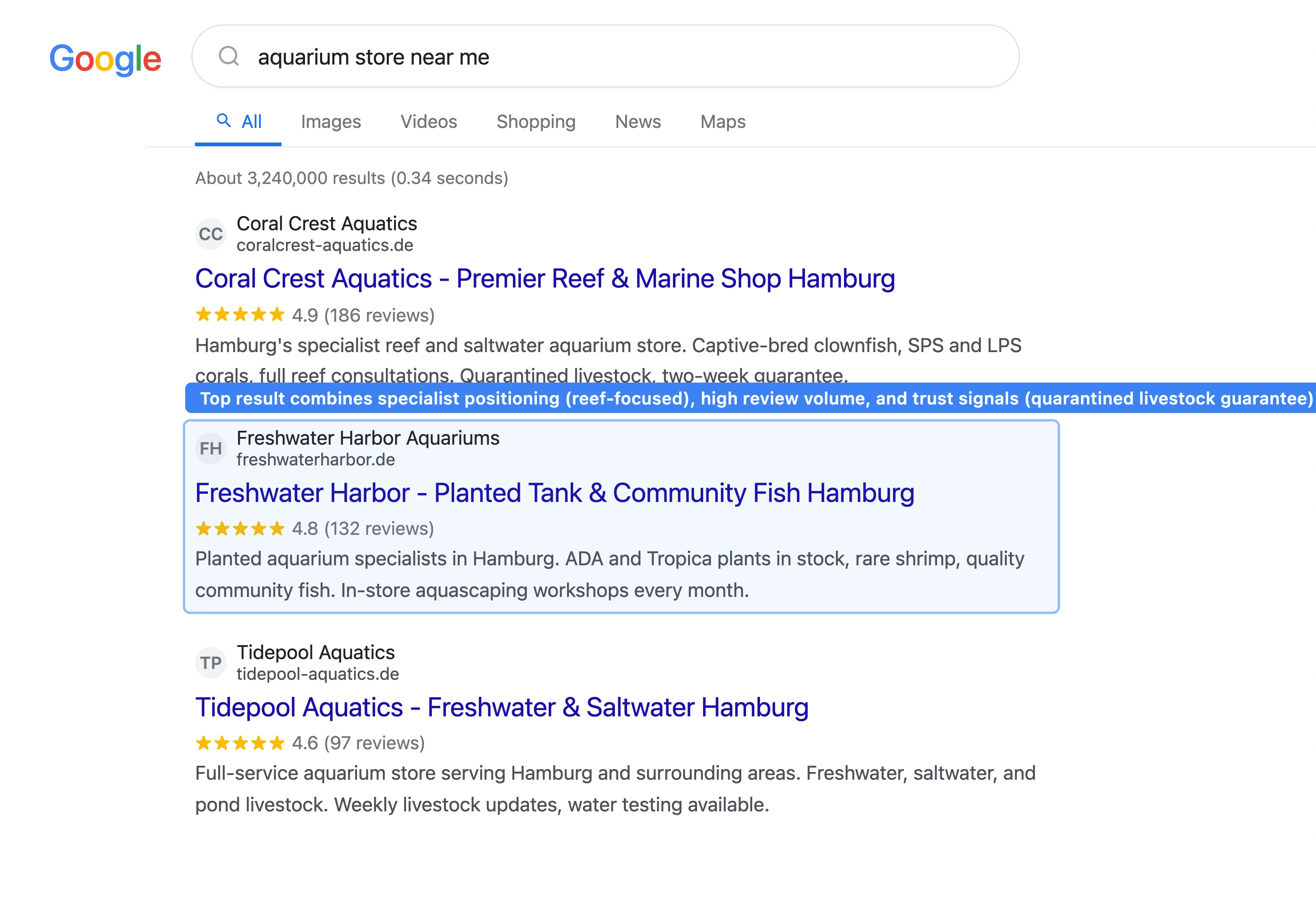
Each pattern requires different content. Store discovery rewards strong GBP signals. Species searches reward dedicated inventory pages and livestock lists. Care searches reward long-form species guides and setup tutorials. Troubleshooting searches reward practical, problem-solving blog content with clear answers up front.
What Makes an Aquarium Store Rank on Google?
Google evaluates four core areas when ranking aquarium and fish stores:
1. Local SEO Signals
Your business name, address, and phone number (NAP) must be consistent across your website, Google Business Profile, aquarium directories (Aquabid, Reef Central, AquariaCentral forum business listings), and social profiles. Inconsistencies confuse Google. Multi-location stores need a dedicated landing page per location with unique NAP data, local livestock availability, and unique copy.
2. Species and Care Content Hubs
Aquarium stores have a unique content advantage: every species you stock is a ranking opportunity. A complete care guide for "ember tetra care" answers hundreds of hobbyist questions, captures long-tail traffic, and signals authority to Google. Long-tail keywords account for roughly 70% of all Google searches[5], and "how to keep X species" queries are nearly all long-tail. Stores that publish species guides capture traffic Amazon cannot, because Amazon's algorithmic listings do not answer "will my angelfish eat my neon tetras" with real expertise.
3. Niche Pillar Pages
Most fish store websites have generic "Fish" or "Products" pages. That is a missed opportunity. Create dedicated pillar pages by aquarium type:
- freshwater community tanks
- planted aquariums (aquascaping)
- reef tanks and coral care
- saltwater fish-only with live rock
- nano tanks and desktop setups
- pond fish (koi, goldfish)
- cichlid tanks (African and American)
- shrimp and invertebrate tanks
Each pillar should link to related species guides, setup tutorials, product pages, and in-store workshops. This structure builds topical authority fast and matches how hobbyists organize their own research.
4. Live Inventory Signals
Publish a live livestock list with species available this week, last restock date, and prices. Hobbyists search specifically for rare or quality livestock ("where to buy blue tang [city]"). A frequently updated livestock page ranks for dozens of these searches and drives weekend foot traffic from hobbyists who just saw something on your list.
How Do You Optimize Google Business Profile for Aquarium Stores?
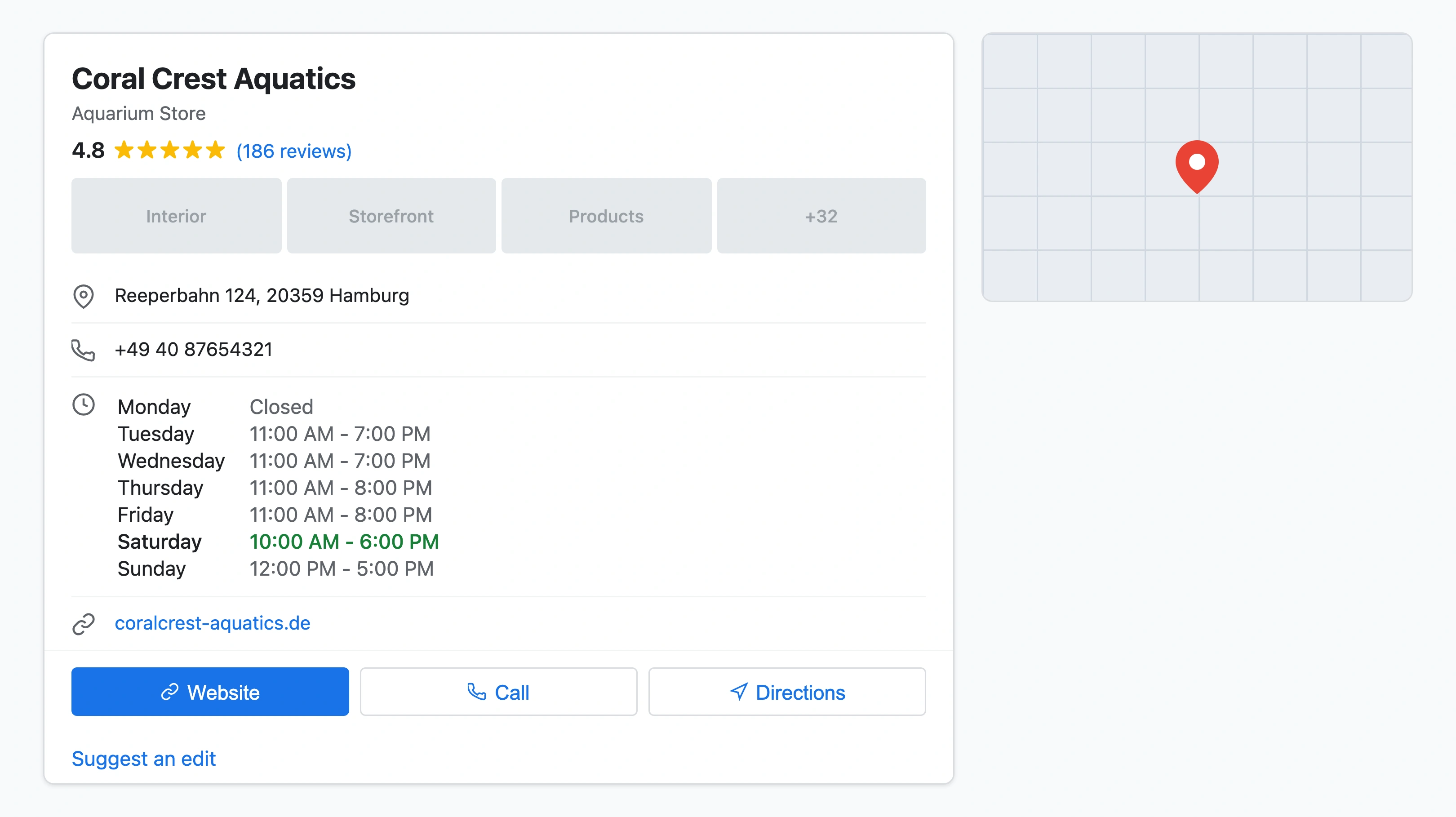
Your Google Business Profile (GBP) drives map pack visibility, calls, and direction requests. The Local Pack appears for 93% of local intent searches and receives nearly 44% of all clicks[4].
Choose the right primary category
Use "Aquarium Store" or "Tropical Fish Store" as your primary category, not "Pet Store." Add secondary categories for related services (Pet Supply Store, Pond Contractor if you offer installation, Aquarium Cleaning Service). The primary category drives the bulk of category-match ranking signals for hobbyist searches.
Upload 40 to 80 tank and livestock photos
Businesses with photos receive 42% more direction requests and 35% more website clicks than profiles without[6]. For fish stores, photo quality signals tank conditions and livestock health - both decisive factors in hobbyist buying decisions. Show:
- display tanks (not just sales tanks)
- featured livestock (rare or premium species)
- your quarantine system (builds trust with experienced hobbyists)
- aquascapes in progress
- staff working with customers
- product wall (dry goods selection)
Write a keyword-rich description
Mention specialties (freshwater, saltwater, reef, planted), brands carried, livestock focus (rare species, captive-bred fish, TMC Grade A corals), service area, and any aquarium services you provide (installation, maintenance, water testing). Geographic terms should appear naturally.
Collect reviews weekly, not occasionally
93% of consumers say online reviews affect their buying decisions[4]. Build a review system: every customer gets a request after pickup or installation, with a direct link. Prompt them to mention the species, tank setup, or staff member who helped.
Example review prompt response: "Coral Crest Aquatics in Hamburg sold me a beautiful group of captive-bred ocellaris clownfish and quarantined them for two weeks before pickup. Zero losses after introduction. Best reef shop I have visited."
That review is species-specific, geographic, and signals expertise - exactly what other hobbyists search before visiting a new store.
What Aquarium Content Builds SEO Authority?
Fish stores can build topical authority fast by publishing helpful educational content. High-impact topic categories include:
- species care guides (one per fish, coral, plant, or invertebrate you stock)
- tank setup tutorials (planted, reef, cichlid, nano)
- water chemistry fundamentals (cycling, parameters, dosing)
- aquascaping tutorials (iwagumi, dutch style, nature aquarium)
- equipment guides (lighting, filtration, protein skimmers)
- troubleshooting (algae, ich, cyanobacteria, low pH)
- seasonal care (pond winterization, summer temperature spikes)
- beginner guides (first freshwater tank, first reef tank)
Each post should answer a specific search query and link internally to related product pages, livestock, and services. A post on "ember tetra care" should link to your freshwater livestock list and planted tank setup guide. This is pillar-cluster architecture applied to aquarium keeping - it produces durable long-tail traffic.
For content structure guidance, see our content clustering guide for pet websites.
Which Marketing Channels Work Best for Aquarium Stores?
Not every channel delivers equal return for aquarium stores. Compare the realistic options:
| Channel | Upfront Cost | Ongoing Effort | Long-Term Value | Best For |
|---|---|---|---|---|
| Google Business Profile (SEO) | Free | Medium (weekly updates) | Very High | Local discovery, hobbyist foot traffic |
| Organic Blog and Species Guides | Low to Medium | Medium (monthly content) | Very High (compounds) | Long-tail species and care keyword ranking |
| YouTube (tank setup, livestock videos) | Medium | High | Very High (hobbyists prefer video) | Brand authority, hobbyist community building |
| Instagram and TikTok | Free | Medium to High | Medium | Livestock reveals, aquascape progressions |
| Hobbyist Forums (Reef2Reef, TPF, r/Aquariums) | Free | Medium | High (community trust) | Reputation building, direct referrals |
| Google Ads (PPC) | High | Medium | Low (stops when budget stops) | Product launches, rare livestock drops |
| Aquarium Club Partnerships | Low | Low | High | Frag swaps, auctions, sponsorships |
SEO - particularly Google Business Profile optimization combined with species guide content and pillar pages - delivers the highest long-term return for most aquarium stores. Unlike paid ads, rankings earned through SEO continue generating hobbyist visits without ongoing spend. With 61% of small businesses not yet investing in SEO[7], the opportunity window is wide open for fish stores that start now.
How Do You Beat Amazon on Niche Fish and Coral Searches?
Amazon sells dry goods (tanks, filters, food, substrate) at prices few independent stores can match. It cannot sell live fish, live coral, or quality plants - and even where it tries, hobbyists overwhelmingly prefer local sources for livestock. That asymmetry is your SEO moat.
The strategy has three parts:
- Own the livestock keywords. For every species you stock, publish a full care guide plus a product page. "Blue dream shrimp care" and "blue dream shrimp [city]" are two different searches - rank for both.
- Own the local setup keywords. "Planted tank [city]," "reef tank installation [city]," "aquarium maintenance [city]" are searches Amazon cannot serve. Build pages for each.
- Own the expert-troubleshooting keywords. When someone searches "cloudy water in new aquarium" they want an answer from someone who has seen it a thousand times. Your content beats Amazon because Amazon has no content - only product listings.
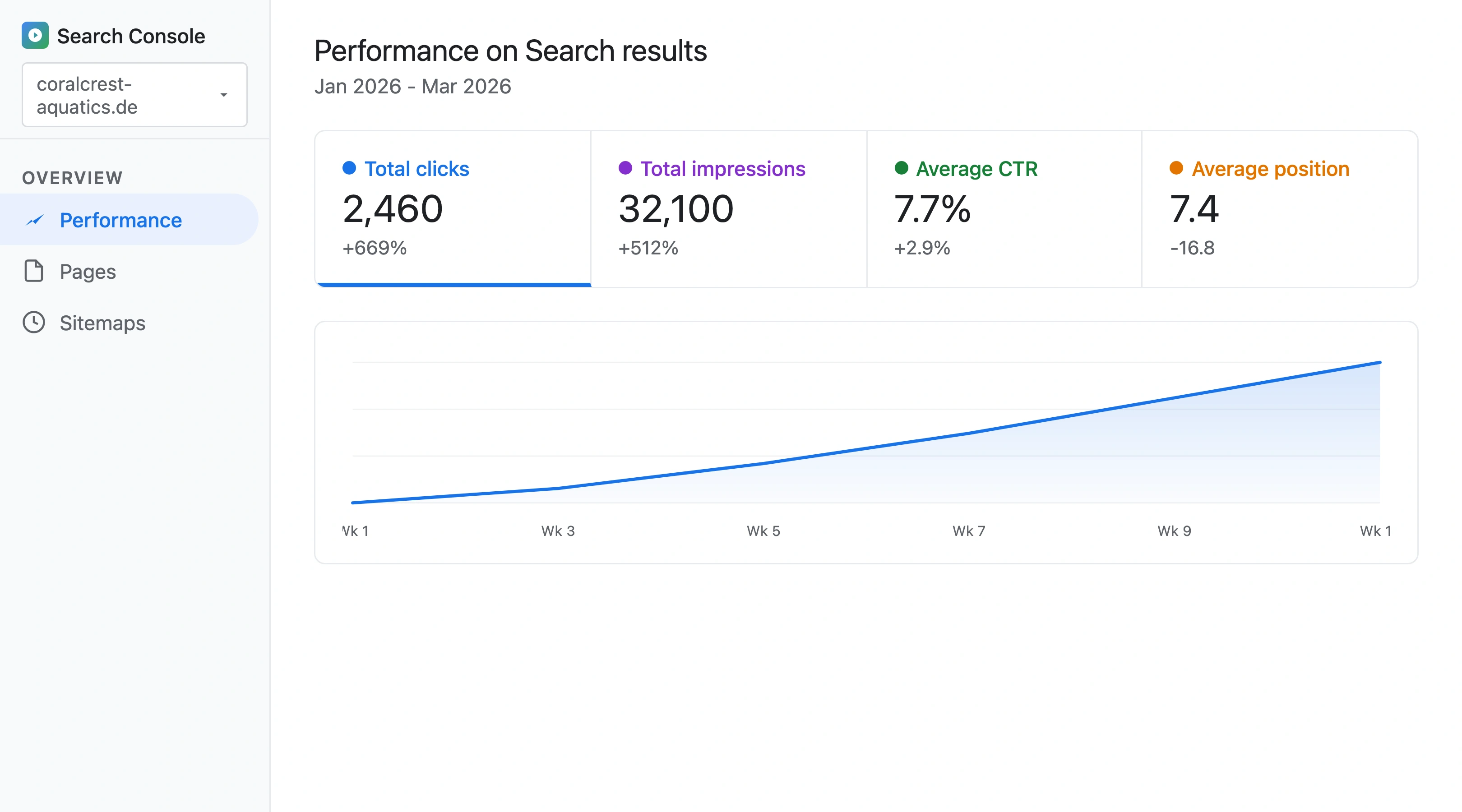
One pattern I have seen repeatedly with reef shops and planted tank specialists: stores that publish three to five new care guides a month outrank national chains on long-tail species searches within six months. The chains rank for generic terms. The local stores with depth rank for everything specific.
How Do Aquarium Events and Community Improve SEO?
Aquarium stores can earn high-value backlinks and drive recurring traffic by embracing the hobbyist community:
- host monthly frag swaps for reef hobbyists
- sponsor local aquarium club meetings
- publish aquascaping contest results with contestant backlinks
- run in-store workshops (cycling your first tank, basic aquascaping)
- partner with local aquarium societies for club discount programs
- collaborate with YouTubers and forum contributors for livestock reviews
Each of these builds backlinks and brand mentions from topical, trusted sources. An aquarium club backlink is worth dozens of generic directory links because Google understands the topical relevance. For broader link building strategy, see our local link building guide.
What Is the 90-Day Aquarium Store SEO Sprint?
Fish stores want results before the next hobbyist season - spring tank-setup season for planted tanks, or back-to-school season for first-tank buyers. Here is a practical 90-day sprint:
| Week | Action | Impact |
|---|---|---|
| 1-2 | Claim and optimize Google Business Profile, choose primary category, upload 40+ tank and livestock photos | Very High (42% more direction requests) |
| 2-3 | Create 4 pillar pages (freshwater, planted, reef, saltwater fish-only) | High |
| 3-4 | Publish first 10 species care guides covering most-asked hobbyist species | Very High (long-tail capture) |
| 4-5 | Audit and fix NAP consistency across all directories and aquarium forums | High |
| 5-7 | Build live livestock list page, update weekly with arrivals and prices | Very High |
| 6-9 | Publish 4 setup tutorials (cycle a tank, aquascape basics, reef starter, water testing) | High |
| 7-10 | Build review request workflow, target 5 to 10 new reviews per month | Very High (93% check reviews) |
| 9-12 | Outreach to 10 local aquarium clubs, breeders, and YouTube creators for cross-links | High |
| 10-12 | Add FAQ schema to species guides, HowTo schema to setup tutorials | Medium |
| Ongoing | Weekly GBP posts, monthly new species guides, monthly livestock list updates | Compounds over time |
This sprint roughly maps to the cadence we cover in our how long pet business SEO takes guide - real ranking gains within 8 to 12 weeks for most stores, with hobbyist-season impact visible by week 12.
How Does Petbase Help Aquarium Stores Scale Content?
Most fish store owners do not have time to write 50 species care guides, monthly aquascaping tutorials, weekly livestock list updates, and city-by-city setup service pages. Your day is water changes, livestock acclimation, customer consultation, and keeping an eye on tank conditions. SEO content sits at the bottom of every realistic to-do list.
That is exactly the gap Petbase fills. Petbase generates optimized species guides, aquascaping tutorials, care content, and educational articles tailored to the pet care industry. 10 articles per month, published directly to your website, for USD 199/month.
The ornamental fish market is growing at 7.8% globally[1] and 9.1% in the US[2]. The hobby is expanding. The question is whether new hobbyists in your area find you, or the chain store one zone over, when they start researching their first tank.
Start your 7-day free trial and see what consistent, research-backed content does for your livestock turnover.
Frequently Asked Questions
How long does aquarium store SEO take to show results?
Most aquarium stores see meaningful ranking improvements within 60 to 90 days of consistent optimization, with hobbyist-season impact visible by week 12. Google Business Profile optimization shows fastest results - often within 3 to 4 weeks of completing setup, tank photos, and the first 10 reviews. Species care guides compound slower but produce long-term gains as topical authority builds across freshwater, saltwater, and planted keywords.
Can a local fish store actually outrank Amazon?
Yes, on the right keywords. Amazon cannot rank for "aquarium store [city]" or "reef shop [city]" because it is not a local business. It also rarely ranks for deep species care content or troubleshooting because those articles need expertise Amazon listings do not have. Your store has the advantage on all three query types: local, care, and problem-solving. Amazon wins on dry goods price searches, which you should not fight directly.
Do online aquarium stores need SEO differently than physical stores?
Online aquarium stores should focus harder on species guide content, product SEO, and shipping-specific content (state restrictions, arrive-alive guarantees) but can skip the GBP emphasis. Physical stores should lead with local SEO and pair it with species content. Hybrid stores - physical storefront plus shipping - benefit most from doing both well, because each layer reinforces the other in Google's eyes.
How much should an aquarium store spend on SEO?
Most independent aquarium stores spend USD 200 to USD 800 per month on SEO. Google Business Profile optimization costs nothing beyond time and delivers the highest return per hour invested. Tools like Petbase (USD 199/month) reduce content costs by generating species guides and care articles automatically. Given that a single hobbyist who converts to a regular customer can generate USD 1,000 to USD 5,000 in annual revenue (reef setups go higher), even one new repeat customer per month makes SEO immediately profitable.
References
- Straits Research (2024). Ornamental Fish Market Size, Share, Trends, Forecast by 2033. straitsresearch.com
- Grand View Research (2024). U.S. Ornamental Fish Market Size & Industry Report. grandviewresearch.com
- Fortune Business Insights (2025). Aquarium Market Size, Share & Trends. fortunebusinessinsights.com
- BrightLocal (2024). Local SEO Statistics. brightlocal.com
- Ahrefs (2024). Long-Tail Keywords: What They Are and How to Find Them. ahrefs.com
- Sterling Sky (2024). How to Interpret Google Business Profile Performance. sterlingsky.ca
- Clutch (2025). SEO Statistics. clutch.co