Breed Guides: Top Traffic Content for Pet Stores


Table of Contents +
- Why Do Pet Stores Keep Losing to Amazon on Generic Keywords?
- How Large Is the Search Volume for Breed-Specific Queries?
- What Makes Breed Content Convert Better Than Generic Pet Content?
- How Do Breed Guides Form Natural Content Clusters?
- What Should a Pet Store Breed Guide Actually Cover?
- How Do You Prioritize Which Breeds to Write About First?
- How Does Breed Content Connect to E-commerce Revenue?
- How Do Breed Guides Perform in AI Search and Voice Queries?
- What Does a Breed Guide Content Calendar Look Like?
- What Mistakes Should Pet Stores Avoid With Breed Content?
- Frequently Asked Questions
- References
Breed-specific content drives more traffic than generic pet keywords. Learn how to build breed guide clusters that rank, convert, and build topical authority.
Most pet stores target the same generic keywords: "dog food," "cat toys," "pet supplies." They compete head-to-head with Amazon, Chewy, and every other retailer in the market. The result is predictable. Their content ranks on page 5 or worse, and organic traffic stays flat month after month.
There is a better approach. Breed-specific content - guides about Golden Retriever nutrition, French Bulldog health issues, Labrador exercise needs - attracts more search traffic, faces less competition, and converts at higher rates than generic pet content. The math is simple: 205 recognized dog breeds[1] multiplied by dozens of search modifiers (food, health, grooming, training, size, temperament) creates thousands of targetable keywords that most pet stores completely ignore.
TL;DR
Breed-specific content is the highest-ROI content type for pet stores. With 200+ dog breeds and 70+ cat breeds, each generating dozens of long-tail keyword variations, breed guides create thousands of low-competition search opportunities. These queries convert 2.5x higher than generic terms and naturally form content clusters that build topical authority. Pet stores that build breed guide clusters outperform those chasing generic keywords.
Why Do Pet Stores Keep Losing to Amazon on Generic Keywords?
The fundamental problem is competition density. A keyword like "best dog food" has a keyword difficulty score above 80 on most SEO tools. The first page is dominated by Amazon, Chewy, PetSmart, and major media publishers with domain authorities above 70. A pet store with a domain authority of 20-30 has virtually zero chance of ranking for these terms.
This is not a content quality problem. It is a strategic positioning problem. Organic search drives 53% of all tracked website traffic[2], and 43% of all e-commerce traffic comes specifically from organic Google search[3]. The traffic is there. The question is which keywords you target to capture it.
Generic keywords attract broad audiences with unclear intent. Someone searching "dog food" could be researching ingredients, comparing brands, looking for a recipe, or writing a school report. Breed-specific queries signal much clearer intent. Someone searching "best food for French Bulldog puppy" owns or is getting a French Bulldog puppy and is ready to buy food. The purchase intent is built into the query itself.
In 25 years of SEO consulting, I have seen this pattern repeat across dozens of pet store clients. The stores that chase head terms spend years on page 3. The stores that build breed-specific content libraries reach page 1 within months - because the competition simply is not there yet. For deeper guidance on choosing the right keywords for your pet store, see our keyword research guide for pet businesses.
Petbase automates SEO content for pet stores - publishing 10 optimized articles monthly so you can focus on running your shop - start your free trial.
How Large Is the Search Volume for Breed-Specific Queries?
The numbers are significant. The Golden Retriever alone generates over 1 million average monthly searches in the US - 40% more than the next most popular breed[4]. That is just the breed name itself. Add modifiers and the keyword universe expands dramatically.
Consider what happens when you map a single breed across common search modifiers:
| Query Type | Example (Golden Retriever) | Example (French Bulldog) | Intent |
|---|---|---|---|
| Nutrition | best food for golden retriever | best food for french bulldog puppy | Commercial |
| Health | golden retriever hip dysplasia | french bulldog breathing problems | Informational |
| Grooming | golden retriever shedding solutions | french bulldog skin care routine | Commercial |
| Training | golden retriever recall training | french bulldog potty training tips | Informational |
| Products | golden retriever harness size | french bulldog cooling vest | Transactional |
| Life stage | senior golden retriever diet | french bulldog puppy weight chart | Informational |
| Conditions | golden retriever joint supplements | french bulldog allergy food | Commercial |
Each breed generates at least 20-30 viable keyword variations. With 205 AKC-recognized dog breeds[1] and 73 cat breeds recognized by TICA[5], the total addressable keyword space runs into the tens of thousands. Most pet stores target fewer than 50 keywords total. Breed guides unlock a keyword universe that is 100x larger.
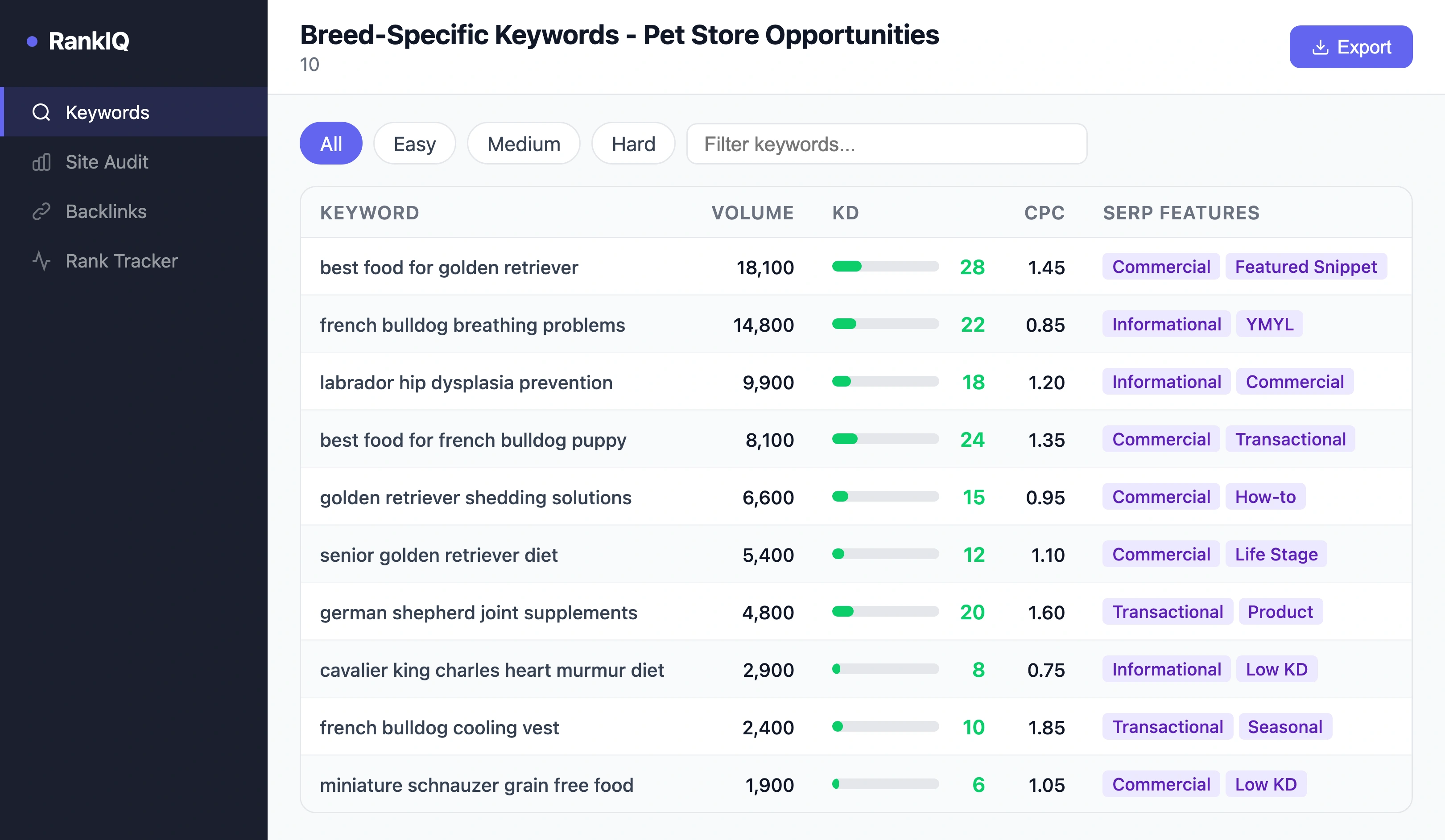
Long-tail keywords (3 or more words) account for 70% of all searches and convert at a 36% average rate - nearly 2.5x higher than short-tail keywords[6]. Breed queries are inherently long-tail. Nobody searches "food" - they search "best grain-free food for miniature schnauzer." This specificity is exactly what makes breed content so valuable for pet stores.
What Makes Breed Content Convert Better Than Generic Pet Content?
Conversion happens when content matches intent precisely. Breed-specific content does this by default because the reader has already self-selected into a narrow audience. They do not want general pet advice. They want advice for their specific breed.
The data supports this. Over half of all searches (52.65%) are informational[7], meaning people are looking for answers, not products. But breed-specific informational queries carry embedded commercial intent. A reader learning about "Labrador hip dysplasia prevention" is one paragraph away from buying joint supplements. A reader researching "Cavalier King Charles heart murmur diet" is one recommendation away from purchasing specialized cardiac-support food.
Royal Canin built an entire business model around this insight. Their breed-specific formulas command a 30-50% price premium over standard pet food[8]. Pet owners willingly pay more because they trust breed-specific products to address their dog or cat's unique needs. The same psychology applies to content. Breed-specific articles build trust faster than generic guides because they demonstrate that you understand the reader's specific situation.
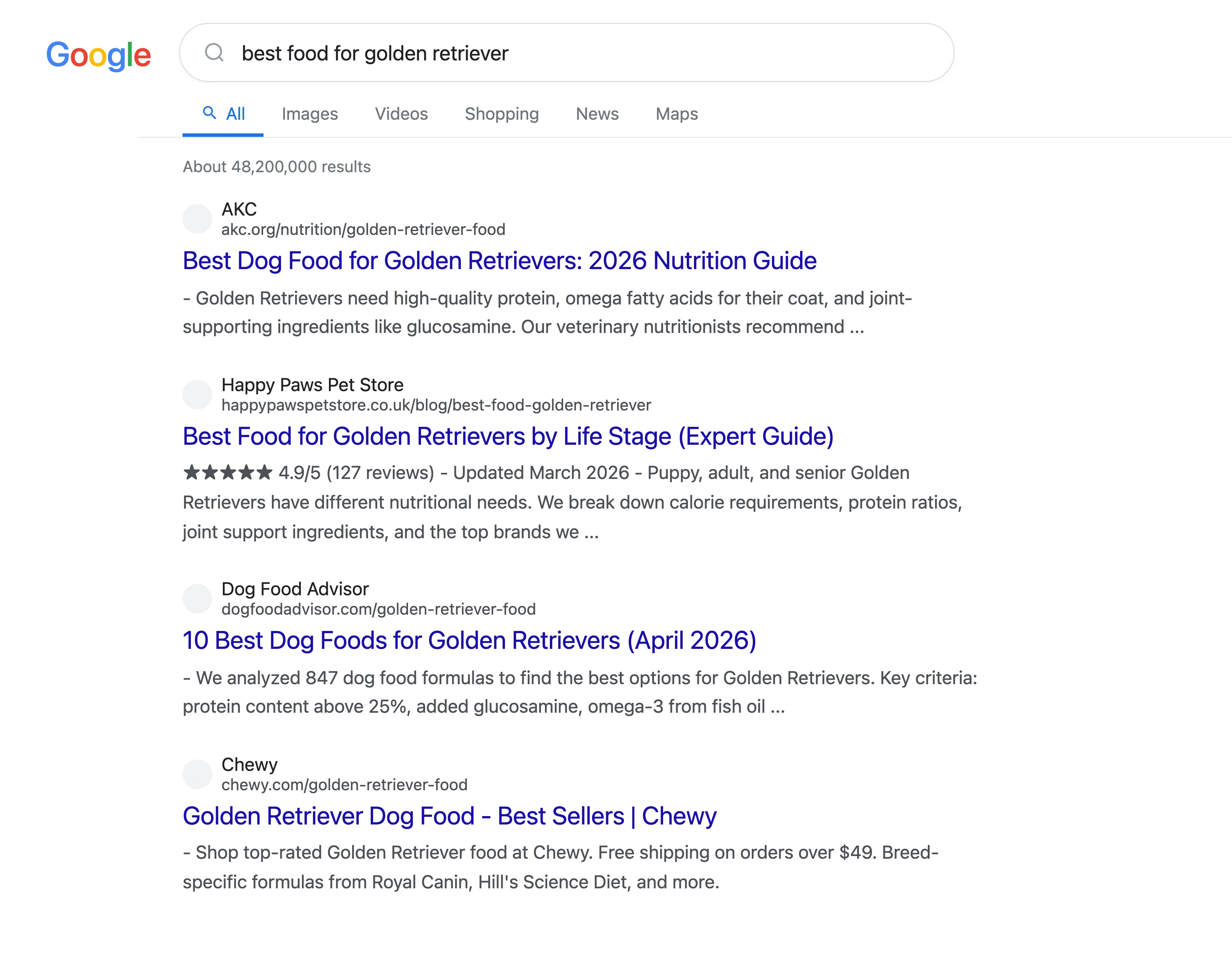
73% of European pet owners consider their pets' nutritional needs equivalent to human family members[9]. When these owners search for breed-specific health or nutrition guidance, they are not casual browsers. They are motivated buyers looking for expert guidance. Your breed guide is the first touchpoint in a purchasing journey. To learn more about how health-focused pet content builds trust with Google, read our guide on pet health content that Google trusts.
How Do Breed Guides Form Natural Content Clusters?
Content clusters drive 30% more organic traffic and hold rankings 2.5x longer than standalone articles[10]. Breed guides are one of the most natural cluster structures in the entire pet industry.
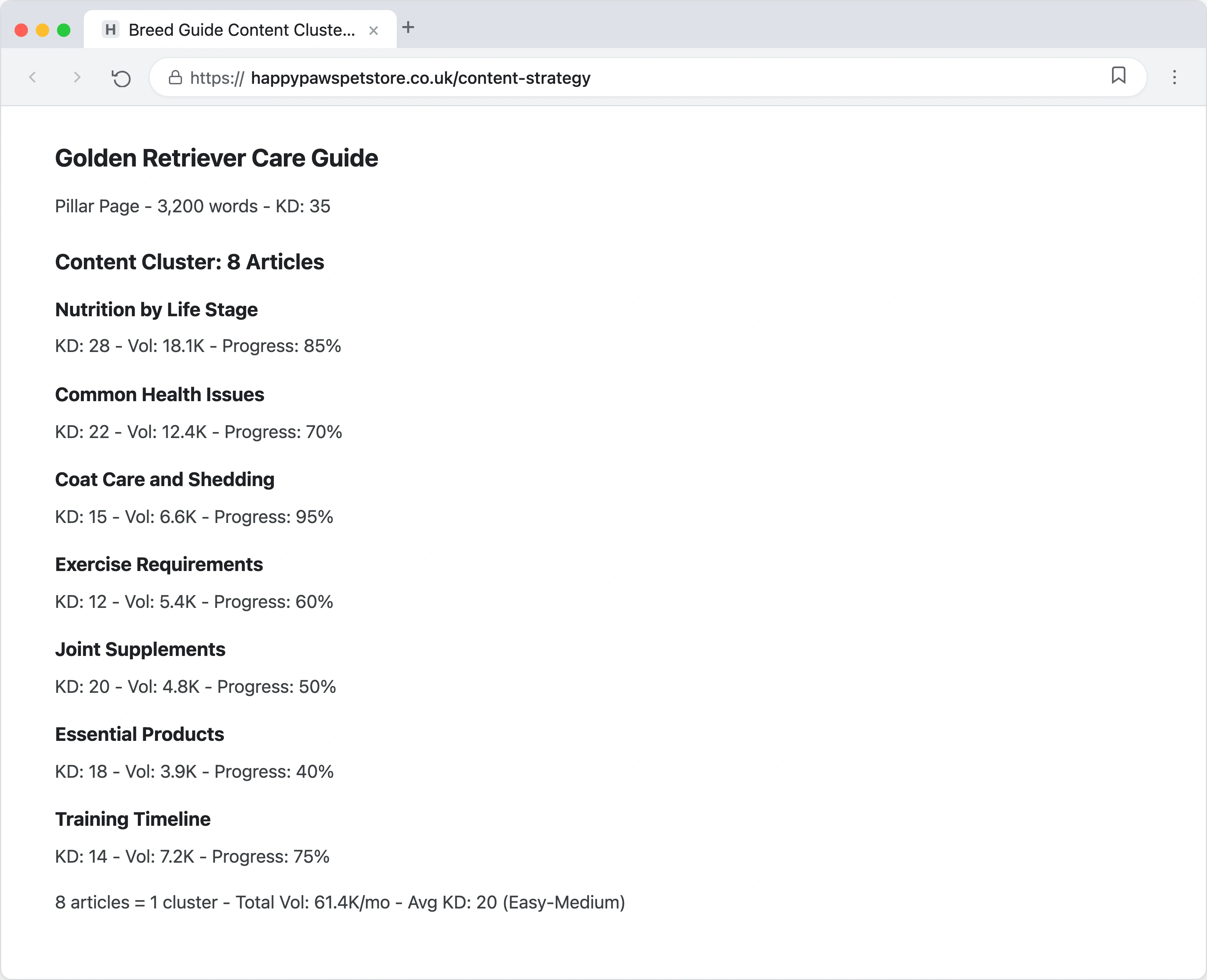
Here is how a single breed cluster works. Take "Golden Retriever" as the pillar topic. The cluster radiates outward into subtopics that each become their own article:
- Pillar: The Complete Golden Retriever Care Guide
- Nutrition spoke: Best Food for Golden Retrievers by Life Stage
- Health spoke: Common Golden Retriever Health Issues and Prevention
- Grooming spoke: Golden Retriever Coat Care and Shedding Management
- Training spoke: Golden Retriever Training Timeline From Puppy to Adult
- Exercise spoke: How Much Exercise Does a Golden Retriever Need
- Products spoke: Essential Products Every Golden Retriever Owner Needs
- Supplements spoke: Joint Supplements for Golden Retrievers - What Works
That is 8 articles from a single breed. Each article targets a distinct long-tail keyword, links to the pillar and 2-3 siblings, and collectively they signal to Google that your site is an authority on Golden Retrievers. A study of 50 websites implementing pillar-cluster architecture found a 63% increase in primary topic keyword rankings within 90 days[11].
Now multiply that across 10 popular breeds and you have 80 interlinked articles, each targeting a specific keyword, each reinforcing the others. This is the compounding effect of clusters. Only 10% of blog posts become compounding content, yet those posts generate 38% of total blog traffic[12]. Breed clusters are designed to compound from day one because they are interconnected by design.
For a deep dive into how content clusters work for pet websites, read our content clustering guide.
What Should a Pet Store Breed Guide Actually Cover?
Not all breed content performs equally. The highest-traffic breed guides share a common structure that addresses the questions pet owners actually search for. Here is the template that works:
Section 1: Breed overview and temperament. Cover size, weight range, life expectancy, energy level, and personality traits. This section captures "what is a [breed] like" queries and serves as the pillar for the breed cluster.
Section 2: Nutrition by life stage. Puppy, adult, and senior nutritional requirements specific to the breed. Calorie needs, protein ratios, breed-specific sensitivities (for example, Golden Retrievers are prone to obesity, so portion control guidance is essential). Link directly to relevant products in your store.
Section 3: Common health issues. Every breed has predictable health concerns. French Bulldogs have brachycephalic airway syndrome. German Shepherds have hip dysplasia. Cavalier King Charles Spaniels have mitral valve disease. Covering these conditions with accurate, veterinary-aligned information positions your store as a trusted resource - not just a retailer.
Section 4: Grooming requirements. Coat type, shedding frequency, bathing schedule, recommended tools. This section converts directly to grooming product sales.
Section 5: Exercise and training. Activity needs by life stage, training recommendations, behavioral traits unique to the breed. This captures informational queries that bring readers into your content ecosystem.
Section 6: Product recommendations. Breed-appropriate food, supplements, toys, beds, harnesses, and grooming tools. This is where informational content becomes transactional. Every recommendation links to a product page in your store.
Companies with blogs generate 55% more website traffic and 67% more leads than those without[12]. Breed guides are the highest-performing blog content type for pet stores because every section naturally connects to products you sell. For a broader strategy on building your pet store blog, see our pet store blog strategy guide.
How Do You Prioritize Which Breeds to Write About First?
You cannot cover 278 breeds (205 dogs + 73 cats) at once. Prioritization determines how fast you see results. Here is a ranking framework based on three factors:
Factor 1: Search volume. Start with the breeds people actually search for. The top 20 dog breeds by search volume cover approximately 60% of all breed-related queries. The French Bulldog, Labrador Retriever, Golden Retriever, German Shepherd, and Poodle consistently lead search interest[13]. Covering the top 20 breeds first captures the majority of available traffic.
Factor 2: Product alignment. Prioritize breeds that match your inventory. If you specialize in large-breed nutrition, start with Golden Retrievers, German Shepherds, and Labrador Retrievers. If you sell brachycephalic health products, start with French Bulldogs, English Bulldogs, and Pugs. The closer the breed guide aligns to your product catalog, the shorter the path from content to conversion.
Factor 3: Competition gaps. Check which breeds your competitors have already covered. Many pet stores have zero breed-specific content. If your direct competitors have not written about Cavalier King Charles Spaniels or Bernese Mountain Dogs, those breeds represent open ranking opportunities even if their overall search volume is lower.
One pattern I have observed across pet store clients is that mid-popularity breeds (ranked 15th-40th in search volume) often deliver the fastest results. They have enough search demand to drive meaningful traffic but low enough competition that a well-written guide can reach page 1 within 8-12 weeks. The top 5 breeds are more competitive, but they build the strongest authority signals once you rank. For a complete SEO roadmap for your pet store, see our pet store SEO guide.
How Does Breed Content Connect to E-commerce Revenue?
Breed guides are not just traffic magnets. They are revenue drivers. The connection between breed content and product sales follows a clear path:
Step 1: Breed guide attracts reader. A pet owner searches "best food for Labrador Retriever puppy" and lands on your guide.
Step 2: Guide builds trust. Your article covers Labrador-specific nutritional needs - higher protein for growth, glucosamine for joint development, portion control to prevent the breed's tendency toward obesity. The reader recognizes you understand their dog's needs.
Step 3: Product recommendation converts. Within the guide, you recommend specific products from your catalog with internal links to product pages. The reader clicks through and purchases.
86% of e-commerce brands lack optimized internal links[3]. Breed guides solve this by creating a natural internal linking structure: breed guide links to product pages, product pages link back to related breed guides, and both link to category pages. This internal linking network distributes authority across your entire site.
The global pet care market is valued at $273.42 billion[14], and e-commerce accounts for a growing share. 139 million European households own at least one pet[15]. These pet owners are searching online for breed-specific guidance before they buy. If your store provides that guidance, you capture both the traffic and the sale. If you do not, Amazon does.
For more on connecting SEO to e-commerce results, read our e-commerce SEO guide for pet stores.
How Do Breed Guides Perform in AI Search and Voice Queries?
Breed content is uniquely positioned for the shift toward AI-powered search. Pets and Animals queries trigger AI Overviews 36.8% of the time - the third highest category after Science and Health[16]. This means breed-specific questions are among the most likely to generate AI-synthesized answers at the top of Google results.
To appear in AI Overviews, your content needs to be the source Google's AI extracts from. Structured, factual, breed-specific content performs well here because AI systems prefer clear, authoritative answers to specific questions. A well-structured breed guide that answers "how much should a French Bulldog puppy eat" with precise, life-stage-specific data is exactly what AI Overviews pull from.
Voice search amplifies this further. Voice queries are conversational and specific - "Hey Google, what is the best food for a senior Golden Retriever" - which aligns perfectly with long-tail breed queries. Google's 2025 ranking factors weight niche expertise at 13% and consistent publication of satisfying content at 23%[17]. A library of breed guides signals both niche expertise and consistent quality.
Only 5.7% of newly published pages rank in Google's top 10 within one year[18]. Breed clusters improve these odds because each new article inherits authority from the existing cluster. Your 15th breed article ranks faster than your first because Google already trusts your site for breed-related content. Learn more about how niche pet stores can build this authority in our guides on veterinary clinic SEO and dog training business SEO.
What Does a Breed Guide Content Calendar Look Like?
A realistic content calendar for a pet store publishing 10 articles per month covers 2-3 breeds per month if you build full clusters, or one breed per week if you publish individual guides first and expand into clusters later.
Month 1-2: Foundation breeds (top 5 by search volume)
- French Bulldog - complete cluster (pillar + 4 spokes)
- Golden Retriever - complete cluster (pillar + 4 spokes)
- 2 standalone guides for Labrador Retriever and German Shepherd
Month 3-4: Expansion (breeds 6-15)
- Poodle and Dachshund clusters
- Standalone guides for Rottweiler, Beagle, Bulldog, Yorkshire Terrier
- Begin cat breed clusters: Maine Coon, Ragdoll
Month 5-6: Long-tail capture (breeds 16-30 + cross-breed content)
- Complete remaining clusters from Month 3-4
- Add Cavalier King Charles, Bernese Mountain Dog, Australian Shepherd
- Cross-breed comparison content: "Golden Retriever vs Labrador - Which Is Right for You"
After 6 months at 10 articles per month, you have 60 breed-related articles covering 20-25 breeds with full cluster structures for your top performers. 76% of blog traffic comes from older posts published months or years ago[12]. Your Month 1 content is already compounding by Month 6, driving traffic while newer content builds additional keyword coverage.
Long-form content (3,000+ words) receives an average of 3,000 more backlinks than shorter posts[19]. Your breed pillar pages naturally hit this word count, attracting backlinks that strengthen the entire cluster. For a complete approach to building your pet store content calendar, see our blog strategy guide.
What Mistakes Should Pet Stores Avoid With Breed Content?
Breed content fails when stores make these common errors:
Mistake 1: Generic content dressed as breed-specific. Writing "feed your dog high-quality food" and slapping a breed name in the title does not work. Google and readers both recognize thin content. Each breed guide must contain genuinely breed-specific information - calorie ranges, known health predispositions, coat-specific grooming needs, breed temperament considerations.
Mistake 2: No internal linking strategy. Publishing 30 breed articles with no links between them wastes 80% of the SEO value. 86% of e-commerce brands lack optimized internal links[3]. Every breed article should link to related breed articles, relevant product pages, and your broader content clusters.
Mistake 3: Ignoring health accuracy. Pet health content falls under Google's YMYL (Your Money or Your Life) guidelines. Inaccurate breed health information can trigger quality penalties. All health claims should be aligned with veterinary consensus, and articles should include clear disclaimers directing readers to consult their veterinarian for medical advice.
Mistake 4: Only covering dogs. Cat breeds are underserved in pet store content. 139 million European households own at least one pet[15], and cats are the most popular pet in many European countries. Germany alone has 15.7 million cats. Maine Coon, Ragdoll, British Shorthair, and Bengal cat guides face less competition than dog breed content and can drive significant traffic.
Mistake 5: Publishing without a cluster plan. Random breed articles do not compound. A breed guide for Dachshunds published in January and a Golden Retriever guide in March with no connection between them are just two isolated articles. Plan your clusters before you write. Map the pillar, spokes, and internal links in advance.
Frequently Asked Questions
How many breed guides does a pet store need before seeing SEO results?
A complete cluster for one breed (pillar + 5-7 spokes) typically reaches page 1 rankings within 8-12 weeks. Content clusters drive 30% more organic traffic than standalone articles[10]. Start with 2-3 complete breed clusters (15-20 articles) and expand from there. Most pet stores see measurable organic traffic growth after publishing their first 10-15 breed articles within a cluster structure.
Should breed guides recommend specific product brands?
Yes, but with transparency. Recommend products you genuinely carry and believe in, and explain why they suit the breed's specific needs. A French Bulldog guide recommending a slow-feeder bowl should explain that the breed is prone to eating too fast due to their shortened muzzle. Product recommendations backed by breed-specific reasoning convert better than generic "best of" lists. Always prioritize accuracy over promotion.
Can breed guides work for niche pet stores that only sell one product category?
Absolutely. A store specializing in pet supplements can write breed-specific supplement guides for every major breed - "Joint Supplements for German Shepherds," "Skin Supplements for French Bulldogs," "Digestive Supplements for Golden Retrievers." The breed is the traffic magnet, and your product category is the conversion path. Long-tail keywords convert at 2.5x the rate of generic terms[6], and breed + product category queries are highly specific long-tail keywords by nature.
How do breed guides help with local SEO for physical pet stores?
Combine breed content with location modifiers: "Best Golden Retriever Grooming in Munich" or "French Bulldog Food Delivery in London." Local breed content captures pet owners searching for breed-specific products and services near them. 46% of all Google searches have local intent[20], and breed + location queries face minimal competition in most markets.
References
- American Kennel Club (2025). Dog Breeds - Types of Dogs. akc.org
- BrightEdge (2025). How Much Traffic Comes from Organic Search. seoinc.com
- Charle Agency (2026). Ecommerce SEO Statistics. charleagency.com
- MetLife Pet Insurance (2025). America's Favorite Breeds: Most Searched Dogs and Cats by State. metlifepetinsurance.com
- TICA - The International Cat Association (2025). Browse All Breeds. tica.org
- Embryo / Ranktracker (2025). 30 Statistics About Long-Tail Keywords. embryo.com
- Amra and Elma (2025). Top Search Intent Statistics. amraandelma.com
- Mars Incorporated / Royal Canin (2025). Royal Canin Revenue and Market Share. aeo.sig.ai
- Market Data Forecast (2025). Europe Pet Market Report. marketdataforecast.com
- HireGrowth (2025). Topic Clusters vs Keyword Targeting: Which Wins. hiregrowth.ai
- Search Engine Land / Backlinko (2025). The Complete Guide to Topic Clusters and Pillar Pages for SEO. searchengineland.com
- HubSpot (2025). Marketing Statistics. hubspot.com
- American Kennel Club (2025). The Most Popular Dog Breeds of 2025. akc.org
- Fortune Business Insights (2025). Pet Care Market Size and Growth. fortunebusinessinsights.com
- FEDIAF (2025). European Pet Food Industry Statistics. europeanpetfood.org
- Ahrefs / Position Digital (2025). AI SEO Statistics. position.digital
- First Page Sage (2025). The Google Algorithm Ranking Factors. firstpagesage.com
- Ahrefs (2025). How Long Does It Take to Rank in Google. ahrefs.com
- BuzzStream (2025). Link Building Statistics. buzzstream.com
- BrightLocal (2025). Local SEO Statistics. brightlocal.com