How to Build Backlinks for Your Pet Store


Table of Contents +
- Why Backlinks Still Matter for Pet Store Rankings
- The Opportunity: Most Pet Stores Are Not Building Links
- What Types of Backlinks Work Best for Pet Businesses?
- How to Get Links From Pet Industry Directories
- How to Earn Links Through Pet Content
- How to Build Links Through Local Partnerships
- How Pet Suppliers and Brands Can Link to You
- What About Guest Posting in the Pet Niche?
- How Many Backlinks Does a Pet Store Need to Rank?
- Backlink Tactics to Avoid
- How Petbase Helps You Earn Backlinks Faster
- Frequently Asked Questions
- References
Build quality backlinks for your pet store with research-backed strategies. Covers directories, content links, local partnerships, supplier links, and tactics to avoid.
Backlinks - links from other websites to yours - remain one of Google's top ranking factors. Yet most pet store owners either ignore link building entirely or resort to spammy tactics that do more harm than good. The pet industry is community-driven, emotionally resonant, and full of natural partnership opportunities - which means you already have an advantage when it comes to earning links.
You do not need to send 500 cold emails begging for links. You do not need to buy links from shady directories. And you do not need to spend thousands on a link building agency. This guide covers practical, research-backed ways to build quality backlinks for your pet store using the assets, relationships, and content you already have (or can easily create).
Why Backlinks Still Matter for Pet Store Rankings
Backlinks function as votes of confidence. When a reputable pet blog, local news site, or industry directory links to your pet store, it tells Google: "This website is trustworthy and relevant." More quality votes mean higher rankings.
The data confirms this. An analysis of 11.8 million Google search results found that the #1 result has an average of 3.8x more backlinks than positions #2 through #10[1]. That gap is not random. Backlinks remain one of the strongest correlations with higher rankings.
For pet stores specifically, backlinks matter because:
- You compete with high-authority sites. Chewy, PetSmart, Amazon, and veterinary publishers have massive backlink profiles. You cannot match their volume, but you can build targeted, niche-relevant links that carry disproportionate weight.
- Local links boost local rankings. 46% of all Google searches have local intent[2]. Links from local businesses, community organizations, and regional media strengthen your Google Business Profile rankings - directly driving foot traffic.
- Pet industry links build topical authority. A link from a pet nutrition blog to your dog food guide signals to Google that your content is recognized by relevant experts.
- Links compound over time. Unlike paid ads that stop when you stop paying, a quality backlink continues sending authority to your pages for years.
The key word is quality. One link from a respected pet industry publication is worth more than 100 links from random, unrelated directories. Focus on relevance and authority, not volume.
Petbase automates SEO content for pet stores - publishing 10 optimized articles monthly so you can focus on running your shop - start your free trial.
The Opportunity: Most Pet Stores Are Not Building Links
The global pet care market is worth $273.42 billion[3], yet 61% of small businesses are still not investing in SEO[4]. That gap is your opportunity.
Organic search drives 53% of all website traffic[5]. If your pet store is not earning backlinks, you are leaving the single largest traffic channel to your competitors. The good news: because most pet stores are not doing link building at all, even a modest effort puts you ahead.
What Types of Backlinks Work Best for Pet Businesses?
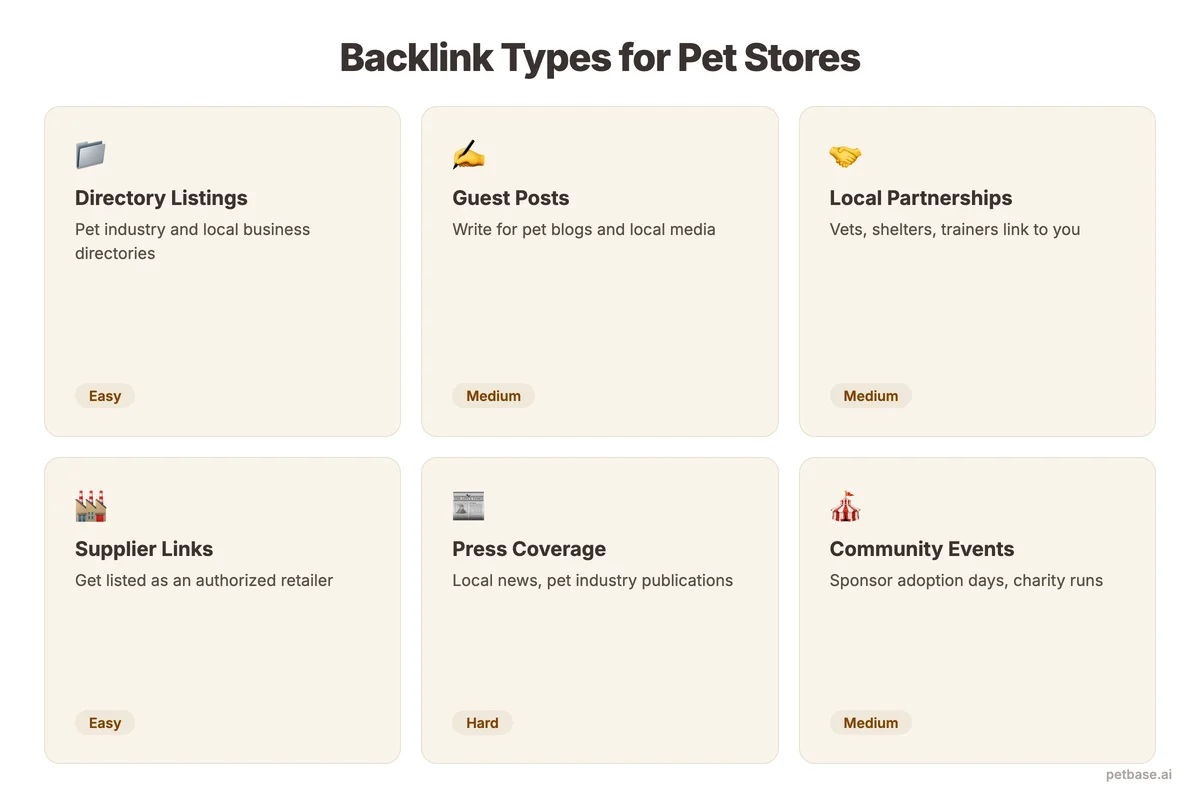
Not all backlinks are equal. For pet businesses, certain link types deliver far more ranking impact than others.
| Link Type | Authority Level | Relevance | Effort to Acquire | Value for Pet Stores |
|---|---|---|---|---|
| Pet industry publication mentions | High | Very high | Medium | Very high - topical authority + traffic |
| Local news/media coverage | High | High (local) | Medium | High - local SEO boost + brand visibility |
| Pet blogger reviews/features | Medium-high | Very high | Low-medium | High - targeted audience + authority |
| Supplier/brand partner pages | Medium-high | High | Low | High - easy to get, relevant |
| Local business directories | Medium | High (local) | Low | Medium-high - foundation for local SEO |
| Pet industry directories | Medium | Very high | Low | Medium-high - targeted traffic + authority |
| Community organization links | Medium | Medium-high | Low | Medium - local trust signals |
| Social media profiles | Low | Medium | Very low | Low-medium - indirect signals only |
| Forum and comment links | Very low | Varies | Low | Low - minimal SEO value, some referral traffic |
Focus your efforts on the top half of this table. Pet industry publications, local media, blogger relationships, supplier partnerships, and relevant directories deliver the most value for the least effort.
How to Get Links From Pet Industry Directories
Pet industry directories are the easiest starting point for link building. Submitting your business to relevant directories takes minimal effort and builds a foundation of niche-relevant links that strengthen your site's authority.
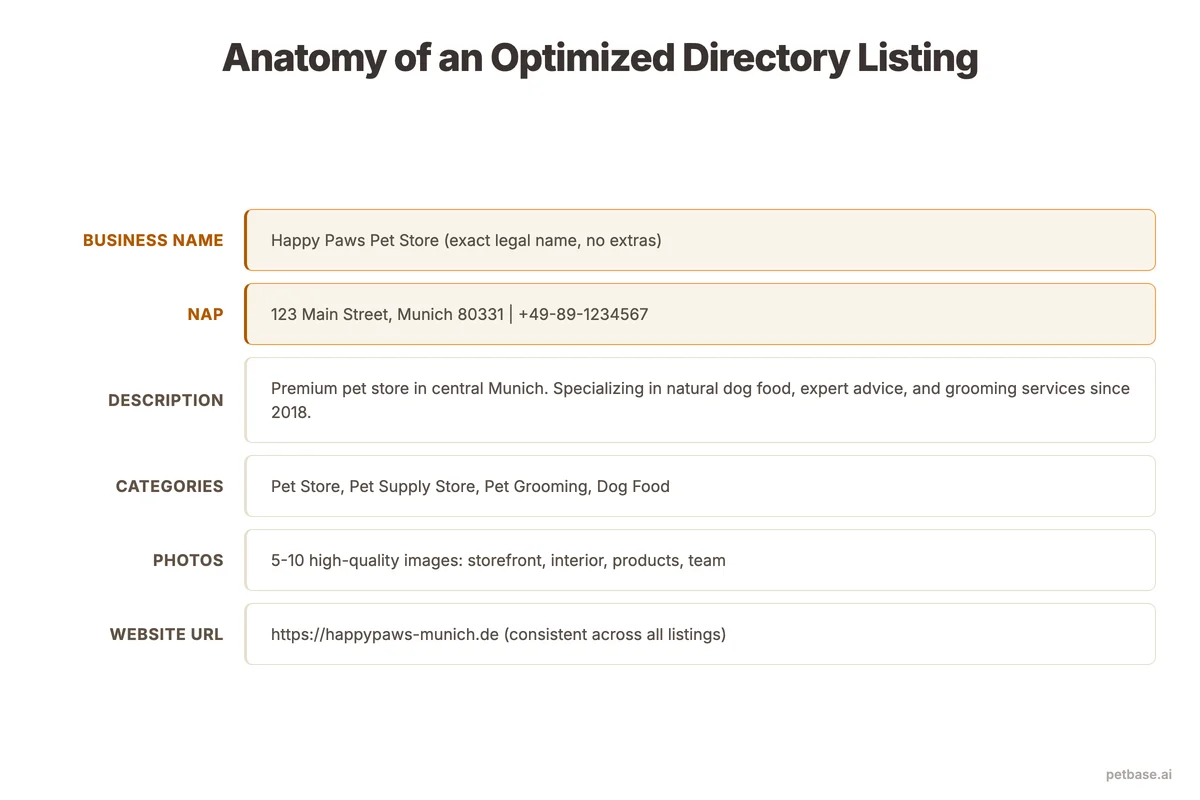
Here are directories worth submitting to:
| Directory | Estimated DA | Cost | Submission Process |
|---|---|---|---|
| BringFido | 55+ | Free basic listing | Submit online, verified within 1-2 weeks |
| Yelp | 90+ | Free | Claim your business listing |
| Trustpilot | 90+ | Free basic | Claim your business profile |
| Local Chamber of Commerce | 40-70 | Membership fee (varies) | Join as member, listed on website |
| Google Business Profile | 100 | Free | Verify and complete your profile |
| Bing Places | 95+ | Free | Claim and verify your listing |
| Apple Maps | 95+ | Free | Submit through Apple Business Connect |
| Facebook Business | 95+ | Free | Create business page |
| Better Business Bureau | 80+ | Membership fee | Apply for accreditation |
| Local pet directories (country-specific) | 20-50 | Free to paid | Varies by directory |
Directory listings also build trust with customers. 93% of consumers say online reviews affect their buying decisions[6], and directories like Yelp and Trustpilot double as review platforms.
Submission tips:
- Use consistent NAP (name, address, phone) across all directories - inconsistencies weaken your local SEO
- Fill out every available field: description, categories, photos, hours, services
- Choose the most specific category available ("Pet Store" not "Retail")
- Add your website URL - this is the actual backlink
- Submit to 15-25 directories as a baseline, then add niche-specific ones
For a complete citation strategy, read our guide on local citations for pet businesses.
How to Earn Links Through Pet Content
The most sustainable link building strategy is creating content that other websites want to link to. 90% of marketers use content marketing specifically to build backlinks[7], and it works exceptionally well in the pet industry because pet content is highly shareable.
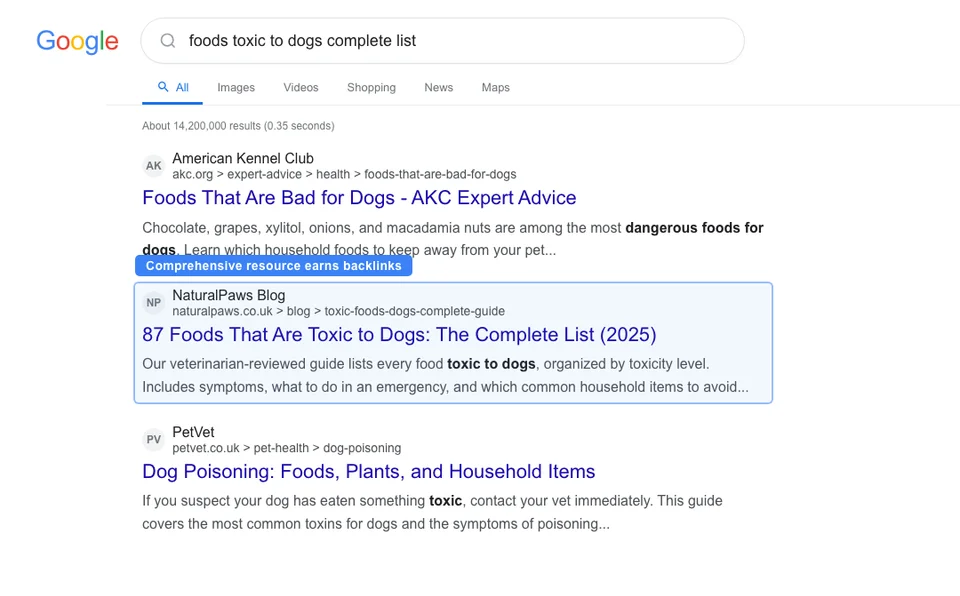
Here is the challenge: 94% of all online content earns zero external links[1]. The content that does earn links follows specific patterns.
Content types that naturally attract backlinks:
Original research and data. "We analyzed 500 pet store websites and found that sites with content clusters rank 14 positions higher." Original data gets cited by other writers, bloggers, and journalists who need statistics to support their articles. Even simple surveys or data analysis from your own business can earn links.
Comprehensive resource guides. "The Complete Guide to Dog Nutrition" or "Every Dog Park in [City]: A Complete Guide." Content over 3,000 words earns 3.5x more backlinks than shorter articles[8]. Comprehensive resources become go-to references that other sites link to when covering related topics. The more thorough and well-organized your guide, the more links it attracts.
Visual content. Infographics, comparison charts, and breed-specific care checklists get shared and embedded on other websites. A well-designed infographic about "Dog Food Ingredients to Avoid" can earn 10-30 backlinks over its lifetime as other sites use it as a reference.
Myth-busting content. "5 Things Your Vet Wants You to Know About Raw Feeding" or "Why Grain-Free Dog Food Is Not Always Better" - content that challenges common beliefs gets shared, discussed, and linked to. Be factual and cite sources.
Seasonal and timely content. "Pet Safety During Fireworks Season" published in June, or "Holiday Foods That Are Toxic to Pets" published in November. Timely content gets picked up by local media and bloggers looking for seasonal angles.
The key: create content worth linking to before you worry about promotion. No amount of outreach can make a thin, generic article earn links. But a genuinely useful, comprehensive, data-backed resource attracts links naturally over time. Companies with active blogs get 55% more website traffic than those without[9] - and that traffic compounds as your content earns links.
For more on creating link-worthy content, see our content marketing guide for pet businesses.
How to Build Links Through Local Partnerships
Pet stores are community businesses. You interact with customers, suppliers, local organizations, and fellow business owners every day. These existing relationships are natural link building opportunities that require no cold outreach.
Veterinary clinics: Offer to create a "recommended local pet stores" or "where to buy prescription diet food" resource page for their website, including your store. In return, link to their clinic from your website. Many vets are happy to recommend reliable local pet stores to their clients.
Dog trainers and behaviorists: Partner on content. A trainer writes a guest post on your blog about "training tips for reactive dogs" with a link to their site. You write a post for their blog about "best training treats for positive reinforcement" with a link to your store. Both parties benefit.
Pet shelters and rescues: Sponsor adoption events, donate products, or volunteer. Shelters typically list sponsors and partners on their website with links. This earns you a quality backlink plus genuine community goodwill.
Local businesses: Partner with pet-friendly cafes, hotels, or shops. Create a "pet-friendly businesses in [city]" guide on your website and ask partner businesses to link to it. Or contribute to their blog about pet-related topics.
Pet events and meetups: Sponsor or organize local pet events. The event page, local media coverage, and community forums will naturally link to your business as an organizer or sponsor.
Local media: Pet stories are perennial media favorites. Offer yourself as a local pet expert for newspaper features, local TV segments, or radio shows. Media coverage almost always includes a link to your website. Angle ideas: seasonal pet safety tips, local pet adoption statistics, community pet events.
Local partnership links are particularly valuable because they send strong geographic relevance signals. With 46% of all Google searches having local intent[2], links from local, trusted organizations directly strengthen your local rankings.
How Pet Suppliers and Brands Can Link to You
Most pet stores stock products from dozens of suppliers and brands. These brands often maintain "stockist" or "where to buy" pages on their websites - and getting listed there is one of the easiest high-quality links you can earn.
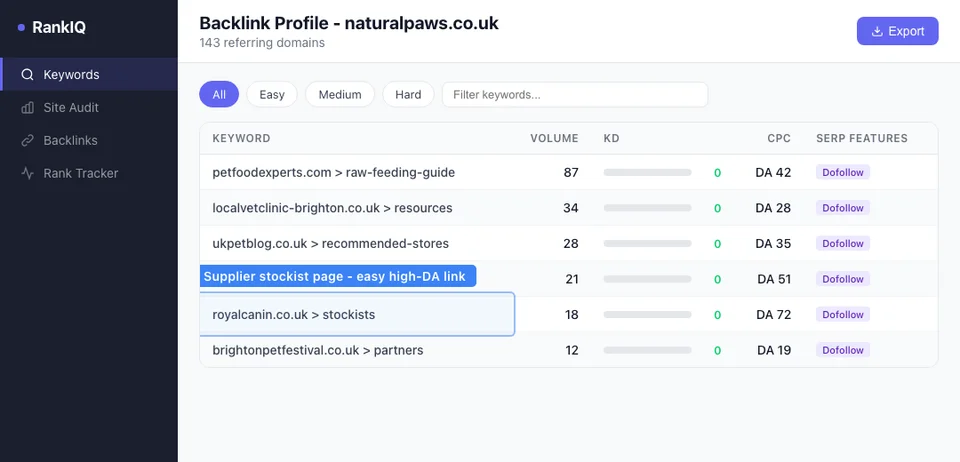
How to get listed:
- Identify the brands and suppliers you carry
- Visit each brand's website and look for a "Find a Retailer," "Where to Buy," or "Stockists" page
- Contact their marketing or sales team and ask to be added. In most cases, they want retailers listed - it helps them sell more product.
- If they do not have a stockist page, suggest they create one and offer to be the first listing
This is genuinely an easy opportunity. A pet store carrying 30 brands could potentially earn 10-15 backlinks from brand websites within a few weeks - simply by asking to be listed where they sell the products.
Additional supplier link opportunities:
- Brand ambassador or partner programs: Some pet brands have formal partner programs that include website features and links
- Product launch promotions: When you stock a new product, the brand may mention your store on their social media or blog
- Co-created content: Write a product review or usage guide and share it with the brand. They may link to it from their website or social channels.
- Case studies: If a brand's product has performed well in your store, offer to be a case study on their website
What About Guest Posting in the Pet Niche?
Guest posting - writing articles for other websites in exchange for a link back to yours - still works in the pet industry when done correctly. The key distinction: write genuine, valuable content for relevant pet websites. Do not mass-produce thin guest posts for link-selling sites.
Where to guest post for pet stores:
- Local pet blogs and community sites
- Pet industry publications (PetAge, Pet Business, Pets+ Magazine)
- Breed-specific websites and forums
- Pet health and wellness blogs
- Local lifestyle and community blogs ("best of [city]" type sites)
How to pitch a guest post:
- Read the target site's existing content to understand their audience and style
- Propose a specific topic that fills a gap in their content - something they have not covered
- Explain your credentials: "I run a pet store specializing in raw nutrition and have 10 years of experience advising pet owners on diet changes"
- Write the full article (1,000-2,000 words) and submit it ready to publish
- Include 1-2 natural links to your website within the content (not forced, not in the bio only)
Guest posting rules:
- Only post on sites relevant to the pet industry - a link from a random marketing blog has no value
- Write content that is genuinely useful to the host site's audience - not a thinly veiled promotion
- Limit guest posting to 2-3 posts per month - quality over quantity
- Never pay for guest post placements on sites that sell links. Google identifies and penalizes paid link schemes
How Many Backlinks Does a Pet Store Need to Rank?
There is no universal number. The number of backlinks you need depends on your keyword competition, your domain authority, and what your competitors have. But here are practical benchmarks:
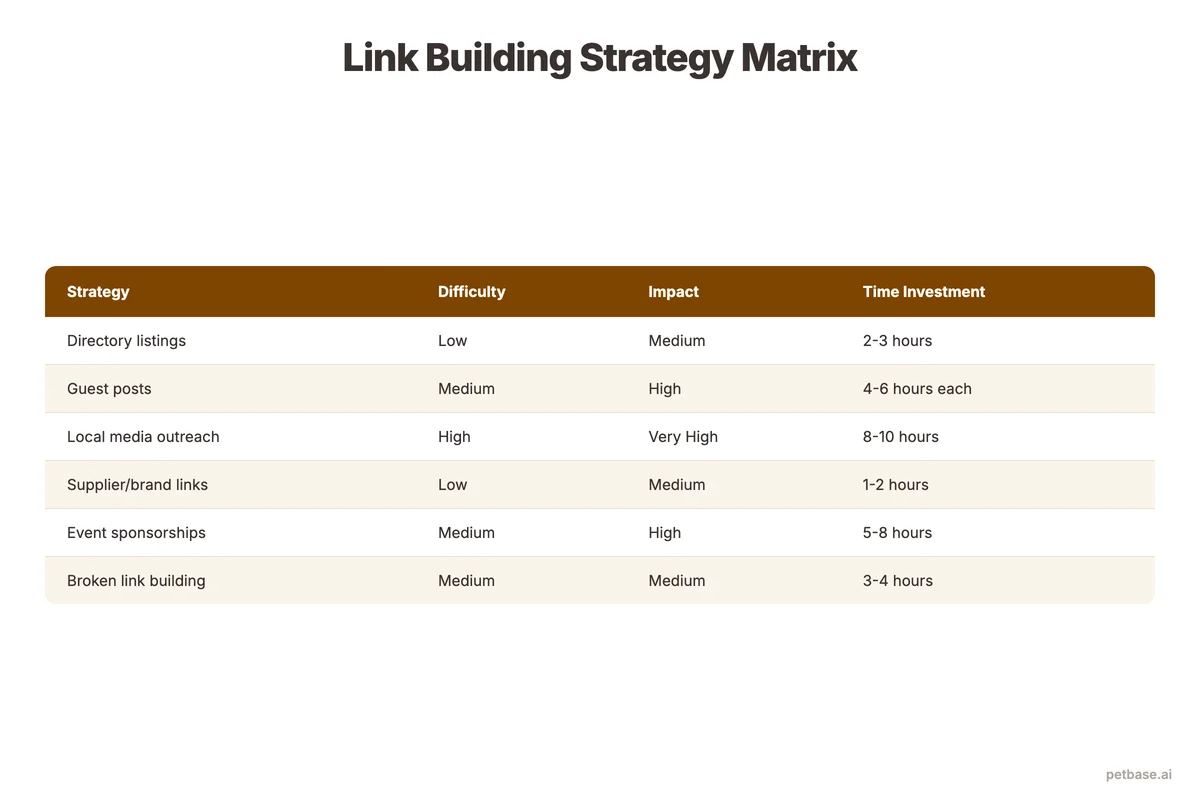
| Keyword Competition | Example Keywords | Typical Backlinks Needed (to the page) | Typical Referring Domains Needed (to the domain) |
|---|---|---|---|
| Low | "best food for senior Miniature Schnauzers" | 0-5 | 20-50 total |
| Medium | "raw dog food guide" | 5-20 | 50-150 total |
| High | "best dog food" | 50-200+ | 500+ total |
| Local | "pet store [city]" | 5-15 local links | 30-80 total |
For most pet stores, the strategy should be:
- Build a foundation of 30-50 referring domains through directories, supplier listings, and local partnerships (achievable in 2-3 months)
- Target low-competition keywords first where 0-5 page-level backlinks are sufficient to rank (combined with strong on-page SEO and content clustering)
- Gradually earn links to your best content through content quality, partnerships, and community involvement
- Never chase high-competition keywords through link building alone - use topical authority (content clusters) to compensate for lower backlink counts
An important insight: content clusters reduce your backlink dependency. A pet store with 10 interlinked articles about dog nutrition can rank for medium-competition keywords with fewer backlinks than a competitor with a single article on the same topic. Topical authority partially substitutes for link authority.
For the full SEO strategy including content clusters, read our pet store SEO strategy roadmap.
Backlink Tactics to Avoid
Bad backlinks can hurt your rankings. Google's algorithm detects unnatural link patterns and penalizes sites that manipulate their backlink profile. Here are tactics that pet stores should never use:
Buying links. Paying for links on "link farms," PBNs (private blog networks), or directory sites that exist solely to sell links violates Google's guidelines. The short-term ranking boost is not worth the long-term penalty risk. Google's SpamBrain algorithm has become very effective at identifying purchased links.
Link exchanges at scale. Swapping links with 50 random websites ("I'll link to you if you link to me") creates an unnatural pattern Google detects. A few natural reciprocal links with genuine partners are fine, but systematic link swaps are a red flag.
Low-quality directory spam. Submitting to 500 random directories with no editorial standards dilutes your backlink profile. Stick to 15-25 reputable, relevant directories.
Comment spam. Dropping your link in blog comments, forums, and social media posts adds no SEO value (these links are almost always nofollow) and damages your reputation.
Automated link building tools. Any tool that promises "1,000 backlinks in 24 hours" is building garbage links that will trigger a penalty. Avoid completely.
| Tactic | Risk Level | Typical Outcome |
|---|---|---|
| Buying links from PBNs | Very high | Manual penalty, rankings drop 50-100+ positions |
| Mass directory submissions (500+) | Medium-high | Diluted link profile, potential algorithmic suppression |
| Link exchange schemes | Medium | Links devalued, potential manual action |
| Comment/forum spam | Low-medium | Links ignored (nofollow), reputation damaged |
| Automated link building | Very high | Penalty, potential de-indexing |
If you are unsure whether a link building tactic is safe, ask yourself: "Would I be comfortable showing this to a Google employee?" If the answer is no, skip it.
Focus on earning links through quality content, genuine relationships, and community involvement. It takes longer, but the results are sustainable and penalty-proof.
How Petbase Helps You Earn Backlinks Faster
The biggest barrier to earning backlinks is content. You need comprehensive, well-researched articles that other sites want to reference - and most pet store owners do not have time to write them.
Petbase publishes 10 SEO-focused articles per month for your pet store at EUR 199/mo. Each article is built around topical authority clusters, which means your content earns links from related sites and ranks for more keywords with fewer backlinks needed. Instead of spending hours writing or thousands on an agency, you get a steady stream of link-worthy content published directly to your site.
For the complete SEO strategy for your pet store, including content, technical, and local optimization, read our pet store SEO guide. For competitor insights, see our competitor analysis guide for pet stores. And for data on what works across the industry, check our analysis of 50 pet store websites.
Ready to build a complete SEO foundation for your pet store? Start with a free site audit and see exactly where your backlink profile stands.
Frequently Asked Questions
How long does it take for a new backlink to affect rankings?
Google typically discovers and processes a new backlink within 1-4 weeks. The ranking impact becomes visible 2-8 weeks after Google processes the link. Higher-authority links from well-crawled sites (major publications, popular blogs) get processed faster than links from smaller sites. Do not expect instant ranking changes from a single backlink - the effect is cumulative. Building 10-15 quality links over 3 months produces more noticeable results than one link today.
Should I disavow bad backlinks pointing to my pet store?
Only if you have received a manual penalty in Google Search Console or if you have a clear history of purchasing spammy links. Google's algorithm is sophisticated enough to ignore most low-quality links automatically. Disavowing links you did not build is rarely necessary and can actually hurt you if you accidentally disavow legitimate links. If you receive a manual action for unnatural links, then use the disavow tool - otherwise, focus your energy on building good links rather than worrying about bad ones.
Is it better to get many links from one domain or one link from many domains?
One link each from 10 different domains is significantly more valuable than 10 links from a single domain. Google counts referring domains (unique websites linking to you) as a stronger signal than total link count. After the first link from a domain, each additional link from the same domain has diminishing value. This is why diverse link building - directories, suppliers, local partners, content links, media mentions - outperforms getting multiple links from a single source.
References
- Backlinko (2020). We Analyzed 11.8 Million Google Search Results. backlinko.com
- BrightLocal (2025). Local SEO Statistics. brightlocal.com
- Fortune Business Insights (2025). Pet Care Market Size, Share & Industry Analysis. fortunebusinessinsights.com
- Clutch (2025). SEO Statistics. clutch.co
- BrightEdge (2019). Organic Search Is Still the Largest Channel. seoinc.com
- BrightLocal (2025). Local Consumer Review Survey. brightlocal.com
- BuzzStream (2025). 70 Link Building Statistics. buzzstream.com
- BuzzStream (2025). Long-Form Content and Backlink Acquisition. buzzstream.com
- HubSpot (2025). Marketing Statistics. hubspot.com