Building an SEO Content Calendar for Your Pet Business


Table of Contents +
- Why a Content Calendar Changes Everything for Pet Store SEO
- How to Build a 3-Month Calendar (Step by Step)
- What Seasonal Topics Should Pet Stores Cover?
- How to Balance Blog Posts, Product Pages, and Social
- How Many Pieces Per Week Is Realistic?
- A Complete 12-Month Template for Pet Stores
- How to Automate Your Content Calendar
- Calendar Mistakes That Waste Time
- Frequently Asked Questions
- References
Build a 3-month and 12-month SEO content calendar for your pet store. Includes seasonal topic map, publishing cadence guide, and a complete monthly template.
7.5 million blog posts go live every single day[1]. Most of them vanish without a trace. The pet stores that actually grow their organic traffic are the ones publishing with a plan - not on impulse.
A content calendar maps out what you publish, when you publish it, and which keywords each piece targets. Without one, most pet store owners post randomly and wonder why rankings never move. With one, every article connects to a keyword strategy, seasonal topics go live before demand peaks, and topic clusters build out methodically. The result is compounding organic traffic that grows month over month.
This guide walks you through building a 3-month and 12-month content calendar tailored to pet businesses.
Why a Content Calendar Changes Everything for Pet Store SEO
Publishing without a calendar is like stocking your shelves without knowing what customers want. You might get lucky, but you will waste most of your effort.
The numbers back this up. Companies publishing 16 or more blog posts per month get 3.5x more traffic than those publishing four or fewer[2]. And 70% of all blog traffic comes from organic search[1] - not social media, not email, not direct visits. That means every article you publish is another door for Google to send you visitors. But only if each article targets the right keyword at the right time.
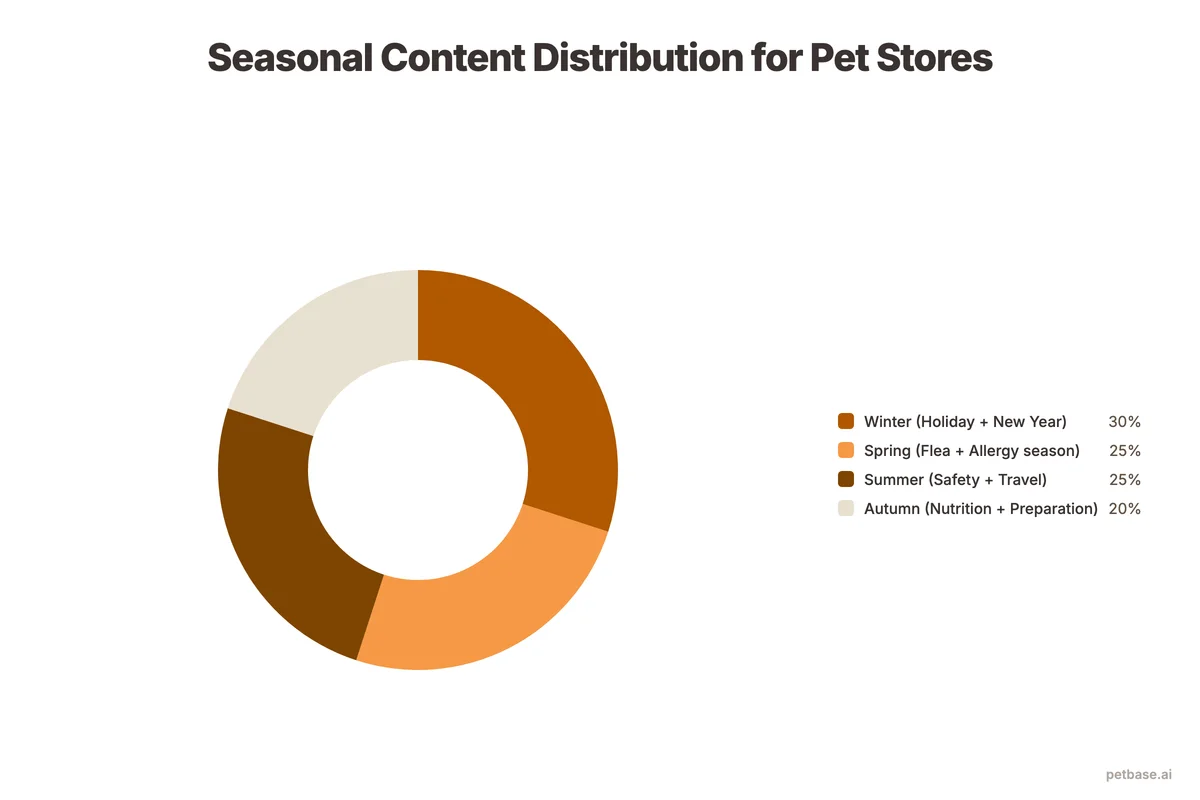
Here is what a structured calendar does for pet store SEO specifically:
- Aligns content with search demand. Pet searches are seasonal. "Dog cooling mat" peaks in May-June. "Christmas gifts for dogs" peaks in October-November. A calendar ensures you publish 6-8 weeks before demand peaks, giving Google time to index and rank your content.
- Builds topical authority systematically. Google rewards sites that cover topics thoroughly. A calendar helps you plan topic clusters - a pillar post plus 5-8 supporting articles - instead of publishing random one-off pieces.
- Prevents content cannibalization. Without a calendar, you might write three articles about "grain-free dog food" that compete with each other in search results. A calendar shows you the full picture so each piece targets a different angle and keyword.
- Creates accountability. "We should blog more" never works. "Publish these 4 specific articles in January" does. A calendar turns vague intentions into concrete deadlines.
Content marketing costs 62% less than outbound marketing and generates 3x more leads[3]. But that only works when content is planned, not random. A calendar is what separates pet stores that grow organic traffic from those that just produce noise.
For background on content marketing fundamentals, read our content marketing guide for pet businesses.
Petbase handles this entire content workflow automatically - 10 SEO articles published to your blog every month - start your free trial.
How to Build a 3-Month Calendar (Step by Step)
Start with a 3-month calendar. It is specific enough to be actionable but short enough to adjust based on results.
Step 1: Define your topic clusters
List 3-4 broad topics you want to be known for. Examples for a pet food store:
- Dog nutrition and diet
- Cat health and wellness
- Pet food ingredients and quality
- Seasonal pet care
Each cluster will have one pillar post and 4-6 supporting articles. Read our guide on content clustering for pet websites for the full framework.
Step 2: Do keyword research for each cluster
For each topic cluster, find 8-12 keywords with clear search intent and reasonable competition. Long-tail keywords account for 70% of all searches and convert at 36% - far above generic terms[4]. Use our keyword research guide for pet businesses to build this list. Prioritize keywords where you can realistically rank in the top 10 within 3-6 months.
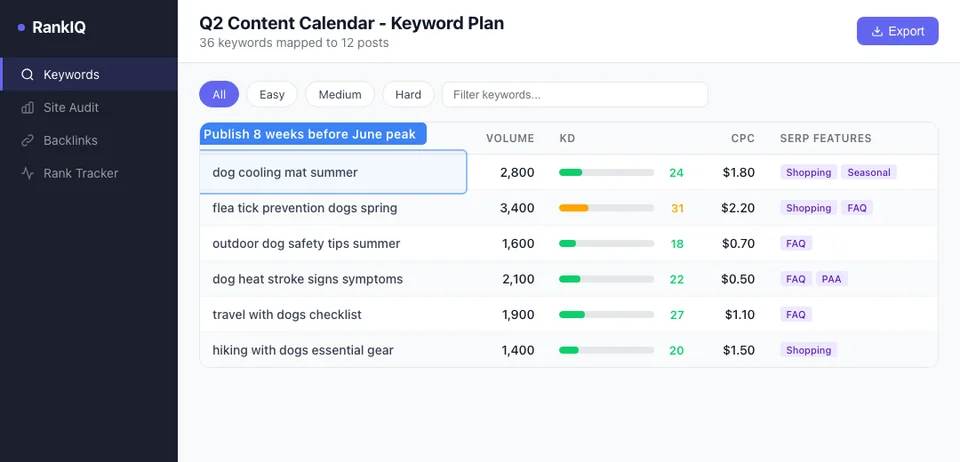
Researching 8-12 keywords per cluster across 3-4 topics means evaluating 24-48 keywords every quarter - checking search volume, competition, and intent for each one before you write a single word. Petbase runs this keyword research automatically based on your niche, competitors, and search trends. You get a prioritized content plan instead of a spreadsheet you have to fill yourself. Start your free trial to see the plan it builds for your store.
Step 3: Map keywords to content types
Not every keyword needs a blog post. Sort your keywords into:
- Blog posts: Informational queries ("how to choose dog food for allergies")
- Product pages: Commercial queries ("grain-free salmon dog food")
- Category pages: Broad commercial queries ("natural dog food")
- FAQ sections: Quick-answer queries ("how much should I feed my puppy")
Step 4: Assign dates and deadlines
Plot each piece on a calendar. Rules to follow:
- Publish pillar posts before supporting articles
- Space cluster articles 1-2 weeks apart (not all at once)
- Schedule seasonal content 6-8 weeks before the season
- Never publish more than you can sustain long-term
Step 5: Add internal linking notes
For each piece, note which existing pages it should link to and which future pieces will link back to it. Internal linking is what turns individual articles into a connected topical authority network.
Tracking internal links across 8-10 new articles per month plus your existing pages turns into a full-time job by month three. One missed link between related posts weakens the entire cluster. Petbase handles this automatically - new articles link to relevant existing content and products on your site, keeping your topic clusters connected without a spreadsheet.
What Seasonal Topics Should Pet Stores Cover?
Pet industry searches follow predictable seasonal patterns. Planning your calendar around these cycles ensures your content is indexed and ranking when demand peaks.
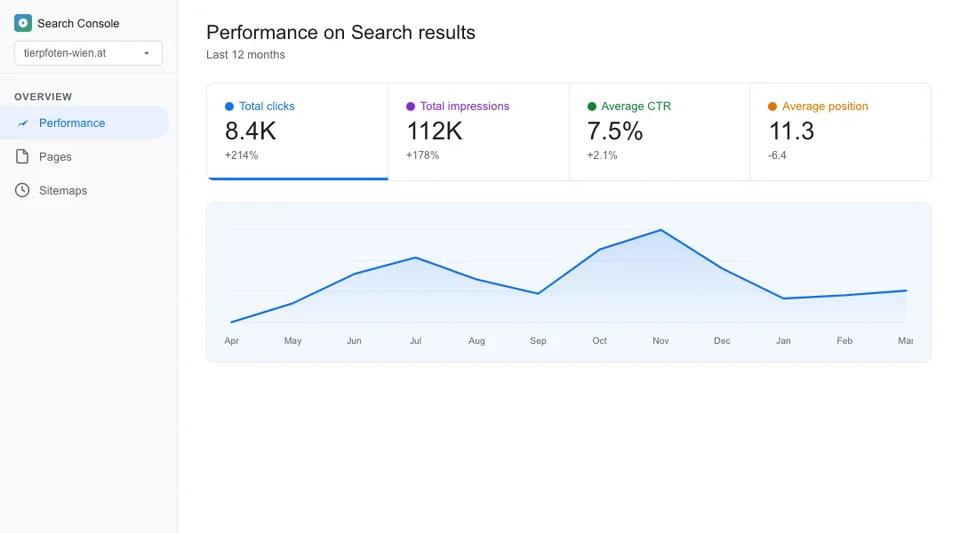
Here is a seasonal topic map:
| Month | Seasonal Topic | Content Ideas | Publish By |
|---|---|---|---|
| January | New Year pet health resolutions | Weight management, diet changes, exercise routines | Mid-November |
| February | Valentine's Day pet safety | Chocolate toxicity, pet-safe treats, gifts for pet lovers | Late December |
| March | Spring allergies | Seasonal allergy symptoms, hypoallergenic foods, grooming | Mid-January |
| April | Flea and tick season begins | Prevention guides, product comparisons, natural options | Mid-February |
| May | Outdoor activity season | Travel gear, hiking with dogs, outdoor safety | Mid-March |
| June | Summer heat safety | Heat stroke signs, cooling products, hydration tips | Mid-April |
| July | Fireworks and anxiety | Calming products, anxiety management, safe spaces | Mid-May |
| August | Back-to-school separation anxiety | Routine changes, enrichment toys, training tips | Mid-June |
| September | Fall grooming and coat care | Shedding season, coat supplements, grooming tools | Mid-July |
| October | Halloween pet safety | Costume safety, candy dangers, stress-free Halloween | Mid-August |
| November | Holiday gift guides | Gift guides by pet type, budget, and age | Mid-September |
| December | Winter care and holiday safety | Cold weather gear, holiday plants/foods to avoid | Mid-October |
Notice the "Publish By" column. Each topic should go live 6-8 weeks before the season. Google needs time to crawl, index, and rank your content. Publishing a summer heat safety guide in July means you miss the entire search wave. For a deeper dive into seasonal planning, check out our guide on seasonal SEO for pet stores.
How to Balance Blog Posts, Product Pages, and Social
Your calendar should not be blog-only. The most effective pet store content strategies balance three content types.
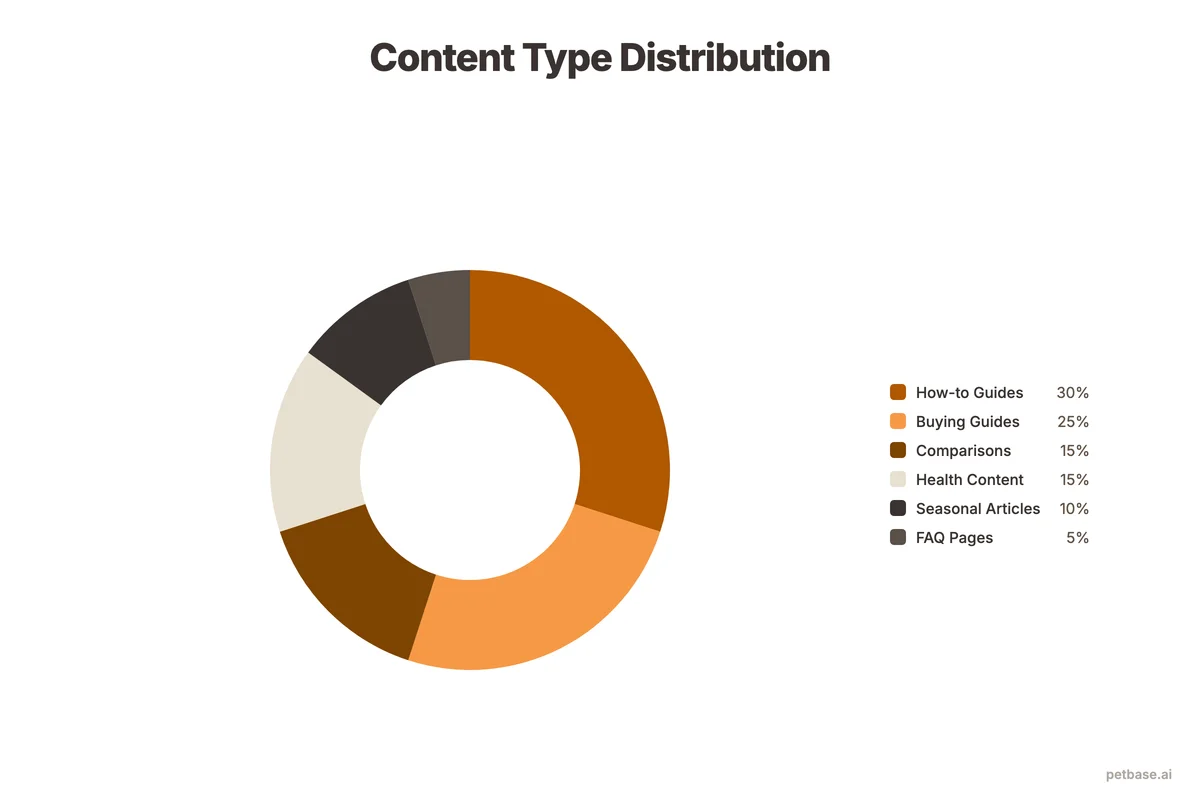
The 60-30-10 rule
- 60% blog content: Informational articles that attract organic traffic and build authority. Organic search drives 53% of all website traffic[5], making blog content your highest-leverage investment.
- 30% product/category page optimization: Improving existing commercial pages for better rankings and conversions
- 10% social and email: Repurposing top-performing content for other channels
How they work together
Blog posts drive traffic. Product pages convert it. Social amplifies it. A blog post about "best food for dogs with allergies" links to your hypoallergenic dog food category page. That category page links to specific products. A social post promotes the blog article, driving initial traffic while Google indexes it.
| Content Type | Monthly Volume | Time Investment | Primary Goal |
|---|---|---|---|
| Blog posts | 8-10 articles | 60% of content time | Organic traffic and authority |
| Product page updates | 10-15 page improvements | 30% of content time | Rankings and conversions |
| Social/email | 8-12 posts from existing content | 10% of content time | Amplification and engagement |
Read our pet store blog strategy guide for more on making blog content drive real business results.
How Many Pieces Per Week Is Realistic?
The right publishing frequency depends on your resources. Publishing 2 great articles per week beats publishing 5 mediocre ones. Consistency matters more than volume.
The average blog post takes 3 hours and 46 minutes to write[1]. A well-researched, SEO-optimized article for a pet store - with keyword targeting, internal links, and product references - takes closer to 5 hours. That time adds up fast.
Here is a realistic breakdown by team size:
- Solo store owner (no dedicated content person): 1 article per week. Focus on quality over quantity. One well-researched, 2,000-word article per week builds real authority over time.
- Small team (1 content person, part-time): 2-3 articles per week. This is the sweet spot for most pet stores. Enough to build topical clusters without burning out.
- With Petbase: 10 articles per month (roughly 2-3 per week) published automatically for EUR 199/mo. This frees your time for product page optimization, customer service, and strategy. The content is created based on your keyword strategy and published on your schedule.
The key metric is not articles per week - it is articles per topic cluster. A complete cluster (1 pillar + 5 supporting articles) takes 3-6 weeks to build at 2 articles per week. Plan your calendar around completing clusters, not hitting arbitrary volume targets.
For more on content cadence, see our guide on long-tail keywords for pet stores - it shows how targeting specific queries makes each article more efficient.
A Complete 12-Month Template for Pet Stores
Here is a month-by-month template you can adapt to your store. It combines seasonal topics, evergreen clusters, and product page optimization into a balanced annual plan.
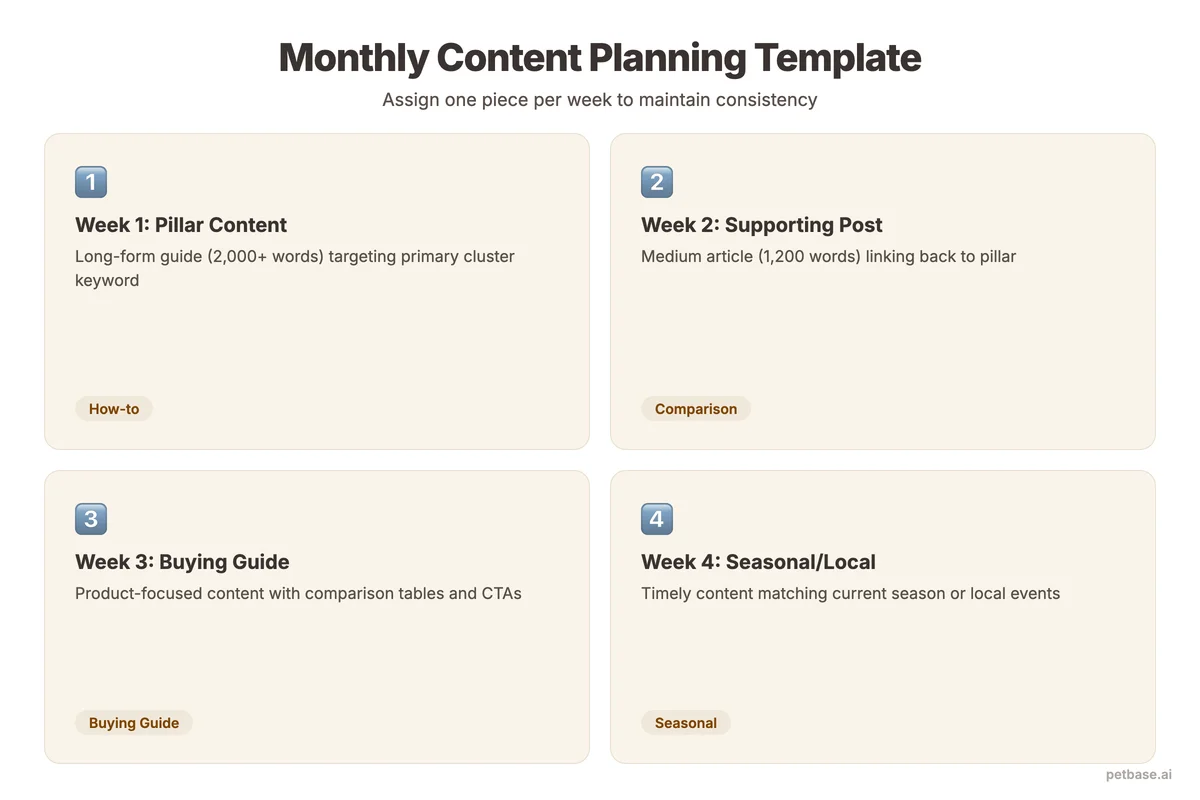
| Month | Blog Focus (8-10 posts) | Product Focus | Cluster to Build |
|---|---|---|---|
| January | New Year health, diet guides, weight management | Health food, supplements | Pet nutrition fundamentals |
| February | Valentine safety, indoor enrichment, dental health month | Dental care products, toys | Pet dental care |
| March | Spring allergy prep, shedding season, adoption month | Grooming tools, allergy products | Seasonal allergy care |
| April | Flea/tick prevention, outdoor gear prep | Flea treatments, harnesses | Parasite prevention |
| May | Outdoor activity, travel with pets, raw feeding | Travel carriers, cooling mats | Pet travel essentials |
| June | Summer safety, hydration, breed-specific summer care | Cooling products, water bowls | Summer pet safety |
| July | Firework anxiety, water safety, summer recipes | Calming products, life jackets | Pet anxiety management |
| August | Back-to-school routines, separation anxiety, senior pets | Enrichment toys, cameras | Senior pet care |
| September | Fall grooming, coat health, immune support | Supplements, grooming tools | Coat and skin health |
| October | Halloween safety, indoor enrichment, joint health | Joint supplements, costumes | Joint and mobility |
| November | Gift guides, holiday prep, Black Friday content | Gift bundles, best sellers | Holiday pet gifting |
| December | Winter care, holiday hazards, year-end review | Winter gear, cozy beds | Winter pet wellness |
This template gives you 12 topic clusters built over 12 months. By year-end, you have comprehensive coverage of the pet care topics your customers search for - and the topical authority to rank for them.
How to Automate Your Content Calendar
Building a calendar is step one. Keeping it running month after month is the hard part. Content marketing returns $7.65 for every $1 spent, compared to $1.80 for paid ads[6]. But that return only materializes if you publish consistently - and most pet stores stall after month two because the manual work piles up.
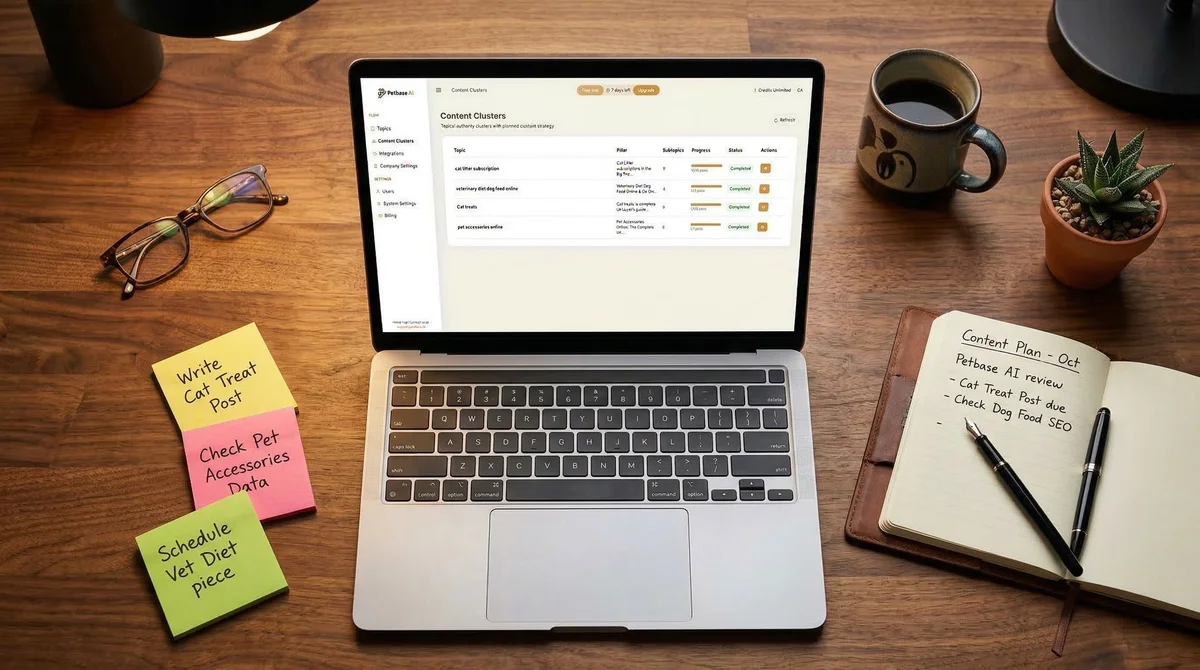
What you can automate
- Keyword research and topic selection. Petbase analyzes your niche, competitors, and search trends to identify the right topics each month. Instead of spending hours in keyword tools, you get a prioritized content plan delivered automatically.
- Content creation. Each article is generated with proper heading structure, internal links, meta descriptions, and target keywords already optimized. Petbase creates 10 articles per month based on your calendar strategy.
- Publishing. Content publishes directly to your CMS - WordPress, Webflow, or via API. No copy-pasting, no formatting fixes, no manual scheduling.
- Internal linking. New articles automatically link to relevant existing content on your site, strengthening your topical clusters without manual link maintenance.
What you should still do manually
- Product page content. Product descriptions benefit from your personal experience with each product.
- Strategy reviews. Review your calendar quarterly. Adjust based on what is ranking, what is not, and what new topics emerge.
- Customer interaction content. FAQs based on real customer questions, buying guides based on common requests - these require your domain knowledge.
The combination of automated blog content and manual product/strategy work is what scales. You cannot automate everything, but you can automate the most time-consuming part - consistent, keyword-targeted blog content - and focus your manual effort where it has the most impact.
Learn more about how automated content fits into your strategy in our guide on AI content for pet businesses.
Calendar Mistakes That Waste Time
These are the content calendar mistakes we see pet stores make repeatedly. Avoid them and you will get more value from every piece you publish.
Mistake 1: Planning 12 months in detail
Plan 3 months in detail, sketch the next 3, and leave the rest flexible. The pet industry moves fast - new trends, new products, seasonal surprises. A rigid 12-month plan becomes outdated by month 4. The template above gives you a framework, not a contract.
Mistake 2: Ignoring what is already working
Before planning new content, check Google Search Console for pages that rank on page 2 (positions 11-20). These are your quickest wins - update and expand them instead of writing something new. One hour updating an existing page often produces better results than five hours creating a new one.
Mistake 3: Publishing everything in one cluster at once
If you publish 6 articles about "dog nutrition" in one week, Google has to process all of them simultaneously. Spread cluster articles across 3-4 weeks. This gives Google time to index each piece and lets you internal-link progressively.
Mistake 4: Calendar without keyword targets
A calendar that says "Write about puppy training" is not a content calendar - it is a wish list. Every entry needs a target keyword, search volume, and content type. Without keyword data, you are guessing.
Mistake 5: No review cycle
The best content calendars include monthly performance reviews. Which articles ranked? Which did not? Why? Use this data to refine next month's plan. A calendar without a feedback loop never improves.
For a complete view of content strategy, read our pet blog SEO guide - it covers the full lifecycle from planning to ranking.
Frequently Asked Questions
How far in advance should I plan my pet store content calendar?
Plan 3 months in detail with specific topics, keywords, and publishing dates. Sketch the following 3 months with topic clusters and seasonal themes. Leave months 7-12 as a loose framework. This gives you enough structure to stay consistent without losing the flexibility to respond to trends, new products, or seasonal shifts you did not anticipate.
What is more important - publishing frequently or publishing high-quality content?
Quality wins every time. One well-researched, 2,000-word article per week that targets a specific keyword and answers a real question will outperform five 500-word posts that skim the surface. Google ranks depth and usefulness, not volume. Set a frequency you can maintain for 12 months without quality dropping. For most pet stores, that is 2-3 articles per week.
Should I include social media in my SEO content calendar?
Yes, but as a distribution channel, not a separate content stream. For every blog post you publish, create 2-3 social posts that link back to it. This drives initial traffic to new content while Google indexes it and helps the content earn engagement signals. Spend 10% of your content time on social repurposing, not 50%. The SEO content is the engine - social is the amplifier.
References
- Orbit Media (2024). Blogging Statistics and Trends. orbitmedia.com
- HubSpot (2024). Marketing Statistics. hubspot.com
- Siege Media (2024). Content Marketing Statistics. siegemedia.com
- Embryo (2024). 30 Statistics About Long-Tail Keywords. embryo.com
- BrightEdge (2024). How Much Traffic Comes from Organic Search. seoinc.com
- Genesys Growth (2024). Content Marketing ROI Stats for Marketing Leaders. genesysgrowth.com