How Pet Stores Can Compete with Amazon on Google

Table of Contents +
- Can a Small Pet Store Really Compete with Amazon?
- Where Amazon Is Weak (and You Are Strong)
- How to Win Product Searches Amazon Cannot Own
- Why Local Search Is Your Unfair Advantage
- How Niche Content Authority Beats Amazon's Scale
- Building Trust Signals Amazon Cannot Replicate
- Real Examples: How Independent Pet Stores Outrank Amazon
- Your 90-Day Plan to Start Competing
- References
How independent pet stores compete with Amazon on Google using local SEO, niche content authority, and trust signals. Includes a 90-day action plan.
The pet e-commerce market is worth $94.89 billion and growing at 7.8% per year[1]. Amazon captures a large share, but independent pet businesses have structural advantages Amazon cannot replicate. This guide shows you exactly where Amazon is vulnerable, which search categories you can win, and how to build a 90-day plan to take traffic Amazon cannot hold onto.
The honest answer to "can I compete with Amazon on Google?" is: not on everything, but absolutely on the searches that matter most to your business. You will not outrank Amazon for "buy dog food online." You do not need to. The U.S. pet industry alone hit $152 billion in 2024[2], and independent stores serve needs Amazon simply cannot meet.
Can a Small Pet Store Really Compete with Amazon?
Yes - but not by playing Amazon's game. Independent pet businesses compete and win in three areas Amazon structurally cannot dominate: local search, niche expertise content, and personalized product guidance.
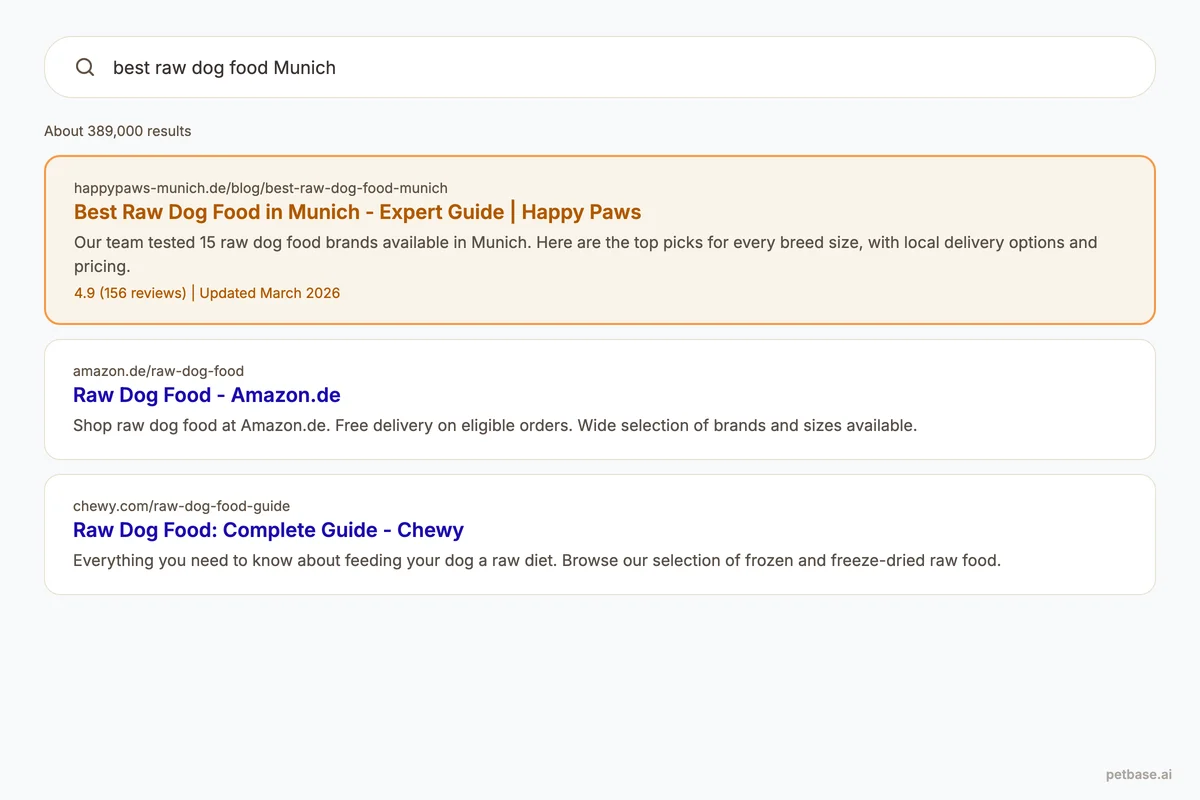
Organic search drives 53% of all website traffic[3]. The question is which searches you target. Long-tail keywords account for 70% of all searches and convert at 36% - far higher than broad terms[4]. Queries like "best food for German Shepherd puppy with sensitive stomach" get answered better by specialist content than by Amazon product listings. Google rewards websites that demonstrate real expertise through its E-E-A-T (Experience, Expertise, Authoritativeness, Trustworthiness) framework - and that favors specialists over generalists.
Here is where the competition actually stands:
| Category | Amazon's Strength | Independent Store's Strength |
|---|---|---|
| Product range | Millions of SKUs | Curated selection with expert picks |
| Price | Competitive pricing, Prime discounts | Bundle deals, loyalty programs, service packages |
| Domain authority | DA 96+ | Local relevance, niche topical authority |
| Local search | No physical stores (in most markets) | Google Business Profile, local pack, "near me" queries |
| Content depth | Product listings only | Blog posts, guides, breed-specific advice |
| Personalization | Algorithm-based recommendations | Human expertise, staff recommendations, custom diets |
| Trust for health products | Mixed reviews, third-party sellers | Direct manufacturer relationships, staff expertise |
| Community | None | Events, training classes, adoption partnerships |
Your pet store SEO strategy should focus on these gaps.
Petbase automates SEO content for pet stores - publishing 10 optimized articles monthly so you can focus on running your shop - start your free trial.
Where Amazon Is Weak (and You Are Strong)
Amazon's weaknesses are structural - they cannot be fixed with more budget. Understanding them is the foundation of your competitive strategy.
Amazon has no local presence
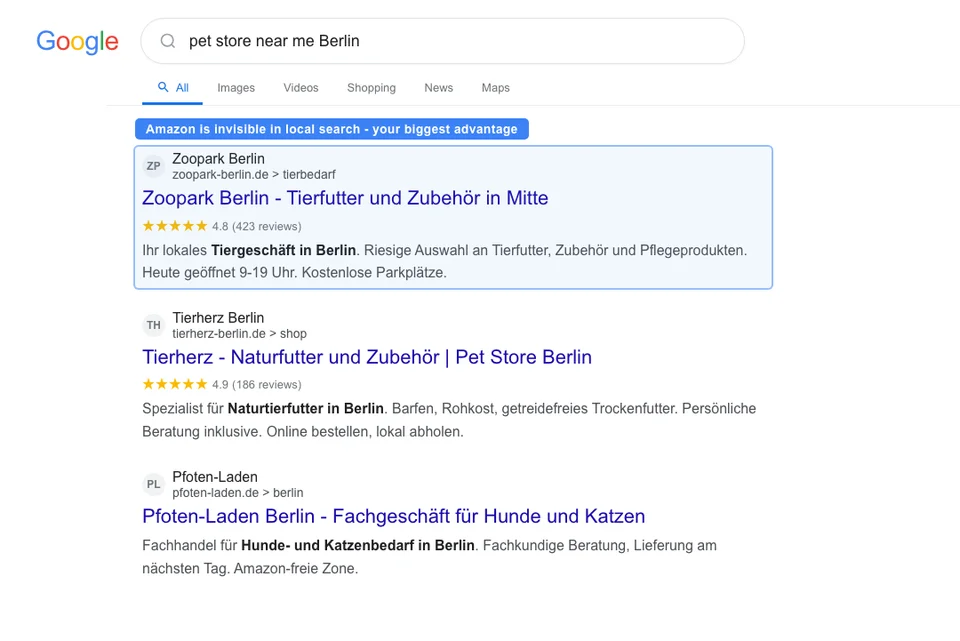
46% of all Google searches have local intent[5]. When someone searches "pet store near me" or "dog food delivery [city name]," Amazon does not appear in the Google Local Pack. Those three map listings at the top of local search results are exclusively for businesses with physical locations. If you have a store, you have an automatic advantage for every local query in your area.
Amazon has no educational content
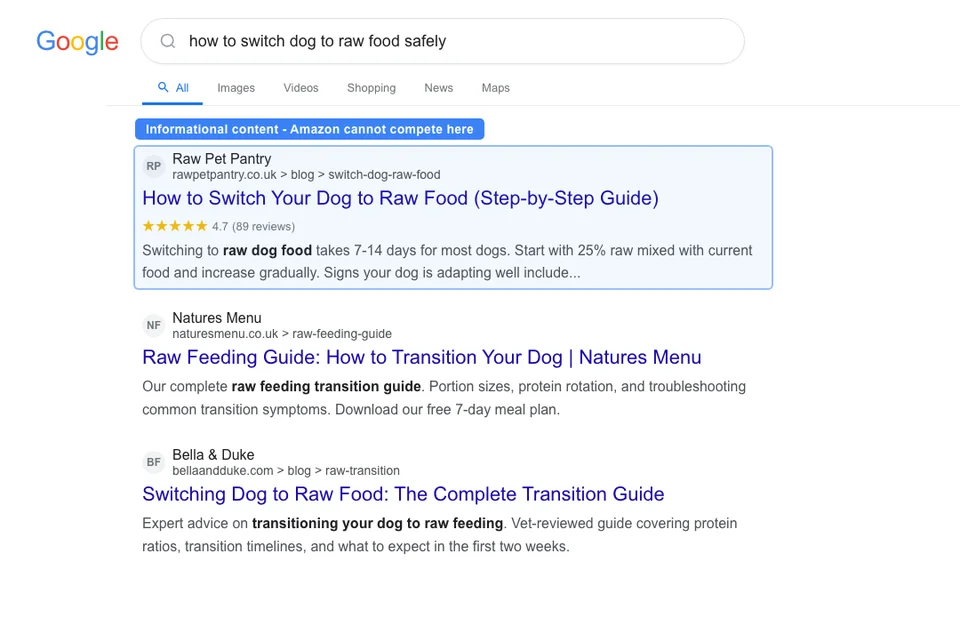
Search for "how to switch your dog to raw food" or "what supplements does my senior cat need" - Amazon does not rank for these queries. They do not publish guides, tutorials, or advice content. These informational queries represent the top of the buying funnel - people researching before they purchase. Companies with blogs get 55% more website traffic than those without[6]. If your blog answers their question, you are the first pet brand they encounter.
Amazon product pages lack depth
An Amazon product listing has a title, bullet points, and a generic description (usually written by the manufacturer). There are no breed-specific recommendations, no staff picks, no feeding guides, no comparison context. Independent stores that write detailed, unique product descriptions can outrank Amazon for specific product queries.
Amazon's reviews are unreliable
93% of consumers say online reviews affect their buying decisions[7]. Fake reviews are a documented problem on Amazon. Pet owners buying food, supplements, and health products for their animals want trustworthy recommendations. An independent store with genuine customer reviews, staff expertise, and transparent sourcing information has a trust advantage that matters more in pet products than almost any other category.
How to Win Product Searches Amazon Cannot Own
You will not rank for "dog food" (a head term Amazon dominates). But you can rank for hundreds of specific product queries that Amazon's generic listings cannot satisfy.
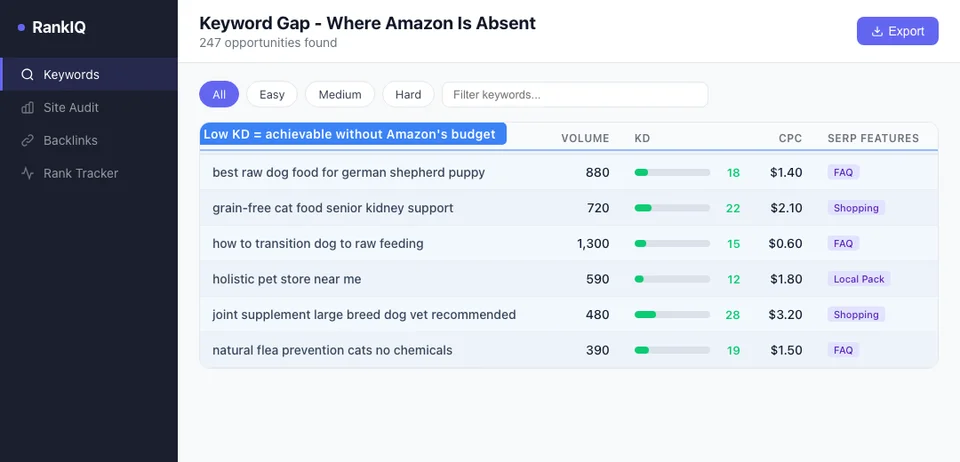
Product query categories where independents win:
| Query Type | Example | Why You Win |
|---|---|---|
| Breed-specific | "best food for French Bulldog allergies" | Requires expert knowledge Amazon does not have |
| Health condition | "dog food for pancreatitis" | Medical context requires trust and expertise |
| Local delivery | "raw dog food delivery Munich" | Amazon does not do local fresh/raw delivery |
| Comparison | "Orijen vs Acana for puppies" | Needs hands-on experience with both products |
| Specialty | "insect-based dog food Europe" | Niche products with limited Amazon availability |
| Service-linked | "best shampoo for dog grooming at home" | Connect product to expertise your staff provides |
The strategy: target the long-tail. Long-tail keywords make up 70% of all searches and convert at 36%[4]. Every specific query you rank for brings a buyer who is further along in their decision process than someone searching a generic term.
For every product category you sell, create content around the specific questions buyers ask. If you sell 5 brands of dog food, write comparison posts for every meaningful pairing. If you specialize in raw feeding, build a content cluster around raw food - types, transition guides, storage, breed suitability, and cost comparisons. This is competitor analysis turned into content strategy.
Why Local Search Is Your Unfair Advantage
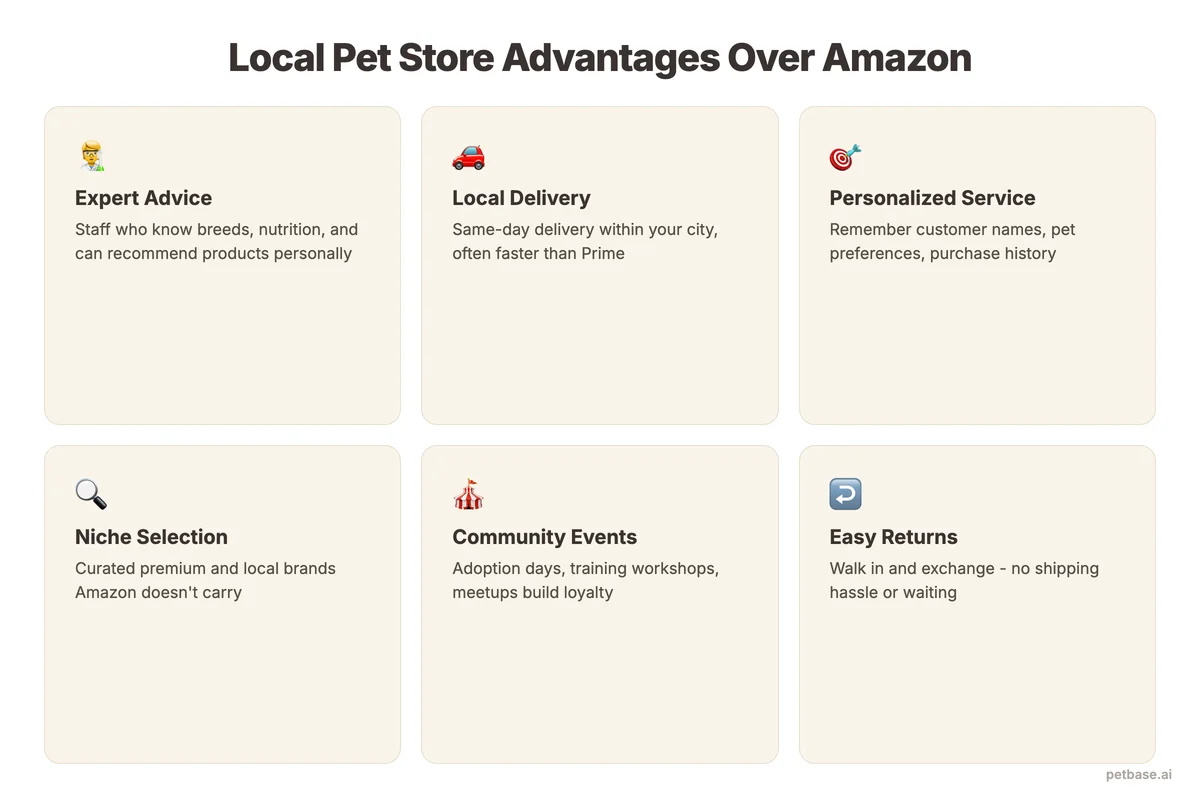
Local SEO is the single biggest advantage independent pet businesses have over Amazon. When someone searches with local intent, Google shows the Local Pack - three map results with store name, address, reviews, and a direct link. Amazon is never in this list.
With 46% of Google searches carrying local intent[5], this is a massive opportunity. Local searches that pet businesses should dominate:
- "pet store near me"
- "dog food delivery [city]"
- "pet grooming [neighborhood]"
- "raw dog food [city]"
- "pet store open now"
- "cat supplies [city]"
To win local search, you need:
- An optimized Google Business Profile: Complete every field. Add 20+ photos. Post weekly updates. Respond to every review.
- Local content: Blog posts that mention your city, neighborhood, and local pet community. "Best dog parks in [city]" and "pet-friendly restaurants in [neighborhood]" are examples of content that builds local relevance.
- Consistent citations: Your business name, address, and phone number should be identical across every directory listing - Google, Yelp, local business directories, pet industry directories.
- Reviews: 93% of consumers say reviews influence their buying decisions[7]. Ask every satisfied customer for a review. Google weighs review quantity, recency, and quality in local rankings.
A comprehensive local SEO strategy is not optional for pet businesses with physical locations. It is the foundation of competing with online-only retailers.
How Niche Content Authority Beats Amazon's Scale
Amazon has scale. You need depth. The concept is called topical authority - Google gives ranking preference to websites that demonstrate comprehensive expertise in a specific subject area.

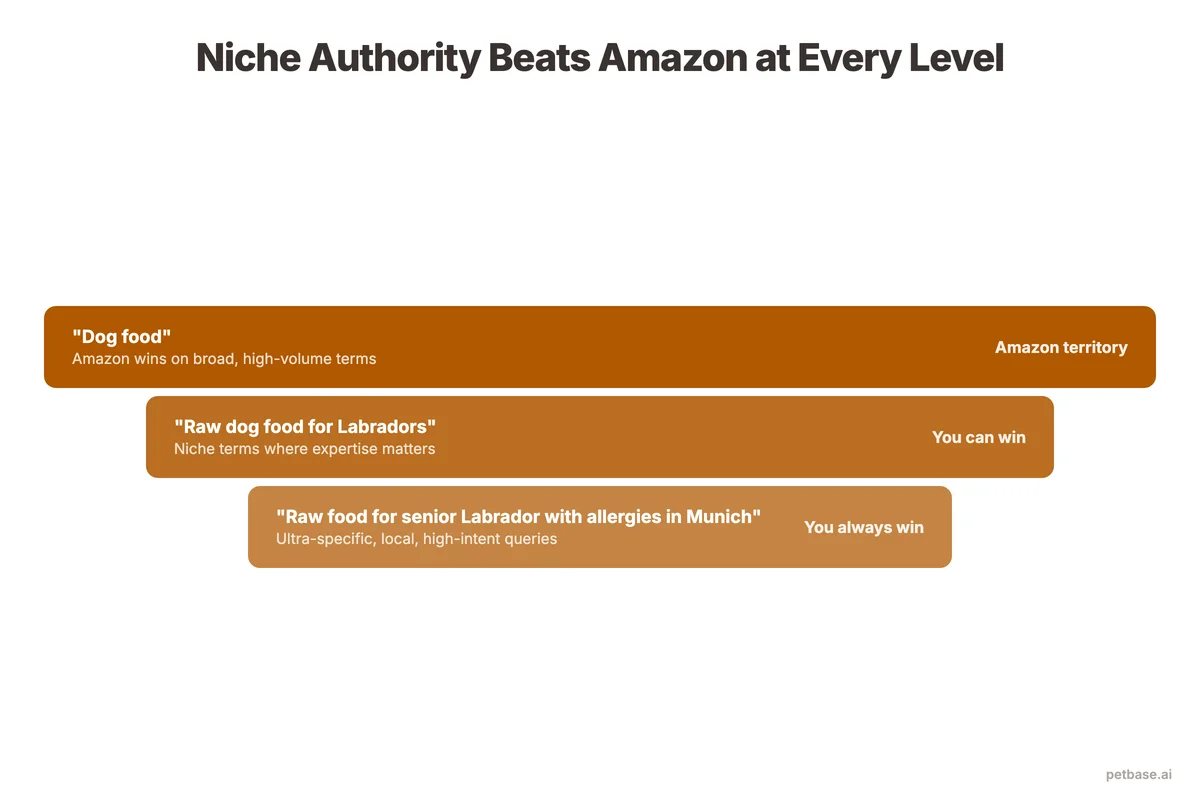
Amazon sells dog food, but they do not publish articles about dog nutrition. They do not explain the difference between grain-free and grain-inclusive diets. They do not write about feeding schedules for senior dogs. They do not cover food rotation protocols.
When you build a content cluster around dog nutrition with 15-20 interconnected articles, Google recognizes your site as an authority on that topic. Your product pages for dog food start ranking higher because they are supported by all that educational content.
Companies with blogs generate 55% more website traffic[6]. But the structure of that blog content matters as much as the volume. This is the same strategy that small specialty publishers use to outrank massive websites. Depth beats breadth when the topic is specific enough.
How to build topical authority against Amazon:
- Pick 3-5 product categories you specialize in
- For each category, map out 10-15 articles covering every angle (buying guides, comparisons, breed-specific advice, health considerations, cost analysis)
- Create a pillar page for each category that links to all the supporting content
- Publish consistently - at least 8-10 posts per month across your chosen topics
- Interlink everything so Google can see the cluster structure
Petbase builds these content clusters automatically. You tell it your product categories and specialty areas, and it generates the full cluster map - pillar pages, supporting articles, internal links, and a publishing schedule. At 10 articles per month for EUR 199/mo, you can build meaningful topical authority in 2-3 topic areas within 6 months. That is a pace Amazon cannot match because they do not publish educational content at all.
Building Trust Signals Amazon Cannot Replicate
Trust is the deciding factor for pet purchases involving health, nutrition, and safety. Pet owners do not want the cheapest option - they want the right option for their animal. Amazon's third-party marketplace model creates trust issues that independent stores do not face.
Trust signals you should emphasize:
- Staff expertise: Show your team's qualifications. Pet nutrition certifications, grooming certifications, years of experience. Put faces and names on your About page.
- Manufacturer relationships: "We work directly with [brand] and can answer questions about their sourcing and formulation." This is something third-party Amazon sellers cannot say.
- Local community involvement: Adoption events, charity partnerships, training classes, vet referral relationships. These prove you care about animals, not just sales.
- Transparent sourcing: Where do your products come from? What quality controls exist? Amazon sellers rarely provide this information.
- Personalized service: "Not sure which food is right for your dog? Call us or visit the store and our nutrition specialist will help." Amazon has chatbots. You have people.
Build these trust signals into your website, your Google Business Profile, and your content. They compound over time, and they are impossible for Amazon to replicate because Amazon's model is built on scale and automation, not personal relationships. Use online reviews strategically to reinforce this trust.
Real Examples: How Independent Pet Stores Outrank Amazon
These examples are anonymized composites based on patterns across European pet businesses. No individual business is identified.
A German raw food specialist
A pet store in southern Germany specializing in raw and fresh dog food built 35 blog posts around raw feeding over 8 months. Topics included transition guides, breed-specific raw feeding plans, cost comparisons with kibble, storage and safety, and nutritional profiles. Within 10 months, their site ranked on page 1 for 120+ raw feeding keywords. Amazon does not sell fresh raw food and does not publish raw feeding content. The store now gets over 3,000 monthly organic visits from raw feeding searches alone.
A UK pet grooming and supply chain
A 3-location pet grooming chain in the UK created location-specific pages for each store plus a blog covering grooming techniques, breed coat care, and product comparisons. They optimized their Google Business Profiles and built up 200+ reviews per location. For searches like "dog grooming [city]" and "best dog shampoo for [coat type]," they consistently outrank Amazon because Amazon does not offer grooming services and their product reviews lack grooming expertise.
A Dutch specialty supplement store
A pet supplement retailer in the Netherlands created detailed content around joint health, skin and coat supplements, senior pet care, and breed-specific supplement guides. They included dosage calculators, ingredient explainers, and vet-reviewed content. For informational queries like "glucosamine for large breed dogs dosage" and "best omega-3 supplement for cats," their pages outrank Amazon because the content depth is incomparable to Amazon's product bullet points.
Your 90-Day Plan to Start Competing
Pet e-commerce is growing at 9% per year - compared to just 1% for brick-and-mortar retail[1]. The stores that build organic visibility now will capture that growth. Here is your step-by-step plan to start taking traffic from queries Amazon cannot own:
| Phase | Timeline | Actions | Target Outcome |
|---|---|---|---|
| Foundation | Days 1-30 | Optimize Google Business Profile. Fix technical SEO issues. Identify 3 specialty topic areas. Write or generate 8-10 blog posts for your first content cluster. | Technical foundation set. First cluster started. GBP fully optimized. |
| Build authority | Days 31-60 | Publish 8-10 more posts expanding your first cluster. Start second cluster. Rewrite top 20 product descriptions to be unique and detailed. Request reviews from 50 customers. | First cluster nearly complete. Organic impressions growing. Review count increasing. |
| Expand and compete | Days 61-90 | Complete first cluster. Continue second cluster with 8-10 posts. Create 3 local content pieces. Build internal links between all content. Monitor rankings for target keywords. | Ranking for 50+ long-tail keywords. Local pack visibility for key searches. Measurable organic traffic growth. |
The publishing pace matters. At 8-10 articles per month, you can build a meaningful content library in 90 days. At 2-3 articles per month, the same progress takes 6-9 months - and your competitors are building at the same time.
Petbase makes this pace sustainable for independent stores. At EUR 199/mo for 10 SEO-optimized articles built around your product categories, you get the content volume of an agency at a fraction of the cost. The system understands pet industry terminology, builds content clusters with proper internal linking, and publishes directly to your CMS. An SEO agency delivering the same output would charge EUR 5,000+/mo.
You do not need Amazon's budget to compete with Amazon. You need depth where they have breadth, local presence where they have none, and expertise where they have product listings. Start your free trial and see how content built specifically for your store's strengths can shift the competition in your favor.
Can a small pet store really outrank Amazon?
Yes, for specific query types. You will not outrank Amazon for generic head terms like "dog food" or "cat toys." But for local searches ("pet store near me"), niche expertise queries ("best food for French Bulldog allergies"), and informational content ("how to switch to raw dog food"), independent stores with focused content strategies consistently outperform Amazon. Long-tail keywords make up 70% of all searches[4], and they are where smaller sites compete and win.
How long does it take to see results when competing with Amazon?
Expect 8-12 weeks before you see meaningful ranking improvements for your target keywords. Local SEO results (Google Business Profile optimization) often appear faster - within 4-6 weeks. Content-based rankings build more slowly but compound over time. A store publishing 10 articles per month typically sees significant traffic growth by month 4-6 as content clusters mature and topical authority builds.
What is the most important thing a pet store can do to compete with Amazon?
Build topical authority in 2-3 specialty areas through consistent content publishing. This is the foundation that supports everything else - product page rankings, local visibility, and customer trust. A store that publishes 40-60 expert articles on dog nutrition, for example, will rank for hundreds of related keywords that Amazon's product pages cannot capture. Start with your strongest product category and build outward.
References
- Grand View Research (2024). Pet Care E-Commerce Market Size and Growth. grandviewresearch.com
- American Pet Products Association (2024). Industry Trends and Stats. americanpetproducts.org
- BrightEdge (2024). How Much Traffic Comes from Organic Search. seoinc.com
- Embryo (2024). 30 Statistics About Long-Tail Keywords. embryo.com
- BrightLocal (2024). Local SEO Statistics. brightlocal.com
- HubSpot (2024). Marketing Statistics. hubspot.com
- BrightLocal (2024). Local SEO Statistics - Reviews. brightlocal.com