Competitor Analysis for Pet Stores: How to Find and Fill SEO Gaps


Table of Contents +
- Why Competitor Analysis Is the Fastest Path to Rankings
- How to Identify Your Real SEO Competitors
- How to Analyze a Competitor's Keyword Strategy
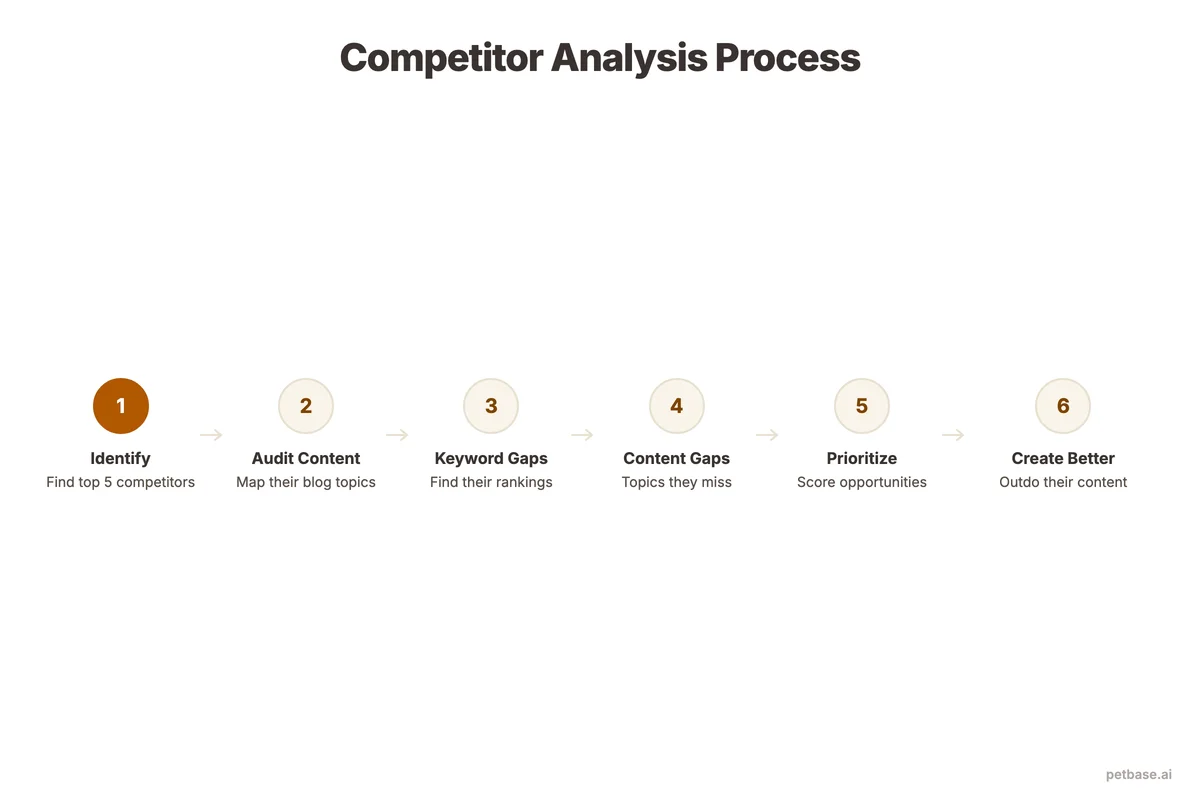
- How to Find Content Gaps in Your Pet Niche
- How to Evaluate Competitor Backlink Profiles
- What to Learn From Competitors' Product Pages
- How to Turn Competitor Intel Into Your Content Plan
- Free and Paid Tools for Pet Store Competitor Analysis
- How Petbase Automates the Hard Part
- Putting It All Together
- Frequently Asked Questions
- References
Learn how to analyze pet store competitors' SEO strategies, find content gaps, and build a data-driven content plan. Step-by-step framework with free tools.
Organic search drives 53% of all website traffic[1]. In a pet care market worth $273.42 billion[2], that means the stores ranking on page 1 of Google capture the majority of buyers. The difference between you and those stores is not budget or luck. It is information.
Competitor analysis is the process of studying what your rivals do well (and poorly) in search, then using that data to make better decisions for your own store. This guide walks you through the exact steps to analyze any pet store competitor - from keywords to backlinks to content gaps - so you can build a strategy based on data, not guesswork.
Why Competitor Analysis Is the Fastest Path to Rankings
Competitor analysis saves you months of trial and error. Instead of guessing which keywords to target or what content to write, you study stores that already rank and reverse-engineer their approach.
Here is why this matters for pet stores specifically:
- Most pet stores ignore SEO entirely. 61% of small businesses are not investing in SEO at all[3]. That means fewer than half of your competitors are even trying. Your bar to outrank them is lower than you think.
- The pet industry is fragmented. You are not competing with one giant. You are competing with dozens of small-to-medium stores, local shops, and niche brands. Opportunities are everywhere - if you know where to look.
- Keywords overlap heavily. Two pet stores selling grain-free dog food target the same searches. The one with better content and more authority wins. Competitor analysis shows you exactly what "better" looks like.
- Backlinks decide close races. Among pages competing for the same keyword, the #1 result has 3.8x more backlinks than results in positions 2 through 10[4]. Knowing where your competitors get their links tells you where to focus your own outreach.
According to a study of 50 pet store websites, the majority have thin content, no blog, and poor technical SEO. Your competitors' weaknesses are your openings.
Petbase automates SEO content for pet stores - publishing 10 optimized articles monthly so you can focus on running your shop - start your free trial.
How to Identify Your Real SEO Competitors
Your SEO competitors are not always who you think. The store down the street might be your business competitor, but your SEO competitors are the websites ranking for the keywords you want.
Here is how to find them:
Step 1: List your target keywords
Start with 10-15 keywords you want to rank for. If you need help choosing these, read our keyword research guide for pet businesses. Examples:
- "organic dog food online"
- "best cat toys for indoor cats"
- "grain-free puppy food"
- "natural flea treatment for dogs"
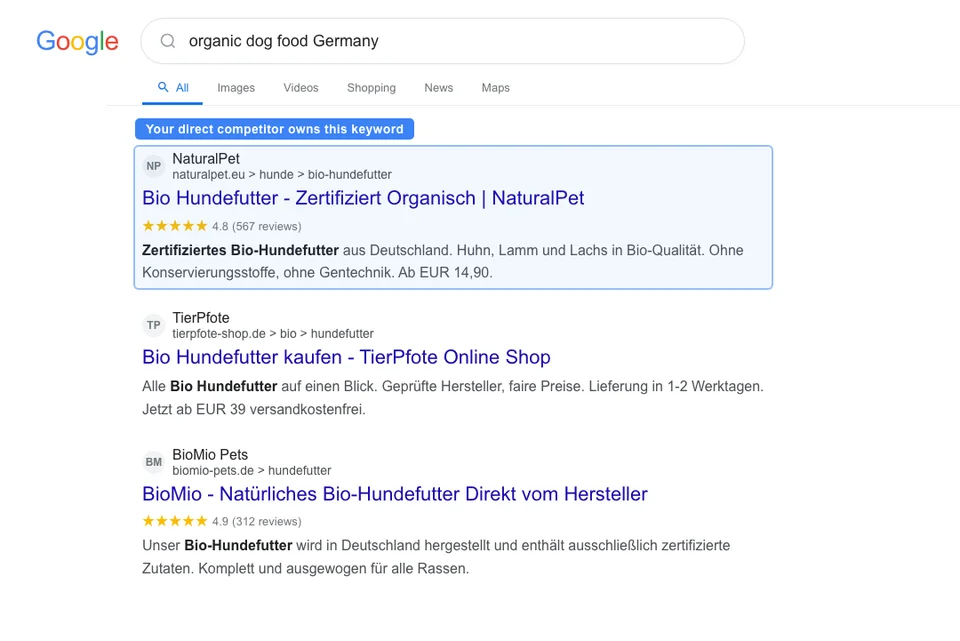
Step 2: Search each keyword on Google
Open an incognito window (to avoid personalized results) and search each keyword. Note the top 5 results for each. Since 46% of all Google searches have local intent[5], pay special attention to local results if you serve a specific region. Those local competitors are often easier to outrank than national brands.
Step 3: Identify repeating domains
Some websites will appear for multiple keywords. These are your true SEO competitors. You will likely find a mix of:
- Direct competitors (other pet stores)
- Content publishers (pet blogs, magazines)
- Marketplaces (Amazon, Chewy, Zooplus)
Step 4: Focus on the right tier
Ignore Amazon and Chewy for now. You cannot outrank them on broad terms. Instead, focus on pet stores and niche sites that are one level above you - they rank for keywords you want, but they are not untouchable giants. For more on competing with large marketplaces, see our guide on how pet stores can compete with Amazon.
Step 5: Build your competitor shortlist
Pick 3-5 competitors to analyze deeply. More than that and you spread yourself too thin.
How to Analyze a Competitor's Keyword Strategy
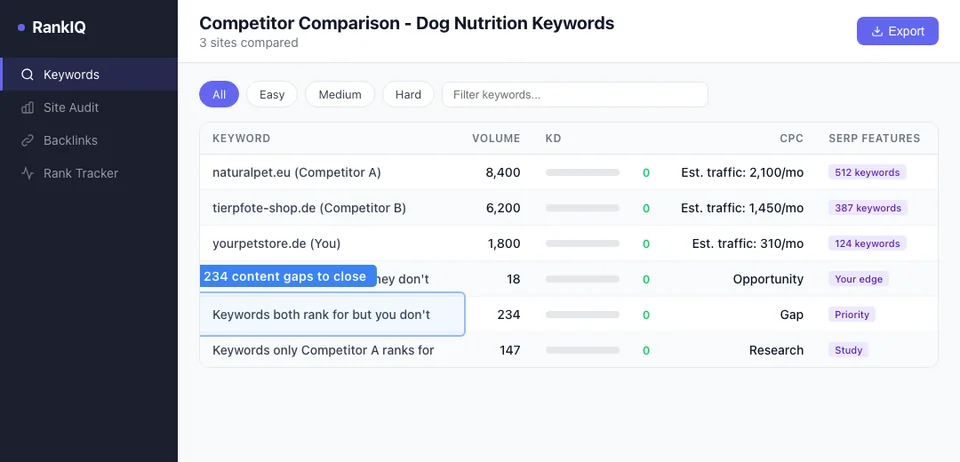
Once you know who your competitors are, the next step is understanding what keywords they rank for - and which ones drive the most traffic. This tells you what topics and products to prioritize.
Here is what to look for:
Total keyword count
How many keywords does the competitor rank for? A store ranking for 500+ keywords has a strong content foundation. One ranking for 50 has gaps you can exploit.
Top-performing keywords
Which keywords drive the most estimated traffic? These are usually a mix of branded searches (their store name) and non-branded searches (product or topic terms). Focus on the non-branded ones - those are the ones you can compete for.
Keyword difficulty distribution
Are they ranking for easy terms (long-tail, low competition) or hard terms (broad, high competition)? Long-tail keywords account for 70% of all searches and convert at 36% - far higher than broad head terms[6]. If most of their traffic comes from long-tail keywords, that tells you a focused strategy works in your niche. Our guide to long-tail keywords for pet stores covers this in detail.
New vs. lost keywords
Check which keywords the competitor recently gained or lost. Newly gained keywords show where they are investing. Lost keywords show where they are slipping - and where you can step in.
| Analysis Area | What It Tells You | Action to Take |
|---|---|---|
| Total keyword count | Content depth and authority | Set a target to match or exceed within 6 months |
| Top traffic keywords | What drives their business | Create better content on the same topics |
| Keyword difficulty | Whether long-tail strategy works | Prioritize low-difficulty keywords first |
| New keywords | Where they are investing now | Follow the trend or get there first |
| Lost keywords | Where they are slipping | Publish content to capture those rankings |
How to Find Content Gaps in Your Pet Niche
Content gaps are topics your competitors cover that you do not. They are the fastest way to expand your keyword footprint because the demand is already proven - you just need to show up.
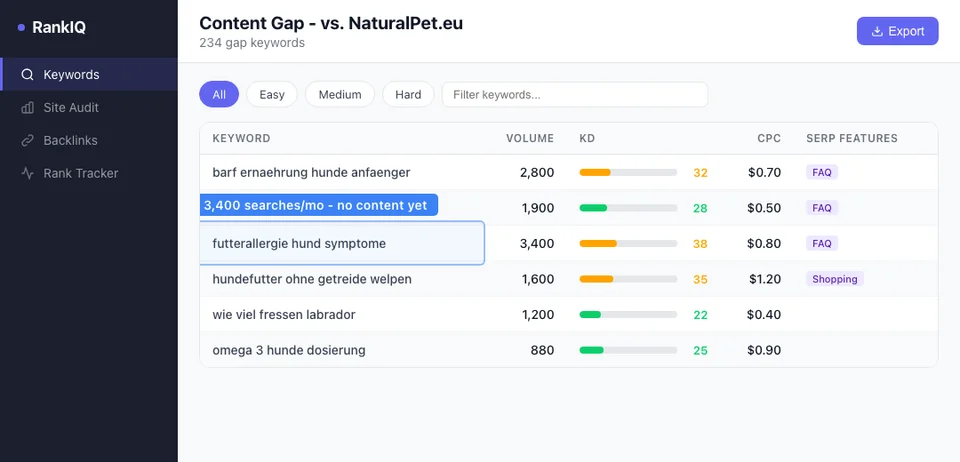
Companies with active blogs get 55% more website traffic than those without[7]. If your competitors have blogs and you do not, that is the first and biggest gap to close.
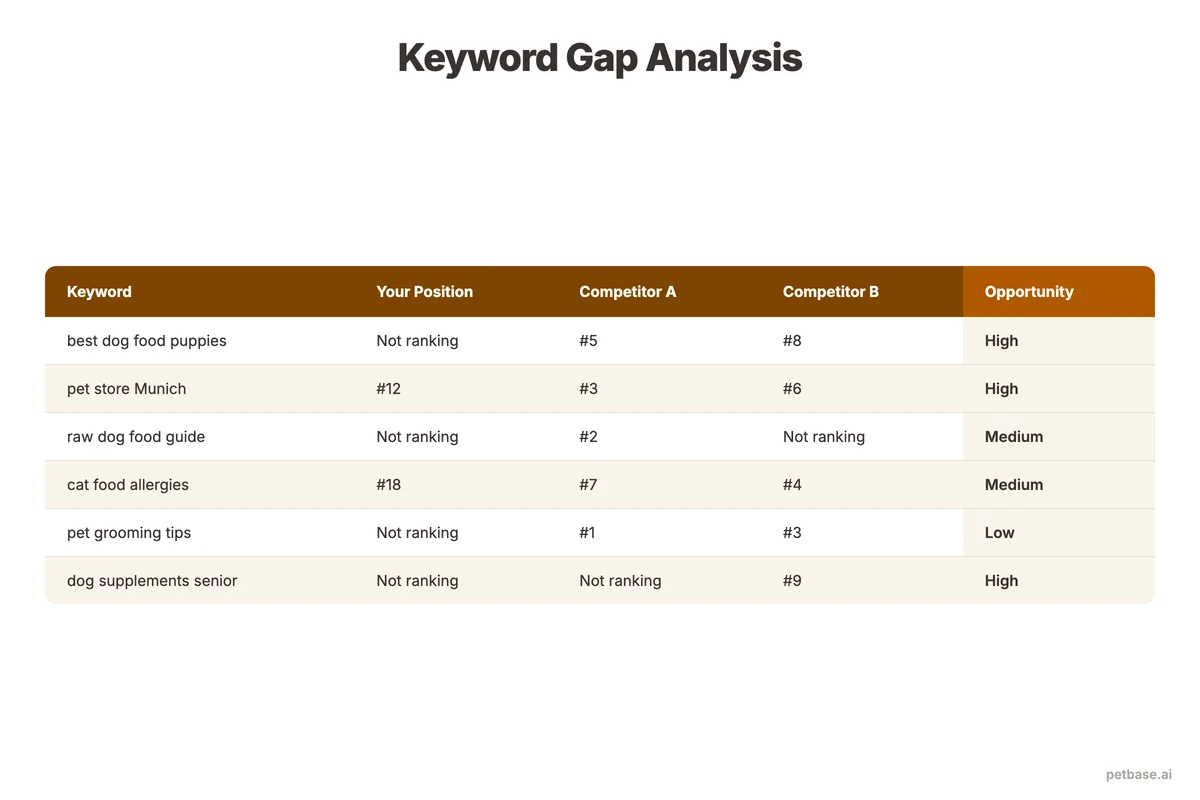
Here is a step-by-step process:
1. Export competitor keywords
Using a tool like Ahrefs, SEMrush, or Ubersuggest, export the full list of keywords your top 3 competitors rank for.
2. Compare against your own keywords
Most tools have a "content gap" or "keyword gap" feature. This shows keywords where competitors rank but you do not.
3. Filter for opportunity
Look for keywords with:
- Search volume above 100/month
- Keyword difficulty below 40
- Clear commercial or informational intent
4. Group into topics
Do not create one article per keyword. Group related keywords into topic clusters. For example, "best flea collar for dogs," "natural flea prevention," and "flea collar vs. spot treatment" all belong in one comprehensive post.
For more on building topic clusters, read our content marketing guide for pet businesses.
5. Prioritize by business value
Not all gaps are worth filling. Prioritize topics that connect to products you sell. A blog post about "best fish tank filters" is only valuable if you sell aquarium supplies.
How to Evaluate Competitor Backlink Profiles
Backlinks are links from other websites pointing to your competitor. They are one of Google's strongest ranking signals. The #1 result for any given keyword has 3.8x more backlinks than results ranking in positions 2 through 10[4]. Understanding where your competitors get those links tells you where to focus your own link-building efforts.
Here is what to examine:
Total backlinks vs. referring domains
A site with 1,000 backlinks from 50 domains is weaker than one with 500 backlinks from 300 domains. Google values diversity. Count referring domains, not total links.
Link quality
Where do the links come from? Links from pet industry publications, veterinary websites, and pet blogs carry more weight than random directories or link farms. For a deeper look at building quality links, read our backlink guide for pet stores.
Anchor text distribution
What text do other sites use when linking to your competitor? Natural anchor text is varied - brand name, generic ("click here"), and keyword-rich ("best organic dog food"). If most anchors are keyword-rich, that can signal manipulation.
Top linked pages
Which pages on the competitor's site attract the most backlinks? These are usually:
- Data-driven blog posts
- Ultimate guides
- Free tools or calculators
- Infographics
This tells you what type of content earns links in the pet space.
| What to Analyze | Why It Matters | What to Ignore |
|---|---|---|
| Referring domains count | Measures true link diversity | Total backlink count (inflated by spam) |
| Links from pet industry sites | High relevance = high value | Links from unrelated niches |
| Top linked content types | Shows what earns links in pet space | Links to homepage only (not actionable) |
| Anchor text distribution | Reveals natural vs. manipulated profiles | Exact match anchor percentages (noisy data) |
| New links per month | Shows growth momentum | Old links from dead sites |
What to Learn From Competitors' Product Pages
Product pages are where most pet stores underperform. While competitors often have the same SEO gaps, studying the best ones reveals what Google rewards.
Look at these elements:
Title tags and meta descriptions
Do they include the product name, brand, and a key benefit? Or are they generic like "Dog Food - Buy Online"? Better title tags look like: "Orijen Original Dry Dog Food - Grain-Free, High Protein | Shop Name."
Product descriptions
How long are they? Do they include ingredients, benefits, usage instructions, and sizing info? Thin product descriptions (under 100 words) are a common weakness. If your competitors have thin descriptions, that is your opportunity to write detailed, SEO-rich ones. Learn more about product page optimization in our pet store SEO guide.
Internal linking
Do product pages link to related blog posts? Do blog posts link back to products? This two-way linking is what top stores do - it builds topical connections that Google rewards.
Customer reviews
Are reviews present on product pages? Reviews add unique content, long-tail keywords, and trust signals. If competitors have reviews and you do not, that is a clear gap to close.
Schema markup
Check if competitors use Product schema (price, availability, ratings). You can verify this using Google's Rich Results Test. Pages with schema markup see up to 30% higher click-through rates, yet only about 30% of websites use it[8]. If your competitors lack schema and you add it, you gain an immediate visibility advantage.
How to Turn Competitor Intel Into Your Content Plan
Competitor analysis is only useful if it leads to action. Here is how to convert your research into a content plan that moves rankings.
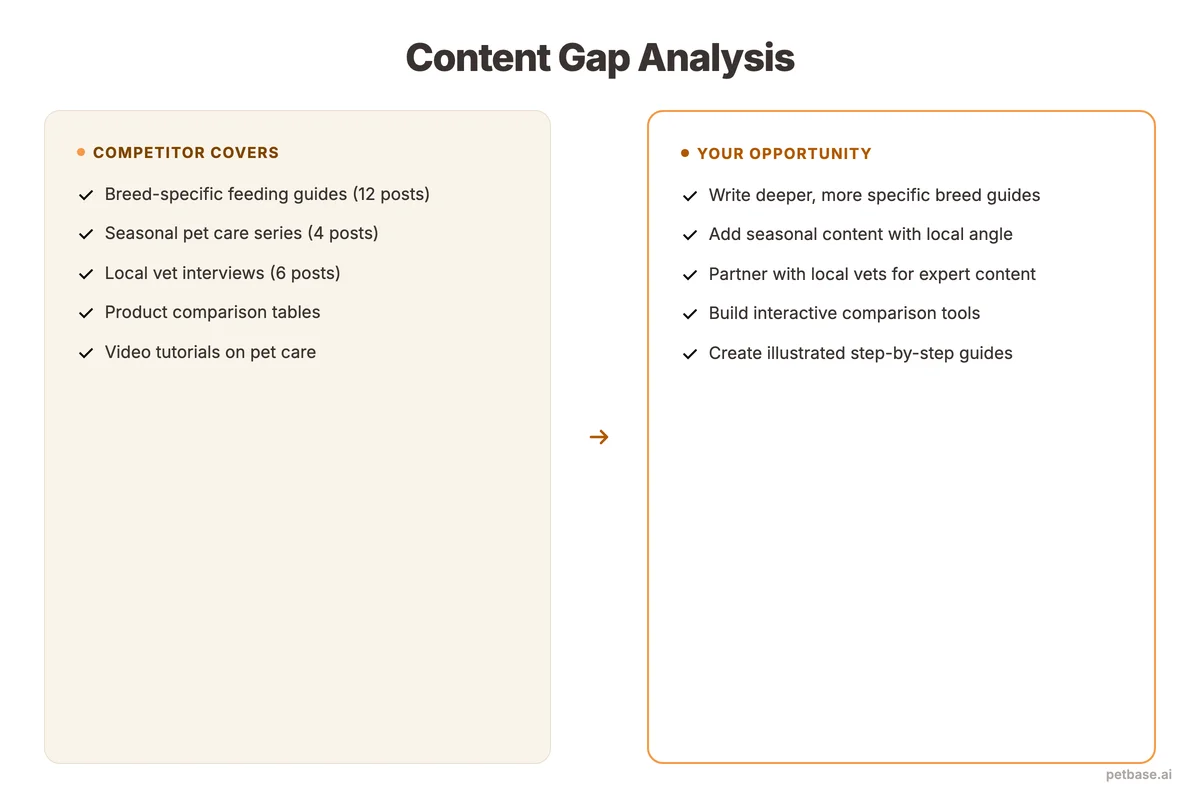
Step 1: Create a priority matrix
List every opportunity you found - content gaps, weak competitor pages, unlinked topics - and score each on two factors:
- Effort: How hard is it to create this content? (1 = easy, 5 = complex)
- Impact: How much traffic or revenue could it drive? (1 = low, 5 = high)
Start with high-impact, low-effort items.
Step 2: Map topics to content types
Not every topic needs a blog post. Some are better served by:
- Product page improvements
- Category page content
- FAQ sections
- Comparison guides
Step 3: Set a publishing cadence
Consistency matters more than volume. Companies with blogs generate 55% more traffic[7], but only if they publish regularly. Two to three quality pieces per week beats 10 mediocre ones per month. For help planning this, see our SEO content calendar guide.
Step 4: Track your progress
Monitor keyword rankings monthly. Compare your growth against the same competitors you analyzed. If you are closing the gap, your strategy is working. If not, revisit your analysis.
Free and Paid Tools for Pet Store Competitor Analysis
You do not need expensive tools to start. Here is a comparison of free and paid options:

| Tool | Free Plan | Best For | Limitations |
|---|---|---|---|
| Google Search | Unlimited | Identifying competitors, manual SERP analysis | No keyword data, time-intensive |
| Ubersuggest | 3 searches/day | Keyword overlap, content ideas | Limited data on free plan |
| Ahrefs Webmaster Tools | Free for own site | Your own keyword and backlink data | Cannot analyze competitors |
| SEMrush | 10 requests/day | Keyword gap analysis, competitor tracking | Very limited without paid plan |
| SimilarWeb | Limited | Traffic estimates, traffic sources | Inaccurate for small sites |
| Google Search Console | Free | Your own search performance data | Only shows your data, not competitors |
| MozBar (browser extension) | Free | Quick domain authority checks in SERPs | Limited to basic metrics |
The free approach (under 2 hours)
- Search your top 10 keywords in Google incognito
- Note the top 3 competing domains for each
- Visit each competitor's blog and product pages
- List topics they cover that you do not
- Check their page titles and meta descriptions
- Use MozBar to see domain authority scores
The paid approach (more thorough)
Tools like Ahrefs (starting at $99/month) or SEMrush ($129/month) let you:
- See every keyword a competitor ranks for
- Run content gap analysis automatically
- Track backlink profiles
- Monitor ranking changes over time
If you are serious about SEO, one of these tools pays for itself quickly. But start free - you can get 80% of the insights with manual research.
How Petbase Automates the Hard Part
Competitor analysis tells you what to do. The harder part is doing it - producing 10+ articles per month, building topic clusters, and maintaining consistency. That is where Petbase fits.
When you connect your store, Petbase runs a site audit that identifies keyword gaps, competitor content patterns, and topic opportunities automatically. It then generates a 30-day content plan with strategically connected articles designed to build topical authority in your niche.
At EUR 199/mo for 10 articles, you get the execution without the 40-60 hours of writing. The competitor research tells you where to aim. Petbase pulls the trigger.
Ready to close the gaps your competitors are leaving open? See Petbase pricing or start your free trial.
Putting It All Together
Competitor analysis is not a one-time project. The best pet stores revisit their competitive landscape every quarter. Markets shift, new competitors appear, and content ages.
Here is a quarterly review checklist:
- Re-run keyword gap analysis against your top 3 competitors
- Check for new competitors entering your niche
- Review which competitor content gained or lost rankings
- Update your content plan based on new findings
- Track your own ranking progress against competitor benchmarks
The pet stores that dominate search results are not always the biggest or the oldest. They are the ones that study the competition, find the gaps, and fill them with better content. You can do the same - it starts with knowing where to look.
For a complete roadmap to improving your pet store's search visibility, check out our pet store SEO checklist.
Frequently Asked Questions
How often should I run competitor analysis for my pet store?
Run a full competitor analysis every quarter. Markets change, new stores enter your niche, and content ages. A quarterly review takes 2-3 hours and keeps your content strategy aligned with current opportunities. Between deep analyses, do a quick monthly check on your top 3 competitors' newest content to spot trends early.
Can small pet stores compete with large chains in SEO?
Yes - and often more effectively than you expect. Large chains target broad, high-competition keywords like "dog food" or "pet supplies." Small stores win by targeting long-tail keywords like "grain-free dog food for allergies" or "natural cat litter for sensitive cats." Long-tail keywords make up 70% of all searches and convert at 36%[6]. A focused niche strategy with consistent content often outperforms a large site with thin, generic pages. See our guide to competing with Amazon for specific tactics.
What is the biggest mistake pet stores make with competitor analysis?
Copying competitors instead of learning from them. If a competitor ranks for a keyword and you publish a nearly identical article, Google has no reason to rank yours higher. The goal is to identify what topics work, then create something genuinely better - more detailed, more current, better structured, with original insights. Study patterns, not pages. Find what competitors miss, not what they cover.
How important are backlinks compared to content?
Both matter, but content is the foundation. You cannot earn backlinks without something worth linking to. That said, among pages with comparable content quality, the #1 result has 3.8x more backlinks than the rest of the top 10[4]. Start with content. Once you have strong pages, pursue backlinks through outreach, partnerships, and data-driven content that earns links naturally.
References
- BrightEdge (2024). How Much Traffic Comes from Organic Search. seoinc.com
- Fortune Business Insights (2024). Pet Care Market Size and Growth. fortunebusinessinsights.com
- Clutch (2025). SEO Statistics. clutch.co
- BuzzStream (2024). Link Building Statistics. buzzstream.com
- BrightLocal (2024). Local SEO Statistics. brightlocal.com
- Embryo (2024). 30 Statistics About Long-Tail Keywords. embryo.com
- HubSpot (2024). Marketing Statistics. hubspot.com
- Amra and Elma (2025). Top Schema Markup Statistics. amraandelma.com