How to Write a Content Brief for Your Pet Store Blog


Table of Contents +
- What Is a Content Brief and Why Does It Matter for Pet Stores?
- Why Do Most Pet Store Blog Posts Fail to Rank?
- What Should a Pet Store Content Brief Include?
- What Does a Complete Content Brief Look Like?
- How Does a Content Brief Fit Into Your SEO Strategy?
- How Long Should You Spend on a Content Brief?
- What Happens When You Write Without a Brief?
- How Do You Use Long-Tail Keywords in Your Brief?
- What Are the Most Common Content Brief Mistakes?
- Frequently Asked Questions
- References
Learn how to write a content brief for your pet store blog. Free template, worked example, and step-by-step guide to plan posts that rank on Google.
You sit down to write a blog post for your pet store. You have a topic in mind - something about dog nutrition. Two hours later, you have 1,200 words that wander between puppy feeding schedules, raw diets, and grain-free controversies. The post does not rank. It does not drive traffic. And tomorrow, you still have 300 orders to pack and a delivery to schedule.
This is what happens when pet store owners skip the content brief. Without a written plan before you write, every blog post is a guess. And guessing does not work in SEO, where 7.5 million blog posts are published every single day[1].
A content brief is the document you write before you write. It takes 20-30 minutes to create - and it is the difference between a blog post that ranks on page 1 and one that disappears into the internet.
TL;DR
A content brief is a one-page planning document that defines your target keyword, search intent, audience, and structure before you write. Pet stores using briefs produce focused content that ranks faster and requires fewer rewrites. This guide includes a complete template and a worked example for a pet store blog post.
What Is a Content Brief and Why Does It Matter for Pet Stores?
A content brief is a short document - typically one to two pages - that outlines everything a writer needs to know before starting a blog post. It defines the target keyword, the audience, the search intent, the structure, and the goal of the piece. Think of it as a blueprint. You would not build a shelf without measurements. You should not write a blog post without a brief.
The data supports this. Marketers with a documented content strategy are 2x more likely to rate their content marketing as highly effective compared to those working from memory alone[2]. Among the most successful companies, 80% have a documented content strategy[3]. A content brief is the smallest unit of that documented strategy - one brief per blog post, one clear plan per piece of content.
For pet stores specifically, briefs solve three problems at once. First, they prevent topic drift - your article about senior dog nutrition stays about senior dog nutrition, not dog food in general. Second, they make writing faster by eliminating decisions during the writing process. Third, they align your content with what people actually search for, which is the entire point of blogging for SEO.
Petbase automates SEO content for pet stores - publishing 10 optimized articles monthly so you can focus on running your shop - start your free trial.
Why Do Most Pet Store Blog Posts Fail to Rank?
The average blog post takes 3 hours and 48 minutes to write[1]. That is a serious time investment for a pet store owner who is already handling purchasing, customer service, and operations. If that post does not rank, those 4 hours are wasted.
Most pet store blog posts fail for the same reasons. The topic is too broad ("dog food guide" instead of "best grain-free food for senior Labrador Retrievers"). The post does not match what the searcher actually wants. There is no keyword targeting. The structure does not signal to Google what the article covers. And there is no connection to other content on your site - no topic clusters, no internal links, no authority building.
All of these problems are brief problems. They happen before the writing starts, not during it. A content brief forces you to answer the critical questions first: What exactly is this post about? Who is searching for it? What do they expect to find? What keyword are we targeting? How does this connect to our other content?
Resource constraints are the number one content marketing challenge, cited by 39% of businesses[4]. Pet store owners have even less time than the average marketer. A brief does not add time to your process - it reduces total time by eliminating rewrites and unfocused drafts. Teams using detailed briefs produce higher-quality first drafts with fewer revision rounds[5].
What Should a Pet Store Content Brief Include?
Every content brief for a pet store blog post should cover these nine elements. Skip any one of them and you leave a gap that either slows down writing or weakens the finished post.
1. Target keyword. The exact phrase you want this post to rank for. Be specific. "Dog food" has millions of competing pages. "Best dog food for French Bulldogs with sensitive stomachs" has far less competition and higher purchase intent. Your keyword research should identify this before the brief.
2. Secondary keywords. Related phrases that support your primary keyword. For the French Bulldog example, secondaries might include "French Bulldog digestive issues," "hypoallergenic dog food small breeds," and "sensitive stomach dog food ingredients." These help Google understand the full scope of your article.
3. Search intent. What does the searcher want? For product-comparison keywords, they want a list with recommendations. For "how to" keywords, they want step-by-step instructions. For "what is" keywords, they want a clear explanation. Matching intent determines whether your post satisfies the reader - and Google measures satisfaction through engagement signals.
4. Target audience. Who is searching this? A first-time puppy owner needs different language and detail than a professional breeder. For pet stores, your audience is almost always the pet owner - but their experience level and specific situation vary by topic.
5. Content outline. A list of H2 and H3 headings that structure the post. This is where you decide what the article covers and in what order. The outline should follow a logical progression and address every question the searcher might have. Pages ranking in the top 10 on Google cover significantly more subtopics than pages on page two[6].
6. Word count target. Based on what is already ranking for your keyword. The average first-page result contains 1,447 words[6]. Do not write 500 words when the top 5 results are all 2,000+. Do not write 4,000 words when 1,200 covers the topic completely. Match the depth to what the keyword requires.
7. Internal links. Which other pages on your site should this post link to? Internal linking builds topic clusters and passes authority between related pages. Every new blog post should link to 3-5 existing posts on related topics and to at least one product or category page on your site.
8. Competitor analysis. What are the top 3-5 results for your keyword doing? Read them. Note what they cover well, what they miss, and where you can add more value. Your brief should include a one-line note on each competitor and the specific gap your post will fill.
9. Call to action. What should the reader do after finishing the post? Visit a product page? Sign up for your newsletter? The CTA should match the topic and the reader's stage in the buying process.
What Does a Complete Content Brief Look Like?
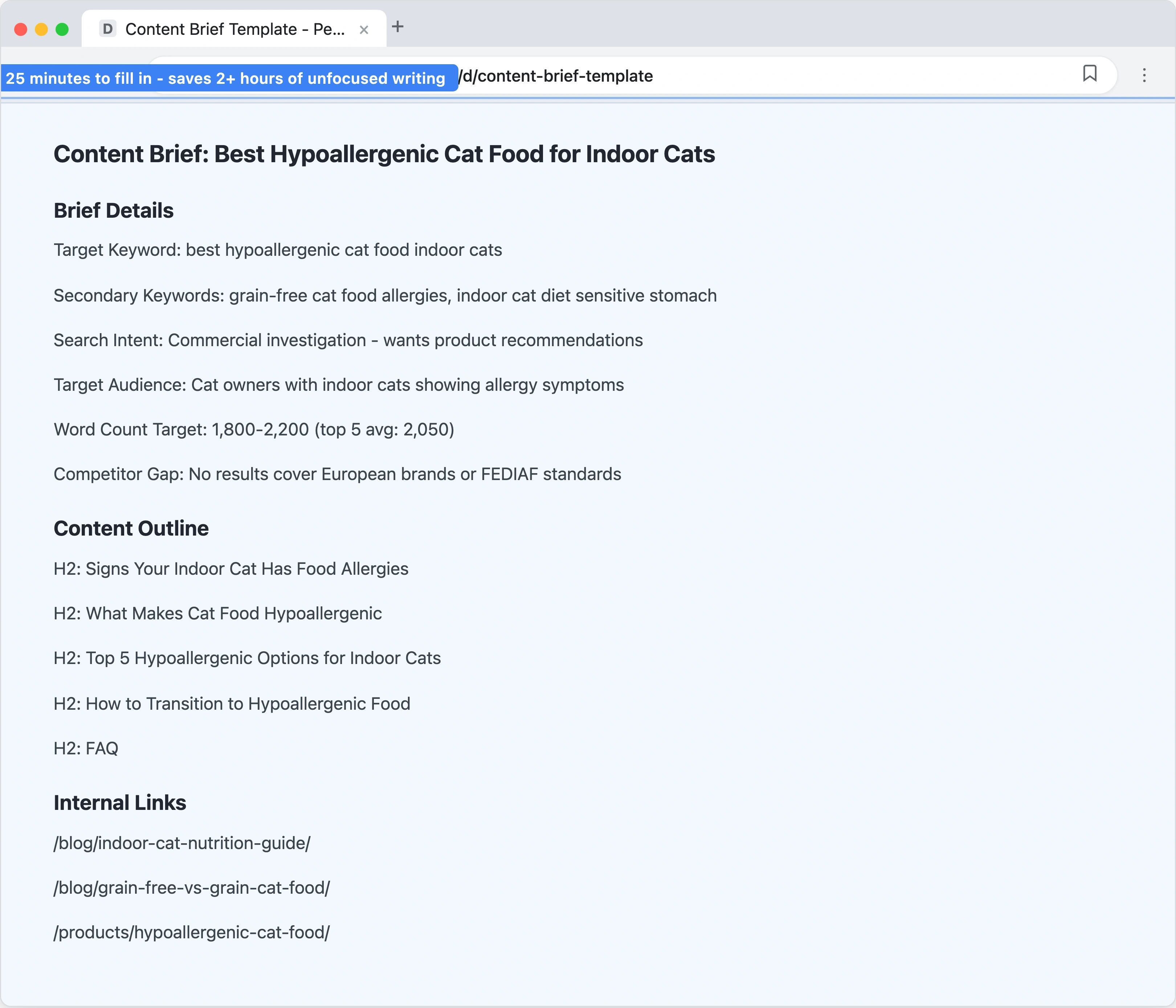
Here is a worked example of a content brief for a pet store blog post. This is exactly the kind of document you would create before writing.
| Element | Details |
|---|---|
| Target keyword | best grain-free dog food senior dogs |
| Secondary keywords | grain-free diet older dogs, senior dog nutrition, grain-free kibble large breeds |
| Search intent | Commercial investigation - the reader wants product recommendations with reasoning |
| Target audience | Dog owners with senior dogs (7+ years), concerned about digestive health and joint support |
| Word count | 1,800-2,200 words (top 5 results average 1,900) |
| Competitor gap | Top results focus only on US brands. None mention European brands or FEDIAF standards. No article addresses the specific nutritional shift dogs need after age 7. |
| CTA | Link to senior dog food category page on the store |
Outline:
- H2: Why Senior Dogs Need Different Nutrition (age-related metabolic changes)
- H2: What Makes Grain-Free Food Suitable for Older Dogs (ingredients, digestion)
- H2: Top 5 Grain-Free Options for Senior Dogs (product comparison with pros/cons)
- H2: How to Transition Your Senior Dog to Grain-Free Food (step-by-step)
- H2: Common Mistakes When Switching Senior Dogs to Grain-Free (warnings)
- H2: FAQ (3 questions from "People Also Ask")
Internal links:
- /blog/senior-dog-nutrition-guide/ (related pillar post)
- /blog/grain-free-vs-grain-dog-food/ (supporting cluster post)
- /products/senior-dog-food/ (product category page)
This brief took about 25 minutes to create. The actual writing from this brief takes 2-3 hours instead of the usual 4+ hours of unfocused writing - because every section is pre-defined, every question is already answered, and the research is done before you open a blank document.
How Does a Content Brief Fit Into Your SEO Strategy?
A single content brief produces a single blog post. But the real value comes when you connect those briefs into a larger plan. This is where content briefs meet blog strategy and content calendars.
Companies with active blogs generate 55% more website traffic and 67% more leads than those without[7]. But that traffic does not come from random posts. It comes from structured topic clusters - groups of related articles that collectively build authority on a subject.
For a pet store, a topic cluster on "dog nutrition" might include 8-12 articles: breed-specific feeding guides, life stage nutrition, ingredient comparisons, diet transition guides, and FAQ posts. Each article has its own content brief. Each brief specifies how that post links to others in the cluster. The result is a web of related content that signals deep expertise to Google.
Companies publishing 16 or more blog posts per month generate 3.5x more traffic than those publishing 4 or fewer[7]. Most pet stores cannot publish 16 posts per month - but 8-10 well-briefed, strategically connected posts will outperform 16 unfocused ones every time. One pattern I have seen repeatedly in my 25 years of SEO consulting: 10 connected articles in a single topic cluster outrank 30 random articles spread across unrelated topics.
Organic search drives 53% of all website traffic[8]. For pet stores, that percentage is often higher because pet owners actively research products, breeds, and health topics online. Every content brief you write is an investment in capturing that search traffic. And because 76% of blog traffic comes from posts published months or years ago[7], the content you plan and publish today continues driving traffic long after you have moved on to other tasks.
How Long Should You Spend on a Content Brief?
A content brief should take 20-30 minutes. If you are spending more than 45 minutes, you are either doing too much research inside the brief or the topic is not well-defined enough.
Here is a realistic time breakdown for the entire brief-to-publish workflow:
| Step | Time | What happens |
|---|---|---|
| Keyword research | 15-20 min | Identify target keyword, check search volume, review competition |
| Content brief | 20-30 min | Fill in all 9 elements, write the outline, note competitor gaps |
| Writing | 2-3 hours | Write the draft following the brief structure |
| Editing | 30-45 min | Review for accuracy, readability, SEO elements |
| Publishing | 15-20 min | Format, add images, set meta description, schedule |
| Total | 3.5-5 hours | One complete, SEO-optimized blog post |
Compare that to writing without a brief. The average blog post already takes 3 hours and 48 minutes to write[1] - and that is just the writing portion. Without a brief, writers often spend an additional 1-2 hours on research during the writing process, go through multiple revision rounds, and still produce content that misses the target keyword or search intent.
Bloggers who invest 6 or more hours per post are 14% more likely to report positive results[1]. A content brief ensures those hours go toward producing a focused, strategic post rather than wandering through multiple drafts.
What Happens When You Write Without a Brief?
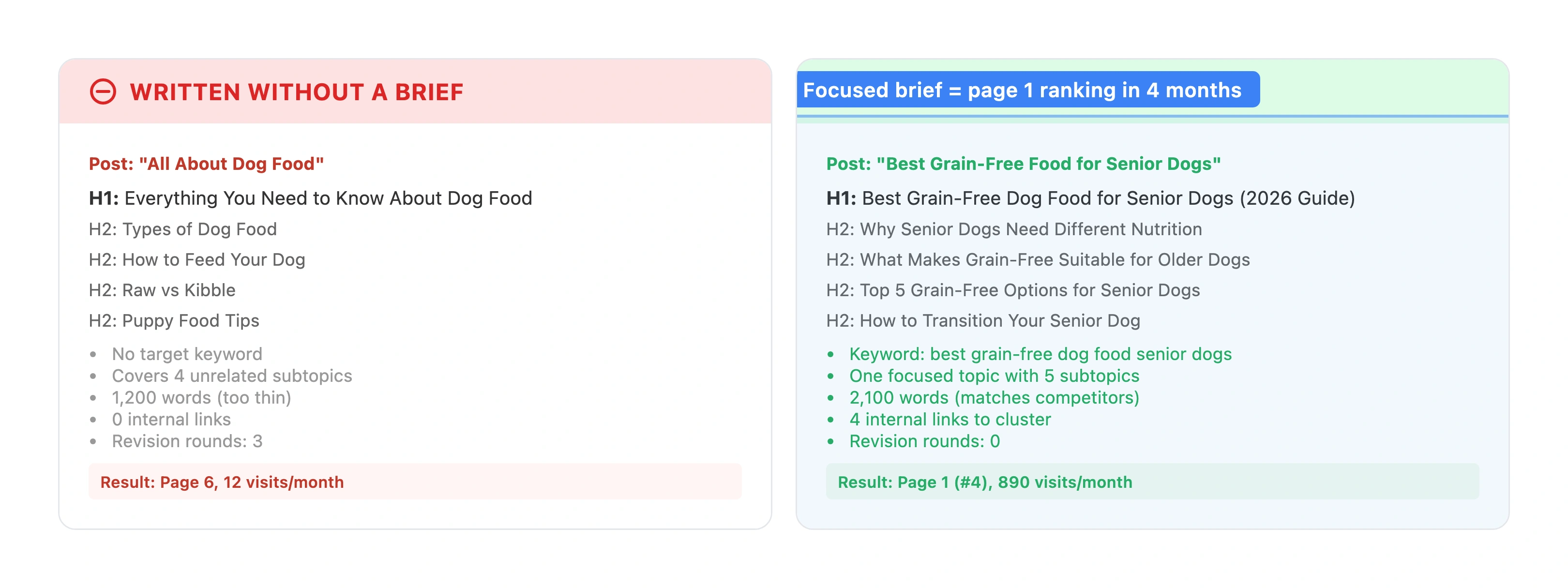
The difference between briefed and unbriefed content is measurable. Here is what the two approaches produce over a 6-month period for a typical pet store publishing 8 posts per month.
| Metric | Without brief | With brief |
|---|---|---|
| Posts ranking on page 1 (6 months) | 3-5 out of 48 | 12-18 out of 48 |
| Average time per post (writing + editing) | 5-6 hours | 3.5-4.5 hours |
| Revision rounds per post | 2-3 rounds | 0-1 rounds |
| Topic overlap between posts | High (cannibalization) | Low (planned clusters) |
| Internal linking structure | Random or missing | Strategic, cluster-based |
| Keyword targeting accuracy | Vague, multiple keywords | Precise, one primary keyword |
| Content gaps identified | Never (reactive writing) | Before writing starts |
The top 3 organic search results receive 68.7% of all clicks[9]. Position 1 alone captures 39.8% of clicks. The difference between ranking at position 4 and position 1 is not incremental - it is the difference between getting occasional visitors and getting consistent traffic. Content briefs are how you push more of your posts into those top positions.
In my experience working with pet stores across Europe, the ones that adopt content briefs see the improvement within the first quarter. It is not because briefs are magic. It is because briefs force you to do the thinking before the writing - and that thinking is where rankings are won or lost.
How Do You Use Long-Tail Keywords in Your Brief?
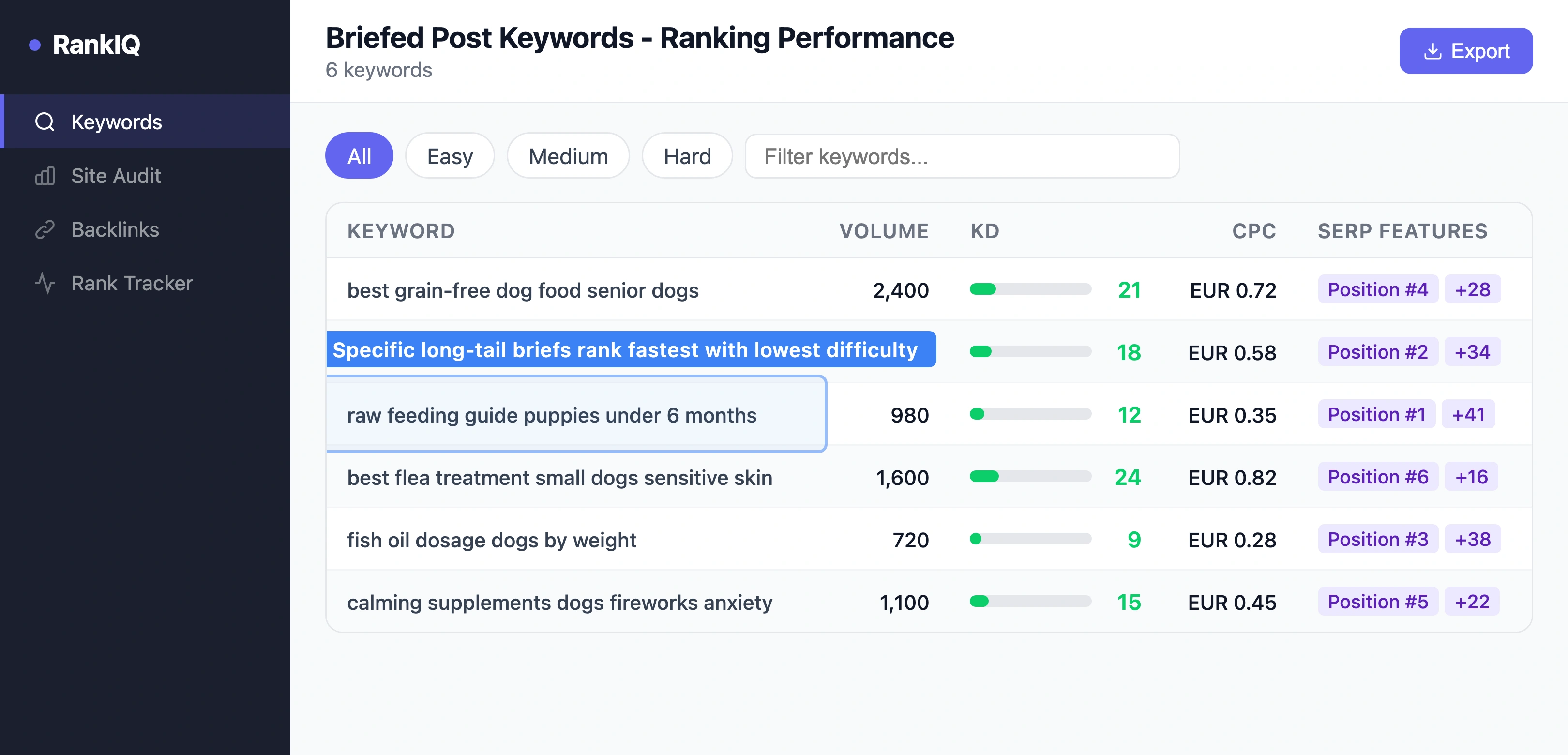
Long-tail keywords are the foundation of effective pet store content briefs. A long-tail keyword is a specific, multi-word phrase like "best hypoallergenic cat food for indoor cats" rather than a broad term like "cat food."
For pet stores, long-tail keywords are especially valuable because they match how pet owners actually search. Nobody types "dog food" when they have a specific need. They type "best dog food for 10-year-old German Shepherd with hip dysplasia" because they want a specific answer. Your content brief should target these specific phrases.
Content marketing returns an average of $7.65 for every $1 spent[10]. That return is highest when your content targets keywords with clear commercial intent - the kind of searches that lead to purchases. Broad keywords attract browsers. Long-tail keywords attract buyers.
When filling in the keyword section of your brief, start with the most specific version of your topic. Then work outward to find 3-5 secondary keywords that support it. Your keyword research process should feed directly into your content briefs. Each brief should target one primary long-tail keyword and 3-5 related secondary keywords.
What Are the Most Common Content Brief Mistakes?
After reviewing hundreds of content briefs from pet stores and small businesses, these are the five mistakes that show up most often.
1. Targeting keywords that are too broad. "Pet food" or "dog training" are not keywords you can rank for with a single blog post. They require dozens of connected articles. Your brief should target a specific long-tail variation that a single post can realistically rank for.
2. Skipping the competitor analysis. If you do not know what already ranks for your keyword, you cannot write something better. Spend 10 minutes reading the top 3 results. Note what they cover, what they miss, and where your expertise adds something new.
3. Writing an outline that is too vague. "Section about nutrition" is not useful. "H2: How Much Protein Does a Senior Labrador Need Daily? (include gram recommendations by weight, compare to adult requirements)" gives the writer exactly what to produce.
4. Forgetting internal links. Every blog post should strengthen your site's overall structure. If your brief does not specify which other pages to link to, the writer will either skip internal links entirely or link randomly. Both hurt your SEO performance.
5. No search intent analysis. A brief for a "how to" keyword that produces a listicle will not rank. A brief for a product comparison keyword that produces a general guide will not rank. The format must match what the searcher expects to find.
Frequently Asked Questions
Do I need a content brief for every blog post?
Yes. Even a simple post benefits from a 10-minute brief that defines the keyword, audience, and structure. The investment is minimal - 20-30 minutes - and it consistently produces better results than writing without a plan. Companies with blogs generate 55% more traffic than those without[7], but only when those posts target the right keywords and match search intent. A brief ensures both.
Can I use the same content brief template for every topic?
Yes. The nine-element template in this guide works for any pet store blog topic - product comparisons, how-to guides, breed profiles, seasonal content, and informational articles. The structure stays the same. The specific keywords, outline, and competitor analysis change with every post. Save the template and reuse it for each new article on your content calendar.
How does a content brief help with SEO specifically?
A content brief improves SEO in four direct ways. It defines a precise target keyword so the post ranks for a specific search. It structures headings to match Google's content understanding. It plans internal links that build topic cluster authority. And it sets a word count target based on what competing pages offer, ensuring your content is comprehensive enough to compete. The average first-page Google result is 1,447 words[6] - a brief ensures you match or exceed that depth.
What if I do not have time to write content briefs?
If you cannot spare 20-30 minutes per post for a brief, you also cannot spare 5-6 hours for an unfocused post that does not rank. Briefs save time overall by reducing revision rounds and eliminating wasted writing. That said, if content planning and writing are taking too much time away from running your pet store, automated content tools can handle the entire process - from keyword research and brief creation to writing and publishing.
References
- Orbit Media (2025). Blogging Statistics and Trends. orbitmedia.com
- Content Marketing Institute (2025). Content Marketing Statistics. contentmarketinginstitute.com
- Semrush (2025). Content Marketing Statistics. semrush.com
- Content Marketing Institute (2025). B2B Content Marketing Trends Research. contentmarketinginstitute.com
- Content Harmony (2025). What Is a Content Brief? contentharmony.com
- Backlinko (2025). Content Marketing Stats. backlinko.com
- HubSpot (2025). Marketing Statistics. hubspot.com
- BrightEdge (2025). How Much Traffic Comes from Organic Search. seoinc.com
- First Page Sage (2026). Google Click-Through Rates by Ranking Position. firstpagesage.com
- Genesys Growth (2025). Content Marketing ROI Stats. genesysgrowth.com