Content Clustering for Pet Websites: Build Authority


Table of Contents +
- What Is Content Clustering and Why Does It Matter for Pet Websites?
- How Does a Content Cluster Differ From Random Blog Posts?
- How to Map Your First Pet Business Content Cluster
- What Does a Real Pet Store Content Cluster Look Like?
- How to Interlink Cluster Pages for Maximum SEO Impact
- Why 10 Clustered Posts Outperform 30 Random Articles
- How to Build Content Clusters Without Writing Everything Yourself
- Measuring Cluster Performance: What to Track
- Frequently Asked Questions
- References
How content clustering builds topical authority for pet websites. Real cluster examples, interlinking rules, and why 10 clustered posts beat 30 random ones.
Most pet websites publish blog posts the same way: find a keyword, write an article, publish it, and move to the next keyword. Each article exists in isolation - no strategic connections, no shared authority, no compounding effect. After 50 posts, they wonder why traffic stays flat.
Content clustering fixes this. Instead of random articles, you create interconnected groups of content that cover topics comprehensively. Organic search drives 53% of all website traffic[1], and the sites that capture the biggest share are the ones Google trusts as genuine authorities on a topic. This guide shows you exactly how to plan, build, and measure content clusters for your pet website.
What Is Content Clustering and Why Does It Matter for Pet Websites?
Content clustering is a strategy where you organize your content into groups of related pages connected by internal links. Each cluster has a pillar page (a comprehensive guide on a broad topic) supported by 8-15 detailed articles on subtopics. Every piece links to related pieces within the cluster, creating a web of topically connected content.
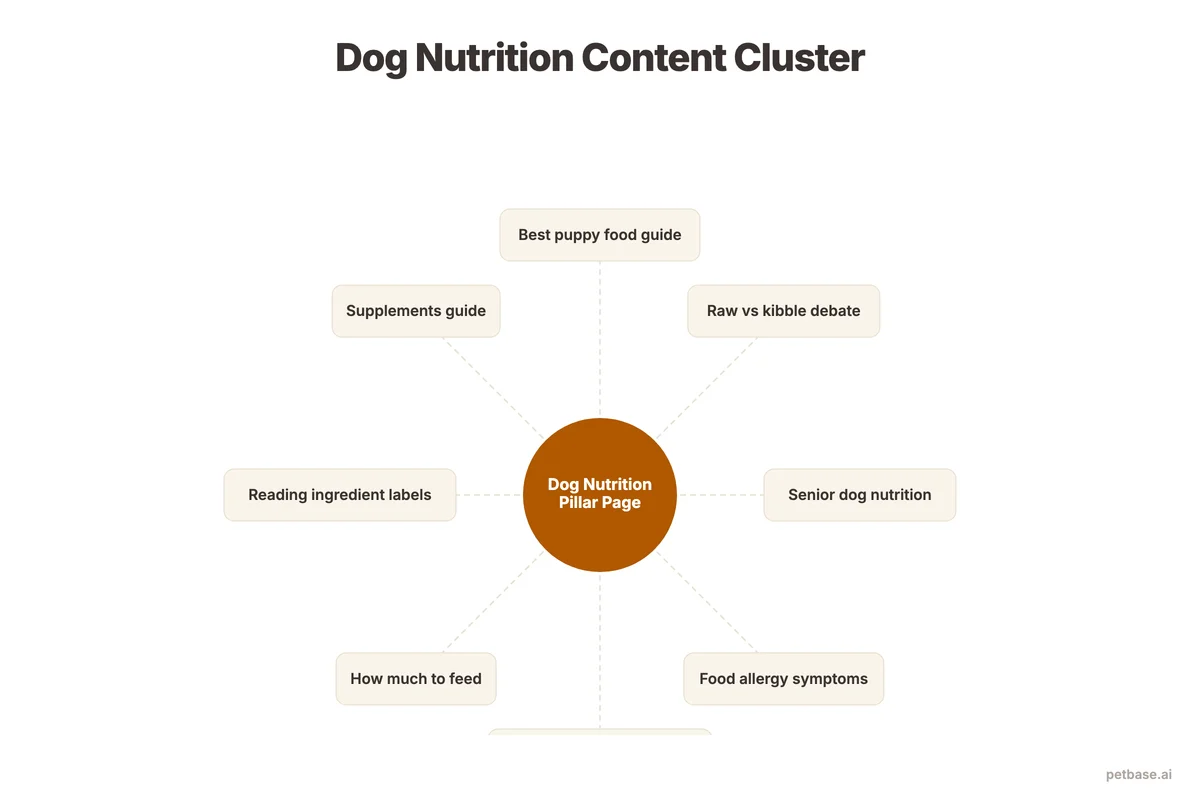
For pet websites specifically, clustering matters because the pet industry has naturally hierarchical topics. The global pet care market is valued at $273.42 billion[2], and competition for organic visibility is growing every year. Dog nutrition splits into puppy nutrition, senior nutrition, breed-specific nutrition, condition-specific nutrition, raw feeding, and ingredient analysis. Each subtopic is a separate article, but together they form a comprehensive cluster that tells Google: "This site truly understands dog nutrition."
The impact is measurable. Pages within structured clusters rank significantly higher than identical content published without cluster structure. The content is the same quality - the difference is entirely in how it is organized and interlinked.
Why does clustering work so well? Google's algorithms evaluate topic coverage at the domain level, not just the page level. A pet store with 12 interconnected articles about dog nutrition is considered more authoritative on that topic than a competitor with 30 random articles about dogs, cats, fish, horses, and reptiles. Depth in one area beats breadth across many areas.
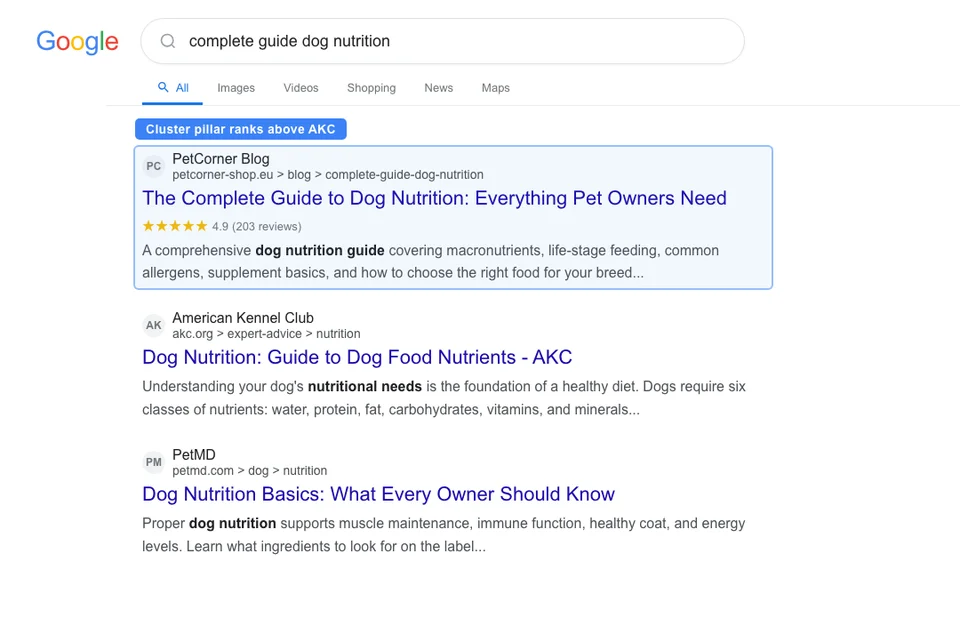
Learn more about the strategic foundations of this approach in our topical authority strategy guide.
Petbase writes and publishes this kind of content automatically - 10 SEO articles per month for pet businesses - start your free trial.
How Does a Content Cluster Differ From Random Blog Posts?
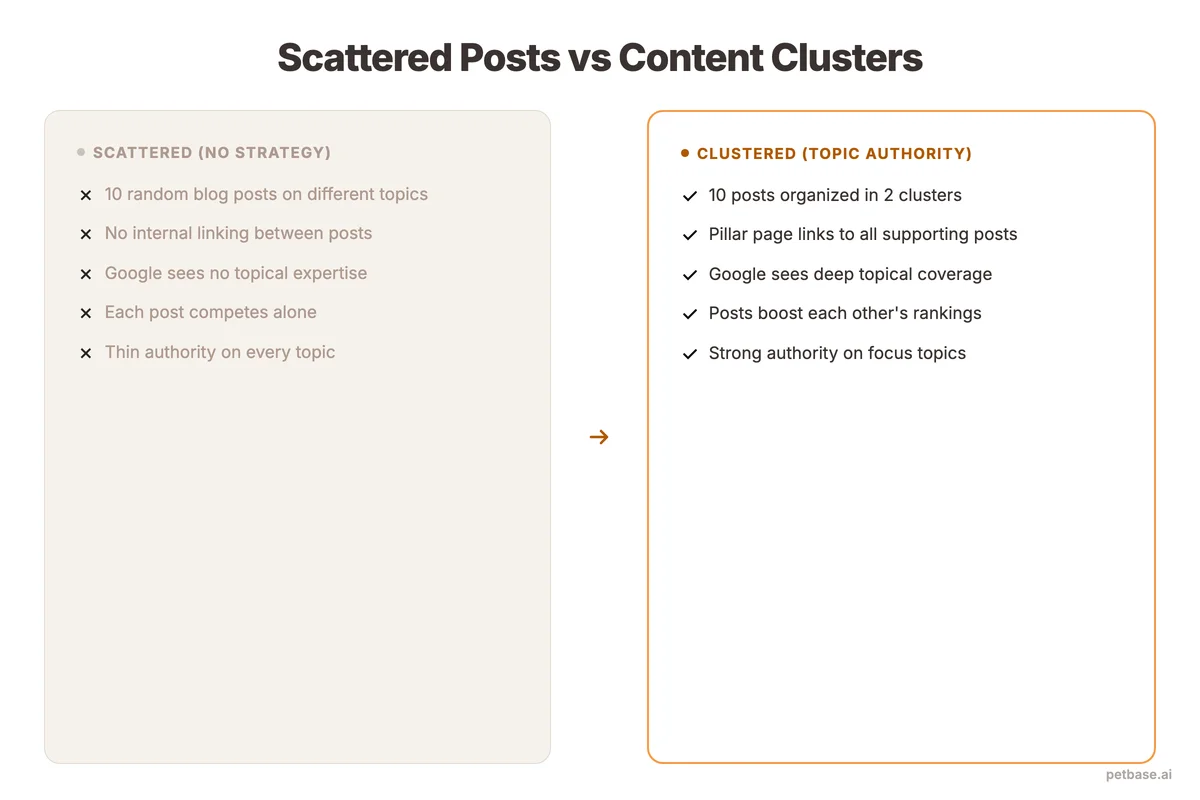
The difference between clustered content and random blog posts is the difference between a library and a pile of books. Both contain information, but only one helps you find what you need - and only one signals expertise to Google.
| Factor | Random Blog Posts | Content Cluster |
|---|---|---|
| Topic coverage | Scattered across unrelated subjects | Comprehensive coverage of one topic |
| Internal linking | Minimal or absent | Strategic hub-and-spoke structure |
| Authority signal to Google | Weak - site covers many things superficially | Strong - site demonstrates deep expertise |
| Ranking trajectory | Each post fights alone, rankings stagnate | New posts lift the entire cluster, compounding growth |
| User experience | Dead ends - readers leave after one post | Clear paths to related content, longer sessions |
| Content planning | Ad hoc, reactive | Intentional, mapped in advance |
| Keyword cannibalization | Common - multiple posts compete for same keyword | Rare - each page targets a distinct subtopic |
| Time to rank (average) | 3-6 months per post | 8-12 weeks for cluster, then faster for each new post |
The compounding effect is what makes clusters so powerful. When you publish the first article in a cluster, it takes time to rank - just like a random post. But when you add the second, third, and fourth articles (all interlinked), Google starts recognizing the pattern. By the time you publish the eighth article, it ranks faster and higher than the first one did - because it inherits authority from the entire cluster.
Random posts never compound. Article #50 ranks no faster than article #1 because there is no structural connection between them.
How to Map Your First Pet Business Content Cluster
Building your first cluster requires planning before writing. Here is the step-by-step process:
Step 1: Choose your cluster topic. Pick a topic that aligns with your core products and your audience's biggest questions. Good cluster topics for pet businesses:
- Dog nutrition (for food retailers)
- Pet grooming by breed (for grooming businesses)
- Cat indoor care (for cat-focused stores)
- Pet supplements and wellness (for health-focused shops)
- Puppy care essentials (for general pet stores)
The topic should be broad enough to support 8-15 subtopic articles but specific enough that you can demonstrate real depth. "Pets" is too broad. "Dog nutrition" is right. "Salmon-based dog food" is too narrow for a pillar.
Step 2: Research subtopics. Use Google's People Also Ask, AnswerThePublic, and your own customer questions to identify 10-20 subtopics within your chosen area. Long-tail keywords account for 70% of all searches and convert at 36%[3], making subtopic articles highly valuable for driving qualified traffic. For "dog nutrition":
- Raw vs kibble comparison
- Dog food for allergies
- Puppy feeding guide by breed size
- Senior dog nutrition
- Reading dog food labels
- Grain-free myths and facts
- Dog food for weight management
- Supplements for dogs
- Homemade dog food pros and cons
- Dog food by breed
Step 3: Define the pillar page. Your pillar page covers the topic broadly - a comprehensive 3,000-4,000 word guide that touches on every subtopic without going deep into any single one. It serves as the hub that connects everything. Title example: "The Complete Guide to Dog Nutrition: Everything Pet Owners Need to Know."
Step 4: Assign keywords to each piece. Each supporting article targets a specific keyword or keyword group. The pillar targets the broadest keyword. Make sure no two articles target the same primary keyword - this prevents keyword cannibalization.
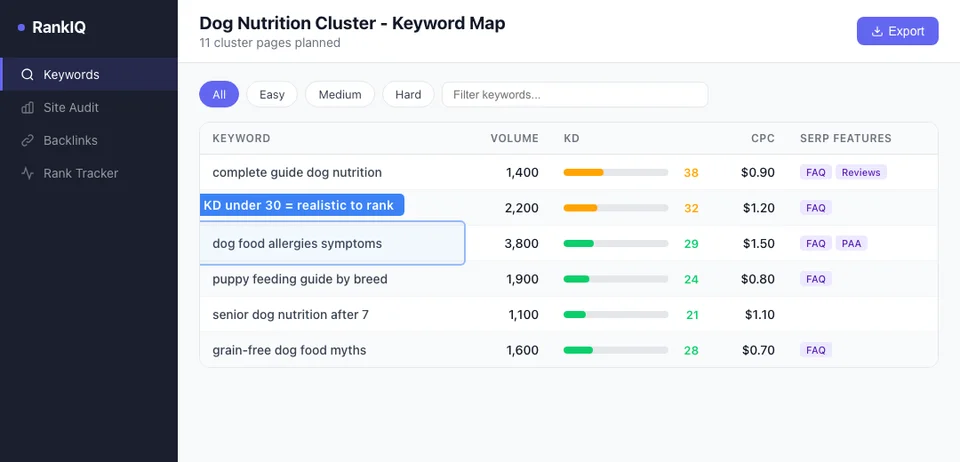
Step 5: Plan internal links. Before writing, map which pages link to which. Every supporting article links to the pillar. Every supporting article links to 2-3 sibling articles. The pillar links to every supporting article. This creates the hub-and-spoke structure Google rewards.
For detailed guidance on keyword research for your clusters, read our keyword research guide for pet businesses.
What Does a Real Pet Store Content Cluster Look Like?
Here is a complete cluster example for a pet store specializing in dog nutrition. This is the actual structure a store would build:
Pillar page: "The Complete Guide to Dog Nutrition"
- Keyword: dog nutrition guide
- Word count: 3,500
- Covers: macronutrients, feeding basics, life stages, common issues, brand selection
- Links to: all 10 supporting articles
Supporting articles:
| # | Article Title | Target Keyword | Word Count | Links To |
|---|---|---|---|---|
| 1 | Raw vs Kibble: A Complete Nutritional Comparison | raw vs kibble dogs | 2,500 | Pillar, #3, #5, #8 |
| 2 | Dog Food Allergies: Symptoms, Causes, and Best Foods | dog food allergies | 2,000 | Pillar, #1, #6, #9 |
| 3 | Puppy Feeding Guide by Breed Size | puppy feeding guide | 2,000 | Pillar, #5, #10 |
| 4 | Senior Dog Nutrition: Adjusting Diet After Age 7 | senior dog nutrition | 1,800 | Pillar, #8, #5 |
| 5 | How to Read Dog Food Labels Like a Nutritionist | read dog food labels | 2,200 | Pillar, #1, #6 |
| 6 | Grain-Free Dog Food: Facts, Myths, and What the Research Says | grain-free dog food myths | 2,000 | Pillar, #2, #5 |
| 7 | Dog Food for Weight Management: A Vet-Informed Guide | dog food weight management | 1,800 | Pillar, #4, #5 |
| 8 | Essential Supplements Every Dog Owner Should Know | dog supplements guide | 2,000 | Pillar, #4, #1 |
| 9 | Homemade Dog Food: Pros, Cons, and Safety Guidelines | homemade dog food pros cons | 2,200 | Pillar, #5, #2 |
| 10 | Best Dog Food by Breed: Nutrition for 20 Popular Breeds | best dog food by breed | 3,000 | Pillar, #3, #4, #2 |
Total cluster: 1 pillar + 10 supporting articles = 11 pieces, approximately 25,000 words. Published at 2-3 articles per week, this cluster takes 4-5 weeks to complete.
Every article links to the pillar (hub). Every article links to 2-3 siblings (spokes). The pillar links to all 10 articles. This creates 40+ internal links within the cluster, sending clear signals to Google about topic relationships.
How to Interlink Cluster Pages for Maximum SEO Impact
Internal linking within a cluster is not random. Strategic interlinking is what transforms a collection of articles into a structure that ranks. Here are the rules:
Rule 1: Every supporting article links to the pillar page. Use the pillar's target keyword or a close variation as anchor text. "Read our complete guide to dog nutrition" or "Learn more about dog nutrition fundamentals."
Rule 2: The pillar links to every supporting article. Within the pillar's content, naturally reference each subtopic and link to the corresponding supporting article. This distributes the pillar's authority to all cluster pages.
Rule 3: Each supporting article links to 2-3 sibling articles. Link where content naturally connects. An article about dog food allergies should link to the grain-free article (because allergy sufferers often consider grain-free) and the label-reading article (because understanding ingredients helps identify allergens).
Rule 4: Use descriptive anchor text. Never use "click here" or "read more." Instead, use text that describes the linked page: "our comparison of raw versus kibble feeding" or "symptoms of food allergies in dogs."
Rule 5: Link from outside the cluster too. Other blog posts, product pages, and category pages on your site should link into the cluster where relevant. A product page for a hypoallergenic dog food should link to the "Dog Food Allergies" article. This brings external authority into the cluster.
Rule 6: Update links as you add new content. When you publish supporting article #8, go back and add links from earlier articles where relevant. Clusters are living structures - maintain them.
Why 10 Clustered Posts Outperform 30 Random Articles
This is the core insight behind content clustering: fewer, strategically connected posts generate more traffic than a larger number of disconnected posts. The numbers are not close.
Companies with active blogs generate 55% more website traffic[4]. But the structure of that blog content matters as much as the volume. Companies publishing 16 or more posts per month see 3.5x more traffic than those publishing four or fewer[4]. The key insight: clustered posts compound, random posts do not.
Consider two pet stores that each invest the same amount in content over 6 months:
Store A: Random approach. Publishes 30 articles about 30 different topics - dog food, cat toys, fish tank setup, horse blankets, hamster wheels, bird cages, puppy training, senior cat care, exotic reptiles, and 21 more. Each article targets a different keyword with no internal linking strategy.
Store B: Cluster approach. Publishes 10 articles about dog nutrition (1 pillar + 9 supporting) and 10 articles about cat health (1 pillar + 9 supporting). Total: 20 articles, all strategically interlinked within their clusters.
After 6 months, typical results:
- Store A: 8 articles rank on page 1, total organic traffic of 3,000 monthly visits
- Store B: 16 articles rank on page 1, total organic traffic of 8,500 monthly visits
Store B publishes fewer articles but generates nearly 3x more traffic. Why? Because each article in a cluster strengthens every other article. The cluster's combined authority lifts all pages, while Store A's disconnected articles fight alone.
Backlinks amplify this effect further. Research shows the #1 ranking result has 3.8x more backlinks than results in positions 2-10[5]. Comprehensive cluster content attracts more backlinks naturally because it serves as a complete resource on a topic. In fact, 90% of marketers use content marketing specifically to earn backlinks, and articles over 3,000 words attract an average of 3,000 more backlinks than shorter content[6]. Your pillar pages naturally hit this word count.
The economics are also better. Store B's 20 articles cost less to produce than Store A's 30 - and deliver more results. This is why topical authority through clustering is the most efficient content strategy for pet businesses.
Dive deeper into why topical authority works in our topical authority guide Part 2.
How to Build Content Clusters Without Writing Everything Yourself
A complete content cluster requires 15,000-30,000 words of high-quality, interlinked content. For a pet store owner who also needs to run their business, writing all of this is unrealistic. Yet 61% of small businesses are still not investing in SEO at all[7]. Here are your options:
Option 1: Write it yourself over time. Budget 40-60 hours per cluster. At 2-3 articles per week, one cluster takes 4-6 weeks. This works if you have the time and enjoy writing about your niche. The cost: your time.
Option 2: Hire freelance writers. Cost: EUR 200-500 per article, so EUR 2,000-5,000 per cluster. You still need to plan the cluster structure, create content briefs, review the content for pet accuracy, and add internal links. Most freelancers lack pet industry expertise, so quality varies significantly.
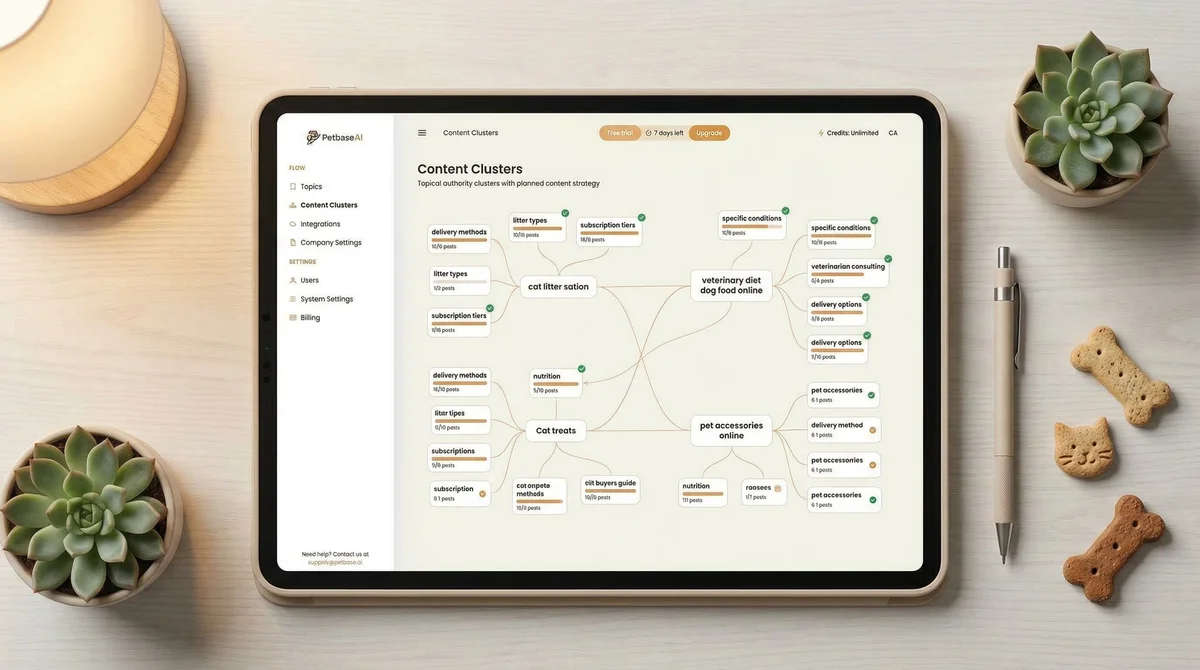
Option 3: Use Petbase. Cost: EUR 199/mo for 10 articles. Petbase builds content clusters automatically. During your site audit, the platform identifies the optimal clusters for your pet niche. Each month, it generates 10 strategically connected articles with proper internal linking, keyword targeting, and pet industry expertise. You review and approve - the strategy and writing happen automatically.
The key advantage of automated clustering is consistency. Petbase publishes 10 articles every month, following the cluster plan. No missed deadlines, no writer availability issues, no quality inconsistency. A complete cluster is built within 4-6 weeks, and the next cluster begins immediately.
For the broader content strategy that includes clustering, see our content marketing guide for pet businesses.
Measuring Cluster Performance: What to Track
A content cluster is a strategic investment. You need to measure whether it is working. Here are the metrics that matter, organized by when to check them:

After 4 weeks (early signals):
- Impressions in Google Search Console - Are your cluster pages starting to appear in search results? Even before clicks, growing impressions mean Google is recognizing your content.
- Pages indexed - Confirm all cluster pages are indexed using the URL Inspection tool. If pages are not indexed within 2 weeks of publishing, investigate crawlability issues.
- Internal link coverage - Verify all planned internal links are in place. Use Screaming Frog to audit link structure.
After 8-12 weeks (growth signals):
- Keyword positions - Track your pillar keyword and top supporting keywords weekly. Expect page 2-3 rankings for most keywords by week 8.
- Organic clicks - Cluster pages should start generating clicks from search. Compare total cluster traffic to your pre-cluster baseline.
- Average position trend - More important than absolute position. A trend from position 45 to 22 over 6 weeks signals the cluster is working even though you are not on page 1 yet.
After 3-6 months (results):
- Page 1 keywords - Count how many cluster pages rank in the top 10 for their target keywords
- Total cluster traffic - Sum organic traffic across all cluster pages. Compare to the total effort (cost and time) to calculate ROI.
- Conversions from cluster - Track which cluster pages drive product page visits, add-to-carts, or purchases. This connects content investment to revenue.
- Cluster expansion opportunities - Identify new keywords appearing in Search Console that relate to your cluster but are not yet covered. These are natural next articles to add.
| Audit Item | What to Check | Tool | Action If Failing |
|---|---|---|---|
| All pages indexed | Every cluster page in Google's index | Search Console | Request indexing, check robots.txt |
| Internal links complete | All planned links are live and working | Screaming Frog | Add missing links, fix broken ones |
| No keyword cannibalization | Each page ranks for its intended keyword, not a sibling's | Search Console | Consolidate competing pages or differentiate content |
| Content freshness | No outdated information in pillar or key articles | Manual review | Update with current data and examples |
| Engagement metrics | Time on page above 2 minutes, low bounce rate | Google Analytics | Improve content quality, add visuals, improve structure |
Review your cluster metrics monthly and optimize quarterly. Update the pillar page every 6 months with fresh data. Add new supporting articles as you discover related keywords in Search Console. A well-maintained cluster grows in value over years.
For more on tracking pet store SEO results, see our pet store SEO guide. Ready to build your first content cluster? See Petbase pricing and start with an automated content cluster plan.
Frequently Asked Questions
How many content clusters should a pet website have?
Start with 1-2 clusters and complete them before adding more. Each cluster needs 8-15 articles to build meaningful topical authority, so spreading your effort across 5 clusters simultaneously means none of them reaches the depth Google rewards. Complete your first cluster in 4-6 weeks, start seeing results by week 8-12, then build your second cluster. A mature pet website with strong organic traffic typically has 5-10 complete clusters covering their core product categories and audience topics.
Can I turn existing blog posts into content clusters?
Yes, and this is often the fastest path to results. Audit your existing content for articles that relate to a common topic. Group them into a cluster, identify the strongest article to serve as the pillar (or create a new one), add internal links between all clustered articles, and fill in subtopic gaps with new articles. A pet store with 40 existing blog posts can often form 2-3 clusters from existing content with just 5-10 new articles needed to fill gaps.
What happens if a content cluster is not performing after 3 months?
First, check the basics: are all pages indexed? Are internal links in place? Is there keyword cannibalization (multiple pages ranking for the same keyword)? If the structure is sound, evaluate content quality - are your articles genuinely better and more comprehensive than what currently ranks on page 1? If competitors have stronger content, upgrade your articles with more depth, better examples, and fresher data. If the topic itself has too little search demand, consider broadening the cluster scope or redirecting effort to a higher-demand cluster.
References
- BrightEdge (2024). How Much Traffic Comes from Organic Search. seoinc.com
- Fortune Business Insights (2024). Pet Care Market Size and Growth. fortunebusinessinsights.com
- Embryo (2024). 30 Statistics About Long-Tail Keywords. embryo.com
- HubSpot (2024). Marketing Statistics. hubspot.com
- BuzzStream (2024). Link Building Statistics. buzzstream.com
- BuzzStream (2024). Link Building Statistics - Content Length and Backlinks. buzzstream.com
- Clutch (2025). SEO Statistics. clutch.co