Content Marketing for Pet Businesses: The Complete Guide


Table of Contents +
- Why Content Marketing Matters for Pet Businesses
- What Types of Content Work Best for Pet Stores?
- How Do You Build a Content Strategy From Scratch?
- What Makes Pet Content Different From Generic Content?
- How Does Topical Authority Apply to Pet Businesses?
- Should You Write Blog Posts, Product Pages, or Both?
- How to Measure Content Marketing Results
- What Does a Month of Content Marketing Look Like?
- Common Content Marketing Mistakes Pet Businesses Make
- How to Scale Content Without Losing Quality
- Frequently Asked Questions
- References
The complete content marketing guide for pet businesses. Learn what content types work, how to build topic clusters, measure ROI, and scale with quality.
Content marketing costs 62% less than outbound marketing and generates 3x more leads per dollar spent[1]. For pet businesses operating in a global market worth $273.42 billion[2], that math changes everything.
But most pet businesses struggle with content marketing. They publish a blog post when they have time, share it on social media once, and move on. No strategy, no measurement, no compounding growth. This guide changes that. It covers everything from building your first content strategy to scaling production without sacrificing quality - specifically for pet businesses.
Why Content Marketing Matters for Pet Businesses
Content marketing drives organic traffic, builds trust, and generates sales without ongoing ad spend. For pet businesses specifically, it works because pet owners are information-hungry. They research breeds, compare products, look up health symptoms, and seek advice before buying.
Every time a pet owner types a question into Google, that is an opportunity for your business to appear with a helpful answer. Organic search drives 53% of all website traffic[3], and unlike paid ads, content keeps working months and years after you publish it.
Here are the numbers that matter:
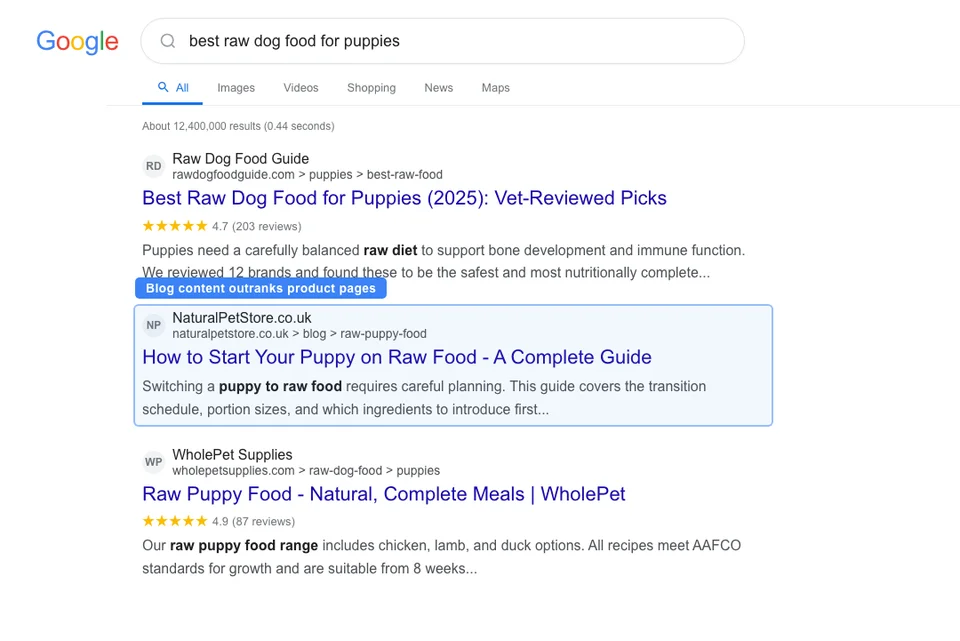
- Companies with blogs get 55% more website traffic and 67% more leads than those without[4]
- 70% of blog traffic comes from organic search, not social media or direct visits[5]
- Content marketing returns $7.65 for every $1 spent, compared to $1.80 for paid ads[6]
- One well-optimized article can generate 500-2,000 visits per month for years
The cost comparison is stark. A single SEO-optimized article costs EUR 200-500 from a freelancer. An SEO agency charges EUR 2,000-5,000+ per month. A Google Ads campaign targeting "best dog food" costs EUR 2-4 per click. Content marketing lets you capture the same traffic for a fraction of the ongoing cost.
Yet 61% of small businesses are still not investing in SEO[7]. That gap is your opportunity. While your competitors sit on the sidelines, consistent content gives you a head start that compounds over time.
For a broader look at how content fits into your overall SEO approach, read our pet store SEO guide.
Petbase writes and publishes this kind of content automatically - 10 SEO articles per month for pet businesses - start your free trial.
What Types of Content Work Best for Pet Stores?
Not all content performs equally. The most effective content types for pet businesses are those that match the way pet owners actually search and make decisions. Here is a breakdown of what works and when to use each type.
| Content Type | Best For | Avg. Traffic Potential | Conversion Potential | Effort Level |
|---|---|---|---|---|
| Buying guides ("Best X for Y") | Commercial intent keywords | High | Very high | Medium |
| How-to articles | Informational queries, building trust | High | Medium | Medium |
| Product comparisons | Decision-stage buyers | Medium-high | Very high | Medium |
| Breed-specific guides | Targeted niche traffic | Medium | High | Medium |
| Health and nutrition articles | Trust building, E-E-A-T signals | High | Medium | High (needs expert review) |
| Seasonal content | Spikes in seasonal traffic | Medium (seasonal) | High | Low-medium |
| FAQ and glossary pages | Long-tail queries, featured snippets | Low-medium | Low | Low |
| Case studies and success stories | Trust, social proof | Low | High | Medium |
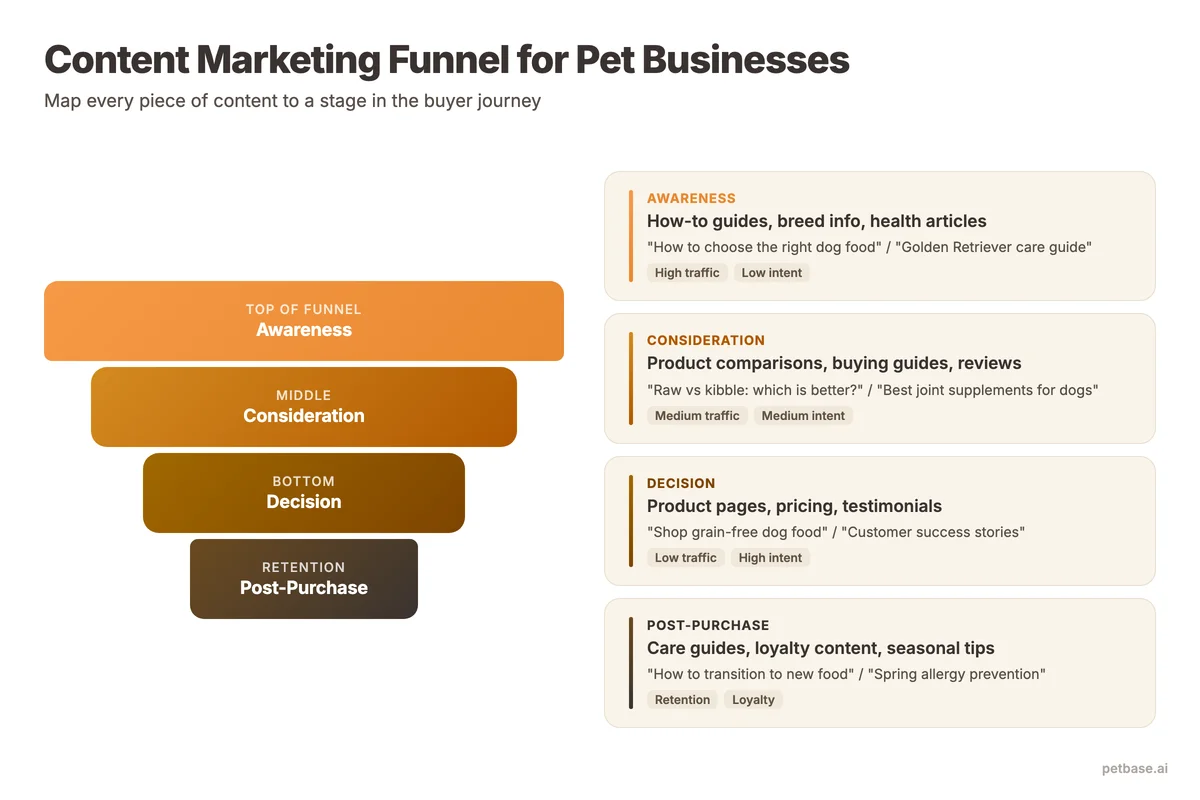
The sweet spot for most pet stores is a mix of buying guides, how-to articles, and breed-specific content. These three types cover the full buyer journey - from research to comparison to purchase.
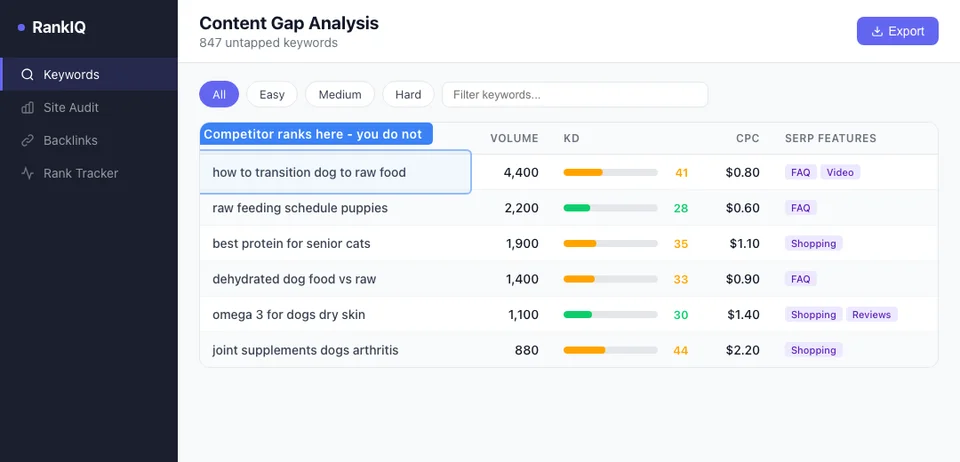
Example content that drives real traffic:
- "Best Dog Food for Golden Retrievers: Puppy, Adult, and Senior" (buying guide)
- "How to Switch Your Cat to Raw Food Safely" (how-to)
- "Orijen vs Acana: Which is Better for Your Dog?" (comparison)
- "German Shepherd Grooming Guide: Coat Care Through the Seasons" (breed-specific)
- "10 Signs Your Dog Has a Food Allergy" (health/nutrition)
Each piece should link to relevant products in your store, related blog posts, and service pages. This creates a web of internal links that strengthens your entire site's SEO performance.
How Do You Build a Content Strategy From Scratch?
Building a content strategy starts with three questions: Who are you trying to reach? What do they search for? And what can you teach them that nobody else does?

Here is a step-by-step process to build your first pet business content strategy:
Step 1: Define your content niche. You cannot write about everything. Pick 2-3 topics where your expertise is deepest and your products are strongest. A raw food pet store should focus on nutrition, ingredients, and feeding protocols - not training or grooming.
Step 2: Research your audience's questions. Use Google Search Console (for existing sites), Google's "People Also Ask" boxes, AnswerThePublic, and your own customer conversations. What do customers ask at the counter or in emails? Those questions are your content topics.
Step 3: Map keywords to content types. Informational keywords ("how to," "what is," "why does") become how-to articles and guides. Commercial keywords ("best," "top," "review," "vs") become buying guides and comparisons. Transactional keywords ("buy," "order," "near me") target your product and location pages.
Step 4: Build topic clusters. Group related keywords into clusters with a pillar page and 5-10 supporting articles. This is the single most important structural decision in your content strategy. Learn more in our topical authority guide.
Step 5: Set a publishing frequency you can maintain. Companies publishing 16 or more blog posts per month get 3.5x more traffic than those publishing four or fewer[4]. Two articles per week is ideal. One per week is the minimum for building momentum. Once per month is too slow to build topical authority. Consistency matters more than volume.
Step 6: Create a content calendar. Map your topics to specific dates. Align seasonal content with buying patterns (e.g., flea and tick content in spring, holiday gift guides in November). Plan 3 months ahead and adjust based on performance data.
In Petbase, steps 1-6 happen during your initial site audit. The platform analyzes your niche, competitors, and keyword opportunities, then generates a 30-day content plan with strategically connected articles. It handles the strategy so you can focus on running your business.
What Makes Pet Content Different From Generic Content?
Pet content requires domain-specific knowledge that generic content tools and writers miss. The difference between good pet content and generic content is the difference between a recommendation from your vet and a random internet list.
Here is what separates expert pet content from generic filler:
Breed specificity: Generic content says "feed your dog high-quality food." Expert pet content says "Labrador Retrievers are prone to obesity, so choose a food with 350-400 kcal per cup and avoid free-feeding. For Labs with hip dysplasia, look for formulas with added glucosamine (at least 300mg per serving)."
Life stage awareness: A puppy's nutritional needs are radically different from a senior dog's. Expert content addresses specific life stages with specific recommendations rather than one-size-fits-all advice.
Health condition knowledge: Pet owners searching for "best food for cats with kidney disease" need clinically accurate information. This is YMYL content that Google evaluates with extra scrutiny. Getting it wrong is not just an SEO problem - it can harm animals.
Seasonal relevance: Pet businesses operate on seasonal cycles. Flea and tick prevention peaks in spring. Holiday pet safety content peaks in December. Allergy content spikes when pollen counts rise. Expert pet content anticipates these cycles.
Product context: Generic content mentions products abstractly. Expert pet content explains why a specific type of product works for a specific situation - "A slow feeder bowl reduces bloat risk in deep-chested breeds like Great Danes by forcing them to eat 3-5x slower than standard bowls."
This level of specificity is what Google rewards under E-E-A-T guidelines. For more on demonstrating expertise, see our guide on E-E-A-T for pet businesses.
How Does Topical Authority Apply to Pet Businesses?
Topical authority means covering a subject so comprehensively that Google considers your site the go-to resource. For pet businesses, this is the most effective SEO strategy available because the pet industry has clearly defined topic boundaries that you can own.
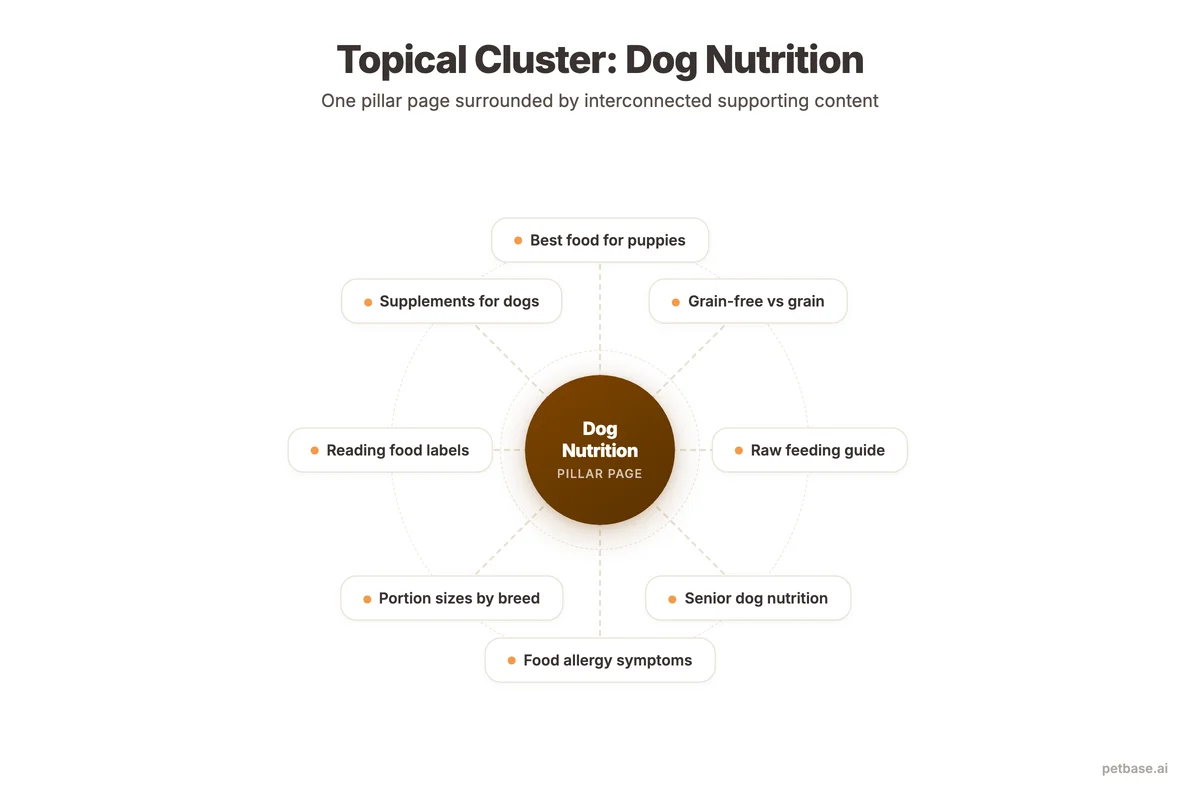
Here is how it works in practice. A pet store that publishes one article about dog food will not rank well, no matter how good that article is. But a pet store that publishes 15 interconnected articles about dog nutrition - covering ingredients, allergies, life stages, breed-specific needs, raw feeding, supplements, and feeding schedules - signals to Google that it genuinely understands dog nutrition. Google then ranks all 15 articles higher than they would rank individually.
The compounding effect is what makes topical authority so valuable. Each new article in a cluster strengthens every other article. Your tenth article about dog nutrition ranks faster and higher than your first - because Google already trusts your site on that topic.
Since 70% of blog traffic comes from organic search[5], every article in your cluster is another entry point for Google to send you visitors. Ten clustered posts regularly outperform 30 random articles because Google rewards depth over breadth.
To build topical authority for your pet business:
- Choose 2-3 core topics aligned with your products (e.g., dog nutrition, cat grooming, pet health supplements)
- Create a comprehensive pillar page for each topic (3,000+ words)
- Build 8-12 supporting articles that cover subtopics in detail
- Interlink every article - supporting posts link to the pillar and to each other
- Publish consistently - 2-3 articles per week within the same cluster until it is complete
- Update and expand existing articles as new information becomes available
Petbase builds topical authority automatically. Each monthly content plan is designed as an interconnected cluster, not a random collection of posts. The platform's topical authority builder maps your niche, identifies the subtopics you need to cover, and creates content that connects systematically.
Dive deeper into this strategy in our topical authority guide for pet businesses.
Should You Write Blog Posts, Product Pages, or Both?
Both - but they serve different purposes and target different stages of the buyer journey. Understanding when to use each is critical for maximizing your content marketing ROI.
Blog posts target informational and early-stage commercial queries. They attract people who are researching, learning, and comparing. A blog post about "signs your dog has joint pain" attracts pet owners who do not yet know they need a joint supplement. The blog post educates them, builds trust, and then links to your joint supplement product page.
Product pages target transactional queries. They convert visitors who already know what they want. A product page for "glucosamine chews for dogs" should include SEO-optimized descriptions, customer reviews, structured data, and clear purchase options.
Category pages target broad commercial queries. "Dog supplements" is a category-level keyword. Your category page should have an educational introduction, subcategory links, and filtering options.
The relationship between these three page types is what drives results:
- Blog posts attract traffic and build authority
- Internal links guide readers from blog posts to product and category pages
- Product pages convert that traffic into sales
- Category pages capture mid-funnel searches
Most pet stores under-invest in blog content and over-invest in product page optimization. The reverse is almost always more effective. Companies with active blogs generate 67% more leads[4]. A pet store with 100 well-optimized product pages but no blog content will lose to a competitor with 50 product pages and 40 strategic blog posts - because the blog content drives the authority that lifts everything.
How to Measure Content Marketing Results
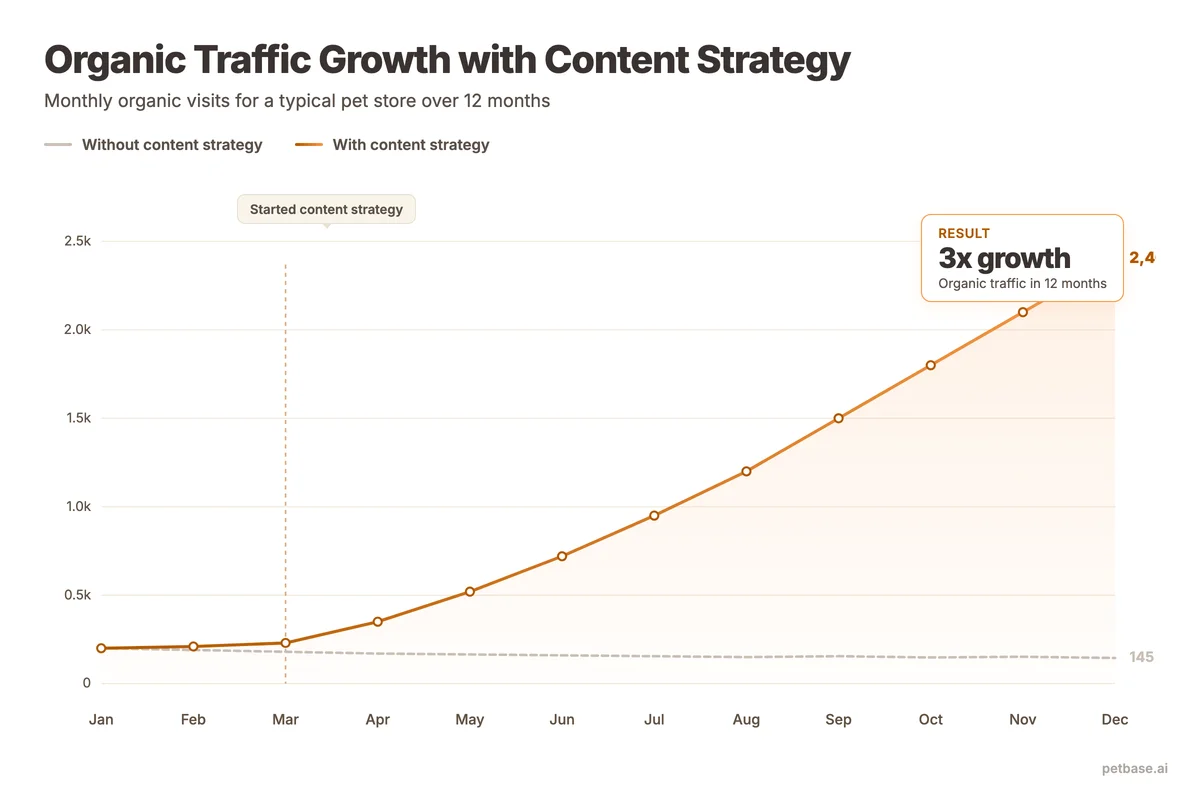
Content marketing is measurable. You do not need to guess whether it is working. Track these metrics monthly to evaluate and improve your content strategy.
Traffic metrics:
- Organic sessions - Total visits from search engines (Google Analytics)
- Impressions and clicks by page - How often your pages appear in search results and how many people click (Google Search Console)
- New vs returning visitors - Content should attract both new readers and bring existing ones back
Ranking metrics:
- Keyword positions - Track your target keywords weekly. Focus on movement trends, not daily fluctuations
- Keywords on page 1 - Count how many of your target keywords rank in the top 10
- Featured snippets won - FAQ and how-to content is particularly good at earning snippets
Engagement metrics:
- Average time on page - Longer is usually better for informational content (target 3-5 minutes)
- Bounce rate by content type - High bounce rates on buying guides may signal poor product linking
- Internal link clicks - Are readers clicking through to product pages?
Conversion metrics:
- Organic revenue - Revenue from visitors who arrived via organic search
- Assisted conversions - Blog visits that contributed to a later purchase
- Email signups from content - Readers who subscribe for more information
Review these metrics monthly. Do not panic about week-to-week fluctuations. Content marketing is a 3-6 month investment that compounds over time. If your impressions and average positions are improving month over month, your strategy is working.
What Does a Month of Content Marketing Look Like?
Here is a realistic monthly content calendar for a mid-size pet store, showing how content types distribute across four weeks:
| Week | Content Piece | Type | Target Keyword | Internal Links To |
|---|---|---|---|---|
| 1 | Complete Guide to Raw Feeding for Dogs | Pillar / How-to | raw feeding dogs guide | Raw food products, nutrition cluster |
| 1 | Raw vs Kibble: A Nutritional Comparison | Comparison | raw vs kibble dogs | Pillar page, dog food category |
| 2 | How to Transition Your Dog to Raw Food Safely | How-to | switch dog raw food | Pillar page, raw food products |
| 2 | Best Raw Food Brands Available in Europe | Buying guide | best raw dog food Europe | Pillar page, product pages |
| 3 | Raw Feeding for Puppies: What You Need to Know | Breed/age-specific | raw feeding puppies | Pillar page, puppy food category |
| 3 | 5 Signs Your Dog Thrives on Raw Food | Health/nutrition | benefits raw food dogs | Pillar page, testimonials |
| 4 | Raw Feeding FAQ: 15 Questions Answered | FAQ | raw feeding dogs FAQ | All cluster articles |
| 4 | Seasonal Pet Care: Spring Allergy Guide | Seasonal | spring allergies dogs cats | Allergy products, separate cluster |
Notice how 7 of 8 articles belong to the same topic cluster (raw feeding). This concentrated approach builds topical authority far faster than publishing 8 unrelated articles about different pet topics.
The eighth article (seasonal content) is a standalone piece timed to capture seasonal search traffic. Including 1-2 timely pieces per month alongside your cluster strategy keeps your content fresh and relevant.
Common Content Marketing Mistakes Pet Businesses Make
After analyzing content strategies across hundreds of pet websites, these are the mistakes we see most frequently:
1. Publishing without a cluster strategy. Random blog posts about unrelated topics do not build authority. Google cannot determine what your site is about if your content covers dog food one week, fish tank maintenance the next, and horse riding the week after. Pick 2-3 core topics and go deep.
2. Writing for search engines instead of pet owners. Keyword-stuffed articles that read like they were written for robots get penalized by Google's Helpful Content Update. Write for the pet owner standing at your counter asking a question. The SEO will follow.
3. Ignoring internal linking. Every blog post should link to 3-5 related pages on your site: other blog posts, product pages, category pages, and service pages. Internal links are how Google discovers and values your content. A blog post with zero internal links is a missed opportunity.
4. No product page connection. Content that does not link to products is a dead end. Your blog exists to educate and guide readers toward your products. Always include natural, helpful links to relevant product and category pages.
5. Inconsistent publishing. Publishing 10 articles in January and zero in February destroys momentum. Google rewards sites that publish consistently. Set a pace you can maintain and stick to it.
6. Copying manufacturer descriptions. Hundreds of pet stores use the same product descriptions from manufacturers. Google sees this as duplicate content and ranks none of them well. Write original descriptions that add real value - usage tips, breed recommendations, personal experience.
7. Ignoring seasonal opportunities. Pet businesses have clear seasonal patterns. Flea prevention in spring, holiday safety in winter, back-to-school pet adjustment in fall. Missing these windows means missing traffic you could easily capture with planned content.
8. Never updating old content. A blog post from 2022 about "best dog food" is outdated. Google knows it. Update your best-performing content every 6-12 months with fresh information, new products, and current data. An updated article often ranks higher than a brand new one.
How to Scale Content Without Losing Quality
The biggest challenge pet businesses face with content marketing is scale. Writing 8-10 quality articles per month takes 40-60 hours - time most pet store owners do not have. Here is how to scale without compromising quality.

Option 1: Hire freelance pet writers. Cost: EUR 200-500 per article. Pros: human-written, can capture brand voice. Cons: expensive at scale, inconsistent quality, requires editing time, most writers lack pet industry expertise.
Option 2: Use a general content agency. Cost: EUR 1,000-3,000 per month for 4-8 articles. Pros: consistent output, professional editing. Cons: generic content, no pet expertise, no SEO strategy included, expensive.
Option 3: Use a pet-specific content tool. Cost: EUR 199/mo for 10 articles with Petbase. Pros: pet industry knowledge model, automatic keyword research, content cluster strategy, auto-publishing to your CMS. Cons: requires review and approval (though this takes 2-4 hours per month, not 40-60).
The ROI math favors content marketing at every price point. Content marketing returns $7.65 for every $1 spent, while paid advertising returns just $1.80[6]. The question is not whether to invest in content - it is how to produce it efficiently.
| Factor | Freelance Writers | Content Agency | Petbase |
|---|---|---|---|
| Monthly cost (10 articles) | EUR 2,000-5,000 | EUR 3,000-6,000 | EUR 199 |
| Pet expertise | Rare - most writers generalize | Usually generic | Built-in pet knowledge model |
| SEO strategy | Not included | Sometimes included | Automatic keyword research + clustering |
| Consistency | Variable | Consistent | 10 articles every month |
| Time from you | 10-15 hrs/mo (briefing, editing) | 5-8 hrs/mo (review, feedback) | 2-4 hrs/mo (review, approve) |
| Auto-publishing | No | No | Yes - direct to your CMS |
| Internal linking | Manual | Manual or basic | Automatic cross-linking within clusters |
The right choice depends on your budget, time, and goals. For most independent pet stores doing EUR 200K-2M in annual revenue, Petbase offers the best balance of quality, volume, and cost. You get 10 strategically planned, pet-expert articles per month for less than the cost of a single freelance article.
Ready to see how it works? Check Petbase pricing or start your free trial.
Frequently Asked Questions
How often should a pet business publish new content?
At minimum, once per week. The ideal pace is 2-3 articles per week, which lets you complete a topic cluster in 4-6 weeks. HubSpot found that companies publishing 16+ posts per month get 3.5x more traffic than those posting four or fewer[4]. If you can only manage one article per week, focus all your effort on a single topic cluster rather than spreading across multiple topics.
What is the ROI of content marketing for pet businesses?
Content marketing generates $7.65 for every $1 spent, compared to $1.80 for paid ads[6]. A single well-optimized blog post can generate 500-2,000 organic visits per month for 2-3 years. At an average conversion rate of 2% and an average order value of EUR 50, one article generating 1,000 monthly visits produces EUR 1,000 in monthly revenue. Over two years, that single article generates EUR 24,000 in revenue. Compare that to paid ads, where you pay for every click and the traffic stops the moment you stop paying.
Should pet businesses write about topics outside their product range?
Only if those topics are closely related to your core expertise and support your topic clusters. A pet food store writing about dog training makes sense because nutrition and behavior are connected. A pet food store writing about aquarium maintenance does not - it dilutes your topical authority. Stay within 1-2 steps of your core topic. If you sell dog food, write about dog nutrition, health, breeds, and feeding. Do not write about cat grooming unless you also sell cat products.
How do you write pet content that meets Google's E-E-A-T standards?
Four things matter most. First, attribute content to authors with verifiable pet industry experience - a certified trainer, veterinary technician, or pet nutritionist. Second, cite veterinary sources and peer-reviewed research for health claims. Third, include specific details that only someone with hands-on experience would know (exact product dosages, breed-specific care nuances, real feeding schedules). Fourth, cover topics comprehensively through topic clusters rather than surface-level individual articles. Google evaluates E-E-A-T at the page level and the site level, so building depth across your entire site matters as much as individual article quality.
References
- Siege Media (2024). Content Marketing Statistics. siegemedia.com
- Fortune Business Insights (2024). Pet Care Market Size and Growth. fortunebusinessinsights.com
- BrightEdge (2024). How Much Traffic Comes from Organic Search. seoinc.com
- HubSpot (2024). Marketing Statistics. hubspot.com
- Orbit Media (2024). Blogging Statistics. orbitmedia.com
- Genesys Growth (2024). Content Marketing ROI Stats for Marketing Leaders. genesysgrowth.com
- Clutch (2025). SEO Statistics. clutch.co