Ecommerce SEO for Pet Stores: Product Pages, Category Pages and Blog Content


Table of Contents +
- Why Does Ecommerce SEO Matter for Pet Stores?
- How Should You Optimize Pet Product Pages?
- How Should You Optimize Pet Store Category Pages?
- How Does Blog Content Support Ecommerce SEO?
- How Do the Three Pillars Work Together?
- What Are the Most Common Ecommerce SEO Mistakes Pet Stores Make?
- How Can Pet Stores Compete With Amazon on SEO?
- What Should Your Ecommerce SEO Roadmap Look Like?
- Scaling Ecommerce SEO With Petbase
- Frequently Asked Questions
- References
43% of ecommerce traffic is organic. Learn how to optimize product pages, category pages, and blog content for your pet store with data-backed strategies.
You have products. You have a website. But 96.55% of all web pages get zero traffic from Google.[1] For pet stores selling online, that statistic is not abstract - it is the difference between a thriving ecommerce operation and a digital storefront that nobody visits.
The opportunity is enormous. 43% of all ecommerce traffic comes from organic search.[2] Yet most online pet stores underperform on three critical pillars: product pages, category pages, and blog content. Fix those three, and organic revenue follows.
TL;DR
43% of ecommerce traffic comes from organic search, yet 86% of online stores lack optimized internal links. For pet stores, the opportunity is three pillars: product pages with unique descriptions and schema markup, category pages with 300+ words of helpful context, and blog content that builds topical authority. This guide breaks down each pillar with data-backed tactics.
Why Does Ecommerce SEO Matter for Pet Stores?
The pet ecommerce market is growing faster than most store owners realize. Online pet product sales now represent a significant share of the $152 billion US pet industry.[3] Consumers increasingly research and buy pet products through search engines rather than walking into physical stores.
Here is why ecommerce SEO deserves priority:
- Organic search delivers a 14.6% close rate, compared to 1.7% for outbound leads like print or direct mail[4]
- The average ecommerce conversion rate is 2.3%, but stores with optimized product content consistently outperform that baseline[5]
- 61% of small businesses have not yet invested in SEO[6] - meaning most pet stores are leaving organic traffic on the table
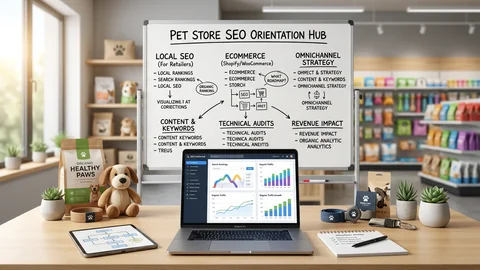
The three-pillar approach - product pages, category pages, and blog content - creates a reinforcing system where each element supports the others. Product pages convert buyers. Category pages capture mid-funnel searches. Blog content builds the topical authority that lifts everything. For a complete overview, see our pet store SEO strategy guide.
Petbase automates SEO content for pet stores - publishing 10 optimized articles monthly so you can focus on running your shop - start your free trial.
How Should You Optimize Pet Product Pages?
Product pages are where revenue happens. Yet 87% of consumers say product content is extremely or very important when deciding to buy.[7] And 20% of purchase failures stem from missing or unclear product information.[8]
Most pet store product pages fail because they copy manufacturer descriptions word for word. Google sees this as duplicate content and ranks the manufacturer or Amazon instead.
Write Unique Product Descriptions
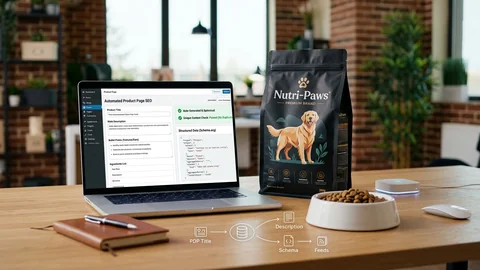
Every product page needs original copy. For a grain-free dog food, do not just list ingredients. Explain which dogs benefit from grain-free formulas, what health outcomes owners can expect, and how the product compares to alternatives. This level of detail is what separates pages that rank from pages that get ignored.
For detailed guidance on writing product descriptions that rank and convert, see our product description writing guide.
Implement Product Schema Markup
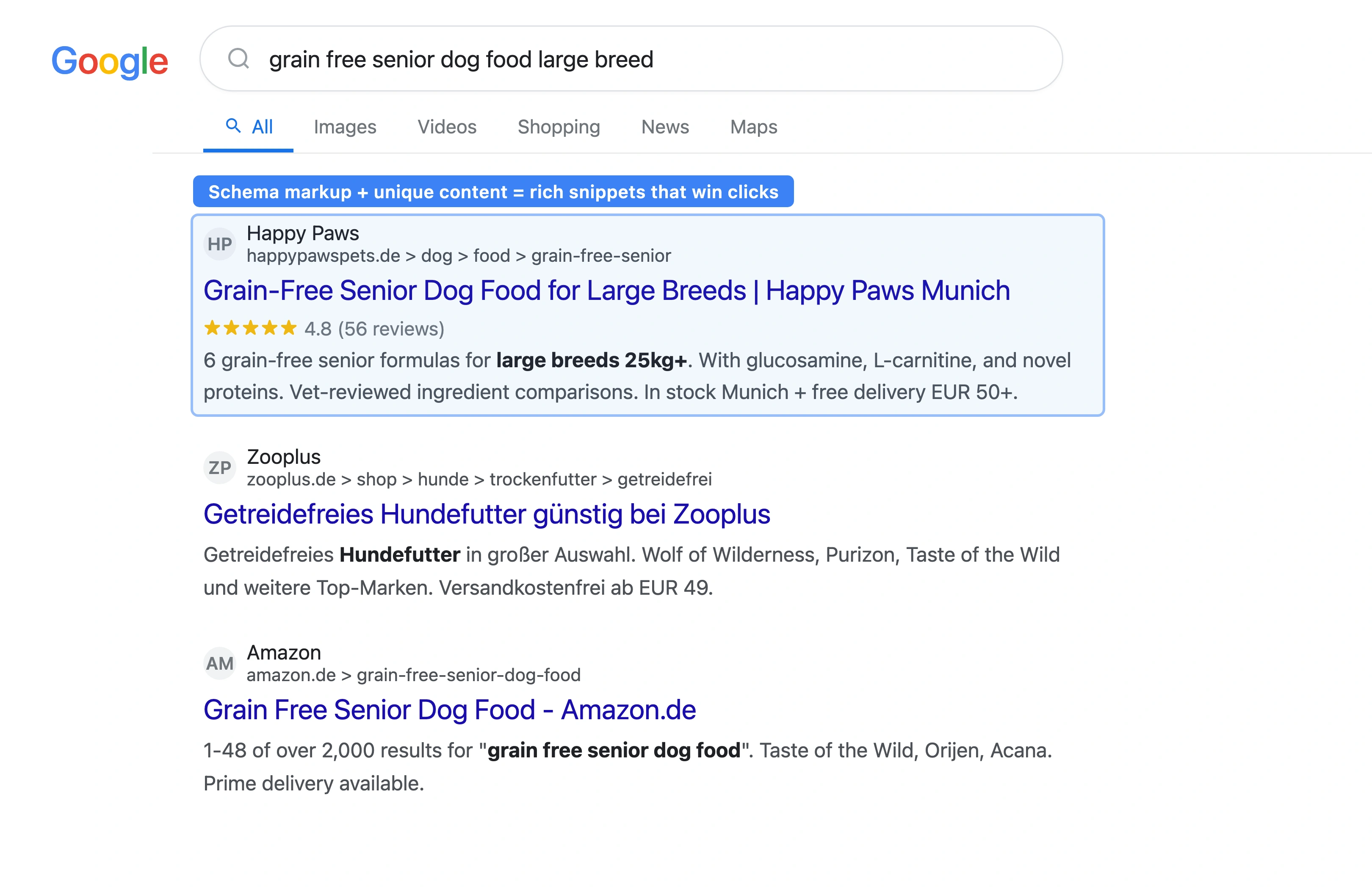
Product schema markup increases search visibility by 4.2x on average.[9] At minimum, include:
- Product name and description
- Price and currency
- Availability status
- Review ratings and count
- Brand name
- SKU or product identifier
Rich results with star ratings and pricing make your listing stand out in search results, increasing click-through rates significantly. For the complete schema implementation guide, see our schema markup for pet stores article.
Optimize Product Images
Product images need descriptive alt text, compressed file sizes, and multiple angles. Pet owners want to see the product packaging, size reference, and the product in use. Each image is an additional ranking opportunity in Google Image Search.
Product Page Checklist
| Element | Status for Most Pet Stores | Impact When Fixed |
|---|---|---|
| Unique product description (150+ words) | Missing on 70%+ of pages | High - removes duplicate content penalty |
| Product schema markup | Missing on most stores | 4.2x visibility increase |
| Descriptive image alt text | Generic or empty | Medium - image search traffic |
| Internal links to category and blog | Rarely implemented | High - distributes page authority |
| Customer reviews on page | Inconsistent | High - social proof + fresh content |
| Clear pricing and availability | Often unclear | Reduces 20% purchase failure rate |
For a deeper look at product page optimization specifically, see our complete product page optimization guide.
How Should You Optimize Pet Store Category Pages?
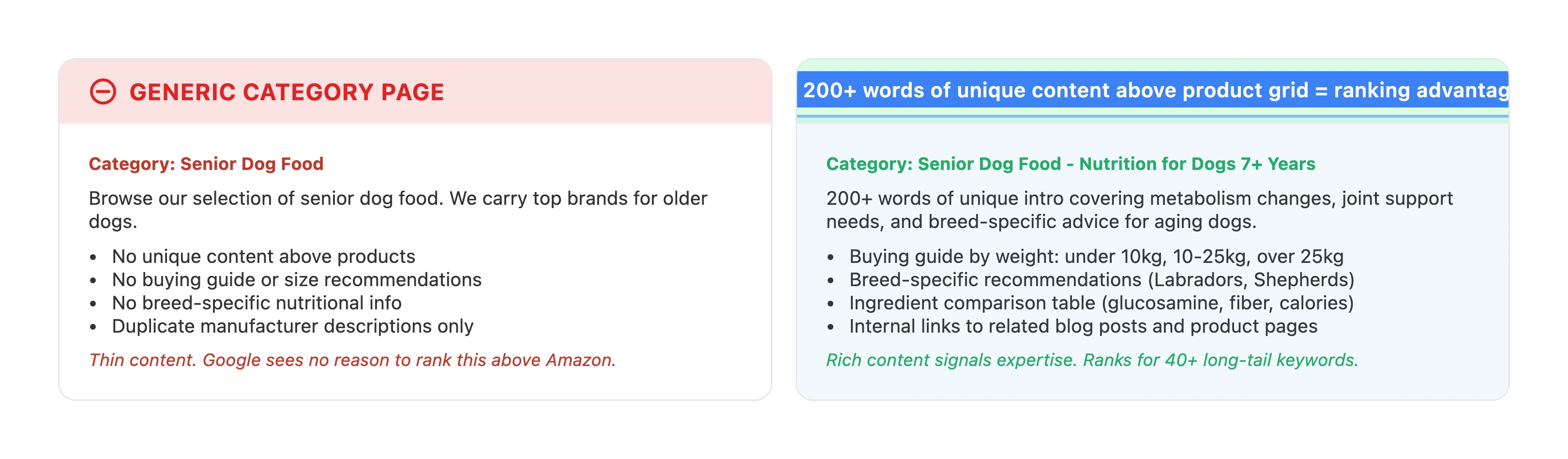
Category pages are where most ecommerce SEO potential goes unrealized. The average ecommerce category page contains just 310 words of content.[10] That is not enough for Google to understand what the page is about or to rank it for valuable mid-funnel keywords.
Category pages capture searches like "organic dog food," "cat scratching posts," or "reptile heating equipment." These are high-intent, mid-funnel queries where the shopper knows what they want but has not chosen a specific product yet.
Add Category Descriptions
Write 300-500 words of unique content for each category page. Cover:
- What products are in this category and who they are for
- How to choose between options (size, breed, life stage)
- Common questions buyers have about this product type
- Links to relevant blog content for deeper research
This content sits above or below the product grid and gives Google the text signals it needs to rank the page.
Optimize Category Page Structure
Each category page needs:
- A unique H1 that includes the target keyword
- Breadcrumb navigation with structured data
- Faceted filters that do not create duplicate URLs
- Internal links to subcategories and related categories
- A unique meta title and description
For comprehensive category page optimization, see our category page optimization guide.
Category Page Hierarchy
A well-structured category hierarchy looks like this:
- Dog Food (parent) → Dry Dog Food, Wet Dog Food, Raw Dog Food, Grain-Free Dog Food (children)
- Cat Supplies (parent) → Cat Litter, Cat Trees, Cat Toys, Cat Food (children)
- Small Pets (parent) → Rabbit Supplies, Hamster Supplies, Guinea Pig Supplies (children)
Each level targets progressively more specific keywords. The parent captures broad intent. The children capture long-tail searches with higher conversion rates.
How Does Blog Content Support Ecommerce SEO?
Blog content is the engine that builds topical authority for your entire ecommerce site. Without it, your product and category pages compete on thin domain authority alone.
Here is what blog content does for ecommerce:
- Captures top-of-funnel searches that product pages cannot target
- Builds internal links that pass authority to product and category pages
- Demonstrates expertise that Google rewards under E-E-A-T (Experience, Expertise, Authority, Trust) evaluation
- Creates content that earns natural backlinks from other websites
Internal linking is the mechanism that ties everything together. Yet 86% of online stores lack optimized internal links.[11] When a blog post about "best food for senior dogs" links to your senior dog food category page, that link passes topical relevance and authority directly to the page you want to rank.
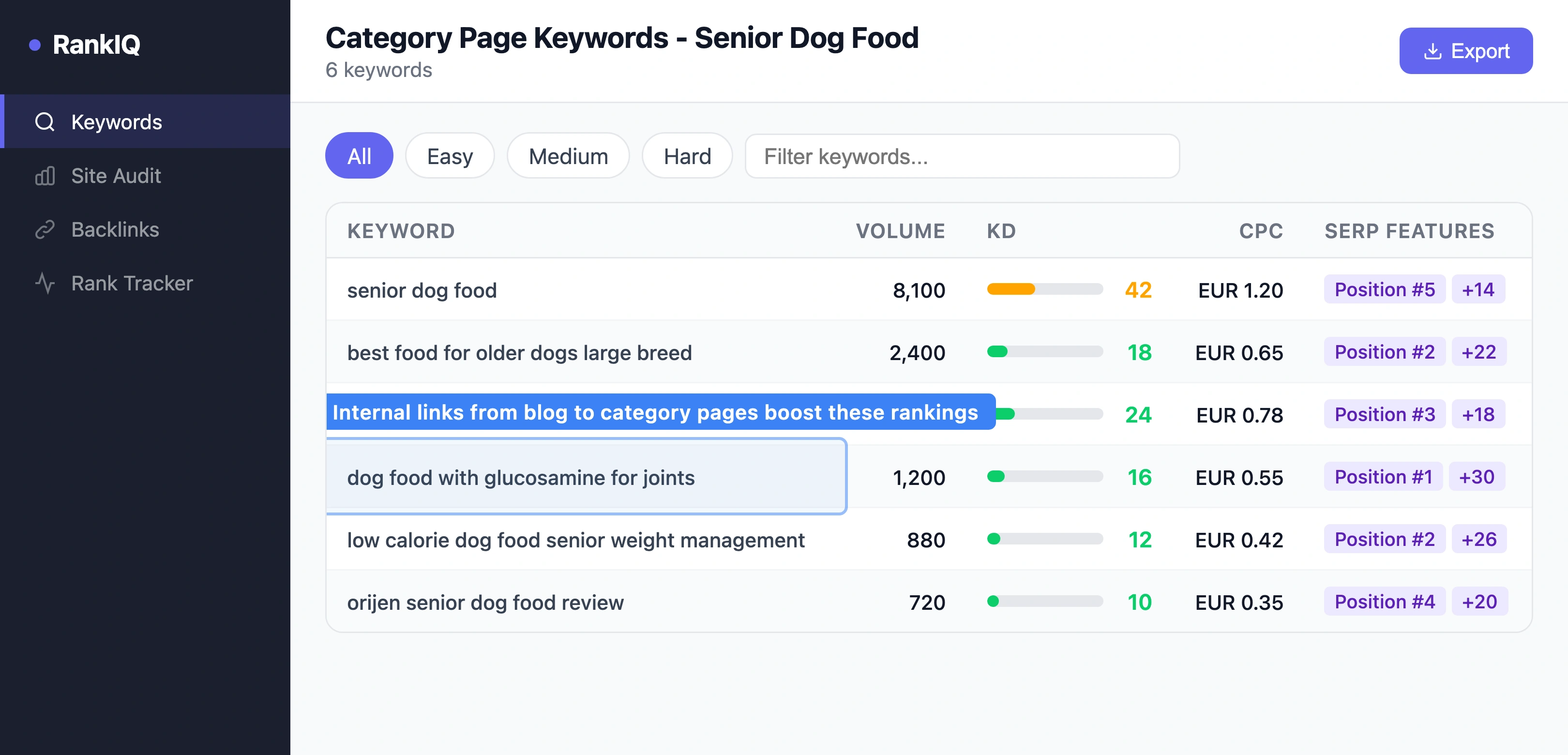
Sites that implement strategic internal linking see an average 23% rise in organic traffic.[11]
Blog Topics That Drive Ecommerce Sales
The most effective blog topics for pet ecommerce stores fall into four categories:
- Buying guides - "How to choose the right dog harness" links to your harness category
- Comparison content - "Grain-free vs. regular dog food" links to both category pages
- Problem-solving content - "Why is my cat scratching furniture" links to cat scratchers and deterrents
- Seasonal content - "Winter coat care for dogs" links to grooming products and supplements
Each blog post should link to at least 2-3 product or category pages. This is how you turn informational traffic into revenue.
How Do the Three Pillars Work Together?
The three pillars create a flywheel effect:
| Pillar | Primary Role | Supports Other Pillars By | Key Metric |
|---|---|---|---|
| Product Pages | Convert buyers | Providing link targets for blog and category pages | Conversion rate (2.3% avg) |
| Category Pages | Capture mid-funnel searches | Organizing products and distributing authority downward | Organic impressions for category keywords |
| Blog Content | Build topical authority | Passing link equity to product and category pages (+23% traffic) | Organic traffic growth and backlink acquisition |
When all three pillars are optimized, each new blog post lifts the authority of your product and category pages. Each new product page creates a fresh link target. Each category page organizes the hierarchy that Google uses to understand your store.
This is the same topic cluster strategy described in our content clustering guide - applied specifically to ecommerce.
What Are the Most Common Ecommerce SEO Mistakes Pet Stores Make?
After analyzing dozens of pet store websites, these are the most frequent problems:
- Duplicate product descriptions. Copying manufacturer text means Google ranks the manufacturer, not you.
- No category page content. 310 words on average is not enough to rank for competitive keywords.[10]
- Missing internal links. 86% of stores lack optimized internal linking.[11] Without links between blog, category, and product pages, authority stays siloed.
- No schema markup. Missing structured data means missing rich results that drive 4.2x more visibility.[9]
- Thin product pages. Pages with just a title, price, and image do not give Google enough to work with.
- Ignoring blog content entirely. Without educational content, there is no topical authority and no internal link source.
For a comprehensive audit of common pet store website mistakes, see our website mistakes guide.
How Can Pet Stores Compete With Amazon on SEO?
Amazon dominates generic product searches, but pet stores have advantages Amazon cannot replicate:
- Local relevance. "Pet store near me" and location-specific searches favor local businesses.
- Expert content. Breed-specific guides, health content, and buying advice build E-E-A-T signals Amazon product pages lack.
- Long-tail keywords. "Best hypoallergenic cat food for sensitive stomachs" is too specific for Amazon to optimize but perfect for a pet store blog.
- Community trust. Reviews from local pet owners, partnerships with local vets, and neighborhood presence build authority Amazon cannot match.
For a complete breakdown of competing with Amazon, see our guide to competing with Amazon as a pet store.
What Should Your Ecommerce SEO Roadmap Look Like?
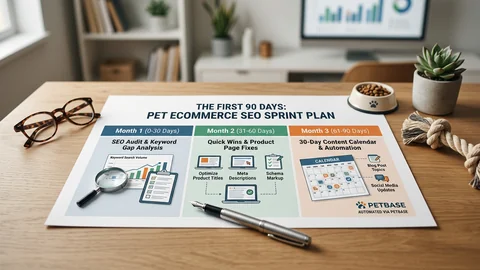
Here is a practical 90-day roadmap for pet store ecommerce SEO:
Month 1: Foundation
- Audit all product pages for duplicate content
- Implement product schema markup across the store
- Write unique descriptions for your top 20 products by revenue
- Fix internal linking between product, category, and blog pages
Month 2: Category Pages
- Add 300-500 words of unique content to your top 10 category pages
- Implement breadcrumb structured data
- Optimize meta titles and descriptions for each category
- Resolve any duplicate URL issues from faceted navigation
Month 3: Blog Content
- Publish 4-6 blog posts targeting buying guide and comparison keywords
- Link each post to 2-3 relevant product or category pages
- Build internal links from existing content to new product pages
- Set up a monthly content calendar for ongoing publishing
This roadmap aligns with the broader strategy outlined in our pet store SEO strategy roadmap.
Scaling Ecommerce SEO With Petbase
Writing unique descriptions for hundreds of products, creating category content, and publishing blog posts every week is a significant workload. Most pet store owners do not have the time or writing resources to sustain it.
Petbase generates 10 expert articles per month for EUR 199/mo - each one optimized for your product categories, target keywords, and customer questions. Every article includes internal links to your product and category pages, building the three-pillar structure automatically.
With 96.55% of pages getting zero traffic[1], the difference between a pet store that ranks and one that does not comes down to consistent, optimized content. Petbase makes that consistency possible.
Start your free trial and build your ecommerce SEO foundation.
Frequently Asked Questions
How long does ecommerce SEO take for pet stores?
Most pet stores see initial ranking improvements within 8-12 weeks of implementing product schema, unique descriptions, and internal linking. Category pages targeting mid-competition keywords typically rank within 3-4 months. Blog content compounds over time, with significant traffic growth visible after 6 months of consistent publishing. The 23% traffic increase from optimized internal links[11] is often the fastest win.
What is the most important ecommerce SEO factor for pet stores?
Unique product content is the single most important factor. With 87% of consumers saying product content drives purchase decisions[7] and 20% of purchases failing due to missing information[8], original descriptions directly impact both rankings and revenue. Schema markup and internal linking amplify the effect, but without unique content there is nothing to amplify.
Should pet stores prioritize product pages or blog content?
Start with product pages. They are closest to revenue. Once your top 20 products have unique descriptions and schema markup, shift focus to category pages and then blog content. Blog content builds the topical authority that lifts product page rankings over time - but it is a slower burn. The ideal approach is parallel: optimize products while publishing 4-6 blog posts per month.
How many internal links should each page have?
Each blog post should link to at least 2-3 relevant product or category pages. Each product page should link to its parent category and 1-2 related products. Each category page should link to its top products and relevant blog guides. The goal is a connected network where no page is more than 3 clicks from any other page. Sites that implement this see a 23% rise in organic traffic on average.[11]
References
- Ahrefs (2024). Search Traffic Study: 96.55% of Pages Get No Traffic. ahrefs.com
- Charle Agency (2024). Ecommerce SEO Statistics. charle.co.uk
- American Pet Products Association (2025). Pet Industry Trends. americanpetproducts.org
- HubSpot (2024). Marketing Statistics. hubspot.com
- Invesp (2024). Average Website Conversion Rate by Industry. invespcro.com
- Clutch (2025). SEO Statistics 2025. clutch.co
- 1WorldSync (2024). The State of Product Content. 1worldsync.com
- Baymard Institute (2024). Cart Abandonment Rate Statistics. baymard.com
- Taylor Scher (2024). Does Schema Markup Help SEO? taylorscher.com
- Digitaloft (2024). Ecommerce SEO Statistics. digitaloft.co.uk
- seoClarity (2024). Ecommerce SEO Study. seoclarity.net