Google Merchant Center Guide for Pet Stores


Table of Contents +
- Why Should Pet Stores Use Google Merchant Center?
- What Are the Required Product Feed Attributes?
- What Are the Pet-Specific Disapproval Traps?
- How Do You Optimize Product Titles for Pet Shopping?
- How Do You Set Up Daily Feed Updates?
- What Are the Pet Vertical Benchmarks?
- What Is the 30-Day Pet Store GMC Setup Playbook?
- How Does Petbase Help Pet Stores Power Their Product Feed?
- Frequently Asked Questions
- References
Google Merchant Center guide for pet stores: feed setup, pet-specific disapproval traps, product title formulas, and vertical benchmarks.
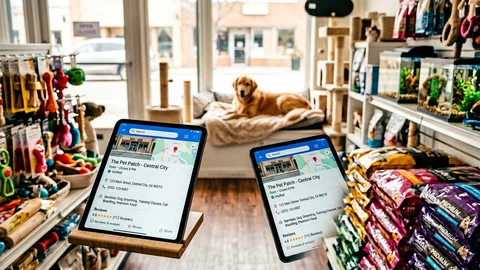
Google Shopping receives 1.2 billion searches every month[1], and over 75% of all US retail ad clicks now come from Shopping Ads. For pet stores, the opportunity is even larger: the pet care vertical posts an 8.12% Shopping click-through rate - 60%+ above the cross-industry average of 3-5%[2]. Yet most pet ecommerce stores either avoid Google Merchant Center entirely or run a sloppy feed that gets half their products disapproved.
This guide covers exactly how pet stores set up Google Merchant Center, build a clean product feed, avoid pet-specific disapproval traps (food, supplements, breed claims), and use the 8.12% pet vertical CTR advantage to drive profitable Shopping campaigns.
TL;DR
Google Merchant Center is the gateway to Google Shopping, free product listings, and Performance Max campaigns. Pet stores who get it right capture an 8.12% CTR (60%+ above cross-industry) and a 1.07% conversion rate at $3.13 CPC. The biggest losses are pet-specific: feed disapprovals on food and supplements, missing GTINs, generic titles, and stale stock data. This guide is the 30-day setup playbook with the exact attributes pet products need.
Why Should Pet Stores Use Google Merchant Center?
Google Merchant Center (GMC) is not optional for pet ecommerce. It powers Google Shopping ads, free product listings on the Shopping tab, Performance Max campaigns, the YouTube Shopping shelf, and product feed integration with the broader Google Ads ecosystem.
Three numbers define the pet store opportunity:
- 1.2 billion Google Shopping searches per month globally[1]
- 75% of US retail ad clicks come from Shopping Ads, not text ads[1]
- 8.12% pet care Shopping CTR, vs 3-5% cross-industry average[2]
The pet vertical CTR advantage is real and significant. Pet shoppers respond to product images more than almost any other category. Combine that with a 4.40% Search network conversion rate for pet products[2], and the math becomes clear - even modest Shopping traffic produces measurable revenue when the feed is set up correctly.
If your pet store does not appear on the Shopping tab, you are invisible to a growing share of high-intent buyers who skip text results entirely. For broader ecommerce SEO context, see our ecommerce SEO guide for pet stores.
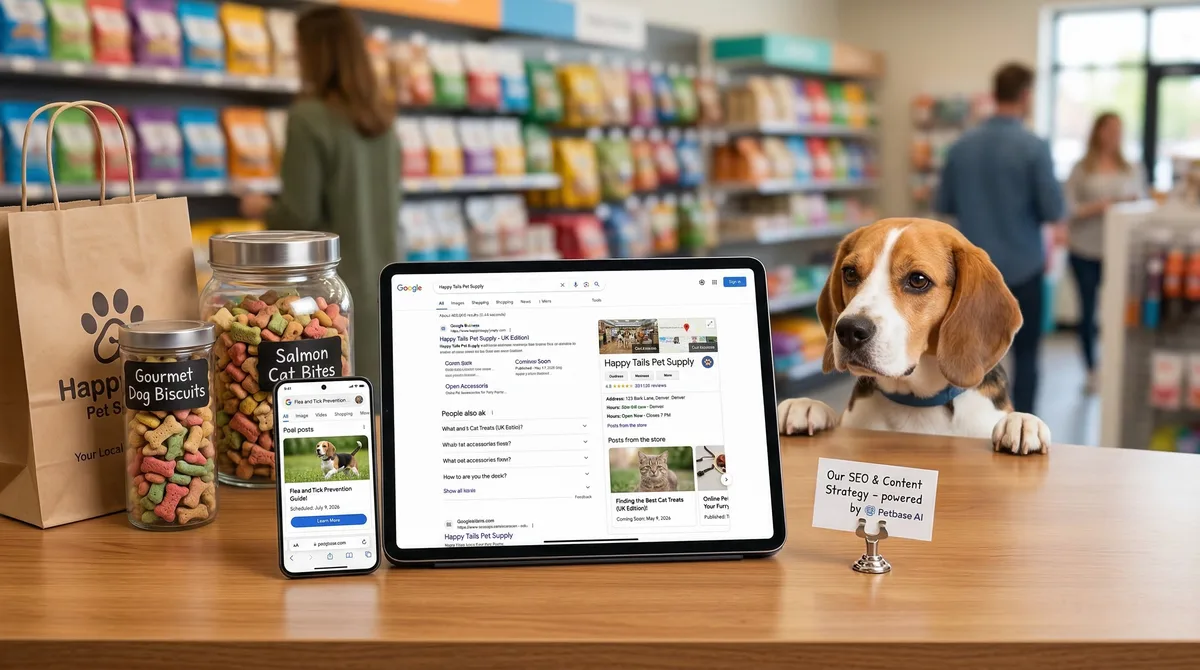
Petbase automates SEO content for pet stores - publishing 10 optimized articles monthly so you can focus on running your shop - start your free trial.
What Are the Required Product Feed Attributes?
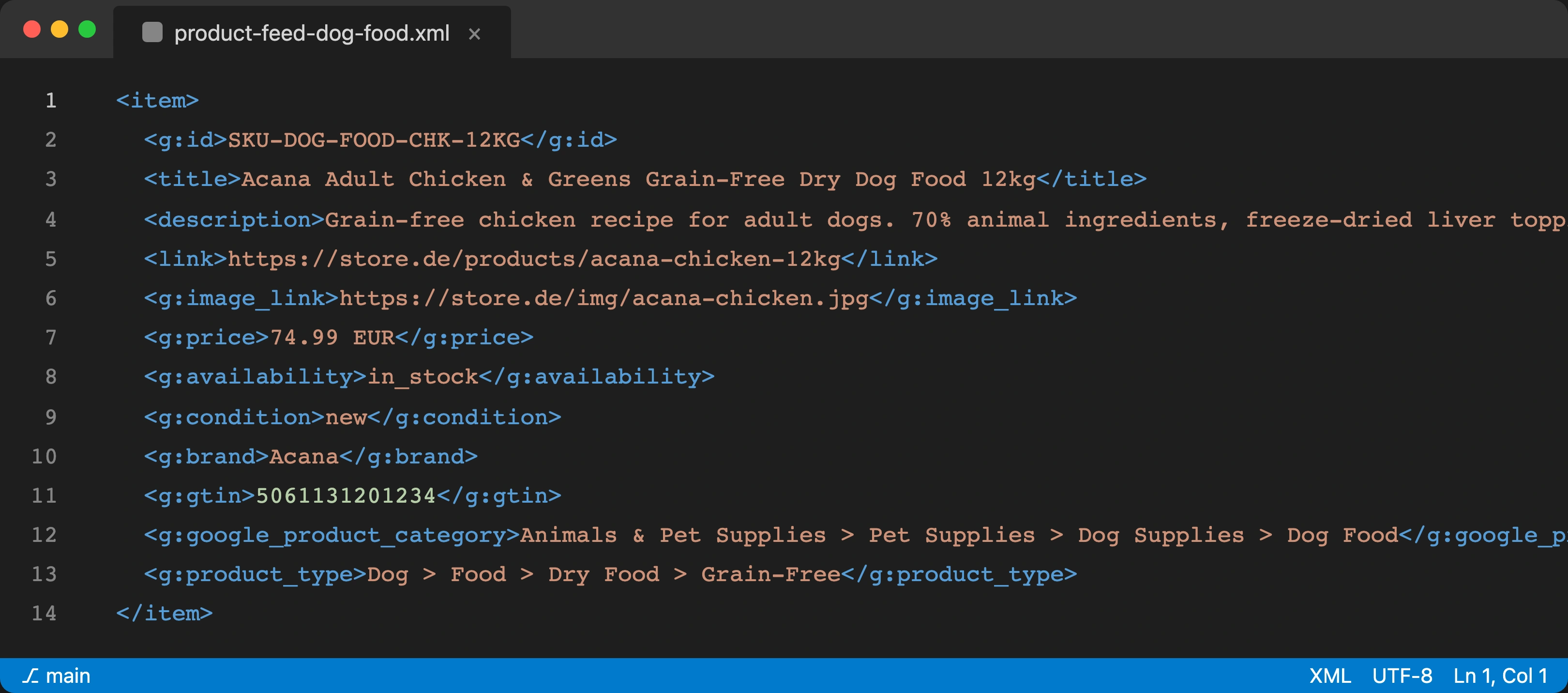
Google's product feed has 170 possible attributes[3]. You need a small core set to be eligible, plus a larger optional set to be competitive.
Required for every pet product
| Attribute | What it does | Pet store example |
|---|---|---|
| id | Unique product identifier | SKU-DOG-FOOD-CHK-12KG |
| title | Product name shown in ads | Acana Adult Chicken Dry Dog Food 12kg |
| description | Product details | Grain-free chicken recipe for adult dogs of all sizes... |
| link | Product page URL | https://store.com/products/acana-chicken-12kg |
| image_link | Main product image | https://store.com/img/acana-chicken-12kg.jpg |
| price | Sale price with currency | 74.99 EUR |
| availability | in_stock, out_of_stock, preorder, backorder | in_stock |
| condition | new, refurbished, used | new |
| brand | Manufacturer brand | Acana |
| gtin | Universal product code (UPC, EAN, ISBN) | 5061131201234 |
Missing GTIN is the single most common cause of pet product disapproval. If a product has a GTIN, you must submit it. If a product genuinely has no GTIN (private label, custom blends), set identifier_exists to false and submit MPN and brand instead.
Required for pet products specifically
These attributes are not always mandatory at the platform level, but pet products without them lose visibility:
- google_product_category - use Google's taxonomy (Animals & Pet Supplies > Pet Supplies > Dog Supplies > Dog Food, etc.)
- product_type - your store's internal category path (Dog > Food > Dry Food > Grain-Free)
- age_group - kids, adult, etc. (less relevant for pets but required for some categories)
- color, size, material - critical for collars, harnesses, beds, toys
- shipping_weight - mandatory if you offer real-time shipping calculation
What Are the Pet-Specific Disapproval Traps?
Pet stores get more product disapprovals than most ecommerce categories because of three pet-specific issues that generic GMC guides ignore:
1. Food and treat compliance
Pet food sits in a regulated category. Common disapprovals include:
- medical or therapeutic claims in titles or descriptions ("prevents joint pain," "cures itchy skin")
- unverified ingredient claims ("100% organic" without certification proof)
- missing or inaccurate AAFCO statements for the US market
- raw food without explicit safety handling notices in some markets
- imported foods without clear country-of-origin attribute
Fix: Audit every food and treat title for medical phrasing. Replace with descriptive language ("joint support formula" not "joint pain cure," "limited ingredient diet" not "allergy-free"). Add explicit ingredient certifications where you have them. For cross-border sales, set shipping attributes by destination country.
2. Supplement and treatment claims
Pet supplements, dental chews, and behavioral treatment products are routinely disapproved when descriptions imply medical efficacy. Google's reviewers do not differentiate between human and pet medical claims - the same restrictions apply.
Fix: Replace "reduces anxiety" with "calming support." Replace "treats arthritis" with "joint mobility support." Replace "prevents fleas" with "flea protection." The clinical-sounding language that converts on your product page can get the entire feed flagged.
3. Breed and life stage accuracy
If you tag a product as "large breed" or "senior," the actual product description and packaging must support that claim. Google increasingly cross-checks attribute claims against product page content. Mismatches cause progressive feed quality penalties.
Fix: Audit your top 100 products quarterly. Make sure breed-specific and life-stage claims in attributes match what's actually on the product page and packaging photos. For more on product-page accuracy, see our guide to optimizing pet product pages.
How Do You Optimize Product Titles for Pet Shopping?
Title optimization is the single highest-ROI lever in Google Merchant Center. Google uses titles for query matching, so a sloppy title costs you impressions across hundreds of relevant searches.
The pet product title formula
Use this structure for most pet product titles:
[Brand] [Product Line] [Variety/Flavor] [Life Stage] [Pack Size or Weight]
Examples:
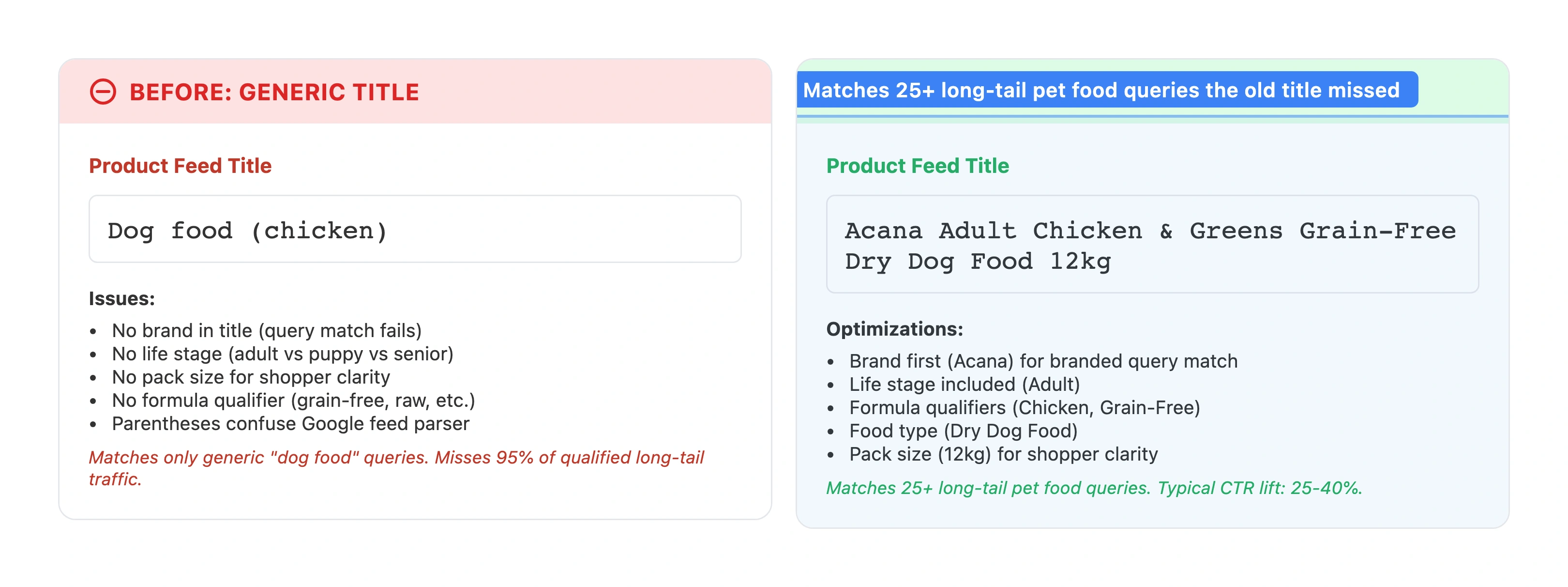
- Bad: "Dog food (chicken)"
- Better: "Acana Adult Chicken Dry Food 12kg"
- Best: "Acana Adult Chicken & Greens Grain-Free Dry Dog Food 12kg"
Include search-relevant qualifiers (grain-free, hypoallergenic, raw, freeze-dried) when they accurately describe the product. Avoid keyword stuffing - Google penalizes titles that read like keyword lists rather than product names.
Category-specific patterns
| Pet category | Title formula | Example |
|---|---|---|
| Dry food | Brand + Product + Variety + Life Stage + Weight | Royal Canin Mini Adult Chicken Dry Dog Food 8kg |
| Wet food | Brand + Product + Variety + Pack Size | Wellness Core Beef & Liver Pate 12 x 156g |
| Treats | Brand + Product + Type + Weight | Whimzees Toothbrush Dental Chews Medium 24-pack |
| Toys | Brand + Product + Material + Size | Kong Classic Natural Rubber Dog Toy Large |
| Beds | Brand + Product + Style + Size | FurHaven Memory Foam Sofa Bed Large 91cm |
| Collars/Harnesses | Brand + Product + Style + Color + Size | Ruffwear Front Range Harness Twilight Grey Medium |
| Supplements | Brand + Product + Form + Count | Nutramax Cosequin Joint Support Soft Chews 60-count |
Apply this consistently across every product. Pet stores with disciplined title formatting typically see 25-40% Shopping CTR improvements within 4-6 weeks of cleaning up their feed.
How Do You Set Up Daily Feed Updates?
Daily feed updates are the industry standard[4] and prevent the most common revenue leak in pet ecommerce: showing in-stock products that are actually sold out, or showing yesterday's price after a promotion ends.
The mechanics:
- Generate a fresh product feed file (XML or TSV) at least once per day. Most ecommerce platforms (Shopify, WooCommerce, BigCommerce) have apps that automate this.
- Host the feed at a stable URL or use SFTP delivery.
- Set GMC to fetch the feed daily at a chosen time. Use overnight hours so updates are live before peak morning traffic.
- Add Content API integration for real-time inventory and price changes between scheduled fetches. The minimum interval is 30 minutes between feed updates[3].
For multi-warehouse pet stores, supplement the daily feed with the supplemental feed feature - one master feed with product details, plus a smaller live-updating feed with only inventory and price. This pattern is faster, cheaper, and more accurate than rebuilding the master feed every hour.
Setting up daily feeds, writing 200+ disciplined product titles, mapping Google taxonomy categories, and configuring supplemental feeds takes 25-40 hours of focused work for a typical pet ecommerce catalog. Most pet store owners cannot find that time alongside daily operations. Or let Petbase generate the optimized product page content that powers your feed automatically.
What Are the Pet Vertical Benchmarks?
Comparing your Google Shopping performance against pet-specific benchmarks (not generic ecommerce averages) is the only way to know if your feed is working. Here are the verified pet care vertical numbers[2]:
| Metric | Pet care average | Cross-industry average | What it means |
|---|---|---|---|
| Shopping CTR | 8.12% | 3-5% | Pet shoppers click product images far more than other categories - leverage strong photography |
| Shopping conversion rate | 1.07% | 1.91% | Below cross-industry average - room to improve via product page UX |
| Shopping CPC | $3.13 | $0.66 | Pet keywords are competitive - feed optimization matters more here |
| Search Network conversion rate | 4.40% | 3.75% | Pet text-search ads convert above average - dual-channel strategy works |
The pattern is clear: pet shoppers click readily but require strong product page experience to convert. The combination of high CPC and below-average conversion rate means feed quality and product page UX are not optional - they are the difference between profitable Shopping campaigns and money-losing ones.
For pet store website conversion fundamentals, see our conversion mistakes guide.
What Is the 30-Day Pet Store GMC Setup Playbook?
Pet stores want fast results. Here is a 30-day playbook that gets a clean feed live and Shopping campaigns running:
| Day | Action | Why it matters |
|---|---|---|
| 1-2 | Create GMC account, verify and claim website ownership, set business and shipping settings | Account-level prerequisite |
| 3-5 | Generate first product feed from your ecommerce platform (Shopify Google channel, WooCommerce GMC plugin, or custom export) | Initial submission |
| 6-8 | Audit feed for required attributes - GTIN, brand, condition, availability, google_product_category | Reduces disapproval rate by 60-80% |
| 9-12 | Rewrite product titles for top 50 SKUs using the [Brand] [Product] [Variety] [Life Stage] [Size] formula | Highest single-lever ROI on Shopping CTR |
| 13-15 | Audit food and supplement descriptions for medical claims, fix and resubmit | Avoids feed-wide quality penalties |
| 16-18 | Configure Content API or supplemental feed for inventory and price freshness | Prevents out-of-stock and stale price disapprovals |
| 19-21 | Upload high-quality product images at 1:1 or 4:3 ratio, minimum 800x800px, white or transparent background | 70%+ shoppers won't consider products with poor photos[1] |
| 22-25 | Enable free product listings (Shopping tab eligibility) before paid Shopping campaigns | Free traffic to validate feed quality |
| 26-28 | Launch first Performance Max campaign with conservative budget cap | Algorithm needs 14-30 days to optimize |
| 29-30 | Set up daily feed update schedule and review first round of disapprovals | Operational baseline |
By day 30, a pet store should have a feed with under 5% disapproval rate, free Shopping listings live, and one Performance Max campaign learning. By day 60, Shopping campaigns typically achieve a stable cost per acquisition that justifies scaling budget.
How Does Petbase Help Pet Stores Power Their Product Feed?
The bottleneck for most pet ecommerce Shopping campaigns is not Google Merchant Center itself - it is the product page content that the feed pulls from. Generic descriptions, missing breed and life stage details, and thin specification data hurt both feed quality and on-site conversion.
That is the gap Petbase fills. Petbase generates pet-specific product page content - breed-aware, life-stage-aware, ingredient-aware, and structured for both human shoppers and the GMC feed. 10 articles per month plus product description support, published directly to your store, for USD 199/month.
The pet vertical Shopping CTR advantage (8.12% vs 3-5% cross-industry[2]) is real, but only realized with a clean feed and strong product pages. The question is whether your store captures that advantage or watches a competitor's well-optimized feed take the clicks first.
Start your 7-day free trial and see what consistent, structured product content does for your Google Shopping performance.
Frequently Asked Questions
How long does it take to set up Google Merchant Center for a pet store?
A clean GMC setup for a pet store with 200-1,000 SKUs takes 25-40 hours spread across 30 days. The first feed submission can happen within a week, but reaching a competitive disapproval rate (under 5%) and properly formatted titles takes the full 30-day window. Free Shopping listings start producing traffic in week 3-4 once feed quality is acceptable. Paid Shopping campaigns need an additional 14-30 days for algorithmic learning before performance stabilizes.
Why are my pet food products getting disapproved?
Pet food disapprovals usually stem from one of three causes: medical claims in product titles or descriptions ("prevents joint pain," "treats allergies"), unverified ingredient claims ("100% organic" without certification), or missing AAFCO statements for the US market. Audit every food product description for clinical phrasing and replace it with descriptive language. Add ingredient certifications where you have them. Set country-of-origin and shipping attributes correctly for cross-border sales.
Should pet stores use Performance Max or Standard Shopping?
Performance Max is the default recommendation for pet stores starting with under USD 5,000 monthly Shopping budget. It uses Google's machine learning to allocate spend across Shopping, Display, YouTube, Gmail, and Discover. Standard Shopping campaigns give more control but require more daily management - better suited to mature pet stores with USD 10,000+ monthly Shopping budget and a dedicated paid media manager. Most independent pet ecommerce stores get better ROAS from Performance Max with strong feed quality than from Standard Shopping with weak feed quality.
What is the average Google Shopping conversion rate for pet products?
The pet care vertical Shopping conversion rate averages 1.07% with a $3.13 CPC[2]. Pet care Search Network ads convert higher at 4.40%. Conversion rate is below cross-industry Shopping averages but click-through rate is significantly higher (8.12% vs 3-5%). The pattern means pet shoppers click readily but require strong product pages to convert. Feed quality and product page UX are the difference between profitable and unprofitable Shopping campaigns in the pet vertical.
References
- Fetch Funnel (2025). Google Merchant Center Product Feed: Flawless 2025 Feed. fetchfunnel.com
- Promodo (2026). Pet Care Marketing Metrics & Benchmarks. promodo.com
- Marpipe (2025). The Complete Guide to Product Feed Optimization. marpipe.com
- Scube Marketing (2025). Google Shopping Feed Requirements: A Step-by-Step Guide. scubemarketing.com