Keyword Research for Pet Stores: What Customers Search


Table of Contents +
- Why Generic Keyword Research Fails for Pet Businesses
- What Types of Keywords Do Pet Customers Use?
- How to Find Pet Keywords With Free Tools
- How to Analyze Search Intent for Pet Queries
- What Are the Best Long-Tail Keywords for Pet Stores?
- How to Group Keywords Into Topic Clusters
- Pet Keyword Research: Real Examples by Niche
- How Many Keywords Should You Target Per Page?
- How to Turn Keyword Research Into a Content Plan
- Frequently Asked Questions
- References
Learn how to find the exact keywords your pet customers search for. Covers intent analysis, long-tail strategies, topic clustering, and real niche examples.
Most pet businesses approach keyword research the wrong way. They open a keyword tool, type "dog food" or "pet store," and build their content strategy around whatever the tool spits out. The result: they target keywords too competitive to rank for, miss the specific phrases their customers actually use, and create content that attracts visitors who never buy.
That is a costly mistake in a global pet care market worth $273.42 billion[1] where organic search drives 53% of all website traffic[2]. Pet industry keyword research is different from general e-commerce keyword research. Your customers search using breed names, health conditions, life stages, ingredient preferences, and care-specific terminology that generic tools do not surface well. This guide shows you how to find those keywords, understand the intent behind them, and turn your research into a content plan that drives traffic and sales.
Why Generic Keyword Research Fails for Pet Businesses
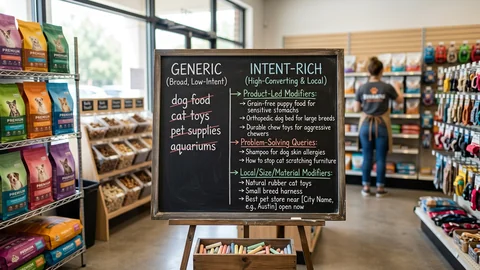
Generic keyword tools surface generic keywords. When you type "dog food" into a tool, you get results like "best dog food," "cheap dog food," "dog food delivery" - all with enormous search volume and brutal competition. A single-location pet store or small online shop has virtually zero chance of ranking for these terms against Chewy, Amazon, PetSmart, and dozens of established media sites.
The problem is not the tools - it is the approach. Pet customers do not search generically. They search with remarkable specificity:
- "best grain-free food for Golden Retrievers with sensitive stomachs"
- "how much should I feed my 8-week-old French Bulldog puppy"
- "calming supplements for dogs with separation anxiety"
- "cat litter that does not track on hardwood floors"
- "raw food diet for dogs with IBD"
These are long-tail queries, and they account for 70% of all search engine queries[3]. They have lower individual search volume (50-500 searches per month), but long-tail keywords convert at a 36% rate compared to single-digit rates for generic head terms[3]. A pet store that ranks for 100 specific long-tail keywords will generate more revenue than one ranking for 5 generic head terms.
The other failure of generic research: it misses pet-specific search patterns. Pet owners search by breed, age, health condition, ingredient, and activity type. These modifiers create thousands of keyword variations that standard tools categorize poorly or miss entirely. You need a research process built for these patterns.
Petbase automates SEO content for pet stores - publishing 10 optimized articles monthly so you can focus on running your shop - start your free trial.
What Types of Keywords Do Pet Customers Use?
Pet customer searches fall into four distinct intent categories. Understanding these categories helps you match the right content type to the right keyword.
| Intent Type | Signal Words | Example Keywords | Best Content Type |
|---|---|---|---|
| Informational | how, what, why, when, signs of, guide | "how to brush a cat's teeth," "signs of food allergies in dogs" | How-to articles, guides |
| Commercial investigation | best, top, review, vs, comparison | "best raw food for puppies," "Orijen vs Acana" | Buying guides, comparisons |
| Transactional | buy, order, price, discount, near me | "buy freeze-dried dog treats," "pet store delivery Berlin" | Product pages, category pages |
| Navigational | brand names, store names | "Zooplus login," "Fressnapf opening hours" | Homepage, brand pages |
For most pet businesses, the sweet spot is commercial investigation keywords. These searchers are past the research phase and actively comparing options before buying. They are your highest-value audience.
But do not ignore informational keywords. They attract a larger audience and build trust. A pet owner who reads your guide on "signs your dog has joint pain" today becomes a customer who buys joint supplements from you next month. The content establishes your expertise and keeps you top of mind.
Local intent matters too. 46% of all Google searches have local intent[4], and "near me" searches reach 1.5 billion per month with over 500% growth in recent years[4]. For pet stores with a physical location, local transactional keywords like "pet store near me" or "dog grooming [city]" are some of the highest-converting queries you can target.
Transactional keywords belong on your product and category pages, not blog posts. A blog post targeting "buy grain-free dog food" will not rank because Google shows product pages for transactional queries. Match intent to page type.
How to Find Pet Keywords With Free Tools
You do not need expensive SEO tools to find high-value pet keywords. Here are five free methods that work specifically well for pet businesses:
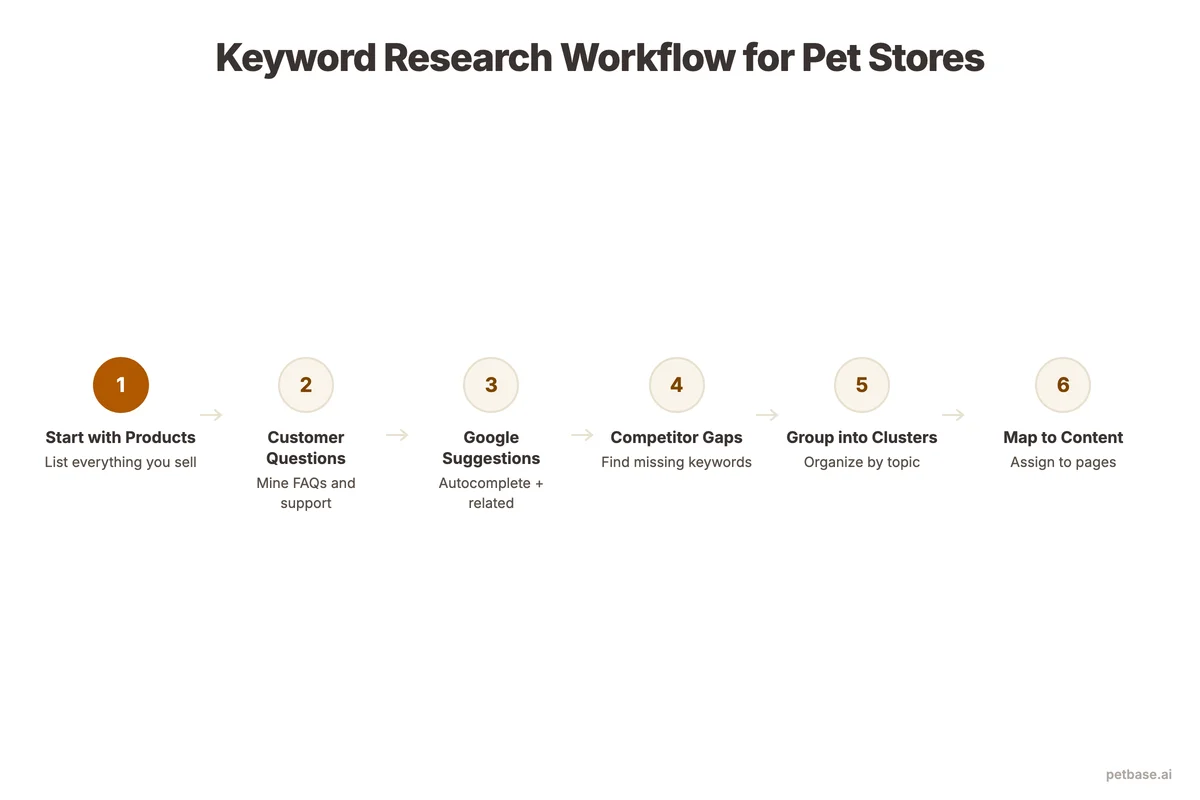
1. Google Search Console (for existing sites). If you already have a website, Search Console shows you which queries generate impressions and clicks. Sort by impressions to find keywords where you already appear but rank on page 2-3. These are your quick wins - create or optimize content for them and you can reach page 1 within weeks.
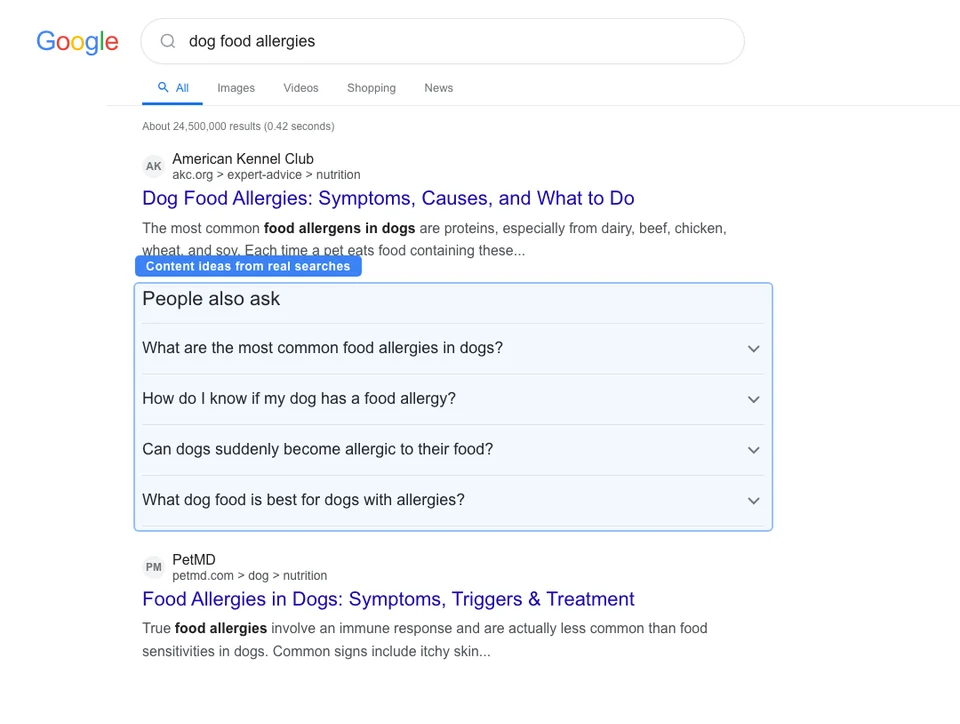
2. Google "People Also Ask" boxes. Search any pet-related query and look at the "People Also Ask" section. Each question reveals real searches from pet owners. Click on questions to expand them - more questions appear. You can generate 20-30 content ideas in 10 minutes this way. Example: searching "dog food allergies" reveals questions like "What are the most common food allergies in dogs?" "How do I know if my dog has a food allergy?" and "Can dogs suddenly become allergic to their food?"
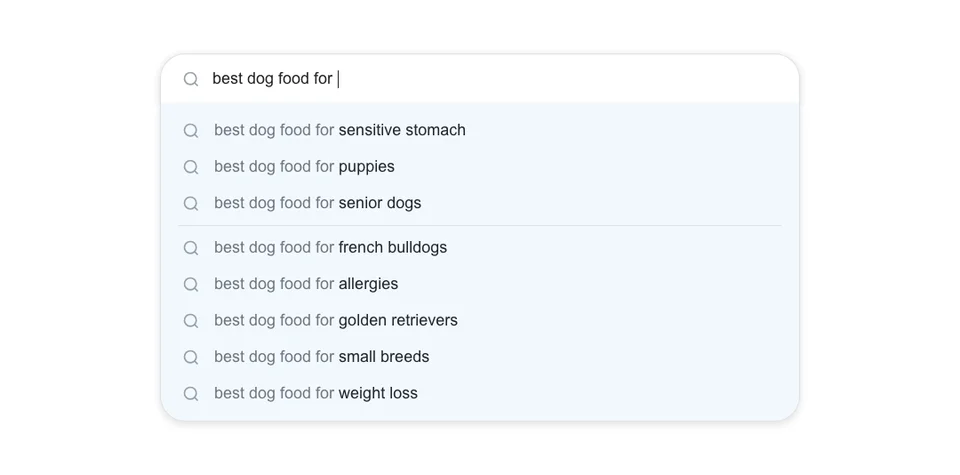
3. Google Autocomplete. Start typing a pet-related query and note the suggestions Google offers. These are real, high-volume searches. Try variations: "best dog food for [breed]," "cat [health condition] treatment," "how to [pet care activity]." Use an underscore in different positions to discover mid-query suggestions: "best _ for puppies" reveals "best food for puppies," "best toys for puppies," "best treats for puppies."
4. AnswerThePublic (free tier). Enter a seed keyword like "dog nutrition" and the tool generates hundreds of question-based keywords organized by who, what, when, where, why, and how. The free tier allows 3 searches per day - enough to research your main topics.
5. Your own customer conversations. This is the most underrated keyword source. What questions do customers ask at your counter? What emails do you receive? What do people ask on your social media? These real questions map directly to search queries. Keep a running list and review it monthly.
With Petbase, keyword research is automatic. During your site audit, the platform analyzes your pet niche, crawls competitor content, and identifies keyword clusters with the highest ranking potential for your specific business. No manual tool work required - you get a prioritized keyword plan as part of your 30-day content strategy.
How to Analyze Search Intent for Pet Queries
Knowing what people search is only half the equation. Understanding why they search determines what type of content you should create. Getting intent wrong means creating content that Google will never rank, no matter how well-written it is.
Here is the simplest way to analyze intent: search the keyword yourself and look at what Google ranks on page 1. Google has already figured out the intent based on billions of user interactions. If page 1 shows blog posts and guides, the intent is informational. If it shows product pages, the intent is transactional.
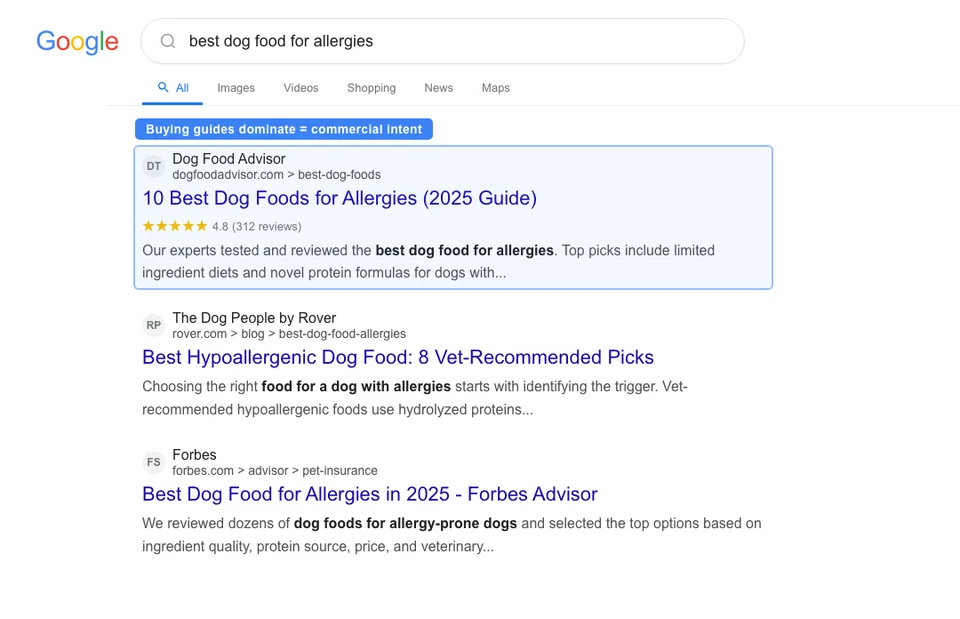
Common intent analysis for pet queries:
| Keyword | Page 1 Results | Intent | Your Content Type |
|---|---|---|---|
| best dog food for allergies | Buying guides, list articles | Commercial investigation | Buying guide with product recommendations |
| dog food allergy symptoms | Veterinary articles, health guides | Informational | In-depth health guide with expert citations |
| buy hypoallergenic dog food | Product pages, category pages | Transactional | Optimized product/category page |
| Royal Canin hypoallergenic review | Review articles, forums | Commercial investigation | Detailed product review |
| dog food near me | Local Pack, store listings | Local transactional | Google Business Profile + location page |
Pay attention to SERP features too. If Google shows a Featured Snippet (a box with a direct answer at the top), the query has informational intent and there is an opportunity to win that snippet with well-structured content. If Google shows a Shopping carousel, the intent is transactional - target it with product pages, not blog posts.
A critical insight for pet businesses: many pet health queries have dual intent. "Best food for diabetic cats" is both informational (people learning about feline diabetes) and commercial (people ready to buy). For these queries, create comprehensive content that educates first and recommends products second. The articles that rank best for dual-intent queries answer the health question thoroughly and then naturally transition to product recommendations.
What Are the Best Long-Tail Keywords for Pet Stores?
Long-tail keywords are specific, multi-word phrases with lower search volume but higher conversion rates. With 70% of all searches being long-tail[3], they are the foundation of a profitable SEO strategy because they match the way pet owners actually search.
Here are the most valuable long-tail keyword patterns for pet stores, with examples:
Breed + product:
- "best harness for French Bulldog"
- "food for senior Labrador Retriever"
- "grooming brush for Poodle coat"
Condition + solution:
- "supplements for dog with hip dysplasia"
- "cat food for urinary tract health"
- "calming treats for anxious rescue dogs"
Life stage + need:
- "how much to feed 10 week old puppy"
- "best food for senior cat with kidney issues"
- "toys for teething puppy"
Ingredient + preference:
- "grain-free dog food without chicken"
- "single protein cat food options"
- "organic dog treats made in Germany"
Activity + product:
- "dog hiking boots for rocky trails"
- "reflective dog collar for night walks"
- "travel crate for medium dogs on planes"
Each pattern generates dozens of keyword variations. A pet store specializing in dog nutrition could target 200+ long-tail keywords across breed, condition, life stage, and ingredient patterns - all with clear commercial intent and manageable competition.
For more on long-tail keyword strategies, read our guide on long-tail keywords for pet stores.
How to Group Keywords Into Topic Clusters
Individual keywords are useful. Grouped keywords are powerful. Topic clusters - groups of related keywords covered by interconnected pages - are how modern SEO works. Google rewards sites that demonstrate comprehensive coverage of a topic, not sites that target keywords in isolation.
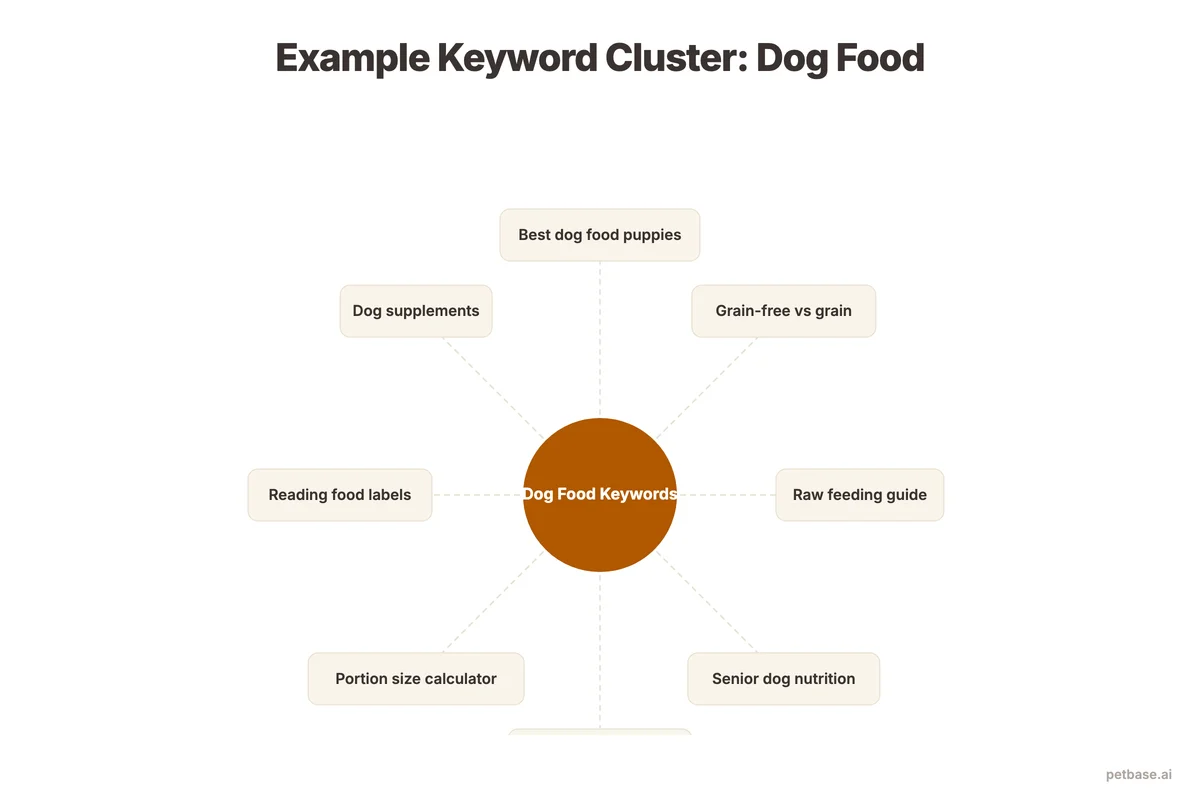
Here is how to cluster your pet keywords:
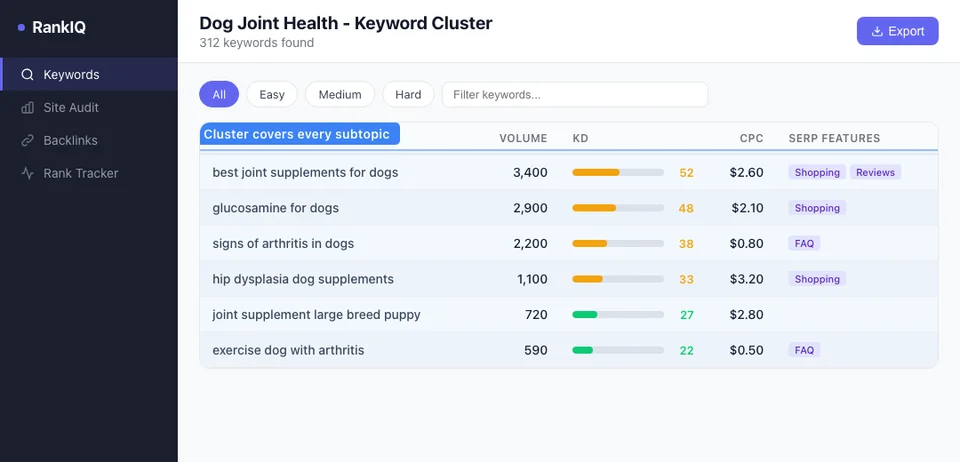
Step 1: Identify your pillar topics. These are broad subjects aligned with your product categories. Examples: "dog nutrition," "cat grooming," "pet supplements," "puppy care."
Step 2: Group related keywords under each pillar. Take all your keyword research and sort each keyword into the pillar topic it most closely relates to. Keywords that do not fit any pillar get set aside for now.
Step 3: Identify the pillar page keyword. This is the broadest, highest-volume keyword in each cluster. It becomes your pillar page (comprehensive guide). Example: "dog nutrition guide" is the pillar keyword for a cluster that includes "raw vs kibble," "grain-free dog food," "dog food allergies," and 15 other subtopics.
Step 4: Assign supporting keywords to individual articles. Each supporting keyword (or small group of closely related keywords) becomes one supporting article. The article targets that specific keyword while linking back to the pillar page.
Here is an example cluster for a pet store:
Cluster: Dog Joint Health
- Pillar page: "Complete Guide to Dog Joint Health" (targets: dog joint health, joint care for dogs)
- Supporting article 1: "Best Joint Supplements for Dogs" (targets: dog joint supplements, glucosamine for dogs)
- Supporting article 2: "Signs of Arthritis in Dogs" (targets: dog arthritis symptoms, arthritis in older dogs)
- Supporting article 3: "Hip Dysplasia in Dogs: Diet and Supplements" (targets: hip dysplasia dog diet)
- Supporting article 4: "Exercise for Dogs With Joint Problems" (targets: exercise arthritic dog)
- Supporting article 5: "Dog Joint Health by Breed" (targets: breeds prone to joint problems)
Every article links to the pillar and to at least 2-3 sibling articles. This internal linking structure tells Google that your site covers dog joint health comprehensively.
The cluster approach works because publishing volume matters. Companies that publish 16 or more blog posts per month get 3.5x more traffic than those publishing 0-4 posts[5]. But the posts need to be connected. 10 interconnected articles in a cluster rank significantly higher than 10 unconnected articles targeting the same keywords. The cluster structure is what makes the difference.
For a closer look at content clustering, read our guide on content clustering for pet websites and our topical authority strategy guide.
Pet Keyword Research: Real Examples by Niche
Different pet niches have different keyword landscapes. The U.S. pet industry alone is worth $152 billion[6], and that spending spreads across dozens of sub-niches, each with its own search behavior. Here are real keyword examples across four common pet business types:

Dog food retailer:
- "best dry dog food for small breeds" - 2,400 monthly searches, medium competition
- "grain-free vs regular dog food" - 1,800 monthly searches, low-medium competition
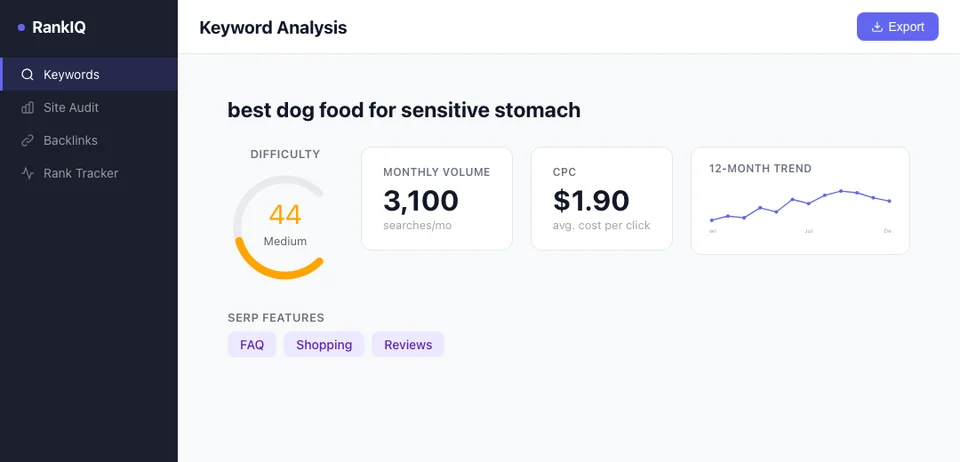
- "dog food for sensitive stomachs" - 3,100 monthly searches, high competition
- "how to read dog food labels" - 720 monthly searches, low competition
- "homemade dog food recipes vet approved" - 4,200 monthly searches, medium competition
Pet grooming business:
- "how often to groom a Golden Retriever" - 880 monthly searches, low competition
- "dog grooming tools for beginners" - 1,200 monthly searches, medium competition
- "Poodle haircut styles" - 2,900 monthly searches, low competition
- "cat grooming near me" - 1,600 monthly searches, medium competition (local)
- "de-shedding treatment for dogs" - 590 monthly searches, low competition
Pet supplement brand:
- "best probiotics for dogs" - 3,400 monthly searches, high competition
- "omega 3 for cats benefits" - 480 monthly searches, low competition
- "dog calming supplements that actually work" - 1,100 monthly searches, medium competition
- "joint supplement for large breed puppies" - 320 monthly searches, low competition
- "turmeric for dogs dosage" - 2,100 monthly searches, low-medium competition
Exotic pet store:
- "bearded dragon diet guide" - 2,800 monthly searches, medium competition
- "best substrate for ball pythons" - 1,500 monthly searches, low competition
- "parakeet cage setup guide" - 890 monthly searches, low competition
- "rabbit enrichment ideas" - 1,200 monthly searches, low competition
- "hermit crab care for beginners" - 1,600 monthly searches, low-medium competition
Notice the pattern: the most valuable keywords for each niche are specific, intent-rich, and often have manageable competition. These are the keywords that drive sales, not just traffic.
How Many Keywords Should You Target Per Page?
A common question with a simple answer: one primary keyword and 2-5 closely related secondary keywords per page.
Your primary keyword goes in the title tag, H1, first paragraph, and URL. Your secondary keywords appear naturally throughout the content, in H2s and H3s, and in image alt text.
Do not try to target unrelated keywords on a single page. "Dog food allergies" and "dog food for weight loss" are different topics with different intent - they need separate pages. But "dog food allergy symptoms" and "signs of food allergies in dogs" are the same intent phrased differently - they belong on the same page.
A practical test: if two keywords would have different ideal articles, they need separate pages. If they would naturally be covered in the same article, target them on one page.
For product pages, the rules are similar. One product page targets one primary product keyword plus related variations (brand name + product, product type + attribute). A product page for a specific dog food brand should target "[Brand] [Product] review," "[Brand] [Product] ingredients," and "[Brand] [Product] for [breed]."
How to Turn Keyword Research Into a Content Plan
Keyword research is only valuable if it becomes published content. With 7.5 million blog posts published every day[7], speed matters - sitting on keyword research while competitors publish means losing ground. Here is how to turn your keyword list into an actionable content plan:
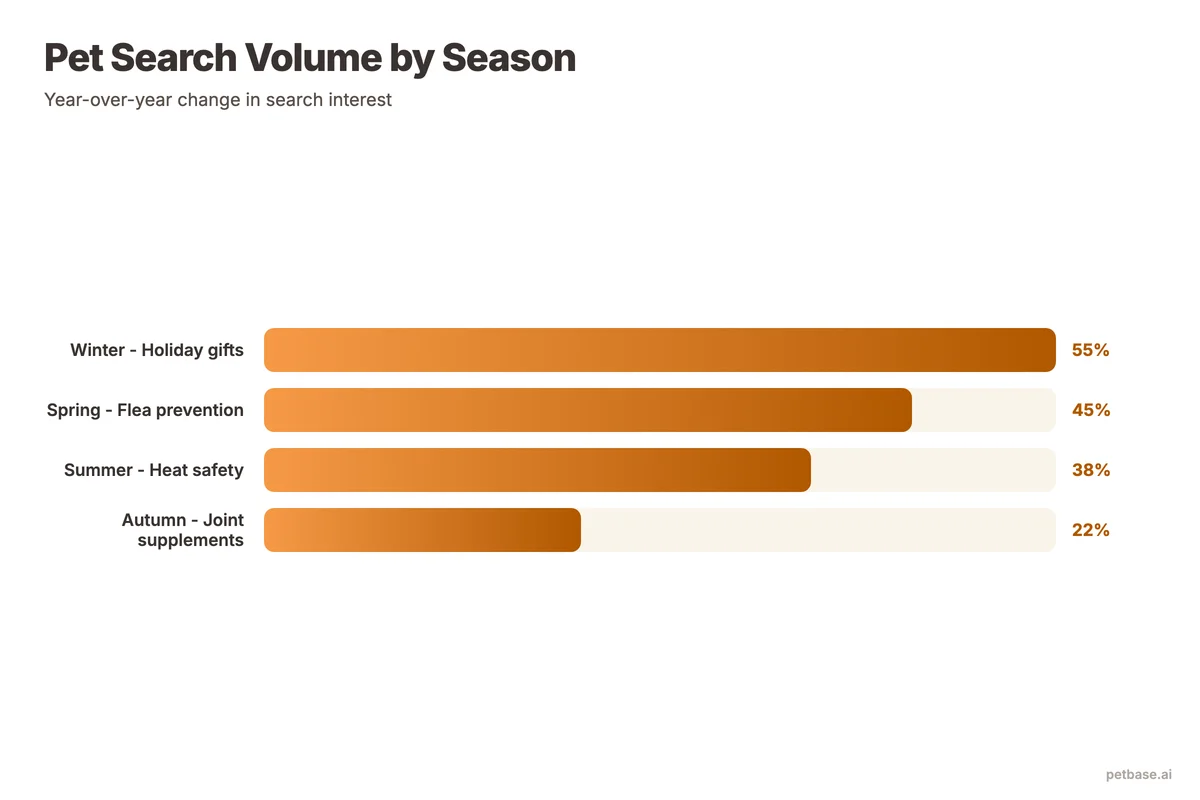
1. Prioritize by impact potential. Score each keyword cluster on three factors: search volume (demand), keyword difficulty (competition), and commercial value (how closely it relates to your products). Start with clusters that score high on all three.
2. Map keywords to content types. Informational keywords become blog posts. Commercial keywords become buying guides. Transactional keywords map to product and category pages. Local keywords map to location pages and GBP optimization.
3. Build your publishing calendar. Assign specific keywords and content pieces to specific weeks. A realistic schedule for most pet businesses: 2-3 articles per week, focused on completing one cluster at a time. Research shows that companies publishing 16+ posts per month see 3.5x more traffic[5], so consistency matters more than perfection.
4. Create content briefs. For each article, document: primary keyword, secondary keywords, search intent, target word count, H2 outline, internal links to include, and products to reference.
5. Publish, interlink, and track. After publishing, add internal links from existing content to the new piece. Track rankings weekly. Adjust your plan based on what performs and what does not.
With Petbase, this entire process is automated. For EUR 199/mo, you get 10 articles per month - each built around researched keyword clusters, properly interlinked, and published directly to your CMS. You review and approve - the strategy and execution happen automatically.
For more on building your content plan, see our guides on pet store blog strategy and content marketing for pet businesses. Ready to get started? Get your free site audit.
Frequently Asked Questions
How many keywords should a pet business target in total?
Start with 50-100 keywords organized into 2-3 topic clusters. This gives you enough content to build topical authority without spreading too thin. As your first clusters gain traction (usually within 8-12 weeks), expand to additional clusters. A mature pet business content strategy targets 300-500 keywords across 8-12 clusters - but you build to that level over 6-12 months, not all at once.
Are free keyword tools good enough for pet businesses?
For most pet businesses, yes. Google Search Console, Google Autocomplete, People Also Ask, and AnswerThePublic provide more keyword ideas than most pet stores can act on. Paid tools like Ahrefs and Semrush offer more precise volume and difficulty data, but the marginal value for a pet store spending EUR 100-200/month on tools is questionable. Invest that budget in content creation instead - the traffic data from Search Console after publishing tells you everything you need to know about keyword performance.
How often should I redo keyword research?
Conduct a full keyword research refresh every 6 months. Pet search trends shift with seasons, product launches, health trends, and cultural events. Between full refreshes, monitor Google Search Console monthly for new queries generating impressions - these are organic opportunities you should capture with new content. Also watch Google Trends for your pet niche to spot emerging topics before competitors do.
What is the biggest keyword research mistake pet businesses make?
Targeting keywords that are too broad and too competitive. A pet store trying to rank for "best dog food" is competing against Chewy, PetMD, AKC, and dozens of media sites with massive domain authority. Instead, target specific variations like "best dog food for Miniature Schnauzers with pancreatitis." Long-tail keywords like this convert at a 36% rate[3] and face achievable competition. Build authority on specific long-tail keywords first, and your ability to rank for broader terms grows naturally over time.
References
- Fortune Business Insights (2025). Pet Care Market Size, Share & Industry Analysis. fortunebusinessinsights.com
- BrightEdge via SEO Inc (2025). How Much Traffic Comes from Organic Search? seoinc.com
- Embryo (2025). 30 Statistics About Long-Tail Keywords. embryo.com
- BrightLocal (2025). Local SEO Statistics. brightlocal.com
- HubSpot (2025). Marketing Statistics. hubspot.com
- APPA (2025). Pet Industry Trends and Stats. americanpetproducts.org
- Orbit Media (2025). Blogging Statistics. orbitmedia.com