Local Citations for Pet Businesses: Full Directory List

Table of Contents +
- What Are Local Citations and Why Do They Help Pet Stores Rank?
- General Business Directories Every Pet Store Needs
- Pet-Specific Directories That Send Qualified Traffic
- Local and Regional Directories for Pet Businesses
- How to Keep Your Citations Consistent (NAP)
- How Many Citations Does a Pet Store Need?
- How to Audit Your Existing Citations
- Common Citation Mistakes Pet Businesses Make
- How Petbase Helps You Rank Locally
- Frequently Asked Questions
- References
Complete directory list for pet business local citations. General, pet-specific, and regional directories plus a NAP consistency system to rank higher.
Local citations are online mentions of your pet business's name, address, and phone number. They appear on directories like Google, Yelp, and industry-specific sites. For pet stores that depend on local customers, citations directly influence how Google ranks you in local search results. 46% of all Google searches have local intent[1], and 98% of consumers search online before visiting a nearby business[2]. More consistent citations mean higher visibility when someone searches "pet store near me." This guide gives you every directory worth listing on, plus a system for keeping your information accurate.
What Are Local Citations and Why Do They Help Pet Stores Rank?
A local citation is any online mention of your business that includes your name, address, and phone number - commonly called NAP. Citations appear on business directories, social media profiles, review sites, chamber of commerce pages, and industry-specific listings. Google uses these citations to verify that your business is real, active, and located where you say it is.
For pet stores, citations serve three purposes:
- Trust signals for Google. When Google finds your pet store listed consistently across 30+ directories, it gains confidence that your business information is accurate. This trust translates directly into higher rankings in Google Maps and local search results. Businesses with complete profiles appear in 80% more searches and receive 4x more visits[3].
- Discovery channels. Many pet owners search for businesses directly on Yelp, Facebook, or pet-specific directories. Being listed means you get found even when people skip Google. "Near me" searches alone generate 1.5 billion queries per month, with growth exceeding 500% in recent years[4].
- Link equity. Most directories include a link back to your website. While these are typically "nofollow" links, they still contribute to your overall online presence. Organic search drives 53% of all website traffic[5], and every signal that strengthens your domain helps you capture more of it.
Citation signals account for roughly 7% of local pack ranking factors. That may sound small, but the local pack captures 44% of all clicks for local searches[6]. In competitive local markets, citations are often the difference between appearing in the map pack and being invisible. Combined with a strong Google Business Profile and positive reviews, citations form the foundation of local SEO for pet businesses.
For broader local SEO strategy beyond citations, see the complete local SEO guide for pet businesses.
Petbase writes and publishes this kind of content automatically - 10 SEO articles per month for pet businesses - start your free trial.
General Business Directories Every Pet Store Needs
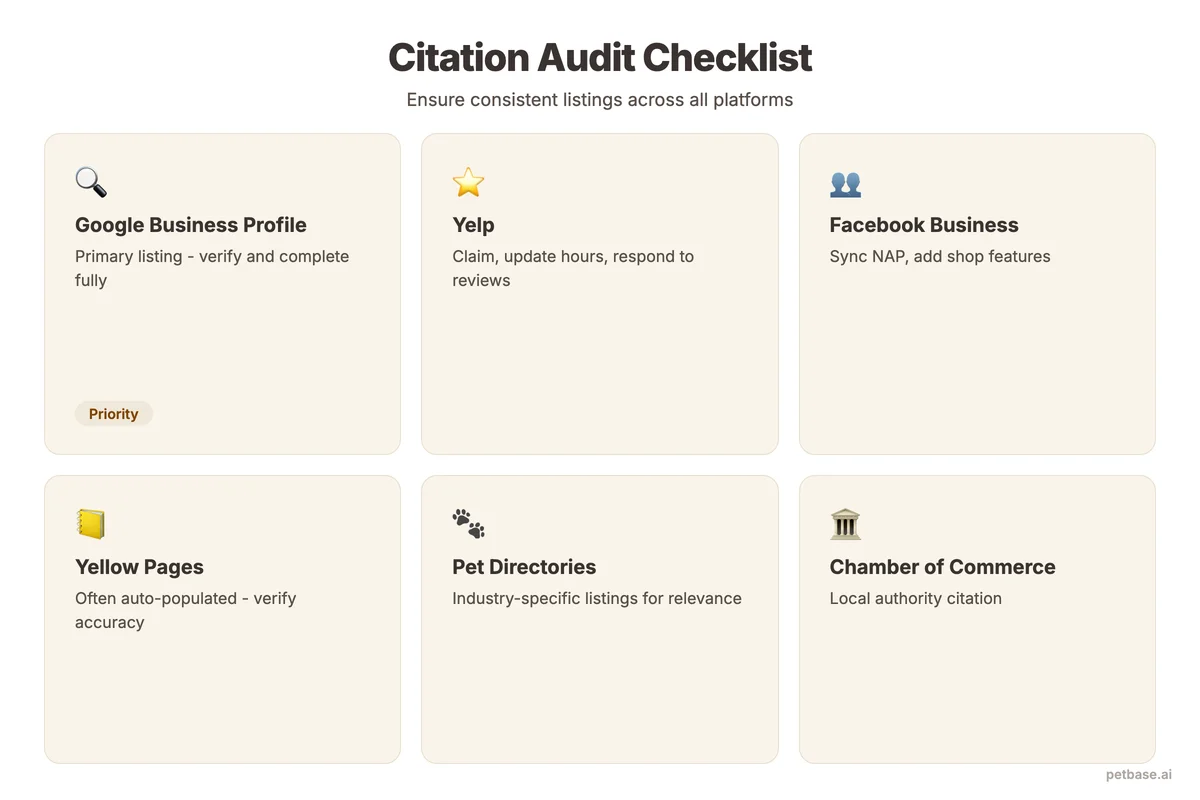
Start with the major directories that Google checks most frequently. These are non-negotiable for any pet business that wants local visibility.
| Directory | Domain Authority | Free Listing | Why It Matters |
|---|---|---|---|
| Google Business Profile | 100 | Yes | Controls your Google Maps listing and local pack appearance |
| Apple Maps (Apple Business Connect) | 100 | Yes | Default maps app on every iPhone - growing search volume |
| Bing Places | 93 | Yes | Powers Bing Maps, Cortana, and some voice search results |
| Yelp | 94 | Yes | Top review platform, frequently appears in Google results |
| Facebook Business Page | 96 | Yes | 2.9 billion users, strong local discovery features |
| Foursquare | 92 | Yes | Feeds data to Apple Maps, Uber, Samsung, and 100+ apps |
| Yellow Pages (yp.com / local equivalent) | 87 | Yes | Still indexed heavily by Google, high domain authority |
| Better Business Bureau | 93 | Paid | Trust signal for both Google and customers |
| Trustpilot | 93 | Yes | Review platform with strong Google visibility in Europe |
| Nextdoor | 87 | Yes | Hyperlocal community platform - strong for neighborhood businesses |
Claim and complete each listing fully. Upload photos, write a business description, add your hours, and select the correct business categories. Listings with photos receive 42% more direction requests[7]. A half-completed listing is worse than no listing - it signals to Google that your business is not actively managed.
Pet-Specific Directories That Send Qualified Traffic
Pet-specific directories attract visitors who are actively looking for pet services. The traffic volume is smaller than Google, but the intent is high. The global pet services market is worth $60.08 billion[8], and these directories help you capture a share of that spending. They also send strong relevance signals to search engines.
| Directory | Domain Authority | Focus | Best For |
|---|---|---|---|
| BringFido | 62 | Pet-friendly businesses | Pet stores, groomers, pet-friendly cafes |
| Rover | 74 | Pet services marketplace | Businesses offering boarding, grooming, daycare |
| PetBacker | 51 | Pet services | International pet service listings |
| Wag! | 64 | Dog services | Dog walking, boarding, training businesses |
| PetSitConnect | 34 | Pet sitting directory | Pet sitters, boarding facilities |
| DogFriendly.com | 48 | Pet-friendly locations | Stores and businesses welcoming dogs |
| AllPaws | 42 | Pet services | General pet business listings |
| Sniff Spot | 45 | Dog spaces | Pet businesses with outdoor spaces |
| PawShake | 47 | Pet care marketplace | Pet care service providers in Europe |
| GoMo Pets | 31 | Pet store directory | Pet retail specifically |
| PetFinder | 80 | Pet adoption/services | Shelters, rescues, pet stores with adoption programs |
| Adopt-a-Pet | 72 | Pet adoption | Stores that partner with rescues |
| PetsWelcome | 52 | Pet-friendly businesses | Travel and hospitality - but includes pet retail |
| Vetstreet | 61 | Veterinary and pet info | Pet health businesses and stores with vet partnerships |
| PetMD | 77 | Pet health directory | Businesses offering health products or vet services |
Prioritize directories with Domain Authority above 50 first. These pass more authority to your website and are more likely to appear in search results themselves. For directories below DA 40, only invest time if they are directly relevant to your specific services.
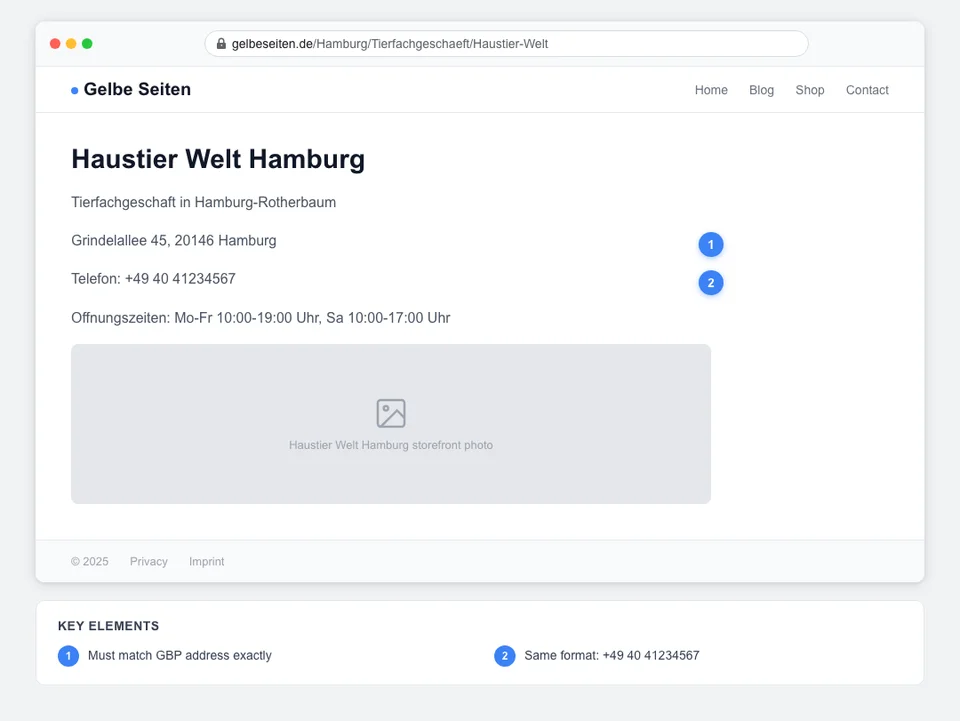
These pet-specific citations also help with building backlinks for your pet store - another critical ranking factor.
Local and Regional Directories for Pet Businesses
Beyond national directories, local and regional listings carry significant weight for Google's local algorithm. These show Google that your business is established within a specific community.
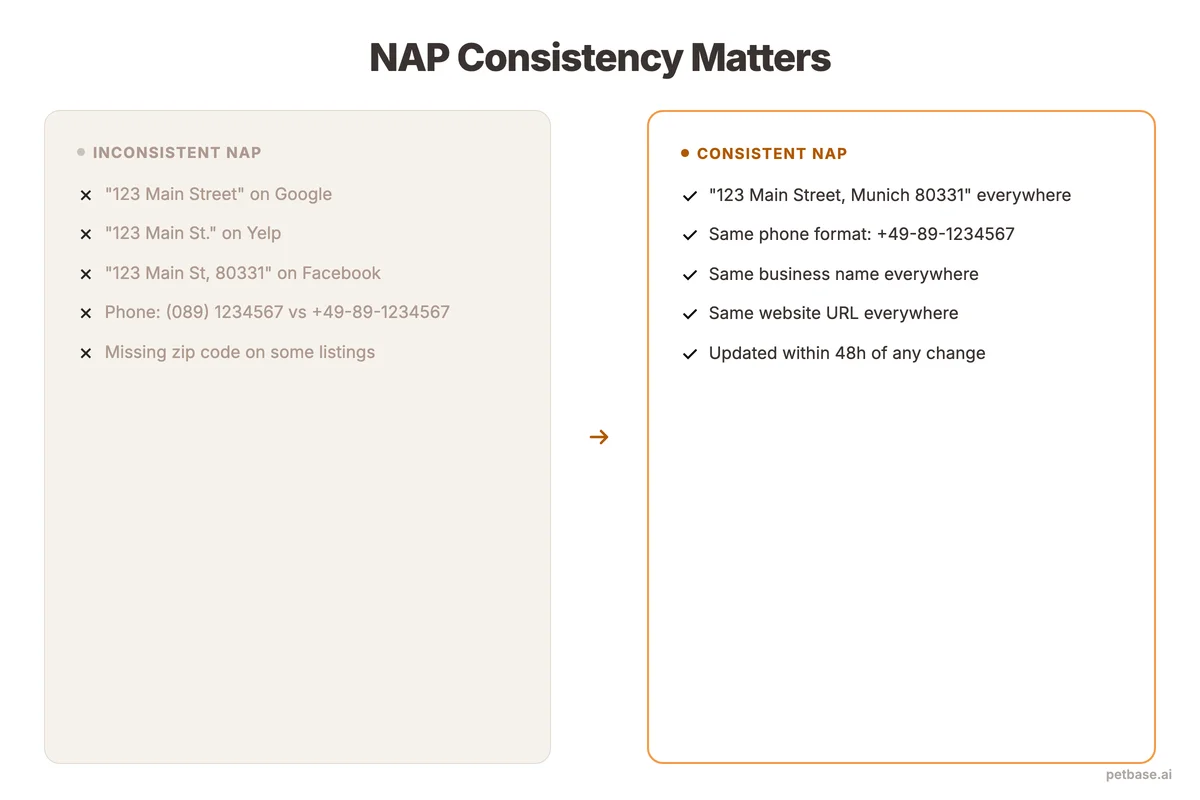
Chamber of Commerce. Your local chamber of commerce almost always offers a business directory. These listings carry high trust because chambers verify business legitimacy. The domain authority is often 50-70, which is strong for a local site.
Local newspaper or media directories. Many local newspapers maintain business directories. Getting listed here connects your business to a trusted local domain.
City or town business directories. Municipal websites sometimes list local businesses. Check your city's official website for a business directory page.
Regional pet associations. In Europe, many countries have pet industry associations with member directories. In Germany, the ZZF (Zentralverband Zoologischer Fachbetriebe) directory is valuable for pet retailers. In the UK, the Pet Industry Federation offers similar listings.
Shopping center or mall directories. If your store is in a shopping center, make sure you are listed on their website. These pages often rank well for "shops near [location]" searches.
Local event sites and community boards. If your city has a community events platform, create a business listing there. You can also list pet events you host - each event listing is an additional citation.
Aim for at least 10-15 local citations in addition to the national directories. The combination of national authority and local relevance creates the strongest signal for Google. For more on how "near me" searches work, see the guide on pet stores near me searches.
How to Keep Your Citations Consistent (NAP)
Consistency is the most important factor in citation management. Google cross-references your business information across dozens of directories. When it finds conflicting data - different phone numbers, old addresses, misspelled names - it loses confidence in your information and may suppress your rankings.
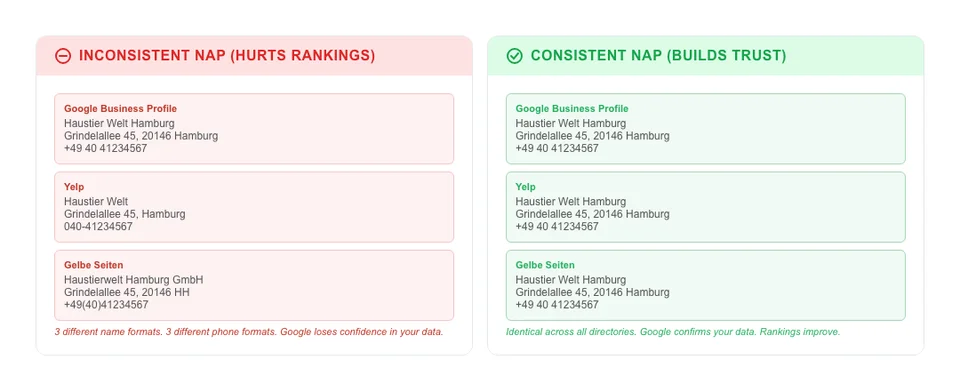
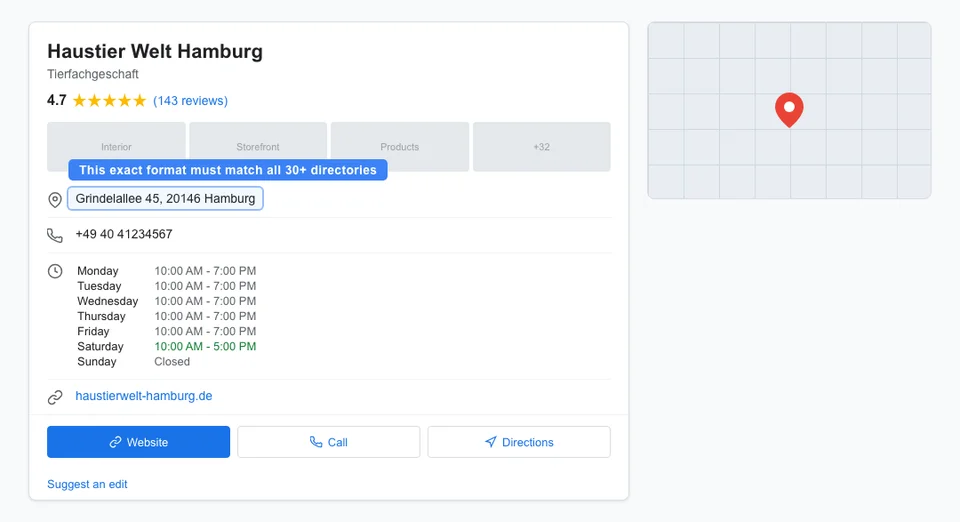
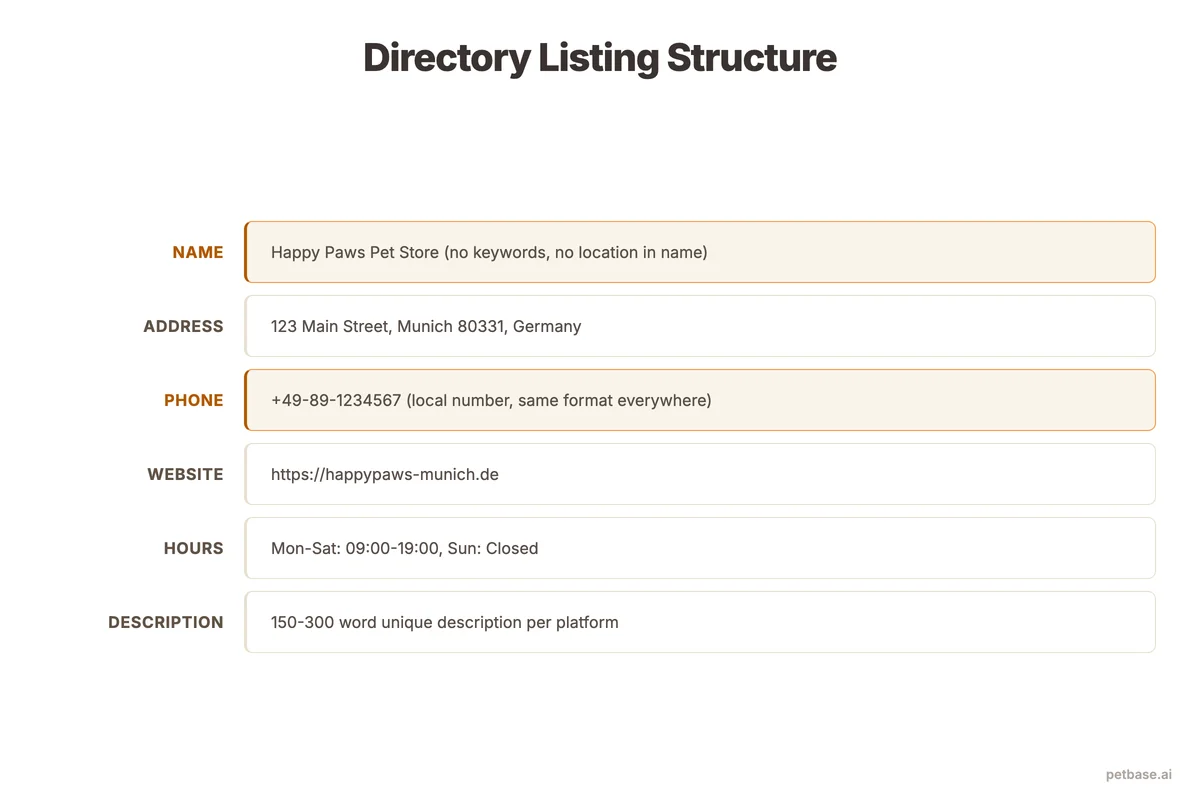
NAP stands for Name, Address, Phone Number. Here is how to keep yours consistent:
| Element | Rule | Common Mistake |
|---|---|---|
| Business Name | Use your exact legal business name everywhere. Do not add keywords. | "Happy Paws Pet Store" on Google, "Happy Paws" on Yelp, "Happy Paws - Best Pet Store in Berlin" on Facebook |
| Address | Use the exact same format everywhere - including abbreviations. | "123 Main St" on Google, "123 Main Street" on Yelp, "123 Main St." on Facebook |
| Phone Number | Use one primary phone number everywhere. Same format. | Mobile number on some listings, landline on others, different area code formats |
| Website URL | Use the same URL format (with or without www, with or without trailing slash). | "happypaws.com" on Google, "www.happypaws.com" on Yelp, "happypaws.com/" on Facebook |
| Business Hours | Update everywhere simultaneously when hours change. | Holiday hours updated on Google but not Yelp - customer arrives at a closed store |
| Categories | Choose the most specific category available on each platform. | Listing as "Store" instead of "Pet Store" or "Pet Supply Store" |
Pro tip: Create a master NAP document with your exact business information - formatted exactly how it should appear everywhere. Save it as a template. Every team member who manages listings should use this document as their reference. This eliminates formatting inconsistencies before they start.
How Many Citations Does a Pet Store Need?
The short answer: quality matters more than quantity, but you need a minimum baseline to compete.
For most local pet stores, here is a practical target:
- Minimum (new business): 30-40 citations across the top general directories, pet-specific directories, and local listings. This covers the essentials and establishes your online presence.
- Competitive (established business): 50-80 citations including niche directories, local associations, and industry-specific platforms. This is where most successful local pet businesses land.
- Aggressive (multi-location or competitive market): 100+ citations including every relevant directory, local media listing, and community platform you can find.
Do not chase raw numbers by submitting to hundreds of low-quality directories. Google can spot spammy directory submissions, and they provide little value. Focus on directories that real people actually use, that have reasonable domain authority (DA 30+), and that are relevant to your industry or location.
A good rule: if you would not be comfortable sending a customer to find your listing on a directory, do not submit to it.
For tracking how your citations affect your search visibility, see the guide on tracking pet store Google rankings.
How to Audit Your Existing Citations
Before building new citations, check what already exists. Many pet businesses have inconsistent or duplicate listings they do not know about - often created by data aggregators or previous owners.
Step 1: Search for your business name
Google your exact business name in quotes. Look through the first 3-4 pages of results. Note every directory listing you find. Check that each one has your current, correct NAP information.
Step 2: Search for your phone number
Google your phone number in quotes. This reveals listings you may have forgotten about or never created. Data aggregators like Acxiom, Infogroup, and Localeze distribute business data to hundreds of directories automatically.
Step 3: Search for your old information
If you have ever changed your business name, address, or phone number, search for the old information. Outdated citations are the most common source of NAP inconsistency. Every old listing needs to be either updated or removed.
Step 4: Use a citation audit tool
Tools like Moz Local, BrightLocal, or Whitespark offer free or affordable citation audits. They scan major directories and report exactly where your business is listed, whether the information is accurate, and where you have gaps.
Step 5: Create an action list
Organize your findings into three categories: citations to update (wrong information), citations to claim (listed but you do not control the listing), and citations to create (directories where you are not listed). Tackle updates first - fixing existing inconsistencies has the most immediate impact on rankings.
Common Citation Mistakes Pet Businesses Make
After auditing hundreds of pet business listings, certain mistakes appear again and again. Avoid these to protect your local rankings.
1. Keyword stuffing the business name. Some pet store owners add keywords to their Google Business Profile name: "Happy Paws - Best Pet Store and Dog Grooming in Berlin." Google explicitly prohibits this and may suspend your listing. Use your real business name, nothing more.
2. Inconsistent suite or unit numbers. If your store is in a shopping center, the suite number must be identical everywhere. "Suite 4," "Ste 4," "#4," and "Unit 4" are all different in Google's eyes.
3. Using a tracking phone number on directories. Call tracking numbers are useful for marketing measurement, but putting a different tracking number on each directory destroys your NAP consistency. Use one consistent phone number across all citations and track calls through your Google Business Profile or a single dedicated line.
4. Forgetting to update after a move or remodel. When a pet store changes its address, most owners update Google and forget about the other 50+ listings. Old addresses on active directories confuse both Google and customers.
5. Duplicate listings on the same directory. This happens more often than you would think, especially on Google. If your store has two Google Business Profiles - maybe from a previous owner or a name change - Google does not know which one to trust. Search for duplicates and merge or remove the old ones.
6. Ignoring pet-specific directories. Many pet businesses only list on the big general directories and skip pet-specific ones. These niche directories send strong relevance signals to Google. A listing on BringFido tells Google that you are definitively in the pet industry - something that a Yelp listing alone does not communicate as clearly.
7. Setting and forgetting. Citations are not a one-time task. Business hours change. Phone numbers change. Directories get sold or shut down. Review your citations at least twice per year to catch and fix any drift.
Your Google Business Profile is the most important citation you have. If you optimize nothing else, optimize that. 93% of consumers say reviews affect their buying decisions[9], and your GBP is where most of those reviews live. But do not stop there - the directories in this guide amplify the signal that Google uses to rank you locally.
For stores managing multiple locations, citation management becomes even more critical. The multi-location SEO guide covers how to handle citations at scale.
How Petbase Helps You Rank Locally
Citations get your pet store visible on maps and directories. But to rank in organic search results - the other 56% of clicks that happen outside the local pack - you need content. Petbase publishes 10 SEO-focused articles per month for your pet store at EUR 199/mo. Each article targets the local and niche keywords your customers search for, building the topical authority that supports your citation efforts. Instead of spending hours writing or thousands on an agency, you get a steady stream of content published directly to your site.
For the full local SEO strategy, including Google Business Profile optimization and review management, read the complete local SEO guide for pet businesses. Ready to see where your pet store stands? Start with a free site audit.
Frequently Asked Questions
How long does it take for new citations to affect rankings?
New citations typically take 4-8 weeks to be indexed by Google and start influencing your local rankings. Some high-authority directories like Yelp or Apple Maps may be picked up faster. The impact is cumulative - you will not see a dramatic jump from one citation. But after building 30-40 consistent citations over 2-3 months, you should notice improved visibility in Google Maps and local search results. Fixing inconsistent citations often produces results faster than building new ones because you are removing confusion rather than adding signals.
Should I pay for citation building services?
Paid citation services can save time, but be selective. Services that manually submit to high-quality, verified directories (like BrightLocal, Whitespark, or Moz Local) are worth the EUR 30-50 per month investment. Avoid services that promise "500 citations for $99" - these typically submit to low-quality, spammy directories that provide no value and can actually harm your SEO. A good test: ask the service for a sample list of directories they submit to. If you recognize fewer than half the names, skip it.
Do citations matter if I only sell online and have no physical store?
Citations are primarily a local SEO factor, so they matter most for businesses with physical locations. If you run a purely online pet store with no storefront, citations are less critical. However, listing your business on pet-specific directories (BringFido, PetFinder) and general business directories (Yelp, Trustpilot) still helps with brand visibility and building your review profile. For online-only stores, invest your time in content SEO and backlinks rather than citation building.
References
- BrightLocal (2025). Local SEO Statistics: 46% of Google Searches Have Local Intent. brightlocal.com
- BrightLocal (2025). Local Consumer Review Survey: 98% Search Online for Local Businesses. brightlocal.com
- Birdeye (2025). State of Google Business Profiles. birdeye.com
- BrightLocal (2025). Near Me Search Trends. brightlocal.com
- BrightEdge (2019). Organic Search Is Still the Largest Channel. seoinc.com
- BrightLocal (2025). Local Pack Click-Through Rate Data. brightlocal.com
- Sterling Sky (2023). How to Interpret Google Business Profile Performance. sterlingsky.ca
- Grand View Research (2025). Pet Services Market Size & Industry Analysis. grandviewresearch.com
- BrightLocal (2025). Consumer Reviews and Purchase Decisions. brightlocal.com