How to Create Local Content That Ranks for Pet Stores

Table of Contents +
- Why Local Content Is Your Pet Store's Best Ranking Opportunity
- What Types of Local Content Work for Pet Stores?
- How to Create Location-Specific Landing Pages
- How to Write Neighborhood Pet Guides
- How to Cover Local Pet Events and Build Links
- How to Optimize Local Content for Search
- How to Scale Local Content Across Multiple Areas
- Your Google Business Profile Supports Your Content
- Let Petbase Handle the Content While You Build Locally
- FAQ
- References
Learn how to create local content that ranks for your pet store. Covers location pages, neighborhood guides, event coverage, and scaling across multiple areas.
Local content is the most underused growth channel for pet stores with a physical location. While most store owners focus on generic product pages or national keywords, the searches happening in their neighborhood - "pet store near me," "best dog food in [city]," "puppy classes [neighborhood]" - go completely uncontested. These are the searches with the highest purchase intent, because the person typing them is ready to visit a store today.
Organic search drives 53% of all tracked website traffic[1], and 46% of all Google searches have local intent[2]. For pet stores, those two facts combine into a clear opportunity: nearly half of the people searching on Google are looking for something nearby, and the biggest traffic channel is organic search. Local content puts you in front of both.
This guide shows you how to create local content that ranks in your area, drives foot traffic, and builds your store's authority as the go-to pet destination in your community. Whether you have one location or several, these strategies work because most of your local competitors are not doing them at all.
Why Local Content Is Your Pet Store's Best Ranking Opportunity
Local content works because it targets searches with almost zero competition from national brands. Chewy, Amazon, and PetSmart cannot write a guide to dog-friendly parks in your city. They cannot cover the local adoption fair at the community center or recommend the best walking trails near your store. That content gap is your opportunity.
"Near me" searches now exceed 1.5 billion per month[2]. Those searches carry strong buying intent: someone searching for a pet store in their neighborhood is ready to visit. And the Local Pack - the three map results at the top of Google - receives 44% of all clicks when it appears[2]. Local content helps your site qualify for both the map pack and the organic results below it.
Google's local algorithm heavily favors businesses that demonstrate local expertise and relevance. When you publish content about your specific area, you send strong signals that your business is a trusted local resource - not just another pet store website.
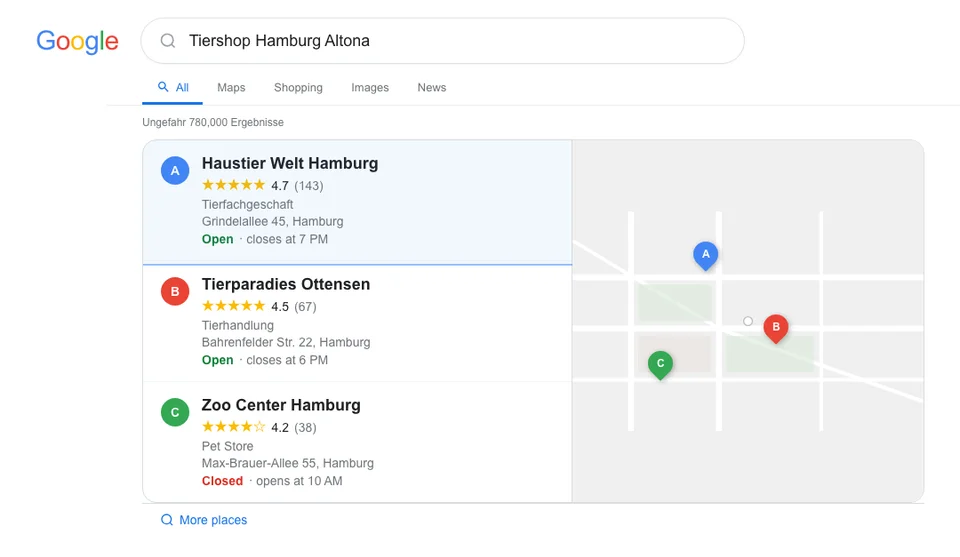
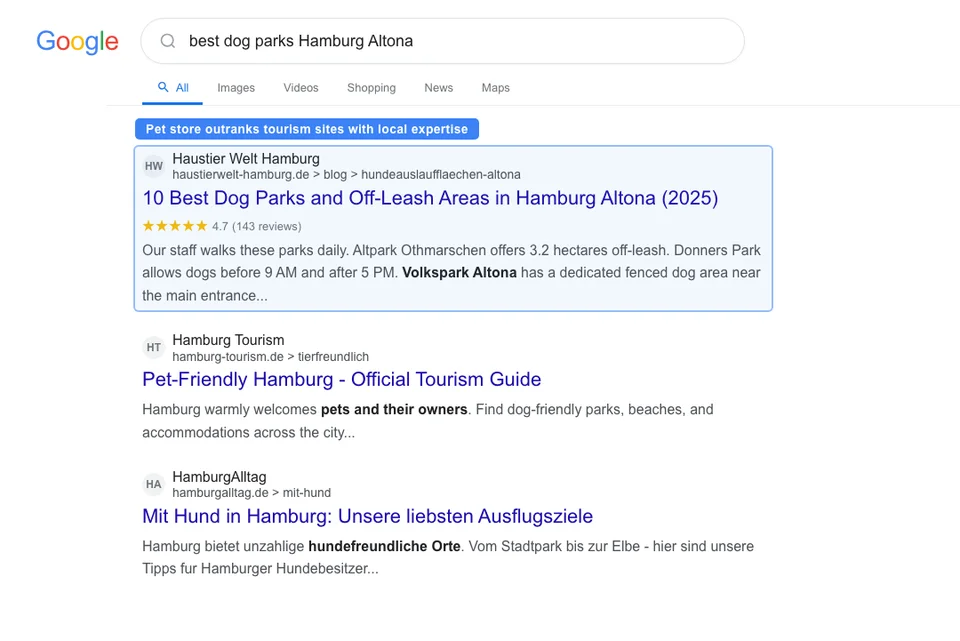
Here is what local content does for your pet store:
- Captures "near me" searches. With 1.5 billion "near me" searches per month[2], local content helps your site appear in both the map pack and organic results for location-specific queries.
- Builds community connections. Writing about local events, parks, and services positions your store as part of the community - not just a place to buy products.
- Earns natural backlinks. Local organizations, event pages, and community blogs are far more likely to link to your content about their area than to a generic product page.
- Converts at higher rates. Someone searching "best pet store in [your city]" is ready to visit. Local content captures these high-intent visitors at the moment they are making a decision.
Businesses with blogs generate 55% more website traffic than those without[3]. When that blog focuses on local topics, the traffic it attracts has far stronger buying intent than visitors from national keywords.
For the full local SEO framework, including Google Business Profile optimization and citations, see our pet business local SEO guide. This article focuses specifically on the content strategy that supports and amplifies those foundational efforts.
Petbase automates SEO content for pet stores - publishing 10 optimized articles monthly so you can focus on running your shop - start your free trial.
What Types of Local Content Work for Pet Stores?
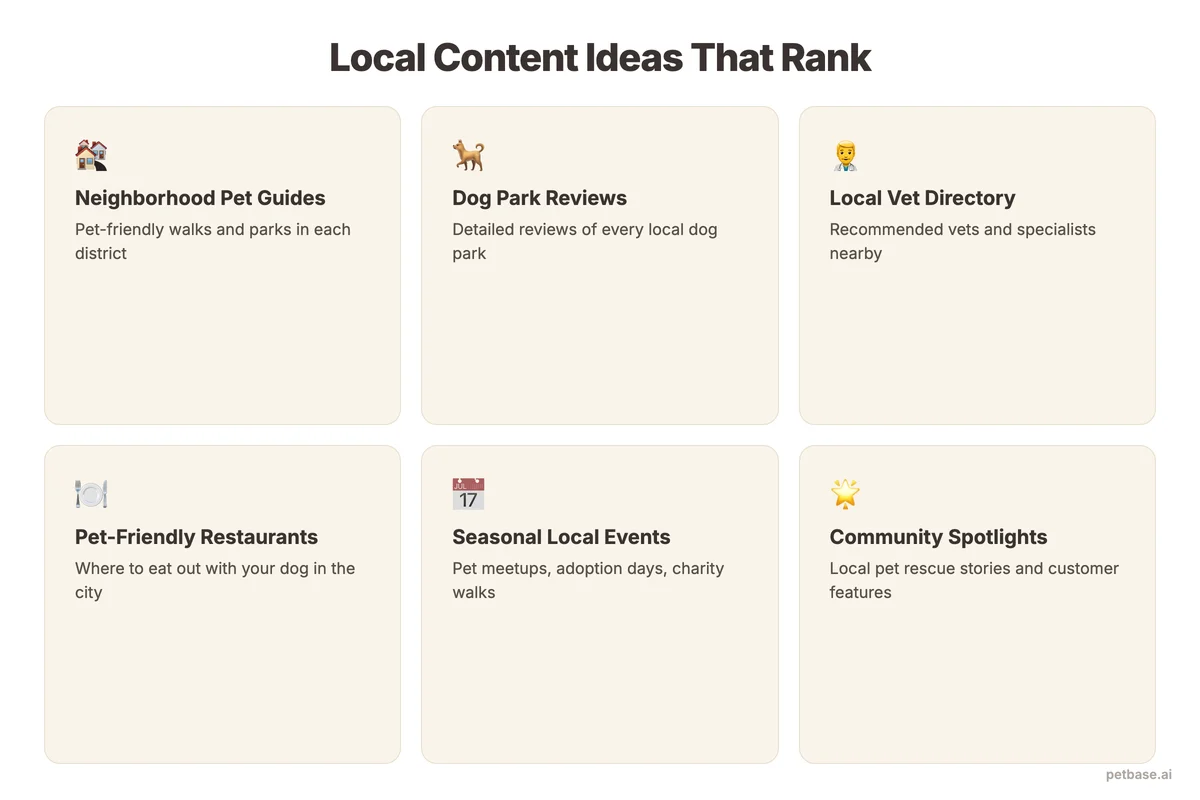
Not all local content is created equal. The best-performing local content for pet stores falls into specific categories that match how pet owners search in their area. Here is a breakdown of the types that consistently drive traffic and foot traffic.
| Content Type | Example Title | Search Intent | Conversion Potential |
|---|---|---|---|
| Location landing pages | Pet Store in [Neighborhood] - [Store Name] | Navigational / local | Very high |
| Local resource guides | 10 Dog-Friendly Parks in [City] | Informational / local | Medium |
| Neighborhood pet guides | Pet Owner's Guide to Living in [Area] | Informational / local | Medium |
| Local event coverage | [City] Pet Adoption Fair - What to Expect | Informational / local | Medium-high |
| Local service directories | Best Dog Groomers in [City]: A Local Guide | Commercial investigation | Low (referral value) |
| Seasonal local content | Summer Dog Safety Tips for [City] Heat Waves | Informational / local | Medium |
| Local breed guides | Best Dog Breeds for [City] Apartment Living | Informational / local | Medium |
| Community spotlights | How [Local Rescue] Has Saved 500+ Pets | Informational / local | High (link earning) |
The most effective approach combines all of these types into a local content cluster. Your location page sits at the center, with local guides, event coverage, and neighborhood content linking back to it. This builds the kind of local topical authority that pushes you above competitors in map pack and organic results.
For more on understanding "near me" search behavior, see our analysis of how pet owners search for stores near them.
How to Create Location-Specific Landing Pages
A location page is the foundation of your local content strategy. It is the page Google shows when someone searches for a pet store in your area. Done right, it becomes your highest-converting page. Done poorly - or not done at all - and you are invisible for your most valuable searches.
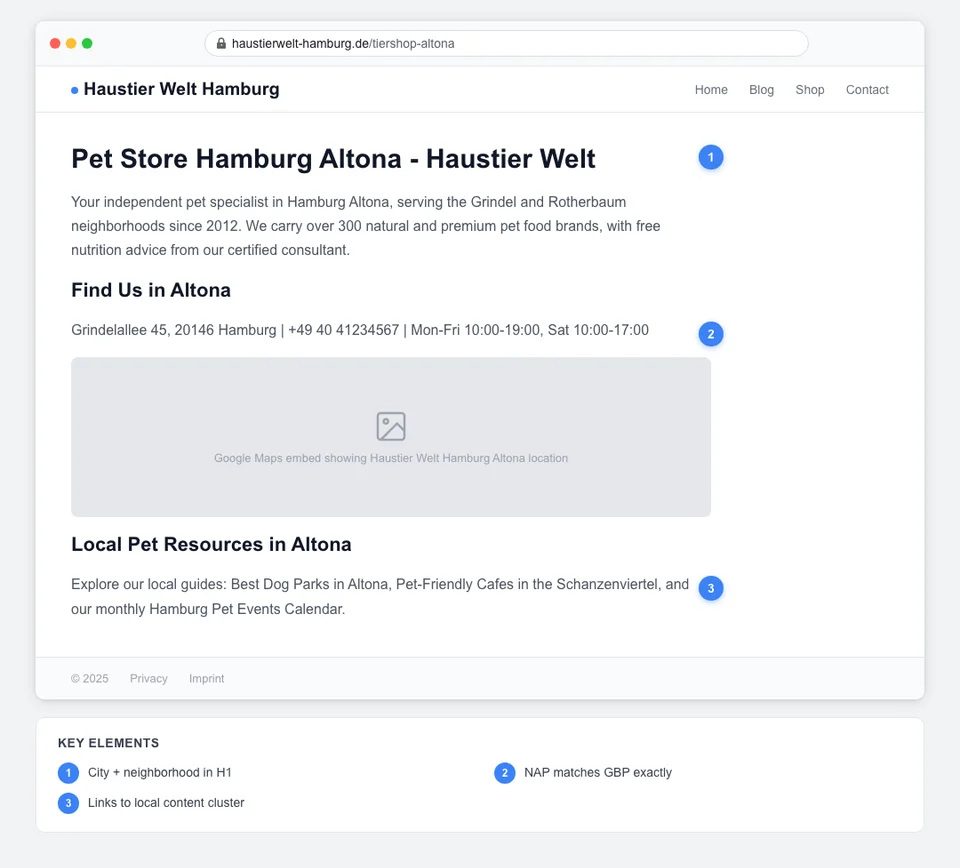
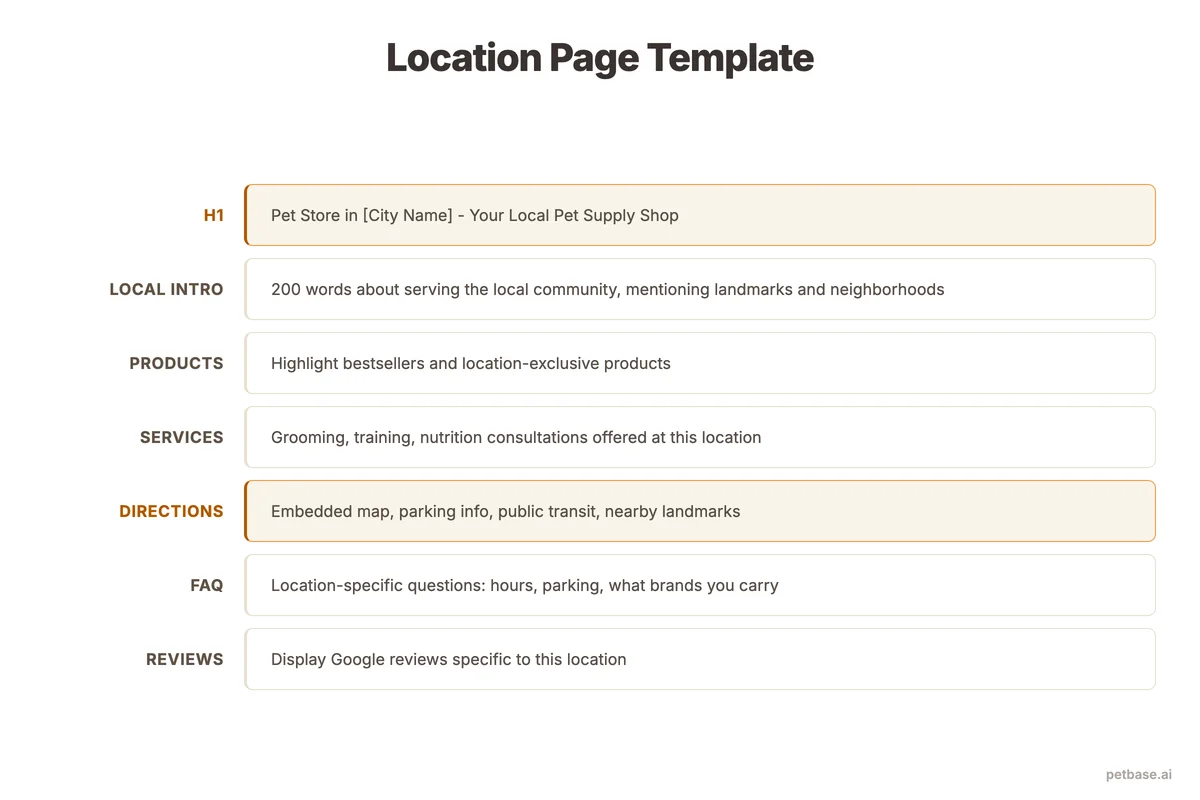
Every location page should include these elements:
Unique, locally relevant copy
Do not just swap city names into a template. Write genuinely unique content about your presence in that specific area. Mention local landmarks, the neighborhood you serve, how long you have been there, and what makes your location different. Google can detect thin, duplicated location pages and will penalize them.
NAP consistency
Your Name, Address, and Phone number must match exactly what appears on your Google Business Profile and in your local citations. Even small differences ("Street" vs. "St.") can confuse Google.
Embedded Google Map
An embedded map helps users find you and sends a local relevance signal to Google. Place it near the top of the page, not buried at the bottom.
Store photos
Real photos of your store - the exterior, interior, staff, and products - build trust and help searchers recognize your location. Avoid stock photos entirely.
Local structured data
Add LocalBusiness schema markup with your address, hours, phone number, and geo-coordinates. This helps Google display rich results for your store in local searches. For more on structured data, see our Google Business Profile guide.
Links to local content
Your location page should link to all your local blog posts - park guides, event coverage, neighborhood guides. This creates a local content hub that reinforces your geographic authority.
Customer reviews or testimonials
Feature reviews from customers in that specific area. "We have been bringing our dogs here since we moved to [neighborhood] three years ago" is far more compelling than a generic review. 93% of consumers say online reviews affect their buying decisions[2], so displaying them on your location page directly supports conversions.
A checklist to ensure nothing gets missed:
| Element | Required | Notes |
|---|---|---|
| Unique local copy (300+ words) | Yes | No template swapping |
| NAP matching GBP | Yes | Exact match required |
| Google Map embed | Yes | Use your Place ID |
| Store photos (4+) | Yes | Real photos, not stock |
| LocalBusiness schema | Yes | Include geo-coordinates |
| Operating hours | Yes | Match GBP hours |
| Links to local blog posts | Yes | Minimum 3 internal links |
| Customer reviews | Recommended | Area-specific preferred |
| Parking / transit info | Recommended | Practical details convert |
| Call-to-action | Yes | Directions, call, or visit |
How to Write Neighborhood Pet Guides
Neighborhood pet guides are the most shareable and link-worthy type of local content you can create. They answer the question every pet owner asks when they move to a new area or visit somewhere new: "What is it like to have a pet here?"
A neighborhood pet guide covers everything a pet owner needs to know about living in a specific area. Think of it as the ultimate local resource.
What to include in a neighborhood pet guide
- Dog-friendly parks and green spaces. List every park within the area, noting which are off-leash, which have water access, and any rules or restrictions.
- Walking routes. Describe 3-5 popular walking routes with distance, terrain, and difficulty level. Pet owners love practical walking content.
- Pet-friendly cafes and restaurants. List establishments that welcome dogs on their patios or indoors. Include any that offer dog treats or water bowls.
- Vet clinics and emergency services. List the closest veterinary clinics with a note on specialties or emergency availability. This is genuinely useful content that earns trust.
- Pet services. Groomers, dog walkers, pet sitters, and training classes in the area. These businesses may link back to your guide, earning you valuable local backlinks.
- Rental and housing tips. Pet-friendly housing information, typical deposit requirements, and breed restrictions in the area. This is especially valuable in urban neighborhoods.
- Your store's connection. Naturally mention how your store serves this area - what products are popular among local pet owners, any local delivery options, or community events you host there.
How to research neighborhood content
Walk the area with your dog. Visit the parks. Talk to local pet owners. Check local Facebook groups and Nextdoor for pet-related discussions. The best neighborhood guides are written from genuine local experience - and Google's E-E-A-T framework specifically rewards that kind of firsthand knowledge.
One neighborhood guide can generate steady traffic for years, especially if you update it seasonally. For a broader content calendar approach, see our guide on building an SEO content calendar.
How to Cover Local Pet Events and Build Links
Local pet events are a goldmine for content and backlinks. Adoption fairs, charity walks, pet expos, breed meetups, and seasonal festivals happen regularly in most cities - and almost nobody is creating search-optimized content about them.
Before the event: preview content
Write a preview post 2-4 weeks before the event. Include the date, location, what to expect, and practical tips for attending with pets. This captures searches from people planning to attend. Contact the event organizer and ask them to link to your preview from their event page - most will happily do so.
During the event: social coverage
Take photos and short videos during the event. Post them on social media and tag the organizers, vendors, and participants. This builds relationships that lead to backlinks and collaboration.
After the event: recap content
Write a recap with photos, highlights, and key takeaways. Link back to your preview post and to the organizer's website. These recap posts often rank for event-name searches for the following year, giving you a head start on next year's traffic.
Create an annual event calendar
Build a comprehensive page listing all pet-related events in your area for the year. Update it monthly. This becomes a go-to local resource that earns links from community sites, local news, and pet organizations.
Event content is particularly effective for building the kind of local backlink profile that strengthens your entire site's local authority. For more on blog strategies that support sales, see our guide on pet store blog strategy.
How to Optimize Local Content for Search
Creating local content is only half the equation. Optimizing it for local search ensures Google understands the geographic relevance and shows it to the right people.

Include location in key on-page elements
Your city or neighborhood name should appear naturally in the title tag, H1, meta description, first paragraph, and at least one H2. Do not stuff it into every sentence - once per section is enough.
Use location-specific long-tail keywords
Instead of targeting "best dog food," target "best dog food store in [city]." Instead of "puppy training classes," target "puppy training classes [neighborhood]." Long-tail keywords (3+ words) account for 70% of all searches and convert at a 36% average rate - nearly 2.5x higher than short-tail keywords[4]. When those long-tail queries include a location, the conversion rate climbs even higher because the searcher has both purchase intent and geographic intent.
Add local schema markup
Beyond your location pages, add geographic schema to your local blog posts. An Article schema with a locationCreated property, combined with mentions of local places, helps Google connect your content to a specific area.
Build internal links between local content
Every piece of local content should link to your location page and to other local posts. Your dog park guide links to your neighborhood guide, which links to your event calendar, which links back to your location page. This creates a tight local content cluster. For more on how clustering works, see our guide on content clustering for pet websites.
Optimize for voice search
Many "near me" searches come from voice assistants. Structure your content with natural-language questions and direct answers. "Where can I buy organic dog food in [city]?" followed by a clear answer is exactly how voice search results are selected.
For the complete local SEO picture including technical optimization, see our pet business local SEO guide.
How to Scale Local Content Across Multiple Areas
If you serve multiple neighborhoods, districts, or cities, you need a scalable approach to local content. The biggest mistake is creating thin, template-based pages with just the city name swapped out. Google penalizes this, and readers see right through it.
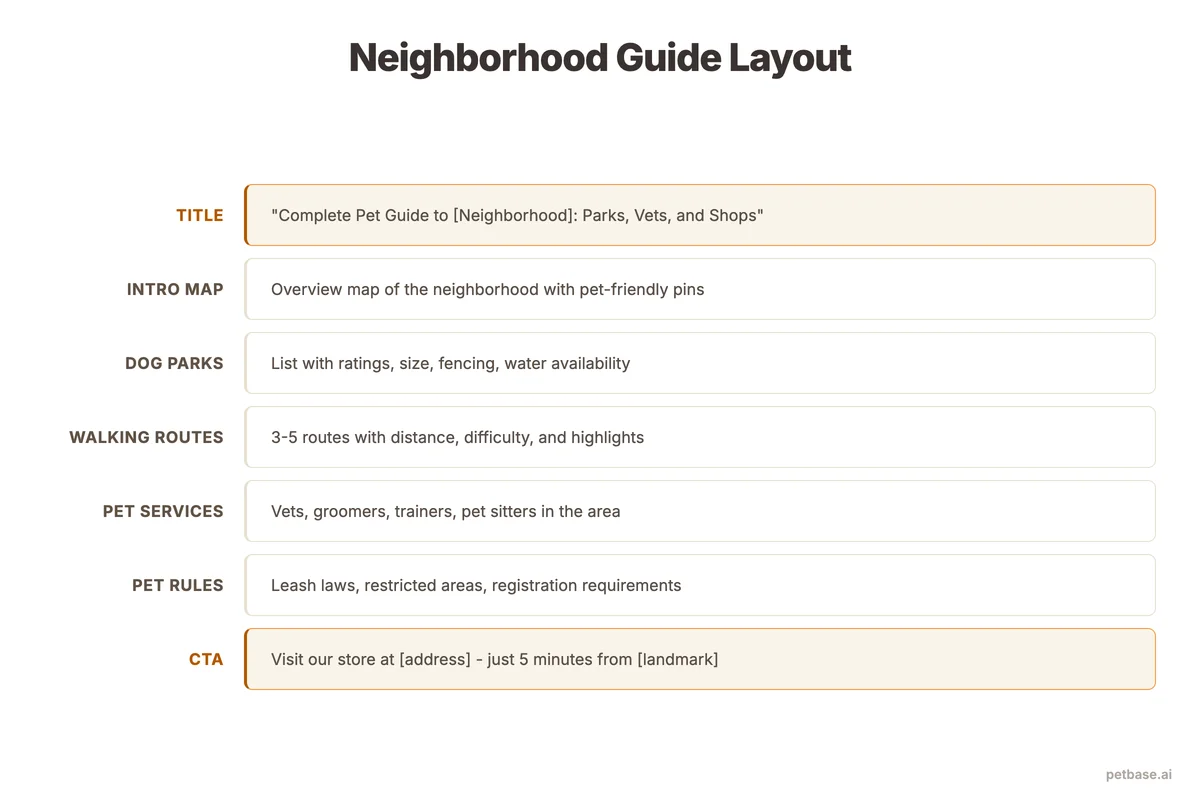
Here is how to scale local content the right way:
Create a content template with unique research requirements
Build a template that defines the sections every local page needs (parks, services, events, walking routes). But require unique research for each area. Every park name, every walking route, every local service should be specific to that neighborhood.
Prioritize by customer density
Start with the areas where most of your customers live. Use your sales data or loyalty program to identify the top 5 zip codes. Create content for those areas first, then expand outward.
Stagger your publishing
Do not publish 10 location pages on the same day. Roll them out over several weeks, promoting each one individually. This gives each page time to be indexed and evaluated by Google without triggering thin-content filters.
Assign local content to staff who live there
If you have employees who live in different neighborhoods, have them contribute local knowledge. Their firsthand experience makes the content authentic and detailed in ways that desk research cannot match.
Update quarterly
Local content goes stale faster than evergreen content. Parks close for renovation, businesses move, events change dates. Set a quarterly review cycle to keep every local page accurate and current.
For stores with multiple physical locations, see our guide on multi-location SEO for pet stores which covers the broader strategy beyond just content.
| Month | Content Focus | Content Pieces |
|---|---|---|
| Month 1 | Location pages for top 3 areas | 3 location pages, 1 neighborhood guide |
| Month 2 | Local resource guides | 2 park guides, 1 service directory, 1 event preview |
| Month 3 | Seasonal local content | 1 seasonal guide, 1 event recap, 1 local breed guide |
| Month 4 | Expand to next 3 areas | 3 location pages, 2 neighborhood guides |
| Month 5 | Update cycle + new content | Update month 1 content, 2 new local posts |
| Month 6 | Link building + events | 2 event posts, 1 community spotlight, outreach |
Your Google Business Profile Supports Your Content
Local content and your Google Business Profile (GBP) reinforce each other. A complete GBP appears 80% more often in search and generates 4x more website visits than an incomplete profile[5]. When your GBP links to location-specific blog content on your site, it strengthens both your map pack and organic rankings.
Every local article you publish gives you something new to share through GBP posts, which keeps your profile active and signals freshness to Google. For the full GBP optimization guide, see our Google Business Profile guide for pet stores.
Let Petbase Handle the Content While You Build Locally
Creating this volume of quality local content takes time. Petbase can handle the blog content for your store - including locally relevant articles - at 10 posts per month for EUR 199/mo. That frees you up to focus on the truly local work: taking photos, attending events, and building community relationships that no tool can replicate.
See how Petbase works and start publishing consistent, search-optimized content for your store.
FAQ
How much local content does a single-location pet store need?
A single-location pet store should aim for a minimum of 8-10 pieces of local content: one location landing page, 2-3 neighborhood or park guides, 2-3 event-related posts, and 2-3 local resource guides. This is enough to establish local topical authority for your primary service area. After the initial batch, add 1-2 local pieces per month to maintain freshness and expand your geographic coverage to surrounding areas.
Should I write about competitor businesses in my local guides?
Yes, when it makes sense. Mentioning other local pet businesses - groomers, trainers, vets - in your neighborhood guides makes the content genuinely useful and increases the chance those businesses will link back to you. You are not promoting competitors who sell the same products. You are building a local resource that positions your store at the center of the pet community. The goodwill and backlinks you earn far outweigh any referral traffic to non-competing businesses.
Can I create local content if my pet store is online-only?
Online-only stores benefit less from hyper-local content, but there are still opportunities. You can create regional shipping guides, state-specific pet regulation content, or climate-based pet care guides ("keeping your dog cool in Texas summers"). These capture location-modified searches without requiring a physical presence. However, if you are purely online, your content budget is better spent on product-focused blog strategy and national keyword targeting.
How do location-specific long-tail keywords compare to broad keywords?
Long-tail keywords (3+ words) make up 70% of all searches and convert at a 36% average rate[4]. That is nearly 2.5x higher than short-tail keywords. When you add a location to a long-tail query - "organic dog food store in Portland" instead of "organic dog food" - you narrow the audience to people who are ready to visit. The trade-off is lower search volume, but the visitors you attract are far more likely to walk through your door.
References
- BrightEdge (2025). How Much Traffic Comes from Organic Search. seoinc.com
- BrightLocal (2025). Local SEO Statistics. brightlocal.com
- HubSpot (2025). Marketing Statistics. hubspot.com
- Embryo (2025). 30 Statistics About Long-Tail Keywords. embryo.com
- Birdeye (2025). State of Google Business Profiles. birdeye.com