Long-Tail Keywords for Pet Stores: Find Easy Ranking Wins


Table of Contents +
- What Are Long-Tail Keywords and Why Do They Matter for Pet Stores?
- Why Long-Tail Keywords Are Easier to Rank for
- How to Find Long-Tail Pet Keywords (Step by Step)
- Which Pet Niches Have the Best Long-Tail Opportunities?
- How to Evaluate a Long-Tail Keyword Before Writing
- 50 Long-Tail Keyword Examples for Pet Stores
- How to Turn Long-Tail Keywords Into Blog Posts
- Why Most Pet Stores Still Have a Window of Opportunity
- Frequently Asked Questions
- References
Find easy-to-rank long-tail keywords for your pet store. 50 keyword examples by niche, free tools, and a step-by-step method to turn them into traffic.
Most pet stores target the same 10 keywords. "Dog food." "Cat toys." "Pet supplies." They compete against Amazon, Chewy, and Petco for terms that get millions of searches - and never see page one. The alternative? Long-tail keywords. These are longer, more specific search phrases that fewer websites target. They are easier to rank for, attract more qualified visitors, and convert at rates up to 36%[1]. In a U.S. pet industry worth $152 billion[2], finding untapped search terms is one of the fastest ways to grow. This guide shows you exactly how to find and use them.
What Are Long-Tail Keywords and Why Do They Matter for Pet Stores?
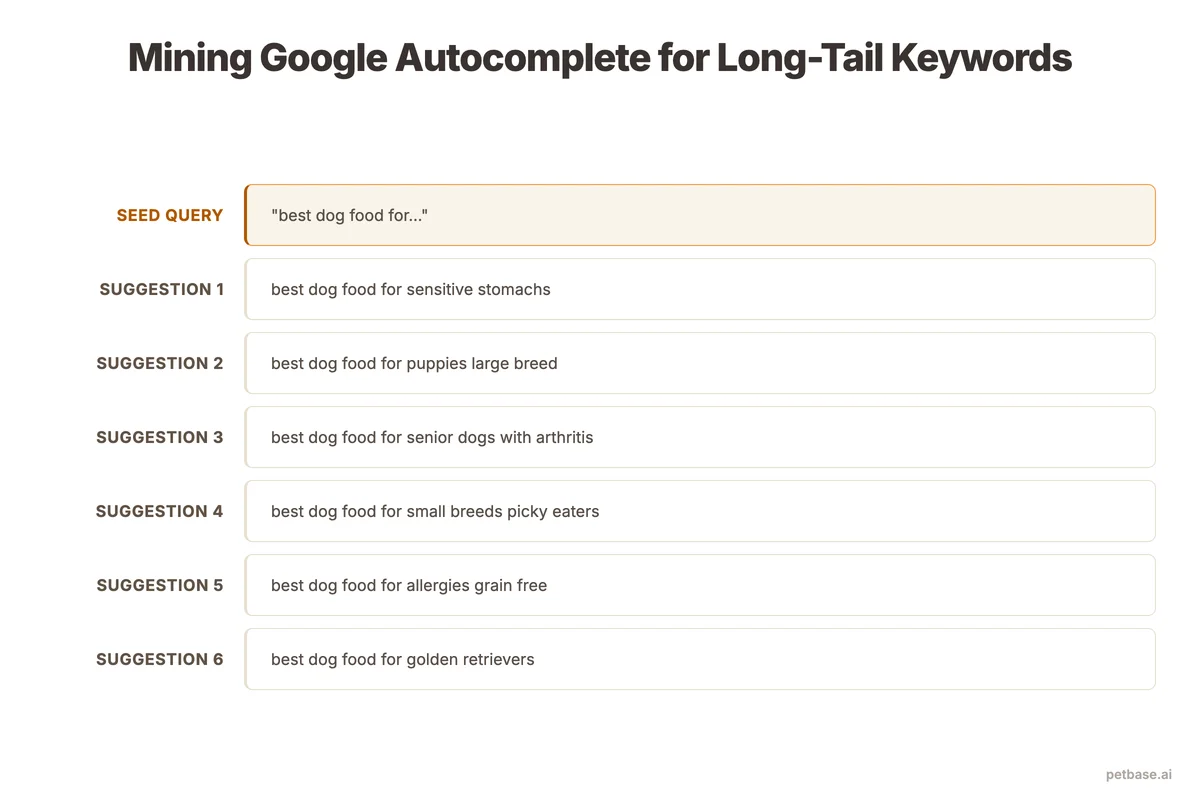
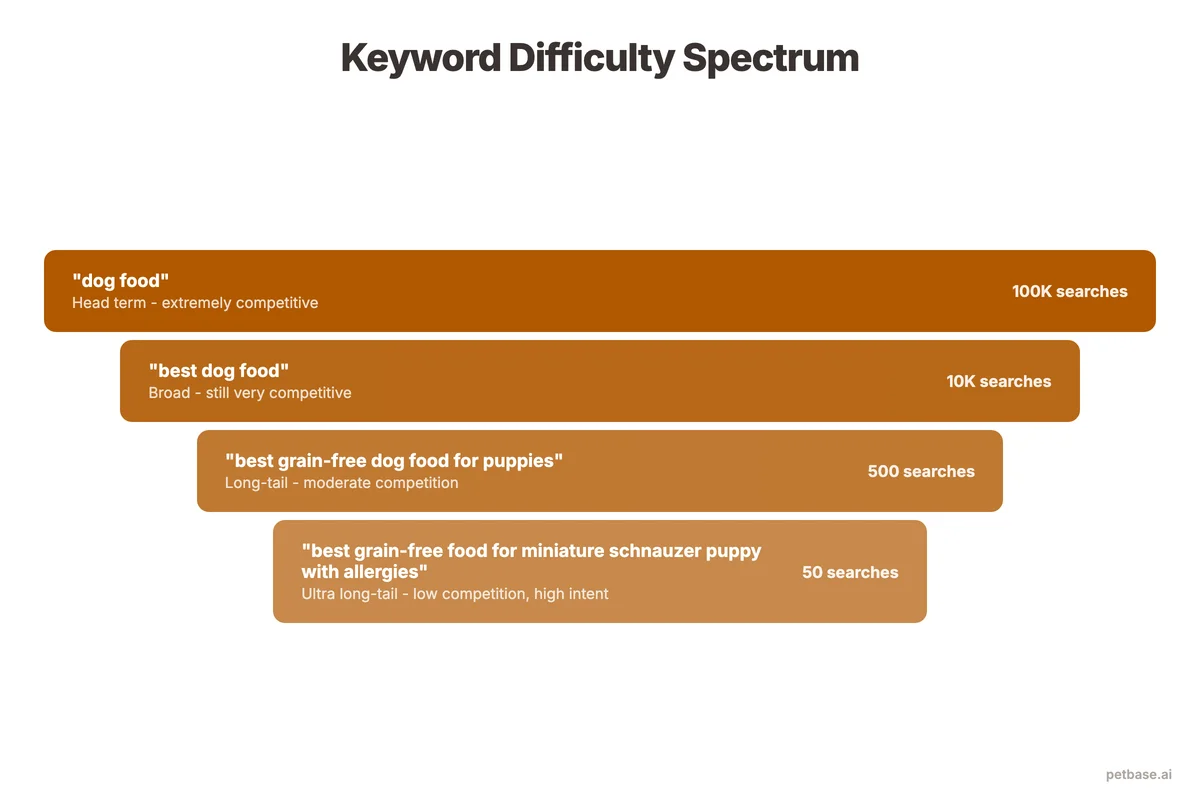
Long-tail keywords are search phrases that contain three or more words. They are more specific than broad "head" keywords. Instead of "dog food," a long-tail version would be "grain-free dog food for senior labradors." These keywords get fewer monthly searches individually, but they make up roughly 70% of all Google searches combined[1].

For pet stores, long-tail keywords matter for three reasons:
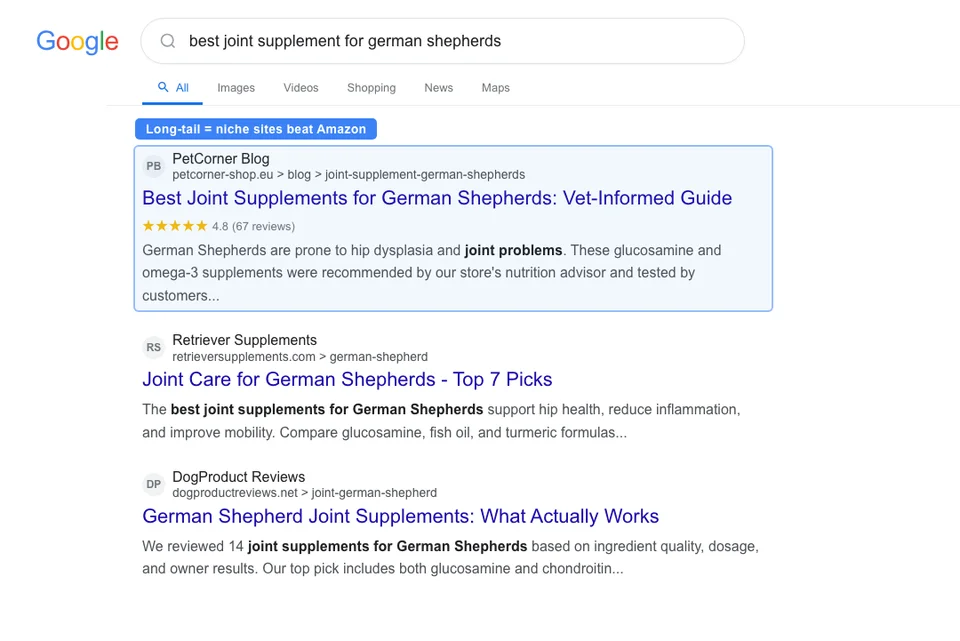
- Less competition. Fewer websites target specific phrases. A keyword like "best joint supplement for german shepherds" has a fraction of the competition that "dog supplements" has.
- Higher intent. Someone searching "where to buy freeze-dried raw dog food in Munich" is closer to buying than someone searching "dog food." They know what they want. With 46% of all Google searches carrying local intent[3], these specific, location-aware queries represent real buying signals.
- Higher conversion rates. Long-tail keywords convert at up to 36%[1]. The visitor already has a specific need - your job is to match it.
Long-tail keywords are where small and mid-sized pet stores can compete with the giants. You will never outrank Amazon for "dog food." But you can absolutely rank first for "best dog food for miniature schnauzers with sensitive stomachs."
If you are new to SEO for pet stores, start with the complete pet store SEO guide for a broader overview of how organic search works for retailers.
Petbase automates SEO content for pet stores - publishing 10 optimized articles monthly so you can focus on running your shop - start your free trial.
Why Long-Tail Keywords Are Easier to Rank for
Long-tail keywords are easier to rank for because fewer websites compete for them. Here is a direct comparison to illustrate the difference.
| Factor | Head Keyword: "dog food" | Long-Tail: "best grain-free dog food for puppies with allergies" |
|---|---|---|
| Monthly search volume | 200,000+ | 500-1,500 |
| Keyword difficulty | 90+ (very hard) | 15-25 (easy) |
| Top competitors | Amazon, Chewy, Purina, PetSmart | Niche blogs, small retailers |
| Searcher intent | Unclear (browsing, researching, buying?) | Clear (specific product need) |
| Conversion rate | 1-2% | 4-8% |
| Time to rank (new site) | 12-24 months | 4-8 weeks |
The math works in your favor. Ten long-tail keywords at 500 searches each bring 5,000 monthly visitors. If those visitors convert at 5% instead of 1%, you get 250 conversions instead of 50 from a single head keyword. More traffic. Better traffic. Faster results.
Google also uses long-tail content to understand your website's expertise. When you publish 20 articles covering specific dog nutrition topics, Google sees your site as an authority on dog nutrition overall. This is called content clustering - and it helps your broader keywords rank too.
How to Find Long-Tail Pet Keywords (Step by Step)
Finding long-tail keywords is not guesswork. There are free and affordable methods that give you real search data. Follow these steps in order.
Step 1: Start with a seed keyword
Pick a broad topic related to your store. Examples: "dog food," "cat litter," "fish tank," "rabbit care," "pet grooming." This is your starting point.
Step 2: Use Google Autocomplete
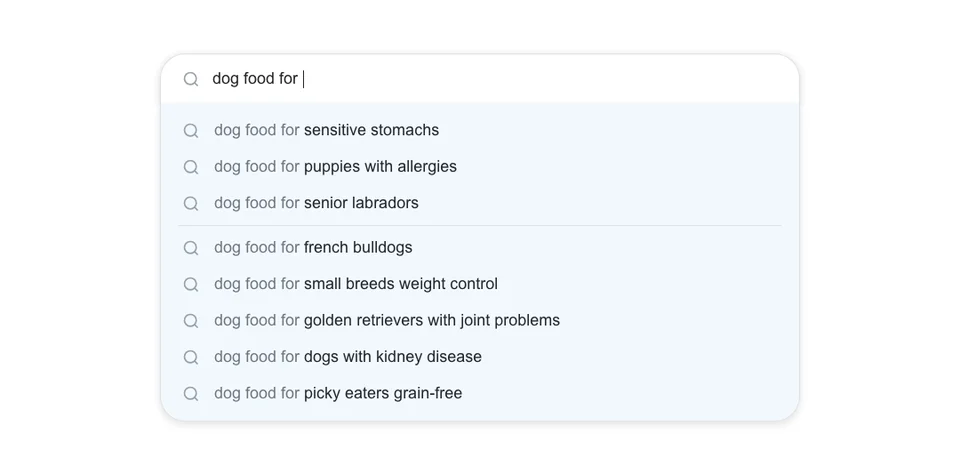
Type your seed keyword into Google and look at what appears in the dropdown. These are real searches that people type frequently. For "dog food," you will see suggestions like:
- dog food for sensitive stomachs
- dog food delivery
- dog food without chicken
- dog food for weight loss
Add each letter of the alphabet after your seed keyword to get more variations. "Dog food a" gives you "dog food allergies." "Dog food b" gives you "dog food brands." This alone can generate 50+ long-tail ideas in 15 minutes.
Step 3: Check "People Also Ask" and "Related Searches"
Google shows a "People Also Ask" box for most searches. These are question-based keywords that are perfect for blog posts. At the bottom of the search results, you will find "Related Searches" - another source of long-tail variations.
Step 4: Use free keyword tools
Several tools expand your seed keyword into hundreds of long-tail variations.
| Tool | Cost | Best For | How It Helps |
|---|---|---|---|
| Google Keyword Planner | Free (with Google Ads account) | Search volume data | Shows monthly searches and competition level for any keyword |
| Ubersuggest | Free (limited) / $29/mo | Keyword suggestions | Generates long-tail variations with difficulty scores |
| AnswerThePublic | Free (limited) / $9/mo | Question keywords | Visualizes questions people ask about any topic |
| Google Search Console | Free | Your existing data | Shows what keywords your site already appears for (find quick wins) |
| Ahrefs Free Keyword Generator | Free | Keyword ideas | Generates up to 100 keyword ideas with difficulty scores |
| KeywordTool.io | Free (limited) / $89/mo | Autocomplete mining | Pulls autocomplete suggestions from Google, YouTube, Amazon |
Step 5: Mine your competitors
Look at what other pet stores and pet blogs rank for. Use Ubersuggest or Ahrefs' free site audit to enter a competitor's URL and see their top keywords. Focus on keywords where they rank on page 2 or 3 - these are topics where the competition is beatable.
Step 6: Listen to your customers
Your best keyword ideas come from real conversations. What questions do customers ask in your store? What do they email you about? What do they search for on your website's search bar? Each question is a potential long-tail keyword.
For a deeper dive into keyword research methods specific to pet businesses, see the keyword research guide for pet businesses.
Which Pet Niches Have the Best Long-Tail Opportunities?
Not all pet niches are equal when it comes to long-tail keyword potential. Some have thousands of untapped opportunities. Others are more competitive. Here is where we see the biggest gaps.
Breed-specific nutrition. There are over 350 recognized dog breeds and 70+ cat breeds. Each one has specific dietary needs, health concerns, and product preferences. "Best food for cavalier king charles spaniels with heart issues" is a real search that almost no one targets. Multiply that across hundreds of breeds, and you have an enormous content opportunity.
Pet health conditions. Pet owners search urgently when their pet is sick. "Why is my golden retriever losing hair on his tail" is a long-tail keyword with high urgency and low competition. These searches also connect directly to products - medicated shampoos, supplements, specialty foods.
Life stage content. Puppies, kittens, senior pets, pregnant pets - each life stage generates unique searches. "How much to feed a 3-month-old french bulldog puppy" is specific enough that a single well-written article can rank in days.
Local pet services. If you operate a physical store, local long-tail keywords are gold. "Near me" searches now exceed 1.5 billion per month globally[3], and queries like "organic dog food store in [your city]" or "where to buy raw pet food near [neighborhood]" have almost zero competition in most markets. For more on this, see the pet blog SEO guide.
Product comparisons. "Orijen vs Acana for large breed dogs" or "best cat litter for multi-cat household" - these comparison searches show strong buying intent and are often underserved by content.
How to Evaluate a Long-Tail Keyword Before Writing
Not every long-tail keyword is worth writing about. Before you invest time in creating content, evaluate each keyword against these five criteria.
1. Search volume. Look for keywords with at least 100-500 monthly searches. Below 100 might not justify a full article (unless it is highly commercial). You can check this in Google Keyword Planner or Ubersuggest.
2. Keyword difficulty. For new or small pet store websites, target keywords with a difficulty score under 30 (on a 0-100 scale). These are realistic to rank for within 8-12 weeks.
3. Search intent match. Does the keyword match something you can genuinely help with? If someone searches "how to make homemade dog food," can you write a genuinely useful article? Does it connect to products you sell? If both answers are yes, it is a strong candidate.
4. Commercial potential. Some long-tail keywords are purely informational. Others lead directly to purchases. Prioritize keywords where the searcher's problem can be solved (at least partly) by a product you carry. "Best dental chews for small dogs" is more commercial than "why do dogs lick their paws."
5. Content gap. Search the keyword in Google. Look at the top 10 results. If you see thin content, outdated articles, or forums filling the top spots - that is a content gap you can fill. If the top results are all 3,000-word guides from major brands, pick a different keyword.
Building a content calendar around these evaluated keywords is key. The SEO content calendar guide shows you how to plan this systematically.
50 Long-Tail Keyword Examples for Pet Stores
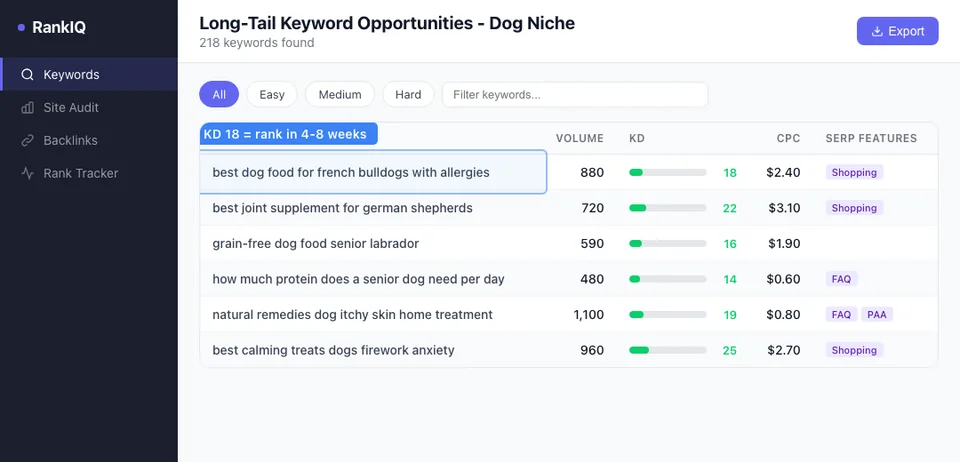
Here are 50 long-tail keywords organized by pet niche. Use these as starting points for your content strategy. Each one represents a blog post or product page opportunity.
| Niche | Long-Tail Keyword | Intent |
|---|---|---|
| Dog Nutrition | best dog food for french bulldogs with allergies | Commercial |
| Dog Nutrition | how much protein does a senior dog need per day | Informational |
| Dog Nutrition | grain-free vs grain-inclusive dog food pros and cons | Comparison |
| Dog Nutrition | raw dog food diet for beginners complete guide | Informational |
| Dog Nutrition | best dog food for labrador retrievers with joint problems | Commercial |
| Dog Health | natural remedies for dog itchy skin home treatment | Informational |
| Dog Health | best hip and joint supplement for large breed dogs | Commercial |
| Dog Health | how to help a dog with separation anxiety naturally | Informational |
| Dog Health | why does my dog eat grass and throw up every morning | Informational |
| Dog Health | best calming treats for dogs with firework anxiety | Commercial |
| Cat Nutrition | best wet food for cats with kidney disease stage 2 | Commercial |
| Cat Nutrition | how to transition a cat from dry food to wet food | Informational |
| Cat Nutrition | high protein low carb cat food for diabetic cats | Commercial |
| Cat Nutrition | best cat food for indoor cats that throw up a lot | Commercial |
| Cat Nutrition | homemade cat food recipes vet approved easy | Informational |
| Cat Care | best cat litter for odor control multi cat household | Commercial |
| Cat Care | how to stop a cat from scratching furniture naturally | Informational |
| Cat Care | best automatic cat feeder for wet food reliable | Commercial |
| Cat Care | how to introduce a new kitten to an older cat safely | Informational |
| Cat Care | best cat tree for large cats that won't tip over | Commercial |
| Small Pets | best bedding for guinea pigs with respiratory problems | Commercial |
| Small Pets | how to set up a hamster cage for the first time | Informational |
| Small Pets | best hay for rabbits timothy vs orchard grass | Comparison |
| Small Pets | how long can a guinea pig go without water safely | Informational |
| Small Pets | best toys for rabbits to keep them entertained indoors | Commercial |
| Fish & Aquatics | best beginner freshwater fish for a 10 gallon tank | Informational |
| Fish & Aquatics | how to cycle a fish tank for beginners step by step | Informational |
| Fish & Aquatics | best low maintenance live plants for betta fish tank | Commercial |
| Fish & Aquatics | why is my fish tank water cloudy after water change | Informational |
| Fish & Aquatics | best filter for 20 gallon planted aquarium quiet | Commercial |
| Reptiles | best heat lamp for bearded dragon 40 gallon tank | Commercial |
| Reptiles | how to set up a leopard gecko habitat for beginners | Informational |
| Reptiles | best substrate for ball python humidity control | Commercial |
| Reptiles | what vegetables can bearded dragons eat daily list | Informational |
| Reptiles | best UVB light for crested gecko bioactive setup | Commercial |
| Birds | best pellet food for cockatiels picky eaters | Commercial |
| Birds | how to stop a parrot from screaming for attention | Informational |
| Birds | best cage size for two budgies living together | Commercial |
| Birds | safe fruits and vegetables for parakeets complete list | Informational |
| Birds | how to tell if your cockatiel is happy or stressed | Informational |
| Dog Grooming | best slicker brush for goldendoodle curly coat | Commercial |
| Dog Grooming | how often should you bathe a german shepherd puppy | Informational |
| Dog Grooming | best nail grinder for large dogs that are scared | Commercial |
| Dog Grooming | how to remove mats from a poodle without cutting | Informational |
| Dog Grooming | best deshedding tool for double coated dogs husky | Commercial |
| Dog Training | how to leash train a stubborn puppy that sits down | Informational |
| Dog Training | best training treats for puppies low calorie small size | Commercial |
| Dog Training | how to crate train an adult rescue dog step by step | Informational |
| Dog Training | best chew toys for teething puppies 8 weeks old | Commercial |
| Dog Training | how to teach a dog to come when called off leash | Informational |
Notice the pattern: every keyword targets a specific breed, condition, life stage, or use case. The more specific you get, the less competition you face. Use these as templates and swap in the breeds, products, and conditions that match your inventory.
How to Turn Long-Tail Keywords Into Blog Posts
Finding keywords is only half the work. Turning them into content that ranks requires a clear process. With 7.5 million blog posts published daily[4], you need a structured approach to stand out.
1. Match the search intent
Before you write a word, search the keyword in Google. Look at what ranks. If the top results are all listicles, write a listicle. If they are how-to guides, write a how-to. If they are product reviews, write a review. Google is showing you what format it prefers for that keyword.
2. Write a better version of what already ranks
Study the top 3-5 results. Note what they cover and what they miss. Your article should include everything they cover - plus the gaps they leave. If the top result lists 5 dog foods for sensitive stomachs, list 10. If they skip ingredient analysis, include it.
3. Use the keyword naturally
Include your long-tail keyword in the title (H1), the first paragraph, at least one H2, and naturally throughout the body. Do not force it. Write for the reader first, then check that the keyword appears where Google looks for it.
4. Add supporting long-tail keywords
Every primary keyword has related variations. "Best grain-free dog food for puppies with allergies" is related to "hypoallergenic puppy food" and "limited ingredient puppy food." Include these related terms naturally. This signals topical depth to Google.
5. Link to related content on your site
Every blog post should link to 3-5 other relevant articles or product pages on your site. This helps Google discover and understand your content. It also keeps readers on your site longer. For more on building these connections, see the guide on content clustering for pet websites.
6. Publish consistently
One article will not make a difference. Companies that publish 16 or more posts per month get 3.5x more traffic than those publishing four or fewer[5]. Publishing 8-10 long-tail-focused articles per month builds momentum. After 3 months, you will have 30+ articles targeting specific keywords - and your site's overall authority starts to compound. The content marketing guide for pet businesses explains how to build this into a sustainable system.
If writing 10 articles per month feels overwhelming, Petbase can generate SEO-optimized pet industry content automatically - turning your keyword list into published blog posts at EUR 199/mo for 10 articles, without the writing burden.
Why Most Pet Stores Still Have a Window of Opportunity
Here is the good news: most of your competitors are not doing this. 61% of small businesses are not investing in SEO at all[6]. That means the majority of pet stores in your market have no long-tail keyword strategy, no content clusters, and no consistent publishing schedule.
Meanwhile, organic search drives 53% of all website traffic[7]. Your competitors are leaving more than half of their potential traffic on the table. Every month you publish and they do not, you widen the gap.
But this window will not stay open forever. As more pet businesses recognize the value of content-driven SEO, the easy wins disappear. The stores that start building topical authority now - article by article, keyword by keyword - will be the ones that own page one when the competition catches up.
Frequently Asked Questions
How many long-tail keywords should a pet store target per month?
Aim for 8-12 long-tail keywords per month, with one blog post per keyword. This builds topical authority steadily without sacrificing content quality. After 3-6 months of consistent publishing, you should see compounding traffic growth as Google recognizes your site as an authority in your pet niche. Quality matters more than quantity - a well-researched 2,000-word article targeting one long-tail keyword will outperform five 400-word thin posts.
Can long-tail keywords work for pet stores that only sell locally?
Absolutely. Local long-tail keywords are some of the easiest to rank for. With 46% of all Google searches carrying local intent[3], phrases like "organic dog food store in [city name]" or "where to buy raw pet food near [neighborhood]" have almost no competition in most markets. Combine location-specific keywords with product-specific terms for even better results. A pet store in Berlin targeting "grain-free dog food delivery Berlin" will rank faster than targeting "grain-free dog food" alone. See the pet store SEO guide for more on combining local and product keywords.
Should I target long-tail keywords on product pages or blog posts?
Use both, but match the keyword to the right page type. Commercial intent keywords like "best calming treats for dogs with firework anxiety" work well on product category pages or buying guides. Informational keywords like "why does my dog eat grass and throw up" belong on blog posts. The blog posts attract traffic and build trust. The product pages convert that trust into sales. Together, they form a complete blog strategy that drives both rankings and revenue.
References
- Embryo (2024). 30 Statistics About Long-Tail Keywords. embryo.com
- American Pet Products Association (2024). Industry Trends and Stats. americanpetproducts.org
- BrightLocal (2024). Local SEO Statistics. brightlocal.com
- Orbit Media (2024). Blogging Statistics. orbitmedia.com
- HubSpot (2024). Marketing Statistics. hubspot.com
- Clutch (2025). SEO Statistics. clutch.co
- BrightEdge (2024). How Much Traffic Comes from Organic Search. seoinc.com