How to Measure Blog ROI for Your Pet Store


Table of Contents +
- Why Do So Many Pet Store Owners Stop Blogging?
- What Happens When You Stop Publishing?
- What Is the Blog ROI Formula?
- Which Metrics Actually Matter for Blog ROI?
- How Do You Set Up Blog ROI Tracking in Google Analytics 4?
- What Are the Leading Indicators That Your Blog Is Working?
- How Do You Calculate Cost Per Customer From Your Blog?
- How Do You Track Blog ROI When You Sell In-Store, Not Online?
- How Do You Compare Blog ROI to Other Marketing Channels?
- How Do You Build a Monthly ROI Dashboard?
- What Is a Realistic ROI Timeline for a Pet Store Blog?
- Frequently Asked Questions
- References
Learn how to measure blog ROI for your pet store with a simple formula, Google Analytics 4 setup, and realistic benchmarks. See the numbers that matter.
You have been publishing blog posts for three months. Your website has more pages, your social media has more links to share, and your content calendar is full. But when someone asks, "Is the blog actually making money?" you do not have an answer. You are not alone. Only 36% of marketers say they can accurately measure their content marketing ROI[1]. For pet store owners who handle their own marketing, that number is almost certainly lower.
The result? Pet store owners invest in content, see no clear proof it works, and stop publishing. Their competitors keep going. Rankings decay. The early investment is wasted. This post gives you a practical framework to measure blog ROI - with tools you already have, numbers that apply to pet stores, and a formula you can run in a spreadsheet.
TL;DR
Blog ROI = (revenue from blog visitors - cost of content) / cost of content. Track it with Google Analytics 4 and Google Search Console. For a pet store spending EUR 199 per month on content, you need roughly 5-8 new customers per month from organic search to reach positive ROI. Most stores see measurable returns within 6-12 months.
Why Do So Many Pet Store Owners Stop Blogging?
The most common reason is not a lack of ideas or a lack of time. It is a lack of proof. When you spend EUR 200 per month on Google Ads, you can see exactly how many clicks and sales that budget produced. When you spend the same amount on blog content, the connection between investment and revenue feels invisible.
This is a measurement problem, not a performance problem. Content marketing delivers an average return of $7.65 for every $1 spent - nearly four times higher than paid advertising at $1.80[2]. Companies with active blogs generate 55% more website traffic and 67% more leads than those without[3]. The ROI is there. The problem is that most pet store owners do not have a system to see it.
The second reason owners stop is impatience. Blog content takes 6-12 months to deliver significant ROI[4]. That is a long time to invest without seeing clear results - unless you know which early metrics signal that your content is working before the revenue arrives. We will cover those leading indicators later in this post.
Petbase automates SEO content for pet stores - publishing 10 optimized articles monthly so you can focus on running your shop - start your free trial.
What Happens When You Stop Publishing?
Stopping feels like it saves money. In reality, it costs more than continuing. Here is why.
Blog content compounds over time. 75% of all blog views and 90% of blog leads come from older posts - articles published months or even years ago[3]. When you stop publishing, your existing posts still generate some traffic, but Google's algorithm favours fresh, regularly updated websites. Your rankings begin to slip. Competitors who keep publishing fill the gaps you leave behind.
Businesses that blog consistently see 13x more positive ROI than those that publish sporadically[3]. The difference is not just volume - it is compounding. Each new post strengthens your site's topical authority, which helps all your other posts rank higher. Stop publishing, and that compounding effect stalls. For a deeper look at how blog content generates sales, read our guide on how blog posts drive sales for pet stores.
What Is the Blog ROI Formula?
The formula itself is simple:
Blog ROI (%) = (Revenue from Blog - Cost of Blog) / Cost of Blog x 100
The challenge is calculating each component accurately. Let us break it down for a typical pet store.
Cost of Blog (monthly): This includes your content creation cost (writing, editing, publishing), any tools you use (SEO software, image creation), and your time reviewing and approving content. If you use a service like Petbase at EUR 199 per month for 10 articles, that is your primary cost. If you write content yourself, calculate your hourly rate multiplied by the hours spent. The average blog post takes 3-5 hours to write[5]. At even EUR 25 per hour, that is EUR 75-125 per post, or EUR 750-1,250 for 10 posts per month.
Revenue from Blog: This is where most pet store owners get stuck. You need to track two paths: direct revenue (someone reads a blog post, clicks to a product, and buys) and assisted revenue (someone discovers your store through a blog post, comes back later, and buys). Google Analytics 4 tracks both of these paths, which we will set up in the next section.
A Real ROI Calculation for a Pet Store
Here is an example using realistic numbers for a European pet store:
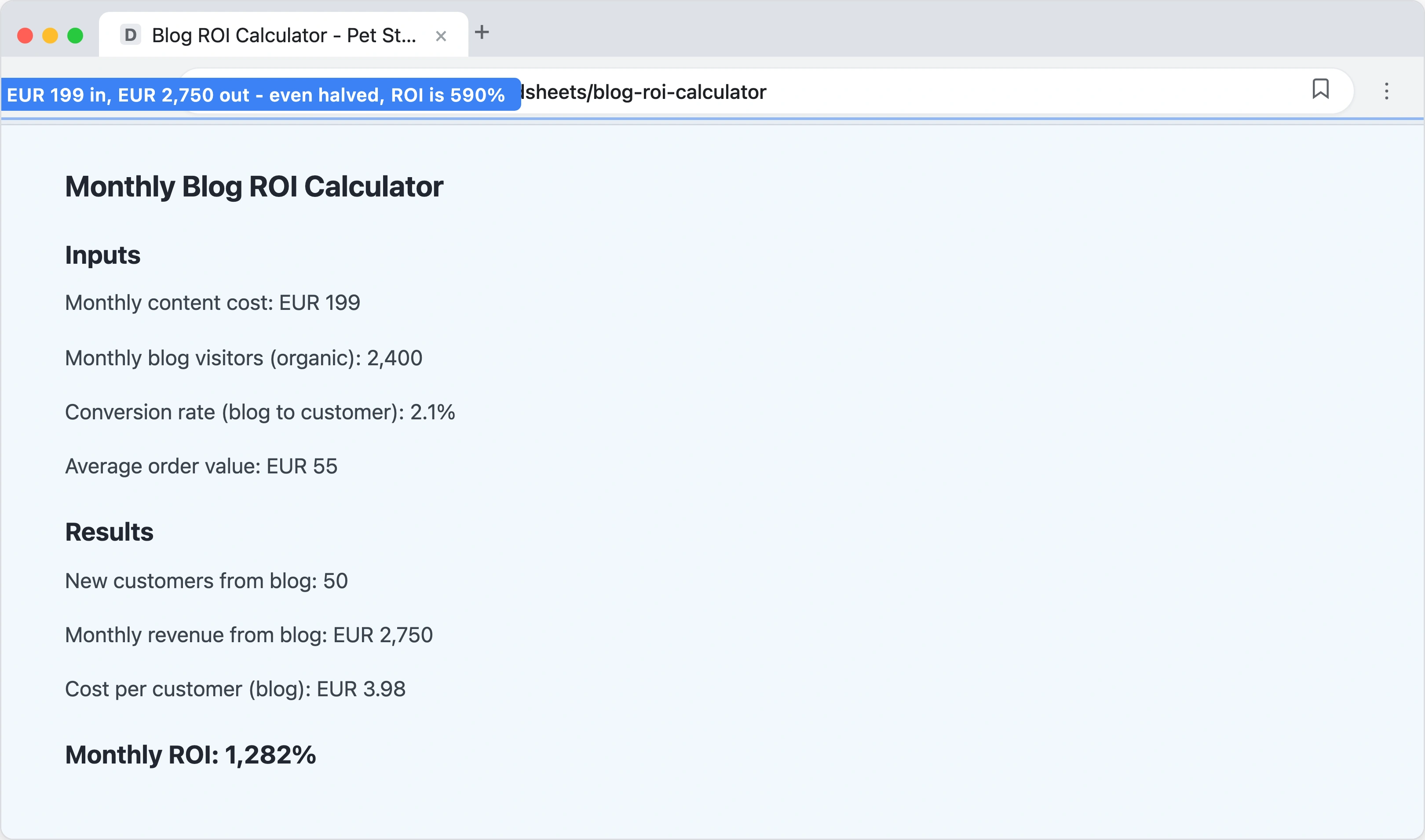
- Monthly content cost: EUR 199 (Petbase subscription)
- Monthly blog visitors from organic search: 2,400 (after 6-8 months of publishing)
- Conversion rate from blog to customer: 2.1% (industry average for organic traffic)
- New customers from blog per month: 50
- Average order value: EUR 55
- Average customer lifetime value (12 months): EUR 220 (4 orders per year)
- Monthly revenue from new blog-acquired customers: 50 x EUR 55 = EUR 2,750
- Annual lifetime value from those customers: 50 x EUR 220 = EUR 11,000
Monthly ROI: (EUR 2,750 - EUR 199) / EUR 199 = 1,282%
Even if you cut these numbers in half - 25 customers, EUR 1,375 revenue - the ROI is still 590%. And these numbers improve every month because older posts continue generating traffic and leads without additional cost. SEO leads also close at 14.6%, compared to just 1.7% for outbound marketing[6]. The customers who find you through search are actively looking for what you sell.
Which Metrics Actually Matter for Blog ROI?
Not all metrics deserve your attention. In my experience, the pet stores that track ROI successfully focus on five core metrics and ignore everything else. Here is the difference between metrics that drive decisions and metrics that just look nice on a dashboard.
| Metrics That Matter | Why | Vanity Metrics | Why They Mislead |
|---|---|---|---|
| Organic traffic from blog | Shows how many potential customers find you through search | Total page views | Includes bots, accidental clicks, and bounces |
| Conversion rate (blog to customer) | Measures how effectively content turns readers into buyers | Social media shares | Shares rarely correlate with sales for pet stores |
| Revenue per blog visitor | Directly connects content to money | Time on page | Long time could mean confusion, not engagement |
| Keyword rankings (positions 1-10) | Predicts future traffic growth | Total number of posts | 50 posts that rank beat 200 that do not |
| Cost per customer acquired via blog | Lets you compare blog ROI to other marketing channels | Bounce rate | Blog readers often find their answer and leave satisfied |
Organic SEO generates leads at approximately EUR 31 per conversion, compared to EUR 181 for pay-per-click advertising[7]. That is 5.8x more cost-effective. But you will only know your specific numbers if you track these metrics consistently. For guidance on tracking your keyword positions, see our guide on how to track your pet store's Google rankings.
How Do You Set Up Blog ROI Tracking in Google Analytics 4?
Google Analytics 4 (GA4) is free and powerful enough for any pet store. Here is a step-by-step setup that takes about 30 minutes:
Step 1: Set up conversion events. In GA4, go to Admin, then Events, then mark key actions as conversions. For a pet store, these include: purchase completed, add to cart, contact form submitted, email sign-up, and phone call clicked. Each of these represents a measurable step toward revenue.
Step 2: Create a blog traffic segment. In the Explore section of GA4, create a segment that filters traffic to pages containing /blog/ in the URL. This isolates blog performance from the rest of your site. You can then compare blog traffic against direct traffic, paid traffic, and social traffic to see which channel converts best.
Step 3: Enable e-commerce tracking. If you sell products online, GA4's e-commerce tracking connects specific blog posts to specific purchases. When a visitor reads "Best Dog Food for Golden Retrievers" and then buys a bag of dog food, GA4 attributes that revenue to the blog post. This is the single most valuable data point for measuring blog ROI.
Step 4: Check assisted conversions. Go to Advertising, then Attribution Paths in GA4. This report shows blog posts that influenced a purchase even when they were not the last page visited before buying. Many blog readers discover your store, leave, and return days later through a direct visit or branded search. Without assisted conversion data, you undercount blog revenue by 30-50%.
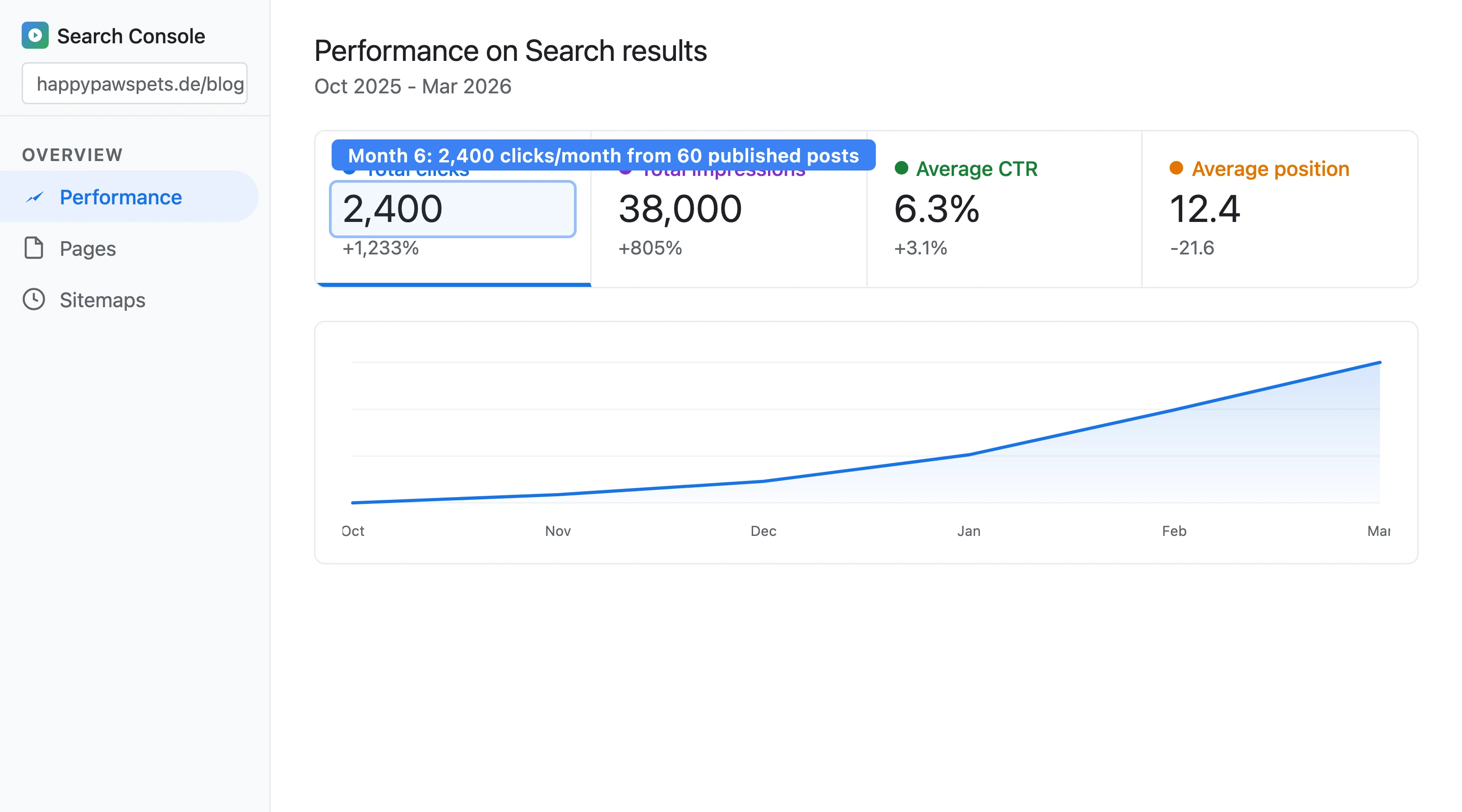
Step 5: Connect Google Search Console. Link GSC to GA4 (Admin, then Product Links, then Search Console). This lets you see which search queries bring people to your blog, which posts rank for which keywords, and how click-through rates change over time. Search Console data is the earliest indicator that your content strategy is working - you will see impression and click growth weeks before it shows up in revenue.
What Are the Leading Indicators That Your Blog Is Working?
Revenue is a lagging indicator. It takes 6-12 months to materialise fully. But there are leading indicators you can track from month one that predict whether your blog will generate ROI.
Months 1-3: Indexing and impressions. Check Google Search Console weekly. Are your new posts getting indexed within 2-5 days? Are impressions (the number of times Google shows your pages in search results) increasing? If impressions grow by 20-30% per month, your content is reaching Google's index and matching search queries. This is the earliest sign of progress.
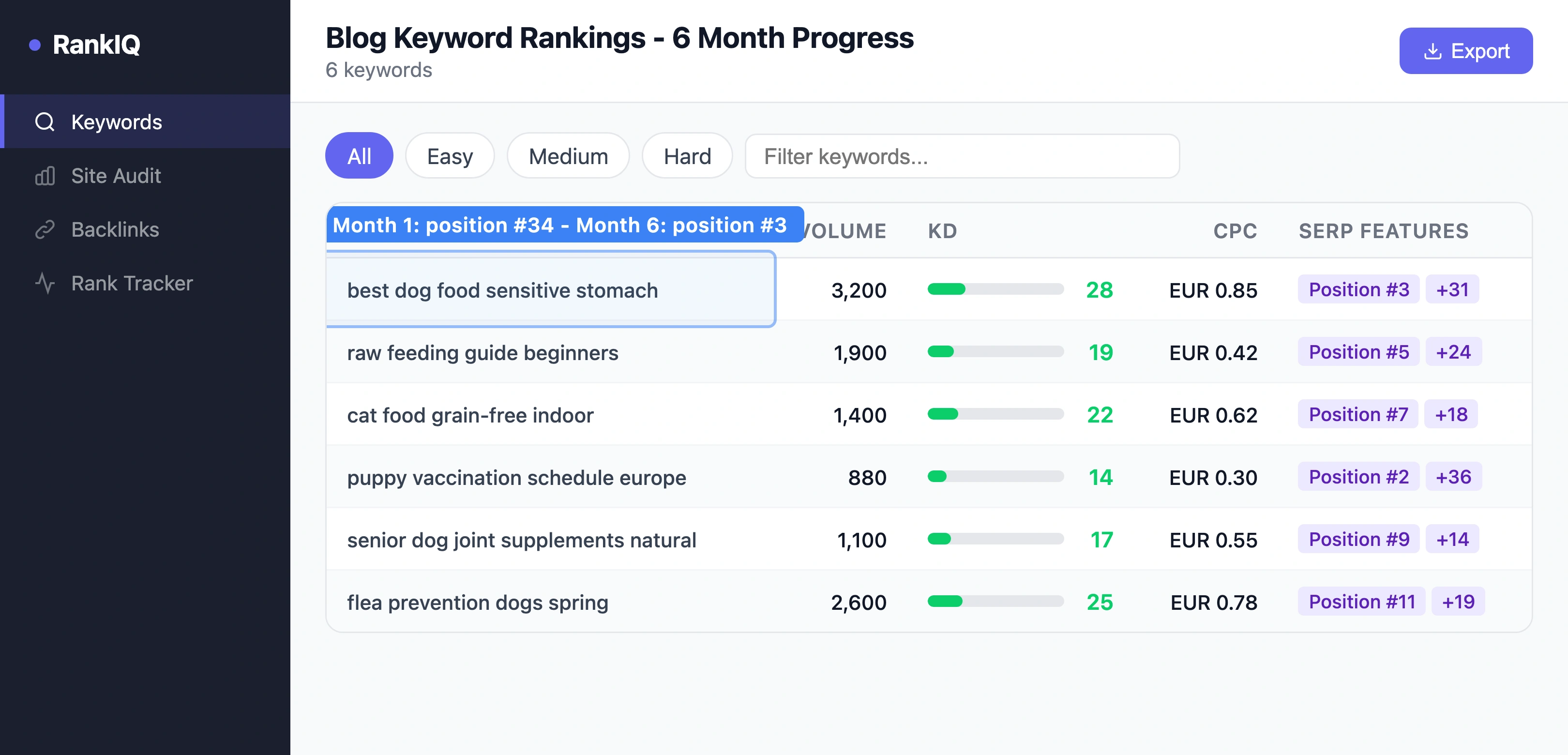
Months 3-6: Click growth and ranking improvements. Watch for posts moving from page 3-4 (positions 20-40) to page 1-2 (positions 1-20). Only 5.7% of new pages reach the top 10 within a year[8], but the posts that do often show steady position improvements in months 3-6. Track your positions with a simple spreadsheet or free tools. If 20-30% of your posts reach page 1 within 6 months, your content strategy is performing above average.
Months 6-12: Traffic compounding and conversions. This is where the ROI becomes visible. Compounding posts - the articles that continue to grow in traffic - make up only 10% of all blog posts, but they generate 38% of total blog traffic[3]. By month 6, you should be able to identify which of your posts are compounding and double down on those topics. For a broader view of where blogging fits among your marketing options, see our comparison of pet store marketing channels.
How Do You Calculate Cost Per Customer From Your Blog?
Cost per customer acquired (CPA) through your blog is one of the most useful numbers you can calculate. It lets you compare blog performance directly against Google Ads, social media, print advertising, or any other channel you use.
The formula:
Blog CPA = Monthly Content Cost / Number of New Customers from Blog
Using our earlier example: EUR 199 / 50 customers = EUR 3.98 per customer. Compare that to the industry average of EUR 181 per lead through PPC advertising[7]. Even at more conservative numbers - say 15 customers per month - your blog CPA would be EUR 13.27. That is still dramatically cheaper than any paid channel.
One metric I always tell my clients to watch is the CPA trend line over time. In the first 3 months, your blog CPA will be high because you are investing in content that has not ranked yet. By month 6-9, the CPA drops sharply as older posts start generating traffic at zero additional cost. By month 12, your blog CPA is typically 60-80% lower than any paid acquisition channel because you are paying for new content while old content continues to bring in customers for free.
This is the compounding advantage of content marketing. Paid advertising stops the moment you stop paying. Blog content keeps working indefinitely. Content marketing costs 62% less than traditional marketing while generating 3x more leads[9]. Over 12 months, the gap between content CPA and paid CPA only widens in your favour.
How Do You Track Blog ROI When You Sell In-Store, Not Online?
Many pet stores generate most of their revenue from walk-in customers, not e-commerce. This makes blog ROI tracking harder but not impossible. Here are four practical methods:
1. "How did you find us?" at checkout. Train your team to ask every new customer how they discovered your store. Track the answers in a simple spreadsheet. "I found you on Google" or "I read your article about dog food" directly connects blog content to foot traffic. It is not perfect data, but it is better than guessing.
2. Unique discount codes in blog posts. Add a small callout in relevant blog posts: "Mention code BLOG10 in-store for 10% off your first purchase." Every redemption is a directly trackable blog conversion. This method has the added benefit of incentivising the first visit.
3. Google Business Profile insights. Your Google Business Profile shows how many people searched for your business, clicked for directions, or called your store. If your blog is building brand awareness and topical authority, you will see these numbers increase as your blog grows. GBP does not attribute visits to specific blog posts, but the correlation between blog growth and GBP engagement is usually clear.
4. Track phone calls and form submissions. If customers call or email to ask about products they read about in your blog, those are blog-attributed leads. Use a simple CRM or spreadsheet to log these interactions and connect them to the blog post that prompted the contact. For tips on optimising your overall pet store SEO strategy, see our complete guide.
How Do You Compare Blog ROI to Other Marketing Channels?
The fairest comparison uses the same metric across all channels: cost per new customer acquired over a 12-month period. Here is how blog content typically compares for a pet store:
| Channel | Monthly Cost | Avg Customers/Month | CPA (Cost per Customer) | Keeps Working After You Stop Paying? |
|---|---|---|---|---|
| Blog content (Petbase) | EUR 199 | 25-50 (at maturity) | EUR 4-8 | Yes - older posts keep ranking |
| Google Ads | EUR 500-1,500 | 10-30 | EUR 50-150 | No - traffic stops immediately |
| Facebook/Instagram Ads | EUR 300-800 | 8-20 | EUR 40-100 | No - traffic stops immediately |
| Local print/flyers | EUR 200-500 | 5-15 | EUR 33-100 | No - one-time distribution |
| SEO agency | EUR 1,500-5,000 | 20-60 | EUR 75-250 | Partially - depends on contract |
The median SEO ROI across industries is 748%[10]. That means for every EUR 1 invested in SEO content, businesses get EUR 7.48 back on average. For pet stores specifically, the ROI tends to be higher because the niche is less competitive than broad e-commerce categories like fashion or electronics. For a detailed breakdown of how different channels perform for pet stores, see our marketing channels comparison. And for a deeper look at the differences between agency and AI content solutions, read our comparison of SEO agencies vs. AI tools.
How Do You Build a Monthly ROI Dashboard?
You do not need expensive software. A simple spreadsheet with five columns, updated monthly, gives you everything you need to track blog ROI:
- Column 1: Month - The reporting period
- Column 2: Organic blog sessions - From GA4 (Acquisition, then Traffic Acquisition, filtered to organic search and /blog/ pages)
- Column 3: Blog conversions - From GA4 (Conversions report, filtered to blog landing pages)
- Column 4: Revenue attributed to blog - From GA4 e-commerce data, or estimated from conversion count x average order value
- Column 5: Content cost - Your monthly content investment (subscription, freelancer fees, or your own time valued at market rate)
Calculate ROI each month using the formula. More importantly, look at the trend line. Your ROI should improve month over month as older content compounds and content costs stay flat. If ROI is declining, it signals either a content quality problem (posts are not ranking) or a conversion problem (visitors are not buying). Both are diagnosable and fixable.
Content repurposing can improve your overall ROI by 32% on average[11]. Once a blog post is generating traffic, turn it into a social media post, an email newsletter, or a Google Business Profile update. This multiplies the return on your original content investment without creating anything new. For practical strategies on this, see our guide to repurposing pet store content.
What Is a Realistic ROI Timeline for a Pet Store Blog?
Set expectations correctly and you will not quit too early. Here is a realistic timeline based on a pet store publishing 10 articles per month at EUR 199 per month:
Months 1-3 (investment phase): Total cost: EUR 597. Revenue from blog: likely EUR 0-200. ROI: negative. This is normal. Your content is being indexed and beginning to rank. Leading indicators to watch: Google Search Console impressions growing 20-30% per month, posts getting indexed within days.
Months 4-6 (early traction): Total cost: EUR 1,194 cumulative. Revenue from blog: EUR 300-1,000 per month. ROI: approaching break-even. Your earliest posts are reaching page 1 for long-tail keywords. Organic traffic from blog pages is growing. You start to see a handful of conversions each month. Companies that publish 16+ posts per month get 4.5x more leads than sporadic publishers[3].
Months 7-12 (compounding phase): Total cost: EUR 2,388 cumulative. Revenue from blog: EUR 1,500-4,000+ per month. ROI: 500-1,500%+. You now have 70-120 indexed posts, many ranking on page 1. Older posts generate traffic without additional cost. New posts rank faster because your site has established topical authority. Your cost per customer from the blog is likely under EUR 10.
The critical insight: month 12 revenue is not just from month 12 content. It is from all 12 months of content working together. That is why stopping at month 3 - when ROI looks negative - is the most expensive decision a pet store owner can make. For more on how content marketing fits into your overall strategy, explore our content marketing guide for pet stores.
Frequently Asked Questions
What is a good ROI percentage for pet store blog content?
Anything above 100% means your blog is generating more revenue than it costs. For pet stores using a content service at EUR 199 per month, a realistic 12-month ROI is 500-1,500%. This is well above the median SEO ROI of 748% across all industries[10]. Pet stores often outperform the median because the niche is less competitive and the content topics are highly specific to purchase intent.
Can I measure blog ROI if I do not have an online store?
Yes. Use the four offline tracking methods described above: ask customers at checkout, use unique discount codes in blog posts, monitor Google Business Profile engagement trends, and log phone calls and emails that reference blog content. These methods will not capture every conversion, but they will give you a reliable minimum baseline. If your tracked numbers show positive ROI, actual ROI is almost certainly higher because some blog-influenced purchases go untracked.
How long should I wait before evaluating blog ROI?
Give your blog a minimum of 6 months before making any ROI judgments. Content marketing typically takes 3-6 months for initial engagement and 6-12 months for significant ROI[4]. During the first 3 months, focus on leading indicators (impressions, indexing speed, ranking improvements) rather than revenue. If those leading indicators are positive, the revenue will follow. If impressions are flat after 3 months, reassess your keyword targeting and content quality before stopping.
Should I track blog ROI separately from overall SEO ROI?
Yes. Your blog is one component of your SEO strategy, alongside your product pages, location pages, and Google Business Profile. Tracking blog ROI separately lets you understand the specific return on your content investment and compare it against other marketing channels. Use GA4 segments to isolate blog traffic (pages containing /blog/) from your overall organic traffic. This gives you a clean measurement of what your content investment produces. For more on tracking your overall SEO performance, read our guide on tracking your pet store's Google rankings.
References
- Content Marketing Institute (2025). B2B Content Marketing Trends Research. contentmarketinginstitute.com
- Genesys Growth (2025). Content Marketing ROI - 45 Statistics Every Marketing Leader Should Know. genesysgrowth.com
- HubSpot (2025). Marketing Statistics, Trends, and Data. hubspot.com
- Contensify (2025). How Long Does It Take to See Content Marketing Results? contensifyhq.com
- Orbit Media (2025). Blogging Statistics. orbitmedia.com
- HubSpot (2025). Inbound Marketing Facts. hubspot.com
- First Page Sage (2026). Average Cost Per Lead by Industry. firstpagesage.com
- Ahrefs (2025). How Long Does It Take to Rank in Google? ahrefs.com
- Siege Media (2025). Content Marketing Statistics. siegemedia.com
- SEOProfy (2026). SEO ROI Statistics. seoprofy.com
- CloudPresent (2025). The Complete Guide to Repurposing Content. cloudpresent.co