On-Page SEO for Pet Stores: Elements That Matter

Table of Contents +
- What Is On-Page SEO and Why Does It Matter for Pet Stores?
- How to Write Title Tags That Rank and Get Clicks
- How to Structure Headers for Pet Store Pages
- How to Write Meta Descriptions That Drive Clicks
- How to Optimize Body Content for Pet Industry Keywords
- How to Use Internal Links to Build Page Authority
- Why Structured Data Gives Pet Stores a Ranking Edge
- Image Optimization for Pet Store Websites
- Mobile Optimization for Pet Store Pages
- How to Avoid Keyword Stuffing on Pet Pages
- On-Page SEO Checklist for Pet Stores
- Frequently Asked Questions
- References
Optimize your pet store's web pages for higher rankings. Covers title tags, headers, meta descriptions, internal links, structured data, and a complete on-page SEO checklist.
Organic search drives 53% of all website traffic[1]. For pet stores, that means more than half of your potential customers start with a Google search. On-page SEO is the practice of optimizing individual web pages so those searchers find you instead of your competitors.
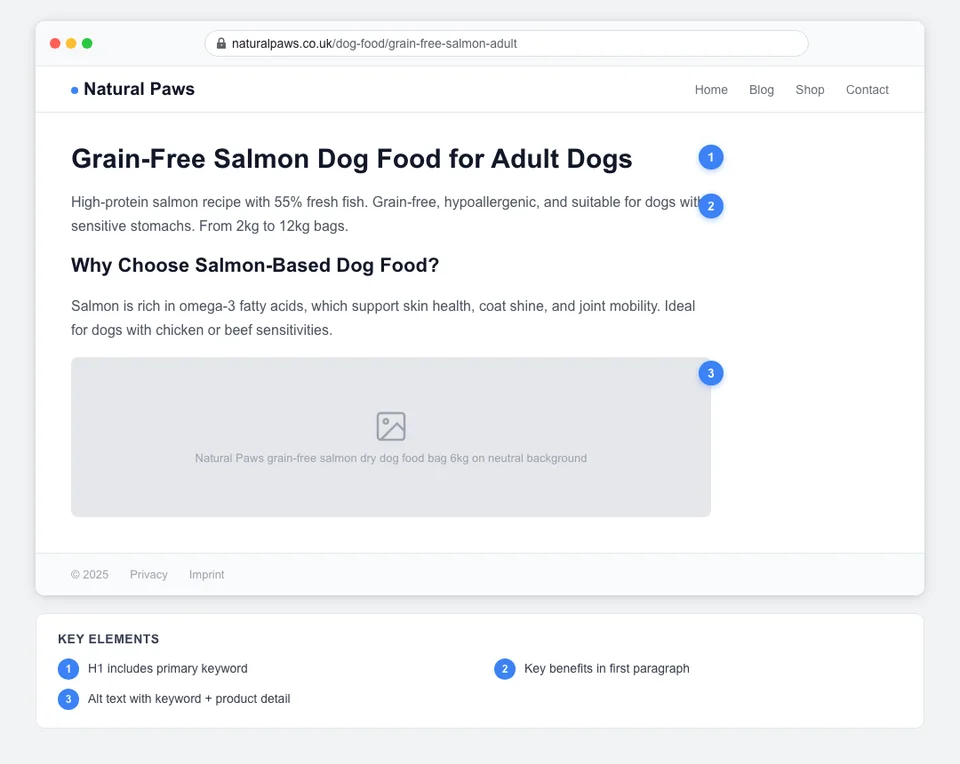
On-page SEO covers everything you control on your own website: title tags, headers, content structure, images, internal links, and meta descriptions. Unlike technical SEO (crawlability and site architecture) or off-page SEO (backlinks and citations), on-page SEO is about making each page as relevant, useful, and well-structured as possible for both Google and the pet owners reading it.
The good news: on-page SEO is entirely within your control. You do not need anyone's permission to optimize your own pages. The bad news: most pet stores get it wrong. They either over-optimize (keyword stuffing) or under-optimize (generic descriptions, missing meta tags, no internal links). This guide shows you the elements that actually move rankings - backed by data - and how to implement each one correctly.
What Is On-Page SEO and Why Does It Matter for Pet Stores?
On-page SEO determines whether Google understands what your page is about and considers it the best answer for a given search query. When someone searches "best grain-free dog food for allergies," Google evaluates hundreds of pages and ranks them by relevance, quality, and authority. On-page optimization is how you tell Google your page deserves to rank.

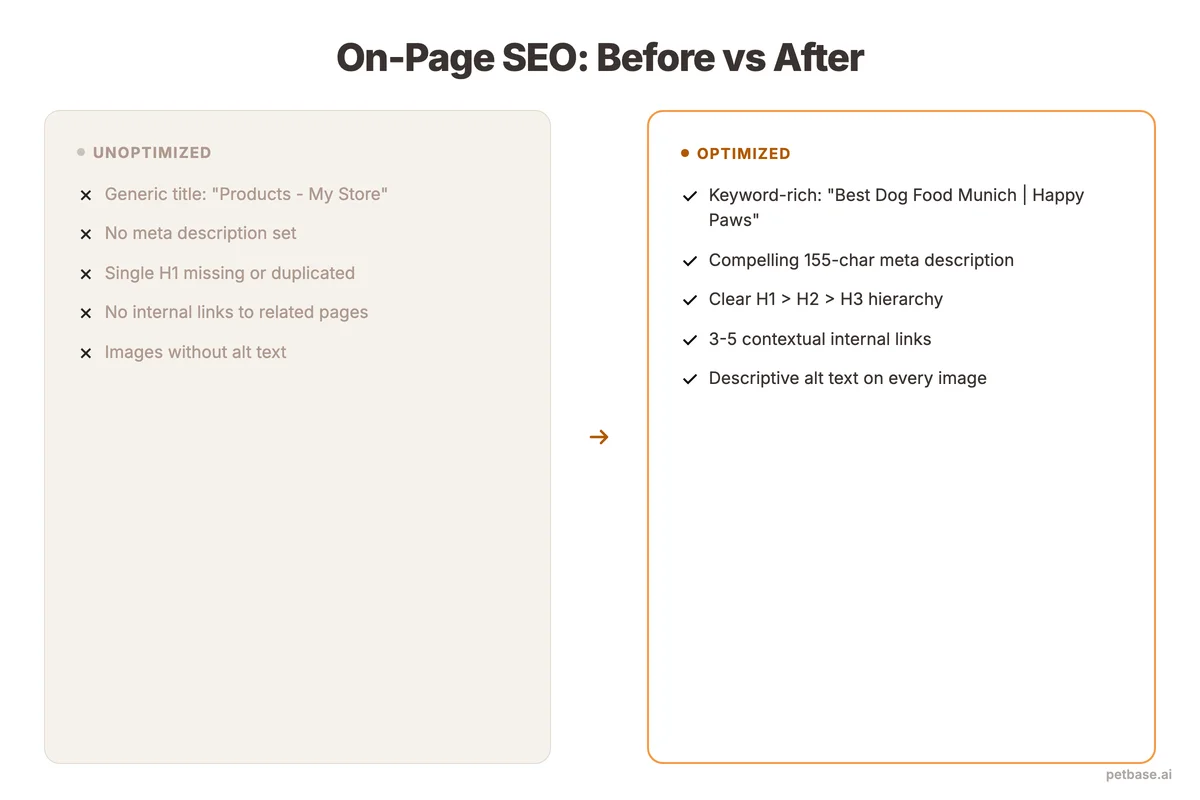
For pet stores, on-page SEO matters for three specific reasons:
1. You have many page types competing for different keywords. Product pages, category pages, blog posts, service pages, and location pages all need different optimization approaches. A one-size-fits-all approach wastes opportunities.
2. Your competitors are often larger brands. Chewy, Amazon, and PetSmart have stronger domain authority. Your on-page optimization needs to be better than theirs to compete on specific, niche keywords where their large-scale content is generic.
3. Pet customers search with high specificity. Long-tail keywords make up 70% of all searches and convert at 36%[2]. "Dog food" is too competitive. But "grain-free salmon dog food for senior Labradors" is achievable with excellent on-page SEO. The more specific the query, the more on-page signals matter relative to domain authority.
On-page SEO is also the fastest type of SEO to implement. You can optimize a page in 30-60 minutes and see ranking changes within days to weeks. Compared to building backlinks (months) or creating content clusters (weeks to months), on-page optimization gives the quickest feedback loop.
Petbase automates SEO content for pet stores - publishing 10 optimized articles monthly so you can focus on running your shop - start your free trial.
How to Write Title Tags That Rank and Get Clicks
The title tag is the single most important on-page element. It appears as the clickable blue link in search results and tells both Google and users what the page is about. A well-written title tag can mean the difference between ranking on page 1 or page 2 - and between a 2% click-through rate or an 8% click-through rate.
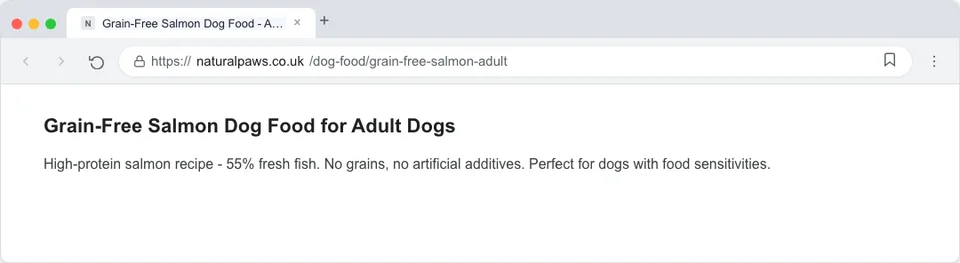
Yet the average e-commerce title tag is just 39 characters long, and the average meta description only 96 characters[3]. Both fall well below the recommended lengths, which means most stores are leaving visibility on the table.
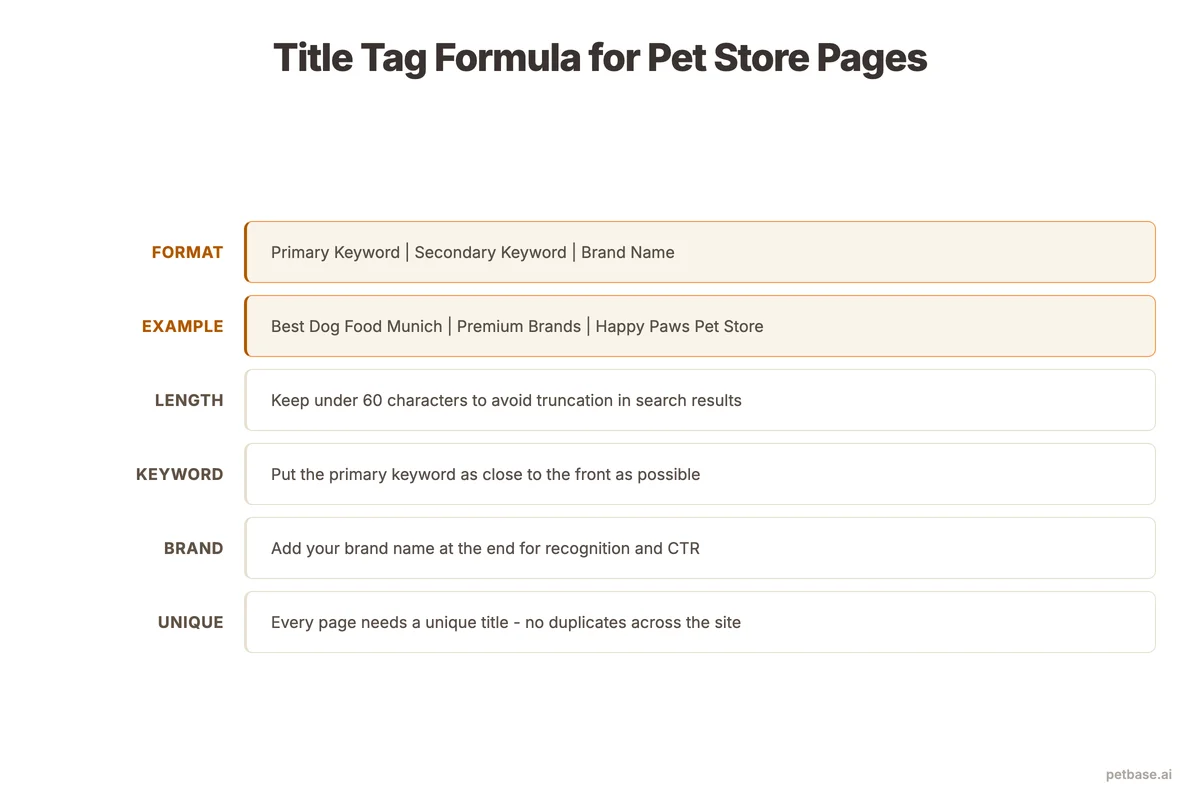
Title tag rules for pet store pages:
- Length: 50-60 characters. Google truncates longer titles. Check your titles at a SERP preview tool.
- Primary keyword first: Put your target keyword near the beginning. "Grain-Free Dog Food for Allergies" ranks better than "Our Selection of Foods Including Grain-Free Options for Dogs With Allergies."
- Unique per page: Every page on your site needs a unique title. Duplicate titles confuse Google about which page to rank.
- Include a modifier: Add words like "best," "guide," "2025," "review," or "[city]" to match more search variations.
- Brand at the end: Add your store name at the end separated by a pipe or hyphen: "Grain-Free Dog Food for Allergies | [Store Name]"
| Page Type | Title Tag Formula | Example |
|---|---|---|
| Product page | [Product Name] - [Key Benefit] | [Store] | Blue Buffalo Chicken Adult Dog Food - Natural Ingredients | PetShop |
| Category page | [Category] - [Modifier] | [Store] | Grain-Free Dog Food - 40+ Premium Brands | PetShop |
| Blog post | [Topic]: [Promise or Number] | Dog Food Allergies: Signs, Causes, and What to Feed Instead |
| Service page | [Service] in [City] - [Differentiator] | [Store] | Professional Dog Grooming in Munich - All Breeds | PetShop |
| Location page | [Store] [City] - [Key Services] | [Brand] | PetShop Hamburg - Premium Pet Food and Grooming | PetShop |
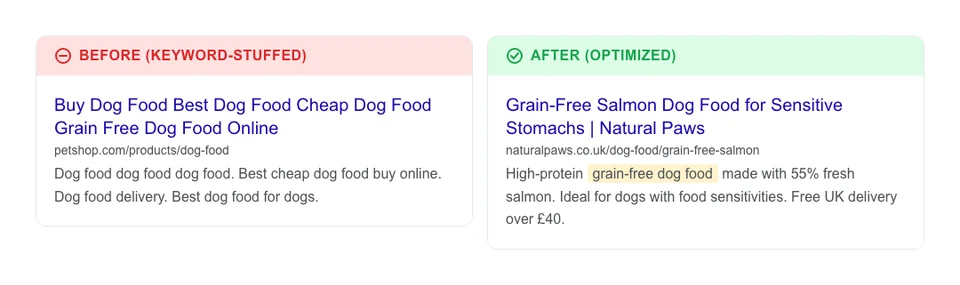
A common mistake: writing titles for Google instead of humans. Your title appears in search results as the first impression of your page. "Buy Dog Food Best Dog Food Cheap Dog Food Online" may target keywords, but no human wants to click on it. Write titles that are clear, descriptive, and enticing.
How to Structure Headers for Pet Store Pages
Headers (H1, H2, H3) create a content hierarchy that helps both Google and users understand your page. Properly structured headers improve readability, signal topic relevance, and create opportunities to target additional keywords.
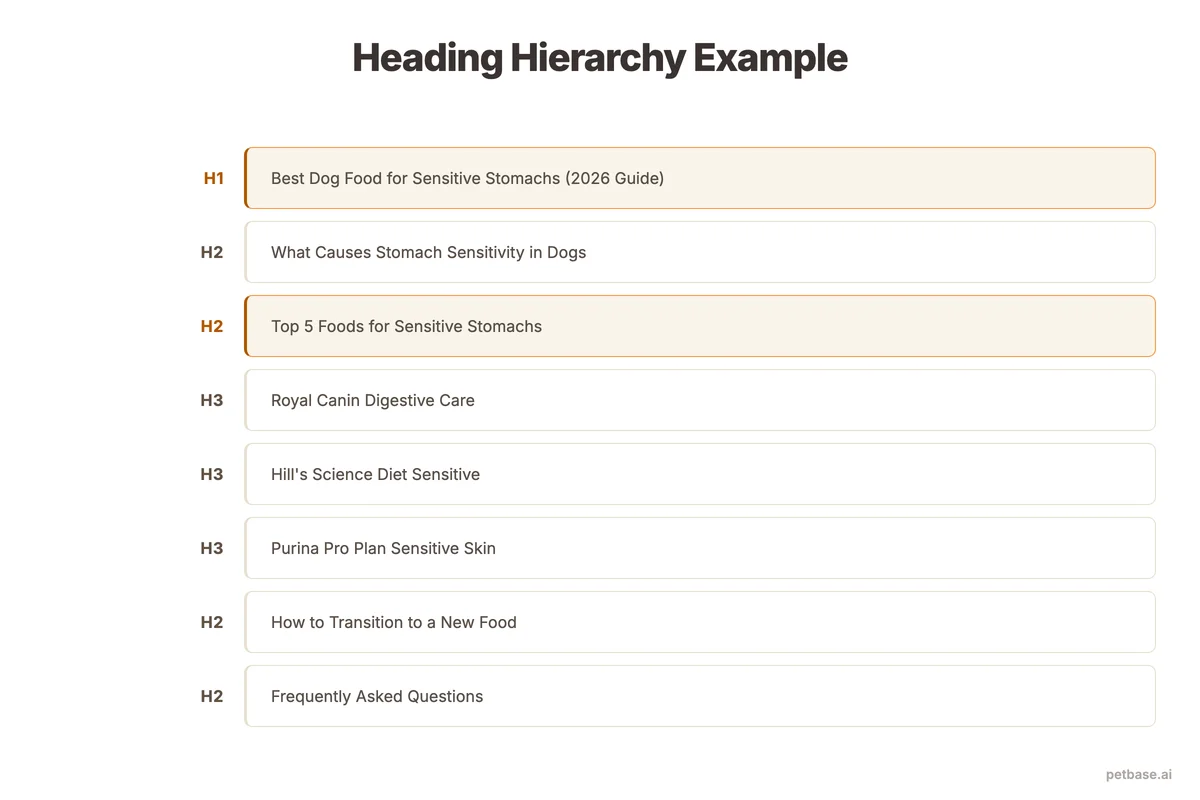
Here is the correct header structure for pet store pages:
H1 - Page title (one per page): Your H1 should match or closely mirror your title tag. It tells Google and users what this entire page is about. Every page gets exactly one H1 - never more.
H2 - Main sections: These divide your content into major topics. On a product page, H2s might be "Product Features," "Nutritional Information," "Who Is This Best For?" On a blog post, H2s are your main headings. Each H2 is an opportunity to include a related keyword naturally.
H3 - Subsections: These break H2 sections into smaller parts. Under an H2 about "Who Is This Best For?," your H3s might be "Best for Puppies," "Best for Senior Dogs," "Best for Dogs With Allergies."
| Header Level | Purpose | Keyword Opportunity | Example |
|---|---|---|---|
| H1 | Page topic | Primary keyword | Grain-Free Dog Food: Complete Buying Guide |
| H2 | Main sections | Secondary keywords | What Is Grain-Free Dog Food? |
| H2 | Main sections | Secondary keywords | Best Grain-Free Dog Food Brands in 2025 |
| H3 | Subsections | Long-tail keywords | Best Grain-Free Food for Small Breeds |
| H3 | Subsections | Long-tail keywords | Grain-Free Options for Dogs With Allergies |
Formatting H2s as questions matches how pet owners actually search. "What Is Grain-Free Dog Food?" targets the exact query a pet owner types into Google. FAQ-style H2s are particularly effective for winning Featured Snippets - the answer boxes that appear above regular search results.
How to Write Meta Descriptions That Drive Clicks
Meta descriptions do not directly affect rankings, but they significantly affect click-through rates. A compelling meta description can double your CTR - which does affect rankings indirectly, because Google promotes pages that users choose to click.
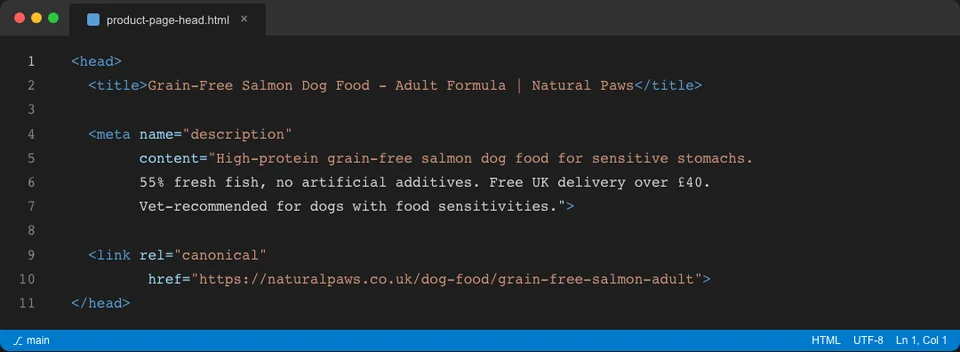
Your meta description is a 150-160 character advertisement for your page. It appears below the title in search results. If you do not write one, Google generates its own - usually a random snippet from your page that may not be compelling. Remember, the average e-commerce meta description is only 96 characters[3] - nearly 40% shorter than the recommended length.
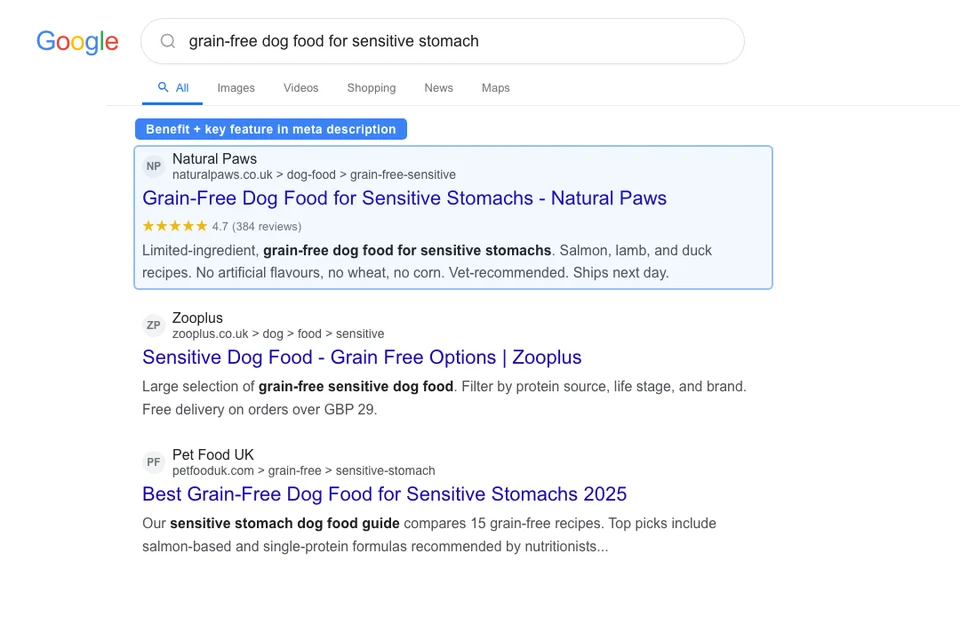
Rules for pet store meta descriptions:
- Length: 150-160 characters. Shorter wastes space. Longer gets truncated.
- Include the primary keyword: Google bolds matching words in the description, making your listing stand out visually.
- Include a benefit or number: "Compare 15 grain-free brands" or "Includes feeding charts by breed" gives the reader a reason to click.
- Add a call to action: "Find the right food for your dog" or "See our expert picks" encourages the click.
- Unique per page: Never reuse meta descriptions. Every page needs its own.
Examples for different pet store page types:
- Product page: "Blue Buffalo Chicken Adult Dog Food - natural ingredients, real meat first, no artificial preservatives. See nutritional breakdown, feeding guide, and customer reviews."
- Category page: "Compare 40+ premium grain-free dog food brands. Filter by breed size, protein source, and life stage. Free delivery over EUR 49."
- Blog post: "Learn to spot the 10 most common food allergy symptoms in dogs. Includes elimination diet steps, vet-recommended hypoallergenic brands, and breed-specific advice."
How to Optimize Body Content for Pet Industry Keywords
Body content optimization is where most pet stores either over-optimize or under-optimize. The goal is natural, helpful content that includes your target keywords where they logically belong - not content written for search engines at the expense of readability.
Long-tail keywords deserve special attention. They make up 70% of all searches and convert at 36%[2] - far higher than broad, competitive terms. For a pet store, this means targeting "grain-free salmon dog food for senior Labradors" instead of just "dog food."
Primary keyword placement:
- In the first 100 words of the page
- In the H1 (once)
- In at least one H2 (naturally)
- In the URL slug
- In the meta description
- In image alt text (at least one image)
Secondary keyword usage:
- Spread naturally throughout the content in H2s, H3s, and body paragraphs
- Use variations and synonyms - Google understands semantic relationships. "Dog food for allergies," "hypoallergenic dog food," and "food for dogs with food sensitivities" all signal the same topic.
- Do not force keywords where they do not fit naturally. If a sentence reads awkwardly with the keyword, rewrite the sentence.
Content depth:
- Product pages: 250-500 words minimum of unique description
- Category pages: 150-300 word introduction plus product listings
- Blog posts: 1,500-4,000 words depending on topic complexity
- Service pages: 500-1,000 words covering what, who, how, and why
Pet-specific content depth matters. A product description that says "high-quality dog food" provides no value. A description that says "high-protein recipe with 38% chicken, formulated for active adult dogs 25-50 lbs, with added glucosamine for joint support" demonstrates real expertise and matches specific search queries.
Companies with blogs get 55% more website traffic[4]. If your pet store does not have an active blog targeting long-tail keywords in your niche, you are missing the largest share of search traffic available to you.
With Petbase, content optimization happens automatically. Every article is written with the target keyword in the right positions, includes related long-tail variations naturally, and is structured with proper header hierarchy. The pet industry knowledge model ensures content includes breed-specific, condition-specific, and product-specific details that generic tools miss. 10 articles per month at EUR 199/mo - less than the cost of a single freelance article.
How to Use Internal Links to Build Page Authority
Internal links are the most underused on-page SEO tactic for pet stores. They do three things simultaneously: help Google discover and crawl your pages, distribute page authority across your site, and guide users to relevant content.
The page ranking #1 for any given query has 3.8x more backlinks than positions 2 through 10[5]. While you cannot control external backlinks directly, internal links are entirely in your hands - and they distribute authority from your strongest pages to the ones that need a boost.
Internal linking rules for pet stores:
Every page should have at least 3-5 internal links. Blog posts should link to related blog posts, product pages, category pages, and service pages. Product pages should link to related products, the parent category, and relevant blog content.
Use descriptive anchor text. "Click here" tells Google nothing. "Our guide to grain-free dog food" tells Google exactly what the linked page is about. The anchor text should naturally describe the destination page's content.
Link from high-authority pages to pages you want to rank. Your homepage and top-performing blog posts have the most authority. Links from these pages to important product categories or new content pass significant value.
Create a hub-and-spoke structure within topic clusters. Your pillar page (hub) links to all supporting articles (spokes). Each spoke links back to the hub and to 2-3 sibling spokes. This structure tells Google these pages are related and should be evaluated as a group.
Link from blog content to product pages naturally. A blog post about "signs your dog needs joint supplements" should link to your joint supplement category page or specific products. This guides the reader from education to purchase without being pushy.
For more on building content that interlinks effectively, read our guides on keyword research for pet businesses and content marketing for pet businesses.
Why Structured Data Gives Pet Stores a Ranking Edge
Structured data (schema markup) is the on-page element most pet stores ignore entirely. It tells Google exactly what your page contains - products, prices, reviews, FAQs, business details - in a format search engines can read directly.
The numbers make the case clearly: structured data leads to a 30% increase in click-through rates, yet only 30% of websites use it[6]. That means 70% of your competitors are leaving rich results on the table.
For pet stores, the most valuable schema types are:
- Product schema: Shows price, availability, and review stars directly in search results. A product listing with a 4.8-star rating and "In Stock" badge gets more clicks than a plain blue link.
- FAQ schema: Turns your FAQ sections into expandable answers in Google search results, taking up more space and pushing competitors down.
- LocalBusiness schema: Shows your store hours, address, phone number, and rating in the Knowledge Panel for local searches.
- BreadcrumbList schema: Shows your site structure in search results (Home > Dog Food > Grain-Free), helping users understand where a page sits within your site.
- Review/AggregateRating schema: Displays star ratings in search results, which significantly increases click-through rates.
Adding schema is a one-time effort per page template. Once your product page template includes Product schema, every product page benefits automatically. The same applies to FAQ, Breadcrumb, and LocalBusiness schema. A few hours of implementation work produces lasting CTR improvements across your entire site.
Image Optimization for Pet Store Websites
Pet stores are image-heavy websites. Product photos, lifestyle shots, grooming results, and blog images make your content engaging - but unoptimized images are the #1 speed killer on most pet store websites.
Speed matters more than most store owners realize. 53% of visitors abandon a site that takes longer than 3 seconds to load, and even a 0.1-second speed improvement can boost conversions by 8.4%[7]. Image optimization is often the single biggest speed win available.
Image optimization covers three areas: file optimization (speed), alt text (accessibility and SEO), and file naming (search visibility).
File optimization:
- Convert all images to WebP format (25-35% smaller than JPEG at equal quality)
- Compress to 80-85% quality - no visible difference, significant file size reduction
- Serve images at display size, not original camera resolution
- Add
loading="lazy"to all images below the fold - Use responsive images (srcset) to serve appropriate sizes for different devices
Alt text:
- Every image needs descriptive alt text
- Describe what is in the image specifically: "Golden Retriever eating from elevated stainless steel food bowl" not "dog eating"
- Include the primary keyword naturally when relevant - but only when it accurately describes the image
- Do not keyword-stuff alt text. "Best dog food grain-free dog food buy dog food" is spam
File naming:
- Use descriptive, hyphenated file names: "golden-retriever-grain-free-food-bowl.webp"
- Rename files before uploading - most CMS platforms preserve the original file name in the URL
- Descriptive file names help images rank in Google Image Search, which drives additional traffic
Mobile Optimization for Pet Store Pages
Google uses mobile-first indexing, which means it evaluates the mobile version of your page before the desktop version. If your pet store pages do not work well on mobile, your rankings suffer regardless of how good the desktop experience is.
Mobile-friendly websites see 32% higher conversion rates[8]. For a pet store doing EUR 10,000 per month in online sales, that difference is worth EUR 3,200 per month - or EUR 38,400 per year.
Key mobile optimization checks for pet store pages:
- Responsive layout: Product images, tables, and navigation should adapt to smaller screens without horizontal scrolling.
- Tap targets: Buttons and links should be at least 48x48 pixels with enough spacing to avoid accidental taps. This matters on product pages where "Add to Cart" sits near other links.
- Font size: Body text at 16px minimum. Smaller text forces users to pinch-zoom, which Google considers a negative mobile signal.
- Image sizing: Serve appropriately sized images for mobile screens. A 1920px-wide hero image on a 390px phone screen wastes bandwidth and slows the page.
- Form usability: Contact forms and search bars should be easy to use on mobile. Use appropriate input types (tel for phone, email for email) so the right keyboard appears.
How to Avoid Keyword Stuffing on Pet Pages
Keyword stuffing - unnaturally repeating keywords to manipulate rankings - is a penalty trigger. Google's algorithms detect it easily, and it makes your content unreadable for humans. Yet many pet stores still do it, especially on product and category pages.
Signs your content is keyword-stuffed:
- The same exact phrase appears more than once per 100 words
- Sentences read awkwardly because keywords were forced in
- Paragraphs exist solely to include keywords, not to inform the reader
- Alt text reads like a keyword list rather than an image description
- The footer contains hidden text with keywords
The fix is simple: write for pet owners first, then check that your target keyword appears in the essential positions (title, H1, first paragraph, URL, one image alt tag). Beyond those positions, use natural language, synonyms, and related terms. Google's natural language processing understands that "grain-free food for dogs with allergies," "hypoallergenic dog food," and "allergy-friendly dog food" all mean the same thing. You do not need to repeat the exact phrase twenty times.
A practical test: read your content out loud. If it sounds natural and helpful, it is fine. If it sounds robotic or repetitive, remove keywords until it reads naturally.
On-Page SEO Checklist for Pet Stores
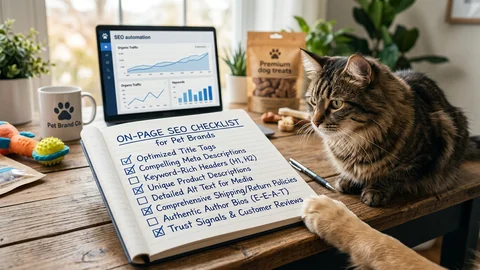
Use this checklist every time you publish or optimize a page on your pet store website:
| Element | Requirement | Check |
|---|---|---|
| Title tag | 50-60 chars, primary keyword near start, unique per page | |
| Meta description | 150-160 chars, includes keyword, has benefit/CTA | |
| URL slug | Short, descriptive, includes primary keyword, hyphen-separated | |
| H1 | One per page, includes primary keyword, matches title intent | |
| H2s | Main sections, include secondary keywords naturally, some as questions | |
| First 100 words | Primary keyword appears naturally | |
| Content depth | Sufficient word count for page type (250-4,000 depending on type) | |
| Internal links | 3-5+ links to related pages with descriptive anchor text | |
| Image alt text | Descriptive, includes keyword where natural, unique per image | |
| Image file names | Descriptive, hyphenated, keyword-relevant | |
| Image format | WebP, compressed, lazy loaded below fold | |
| No keyword stuffing | Content reads naturally, no unnatural repetition | |
| Structured data | Product, FAQ, or BreadcrumbList schema where applicable | |
| Mobile-friendly | Content renders well on mobile devices | |
| Page speed | Loads under 3 seconds, images optimized, lazy loaded |
This checklist covers the elements that move rankings. Nail these consistently across every page and you will outperform competitors who skip most of them.
For the broader SEO strategy that wraps around on-page optimization, see our pet store SEO guide and technical SEO guide. Ready to see how your pages measure up? See Petbase pricing to get your site audit and content plan started.
Frequently Asked Questions
How often should I update on-page SEO on existing pet store pages?
Review and update your most important pages every 6 months. Check title tags for relevance, refresh content with current information, add new internal links to recently published content, and update meta descriptions based on click-through rate data from Search Console. Product pages should be updated whenever inventory or pricing changes. Blog posts perform best when refreshed annually with new data and examples.
Does on-page SEO matter more than backlinks for pet stores?
For long-tail keywords - which make up 70% of all searches[2] - on-page SEO matters more. A perfectly optimized page targeting "best joint supplement for senior German Shepherds" can rank on page 1 with minimal backlinks because competition is manageable. For broad, competitive keywords like "best dog food," backlinks play a larger role. The #1 ranking page has 3.8x more backlinks than positions 2 through 10[5]. The ideal approach is strong on-page SEO across all pages combined with a content cluster strategy that naturally attracts backlinks over time.
Should I optimize my pet store for voice search?
Voice search optimization happens naturally when you follow good on-page SEO practices. Voice queries are typically longer and more conversational ("what is the best dog food for a Golden Retriever puppy"), which means they match long-tail keywords you should already be targeting. Using question-format H2s and providing direct answers in the first paragraph after each H2 captures both voice search queries and Featured Snippets. No special voice-search-specific optimization is needed beyond what this guide covers.
References
- BrightEdge (2024). How Much Traffic Comes from Organic Search. seoinc.com
- Embryo (2024). 30 Statistics About Long-Tail Keywords. embryo.com
- Taylor Scher (2025). Ecommerce SEO Statistics. taylorscherseo.com
- HubSpot (2024). Marketing Statistics. hubspot.com
- Ahrefs/BuzzStream (2024). Link Building Statistics. buzzstream.com
- Amra and Elma (2025). Top Schema Markup Statistics. amraandelma.com
- Deloitte/Google (2024). Understanding Google's Core Web Vitals. magnet.co
- Clutch (2025). SEO Statistics. clutch.co