How to Optimize Pet Product Pages for Google

Table of Contents +
- Why Product Pages Are the Most Undervalued SEO Asset
- How to Write Title Tags That Rank and Get Clicks
- How to Optimize Descriptions for Search and Sales
- Why Page Speed Decides Whether Visitors Buy or Leave
- What Image Optimization Does a Pet Product Page Need?
- How to Add Schema Markup to Pet Product Pages
- How to Build Internal Links Between Product and Blog
- How to Handle Similar Products Without Cannibalization
- Category Pages vs. Product Pages: How to Optimize Both
- How Petbase Helps You Optimize Product Pages at Scale
- Frequently Asked Questions
- References
Optimize pet product pages for Google with title tags, descriptions, images, schema markup, and internal links. Complete SEO checklist for pet store products.
Product pages are where transactions happen, yet most pet stores treat them as afterthoughts. A typical pet store product page has a manufacturer description copied from the supplier's website, one or two low-resolution images, and no structured data. Google sees hundreds of identical pages across different stores and has no reason to rank yours above the rest.
The pet care e-commerce market was valued at $94.89 billion in 2024[1], and organic search drives 53% of all website traffic[2]. If your product pages are not optimized, you are handing that traffic to competitors who sell the same products. This guide covers every element of pet product page optimization - from title tags to schema markup to internal linking strategies that connect your blog content to your product catalog. If you are already working on your pet product brand SEO, this is where the technical execution happens.
Why Product Pages Are the Most Undervalued SEO Asset
Product pages are undervalued because most pet store owners think of them as catalog entries rather than SEO opportunities. But consider this: product pages target transactional keywords - the exact searches where someone is ready to buy. A blog post about "best dog harnesses for hiking" drives informational traffic. The product page for a specific hiking harness captures the buyer who has already decided what to purchase.
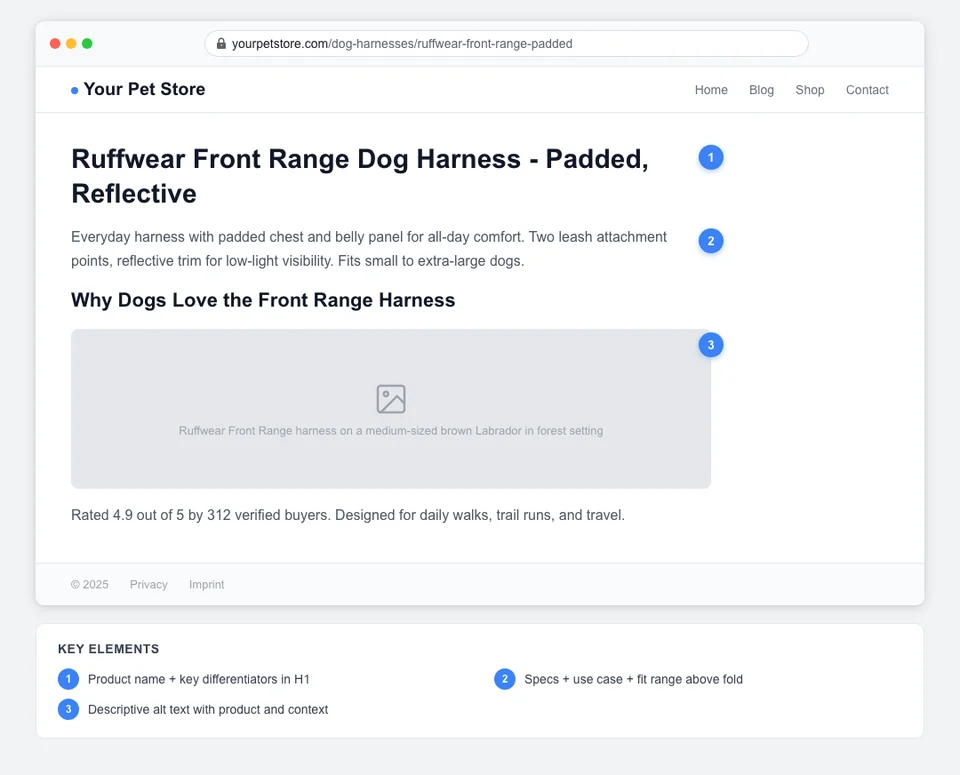
Long-tail keywords (3+ words) account for 70% of all searches and convert at a 36% average rate - nearly 2.5x higher than short-tail keywords[3]. A product page ranking for "Ruffwear Front Range harness size medium" might only get 200 visits per month, but 15 to 20 of those visitors will buy. That is a 7.5 to 10% conversion rate compared to the 1 to 2% you see from blog traffic.
The math is straightforward:
- 100 optimized product pages each getting 200 visits per month = 20,000 monthly visits
- At a 7.5% conversion rate = 1,500 orders per month from organic search alone
- Compare this to writing 100 blog posts that each drive 500 visits at 1.5% conversion = 750 orders
Product pages also strengthen your site's overall authority. When Google sees detailed, unique product content linked to comprehensive blog content, it understands your site as a genuine authority in the pet space - not just a content farm or a thin affiliate site.
Petbase automates SEO content for pet stores - publishing 10 optimized articles monthly so you can focus on running your shop - start your free trial.
How to Write Title Tags That Rank and Get Clicks
Your title tag is the single most important on-page SEO element for product pages. It determines what Google displays in search results and heavily influences whether someone clicks through to your page. A well-crafted title tag does two jobs simultaneously: it includes the target keyword for rankings and it compels humans to click.
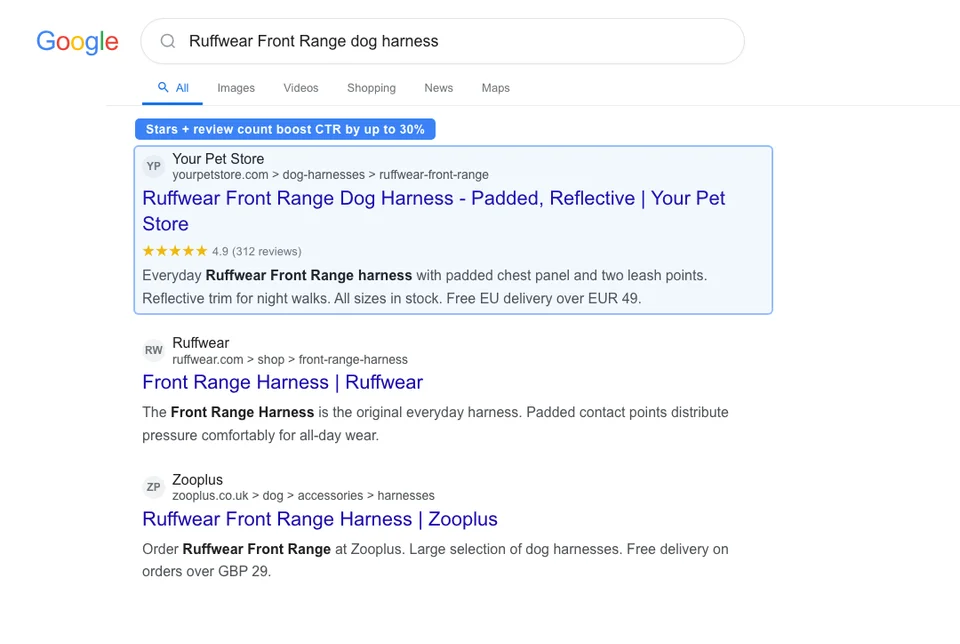
Here is the problem: the average e-commerce page title is just 39 characters, and the average meta description is only 96 characters[4]. Both fall well below the recommended 50-60 characters for titles and 150-160 characters for descriptions. Most stores are leaving ranking signals and click-through potential on the table.

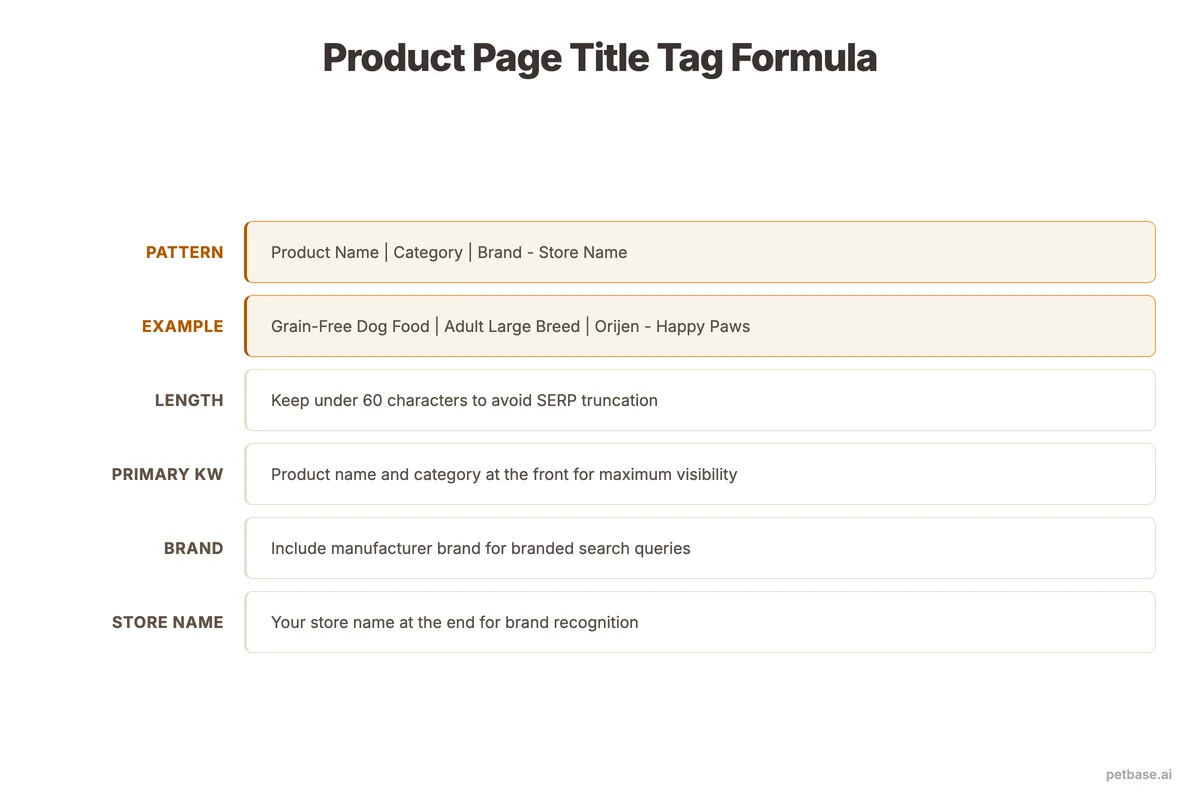
Here is the formula for pet product title tags:
[Product Name] + [Key Differentiator] + [Brand or Store Name]
Examples:
- "Ruffwear Front Range Dog Harness - Padded, Reflective | YourPetStore"
- "Orijen Original Dry Dog Food 11.4kg - Grain-Free, Fresh Meat | YourPetStore"
- "Catit Flower Water Fountain 3L - BPA-Free, Triple Filtration | YourPetStore"
Rules for product title tags:
- Keep under 60 characters (Google truncates longer titles)
- Put the product name first - it is the primary keyword
- Include one to two differentiators that set you apart
- Add your store name at the end, separated by a pipe character
- Never stuff keywords - "Dog Harness Best Dog Harness Buy Dog Harness" hurts rankings
Common mistakes to avoid:
- Using the manufacturer's generic title without customization
- Including the price in the title (it changes and becomes inaccurate)
- Writing clickbait titles that do not match the page content
- Duplicating the same title structure across every product with only the name changed
If you sell 500 products, yes, you need 500 unique title tags. This is where tools like Petbase save significant time. The platform generates unique, keyword-optimized titles based on each product's actual attributes using the AIDA framework to combine search optimization with persuasive copy.
How to Optimize Descriptions for Search and Sales
The product description is where most pet stores lose the SEO battle. Over 60% of online pet stores use the manufacturer's default description - which means dozens of stores have identical content on the same product. Google devalues duplicate content. If your description matches 30 other sites, you have no competitive advantage.
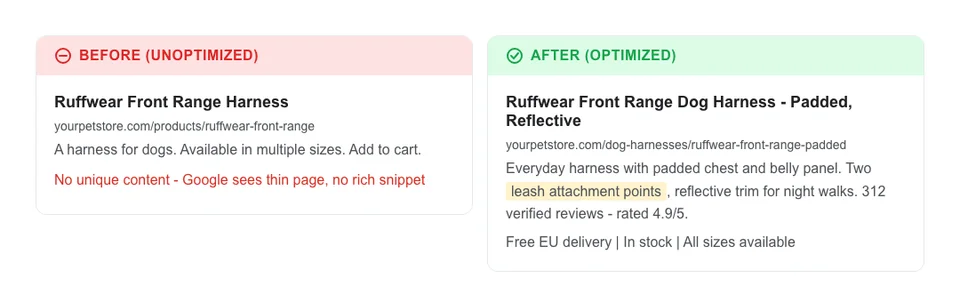
Write unique descriptions for every product. Here is a structure that works for both Google and buyers:
- Opening sentence (problem or desire): Start with what the pet owner needs. "Your dog pulls on every walk, turning a simple outing into a tug-of-war."
- Solution paragraph (50-80 words): Describe how this specific product solves that problem. Focus on benefits, not features. "This front-clip harness redirects pulling force to the side, teaching your dog to walk beside you without choking or discomfort."
- Feature list (bullet points): List 5 to 8 specific features with measurements, materials, and specifications. This is where you include long-tail keywords naturally.
- Use case or scenario: Describe when and where the product is most useful. "Ideal for daily walks, hiking trails, and training sessions with reactive dogs."
- Trust elements: Include sizing guides, care instructions, or compatibility notes.
Aim for 200 to 400 words per product description. Products under 100 words look thin to Google. Products over 500 words risk burying the purchase button below the fold. The sweet spot balances SEO depth with shopping usability.
Your product descriptions should link to related blog content. A harness product page should link to your blog post about writing product descriptions that rank and sell. A dog food product page should link to your nutrition guide. These internal links pass authority between your blog and product catalog in both directions.
Why Page Speed Decides Whether Visitors Buy or Leave
A perfectly optimized product page means nothing if it loads too slowly. 53% of mobile users abandon a page that takes over 3 seconds to load[5]. For an e-commerce store, every fraction of a second counts: improving page speed by just 0.1 seconds boosts retail conversion rates by 8.4%[5].
The impact compounds at scale. E-commerce sites loading in 1 second have a 2.5x higher conversion rate than those loading in 5 seconds[6]. With 57% of global e-commerce sales happening on mobile devices[6], mobile speed optimization is not optional - it is a direct revenue driver.
Here is a speed optimization checklist for pet product pages:
| Element | Action | Impact |
|---|---|---|
| Images | Use WebP format, compress to 80-85% quality | 30-50% smaller file sizes than JPEG |
| Lazy loading | Lazy load all images except the main product photo | Faster initial page render |
| Image dimensions | Serve responsive images with srcset | Smaller payloads on mobile |
| Third-party scripts | Defer non-critical JavaScript (chat widgets, analytics) | Faster time to interactive |
| Caching | Set browser cache headers for static assets | Instant repeat visits |
| Server response | Target under 200ms server response time | Foundation for all other metrics |
Cart abandonment sits near 70% across all e-commerce[7]. Slow product pages make that number worse. Every speed improvement you make reduces friction between the shopper and the checkout button.
What Image Optimization Does a Pet Product Page Need?
Images directly impact product page rankings and conversion rates. Google Image Search drives 20 to 30% of organic traffic to e-commerce product pages. If your images are not optimized, you are leaving that traffic on the table.
Here is a complete image optimization checklist for pet product pages:
| Element | Requirement | Why It Matters |
|---|---|---|
| File format | WebP (with JPEG fallback) | 30-50% smaller file sizes than JPEG at same quality |
| File name | Descriptive, hyphenated (ruffwear-front-range-harness-red.webp) | Google reads file names as relevance signals |
| Alt text | Descriptive with product name ("Ruffwear Front Range dog harness in red, front-clip design") | Required for accessibility and image search rankings |
| Image dimensions | Minimum 800x800px, ideally 1200x1200px | Google Shopping requires 800px minimum |
| Number of images | 4-8 per product | More angles = higher conversion rates |
| Loading | Lazy load all except hero image | Page speed improvement |
| Compression | Quality 80-85% WebP | Balance between quality and file size |
For each product, include these image types:
- Main product photo on white background (for Google Shopping)
- Product in use (dog wearing the harness, cat using the fountain)
- Close-up of key features (buckle detail, material texture)
- Size comparison (product next to a common object for scale)
- Package contents (everything included in the box)
If you sell the same product in multiple colors or sizes, create unique images for each variant. This gives each variant URL a unique image to rank in Google Image Search.
How to Add Schema Markup to Pet Product Pages
Schema markup tells Google exactly what your page contains in a language it understands perfectly. For product pages, this means structured data about price, availability, reviews, and product attributes. Pages with product schema are eligible for rich results - enhanced search listings that show star ratings, prices, and availability directly in Google's results.
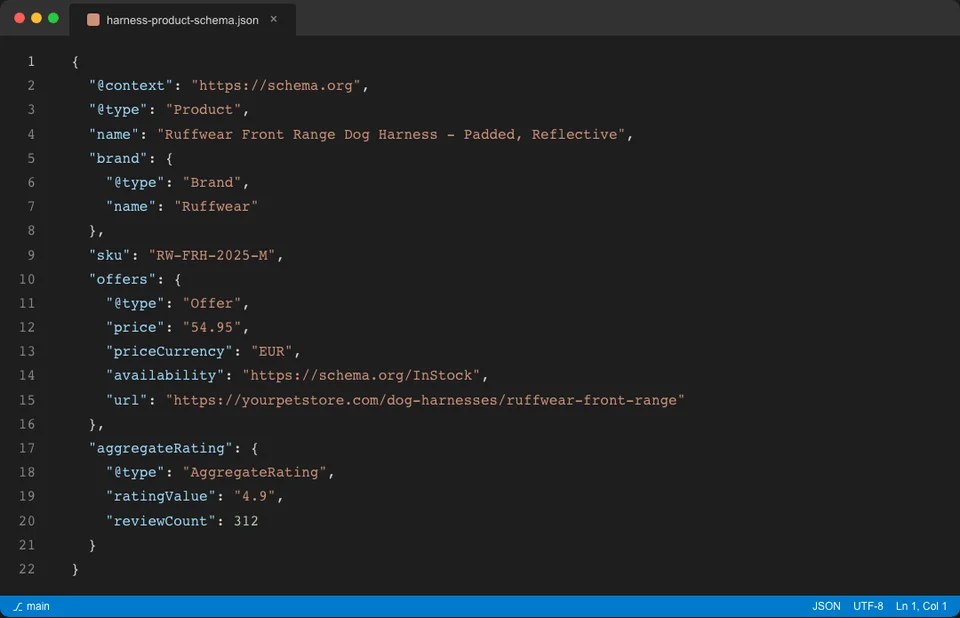
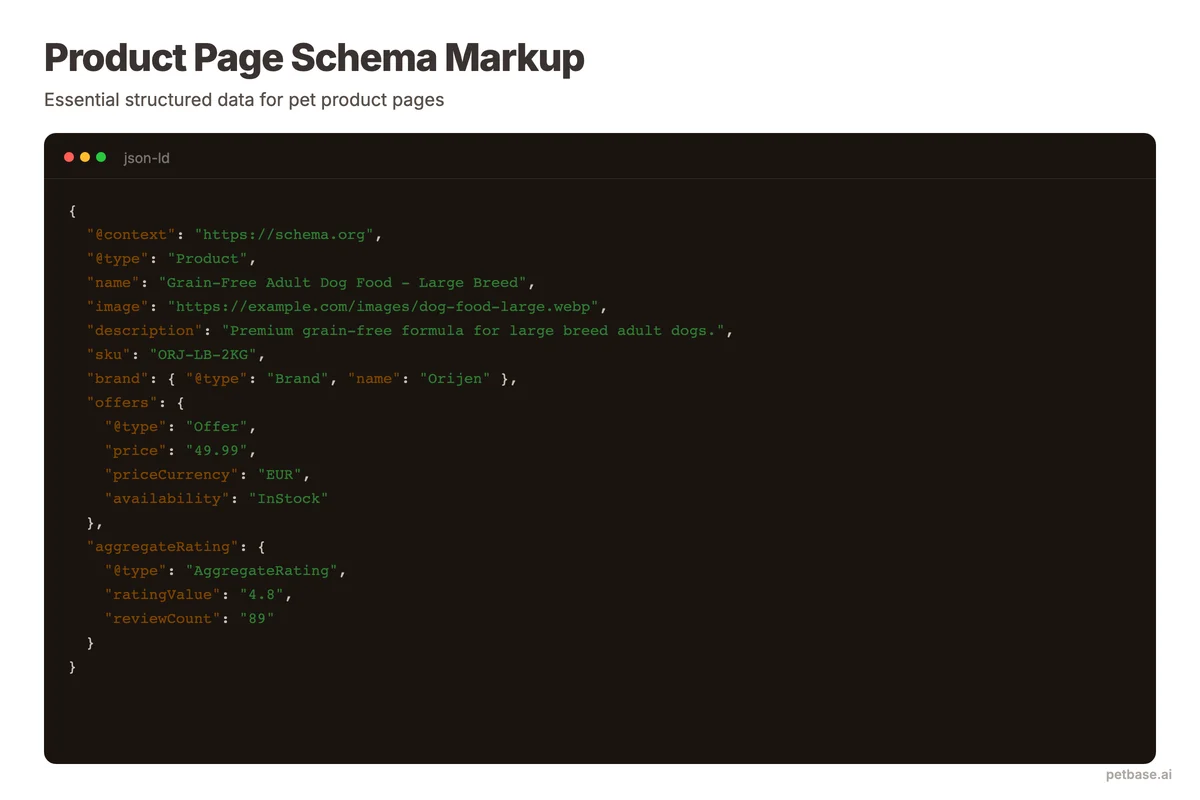
Pages with schema markup see an average click-through rate increase of 30%, yet only 30% of websites currently use it[8]. For pet stores, that means 70% of your competitors are missing out on richer search listings - and you can take that advantage right now.
Here are the essential schema fields for pet product pages:
| Schema Field | Required? | Example Value | Impact |
|---|---|---|---|
| @type | Yes | Product | Tells Google this is a product page |
| name | Yes | Ruffwear Front Range Dog Harness | Displays in rich results |
| description | Yes | Padded, reflective dog harness... | May display in search |
| image | Yes | URL to main product image | Shows in rich results and image search |
| offers.price | Yes | 45.99 | Displays price in search results |
| offers.priceCurrency | Yes | EUR | Required with price |
| offers.availability | Yes | InStock | Shows availability in results |
| brand.name | Recommended | Ruffwear | Brand filtering in search |
| aggregateRating | Recommended | 4.7 (based on 234 reviews) | Shows star ratings - biggest CTR boost |
| review | Recommended | Individual review objects | Supports aggregate rating |
| sku | Recommended | RF-30501-RED-M | Product identification |
| gtin/mpn | Recommended | Barcode or manufacturer part number | Google Shopping eligibility |
For a deeper walkthrough of schema implementation across your entire pet store, see our complete schema markup guide for pet stores. That guide covers Organization, LocalBusiness, BreadcrumbList, and FAQ schema in addition to Product schema.
How to Build Internal Links Between Product and Blog
Internal links between your product pages and blog content create a virtuous cycle. Blog posts bring informational traffic and build topical authority. Product pages convert that authority into sales. When these pages link to each other, both benefit from shared ranking signals.
Here is how to structure the linking:
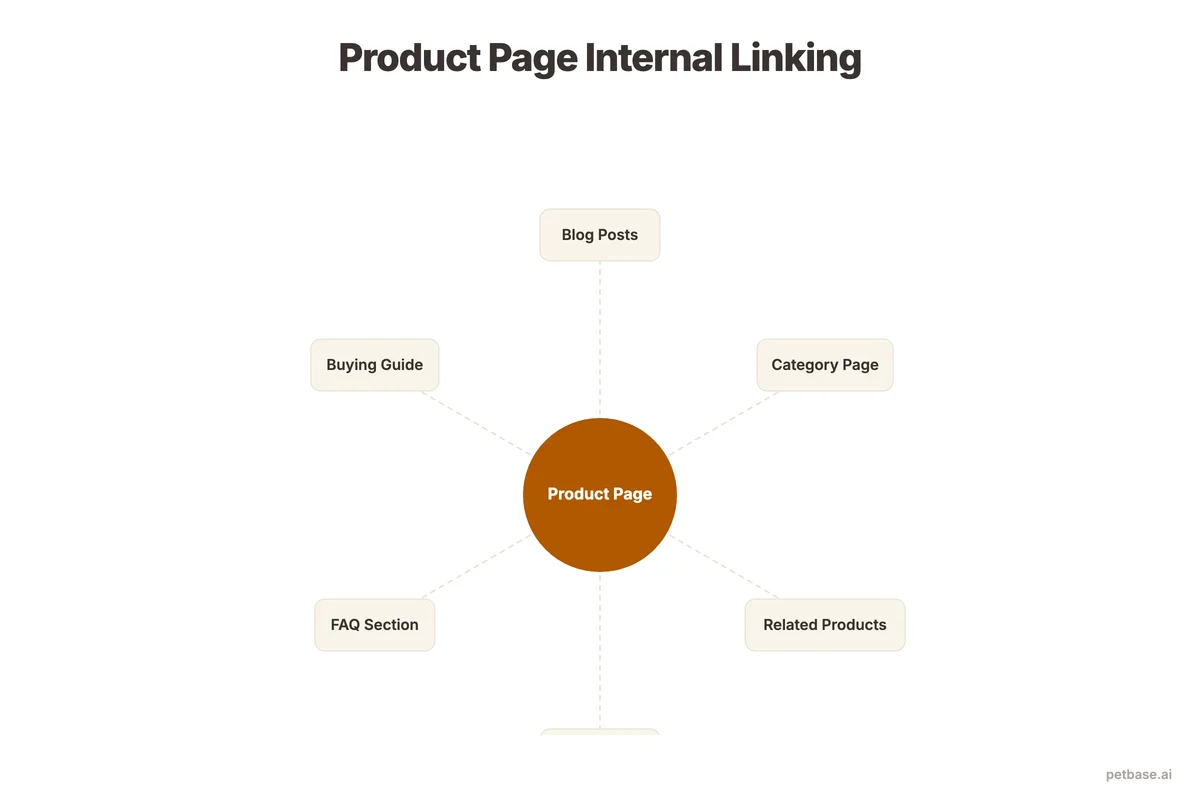
Blog to Product: Every blog post that mentions a specific product type should link to the relevant product or category page. A post about "best dog foods for sensitive stomachs" should link to your sensitive stomach dog food category. Use descriptive anchor text that includes the product keyword.
Product to Blog: Every product page should link to 1 to 2 related blog posts in a "Learn More" or "Related Guides" section below the product description. A harness product page links to your guide about choosing the right harness size. A dog food product links to your nutrition FAQ.
Product to Product: "Customers also viewed" or "Frequently bought together" sections link related products. A dog harness page links to leashes, poop bag holders, and reflective vests.
The result is a web of interconnected pages that Google can crawl efficiently and that shoppers can navigate intuitively. This directly supports your on-page SEO strategy by distributing page authority throughout your site.
How to Handle Similar Products Without Cannibalization
Keyword cannibalization happens when multiple pages on your site compete for the same search query. For pet stores, this is common with similar products - five different dog harnesses all targeting "dog harness." Google does not know which page to rank, so it ranks none of them well.
Here is how to prevent cannibalization:
- Each product targets a unique long-tail keyword. Instead of all harnesses targeting "dog harness," target "front-clip dog harness," "no-pull padded harness," "reflective hiking harness," and so on. Long-tail keywords convert at 36%[3], so this approach is not just safer - it is more profitable.
- Use the category page for the broad keyword. Your "Dog Harnesses" category page should target "dog harness" while individual product pages target specific variations.
- Differentiate title tags and descriptions. No two product pages should have the same title tag or meta description, even for similar products.
- Canonical tags for true duplicates. If you sell the same product in different sizes with separate URLs, use canonical tags to point size variants to the main product page.
When you find existing cannibalization on your site, the fix depends on the severity. If two product pages split traffic 50/50 for the same keyword, consolidate them into one stronger page and redirect the weaker URL. If a product page and a blog post compete, adjust the blog post's keyword focus to target an informational variant while the product page keeps the transactional keyword.
Category Pages vs. Product Pages: How to Optimize Both
Category pages and product pages serve different roles in your SEO strategy. Understanding the difference helps you allocate optimization effort correctly.
| Element | Category Page | Product Page |
|---|---|---|
| Target keyword type | Broad ("dog harnesses") | Specific ("Ruffwear Front Range harness") |
| Search intent | Browsing, comparing options | Ready to purchase specific item |
| Content length | 300-500 words + product grid | 200-400 words + images + specs |
| Internal links | Links to all products in category | Links to category, related products, blog |
| Schema type | CollectionPage or ItemList | Product with Offer |
| Conversion role | Helps shoppers narrow choices | Closes the sale |
| Update frequency | When products are added/removed | When price, stock, or details change |
Category pages should rank for "head" terms ("dog food," "cat toys," "bird cages"), while product pages rank for specific product names and long-tail variations. Together, they form a hierarchy that Google can crawl and understand clearly.
For a detailed guide on optimizing your category pages specifically, see our category page optimization guide. And if you want to see how this fits into the bigger picture of competing with larger retailers, our guide on competing with Amazon as a pet store covers the full strategy.
How Petbase Helps You Optimize Product Pages at Scale
Writing unique, keyword-targeted content for every product page is the right strategy - but doing it manually for 500+ products is a full-time job. Petbase publishes 10 SEO-focused articles per month for your pet store at EUR 199/mo. Each article is built around topical authority clusters that strengthen both your blog and product pages through internal linking.
The platform generates unique, SEO-optimized product descriptions using the AIDA framework and pet industry-specific language. Instead of spending hours writing individual descriptions, you get unique content for your entire product catalog that targets the right long-tail keywords and speaks directly to pet owners. See the pricing and features to understand how it fits your store.
Frequently Asked Questions
How many words should a pet product description be for SEO?
Aim for 200 to 400 words per product. This is enough for Google to identify unique content and rank the page, but short enough that the buy button stays visible without excessive scrolling. For high-competition products where you want to rank for multiple keyword variations, you can go up to 600 words by including a detailed specifications section, a use-case paragraph, and a FAQ block. Products with very low competition (niche or branded items) can rank with 150 words if the content is unique and the page has strong technical SEO.
Should I use the manufacturer's product description or write my own?
Always write your own. Manufacturer descriptions appear on every retailer's site that sells the same product. Google treats this as duplicate content and has no reason to rank your version over anyone else's. Your unique description is a competitive advantage. Use the manufacturer's description as a starting point for product specifications, but write the benefits, use cases, and opening paragraph from scratch. If you sell 500+ products and cannot write unique descriptions for all of them, prioritize your top 50 revenue-generating products first, then use Petbase to generate unique descriptions for the rest.
Do product pages need blog-style content or just product details?
Product pages need product-focused content, not blog-style articles. The primary purpose is to help someone decide to buy. However, adding a 50 to 100 word "Why pet owners choose this" section, a brief FAQ (2 to 3 questions), and links to related blog posts gives Google more content to index without turning the product page into an article. Keep the buying experience clean and fast. Save the in-depth educational content for your blog, and let internal links connect the two.
References
- Grand View Research (2024). Pet Care E-Commerce Market Size & Trends Analysis Report. grandviewresearch.com
- BrightEdge (2019). Organic Search Is Still the Largest Channel. seoinc.com
- Embryo / Ranktracker (2025). 30 Statistics About Long-Tail Keywords. embryo.com
- Taylor Scher SEO (2025). E-Commerce SEO Statistics. taylorscherseo.com
- Deloitte / Google (2025). Understanding Google's Core Web Vitals. magnet.co
- Smart Insights (2025). E-Commerce Conversion Rates. smartinsights.com
- Baymard Institute / Smart Insights (2025). Cart Abandonment Rate Statistics. smartinsights.com
- Amra and Elma (2025). Top Schema Markup Statistics. amraandelma.com