Pet Business Local SEO: Dominate Local Search

Table of Contents +
- Why Local SEO Is the Lifeline of Every Pet Business
- How Pet Owners Search Locally
- The Heart of Local SEO - Google Business Profile Optimization
- Local vs. Organic SEO: Understanding the Difference
- Local On-Page SEO - Optimizing Your Website for Local Visibility
- Reviews - The Most Powerful Local Ranking Factor
- Local Content - What Most Pet Businesses Miss
- Building Authority Through Backlinks and Local Partnerships
- Tracking Your Local SEO Progress
- Local SEO Action Plan for Pet Businesses
- Scaling Local SEO With Petbase
- Frequently Asked Questions
- References
Data-backed local SEO guide for pet businesses. Learn how pet stores, vets, groomers, and trainers rank in Google Maps and attract more local clients.
Pet stores rank higher in local search by optimizing their Google Business Profile, collecting keyword-rich reviews, and publishing location-specific content on their website. Google weighs three factors for local rankings: relevance, distance, and prominence. Most pet businesses can move from page 2 into the Local Pack within 8-12 weeks by improving all three consistently.
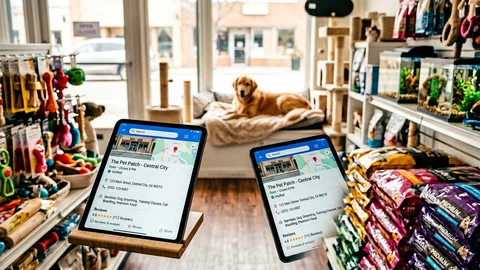
The global pet services market is valued at $60.08 billion[1], and local search is how pet owners find those services. Whether someone needs a groomer, a pet store, a trainer, or a veterinary clinic, 98% of consumers search online for nearby businesses[2]. The moment a pet owner types "pet groomer near me" or "pet store open now," Google decides which businesses show up first - and those top results receive almost all of the clicks.
This makes pet business local SEO essential for every local pet brand. From groomers and vets to boarding facilities, trainers, pet stores, breeders, and sitters, your visibility in local search determines your growth, credibility, and customer flow.
Why Local SEO Is the Lifeline of Every Pet Business
46% of all Google searches have local intent[2]. That means nearly half of every search on Google is someone looking for something nearby. For pet businesses, those searches are even more concentrated because pet care needs are urgent, personal, and location-dependent.
"Near me" searches now exceed 1.5 billion per month and have grown over 500% in recent years[2]. Queries like "pet store near me," "emergency vet," and "dog groomer near me" represent pet owners ready to visit, call, or book right now.
A pet's health, behavior, grooming, or comfort are immediate concerns. Pet owners choose a business based on:
- Who shows up first in search results
- Who has the best reviews
- Who displays transparency and expertise
- Who is closest to them
If your business does not appear in the Local Pack - the 3 prominent map results - you are invisible. The Local Pack appears for 93% of local intent searches and receives 44% of all clicks[2]. That is nearly half the traffic going to just three businesses.
Petbase builds this SEO foundation automatically for pet businesses - 10 optimized articles published every month - start your free trial.
How Pet Owners Search Locally
Pet owners almost always search with high intent. Their queries reflect an immediate need:
- Grooming: "dog groomer near me," "cat grooming local"
- Health concerns: "emergency vet," "dog x-ray cost near me"
- Training: "puppy classes in [city]"
- Supplies: "pet store near me," "pet food store open now"
- Services: "pet daycare near me," "pet sitter [city]"
What makes local search so effective is that intent meets proximity. Google matches three factors for every local query:
- Relevance - how well your listing matches the search
- Distance - how close you are to the searcher
- Prominence - how well-known and trusted your business is online
The more your website shows topical relevance - by covering related topics such as pet store SEO strategy or dog training SEO - the clearer your authority becomes to Google.
The Heart of Local SEO - Google Business Profile Optimization
Your Google Business Profile (GBP) is the single most important ranking factor in local SEO. Businesses with a complete GBP receive 80% more search appearances and 4x more visits than incomplete profiles[3]. It functions like your digital storefront - if it is not updated, optimized, and active, Google will not trust it, and neither will pet owners.
1. Name, Category, and Details
Your business name should reflect your brand. Your category should be precise:
- "Pet Groomer"
- "Veterinarian"
- "Dog Trainer"
- "Pet Supply Store"
Fill in every available field: hours, phone number, website, service area, attributes. Completeness is a direct ranking signal.
2. Add High-Quality Photos
Photos build trust immediately - and they directly affect clicks. Business profiles with photos receive 42% more direction requests and 35% more website clicks than profiles without[4].
Pet businesses should upload:
- grooming photos and before/after results
- staff images
- facility interiors
- veterinary equipment
- pet training sessions
- products on shelves
- happy clients and pets
This is the same principle discussed in pet groomer SEO and veterinary SEO, where credibility is essential. For a detailed GBP setup guide specific to pet stores, read our dedicated Google Business Profile guide for pet stores.
3. Use Local Keywords in Your Description
Mention your city, neighborhood, and services naturally in the description. Google uses this text to match your listing with relevant searches.
4. Post Updates Regularly
Google rewards active profiles. Share:
- promotions and seasonal offers
- pet tips and care reminders
- new products or services
- seasonal grooming reminders
- vaccination clinic schedules
- training class availability
Local vs. Organic SEO: Understanding the Difference
Many pet business owners treat local SEO and organic SEO as the same thing. They are related but distinct - and each requires different actions.
| Factor | Local SEO (Map Pack) | Organic SEO (Blue Links) |
|---|---|---|
| Primary signal | Google Business Profile | Website content and backlinks |
| Key ranking inputs | Reviews, proximity, GBP completeness | On-page optimization, topical authority |
| Where results appear | Map pack (top 3 map results) | Standard search results below map |
| Best for | Foot traffic, phone calls, directions | Online sales, long-tail queries, blog traffic |
| Time to results | 4-8 weeks with active GBP | 8-16 weeks with consistent content |
| Main content type | Photos, posts, review responses | Service pages, blog articles, guides |
The strongest local SEO strategy combines both. Your GBP drives map pack visibility while your website builds the organic rankings that appear below the map. These two reinforce each other - a well-optimized website makes your GBP more trusted, and a strong GBP sends trust signals back to your site.
To understand which keywords your store should target in both channels, see our guide on how "pet stores near me" searches work and how to rank for them.
Local On-Page SEO - Optimizing Your Website for Local Visibility
Your website must reflect your local service structure clearly. Google should instantly understand where you are located, what you offer, and which nearby areas you serve.
Mobile-friendly websites convert at a 32% higher rate than non-responsive sites[5]. Since the majority of local searches happen on mobile devices, responsive design is not optional - it is a ranking factor and a conversion factor.
1. Add City Names Naturally in Service Pages
Example: "Professional dog grooming in Denver with specialized tools and gentle techniques."
This is also where you link to relevant articles like the pet blog SEO guide, building topical authority around content creation.
2. Build Neighborhood or Service-Area Pages
These pages are high-value targets. For example:
- Dog Trainer in Austin
- Pet Grooming in Phoenix
- Veterinary Clinic Serving North Seattle
These improve your ranking even if your location is slightly outside a popular neighborhood.
3. Strengthen Your Internal Linking
Your local SEO page should link to:
And each of those pages links back to this one. This creates a web of interlinked relevance that strengthens every page in the cluster.
Reviews - The Most Powerful Local Ranking Factor
93% of consumers say online reviews affect their buying decisions for local businesses[2]. Businesses with a 4+ star average are 3x more likely to receive clicks than those with lower ratings[2]. For pet businesses, reviews influence click-through rate, visibility, Google's trust in your listing, and customer confidence.
Ask customers to mention the service they used and their city. For example:
"Best dog groomer in Tampa - my golden retriever looks amazing!"
or
"This veterinary clinic in Austin took incredible care of my cat."
These natural keywords boost relevance significantly. This strategy aligns with the approach used in other pet business SEO areas such as the pet product brand SEO guide, where user language strengthens SEO signals.
Local Content - What Most Pet Businesses Miss
Local content separates businesses that rank from those that stay invisible.
High-performing local content includes:
- "Best dog parks in [city]"
- "How to choose a pet groomer in [city]"
- "Top 5 dog trainers in [city]"
- "What to do if your pet is lost in [city]"
- Seasonal pet-care guides based on your region
You can then internally link these articles to your primary service pages to show Google your breadth of local expertise. A local pet-care article can link to the veterinary SEO guide or pet affiliate SEO overview when discussing product recommendations.
Building Authority Through Backlinks and Local Partnerships
Backlinks are endorsements. When other websites link to yours, Google sees this as validation.
For pet businesses, strong backlink sources include:
- local animal shelters
- dog trainers and pet groomers
- pet influencers and bloggers
- rescue organizations
- local media outlets
- neighborhood business directories
Collaborations build both local trust and industry relevance. Linking from blogs to articles like the pet influencer SEO guide strengthens your inter-topic authority further.
Tracking Your Local SEO Progress
SEO effort without measurement is guesswork. Pet businesses should track at least three metrics each month: keyword rankings in their target city, Google Business Profile impressions, and the number of calls or direction requests from the GBP.
Our guide on tracking your pet store's Google rankings covers the free and paid tools that make this straightforward, even if you have no analytics background.
Local SEO Action Plan for Pet Businesses
Here is a practical checklist to follow, ordered by impact:
| Action | Impact | Time to Complete |
|---|---|---|
| Complete every GBP field (80% more search appearances) | Very High | 1-2 hours |
| Upload 30+ photos (42% more direction requests) | High | 1 hour |
| Ask 5 clients for keyword-rich reviews this week | High (93% check reviews) | 30 minutes |
| Create individual service pages with city names | High | 2-4 hours |
| Ensure consistent NAP across all directories | High | 1-2 hours |
| Make your website mobile-friendly (32% higher conversion) | High | 2-4 hours |
| Publish 1 local content piece per month | Medium-High | 2-3 hours |
| Post weekly updates to GBP | Medium | 15 minutes/week |
Scaling Local SEO With Petbase
Local SEO requires keyword research, fresh content, optimized pages, updated listings, internal linking, metadata, and competitive analysis. That is a lot to manage when you are also running a pet business.
Petbase handles:
- local keyword clustering
- content briefs for city, county, and neighborhood pages
- optimized metadata
- internal link recommendations
- pet-industry content creation
- competitive content gap analysis
Unlike generic writing tools, Petbase understands pet terminology, care topics, service vocabulary, breed specifics, and pet-owner psychology. 10 articles per month, published directly to your website, for EUR 199/mo.
The pet services market is growing at $60.08 billion globally[1]. More pet owners are searching online than ever - 98% search for nearby businesses before visiting[2]. The question is whether they find you or your competitor first.
Start your free trial and see what consistent, research-backed content does for your local rankings.
Frequently Asked Questions
How do I rank my pet store on Google Maps?
Complete your Google Business Profile fully - category, description, hours, photos, and services. Businesses with a complete profile receive 80% more search appearances[3]. Then collect reviews consistently, post weekly updates, and make sure your website mentions your city and services. Stores that update their profile at least once per week typically see results within 4-8 weeks.
Do I need a website for local SEO?
A website is not strictly required to appear in Google Maps, but it significantly increases your ranking potential. Businesses with websites rank higher than GBP-only listings because Google can cross-reference your location, services, and topical relevance. Mobile-friendly websites also convert at 32% higher rates[5]. Even a simple 5-page website with clear service descriptions makes a measurable difference.
How long does local SEO take for a pet business?
Most pet businesses see GBP ranking improvements within 4-8 weeks of consistent optimization. Organic website rankings take longer - typically 8-16 weeks for competitive local terms. The combination of an active GBP and a growing website compounds over time, with the strongest gains usually visible at the 3-month mark.
How many Google reviews does a pet business need to rank?
There is no fixed number, but businesses with 30+ reviews and a 4.5+ average consistently outperform those with fewer reviews in the same area. 93% of consumers say reviews affect their buying decisions[2], and stores with 4+ stars get 3x more clicks[2]. What matters most is recency - 5 new reviews this month signals more trust than 50 reviews from 3 years ago.
References
- Grand View Research (2024). Pet Services Market Size, Share & Trends Analysis Report. grandviewresearch.com
- BrightLocal (2024). Local SEO Statistics. brightlocal.com
- Birdeye (2024). State of Google Business Profiles. birdeye.com
- Sterling Sky (2024). How to Interpret Google Business Profile Performance. sterlingsky.ca
- Clutch (2025). SEO Statistics. clutch.co