Pet Food Brand SEO: Build Ingredient Authority


Table of Contents +
- Why Do Pet Food Brands Need SEO in 2026?
- How Do Pet Parents Search for Pet Food?
- What Makes a Pet Food Brand Website Rank?
- How Do You Build an Ingredient Content Hub?
- What Content Wins the "Best Dog Food for [X]" Battle?
- Which Marketing Channels Work Best for Pet Food Brands?
- How Do Expert Reviews and Vet Partnerships Boost E-E-A-T?
- What Is the 90-Day Pet Food Brand SEO Sprint?
- How Does Petbase Help Pet Food Brands Scale Content?
- Frequently Asked Questions
- References
Data-backed SEO guide for pet food brands. Build ingredient and condition content hubs, win 'best food for [X]' searches, and convert research into subscribers.
The global pet food market was valued at $134.49 billion in 2025 and is projected to reach $200.89 billion by 2032[1]. Within that market, the DTC segment is exploding - $3.66 billion in 2025, projected to hit $22.8 billion by 2035 at a 20.2% CAGR[2]. Natural pet food is at $15.28 billion[3] and growing. Fresh, raw, and frozen formats are expanding fast[4]. The category is a land grab. The winners are brands that own ingredient-led and condition-led search.
This guide covers exactly how pet food brands rank on Google, build the E-E-A-T signals Google rewards for health-adjacent content, and convert research-stage searches into subscription customers - backed by industry data at every step.
TL;DR
The DTC pet food segment is growing 20.2% per year, but most brands lose search to Chewy, Amazon, and established CPG. Pet food SEO wins when brands treat ingredients, conditions, and breeds as a topical authority play - backed by vet-reviewed content, Product schema, and E-E-A-T signals. This guide shows the exact ingredient hub, condition content, and schema playbook that earns "best dog food for sensitive stomach" rankings.
Why Do Pet Food Brands Need SEO in 2026?
Pet food is a research-heavy purchase. Before a pet parent commits to a new brand or formula, they search: they read ingredient lists, compare protein sources, look up condition-specific recommendations, ask whether grain-free is safe, check reviews, and often consult vet-reviewed guidance. Each research query is a chance for a food brand to build trust, rank on Google, and convert the reader into a subscription customer.
The market context makes this urgent. The DTC pet food segment alone is projected to grow from $3.66 billion to $22.8 billion in a decade[2]. Natural formulas are $15.28 billion and climbing[3]. European pet food alone is EUR 29.2 billion annually across more than 400 companies[5]. Volume and spend are expanding, but so is competition.
Trust starts with discovery. 97% of US owners consider their pets family members[6], and they transfer human-grade scrutiny onto pet food labels. Pet parents Google "is chicken meal safe for dogs," "best food for dog with IBD," or "grain-free dog food risks" before buying. Brands that answer those questions rank, earn trust, and win the sale. Brands that stay silent get beaten by retailers and blog aggregators.
For broader content strategy fundamentals, see our pet business content marketing guide.
Petbase builds this SEO foundation automatically for pet businesses - 10 optimized articles published every month - start your free trial.
How Do Pet Parents Search for Pet Food?
Pet food searches break into four distinct intent patterns:
- Ingredient-led searches - "chicken meal vs chicken," "is xylitol safe for dogs," "best protein for cats," "grain-free dog food safe." Research stage, high intent.
- Condition-led searches - "best dog food for sensitive stomach," "food for kidney disease cats," "hypoallergenic dog food," "puppy food for large breed." Largest conversion potential - reader has a real problem.
- Breed and life-stage searches - "food for French bulldog," "kibble for senior labradors," "best kitten food," "large breed puppy food." Very specific and commercially intent-rich.
- Brand comparison searches - "Ollie vs Farmer's Dog," "Nutro vs Hill's Science Diet," "best subscription dog food." Bottom-of-funnel, purchase-ready.
Each pattern requires different content. Ingredient searches reward long-form educational content with citations and vet review. Condition searches reward depth - the reader needs to trust your expertise before buying food their vet might disapprove of. Breed and life-stage searches reward dedicated feeding guides per segment. Brand comparison searches reward honest, data-driven comparison pages.
What Makes a Pet Food Brand Website Rank?
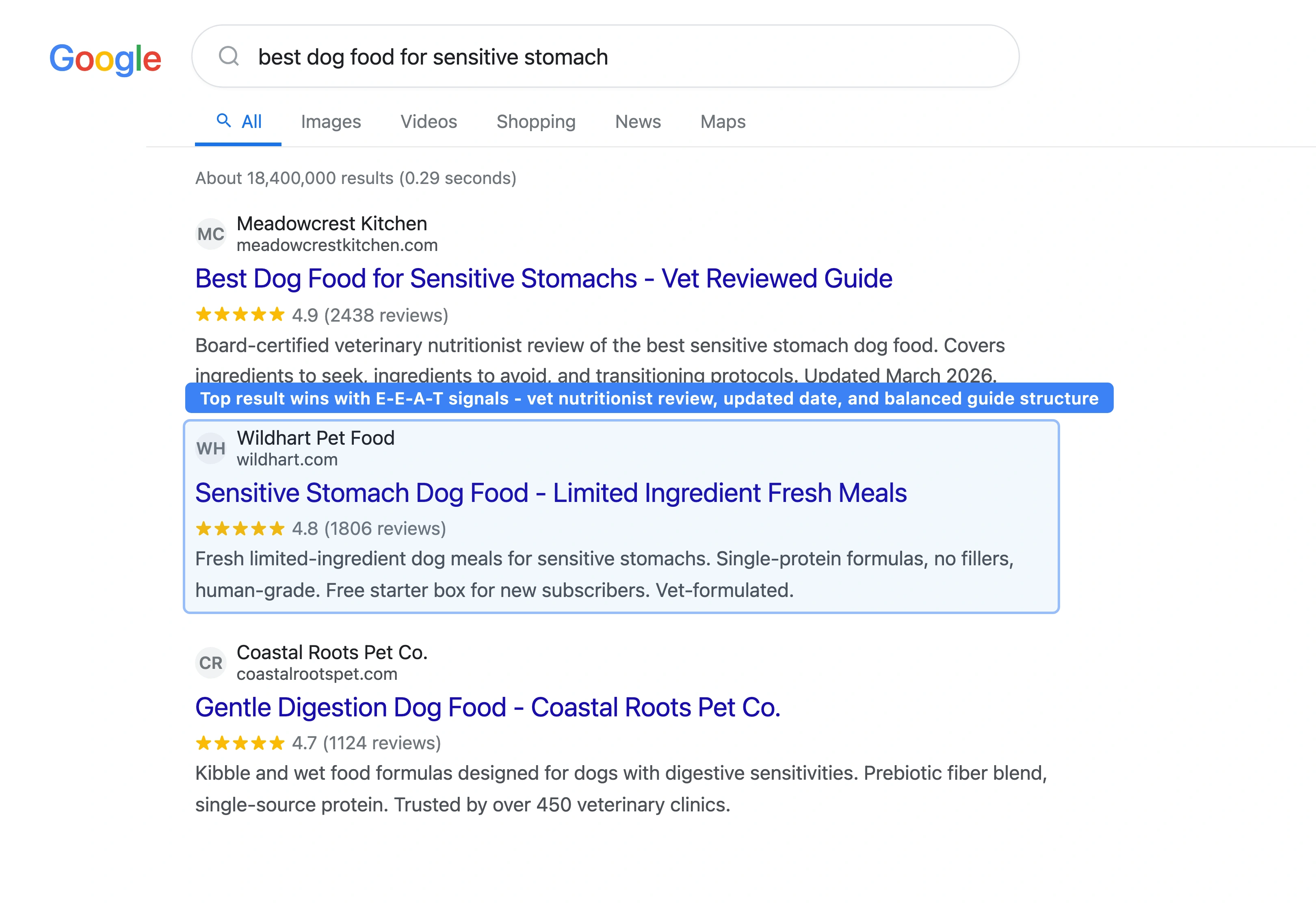
Google evaluates four core areas when ranking pet food brands, and one of them - E-E-A-T - matters more here than almost any other category:
1. E-E-A-T and YMYL Signals
Pet food touches animal health. Google treats health-adjacent content as Your Money or Your Life (YMYL), meaning the E-E-A-T bar (Experience, Expertise, Authoritativeness, Trustworthiness) is set higher. This is why veterinary-reviewed brand blogs consistently outrank generic DTC content. Signals that help:
- veterinary or board-certified nutritionist byline on every content piece
- author pages with credentials, Person schema, and linked professional profiles
- transparent ingredient sourcing pages with supplier names and quality certifications
- reviewed-by dates on all health content, refreshed annually
- About page detailing the formulation team and nutrition philosophy
2. Product Schema
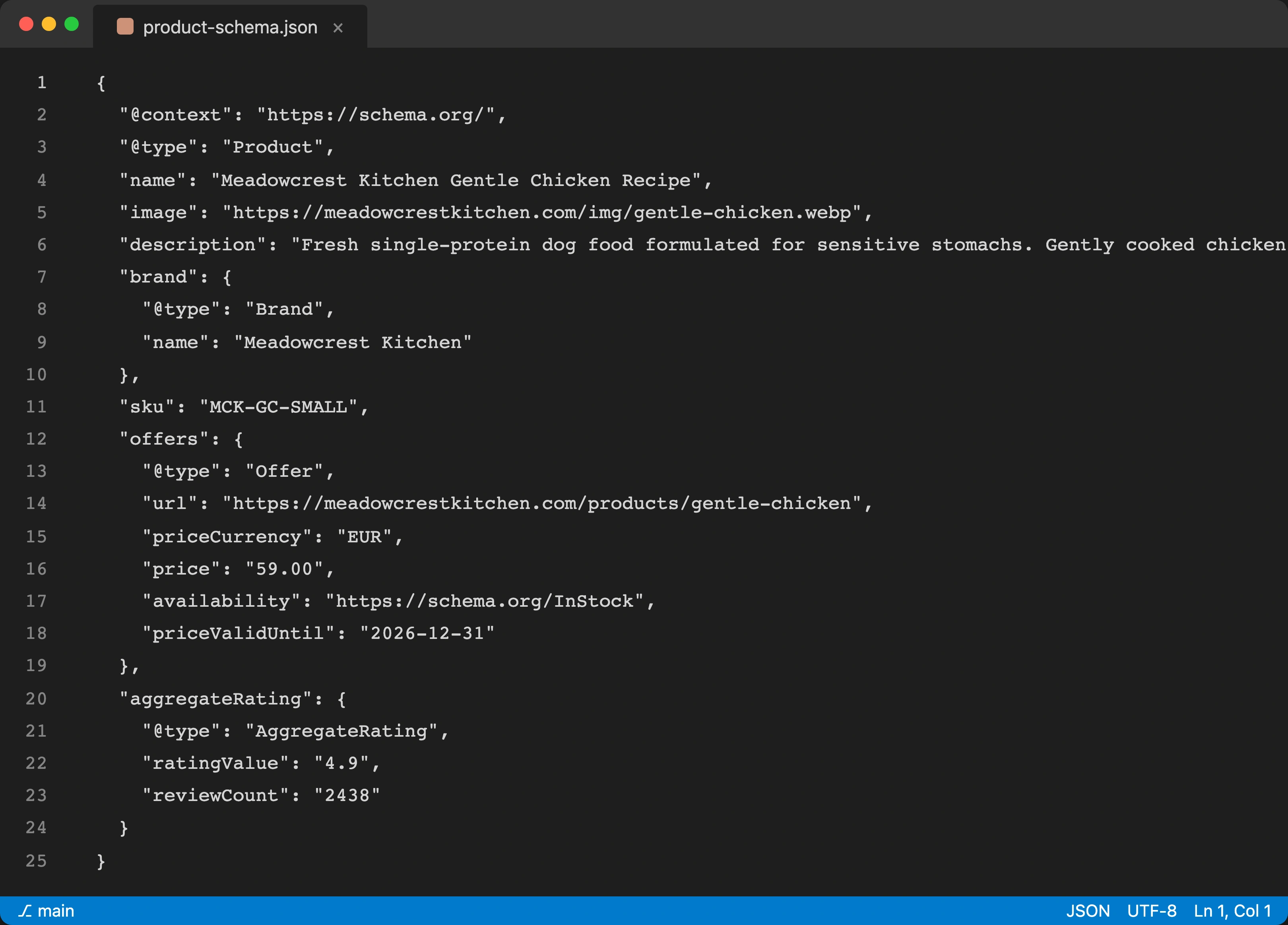
Every product page should implement schema.org/Product structured data with price, brand, offers, availability, and AggregateRating fields. Product rich snippets unlock price, rating, and availability in the SERP, which drives 30%+ higher click-through rates against equally-ranked competitors[7].
3. Ingredient and Condition Content Hubs
Pet food brands have a unique content advantage: every ingredient you use is a ranking opportunity, and every condition your product helps is a ranking opportunity. Long-tail keywords account for roughly 70% of all Google searches[8], and ingredient/condition queries are nearly all long-tail. Brands that build content hubs outrank pure e-commerce sites because Amazon listings do not answer "why is chicken meal actually higher in protein than chicken."
4. Subscription and DTC Funnel Pages
Most pet food brand sites treat the subscription signup as an afterthought. It is the highest-value page. Create dedicated pages for:
- your subscription value proposition (vs one-time purchase)
- feeding trial landing pages (discounted starter box)
- switching guides (transitioning from kibble to fresh, etc.)
- life-stage subscription plans (puppy, adult, senior)
- multi-dog household subscription options
How Do You Build an Ingredient Content Hub?
Ingredient content is the unique moat most pet food brands ignore. Chewy and Amazon are aggregators - they cannot produce original ingredient expertise. A well-built ingredient hub ranks for thousands of long-tail queries and signals E-E-A-T to Google.
Start with a pillar page: "Pet Food Ingredients Explained." From that pillar, link to individual ingredient pages - one per major ingredient your brand uses or competitors use:
- protein sources (chicken, turkey, salmon, beef, lamb, novel proteins)
- carbohydrates and grains (rice, oats, barley, grain-free alternatives)
- vegetables and fruits used in pet food
- supplements (glucosamine, chondroitin, omega-3, probiotics)
- preservatives and stabilizers (natural vs synthetic)
- controversial ingredients (by-products, meat meal, ethoxyquin)
Each ingredient page should cover: what it is, nutritional role, safety data, typical inclusion rate, sourcing considerations, and - crucially - whether your brand uses it and why. Link every ingredient page to the pillar and to relevant product pages. This structure is pillar-cluster architecture applied to pet nutrition.
For pillar-cluster strategy fundamentals, see our content clustering guide.
What Content Wins the "Best Dog Food for [X]" Battle?
"Best dog food for sensitive stomach," "best food for French bulldogs," "best senior cat food" - these queries are where pet food brand SEO is won or lost. Every segment, condition, breed, and life stage is a content opportunity.
By Breed
Breed-specific feeding guides capture highly commercial searches. Focus on the top 20 breeds in your target markets - golden retriever, labrador, French bulldog, german shepherd, poodle, husky, rottweiler, and so on. Each guide covers typical size, common health predispositions, ideal macronutrient profile, feeding amounts by age, and which of your products fit best.
By Condition
Condition-specific food content is YMYL at its most sensitive. Cover: sensitive stomach, allergies, weight management, joint support, kidney disease, diabetes, pancreatitis, IBD, skin and coat issues, urinary health. Every condition post needs veterinary review, and the review should be disclosed prominently with the vet's name, credentials, and date of review.
By Life Stage
Puppy, adult, senior, and special-needs feeding guidance is core evergreen content. Add breed-size overlays (large breed puppy, small breed senior) for long-tail capture.
By Protein Source
For brands selling novel proteins (duck, venison, insect, fish-based), dedicated protein guides capture hobbyist and allergen-conscious buyers. These are smaller-volume but very high intent.
Which Marketing Channels Work Best for Pet Food Brands?
Not every channel delivers equal return for DTC pet food brands. Compare the realistic options:
| Channel | Upfront Cost | Ongoing Effort | Long-Term Value | Best For |
|---|---|---|---|---|
| Organic SEO (ingredient + condition hubs) | Medium | Medium (monthly content) | Very High (compounds) | Research-stage capture, authority building |
| Product Schema + On-Page SEO | Low | Low | High | Rich snippets, higher CTR |
| Subscription Landing Pages | Low to Medium | Low | High | Brand comparison capture |
| Paid Search (Google Ads) | High | Medium | Low (stops when budget stops) | New product launches, competitive keywords |
| Paid Social (Meta, TikTok) | High | High | Medium | New customer acquisition, retargeting |
| Amazon (if listed) | Medium | Medium | Medium (Amazon owns the customer) | Incremental revenue, sampling channel |
| Veterinarian and Nutritionist Partnerships | Low | Low to Medium | Very High (E-E-A-T) | Authority, backlinks, trust signals |
| Influencer and Creator Campaigns | Medium to High | Medium | Medium | Discovery, DTC social proof |
SEO - particularly ingredient hubs, condition content, and strong Product schema - delivers the highest long-term return for DTC pet food brands. Unlike paid ads, the rankings earned through SEO continue driving subscribers without ongoing spend. One pattern I have seen repeatedly with DTC pet food brands: the brands that publish weekly vet-reviewed condition content outrank paid-only competitors within 12 months on the queries that matter most.
How Do Expert Reviews and Vet Partnerships Boost E-E-A-T?
Pet food is YMYL. Google specifically rewards content that demonstrates real expertise. Vet and nutritionist partnerships are the fastest way to earn that signal. Tactics that work:
- board-certified veterinary nutritionist (DACVN, ECVCN) byline on all condition content
- veterinarian bylined author pages with Person schema including jobTitle, affiliation, and sameAs links to professional directories
- medically-reviewed badges with review date visible on every relevant page
- editorial policy page describing how content is vetted and updated
- third-party expert interviews published on your blog (with schema markup on Quote)
- research partnerships published as proprietary data (studies, feeding trial outcomes)
Each of these signals to Google that your brand meets the E-E-A-T bar for health-adjacent content. They also drive backlinks: a veterinary interview gets cited. A published feeding trial outcome gets cited. These become permanent SEO assets.
For broader author and E-E-A-T strategy, see our pet business E-E-A-T guide.
What Is the 90-Day Pet Food Brand SEO Sprint?
Pet food brands want results before the next product launch or subscription push. Here is a practical 90-day sprint:
| Week | Action | Impact |
|---|---|---|
| 1-2 | Implement Product schema on all product pages, add AggregateRating and Offers fields | Very High (rich snippets, higher CTR) |
| 2-3 | Audit and upgrade author pages - add credentials, Person schema, review dates | High (E-E-A-T) |
| 3-4 | Launch ingredient pillar page and first 10 ingredient articles (most-used ingredients) | Very High |
| 4-6 | Publish 4 condition-specific food guides with vet review (sensitive stomach, allergies, weight, joint) | Very High |
| 5-8 | Publish 10 breed feeding guides for top breeds in your primary market | High |
| 6-9 | Build 4 subscription landing pages (trial, switching, life-stage, multi-dog) | Very High (conversion) |
| 7-10 | Publish 3 brand comparison pages (honest, data-backed) | Very High (purchase intent) |
| 9-11 | Outreach to 10 veterinarians and nutritionists for content review partnerships | High (backlinks + E-E-A-T) |
| 10-12 | Add FAQPage schema to condition content, HowTo schema to feeding transition guides | Medium (AI Overview eligibility) |
| Ongoing | Weekly content (ingredient or condition), monthly vet-reviewed updates, quarterly comparison refreshes | Compounds over time |
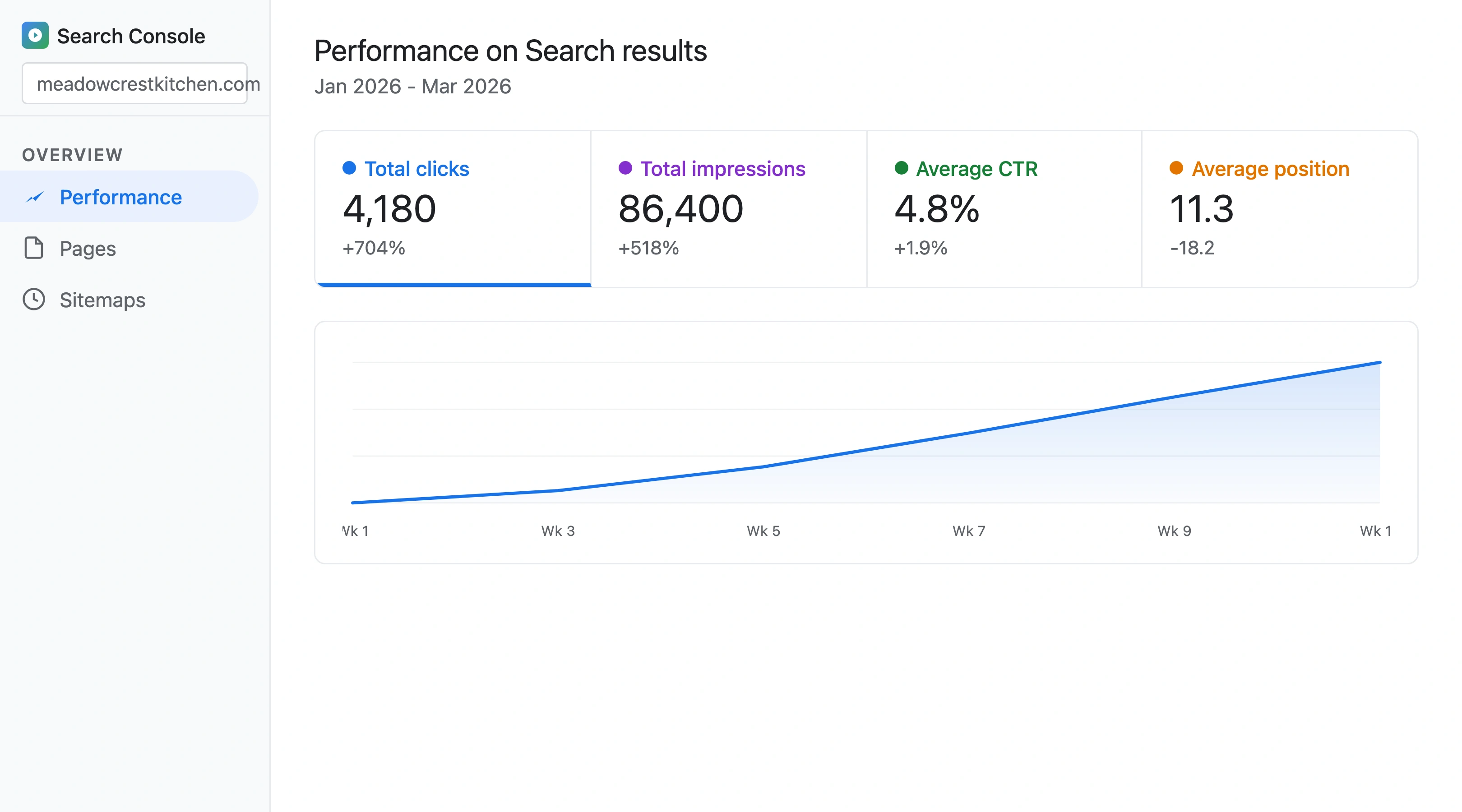
This sprint roughly maps to the cadence we cover in our how long pet business SEO takes guide - real ranking gains within 8 to 12 weeks, with subscription-driven impact visible by week 12.
How Does Petbase Help Pet Food Brands Scale Content?
Most pet food brand marketing teams cannot write 50 ingredient pages, 20 condition guides, 30 breed feeding articles, and monthly vet-reviewed updates. Your team is running launches, managing subscription churn, handling customer service, and negotiating with manufacturers. SEO content sits at the bottom of every realistic roadmap.
That is exactly the gap Petbase fills. Petbase generates optimized ingredient content, condition guides, breed feeding articles, and educational content tailored to the pet care industry. 10 articles per month, published directly to your website, for USD 199/month.
The DTC pet food market is growing at 20.2% annually[2]. Natural, fresh, and condition-specific segments are expanding the fastest. The question is whether new pet parents searching "best food for my [breed] with [condition]" find your brand - or the competitor who published that content last quarter.
Start your 7-day free trial and see what consistent, research-backed content does for your subscription funnel.
Frequently Asked Questions
How long does pet food brand SEO take to show results?
Most pet food brands see meaningful ranking improvements within 90 to 180 days of consistent optimization, with subscription-driven impact visible by month six. Product schema and author page upgrades show fastest results - often within 4 to 6 weeks of implementation as Google recrawls and surfaces rich snippets. Ingredient and condition content compounds slower but produces the most durable rankings as topical authority builds across health-adjacent queries.
Does pet food qualify as YMYL content?
Yes, effectively. Google treats content that affects animal (or human) health with elevated scrutiny. Pet food sits on the edge of YMYL - more sensitive than general e-commerce but less sensitive than human medical content. Condition-specific food content (diabetic dog food, kidney disease cats) is firmly YMYL and should always carry veterinary review and transparent credentials. General brand content can get by with editorial oversight, but authority signals help everywhere.
Should small pet food brands compete on branded keyword comparisons (e.g. 'Brand X vs Brand Y')?
Yes, selectively. Brand comparison pages convert at 5% to 10% versus 1% to 2% for general content. Focus on comparisons where you have a genuine, defensible advantage (fresh vs kibble, grain-free vs grain-inclusive, organic vs conventional). Avoid trademark infringement by using "alternative to" framing where needed. Include honest trade-offs; Google ranks balanced comparison content higher than one-sided marketing copy.
How much should a DTC pet food brand spend on SEO?
Most emerging DTC pet food brands spend $3,000 to $15,000 per month on SEO (content + technical + link building). Product schema and author page upgrades cost little beyond developer time. Tools like Petbase (USD 199/month) reduce content costs by generating ingredient and condition articles automatically. Given that a new subscription customer is typically worth USD 600 to USD 2,400 in lifetime revenue, even three to five new subscribers per month from SEO makes it profitable immediately.
References
- Stellar Market Research (2026). Pet Food Market Size, Share & Growth Trends 2026-2032. stellarmr.com
- InsightAce Analytic (2025). Direct to Consumer (DTC) Pet Food Market Size and Growth Analysis 2026 to 2035. insightaceanalytic.com
- Future Market Insights (2025). Natural Pet Food Market Size, Trends & Forecast. futuremarketinsights.com
- Future Market Insights (2025). Raw, Fresh & Frozen Dog Food Market Size & Share 2025-2035. futuremarketinsights.com
- FEDIAF (2025). European Pet Food Industry Statistics. europeanpetfood.org
- American Pet Products Association (2024). National Pet Owners Survey. americanpetproducts.org
- Google Search Central (2024). Product (Product, Review, Offer) Structured Data. developers.google.com
- Ahrefs (2024). Long-Tail Keywords: What They Are and How to Find Them. ahrefs.com