How to Write Pet Health Content Google Actually Trusts

Table of Contents +
- Why Pet Health Content Is Harder to Rank Than Other Pet Topics
- What Is YMYL and How Does It Apply to Pet Content?
- How to Structure Pet Health Content for E-E-A-T
- What Sources Should You Cite in Pet Health Articles?
- How to Show Expertise When You Are Not a Vet
- Which Pet Health Topics Are Safe to Write About?
- How to Add Veterinary Review Signals to Your Content
- Pet Health Content Templates That Rank
- Frequently Asked Questions
- The Bottom Line
- References
Pet health content falls under Google's YMYL guidelines. How to write health-related pet content that ranks without triggering quality filters.
Pet health content is some of the hardest content to rank in the pet niche. Google applies its most rigorous quality filters to anything that could affect an animal's wellbeing. Most pet businesses that try to write about nutrition, symptoms, or medications either get ignored by Google or filtered out entirely. But the businesses that get it right build enormous organic visibility - because high-quality pet health content is rare.
The stakes are real. Organic search drives 53% of all website traffic[1], and the global veterinary services market is worth $138.98 billion[2]. Pet owners are actively searching for health information online - and 97% of them consider their pets family members[3]. That emotional investment means they read health content carefully and trust the sources that earn it.
This guide explains exactly what Google looks for in pet health content, how to build the signals that earn trust, and which topics are safe for a pet business to write about without a veterinary team.
Why Pet Health Content Is Harder to Rank Than Other Pet Topics
Pet health content faces a higher bar than product reviews or breed guides. Google's quality raters apply stricter standards to any content that could lead to a harmful decision - including decisions about what to feed, treat, or give to a pet. A poorly written article about dog supplements can do real damage, and Google knows it.
The result is that generic, thinly researched pet health articles rarely rank on page one. Google's Search Quality Evaluator Guidelines specifically flag health-related topics as requiring demonstrated expertise, authoritative sourcing, and clear ownership. This applies whether the content is about human health or animal health.
For pet businesses, this creates both a challenge and an opportunity. Most competitors skip health topics entirely or publish shallow articles without sources. 61% of small businesses are still not investing in SEO at all[4]. If you invest in quality, you face almost no real competition for some of the most-searched pet queries online.
Three factors make pet health content harder than other pet content:
- User intent carries higher stakes. Someone searching for "dog ate chocolate how much is dangerous" is in crisis mode. Google ranks sources it trusts to give accurate answers.
- Thin content gets filtered fast. A 400-word article with no sources and no author credentials will not rank for competitive health queries.
- AI content without E-E-A-T signals gets suppressed. Google's helpful content system specifically downgrades content that reads like it was generated without real experience or expertise behind it.
The fix is not to avoid health topics. The fix is to write them properly - with structure, sourcing, and the right signals. Here is how to do that.
Petbase builds this SEO foundation automatically for pet businesses - 10 optimized articles published every month - start your free trial.
What Is YMYL and How Does It Apply to Pet Content?
YMYL stands for Your Money or Your Life. It is Google's internal classification for content that could significantly affect a reader's health, safety, finances, or wellbeing. Google applies higher quality standards to YMYL content during its ranking evaluations.
Pet health content sits inside YMYL. A pet owner who reads your article about tick treatment and follows bad advice could harm their animal. That makes it YMYL by Google's definition - even though it is about pets, not people.
Not all pet health content carries the same risk level. Google's raters use judgment about how directly content could cause harm. A post about the best dog food brands is lower risk than a post about diagnosing skin conditions in cats. The more specific and treatment-oriented the content, the higher the standard Google applies.
| Topic Type | YMYL Risk Level | What Google Looks For |
|---|---|---|
| Dog food comparisons, breed overviews | Low | Basic accuracy, helpful framing |
| Nutrition guides, supplement explainers | Moderate | Sourced claims, author context |
| Symptom guides, medication dosing | High | Veterinary review signal, clear sourcing |
| Emergency triage, toxicity guides | Very High | Vet authorship or explicit expert review |
| Breed-specific genetic conditions | High | Cited research, consistent with clinical sources |
| Pet training and behavior basics | Low-Moderate | Experience signal, practical framing |
| Grooming how-tos | Low | Helpfulness, safety notes where relevant |
| Seasonal care tips | Low-Moderate | Accuracy, product safety notes |
The practical takeaway: the higher the YMYL risk, the more trust signals you need in the article. For low-risk topics, good writing and basic accuracy is enough. For high-risk topics, you need sourcing, author credentials, and ideally a veterinary review note.
For more on how Google evaluates expertise in this context, see our guide to E-E-A-T for pet businesses.
How to Structure Pet Health Content for E-E-A-T
E-E-A-T stands for Experience, Expertise, Authoritativeness, and Trustworthiness. It is the framework Google's quality raters use to evaluate content quality. For pet health content, E-E-A-T is not optional - it is the difference between ranking and not ranking.

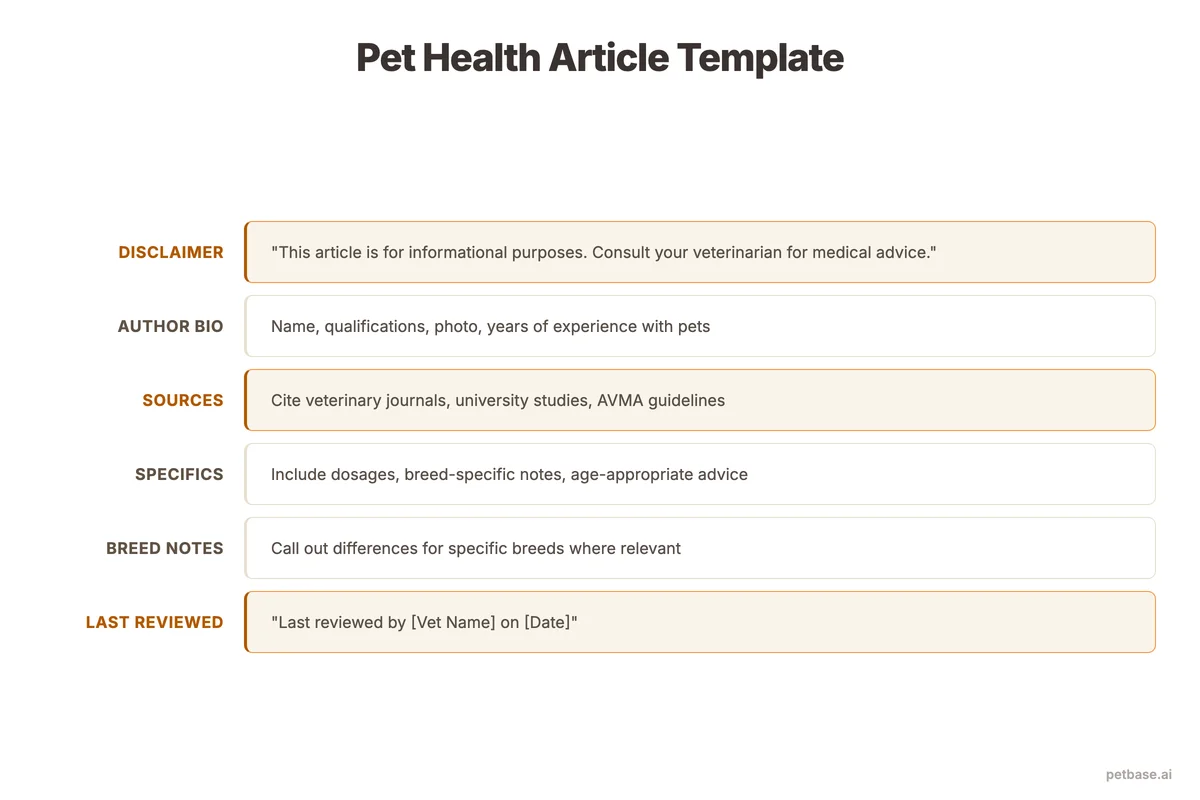
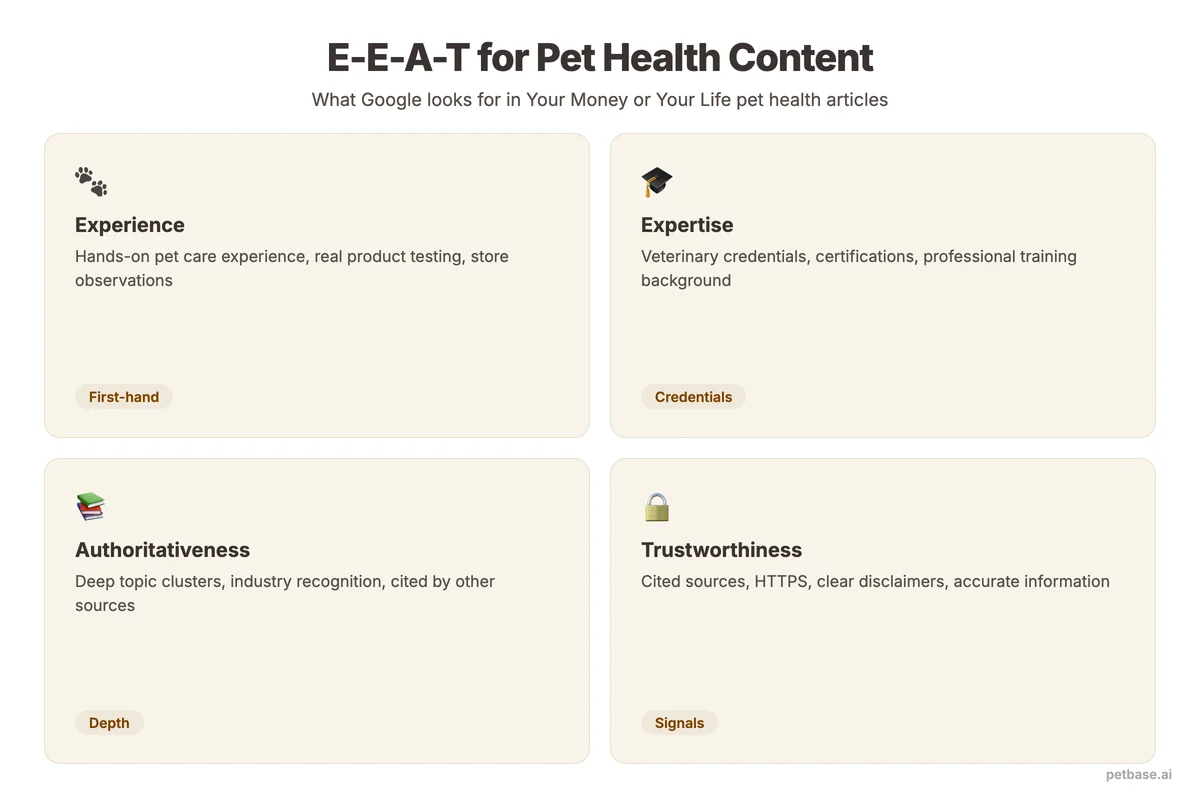
Each letter maps to a specific set of signals you can build into your content:
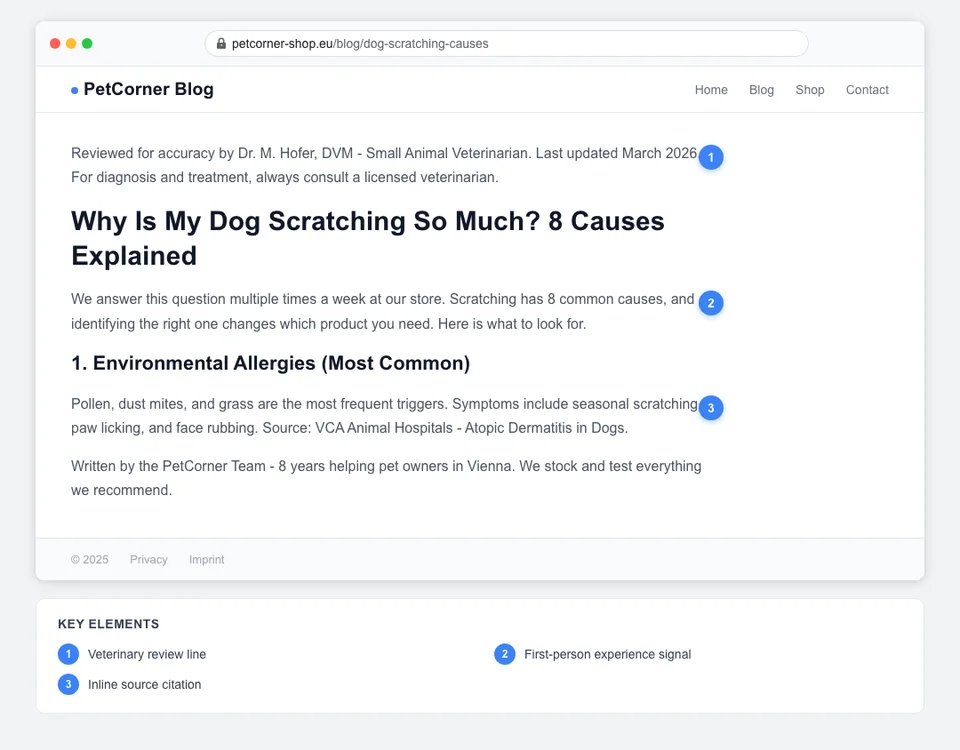
Experience means demonstrating first-hand knowledge. For a pet business, this means writing from the perspective of someone who works with pet owners daily. Phrases like "we see this question constantly" or "customers often ask us about..." are experience signals. So is specificity - describing real scenarios, real products, real results.
Expertise means demonstrating subject-matter knowledge. In pet health content, this means showing you understand the topic at a level beyond what a casual reader could produce. Citing mechanisms of action, referencing clinical studies, explaining why something works - these are expertise signals.
Authoritativeness is about who you are, not just what you say. It is built through author bios, external links pointing to your content, citations from authoritative sources pointing outward, and consistent publication over time. The data backs this up: the #1 Google result has an average of 3.8x more backlinks than positions #2 through #10[5]. A pet business that publishes 10 well-sourced health articles per month builds authority faster than one that publishes 1 article a year.
Trustworthiness covers the operational signals: author names visible, contact information present, sources cited, dates current, accuracy consistent with clinical consensus. It also means being honest about what you do not know and pointing readers to a vet when needed. 93% of consumers say online reviews affect their buying decisions[6] - trust is not just a Google metric, it is a business metric.
| E-E-A-T Signal | How to Implement It | Priority for Pet Health |
|---|---|---|
| Named author with bio | Add author name and short credential line to every health post | High |
| Veterinary review note | Add Reviewed by [Vet Name], DVM or equivalent disclaimer | High for YMYL topics |
| Cited sources (inline links) | Link to VCA, PetMD, AVMA, peer-reviewed studies | High |
| Publish date + last updated date | Show both dates at top of article | Medium |
| First-person experience signals | Reference real-world observations from store or customers | Medium |
| Clear scope statements | Open with what the article does and does not cover | Medium |
| Vet referral statements | Explicitly recommend consulting a vet for diagnosis and treatment | High for symptom content |
| Consistent factual accuracy | Cross-check every claim against a clinical source before publishing | Very High |
| Contact page + about page | Site-level trust signals that support article-level trust | Medium |
| Topic cluster depth | Multiple connected health articles signal topical authority | High over time |
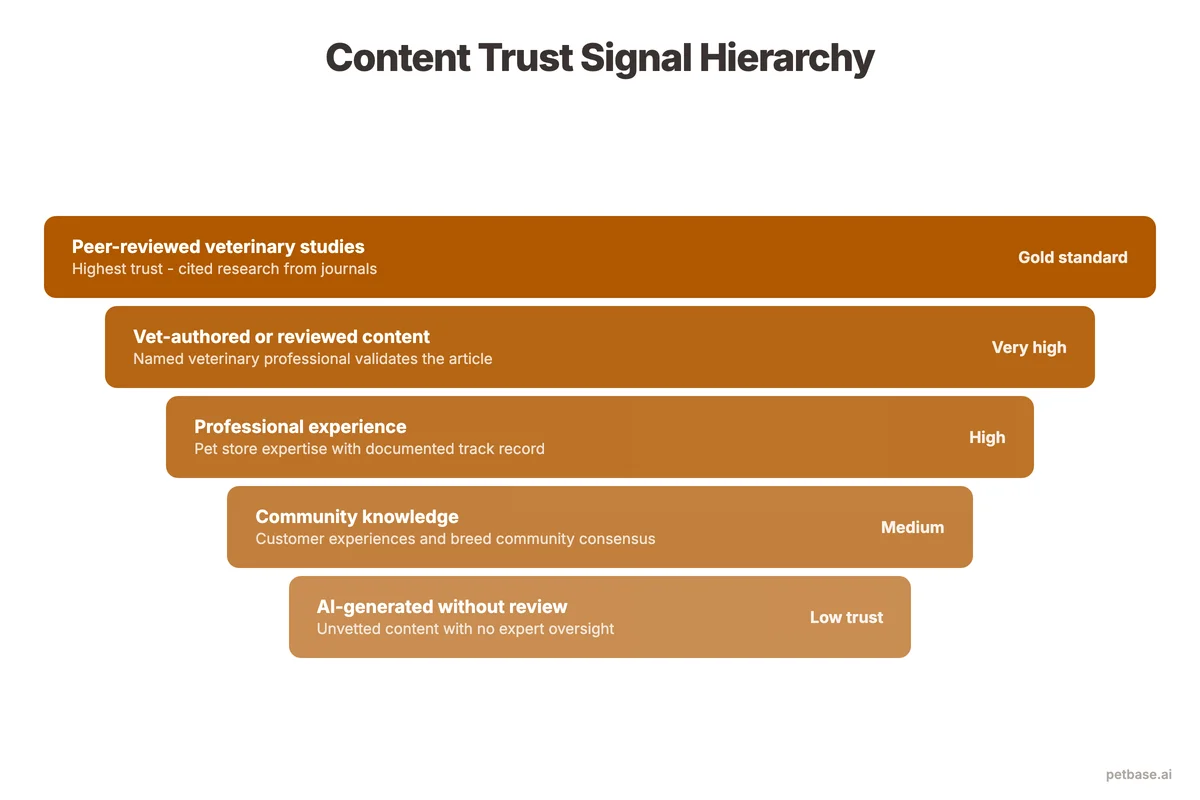
The most common mistake pet businesses make is writing health content without any of these signals. The article might be accurate, but it looks like a machine wrote it with no accountable human behind it. That is a trust failure, and Google's quality filters will catch it.
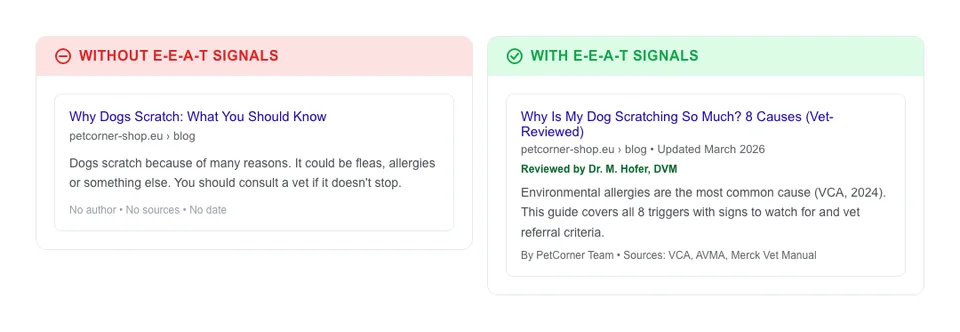
This connects directly to the broader SEO strategy. See our post on pet blog SEO for how individual health articles fit into a larger topical authority structure.
What Sources Should You Cite in Pet Health Articles?
Citing sources is not just about covering yourself - it is a direct trust signal that Google's quality raters look for in YMYL content. The right sources add credibility to your article and signal that you have done the research to back up your claims.
The wrong sources (or no sources) do the opposite. An article that cites no one, or cites another pet business's blog as its authority, looks like a copy-and-paste job. Google's systems have seen enough of those to filter them reliably.
These are the source types that carry the most weight for pet health content:
| Source Type | Examples | Trust Impact | When to Use |
|---|---|---|---|
| Veterinary clinical databases | VCA Animal Hospitals, Merck Veterinary Manual | Very High | Symptom descriptions, medications, dosing |
| Veterinary professional associations | AVMA, BSAVA, BVA | Very High | Policy statements, general health guidance |
| Peer-reviewed research | PubMed, Journal of Veterinary Internal Medicine | Very High | Specific health claims, efficacy data |
| Veterinary schools and universities | Cornell Feline Health Center, UC Davis | High | Breed health, condition overviews |
| Government animal health agencies | USDA APHIS, DEFRA (UK) | High | Regulatory topics, disease outbreaks |
| Established pet health publishers | PetMD, AKC Health, The Spruce Pets | Medium-High | General care guides, breed info |
| Other pet business blogs | Competitor content, generic pet sites | Low | Avoid for health claims |
| Unattributed health claims | Experts say, studies show (without citation) | Very Low | Never use for YMYL topics |
The practical rule: every factual health claim in your article should be traceable to a clinical source. You do not need to cite every sentence, but any claim about dosing, symptoms, safety, or efficacy needs a link.
Inline links are better than footnotes for web content. Link the specific phrase, not "click here." And keep your sources current - a 2009 study on pet nutrition is less credible than a 2023 update from the same institution.
Adding structured data (schema markup) to your health articles amplifies these trust signals. Pages with schema markup see up to 30% higher click-through rates[7]. MedicalWebPage or Article schema with author and reviewer properties tells Google exactly who stands behind the content.
How to Show Expertise When You Are Not a Vet
Pet businesses are not veterinary clinics, and pretending otherwise is a mistake. But not being a vet does not disqualify you from writing credible pet health content. It just means you need to be honest about your perspective and build expertise signals from where you actually stand.
The pet business perspective is genuinely valuable. You see hundreds of pet owners every month. You know what questions come up constantly. You know which products customers reach for when their dogs are scratching or their cats stop eating. That experiential knowledge is a legitimate E-E-A-T signal if you frame it correctly.
Here is how to write credible pet health content without veterinary credentials:
Write from the pet owner's perspective, not the clinician's. You are helping someone understand a situation, decide whether to see a vet, and find the right products while they wait. You are not diagnosing or prescribing. That framing is honest and appropriate.
Use your business experience as a credibility anchor. Phrases like "We get asked about this every week" or "Customers who come in with this problem usually tell us..." are legitimate experience signals. They show you have real-world contact with the problem, not just research knowledge.
Be explicit about the limits of the article. Opening with a note like "This article explains what to look for. For diagnosis and treatment, always consult a vet" is not a weakness - it is a trust signal. It shows you understand the limits of your role.
Partner with a local vet for review. Many veterinarians are happy to review content in exchange for a mention and a backlink. One vet reviewing 2-3 articles per month changes the entire credibility profile of your blog.
Cite everything that counts as medical information. If you write that a symptom usually resolves in 3-5 days, link to the clinical source. If you say a certain food ingredient is safe, link to the study. Sourcing replaces credentials when credentials are not available.
This approach is how pet businesses with no veterinary staff build genuine authority in pet health content. The key is consistency - 10 well-sourced, properly framed health articles over 3 months builds more trust than 1 vet-written article published once. Companies with active blogs get 55% more website traffic than those without[8]. That traffic compounds as each article reinforces your topical authority.
See how this fits into a full content strategy in our guide to content marketing for pet businesses.
Which Pet Health Topics Are Safe to Write About?
Not all health topics carry the same risk. Some are well within reach for a pet business blog - they get high search volume, they help customers, and they do not require veterinary credentials to write accurately. Others sit in territory where a single factual error could cause real harm, and those require a higher level of care.
Here is how to think about topic selection:
Safe to write about (low-moderate YMYL risk):
- General nutrition principles (protein needs, hydration, feeding schedules)
- Life-stage care (puppy vs. adult vs. senior nutrition differences)
- Common supplements (omega-3, probiotics - mechanisms, benefits, general safety)
- Seasonal care (flea and tick prevention timing, heatstroke prevention basics)
- Breed overviews with health notes (common breed predispositions, not diagnosis)
- Dental care basics (brushing frequency, signs to watch for)
- Weight management and body condition scoring
- Behavioral health basics (stress signs, enrichment, exercise needs)
Write with care (moderate-high YMYL risk - needs sourcing and vet referral):
- Symptom explainers (what does it mean when my dog vomits foam)
- Medication overviews (what a drug is, how it works - not dosing advice)
- Specific condition overviews (diabetes, kidney disease, arthritis in dogs)
- Vaccination schedules and general guidance
- Parasite identification and prevention
- Food safety (what is toxic vs. safe - link to authoritative lists)
Avoid or only publish with vet authorship (very high YMYL risk):
- Dosing recommendations for any medication
- Diagnostic guidance (if your dog shows these 3 symptoms, it is probably...)
- Treatment protocols
- Surgical preparation or recovery guidance
- Emergency first aid beyond basic triage (keep calm, go to the vet now)
The volume opportunity is in the first two categories. Thousands of pet owners search for symptom explainers and condition overviews every day. If you write those well - with proper framing, sourcing, and vet referral language - you can capture significant traffic without needing a vet on staff.
For a full picture of which blog topics drive actual sales, see our article on which blog posts drive sales for pet stores.
How to Add Veterinary Review Signals to Your Content
A veterinary review signal is any on-page element that shows a qualified professional has verified the medical content. It is one of the strongest E-E-A-T signals for pet health articles, and it is more accessible than most pet businesses realize.
You do not need a full-time consulting vet. You need a consistent relationship that adds a credibility layer to your highest-risk content.
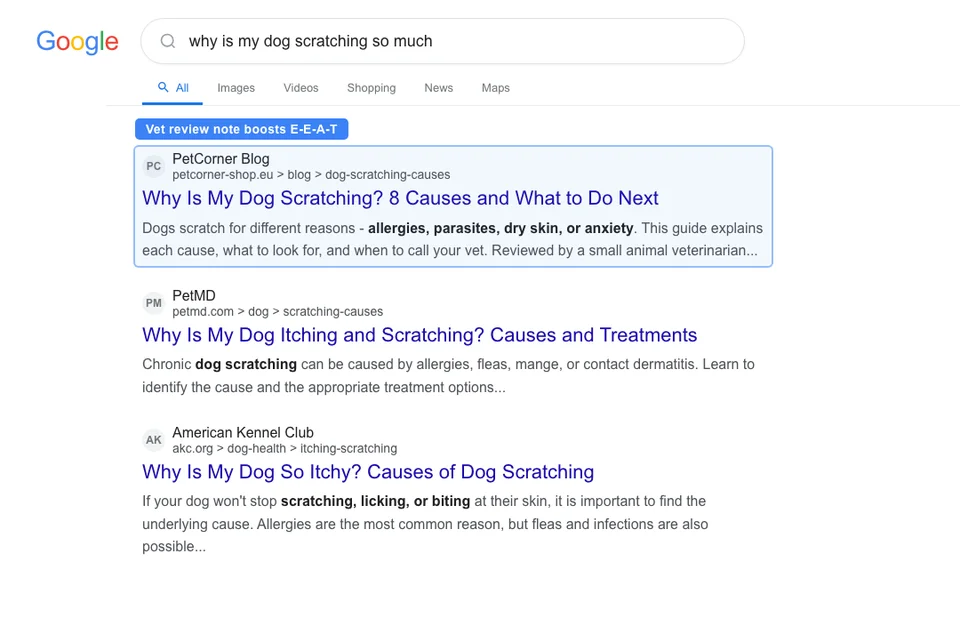
The review byline. The simplest signal is a line at the top of the article: "Reviewed by [Name], DVM." This works best when the vet is named, has a short bio link, and the bio confirms their credentials. An anonymous "reviewed by a vet" is weaker but still better than nothing.
The disclaimer block. A visible block at the top of every health article that says something like: "This article is for informational purposes only and does not substitute veterinary advice. Always consult a licensed veterinarian for diagnosis or treatment." This is not just a legal disclaimer - it is a trust signal that tells Google and the reader you understand the limits of the content.
The expert quote. Including a direct quote from a vet - even a single sentence - adds a strong expertise signal. For example: "Dr. Sarah K., a small animal veterinarian, notes that early detection is critical in managing feline hyperthyroidism." This is credible even if the vet is not actively reviewing the full article.
The linked source chain. If every medical claim in the article links to a clinical source (VCA, Merck Vet Manual, PetMD), the article self-certifies its accuracy. This partially replaces the vet review signal when a review is not available.
The update date and accuracy note. Adding "Last reviewed for accuracy: [Month Year]" tells Google this content is actively maintained. Outdated health content is a negative signal - current content is a positive one.
None of these are hard to implement. A pet business publishing 10 articles per month with consistent review signals builds a trust profile that very few competitors can match in the pet niche.
For veterinary clinics looking at the same challenge from a different angle, see our guide on SEO for veterinary clinics.
Pet Health Content Templates That Rank
Template-based writing sounds mechanical, but it is how you consistently hit the E-E-A-T signals that health content requires. The best-performing pet health articles follow predictable structures because those structures work - they answer the reader's question quickly, build trust early, and satisfy Google's quality criteria.
Here are the three templates used most often for pet health content that ranks:
Template 1: The Symptom Explainer
Use for: "Why is my dog doing X" or "what does it mean when my cat..."
- 40-60 word direct answer: the most common causes, framed clearly
- The full list of possible causes (2-3 sentences each)
- Warning signs that mean go to the vet now (bulleted list)
- What you can do at home while you wait (practical, non-diagnostic)
- Products that help (link to relevant items in your store)
- When to call the vet (clear, specific guidance)
- Sources (inline links throughout and visible list at end)
Template 2: The Nutrition or Supplement Guide
Use for: "best [ingredient] for dogs," "should I give my cat [supplement]"
- Direct answer: what it is and whether it is generally recommended
- How it works (mechanism of action in plain language)
- Benefits backed by sources
- How to choose (what to look for on the label)
- How to dose (reference a clinical source, not your own recommendation)
- Products in your store that fit the criteria
- Vet referral note
Template 3: The Condition Overview
Use for: "diabetes in cats," "arthritis in older dogs," "feline kidney disease"
- What is [condition] - definition in plain language
- Symptoms to watch for (list format)
- How it is diagnosed (brief - this is the vet's territory)
- How it is typically managed (reference clinical sources)
- What you can do as an owner (diet, environment, monitoring)
- Products that support management (relevant store items)
- Disclaimer block and vet referral
The key element in all three templates: products appear naturally, after the educational content. The reader learns first, then finds relevant products in context. This is more persuasive than leading with products, and it is what Google considers genuinely helpful content.
This is also where AI content tools for pet businesses fit in - generating first drafts of these templates at scale, then reviewing and sourcing them before publish.
For a deeper look at building a sustainable blog strategy around these templates, see our guide to pet store blog strategy.
Frequently Asked Questions
Can a pet business write about pet health topics?
Yes. Pet businesses can write credible pet health content as long as it is framed from the owner and retailer perspective - not as clinical advice. The key is to explain, inform, and guide readers toward a vet when needed, not to diagnose or prescribe. Pet businesses that write honestly about their limits and source their claims consistently build real Google trust over time.
Do I need a vet to review my content?
For low-to-moderate YMYL topics (nutrition basics, seasonal care, supplement overviews), a vet review is helpful but not required if your sourcing is strong. For higher-risk topics (symptom guides, specific conditions, medication overviews), a vet review line significantly improves both your trust signal and your ranking potential. The minimum viable approach: source every health claim to a clinical database and add a clear disclaimer at the top of every health article.
What pet health topics should I avoid writing about?
Avoid any content that could be interpreted as diagnostic or prescriptive: stating that your dog probably has a specific condition based on symptoms, specific medication dosing, surgical guidance, or emergency protocols that go beyond directing readers to a vet immediately. These topics require veterinary authorship. Every other health topic is available to you if you write it with proper framing, sourcing, and referral language.
How does Google evaluate pet health content?
Google applies its YMYL (Your Money or Your Life) guidelines to pet health content. That means quality raters look for E-E-A-T signals: named authors with relevant experience or credentials, citations to authoritative clinical sources, accurate and current information, and clear trust signals like vet review notes and disclaimer blocks. Generic, unsourced health articles are filtered out in favor of content that demonstrably invested in accuracy and trustworthiness.
The Bottom Line
Pet health content is not impossible for a pet business - it just requires more structure than a product roundup. The businesses that get it right earn organic traffic that compounds over months and years, because well-sourced health content stays relevant and keeps ranking long after it is published.
The formula is consistent: write from your actual perspective, source every health claim, add visible trust signals, and frame every article around helping the pet owner - not diagnosing their pet. That is the content Google rewards.
If you want to publish pet health content at scale without writing every article from scratch, Petbase generates E-E-A-T-aligned, sourced pet health articles tailored to your niche - and publishes them directly to your CMS every month. 10 articles per month at EUR 199/mo. Start your free trial and see what consistent health content publishing looks like for your business.
References
- BrightEdge (2019). Organic Search Is Still the Largest Channel. seoinc.com
- Precedence Research (2025). Veterinary Services Market Size, Share & Trends Analysis. precedenceresearch.com
- Grand View Research (2025). Pet Grooming Services Market Analysis. grandviewresearch.com
- Clutch (2025). SEO Statistics. clutch.co
- BuzzStream (2025). 70 Link Building Statistics. buzzstream.com
- BrightLocal (2025). Local Consumer Review Survey. brightlocal.com
- Amra and Elma (2025). Top Schema Markup Statistics. amraandelma.com
- HubSpot (2025). Marketing Statistics. hubspot.com