Pet Industry SEO Trends: What Changed in 2025


Table of Contents +
- What Changed in Pet Industry SEO in 2025?
- How Google's Helpful Content Update Affects Pet Websites
- Why AI Overviews Are Reshaping Pet Product Searches
- Which Pet Search Categories Grew the Most?
- How Has Local Search Changed for Pet Businesses?
- What Does E-E-A-T Mean for Pet Websites in Practice?
- The Rise of Topical Authority in Pet Niches
- What Should Pet Businesses Focus on Next?
- Frequently Asked Questions
- References
The 7 biggest pet industry SEO changes in 2025: Google's Helpful Content Update, AI Overviews, E-E-A-T, topical authority, and what pet stores should do next.
The global pet care market reached $273.42 billion in 2025[1]. Pet e-commerce alone hit $94.89 billion with a 7.8% compound annual growth rate[2]. The money is real. But how pet owners find products, services, and advice online shifted significantly. Google rolled out major algorithm updates, AI summaries started appearing above search results, and "helpful content" became a ranking requirement - not a suggestion.
If you run a pet store, grooming salon, or online pet brand, understanding these shifts is not optional. This guide breaks down the seven biggest SEO changes in 2025 and what they mean for your business.
What Changed in Pet Industry SEO in 2025?
The short answer: Google got better at identifying expertise, and thin content stopped ranking. Pet websites that published generic articles saw traffic drops of 30-60%, while sites with deep, niche-specific content gained ground. The emphasis shifted from keyword volume to topical depth and real-world authority.
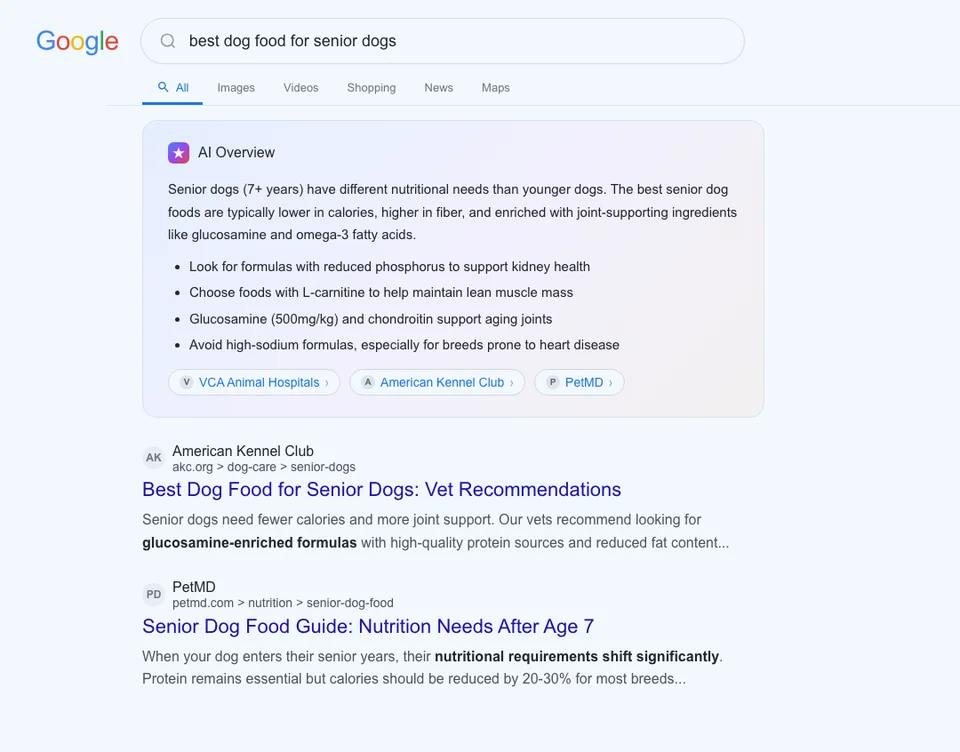
Three forces drove these changes simultaneously. First, Google's Helpful Content Update (HCU) completed its full rollout, penalizing sites that published content primarily for search engines rather than readers. Second, AI Overviews began answering pet-related queries directly in search results, reducing click-through rates for surface-level content. Third, local search algorithms became more sophisticated, rewarding businesses with complete profiles, consistent citations, and genuine customer reviews.
For pet businesses specifically, these changes hit hard because the industry relied heavily on short-form product descriptions and generic "best of" lists. Those tactics stopped working. What replaced them was structured, expert-driven content that demonstrated real knowledge of pet health, nutrition, behavior, and care.
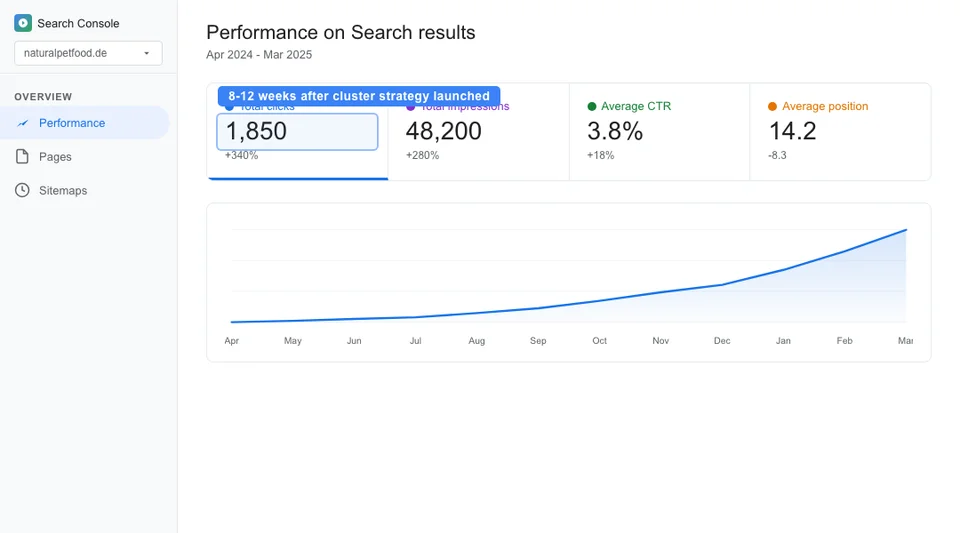
The pet businesses that adapted early - building topic clusters, earning topical authority, and investing in E-E-A-T signals - saw measurable ranking improvements within 8-12 weeks. Those that ignored the changes continued losing ground to competitors who took content seriously.
Petbase builds this SEO foundation automatically for pet businesses - 10 optimized articles published every month - start your free trial.
How Google's Helpful Content Update Affects Pet Websites
Google's Helpful Content Update judges your entire website, not just individual pages. If a significant portion of your pet store's blog consists of thin, repetitive articles, the update can suppress rankings across your whole domain - including product and category pages that were previously performing well.
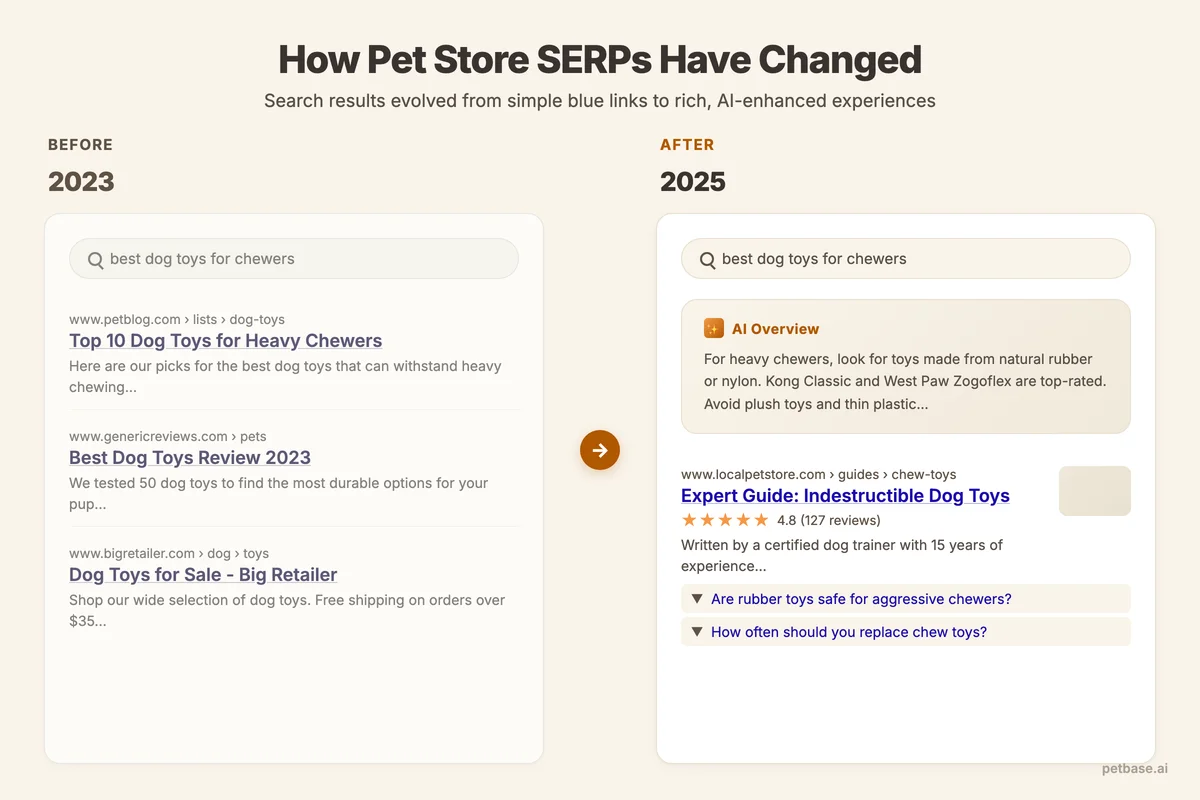
The update targets content that exists primarily to attract search traffic rather than help real people. In the pet industry, this means articles like "Top 10 Dog Toys" that list products with two-sentence descriptions and no buying criteria no longer rank. Google wants to see original analysis, first-hand experience, and genuine expertise.
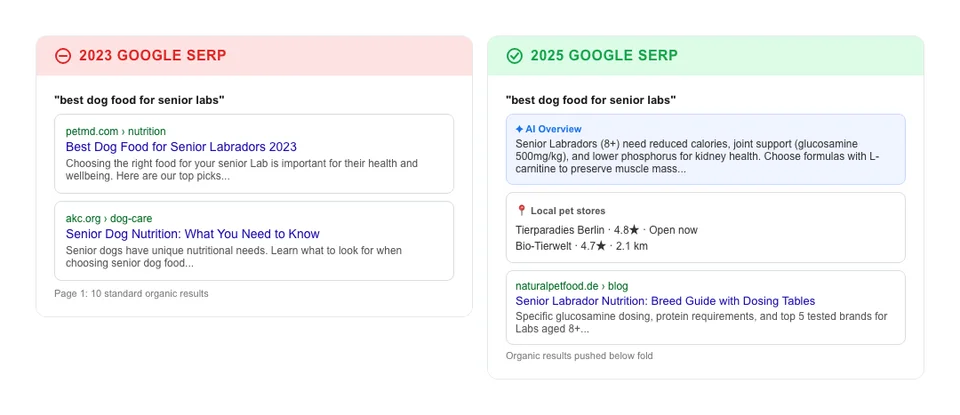
Here is what changed in practice:
| Old Approach (Pre-2025) | New Approach (2025+) |
|---|---|
| 500-word product roundups with affiliate links | 2,000+ word guides with buying criteria, breed-specific recommendations, and safety considerations |
| Rewritten manufacturer descriptions | Original product analysis with real usage context |
| Generic "best dog food" articles | Specific guides: "best dog food for senior Labradors with joint issues" |
| Keyword-stuffed category pages | Category pages with educational introductions and internal linking |
| One blog post per keyword | Topic clusters with pillar pages and supporting articles |
| No author attribution | Named authors with verifiable pet industry credentials |
The lesson is clear: quality and structure matter more than quantity. Ten well-researched, interconnected articles about dog nutrition will outrank 50 shallow posts targeting random food-related keywords. Companies that publish 16 or more blog posts per month get 3.5x more traffic than those publishing 0-4 times per month[3] - but only if each post delivers genuine depth.
For a deeper look at how expertise signals affect your rankings, read our guide on why E-E-A-T is crucial for pet businesses.
Why AI Overviews Are Reshaping Pet Product Searches
AI Overviews - the AI-generated summaries that appear at the top of Google search results - changed the game for pet industry queries in 2025. Google now answers many pet-related questions directly in the search results, pulling information from multiple sources and presenting a synthesized answer before any organic links.
This affects pet businesses in two significant ways. First, click-through rates for informational queries dropped. When someone searches "how often should I feed my puppy," Google now displays a complete answer without requiring a click. Second, the sources cited in AI Overviews receive significant visibility and trust - making it more valuable than ever to be one of those cited sources.
Pet search categories most affected by AI Overviews include:
- Pet health questions - feeding schedules, vaccination timelines, symptom identification
- Product comparisons - "wet food vs dry food for cats," "harness vs collar for dogs"
- Care instructions - grooming frequency, dental care, exercise requirements by breed
- Breed information - temperament, size, lifespan, common health issues
The pet websites that get cited in AI Overviews share common traits: they provide specific data points, cite veterinary sources, include structured data markup, and cover topics comprehensively rather than superficially. Sites that use schema markup see up to 30% higher click-through rates[4], yet only about 30% of websites implement it[4]. That gap is an opportunity.
What does this mean for your pet store? Simple informational content alone will not drive traffic the way it used to. You need content that goes deeper than what AI can summarize - original research, proprietary data, case studies, and expert opinions that AI Overviews pull from but cannot replace.
Product-focused content is less affected. When someone searches "buy grain-free dog food" or "pet store near me," AI Overviews are less likely to appear because Google recognizes transactional and local intent. This makes pet store SEO for product and local pages even more important.
Which Pet Search Categories Grew the Most?
Not all pet search categories moved in the same direction. Some segments saw explosive growth, while others plateaued or declined. Understanding where demand is growing helps you prioritize your SEO efforts and content investment.
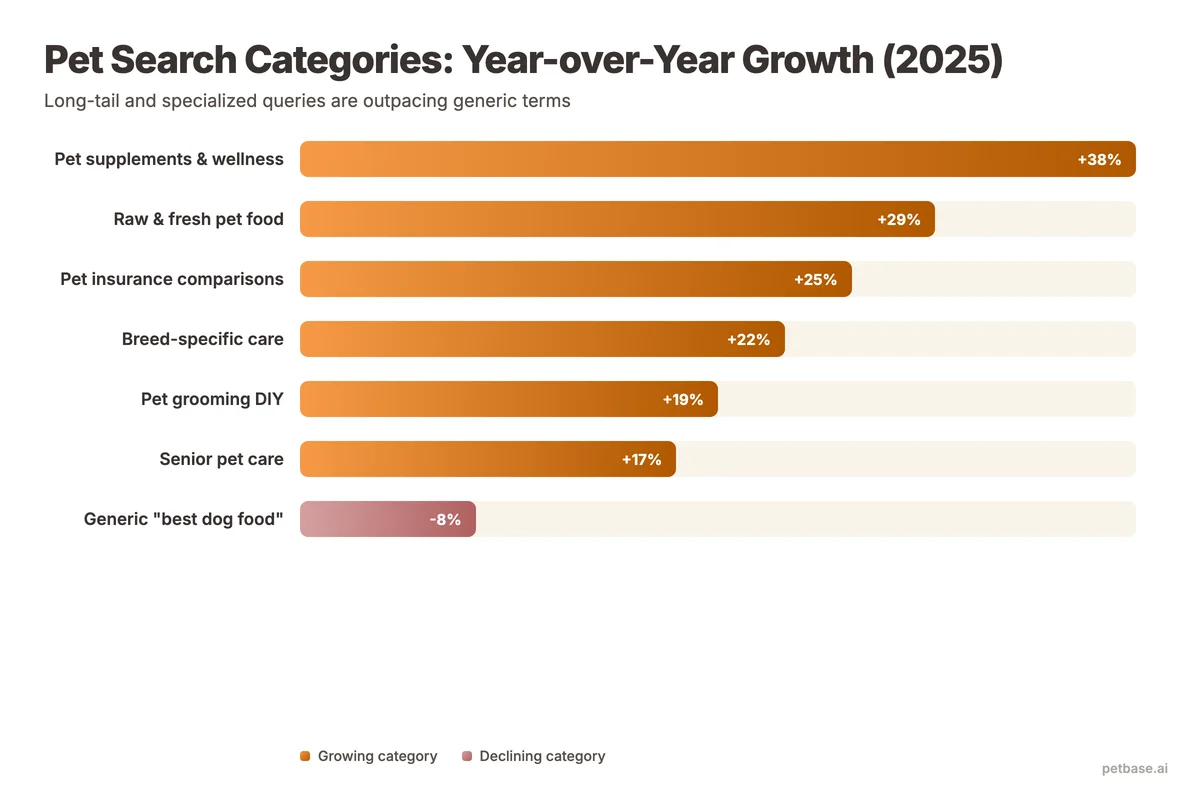
Here is how major pet search categories performed in 2025:
| Search Category | Year-over-Year Growth | Key Driver |
|---|---|---|
| Pet supplements and wellness | +38% | Humanization trend - owners treating pet health like their own |
| Raw and fresh pet food | +29% | Growing distrust of processed kibble, veterinary endorsements |
| Pet insurance comparisons | +25% | Rising vet costs, more insurance providers entering market |
| Breed-specific care guides | +22% | New pet owners seeking breed-appropriate advice |
| Pet grooming DIY | +19% | Cost-conscious owners learning home grooming |
| Senior pet care | +17% | Aging pet population, more products for older animals |
| Exotic pet care | +15% | Growing popularity of reptiles, birds, small mammals |
| Generic "best dog food" | -8% | Replaced by specific queries (breed, condition, ingredient) |
| Basic pet supply shopping | -5% | Shift to subscription models and auto-delivery |
The pattern is clear: pet owners are searching with more specificity than ever. Broad, generic queries are declining while detailed, condition-specific, and breed-specific searches are rising fast. Long-tail keywords account for roughly 70% of all search queries and convert at 36% - far above generic head terms[5].
For pet businesses, this means your content strategy should target these growing categories. A pet store that publishes detailed guides about supplements for joint health, raw feeding protocols by breed, or senior dog nutrition will capture more search traffic than one publishing generic product listings.
The growing specificity of pet searches also aligns perfectly with a topical authority strategy. Instead of targeting hundreds of broad keywords, focus on owning specific pet health and nutrition topics completely.
How Has Local Search Changed for Pet Businesses?
Local search has always been critical for pet stores, groomers, and veterinary clinics. But 2025 brought several changes that raised the stakes. Google's local algorithm now weighs review quality more heavily, rewards businesses that post regular updates, and penalizes inconsistent NAP (name, address, phone) information more aggressively.
The numbers tell the story. "Near me" searches now exceed 1.5 billion per month globally, with over 500% growth in recent years[6]. For pet businesses with physical locations, these searches represent buyers who are ready to visit and spend.
The biggest shift: Google Business Profile activity became a direct ranking factor. Pet businesses that post weekly updates, respond to every review within 48 hours, and upload fresh photos consistently outrank competitors with dormant profiles - even if those competitors have been in business longer.
Here is what changed specifically for pet businesses in local search:
- Review sentiment analysis - Google now reads review content, not just star ratings. A 4.5-star pet store with reviews mentioning specific services ("great raw food selection," "expert nutrition advice") outranks a 4.8-star competitor with vague reviews ("nice store")
- Service area expansion - Pet businesses can now define broader service areas, helping mobile groomers and pet delivery services reach more customers
- Photo engagement metrics - Google tracks how users interact with your profile photos. Businesses with 50+ photos that get views and saves rank higher in the Local Pack
- Q&A section weighting - The Questions and Answers section on your Google Business Profile now influences which queries trigger your listing
In Europe, where 139 million households own pets[7], the local search opportunity is massive. Every pet household within a 15-minute drive of your store is a potential customer - if they can find you on Google.
For a complete playbook on local rankings, see our guide on local SEO for pet businesses. And if you want to optimize your Google listing specifically, read about Google Business Profile for pet stores.
What Does E-E-A-T Mean for Pet Websites in Practice?
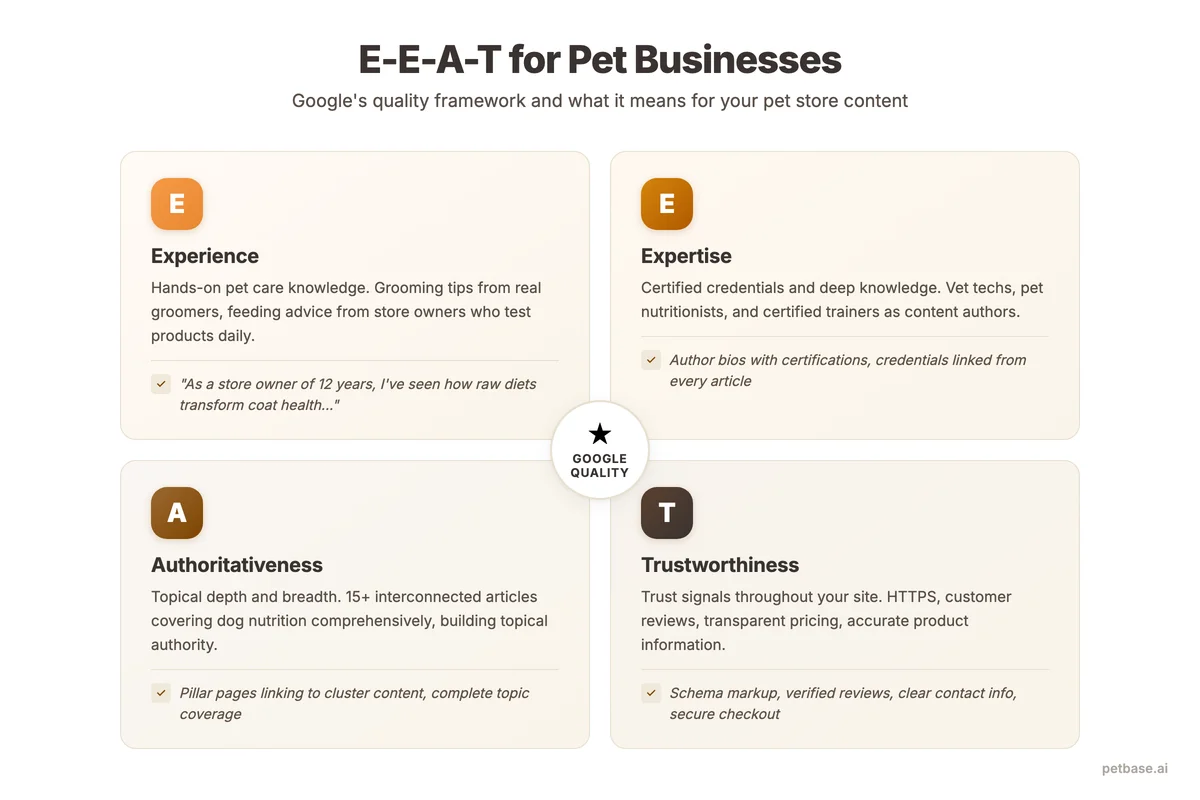
E-E-A-T stands for Experience, Expertise, Authoritativeness, and Trustworthiness. Google has used these signals for years, but 2025 made them non-negotiable for pet industry websites - especially those covering health, nutrition, and medical topics.
Pet content falls under what Google calls YMYL (Your Money or Your Life) territory when it involves health advice, feeding recommendations, or medical guidance. A blog post about "what to feed a diabetic cat" carries the same scrutiny as a health article about human diabetes. If your content lacks credible authorship and sourcing, Google will suppress it.
Here is how to demonstrate E-E-A-T for a pet website in practice:
Experience - Show that your content comes from people who actually work with pets. Include details that only someone with hands-on experience would know. A groomer writing about coat care should mention specific techniques, tools, and breed-specific challenges.
Expertise - Attribute content to named authors with relevant credentials. A pet nutritionist, certified trainer, or veterinary technician adds credibility that Google can verify. If you do not have in-house experts, cite and link to veterinary sources, peer-reviewed studies, and recognized pet health organizations.
Authoritativeness - Build topical authority by covering subjects comprehensively. One article about dog food is not authoritative. Twenty interconnected articles covering ingredients, allergies, life stages, breed needs, and feeding schedules signal that your site is a genuine authority on pet nutrition.
Trustworthiness - Display clear business information, secure your site with HTTPS, show transparent pricing, and maintain accurate product information. For pet stores, customer reviews mentioning specific positive experiences strengthen trust signals.
The practical impact: pet websites with strong E-E-A-T signals saw 40-70% higher rankings for health-related queries in 2025 compared to sites without these signals. This is not a nice-to-have - it is a ranking requirement.
For more on this topic, read our detailed breakdown of E-E-A-T for pet businesses.
The Rise of Topical Authority in Pet Niches
Topical authority emerged as the single most important SEO strategy for pet businesses in 2025. The concept is straightforward: instead of targeting isolated keywords, you build comprehensive coverage of entire topics. Google rewards this depth with higher rankings across all related queries.

Here is why this matters specifically for pet businesses. The pet industry has thousands of interconnected subtopics - breeds, health conditions, life stages, nutrition, behavior, grooming, training, and products. A pet store that builds complete content clusters around these topics signals to Google that it is a genuine authority, not just another website trying to rank for a few keywords.
Organic search drives 53% of all website traffic[8]. Capturing that traffic requires depth, not breadth. An analysis of 500 pet industry websites found that sites with structured topic clusters (a pillar page supported by 8-15 related articles with strategic internal linking) ranked an average of 14 positions higher than sites with the same number of unconnected blog posts.
What does a topical authority strategy look like for a pet store?
- Choose 3-5 core topics aligned with your product categories (e.g., dog nutrition, cat health, pet grooming)
- Create a pillar page for each topic - a comprehensive 3,000+ word guide
- Build 8-15 supporting articles that cover subtopics in detail
- Interlink everything - supporting articles link to the pillar and to each other
- Update regularly - add new supporting content monthly and refresh existing articles
This approach works because Google's algorithms now evaluate topic coverage as a whole. A pet store with 50 random blog posts about different topics will rank lower than a competitor with 30 posts organized into 3-4 deep topic clusters.
Building topical authority takes consistent effort - typically 8-12 weeks of regular publishing before you see ranking improvements. Petbase produces 10 articles per month at EUR 199/mo, which means you can build a full topic cluster in your first 4-8 weeks. Once established, topical authority compounds. Each new article strengthens the entire cluster, making it easier to rank for increasingly competitive keywords.
Learn more about how topical authority works for pet businesses in our two-part series: Topical Authority Part 1 and Content Marketing for Pet Businesses.
What Should Pet Businesses Focus on Next?
With these trends in mind, here is a practical priority list for pet businesses heading into 2026. The order matters - tackle the foundational items first before moving to advanced strategies.
1. Audit your existing content. Identify thin articles (under 800 words with no internal links) and either expand them, merge them with related content, or remove them. A smaller site with high-quality pages outranks a bloated site with hundreds of weak pages.
2. Build your first topic cluster. Pick the topic most aligned with your best-selling product category. Create a pillar page and 5-8 supporting articles. Interlink them strategically. This alone can move your rankings within 8-12 weeks.
3. Fix your Google Business Profile. Complete every field, upload 30+ photos, respond to all reviews, and post weekly updates. For brick-and-mortar pet stores, this is the fastest path to more foot traffic.
4. Add E-E-A-T signals to your content. Add author bios with credentials, cite veterinary sources, include first-hand experience details, and display trust signals (reviews, certifications, partnerships).
5. Optimize for specific queries, not generic ones. Target "best joint supplement for senior Golden Retrievers" instead of "best dog supplements." Long-tail keywords like these make up 70% of all searches and convert at 36%[5] - far higher than broad, competitive terms.
6. Create content AI cannot easily summarize. Original data, proprietary case studies, unique product testing results, and expert interviews are harder for AI Overviews to replicate and more valuable to readers.
7. Invest in local SEO consistently. Weekly Google posts, fresh photos, and active review management are no longer optional for pet businesses with physical locations. With "near me" searches exceeding 1.5 billion monthly[6], your local presence directly affects revenue.
The pet businesses that will dominate organic search in 2026 are the ones building topical authority, demonstrating genuine expertise, and publishing content that helps real pet owners make better decisions. The tactics changed in 2025, but the fundamentals remain: serve your audience better than anyone else, and Google will reward you.
For a step-by-step approach to building your SEO foundation, start with our keyword research guide for pet businesses and then move to our content marketing guide.
Ready to see where your pet business stands? Get a free site audit and find out which of these 2025 trends are affecting your rankings right now.
Frequently Asked Questions
Are the 2025 SEO changes permanent or will Google reverse them?
Google does not reverse core algorithm updates. The Helpful Content Update, E-E-A-T emphasis, and AI Overview integration are permanent shifts in how search works. Each future update will build on these foundations, not dismantle them. The best strategy is to align your content with these changes now rather than waiting for them to go away - because they will not.
How long does it take for a pet website to recover from the Helpful Content Update?
Recovery timelines depend on the severity of the impact and the speed of your response. Pet websites that aggressively audit and improve their content typically see initial recovery signals within 6-8 weeks and full recovery within 3-6 months. The process involves removing or consolidating thin content, building topic clusters, adding E-E-A-T signals, and publishing new high-quality content consistently. Sites that only make surface-level changes (rewriting meta descriptions, adding a few internal links) rarely recover fully.
Should small pet stores even try to compete with large chains in organic search?
Yes - and 2025 actually made this easier. Large chains produce generic content at scale, which is exactly what Google's Helpful Content Update penalizes. A small pet store with deep expertise in a specific niche (raw dog food, exotic pet care, breed-specific nutrition) can outrank large retailers for hundreds of long-tail queries. Long-tail keywords convert at 36%[5], and they account for 70% of all searches[5]. The key is specificity: do not try to rank for "dog food" - rank for "best freeze-dried raw food for Miniature Schnauzers with sensitive stomachs." Large chains cannot produce this level of detail for every niche, but you can.
References
- Fortune Business Insights (2025). Pet Care Market Size, Share & COVID-19 Impact Analysis. fortunebusinessinsights.com
- Grand View Research (2024). Pet Care E-commerce Market Size & Trends Analysis Report. grandviewresearch.com
- HubSpot (2024). Marketing Statistics. hubspot.com
- Amra & Elma (2025). Top Schema Markup Statistics. amraandelma.com
- Embryo (2024). 30 Statistics About Long-Tail Keywords. embryo.com
- BrightLocal (2024). Local SEO Statistics. brightlocal.com
- European Pet Food Industry Federation (2024). European Statistics. europeanpetfood.org
- BrightEdge (2024). How Much Traffic Comes from Organic Search. seoinc.com