Why Your Pet Store Blog Isn't Getting Traffic


Table of Contents +
- Why Your Pet Store Blog Isn't Working (9 Reasons)
- Reason 1: Writing Topics Nobody Searches For
- Reason 2: Posts Don't Match Search Intent
- Reason 3: No Topic Cluster Strategy
- Reason 4: Content Is Too Thin
- Reason 5: No Internal Linking Between Posts
- Reason 6: Technical SEO Is Broken
- Reason 7: You Publish Once and Never Update
- Reason 8: Content Reads Like Everyone Else's
- Reason 9: Not Measuring the Right Things
- How to Fix Your Pet Store Blog in 30 Days
- References
9 reasons your pet store blog isn't getting traffic and a 30-day fix plan. Learn how to choose the right topics, match search intent, and build clusters.
You started a blog for your pet store. You wrote about your favorite dog food brands. You posted a few seasonal tips. Maybe you shared a photo of a new kitten in the shop. And then - nothing happened. No traffic. No rankings. No leads.
You are not alone. Organic search drives 53% of all website traffic[1], and companies with active blogs get 55% more traffic than those without[2]. The opportunity is real. But most pet store blogs fail to capture any of it because they repeat the same nine mistakes.
The good news: every one of these mistakes is fixable. This guide walks through each problem, shows you how to spot it on your own site, and gives you a concrete 30-day plan to turn your blog into a real traffic source.
Why Your Pet Store Blog Isn't Working (9 Reasons)
When a pet store blog does not get traffic, the problem is almost never "Google hates us." The problem is structural. With 7.5 million blog posts published every single day[3], most pet store blogs fail because of a combination of wrong topics, weak content, and missing technical foundations.
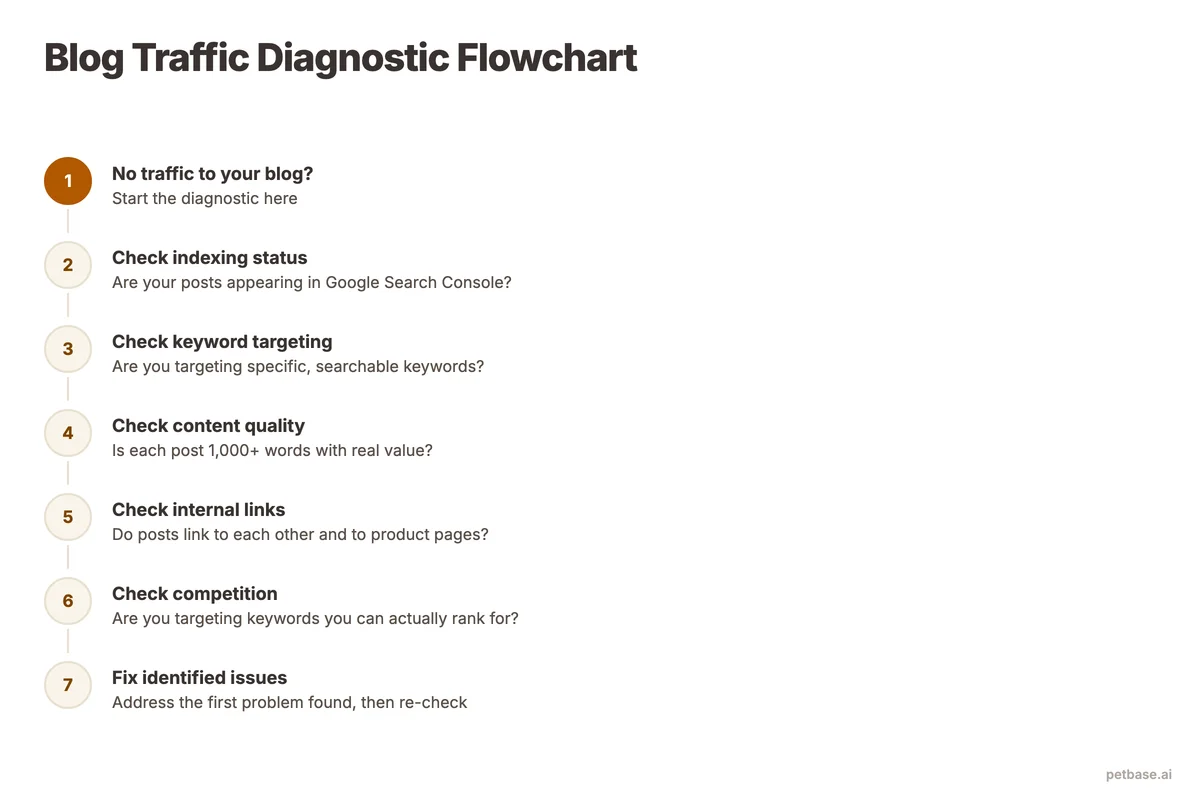
Here is a quick overview of all nine reasons before we dig into each one:
| Reason | Symptom | Fix | Priority |
|---|---|---|---|
| Writing topics nobody searches for | Posts get 0-10 visits/month | Keyword research before writing | High |
| Posts don't match search intent | High impressions, low clicks | Rewrite to match what searchers want | High |
| No topic cluster strategy | Random, disconnected posts | Build content clusters around core topics | High |
| Content is too thin | Posts under 800 words with no depth | Expand with real detail and examples | Medium |
| No internal linking between posts | Each post is an island | Add 3-5 internal links per post | Medium |
| Technical SEO is broken | Slow site, missing meta tags | Audit and fix technical foundations | High |
| Publish once and never update | Content ages out of relevance | Quarterly refresh schedule | Medium |
| Content reads like everyone else's | No differentiation, no expertise | Add unique insights and experience | Low |
| Not measuring the right things | Tracking vanity metrics only | Focus on impressions, clicks, conversions | Low |
Let's break each one down.
Petbase automates SEO content for pet stores - publishing 10 optimized articles monthly so you can focus on running your shop - start your free trial.
Reason 1: Writing Topics Nobody Searches For
This is the single biggest reason pet store blogs fail. You write what feels interesting to you - not what your customers are actively searching for on Google.
Common examples of zero-search topics:
- "Meet our new staff member Sarah"
- "Our favorite products this month"
- "Happy holidays from [store name]"
- "We just remodeled the shop"
These posts matter to your existing customers, but they bring zero new visitors from search. Nobody types "pet store staff introduction" into Google.
Meanwhile, hundreds of people in your area search for terms like:
- "best dog food for sensitive stomachs"
- "how often to groom a golden retriever"
- "grain-free vs regular dog food"
- "what treats are safe for puppies"
Long-tail keywords like these account for 70% of all searches and convert at 36%[4]. Each of these represents a real person with a real question - and a potential customer. The difference between a blog that gets traffic and one that does not starts right here: keyword research for pet businesses is not optional. It is the foundation.
How to check if your topics have search demand:
- Open Google Search Console (it is free)
- Look at which queries bring impressions to your site
- Use Google's "People also ask" box to find related questions
- Check Google autocomplete suggestions for your core topics
If you are writing 4 posts per month and none target keywords with actual search volume, you could publish for years and never see results.
Reason 2: Posts Don't Match Search Intent
Even when you target the right keyword, your post might not match what the searcher actually wants. This is called search intent mismatch, and it is a traffic killer.
There are four main types of search intent:
- Informational: "how to trim dog nails" - the person wants a guide
- Commercial: "best dog nail clippers" - the person wants a comparison
- Navigational: "PetSmart dog nail clippers" - the person wants a specific brand
- Transactional: "buy dog nail clippers online" - the person wants to purchase
Here is where pet stores go wrong: someone searches "best grain-free dog food" (commercial intent - they want a comparison), and your blog post is a 300-word opinion piece about why you personally like one brand. Google sees this mismatch and ranks the comparison articles instead.
How to fix intent mismatch:
- Search your target keyword on Google
- Look at the top 5 results
- Note the format: is it a list? A guide? A comparison? A product page?
- Match that format in your own content
Your pet blog SEO strategy depends on getting intent right. A 3,000-word guide will not rank for a keyword where Google shows product pages. A product page will not rank where Google shows educational guides.
Reason 3: No Topic Cluster Strategy
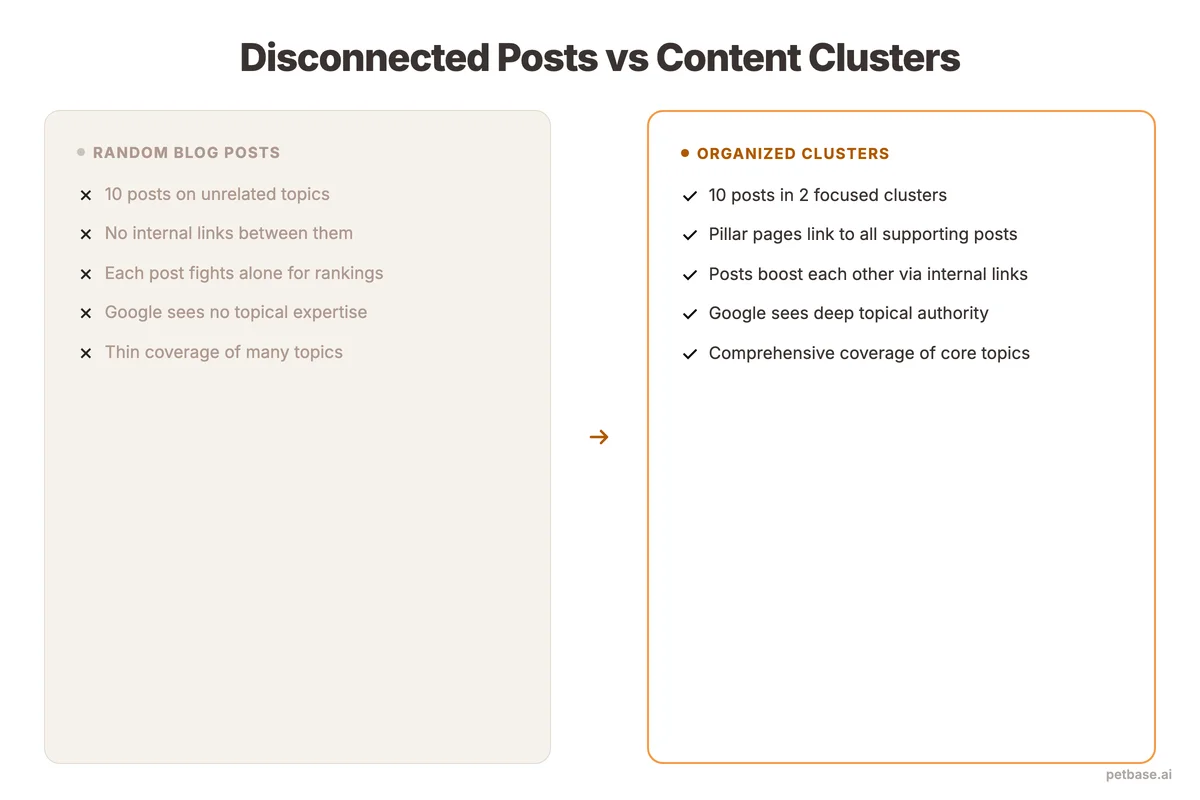
Most pet store blogs are a random collection of unrelated posts. One week it is a dog food review. Next week it is a cat grooming tip. Then a holiday sale announcement. There is no structure connecting these pieces.
Google ranks websites higher when they demonstrate deep expertise in a topic area. A single post about "dog nutrition" is a signal. Twenty interconnected posts about dog nutrition - covering ingredients, allergies, life stages, specific breeds, and feeding schedules - is a much stronger signal.
This is called content clustering, and it is how smaller pet stores outrank bigger competitors.
A content cluster has three parts:
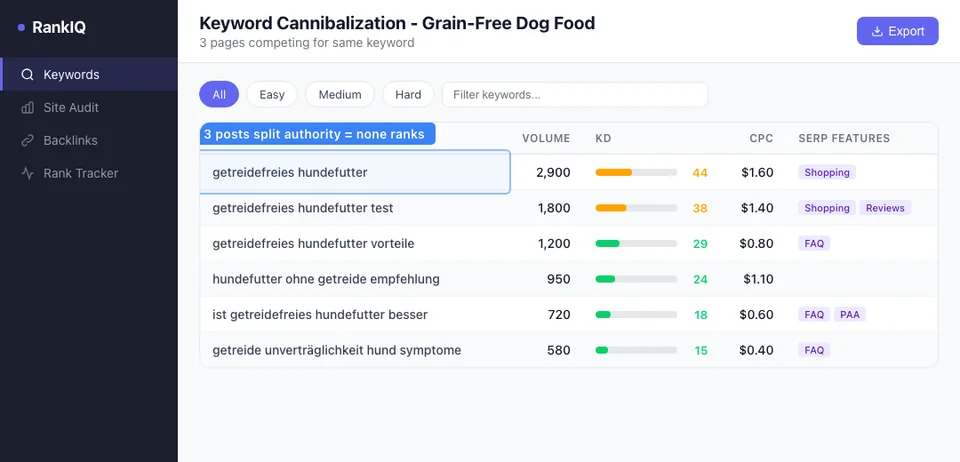
- Pillar page: a comprehensive guide (e.g., "Complete Guide to Dog Nutrition")
- Cluster posts: specific subtopics that link back to the pillar (e.g., "Best Food for Puppies," "Grain-Free vs Regular," "Feeding Schedule by Breed Size")
- Internal links: every cluster post links to the pillar and to related cluster posts
Without clusters, each blog post fights alone. With clusters, your posts support each other and tell Google: "This site is an authority on this topic."
Petbase builds content clusters automatically. When you set up your store's topic areas, the system maps out pillar pages and supporting posts, then publishes them on a schedule that builds topical authority over time. Instead of guessing which posts to write next, the cluster strategy is planned from the start.
Reason 4: Content Is Too Thin
Thin content is any post that fails to fully answer the searcher's question. For pet store blogs, this usually means posts that are under 800 words and only scratch the surface of a topic.
Here is a real pattern we see constantly: a pet store writes a post titled "How to Choose Dog Food" and it contains 400 words of generic advice like "look at the ingredients" and "talk to your vet." Meanwhile, the posts ranking on page 1 for that keyword contain 2,500+ words covering specific ingredients, life stage differences, breed-specific needs, common allergens, and feeding guidelines.
Companies that publish 16 or more posts per month get 3.5x more traffic than those publishing 0 to 4[5]. Volume matters, but only when each post has real depth. Thin content does not just fail to rank - it can actively hurt your site. When Google sees multiple thin posts on your domain, it lowers its quality assessment of your entire site.
What "enough depth" looks like for pet store content:
| Topic Type | Minimum Word Count | What to Include |
|---|---|---|
| Product comparison | 1,500-2,500 | Features, pros/cons, pricing, who it is best for |
| How-to guide | 1,500-3,000 | Step-by-step instructions, photos, common mistakes |
| Breed-specific guide | 2,000-3,500 | Needs, recommended products, care schedule |
| Ingredient explainer | 1,000-2,000 | What it is, benefits, risks, which products contain it |
| Pillar page | 3,000-5,000 | Comprehensive coverage, links to all subtopics |
You do not need to write every post at 5,000 words. But you do need to fully answer the question the searcher asked. If the top-ranking results are 2,000 words and yours is 400, you are not competitive. A solid pet store blog strategy plans depth from the start.
Reason 5: No Internal Linking Between Posts
Internal links are one of the most underused tools in pet store SEO. Every time you write a new blog post and do not link it to related existing posts, you waste an opportunity to strengthen both pages.
Internal links do three things:
- They help Google discover and index your pages
- They pass authority from one page to another
- They keep visitors on your site longer (which is a ranking signal)
Here is the rule of thumb: every blog post should contain at least 3-5 internal links to other relevant pages on your site. And when you publish a new post, go back to 2-3 existing posts and add a link to the new one.
For example, if you write a post about "best treats for puppies," you should link to:
- Your puppy nutrition pillar page
- Your treats category page
- Your post about puppy training (treats as rewards)
- Your post about ingredients to avoid for young dogs
Most pet store blogs we audit have zero internal links between posts. The posts exist in isolation. Google has no way to understand the relationship between your content pieces. This is one of the areas where on-page SEO for pet stores makes an immediate difference.
Petbase handles internal linking as part of every article it generates. Each post includes contextually relevant links to other posts in your cluster, building the web of connections that Google rewards.
Reason 6: Technical SEO Is Broken
You could write the best pet content in the world, and it will not rank if your technical SEO is broken. Technical issues act as a ceiling on your blog's potential.
The most common technical problems on pet store websites:
- Slow page speed: Images not compressed, no caching, heavy themes. Research shows 53% of visitors abandon a page that takes more than 3 seconds to load[6]. Even small improvements matter - each 0.1-second speed gain boosts conversions by 8.4%[6].
- Missing or poorly written meta tags: Data from an analysis of e-commerce sites shows the average title tag is just 39 characters and the average meta description is 96 characters[7]. If your tags are too short, too generic, or missing entirely, you lose clicks in search results.
- No schema markup: Schema helps Google understand your content type (article, FAQ, product). Without it, you miss out on rich snippets.
- Broken links: Links to pages that no longer exist create a poor user experience and waste your site's authority.
- No XML sitemap: Your sitemap tells Google which pages to crawl. Without one, Google might miss your blog posts entirely.
- Mobile issues: Over 60% of pet-related searches happen on mobile. If your site is not mobile-friendly, you lose the majority of your audience.
Run a quick health check on your blog using this diagnostic:
| Check | How to Test | Pass/Fail Criteria |
|---|---|---|
| Page speed | Google PageSpeed Insights | Score above 50 on mobile |
| Mobile friendly | Google Mobile-Friendly Test | No errors |
| Meta descriptions | View page source, search for meta description | Every page has a unique one |
| Sitemap | Visit yoursite.com/sitemap.xml | File exists and lists your blog posts |
| Broken links | Free tool like Broken Link Checker | Zero broken internal links |
| HTTPS | Check browser address bar | Padlock icon visible |
| Index status | Google Search Console Coverage report | Blog posts showing as "Valid" |
For a detailed walkthrough, see our technical SEO guide for pet websites. Fixing technical issues often produces the fastest ranking improvements because you are removing barriers rather than building something new.
Reason 7: You Publish Once and Never Update
Google favors fresh, accurate content. A blog post about "best dog food 2024" that has not been updated since it was published is already losing relevance. Search engines know when content was last modified, and they weigh freshness in their rankings.
The pet industry moves fast. New products launch. Ingredients fall in and out of favor. Feeding guidelines get updated. Regulations change. If your blog content does not keep up, it gradually drops in rankings.
Here is what an update schedule looks like for a pet store blog:
- Every 3 months: Review your top 10 posts by traffic. Update any outdated information, add new products, refresh internal links.
- Every 6 months: Rewrite posts that have dropped more than 10 positions. Add new sections, update the title if needed, add new images.
- Every 12 months: Audit all posts. Remove or consolidate posts that never gained traction. Redirect deleted posts to relevant alternatives.
Updating old content is often more effective than writing new posts. A refreshed post already has backlinks, indexation history, and domain authority working for it. A new post starts from zero. For a detailed approach, read our guide on updating old pet store blog posts.
Reason 8: Content Reads Like Everyone Else's
If your blog post about "how to choose dog food" reads exactly like every other post on page 1, Google has no reason to rank yours higher. Identical content adds no new value to the search results.
Google's Helpful Content system specifically rewards content that offers unique expertise, original insights, or a perspective that cannot be found elsewhere. For pet stores, this is actually a huge advantage - you have something most generic content writers do not: hands-on experience with products and customers.
Ways to differentiate your pet store content:
- Share what you see in-store: "We sell 3x more of Brand X than Brand Y because customers say..."
- Include specific product observations: "After stocking this treat for 6 months, we noticed dogs with sensitive stomachs tolerate it better than..."
- Add staff expertise: "Our groomer recommends this brush for double-coated breeds because..."
- Use customer questions: "The #1 question we get about raw feeding is..."
- Show real results: "Customers who switched to this food report coat improvements within 3-4 weeks"
This is the kind of first-hand experience that makes your content genuinely helpful. It is also exactly what Google's E-E-A-T (Experience, Expertise, Authoritativeness, Trust) framework rewards. Learn more about why this matters in our guide on E-E-A-T for pet businesses.
Reason 9: Not Measuring the Right Things
Many pet store owners check their blog traffic once, see low numbers, and give up. Others check vanity metrics like total page views without understanding what those numbers actually mean.
Here are the metrics that actually matter for a pet store blog:
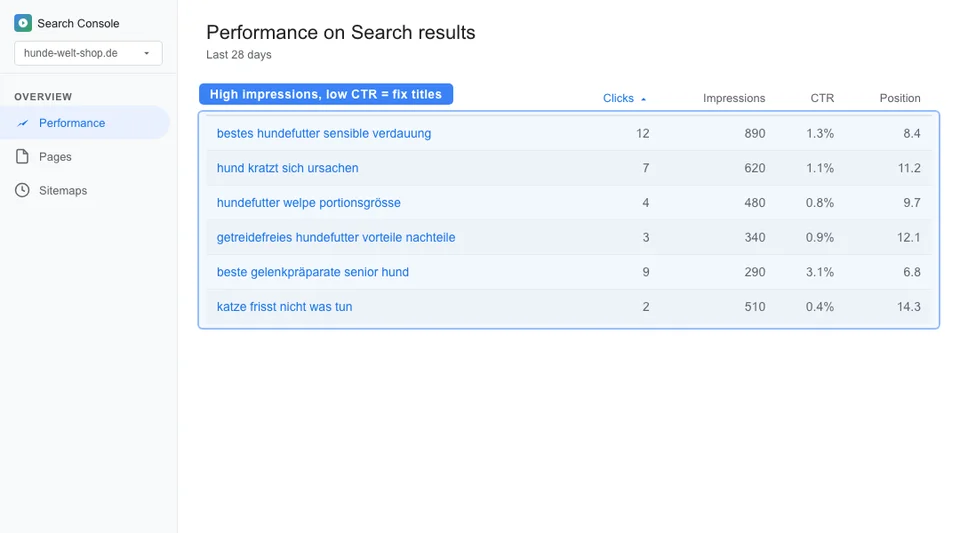
- Organic impressions: How many times Google showed your posts in search results. Rising impressions mean your content is being recognized, even if clicks have not followed yet.
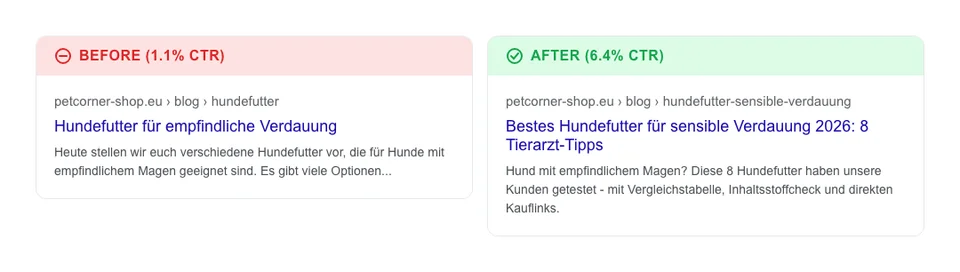
- Click-through rate (CTR): The percentage of impressions that turn into clicks. Low CTR usually means your title or meta description needs improvement.
- Keyword positions: Which keywords your posts rank for and where. Movement from position 50 to position 15 is significant progress, even though you are not on page 1 yet.
- Pages per session: Are visitors reading one post and leaving, or exploring more of your site? Internal linking improves this.
- Conversions: What do you want visitors to do? Visit a product page? Sign up for a newsletter? Visit the store? Track these actions.
What NOT to focus on:
- Total page views (easily inflated by bots)
- Bounce rate in isolation (informational posts naturally have higher bounce rates)
- Social media shares (nice but not an SEO signal)
Set up Google Search Console (free) and check it weekly. Look at your top-performing queries, click-through rates, and position changes. This data tells you what is working and what needs attention. For more detail, see our guide on pet store SEO fundamentals.
How to Fix Your Pet Store Blog in 30 Days
Here is your concrete recovery plan. Follow this schedule and you will see measurable improvements within 30 to 60 days.

| Week | Actions | Expected Outcome |
|---|---|---|
| Week 1: Audit | Run technical SEO check. List all blog posts with traffic data. Identify top 5 posts by impressions. Find 10 keywords with search volume you are not targeting. | Clear picture of what you have and what is missing |
| Week 2: Fix foundations | Fix technical issues (speed, meta tags, sitemap). Add internal links to top 5 posts. Update or expand your 3 best-performing posts. | Technical ceiling removed. Existing content strengthened. |
| Week 3: Plan clusters | Choose 2-3 core topic clusters (e.g., dog nutrition, cat care, pet grooming). Map out 5-8 posts per cluster. Prioritize posts by search volume. | A content roadmap for the next 3-6 months |
| Week 4: Publish and measure | Publish 2-4 new posts from your cluster plan. Add internal links between new and existing posts. Set up Google Search Console tracking for target keywords. | First cluster posts live. Tracking in place. |
This is a starting point. For sustained growth, you need to publish consistently. Research shows that companies publishing 16 or more posts per month get 3.5x more traffic than those publishing 0 to 4[5]. The challenge is that most pet store owners do not have 20+ hours per month to write, optimize, and publish content.
This is the problem Petbase solves. Petbase generates 10 SEO-optimized blog articles per month for your pet store, built around topic clusters with automatic internal linking. Each article targets a keyword your customers are searching for, matches search intent, and is written with pet industry expertise built into the system. At EUR 199/mo, it costs less than a single article from most content marketing agencies - and produces 10x the volume.
The #1 Google result has 3.8x more backlinks than positions #2 through #10[8]. Consistent publishing builds the backlink profile and topical authority that move your pages up. You do not need to choose between running your store and building your blog. You can do both. Start your free trial and see the first articles within days.
How long does it take to see traffic from a pet store blog?
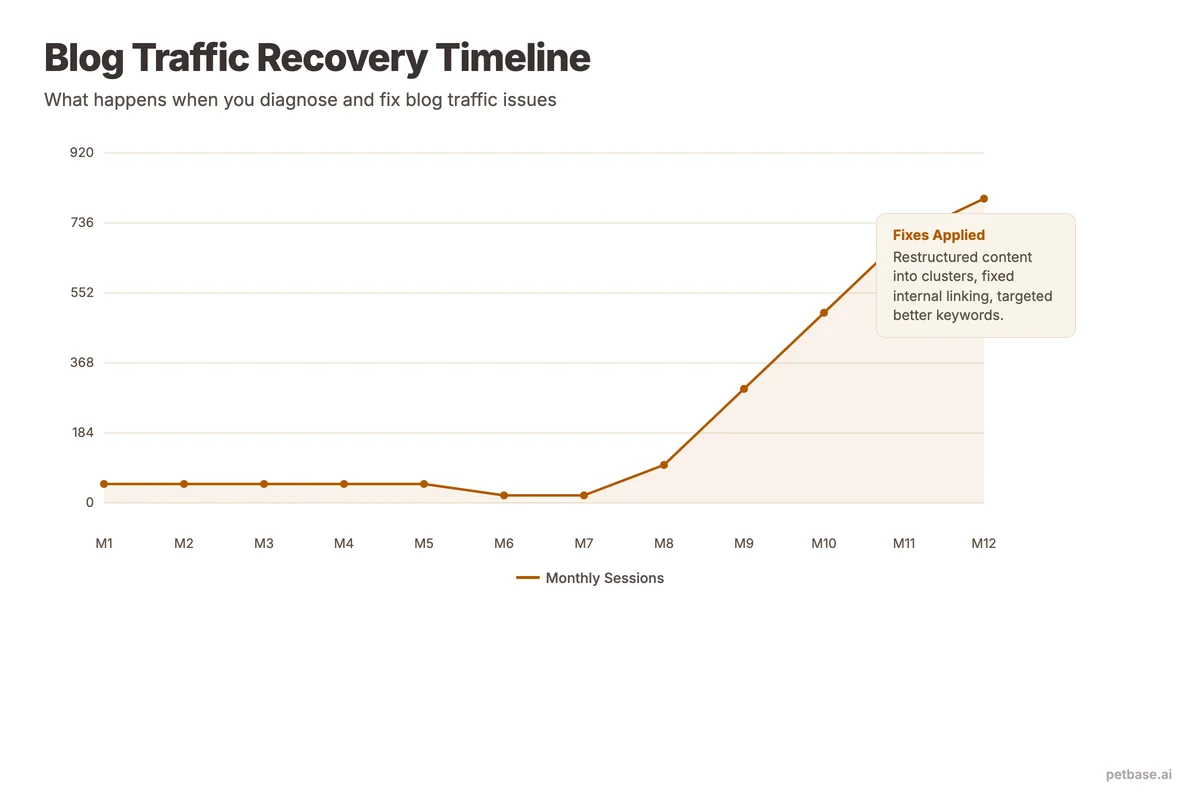
Most pet store blogs start seeing measurable organic traffic within 8-12 weeks of consistent publishing. The timeline depends on your domain authority, competition level, and content quality. Stores that publish 8-10 optimized posts per month typically see results faster than those publishing 2-3 posts. The compounding effect accelerates after 3-6 months as topic clusters mature.
Can I fix my pet store blog without hiring an SEO agency?
Yes. The nine fixes in this guide are all doable without an agency. Google Search Console is free and gives you the data you need. The biggest challenge is not knowledge - it is time. Writing 8-10 optimized posts per month takes 40-50 hours. Petbase handles the content production at EUR 199/mo, which frees your time for the strategic decisions only you can make.
What is the biggest mistake pet store blogs make?
Writing about topics nobody searches for. A pet store could have perfect technical SEO, excellent writing quality, and beautiful images - but if every post targets a keyword with zero search volume, the blog will never generate organic traffic. Long-tail keywords make up 70% of all searches and convert at 36%[4]. Always start with keyword research before writing a single word.
References
- BrightEdge (2019). Organic Search Is Still the Largest Channel. seoinc.com
- HubSpot (2025). Marketing Statistics. hubspot.com
- Orbit Media (2025). Blogging Statistics. orbitmedia.com
- Embryo (2025). 30 Statistics About Long-Tail Keywords. embryo.com
- HubSpot (2025). Blog Publishing Frequency and Traffic. hubspot.com
- Magnet (2025). Understanding Google's Core Web Vitals. magnet.co
- Taylor Scher SEO (2025). Ecommerce SEO Statistics. taylorscherseo.com
- BuzzStream (2025). Link Building Statistics. buzzstream.com