Pet Store Blog Strategy: What to Write With No Ideas


Table of Contents +
- Why Most Pet Store Blog Strategies Fail
- How to Find Blog Topics Your Customers Actually Search For
- 47 Blog Post Ideas for Pet Stores (by Category)
- How to Prioritize Which Topics to Write First
- What Makes a Pet Blog Post Rank on Google?
- How to Structure a Pet Store Blog Post for SEO
- How Often Should a Pet Store Publish?
- How to Create a 3-Month Blog Plan in 30 Minutes
- The Real Cost of Blog Content for Pet Stores
- What to Do When Your Blog Posts Do Not Get Traffic
- FAQ
- References
Build a pet store blog strategy that drives organic traffic. Get 47 blog post ideas, a priority matrix, publishing schedules, and a blog plan template.
Companies with blogs get 55% more website traffic and 67% more leads than those without[1]. Yet most pet store owners stare at a blank screen, wondering what to write. The problem is not a lack of ideas. It is a lack of strategy.
A pet store blog strategy turns scattered topics into a system that attracts the right visitors, builds your authority with Google, and drives sales. This guide shows you exactly how to build that system from scratch - even if you have never written a blog post before. Every recommendation is backed by research, not guesswork.
Why Most Pet Store Blog Strategies Fail
The majority of pet store blogs fail not because the writing is bad, but because there is no strategy behind the content. Store owners publish a few posts, see no traffic after two weeks, and give up. Understanding why this happens is the first step to building a blog that works.
Here are the most common reasons pet store blogs stall out:
- Random topic selection. Writing about whatever comes to mind instead of what customers actually search for leads to posts nobody finds. A post about your store anniversary has zero search volume.
- No keyword intent matching. Even when store owners pick decent topics, they miss the search intent. Writing a general overview when people want specific product comparisons means Google shows someone else's content instead.
- Publishing without a cluster plan. Isolated posts do not build topical authority. Google wants to see that you cover a subject comprehensively - not that you wrote one article about dog food and moved on to cat toys.
- Inconsistent publishing schedule. Posting three articles one week and nothing for two months tells Google your site is not a reliable source. Consistency matters more than volume.
- No internal linking. Each blog post sits alone like an island. Without links connecting related content, Google cannot understand your site's topical depth, and readers cannot discover your other articles.
- Giving up too early. SEO results take 8-12 weeks to appear. Most store owners quit in week 3 because they expected instant results.
The good news is that every one of these problems has a straightforward fix. You do not need to be a professional writer or SEO expert to implement them.
If you want a deeper look at the full SEO picture for pet retailers, start with the complete pet store SEO playbook before diving into content strategy.
Petbase automates SEO content for pet stores - publishing 10 optimized articles monthly so you can focus on running your shop - start your free trial.
How to Find Blog Topics Your Customers Actually Search For
Finding the right topics is the single most important step in any pet store blog strategy. You need to write about what your customers are already typing into Google - not what you think they should care about. The gap between store owner assumptions and actual search behavior is where most blogs go wrong.
Organic search drives 53% of all website traffic[2]. Every topic you choose should target a query that real pet owners type into Google. Here is a practical process for finding those topics:
Start with your product categories
Every product you sell has questions attached to it. Dog food leads to questions about ingredients, allergies, portion sizes, and brand comparisons. Cat litter leads to questions about odor control, dust-free options, and multi-cat households. List your top 10 product categories and brainstorm 5 questions per category. That alone gives you 50 potential topics.
Mine your customer conversations
Your staff answers the same questions every day. What food is best for a puppy? How do I stop my dog from pulling on the leash? What size crate does my breed need? These questions are not just conversations - they are search queries. Start keeping a running list of every question customers ask in-store.
Use Google's own suggestions
Type a product or topic into Google and look at three areas: the autocomplete suggestions, the "People also ask" box, and the related searches at the bottom. These are real queries from real people. For example, typing "best dog food for" reveals autocomplete suggestions like "sensitive stomachs," "senior dogs," "puppies with allergies," and "small breeds." Each one is a blog post waiting to be written.
Check competitor blogs
Look at what other pet stores and pet content sites are writing about. You are not copying their content - you are identifying topic gaps and finding angles they missed. If a competitor wrote "10 Best Dog Toys" but did not cover durability testing or size-specific recommendations, that is your opportunity.
Focus on long-tail keywords
Long-tail keywords account for 70% of all searches and convert at 36% - far higher than broad terms[3]. Instead of targeting "dog food" (nearly impossible to rank for), target "best dog food for senior Labradors with joint pain." These specific queries have less competition and attract buyers closer to a purchase decision.
Use keyword research tools
Free tools like Google Keyword Planner or paid tools like Ahrefs and SEMrush show you exact search volumes and difficulty scores. For a deeper walkthrough, see our guide on keyword research for pet businesses. Focus on keywords with decent search volume (50-500 monthly searches) and low to medium competition - these are the sweet spot for pet stores.
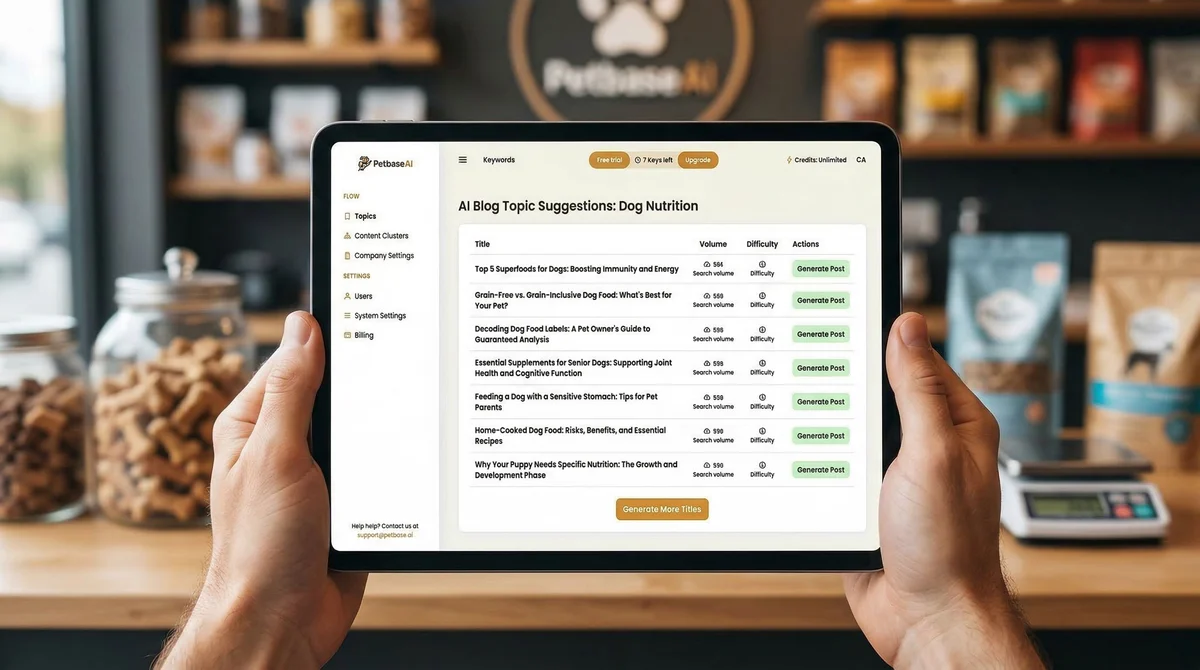
That is six separate research steps before you write a single word. Most store owners spend more time researching topics than creating content - and the research repeats every month. Petbase runs a full keyword and competitor gap analysis for your store automatically, then turns the findings into a ready-to-publish content plan. Start your free trial to see the topics it finds for your niche.
The key principle: write for search intent, not for yourself. Every topic should answer a specific question that a potential customer is asking Google right now.
47 Blog Post Ideas for Pet Stores (by Category)
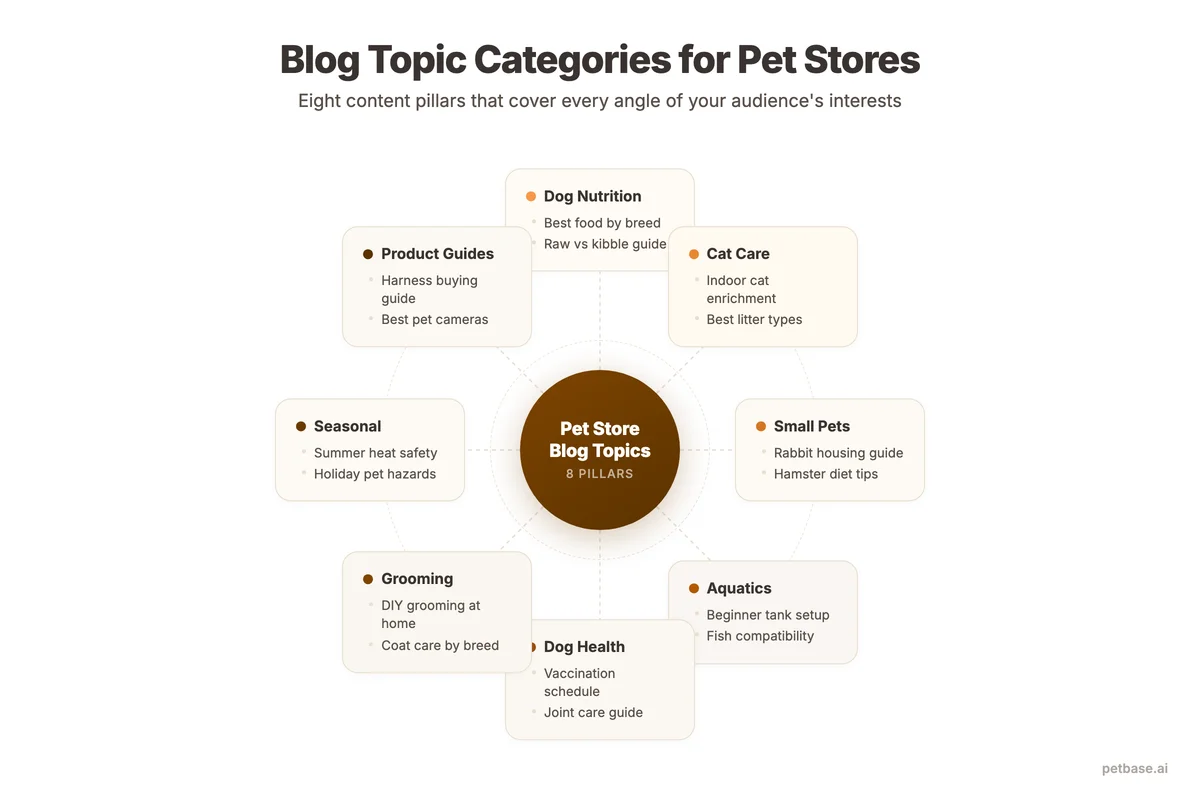
When you are staring at a blank screen, a list of proven topics is worth its weight in gold. Here are 47 blog post ideas organized by category, each tied to real search behavior. Pick the ones most relevant to your product mix and audience.
| Category | Blog Post Idea | Search Intent |
|---|---|---|
| Dog Nutrition | Best dog food for sensitive stomachs: what to look for | Commercial investigation |
| Dog Nutrition | How much should I feed my puppy? A portion guide by breed size | Informational |
| Dog Nutrition | Grain-free vs. grain-inclusive dog food: what the research says | Informational |
| Dog Nutrition | Raw feeding for dogs: benefits, risks, and how to start | Informational |
| Dog Nutrition | Top 5 dog food brands for large breed puppies | Commercial investigation |
| Dog Nutrition | How to read a dog food label: ingredients explained | Informational |
| Cat Care | Best cat litter for odor control in small apartments | Commercial investigation |
| Cat Care | How to introduce a new cat to a multi-cat household | Informational |
| Cat Care | Indoor enrichment ideas to keep your cat active | Informational |
| Cat Care | Why does my cat scratch furniture? Solutions that work | Informational |
| Cat Care | Best wet food for senior cats with kidney issues | Commercial investigation |
| Cat Care | Automatic feeders for cats: do they really help? | Commercial investigation |
| Small Pets | Complete guide to setting up a rabbit hutch | Informational |
| Small Pets | Best bedding for hamsters: wood, paper, or fleece? | Commercial investigation |
| Small Pets | What do guinea pigs eat? A complete diet guide | Informational |
| Small Pets | How to handle and tame a new pet bird | Informational |
| Aquatics | Best beginner freshwater fish for a 10-gallon tank | Informational |
| Aquatics | How to cycle a new aquarium: step-by-step | Informational |
| Aquatics | Live plants vs. artificial: what is better for your fish tank? | Informational |
| Dog Health | Why is my dog itching? Common causes and when to see a vet | Informational |
| Dog Health | Best joint supplements for senior dogs | Commercial investigation |
| Dog Health | How to keep your dog's teeth clean between vet visits | Informational |
| Dog Health | Seasonal allergies in dogs: symptoms and relief options | Informational |
| Dog Health | Flea and tick prevention: collars, drops, or chewables? | Commercial investigation |
| Dog Training | How to crate train a puppy in 7 days | Informational |
| Dog Training | Best training treats for puppies that actually motivate | Commercial investigation |
| Dog Training | Loose leash walking: a step-by-step method | Informational |
| Dog Training | How to stop a dog from jumping on guests | Informational |
| Grooming | Best brushes for double-coated dog breeds | Commercial investigation |
| Grooming | How often should you bathe your dog? | Informational |
| Grooming | DIY dog grooming at home: tools and techniques | Informational |
| Grooming | How to trim your dog's nails without the stress | Informational |
| Seasonal | Summer safety tips for dogs: heat, hydration, and paw care | Informational |
| Seasonal | Holiday gift guide for dog lovers | Commercial investigation |
| Seasonal | How to keep pets calm during fireworks season | Informational |
| Seasonal | Winter coat and boot guide for cold-weather dog breeds | Commercial investigation |
| Seasonal | Spring cleaning tips for pet owners | Informational |
| Product Guides | Best dog harnesses for dogs that pull | Commercial investigation |
| Product Guides | Elevated dog beds vs. traditional: which is better? | Commercial investigation |
| Product Guides | Best interactive toys for dogs home alone | Commercial investigation |
| Product Guides | How to choose the right size dog crate | Informational |
| Product Guides | Best pet cameras: features worth paying for | Commercial investigation |
| Local Content | Dog-friendly parks and trails in [your city] | Local informational |
| Local Content | Pet events and adoption fairs near [your area] | Local informational |
| Local Content | Emergency vet clinics in [your region]: a guide for pet owners | Local informational |
| Breed Guides | Complete guide to owning a French Bulldog | Informational |
| Breed Guides | Golden Retriever vs. Labrador: which breed is right for you? | Informational |
You do not need to write all 47. Start with the categories that match your best-selling products and the questions your customers ask most. For guidance on connecting these topics into clusters, read about content clustering for pet websites.
How to Prioritize Which Topics to Write First
Having 47 ideas is exciting but also overwhelming. The key is prioritization - writing the posts that will have the biggest impact first. Not all blog topics are created equal, and the order you publish them in matters for both SEO and business results.
Use this priority matrix to score each topic:
| Factor | High Priority (Score 3) | Medium Priority (Score 2) | Low Priority (Score 1) |
|---|---|---|---|
| Search Volume | 200+ monthly searches | 50-200 monthly searches | Under 50 monthly searches |
| Competition | Low (few quality results) | Medium (some good results) | High (strong established pages) |
| Business Relevance | Directly tied to products you sell | Related to your market | General pet interest |
| Customer Questions | Asked weekly in-store | Asked occasionally | Rarely asked |
| Purchase Intent | Reader likely to buy | Reader in research phase | Pure information seeker |
Score each topic across all five factors. Topics scoring 12-15 go into your first month. Topics scoring 9-11 go into months two and three. Anything below 9 goes into your backlog.
The sweet spot for most pet stores is product-adjacent informational content. A post about "best dog food for sensitive stomachs" has high search volume, directly relates to products you sell, and attracts readers who are ready to purchase. That beats a general post about "fun facts about dogs" every time.
For help identifying the exact keywords behind each topic, see our guide on keyword research for pet businesses.
What Makes a Pet Blog Post Rank on Google?
Ranking on Google requires more than picking the right topic. Your content needs to satisfy both the reader and Google's algorithm. The good news is that what works for readers almost always works for Google too. Here is what separates pet blog posts that rank on page one from those buried on page five.
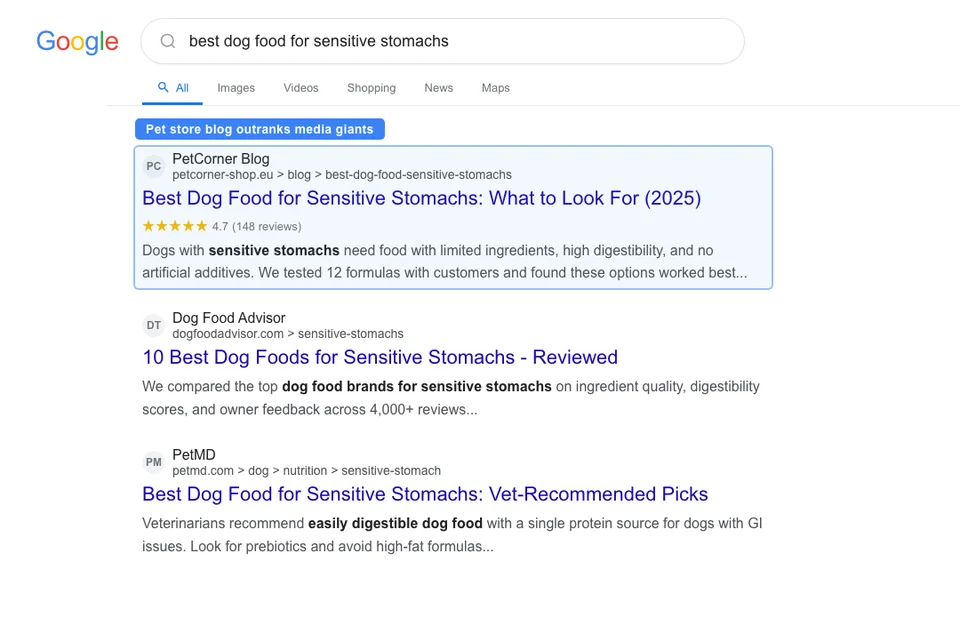
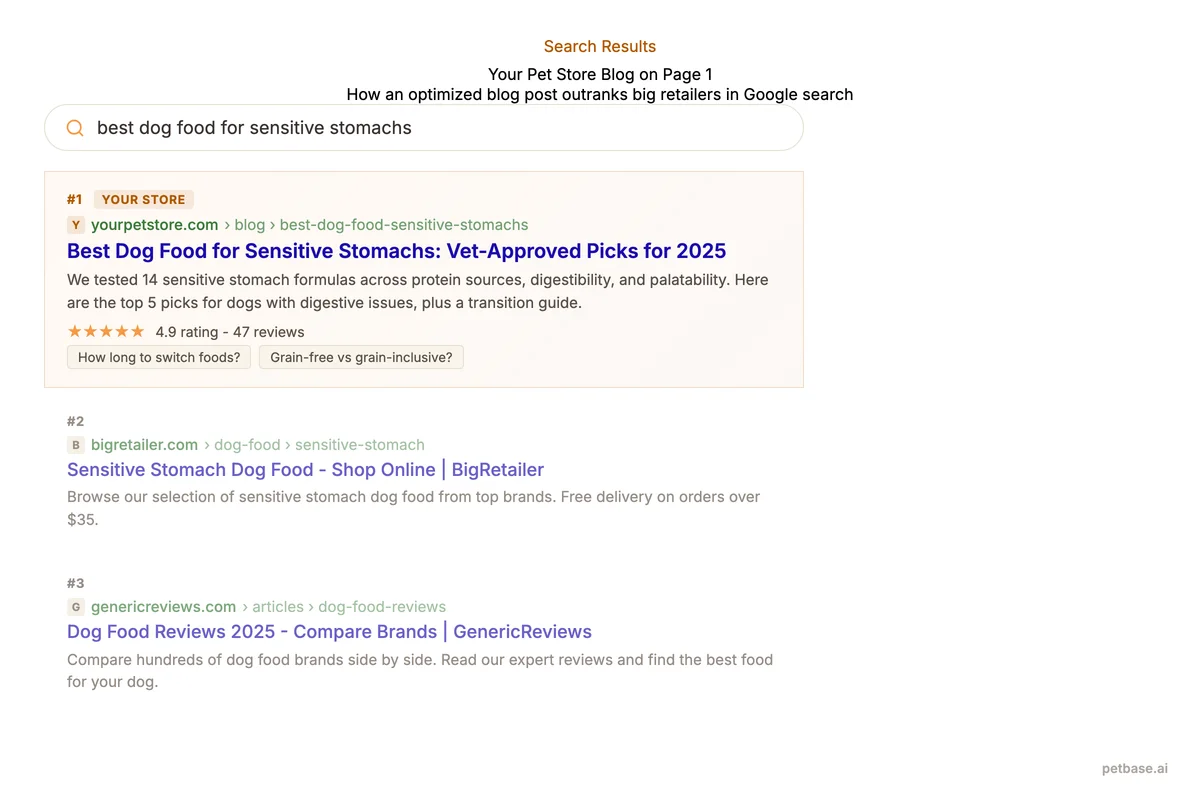
Comprehensive coverage
Google favors content that fully answers a question. If someone searches "how to crate train a puppy," they expect a complete guide - not a 300-word summary. Aim for 1,500 to 3,000 words on most topics, covering every angle a reader might need.
Clear search intent match
Your post should match exactly what the searcher wants. If they are searching for a product comparison, give them a comparison table - not a history lesson. If they want step-by-step instructions, number the steps and make them scannable.
Strong on-page SEO
This includes your title tag, meta description, H2 and H3 headings, image alt text, and URL structure. Your primary keyword should appear naturally in the title, first paragraph, and at least two subheadings. Do not force it - readability always wins.
Internal links to related content
Every blog post should link to 3-5 other relevant posts on your site. This helps Google understand your topical coverage and keeps readers engaged longer. For a closer look at why this matters, read about how topical authority drives rankings.
Helpful, original perspective
Google's helpful content system rewards content written from experience. As a pet store owner, you have direct product knowledge, customer feedback, and hands-on expertise that generic content farms cannot replicate. Use it.
For the complete picture on optimizing your pet content for search, see our pet blog SEO guide.
How to Structure a Pet Store Blog Post for SEO
Structure is not just about formatting - it directly affects how Google reads and ranks your content. A well-structured blog post is easier for readers to scan, keeps them on the page longer, and gives Google clear signals about what your content covers.
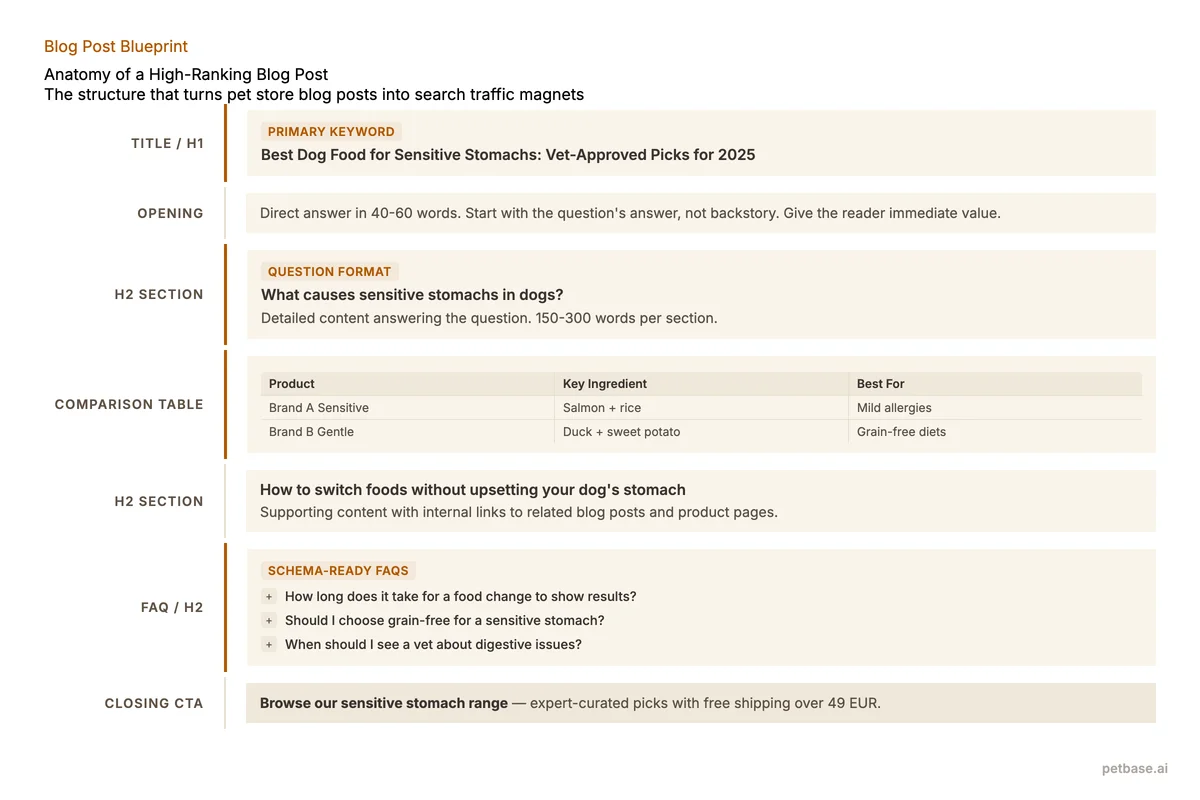
Here is the structure that works for pet store blog posts:
The opening paragraph (40-60 words)
Start with a direct answer to the question implied by your title. No fluff, no long introductions. If your post is about the best dog food for sensitive stomachs, your first sentence should address sensitive stomach dog food - not the history of canine nutrition.
Use H2 headings for main sections
Each H2 should be a distinct subtopic or question. Phrase at least some as questions - they match how people search and can win featured snippets. "How much protein does a senior dog need?" is better than "Protein Requirements."
Use H3 headings for subsections
Within each H2 section, use H3 headings to break down details. This creates a clear hierarchy that both readers and search engines appreciate.
Include comparison tables
Tables are scannable, earn featured snippets, and help readers make decisions. Product comparisons, ingredient breakdowns, and pros-and-cons lists all work well as tables.
Add a FAQ section
End with 3-4 frequently asked questions using H3 headings. These capture long-tail searches and can appear in Google's FAQ rich results.
Include a clear CTA
End every post with a relevant call to action. For pet stores, this might be linking to a product category, inviting readers to visit the store, or suggesting related articles. The goal is to move the reader to the next step.
For more on structuring content that ranks, see our guide on content marketing for pet businesses.
How Often Should a Pet Store Publish?
Consistency matters more than frequency. Publishing 2 articles per week for 12 months will always beat publishing 10 articles in one week and then nothing for six months. Google rewards sites that demonstrate ongoing commitment to content creation.
The average blog post takes 3 hours and 55 minutes to write[4]. That adds up fast when you are also running a store. Here is a realistic publishing cadence based on your resources:
| Approach | Posts per Month | Time Investment | Expected Results Timeline |
|---|---|---|---|
| DIY (writing yourself) | 2-4 | 8-16 hours/month | 6-12 months for meaningful traffic |
| Freelance writer | 4-8 | 2-4 hours/month (editing) | 4-8 months for meaningful traffic |
| SEO agency | 4-10 | 1-2 hours/month (review) | 3-6 months, but EUR 5,000+/month |
| Petbase | 10 | 2-3 hours/month (review) | 8-12 weeks for rankings to appear |
The minimum effective dose is 4 posts per month. Below that, you are building topical authority too slowly to compete. Companies publishing 16 or more blog posts per month get 3.5x more traffic than those publishing four or fewer[1]. At 10 posts per month - the output Petbase delivers for EUR 199/mo - you are publishing fast enough to build topical authority within a single quarter.
Whatever cadence you choose, commit to it for at least 3 months before evaluating results. SEO is a compounding investment - the first posts lay the foundation for everything that follows.
How to Create a 3-Month Blog Plan in 30 Minutes
A blog plan does not need to be complicated. You just need to know what to publish, in what order, and when. Here is a simple process you can complete in 30 minutes that will give you a clear roadmap for the next 90 days.
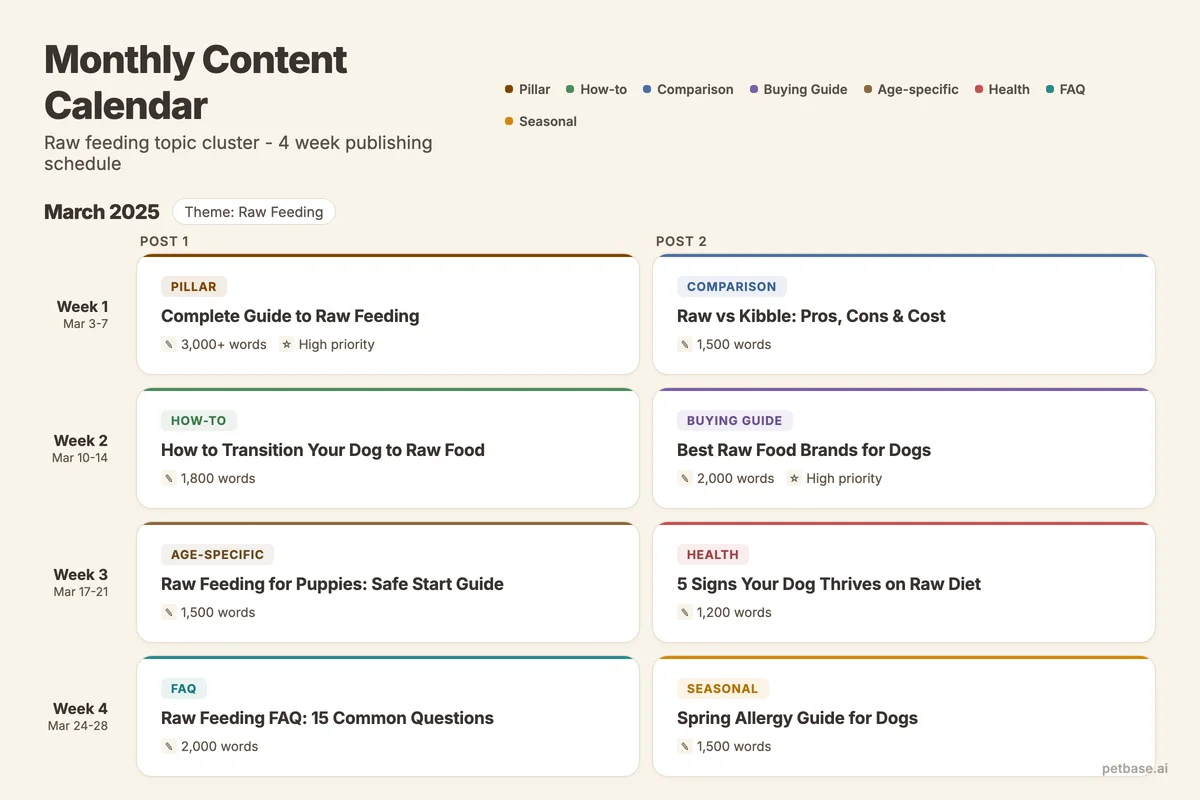
Step 1: Pick your top 3 content clusters (5 minutes)
Based on your products and customer questions, choose three broad topics. For example: dog nutrition, cat care, and seasonal pet safety. These become your content pillars.
Step 2: List 4 subtopics per cluster (10 minutes)
Under each pillar, write down 4 specific post ideas. Use the 47 ideas list above or your own customer questions. That gives you 12 posts - one for each week of the quarter.
Step 3: Assign dates and set internal linking (10 minutes)
Spread posts across the quarter so you alternate between clusters. Week 1: dog nutrition. Week 2: cat care. Week 3: seasonal. Week 4: dog nutrition again. Plan which posts will link to each other within each cluster.
Step 4: Create a simple tracking sheet (5 minutes)
A spreadsheet with columns for: topic, target keyword, publish date, status, and URL. Nothing fancy - just enough to keep yourself accountable.
For a more detailed approach to content calendars, see our guide on building an SEO content calendar for your pet business.
If even 30 minutes feels like too much, Petbase builds your content plan automatically based on your store's products, location, and target keywords. It handles topic selection, keyword research, cluster planning, and article creation - so you can focus on running your store.
The Real Cost of Blog Content for Pet Stores
Before choosing how to produce blog content, understand the economics. Content marketing returns $7.65 for every $1 spent, compared to $1.80 for paid ads[5]. That makes it one of the highest-ROI marketing channels available to pet stores. But the cost of producing content varies wildly depending on your approach.
With 7.5 million blog posts published every day[4], standing out requires quality, consistency, and strategy. Here is what each approach costs:
| Factor | DIY | Freelance Writer | SEO Agency | Petbase |
|---|---|---|---|---|
| Cost per 10 articles | Free (your time) | EUR 2,000-5,000 | EUR 3,000-6,000 | EUR 199 |
| Time from you | 40-60 hrs/mo | 10-15 hrs/mo | 5-8 hrs/mo | 2-3 hrs/mo |
| Pet expertise | Your own knowledge | Rare - most generalize | Usually generic | Built-in pet knowledge model |
| Keyword research | Manual | Not included | Sometimes included | Automatic |
| Internal linking | Manual | Manual | Manual or basic | Automatic cross-linking |
| Auto-publishing | No | No | No | Yes - direct to your CMS |
The global pet care market is valued at $273.42 billion[6]. Competition for online visibility is growing every year. The stores that invest in consistent, strategic blog content now will capture organic traffic that compounds over time. The stores that wait will pay more later to catch up.
What to Do When Your Blog Posts Do Not Get Traffic
You have been publishing for two months and your analytics still show single-digit visits. Before you give up, understand that this is normal - and fixable. Most pet store blog posts need 8-12 weeks before they start ranking meaningfully. But if you are past that window and still seeing nothing, here is what to check.
Check your keyword targeting
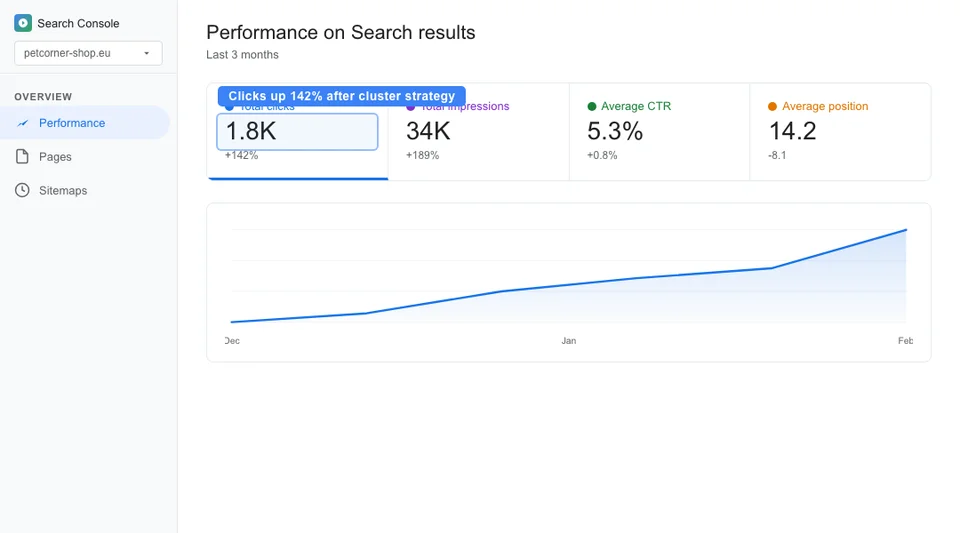
Are you targeting keywords that people actually search for? A post titled "Our Thoughts on Premium Dog Food" might get zero searches, while "Best premium dog food for small breeds" gets hundreds per month. Use Google Search Console to see which queries your posts are appearing for - even at low positions.
Evaluate your competition
Search your target keyword and look at the top 5 results. If they are all from major brands like Chewy, PetMD, or AKC, you might be targeting too competitive a keyword. Long-tail keywords account for 70% of all searches[3], and they are where smaller sites can compete. Shift to long-tail keywords where you have a real chance of ranking.
Improve your content depth
Compare your post to the top-ranking results. Is theirs more detailed? Does it have better structure, more examples, comparison tables, or FAQ sections? If your post is 500 words and theirs is 2,500, you know what to do.
Fix your internal linking
If a blog post has no internal links pointing to it from other pages on your site, Google may not even know it exists. Add links from related posts, category pages, and even your homepage if relevant.
Update and republish
Old posts can be refreshed. Update statistics, add new sections, improve the structure, and republish with a current date. Google treats meaningful updates as fresh content.
Diagnosing why a post is not ranking means auditing keywords, SERP competition, content depth, and internal links across your entire site. That is hours of work per underperforming post. Petbase handles keyword targeting, content depth, and internal linking from the start - so your posts are built to rank before they publish. Start your free trial to see how it works.
Be patient with new domains
If your website is less than a year old, everything takes longer. New domains need time to build trust with Google. Keep publishing consistently and the compound effect will kick in.
For a full diagnostic framework, see our guide on pet store SEO which covers technical issues that might be holding your content back.
FAQ
How many blog posts does a pet store need to start seeing traffic?
Most pet stores start seeing measurable organic traffic after publishing 15-20 well-optimized blog posts within the same topical cluster. Individual posts may rank sooner, but the compound effect of clustered content is what drives consistent growth. At 4 posts per month, expect to see initial results around month 4. At 10 posts per month with Petbase, you can reach that threshold in under 8 weeks.
Should I write about topics outside my product range?
Yes, but strategically. Writing about topics adjacent to your products - like training tips, breed guides, or health advice - builds topical authority that benefits your product-focused posts too. The key is to keep everything connected through internal links. A post about puppy training tips can naturally link to your post about the best training treats you sell. Just avoid going so far off-topic that Google cannot understand what your site is about.
Can I use the same blog strategy if I only sell online?
Absolutely. The blog strategy in this guide works for both physical pet stores and online pet retailers. The only difference is that online stores should focus more on commercial investigation keywords (product comparisons, "best of" lists, buyer guides) and less on local content. Everything else - topic clustering, internal linking, publishing consistency, and SEO structure - applies equally. For more on how blog posts drive pet store sales, see our dedicated guide.
What if I do not have time to write blog posts myself?
You have three options: hire a freelance writer with pet industry knowledge, work with an SEO agency (typically EUR 5,000+ per month), or use a specialized tool like Petbase that generates SEO-optimized pet industry content automatically. Petbase creates 10 articles per month for EUR 199/mo, handles keyword research and content planning, and publishes directly to your CMS. It is built specifically for pet businesses, so the content reflects real product knowledge - not generic filler.
References
- HubSpot (2024). Marketing Statistics. hubspot.com
- BrightEdge (2024). How Much Traffic Comes from Organic Search. seoinc.com
- Embryo (2024). 30 Statistics About Long-Tail Keywords. embryo.com
- Orbit Media (2024). Blogging Statistics. orbitmedia.com
- Genesys Growth (2024). Content Marketing ROI Stats for Marketing Leaders. genesysgrowth.com
- Fortune Business Insights (2024). Pet Care Market Size and Growth. fortunebusinessinsights.com