Pet Store Marketing Channels: SEO vs. Ads vs. Social

Table of Contents +
- Why Pet Store Owners Struggle With Marketing Channel Selection
- SEO for Pet Stores: Pros, Cons, and Real Numbers
- Google Ads for Pet Stores: When It Works and When It Doesn't
- Social Media Marketing for Pet Businesses: The Truth
- Email Marketing for Pet Stores: The Forgotten Channel
- How to Compare Channels: Cost per Customer Acquisition
- Which Channel Should You Start With?
- The Best Approach: How Channels Work Together
- Frequently Asked Questions
- References
Compare SEO, Google Ads, social media, and email marketing for pet stores. Real costs, conversion rates, and budget allocation recommendations by store size.
Organic search drives 53% of all website traffic[1]. Yet 61% of small businesses are not investing in SEO[2]. That gap matters for pet store owners because the U.S. pet industry alone is worth $152 billion[3] - and a growing share of that spending starts with a Google search.
The question every pet store owner faces: where should you put your marketing budget? Google Ads promise instant traffic. Instagram shows viral pet content reaching millions. Email gurus say the list is everything. SEO advocates point to organic search as the only channel that compounds over time.
This guide compares the four main marketing channels using real numbers - not theories - and gives you a framework to decide where your budget goes based on your store size, goals, and growth stage.
Why Pet Store Owners Struggle With Marketing Channel Selection
Most pet store owners spend EUR 500-2,000/month on marketing without a clear strategy. They try a bit of everything - some Google Ads, occasional Instagram posts, a few blog articles, an email newsletter when they remember. The result: mediocre performance across all channels because no single one gets enough investment to produce meaningful results.
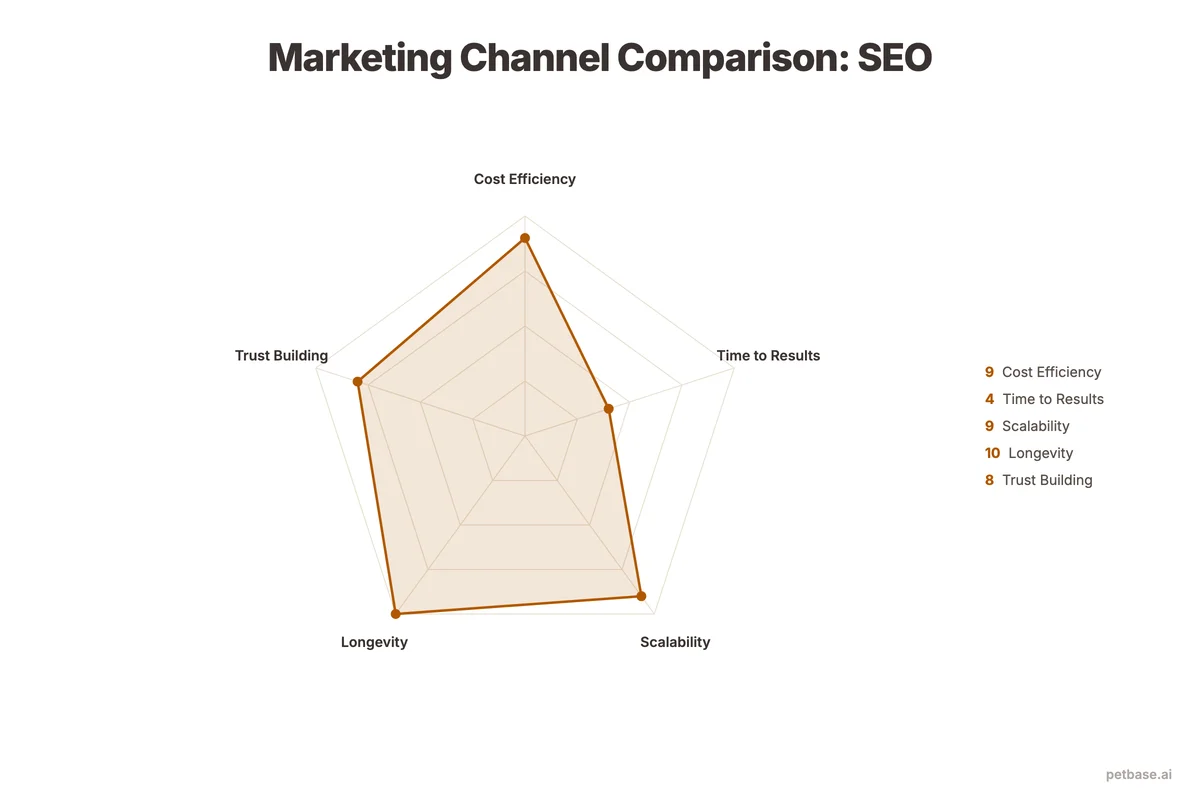
The solution is not to do everything. It is to choose 1-2 channels, invest enough to see results, and expand only after those channels are profitable.
Here is the full comparison at a glance:
| Factor | SEO / Content | Google Ads | Social Media | Email Marketing |
|---|---|---|---|---|
| Monthly cost (typical) | EUR 199-500 | EUR 500-3,000 | EUR 200-1,500 | EUR 50-300 |
| Time to first results | 8-12 weeks | 1-3 days | 4-12 weeks | Immediate (to existing list) |
| Cost per customer acquisition | EUR 5-25 (after 6 months) | EUR 15-80 | EUR 20-100 | EUR 2-10 |
| Scalability | High (compounds over time) | High (scales with budget) | Medium (organic reach limited) | Medium (limited by list size) |
| Sustainability | High (content stays indexed) | None (stops when you stop paying) | Low (content lifespan: 24-48 hours) | Medium (ongoing list required) |
| Required expertise | Medium | High | Medium-High | Low |
| Best for | Long-term traffic, authority | Immediate sales, seasonal pushes | Brand awareness, community | Customer retention, repeat purchases |
Let's examine each channel in detail.
Petbase automates SEO content for pet stores - publishing 10 optimized articles monthly so you can focus on running your shop - start your free trial.
SEO for Pet Stores: Pros, Cons, and Real Numbers
SEO means appearing in Google's organic results when pet owners search for products, advice, or local stores. It is driven by content creation, technical optimization, and building topical authority over time.
The case for SEO is strong for pet stores because pet owners are research-heavy buyers. They search for breed-specific food recommendations, health condition advice, product comparisons, and local stores before buying. Nearly half of all Google searches have local intent[4], which means pet owners are looking for stores near them right now. If your content answers their questions, you are the first brand they encounter.
Pros:
- Compounding returns: Each article you publish continues to attract traffic for months or years. After 12 months of publishing 10 articles/month, you have 120 pages each contributing to your total traffic.
- Lowest long-term cost per visitor: After the initial investment period (6-12 months), organic traffic costs EUR 0.04-0.15 per visitor - 10-50x less than paid ads.
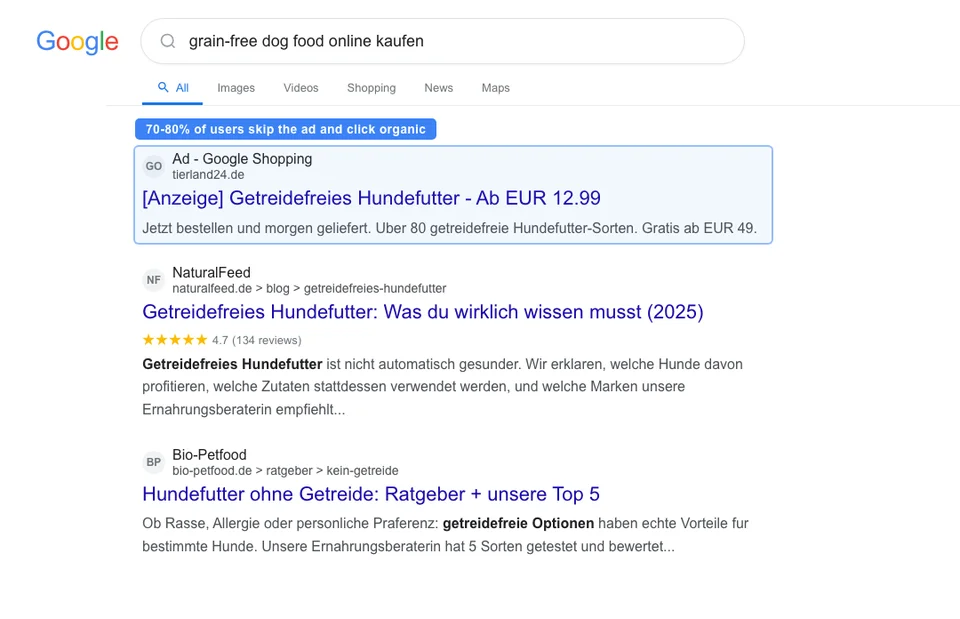
- Trust and authority: Organic results are trusted more than ads. 70-80% of users skip paid ads and click organic results.
- Permanent assets: Content stays on your site even if you stop investing. The traffic declines gradually but does not disappear overnight like paid ads.
Cons:
- Slow start: 8-12 weeks before you see meaningful results. Not suitable if you need traffic tomorrow.
- Requires consistency: Sporadic publishing does not build topical authority. You need at least 8-10 articles/month for 6+ months to see significant results.
- No guaranteed outcomes: Rankings depend on competition, Google algorithm updates, and content quality. You cannot buy a specific position.
Real numbers for pet stores:
- Petbase at EUR 199/mo produces 10 articles/month. After 6 months: 60 articles, estimated 500-2,000 monthly organic visitors (depending on market competitiveness).
- After 12 months: 120 articles, estimated 2,000-5,000+ monthly organic visitors.
- Cost per visitor at month 12: EUR 0.04-0.10
Content marketing costs 62% less than outbound marketing and generates 3x more leads per dollar spent[5]. Companies with blogs get 55% more website traffic[6]. These numbers explain why SEO consistently outperforms other channels for long-term growth.
For a deeper look at what SEO costs and delivers for pet stores, see our guide on the real cost of ignoring SEO. For the complete strategy, see our pet store SEO guide.
Google Ads for Pet Stores: When It Works and When It Doesn't
Google Ads puts your pet store at the top of search results immediately - for a price. You pay each time someone clicks your ad. For pet stores, this includes Search ads (text results), Shopping ads (product images with prices), and Local ads (map listings).
When Google Ads work for pet stores:
- Seasonal promotions: Black Friday, Christmas, summer pet travel products. You need traffic now, not in 3 months.
- New product launches: Get immediate visibility for products you just added to your catalog.
- High-margin products: If your margin allows EUR 15-30 in customer acquisition cost, ads can be profitable on products with EUR 50+ margins.
- Local store promotions: Drive in-store visits with location-based ads targeting people near your store.
When Google Ads don't work:
- Low-margin commodity products: If you sell standard dog food with EUR 3-5 margins, paying EUR 1-2 per click is not sustainable. You need 3+ clicks before a sale, putting your acquisition cost at EUR 3-6 per order on a EUR 3-5 margin.
- As a long-term strategy without SEO: Ads stop the moment you stop paying. Relying entirely on ads means your traffic bill never decreases.
- Broad keyword targeting: Bidding on "dog food" puts you against Amazon, Chewy, and every major retailer. Cost-per-click for broad pet keywords ranges from EUR 1-3. Target specific, long-tail keywords instead.
Real numbers for pet stores:
- Average CPC for pet industry keywords: EUR 0.40-2.50 (varies by market and keyword)
- Typical monthly budget for a small pet store: EUR 500-1,500
- Expected clicks: 200-3,750 per month
- Conversion rate: 2-4% for product purchases
- Expected monthly sales from ads: 4-150 orders
- Cost per acquisition: EUR 10-375 per order (highly variable)
The key metric is ROAS (Return on Ad Spend). If you spend EUR 1,000 on ads and generate EUR 4,000 in sales, your ROAS is 4:1 - generally considered profitable. Below 3:1, most pet stores lose money on ads after accounting for product costs, shipping, and overhead.
Compare that to content marketing, which returns $7.65 for every $1 spent versus $1.80 for paid ads[7]. Ads have their place, but the ROI gap is significant over time.
Social Media Marketing for Pet Businesses: The Truth
Social media is where pet content goes viral. Cute dog photos, funny cat videos, and heartwarming rescue stories can reach millions of people. This creates the illusion that social media is a powerful marketing channel for pet stores. The reality is more complicated.
The opportunity:
- Pet content has the highest engagement rates of any category on Instagram and TikTok
- Visual product marketing (pet wearing a new harness, dog enjoying a toy) performs well
- Community building is powerful for local stores - customer pet photos, events, adoption spotlights
The reality:
- Organic reach is nearly dead: Facebook organic reach is 2-5% of followers. If you have 1,000 followers, your post reaches 20-50 people. To reach more, you pay.
- Instagram and TikTok reach is declining: Both platforms now prioritize paid content over organic posts from businesses.
- Engagement does not equal sales: A viral pet video might get 100,000 views and zero sales. Social media users are browsing for entertainment, not shopping.
- Time investment is high: Creating good social content takes 10-20 hours/month for photography, editing, copywriting, and community management.
Real numbers for pet stores:
- Organic social media posting (no paid ads): 10-20 hours/month, negligible direct sales
- Paid social ads: EUR 200-1,000/month, 0.5-2% conversion rate on clicks
- Cost per acquisition through social ads: EUR 20-100+ per order
- Best-performing social content for pet stores: user-generated customer photos, staff picks, educational reels (short-form video)
Social media is best used as a brand awareness and community channel, not a primary sales driver. It complements SEO and email marketing but should not be your main investment unless you have a strong content creation capability and the budget for paid promotion.
Email Marketing for Pet Stores: The Forgotten Channel
Email marketing consistently delivers the highest ROI of any digital marketing channel - approximately EUR 36 for every EUR 1 spent according to industry averages. Yet most pet stores either do not collect email addresses or send emails so infrequently that their list goes cold.
Why email works for pet stores:
- Repeat purchase cycle: Pet food and supplies are consumable products. Customers buy the same items every 2-6 weeks. Email reminders drive repeat purchases.
- Personalization potential: You know what type of pet each customer has, what they buy, and when they last purchased. Personalized emails ("Time to restock [product name]?") convert at 5-10x the rate of generic newsletters.
- Low cost: Email platforms cost EUR 20-100/month for lists under 10,000 subscribers. The marginal cost of each email sent is nearly zero.
- Owned audience: Unlike social media followers, your email list is yours. Platform algorithm changes do not affect your reach.
The limitation:
- Email does not acquire new customers - it retains and reactivates existing ones. You need other channels (SEO, ads) to build the list in the first place.
Real numbers for pet stores:
- Average email list for a pet store: 500-5,000 subscribers
- Average open rate for pet industry emails: 20-25%
- Average click-through rate: 2-4%
- Revenue per email send (1,000 subscribers): EUR 50-200
- Monthly sends: 4-8 emails
- Monthly revenue from email: EUR 200-1,600
Email marketing is the highest-ROI channel for pet stores that already have customers. It should be part of every pet store's marketing stack - but it cannot replace SEO or ads for new customer acquisition.
How to Compare Channels: Cost per Customer Acquisition
The most useful comparison metric is CPA (Cost per Customer Acquisition) - how much you spend to get one new paying customer through each channel.
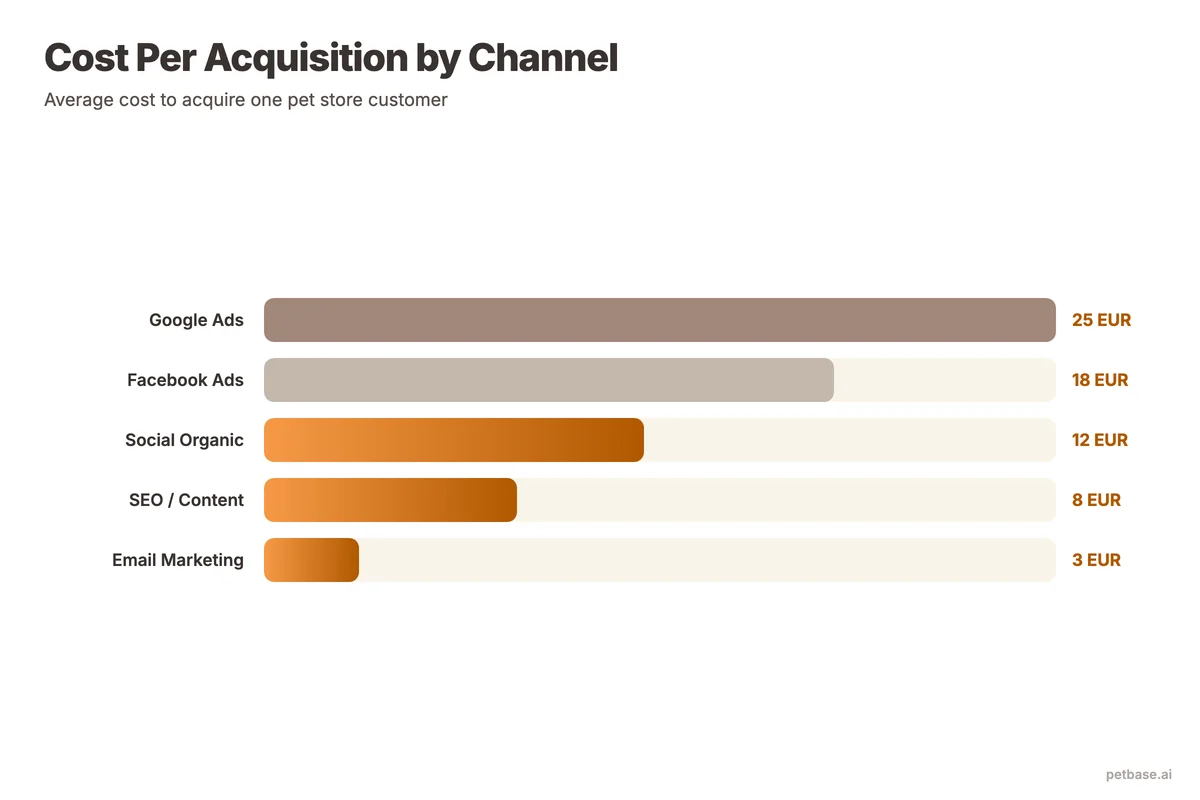
| Channel | Typical CPA (Pet Store) | Time to Profitability | Lifetime Value Impact |
|---|---|---|---|
| SEO / Content | EUR 5-25 (after 6 months) | 4-8 months | High - blog readers become repeat customers |
| Google Ads | EUR 15-80 | Immediate (if profitable) | Low-Medium - ad-acquired customers are price-sensitive |
| Social Media (paid) | EUR 20-100 | 1-3 months | Medium - varies by product category |
| Email Marketing | EUR 2-10 (for reactivation) | Immediate | Very High - nurtures highest-value customers |
The CPA for SEO decreases over time because the content you create continues to generate traffic without additional cost. After 12 months, your cost per visitor drops to EUR 0.04-0.10, making each new customer acquisition extremely efficient. Google Ads CPA stays constant or increases over time as competition for keywords grows.
Which Channel Should You Start With?
The right starting channel depends on where your business is today:
If you have fewer than 500 monthly website visitors: Start with SEO. You need a traffic foundation. At EUR 199/mo with Petbase, you build that foundation with 10 articles/month while keeping costs low enough to survive the 8-12 week ramp-up period. Supplement with a basic Google Business Profile optimization if you have a physical store.
If you have 500-2,000 monthly visitors but low sales: Start with email marketing and conversion optimization. You have traffic but are not converting it. Capture emails with a useful lead magnet ("free feeding guide for puppies"), set up automated repurchase emails, and fix your product pages. Then add SEO to grow traffic further.
If you need immediate sales this month: Start with Google Ads targeting high-intent, long-tail keywords ("buy grain-free dog food online" rather than "dog food"). Set a daily budget you can afford to test with. Use ads as a bridge while building organic traffic through SEO.
If you have an established customer base but stagnant growth: Layer email marketing (retention) + SEO (acquisition). This combination delivers the highest ROI because email maximizes the value of existing customers while SEO brings new ones at declining cost over time.
The Best Approach: How Channels Work Together
The most effective marketing strategies for pet stores use channels in combination, not isolation. Here is how they work together:
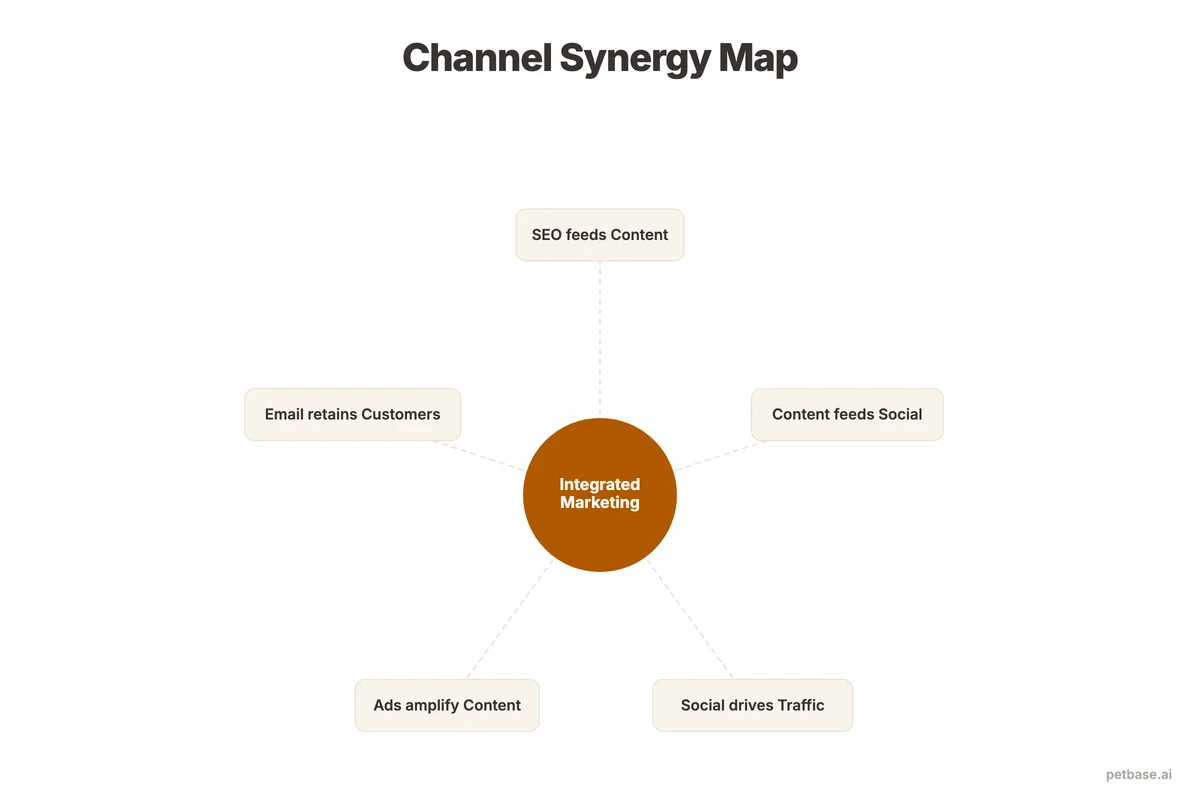
- SEO brings new visitors through blog content and product page rankings. A customer searches "best food for dogs with allergies," finds your blog post, reads your recommendations.
- Email captures those visitors. A pop-up offers "Free Dog Nutrition Guide" in exchange for an email address. 2-5% of blog visitors convert to email subscribers.
- Email nurtures the relationship. Automated sequences send relevant content, product recommendations, and special offers. The subscriber's first purchase happens 2-4 weeks after joining the list.
- Google Ads fill gaps. For seasonal promotions, new product launches, or keywords where you do not rank organically yet, paid ads provide immediate visibility.
- Social media builds community. Customer photos, staff picks, and event announcements keep your brand top-of-mind between purchases.
93% of consumers say online reviews influence their purchase decisions[4]. Your content strategy should include encouraging reviews across Google, social media, and your website - they reinforce every channel.
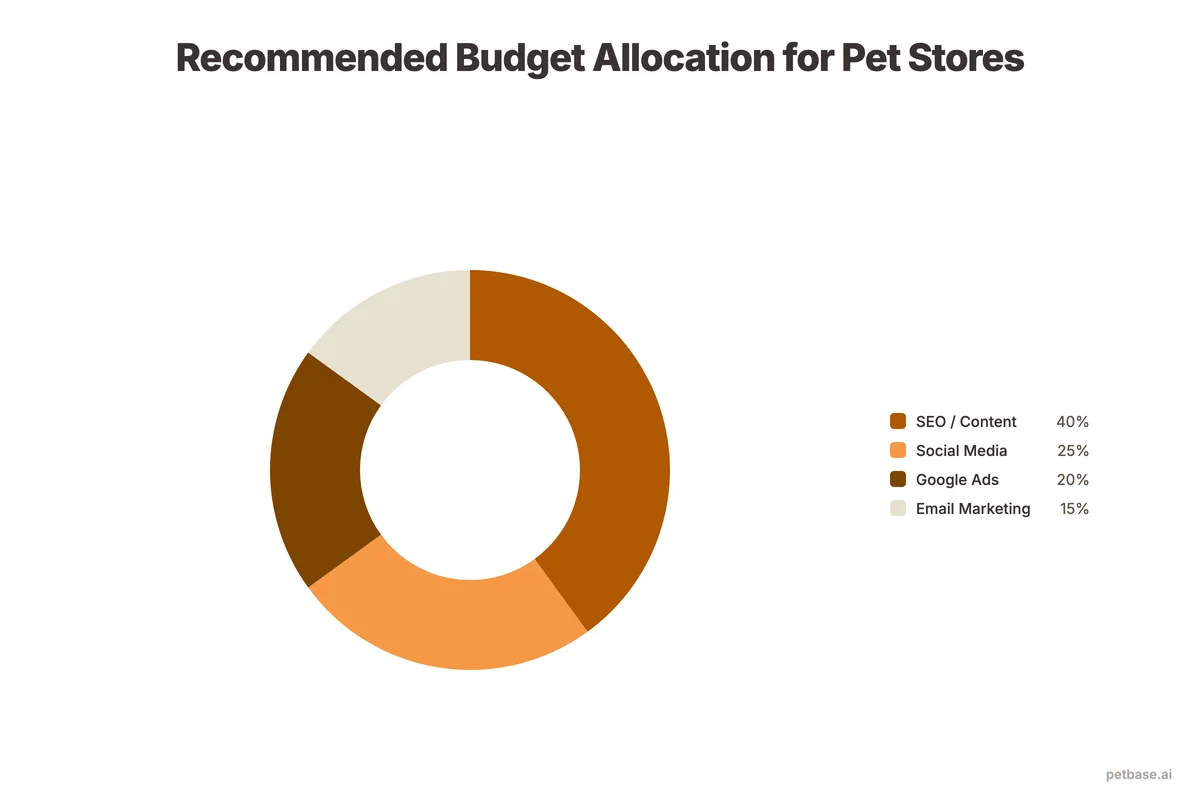
Here is how to allocate budget based on store size:
| Monthly Budget | SEO / Content | Google Ads | Social | |
|---|---|---|---|---|
| Under EUR 300 | EUR 199 (Petbase) | EUR 0 | EUR 50 (platform) | EUR 0 (organic only) |
| EUR 300-500 | EUR 199 (Petbase) | EUR 150-200 | EUR 50 | EUR 0 (organic only) |
| EUR 500-1,000 | EUR 199 (Petbase) | EUR 300-500 | EUR 50-100 | EUR 100-200 (boosted posts) |
| EUR 1,000-2,000 | EUR 199 (Petbase) + EUR 200 tech SEO | EUR 500-800 | EUR 100 | EUR 200-400 |
| EUR 2,000+ | EUR 500-1,000 (tool + consultant) | EUR 800-1,500 | EUR 100-200 | EUR 300-500 |
At every budget level, SEO and content get the largest share because they produce compounding returns. The cost per visitor decreases every month as your content library grows. No other channel offers this compounding dynamic.
For pet stores ready to build their organic traffic foundation, Petbase produces 10 SEO-optimized articles per month at EUR 199/mo - leaving room in even the smallest marketing budget for email and occasional paid promotion. The pet industry knowledge model ensures every article contains the specific, accurate detail that positions your store as an authority. Start your free trial and see the first articles within days.
Frequently Asked Questions
What is the single best marketing channel for a new pet store?
SEO combined with Google Business Profile optimization. For a new store, you need to be found by people who do not know you yet. SEO builds that discovery mechanism permanently, while a GBP listing provides immediate local visibility. 46% of Google searches have local intent[4], so your local presence matters from day one. Start with Petbase for content (EUR 199/mo) and optimize your GBP for free. Add Google Ads only after you have a baseline of organic traffic and know which keywords convert for your specific products.
How much should a pet store spend on marketing per month?
Industry benchmarks suggest 5-10% of revenue. A pet store generating EUR 10,000/month in revenue should invest EUR 500-1,000 in marketing. The key is concentrating this budget on 1-2 channels rather than spreading it thin across everything. For most stores, EUR 199/mo on SEO content plus EUR 50/month on email marketing provides the best foundation. Add Google Ads when your budget allows EUR 300+/month for paid search.
Can I rely on social media alone to market my pet store?
No. Social media alone is not enough for sustainable pet store growth. Organic reach on Facebook and Instagram is 2-5% of your followers, and social media users are browsing for entertainment rather than actively shopping. Social media works best as a supplementary channel for brand awareness and community building - not as your primary customer acquisition channel. SEO and email marketing deliver higher ROI for direct sales.
How long before my marketing investment pays for itself?
Google Ads: can be profitable from day 1 if targeting the right keywords. Email marketing: profitable within the first month for stores with existing customer lists. SEO: typically becomes ROI-positive within 4-8 months as organic traffic grows. Social media: rarely directly profitable for pet stores, but supports other channels. The fastest path to profitability is email marketing to existing customers + SEO for new customer acquisition. See our rankings timeline guide for realistic SEO expectations.
References
- BrightEdge (2024). How Much Traffic Comes from Organic Search. seoinc.com
- Clutch (2025). SEO Statistics. clutch.co
- American Pet Products Association (2024). Industry Trends and Stats. americanpetproducts.org
- BrightLocal (2024). Local SEO Statistics. brightlocal.com
- Siege Media (2024). Content Marketing Statistics. siegemedia.com
- HubSpot (2024). Marketing Statistics. hubspot.com
- Genesys Growth (2024). Content Marketing ROI Stats for Marketing Leaders. genesysgrowth.com