Pet Store SEO Checklist: 25 Things to Fix First

Table of Contents +
- Why You Need a Pet-Specific SEO Checklist
- Technical SEO Checks (Items 1-7)
- On-Page SEO Checks (Items 8-14)
- Content Quality Checks (Items 15-19)
- Local SEO Checks (Items 20-22)
- Product Page Checks (Items 23-25)
- The Complete 25-Point Checklist
- Quick Wins: Items You Can Fix in Under 30 Minutes
- What Petbase Handles Automatically vs. Manual Tasks
- How to Use This Checklist Weekly
- Frequently Asked Questions
- References
A 25-point SEO checklist built for pet stores. Covers technical SEO, on-page optimization, content quality, local SEO, and product pages with priority rankings.
Organic search drives 53% of all website traffic[1]. Every blog post, product page, or category page you publish is a chance to capture that traffic - or lose it to a competitor who checked a few more boxes before hitting publish.
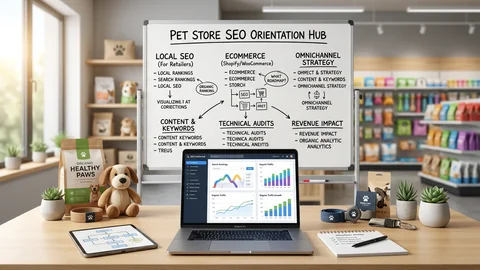
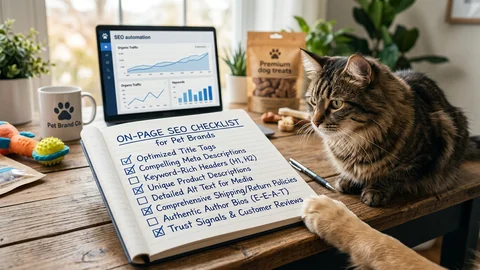
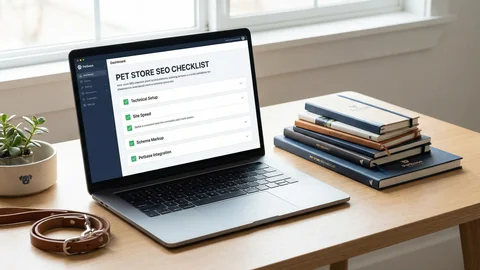
This checklist covers 25 specific items every pet store should verify before publishing. It is organized by category - technical SEO, on-page SEO, content quality, local SEO, and product pages - so you can work through it systematically. Bookmark this page. Use it weekly. The stores that rank consistently are the ones that never skip the basics.
Why You Need a Pet-Specific SEO Checklist
Generic SEO checklists miss what matters for pet stores. They do not account for product schema on pet food pages, seasonal content cycles for flea and tick season, or the local search dynamics that drive foot traffic to brick-and-mortar pet shops.
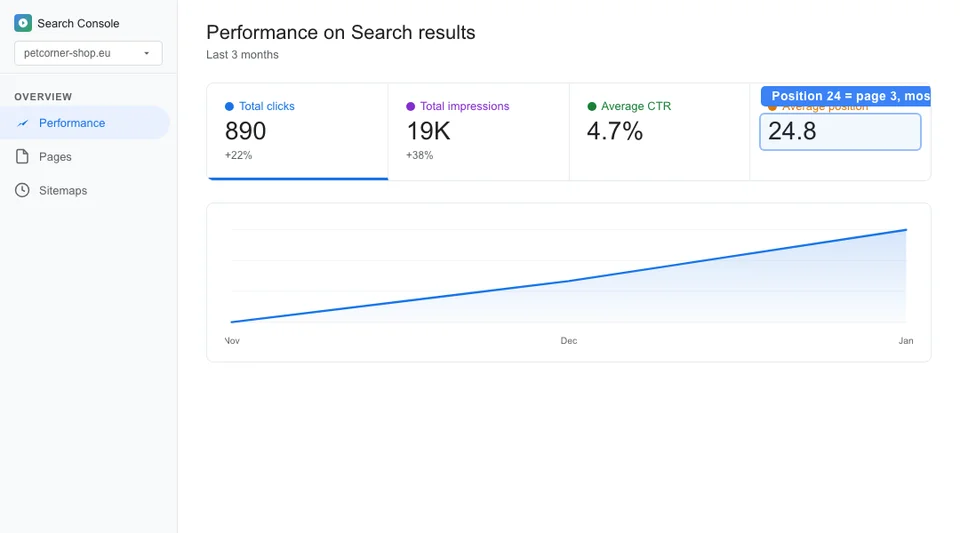
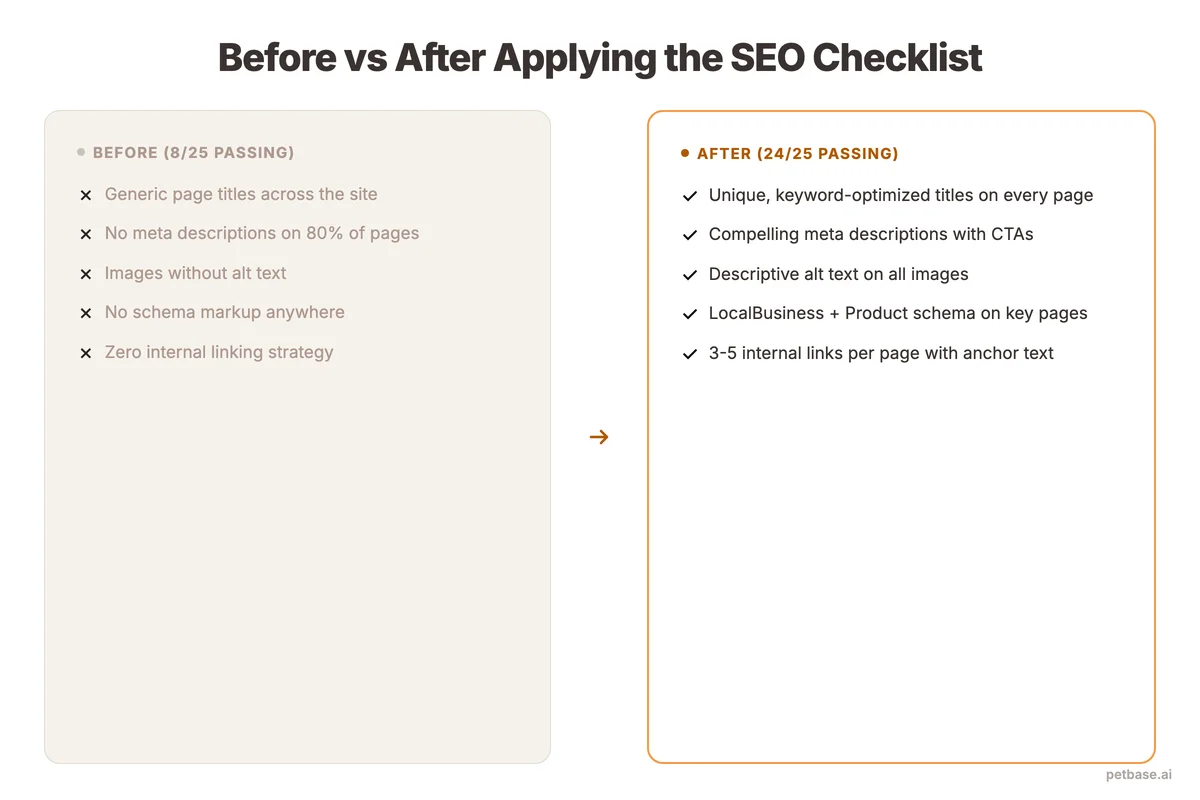
Pet stores face unique SEO challenges:
- Product pages with thin content. Most pet stores have hundreds of products with manufacturer-copied descriptions. Google treats duplicate descriptions as thin content and rarely ranks them.
- Seasonal demand swings. Searches for "dog cooling mat" spike in June, "pet Christmas gifts" in November. Miss the publishing window and you wait a full year.
- Local competition. 46% of all Google searches have local intent[2]. "Pet store near me" searches have surged over the past three years, and your Google Business Profile and local signals matter as much as your website.
- Health and safety content. Pet health topics fall under Google's YMYL (Your Money or Your Life) guidelines. Accuracy and expertise signals are not optional - they are ranking factors.
A checklist built for pet stores catches these issues. A generic one does not.
Petbase automates SEO content for pet stores - publishing 10 optimized articles monthly so you can focus on running your shop - start your free trial.
Technical SEO Checks (Items 1-7)
Technical SEO is the foundation. If Google cannot crawl, index, and render your pages properly, nothing else matters. These seven items ensure your pet store's technical base is solid.
1. Page loads in under 3 seconds
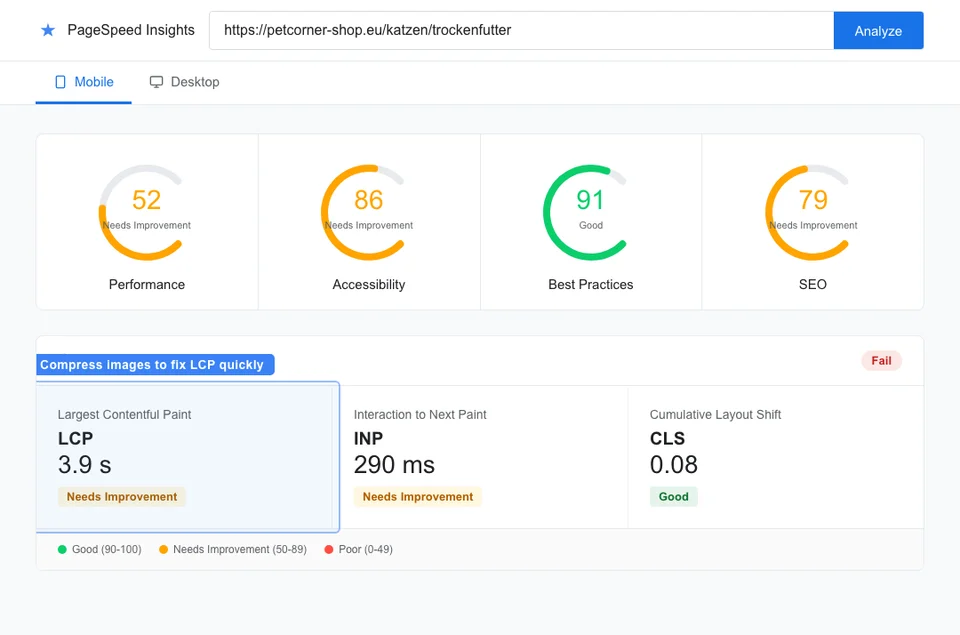
Use Google PageSpeed Insights to test your page. Pet product pages with multiple images are the usual culprits. Compress images to WebP format and enable browser caching. 53% of mobile visitors leave if a page takes more than 3 seconds to load[3]. Even a 0.1-second speed improvement can boost conversions by 8.4%[3].
2. Page is mobile-friendly
Google uses mobile-first indexing. Test your page with Google's Mobile-Friendly Test tool. Common pet store issues: product images that overflow on mobile, filters that are impossible to tap, and text too small to read without zooming.
3. Page is indexed (or intentionally not)
Search site:yourdomain.com/page-url on Google. If the page does not appear, check for accidental noindex tags or robots.txt blocks. Conversely, make sure thank-you pages and cart pages are not indexed. For a deeper look at technical foundations, see our technical SEO guide for pet websites.
4. URL is clean and descriptive
Good: /products/grain-free-dog-food. Bad: /products/item-23847. URLs should include the target keyword, use hyphens to separate words, and avoid parameters when possible.
5. HTTPS is active (no mixed content)
Your entire site should load over HTTPS. Mixed content warnings (where some resources load over HTTP) break the padlock icon and can hurt rankings. Check using your browser's developer tools or a tool like Why No Padlock.
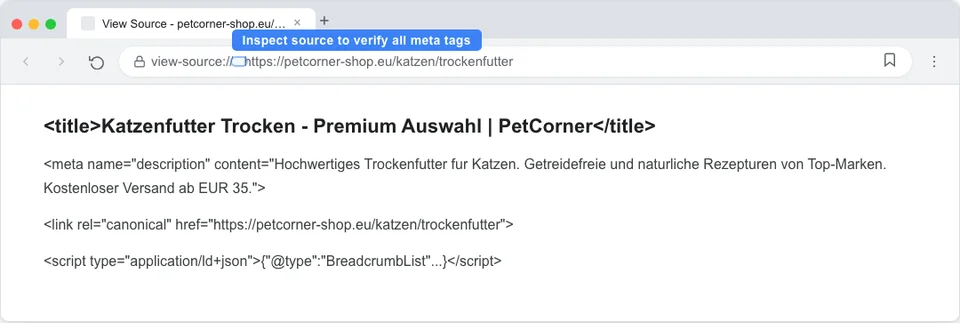
6. Canonical tag points to the correct URL
If your product appears under multiple URLs (via filters, sorting, or categories), the canonical tag tells Google which version to index. Without it, you split ranking signals across duplicate pages.
7. Structured data is valid
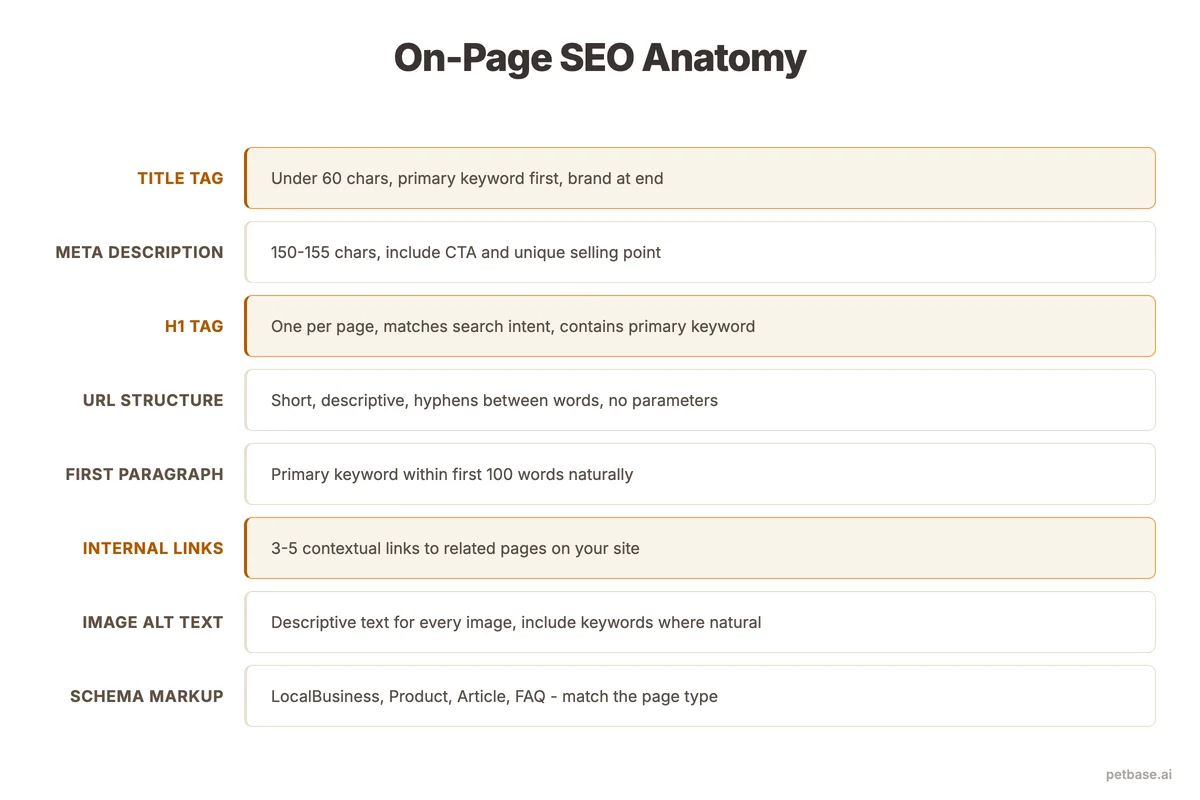
Use Google's Rich Results Test to verify your schema markup. Product pages should have Product schema. Blog posts should have Article schema. Local pages need LocalBusiness schema. Sites with structured data see up to 30% higher click-through rates in search results[4] - yet only about 30% of websites implement it[4]. That is a significant advantage for stores that do. For implementation details, see our guide on schema markup for pet stores.
On-Page SEO Checks (Items 8-14)
On-page SEO is what Google reads when it visits your page. These elements directly influence how your page is understood and ranked.
8. Title tag includes target keyword
Your title tag should include the primary keyword near the beginning, stay under 60 characters, and be unique across your site. The average e-commerce site has title tags of just 39 characters[5] - 21 characters below the recommended 60. That is wasted real estate. Example: "Grain-Free Dog Food - Natural, High-Protein | YourStore" is better than "Dog Food - Buy Online."
9. Meta description is compelling and under 160 characters
Meta descriptions do not directly affect rankings, but they influence click-through rates. The average e-commerce meta description is only 96 characters[5] - 64 characters shorter than the 160-character best practice. Include the keyword, a clear benefit, and a reason to click. Every page needs a unique meta description.
10. H1 tag matches the page topic
Every page needs exactly one H1 tag, and it should clearly state what the page is about. For a product page: "Orijen Original Grain-Free Dry Dog Food." For a blog post: "How to Choose the Right Dog Food for Sensitive Stomachs." Our on-page SEO guide for pet stores covers heading structure in detail.
11. Heading hierarchy is logical
H1 comes first, followed by H2s for main sections, H3s for subsections. Do not skip levels (H1 to H3) or use headings for styling. Screen readers and Google both use heading hierarchy to understand page structure.
12. Images have descriptive alt text
Every image needs alt text that describes what the image shows. Not "image1.jpg" - something like "Golden Retriever eating from stainless steel bowl." Alt text helps Google understand your images and is required for accessibility.
13. Internal links connect related content
Every new page should link to 2-3 related pages on your site, and those pages should link back. A blog post about dog nutrition should link to your dog food category page and to related blog posts. This is how you build topical authority. See our complete pet store SEO guide for more on internal linking strategy.
14. External links cite authoritative sources
When you reference health claims, statistics, or expert opinions, link to the source. For pet health content, link to veterinary institutions, peer-reviewed studies, or recognized pet health organizations. This builds E-E-A-T signals that Google rewards.
Content Quality Checks (Items 15-19)
Content quality is what separates pages that rank from pages that sit on page 5. Google evaluates whether your content genuinely helps the reader - and for pet stores, that bar is higher because many topics touch pet health and safety.
15. Content answers the search query directly
Read your page title, then read the first two paragraphs. Does the content deliver what the title promises? If your title says "Best Dog Food for Allergies" but the first 300 words are about your company history, you have a problem. Answer the question first, add context second.
16. Content is at least 800 words for blog posts
Thin content rarely ranks. For informational blog posts targeting competitive keywords, aim for 1,500-3,000 words. For product pages, aim for at least 300 words of unique description beyond what the manufacturer provides. Businesses that blog consistently generate 55% more website traffic and 67% more leads than those that do not[6]. Check our E-E-A-T guide for pet businesses for content depth recommendations.
17. No duplicate content from manufacturer descriptions
If you copy-paste product descriptions from your supplier, so did every other store selling that product. Google filters duplicates. Write original descriptions that add your expertise - usage tips, customer feedback themes, comparisons, and personal recommendations.
18. Content includes specific numbers and examples
"Feed your dog twice daily" is vague. "Feed adult dogs 2-3 cups per day based on weight (30-50 lbs = 2 cups, 50-75 lbs = 2.5 cups)" is specific. Specific content ranks better because it is more useful.
19. Author and expertise signals are visible
Google's E-E-A-T framework looks for experience, expertise, authoritativeness, and trust. Show who wrote the content. If it is a pet nutritionist, say so. If you consulted a veterinarian, mention that. Add author bios with credentials to blog posts.
Local SEO Checks (Items 20-22)
If you have a physical pet store, local SEO drives foot traffic. 46% of all Google searches have local intent[2], and 93% of consumers say reviews influence their purchasing decisions[2]. These three items ensure you show up in "near me" searches and Google Maps results.
20. Google Business Profile is complete and current
Your profile needs: correct business name, address, phone number, website URL, business hours (including holiday hours), business category ("Pet Store" plus relevant secondary categories), and at least 10 photos. Profiles with photos receive 42% more direction requests[7] than profiles without. An incomplete profile loses to a complete one every time. Read more in our local SEO guide for pet businesses.
21. NAP is consistent across all listings
NAP stands for Name, Address, Phone number. These must be identical everywhere - your website, Google Business Profile, Yelp, Facebook, pet directories. Even small differences ("St." vs. "Street") confuse Google and dilute your local signals.
22. Local keywords appear on your website
Your website should mention your city, neighborhood, and service area naturally. "Premium pet food in Munich" or "Serving pet owners across South London." Include this on your homepage, About page, and contact page at minimum.
Product Page Checks (Items 23-25)
Product pages are where pet stores lose the most SEO value. These final three items address the most common product page problems.
23. Each product page has a unique title and description
Do not use templates that generate identical titles like "Buy [Product] Online." Each product needs a unique title tag and a unique meta description that highlights what makes that specific product different. For in-depth product page optimization, see our guide on writing pet product descriptions that rank and sell.
24. Product schema markup is implemented
Product schema tells Google the price, availability, brand, and rating of each product. This information appears directly in search results as rich snippets. With structured data driving up to 30% higher CTR[4], stores with product schema get meaningfully more clicks than those without.
25. Product pages link to related blog content
A product page for joint supplements should link to your blog post about "Joint Health for Senior Dogs." A cat food product page should link to "How to Choose the Right Cat Food." These links build topical relevance and keep visitors on your site longer.
The Complete 25-Point Checklist
| # | Item | What to Check | Priority | Tool |
|---|---|---|---|---|
| 1 | Page speed | Loads under 3 seconds | High | PageSpeed Insights |
| 2 | Mobile-friendly | Renders correctly on phone | High | Mobile-Friendly Test |
| 3 | Indexing | Page appears in Google | High | site: search |
| 4 | Clean URLs | Descriptive, keyword-rich | Medium | Manual check |
| 5 | HTTPS | No mixed content warnings | High | Browser DevTools |
| 6 | Canonical tag | Points to correct URL | High | View page source |
| 7 | Structured data | Valid, error-free schema | Medium | Rich Results Test |
| 8 | Title tag | Keyword included, under 60 chars | High | SEO browser extension |
| 9 | Meta description | Compelling, under 160 chars | Medium | SEO browser extension |
| 10 | H1 tag | One per page, matches topic | High | View page source |
| 11 | Heading hierarchy | H1 > H2 > H3, no skips | Medium | HeadingsMap extension |
| 12 | Image alt text | Descriptive, not empty | Medium | Manual check |
| 13 | Internal links | 2-3 related pages linked | High | Manual check |
| 14 | External citations | Claims backed by sources | Medium | Manual check |
| 15 | Query match | Content answers the title's promise | High | Manual review |
| 16 | Content depth | 800+ words (blog), 300+ (product) | High | Word counter |
| 17 | Original content | No copy-pasted descriptions | High | Copyscape |
| 18 | Specific details | Numbers, examples, data | Medium | Manual review |
| 19 | Author signals | Author bio, credentials visible | Medium | Manual check |
| 20 | Google Business Profile | Complete with photos | High | GBP dashboard |
| 21 | NAP consistency | Identical across all listings | High | Manual audit |
| 22 | Local keywords | City/area mentioned on site | Medium | Manual check |
| 23 | Unique product titles | No template duplicates | High | Screaming Frog |
| 24 | Product schema | Price, availability, ratings | Medium | Rich Results Test |
| 25 | Product-to-blog links | Related content linked | Medium | Manual check |
Quick Wins: Items You Can Fix in Under 30 Minutes
| Item | Time to Fix | Expected Impact |
|---|---|---|
| Add meta descriptions to top 10 pages | 20 minutes | Higher click-through rates from search |
| Compress images to WebP | 15 minutes | Faster page load, better Core Web Vitals |
| Add alt text to product images | 15 minutes | Image search visibility, accessibility |
| Fix heading hierarchy on homepage | 10 minutes | Better content structure signals |
| Add internal links to latest 5 blog posts | 15 minutes | Faster indexing, stronger topical signals |
| Update Google Business Profile hours | 5 minutes | Accurate local search results |
What Petbase Handles Automatically vs. Manual Tasks
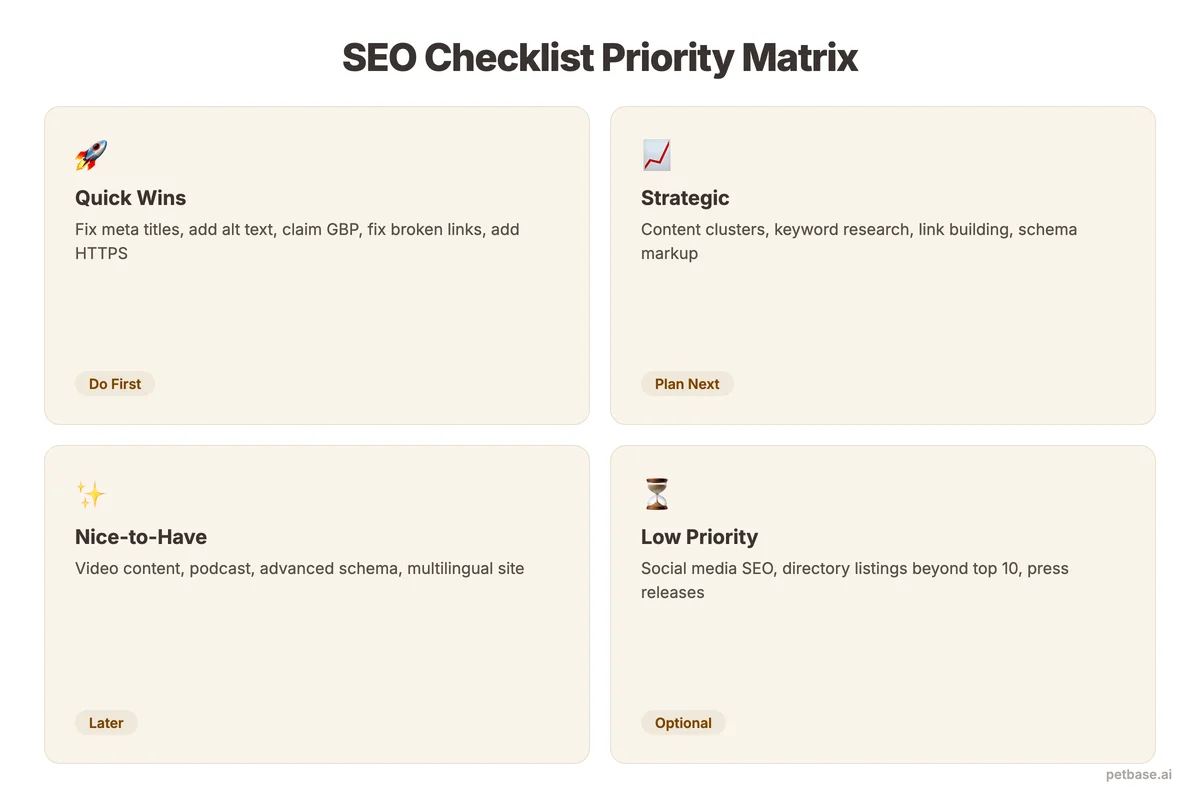
If you are already using Petbase, several items on this checklist are handled for you automatically. Here is how the workload splits:
| Checklist Area | Petbase Handles | You Handle |
|---|---|---|
| Title tags and meta descriptions | Blog posts (auto-generated with target keywords) | Product and category pages |
| Content quality and depth | Blog posts (1,500-3,000 words, E-E-A-T aligned) | Product descriptions, about page |
| Internal linking | Blog-to-blog links (automatic topical linking) | Product-to-blog and blog-to-product links |
| Heading structure | Blog posts (proper H2/H3 hierarchy) | Product and category pages |
| Keyword research | Monthly keyword analysis and topic selection | Product keyword mapping |
| Publishing cadence | 10 posts/month on autopilot | Product page updates, seasonal adjustments |
| Schema markup | Article schema on blog posts | Product, LocalBusiness, and FAQ schema |
| Technical SEO | Not applicable | Site speed, HTTPS, crawlability |
| Local SEO | Not applicable | GBP, NAP, local keywords |
Petbase eliminates the most time-consuming part of this checklist - consistent, high-quality content creation with proper on-page optimization. At EUR 199/mo for 10 articles per month, that frees you to focus on the manual items that require your direct attention: product pages, technical fixes, and local SEO.
How to Use This Checklist Weekly
Do not try to fix everything at once. Build the checklist into your weekly routine:
Monday: Review new content (10 minutes)
Before publishing anything new, run through items 8-19. These are the on-page and content quality checks that directly affect whether your new page ranks.
Wednesday: Technical spot check (15 minutes)
Pick 5 random pages and verify items 1-7. Site speed can degrade as you add products. Indexing issues can creep in after CMS updates. Catching technical problems early prevents ranking drops.
Friday: Local and product audit (15 minutes)
Check items 20-25. Update any new products with proper schema and descriptions. Verify your Google Business Profile reflects current hours and photos.
Monthly: Full audit
Once per month, run through all 25 items across your most important pages (homepage, top 5 product pages, top 5 blog posts). Use our pet store website audit guide for a deeper monthly review. Track improvements in a spreadsheet. The combination of weekly spot checks and monthly full audits keeps your pet store's SEO foundation strong without requiring hours of work.
For a broader strategy that puts this checklist into context, read our pet store SEO strategy roadmap - it maps out what to prioritize in your first 90 days and beyond.
Frequently Asked Questions
How long does it take to work through this entire checklist?
A full run through all 25 items takes 2-3 hours for a typical pet store website with 50-200 pages. You do not need to do it all at once. Start with the high-priority items (marked "High" in the table) - those take about 45 minutes and cover the checks with the biggest ranking impact. Use the weekly schedule above to maintain everything after the initial pass.
Which checklist items have the biggest impact on rankings?
Three items make the biggest difference: content quality (items 15-19), title tags (item 8), and internal linking (item 13). If your content does not match search intent, no amount of technical optimization helps. Title tags determine whether Google understands your page. Internal links determine whether Google sees your site as an authority on pet topics. Fix these three areas first.
Do I need to check all 25 items for every single page?
No. Blog posts need items 8-19 most. Product pages need items 8-12 and 23-25. Local landing pages need items 20-22. Technical items 1-7 apply site-wide, so check them once and fix globally rather than page by page. Focus your per-page checks on the items relevant to that page type.
References
- BrightEdge (2024). How Much Traffic Comes From Organic Search. seoinc.com
- BrightLocal (2024). Local SEO Statistics. brightlocal.com
- Deloitte/Google (2024). Understanding Google's Core Web Vitals. magnet.co
- Amra and Elma (2025). Top Schema Markup Statistics. amraandelma.com
- Taylor Scher (2025). E-commerce SEO Statistics. taylorscherseo.com
- HubSpot (2024). Marketing Statistics. hubspot.com
- Sterling Sky (2024). How to Interpret Google Business Profile Performance. sterlingsky.ca