Pet Store SEO Strategy: Build Your Roadmap in 7 Steps

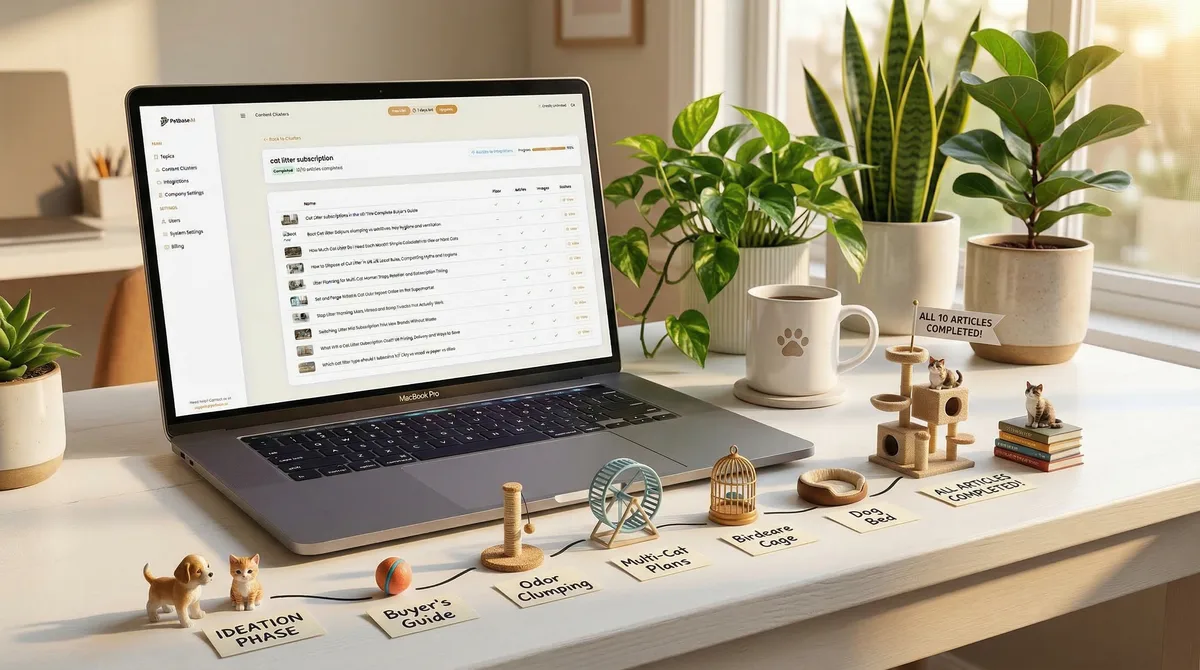
Table of Contents +
- Why Your Pet Store Needs an SEO Strategy (Not Just Random Tactics)
- Step 1: Audit Where You Stand Today
- Step 2: Define Your Target Keywords by Pet Niche
- Step 3: Fix Technical Issues First
- Step 4: Build Your Content Cluster Plan
- Step 5: Optimize Your Product and Category Pages
- Step 6: Set Up Local SEO Foundations
- Step 7: Create a Publishing Calendar and Stick to It
- What Does a 90-Day Pet Store SEO Roadmap Look Like?
- Frequently Asked Questions
- References
Build a complete pet store SEO strategy in 7 steps. Includes a 90-day roadmap, keyword clustering, content planning, and a DIY vs tool vs agency comparison.
Most pet stores approach SEO backwards. They publish a few blog posts, optimize some product titles, and wonder why nothing happens after three months. The problem is not effort - it is the absence of a strategy. Random SEO tactics without a roadmap are like stocking shelves without knowing what your customers want to buy.
The global pet care market is worth $273.42 billion[1], and organic search drives 53% of all website traffic[2]. If your pet store does not have an SEO strategy, you are leaving a significant share of that market to competitors who do.
This guide walks you through a complete 7-step SEO strategy built specifically for pet stores. Whether you sell online, in-store, or both, this roadmap gives you a clear sequence - what to do first, what to do next, and what to measure along the way.
Why Your Pet Store Needs an SEO Strategy (Not Just Random Tactics)
An SEO strategy connects every action to a measurable outcome. Without one, you waste time on activities that feel productive but deliver nothing. A strategy tells you which keywords to target, what content to create, how to structure your site, and when to expect results.
Here is why this matters: 61% of small businesses are not investing in SEO at all[3]. That means the majority of your competitors have no strategy. A structured approach puts you ahead of most pet stores before you publish a single article.
Here is the difference between random SEO tactics and a real strategy:
| Component | Random Tactics | SEO Strategy |
|---|---|---|
| Keyword selection | Pick whatever sounds relevant | Research volume, intent, difficulty, and map to business goals |
| Content creation | Write a blog post when you have time | Follow a publishing calendar aligned with topic clusters |
| Technical SEO | Fix issues when someone notices | Proactive monthly audits with prioritized action items |
| Internal linking | Add links randomly | Strategic hub-and-spoke model connecting related pages |
| Measurement | Check traffic occasionally | Track rankings, conversions, and revenue by keyword cluster |
| Timeline | No clear milestones | 90-day roadmap with weekly goals and checkpoints |
Pet stores face unique challenges that make strategy essential. You compete with massive retailers (Chewy, Amazon, PetSmart) for product keywords, with local competitors for "near me" searches, and with veterinary websites for health-related queries. A strategy helps you find gaps where you can win instead of fighting battles you cannot.
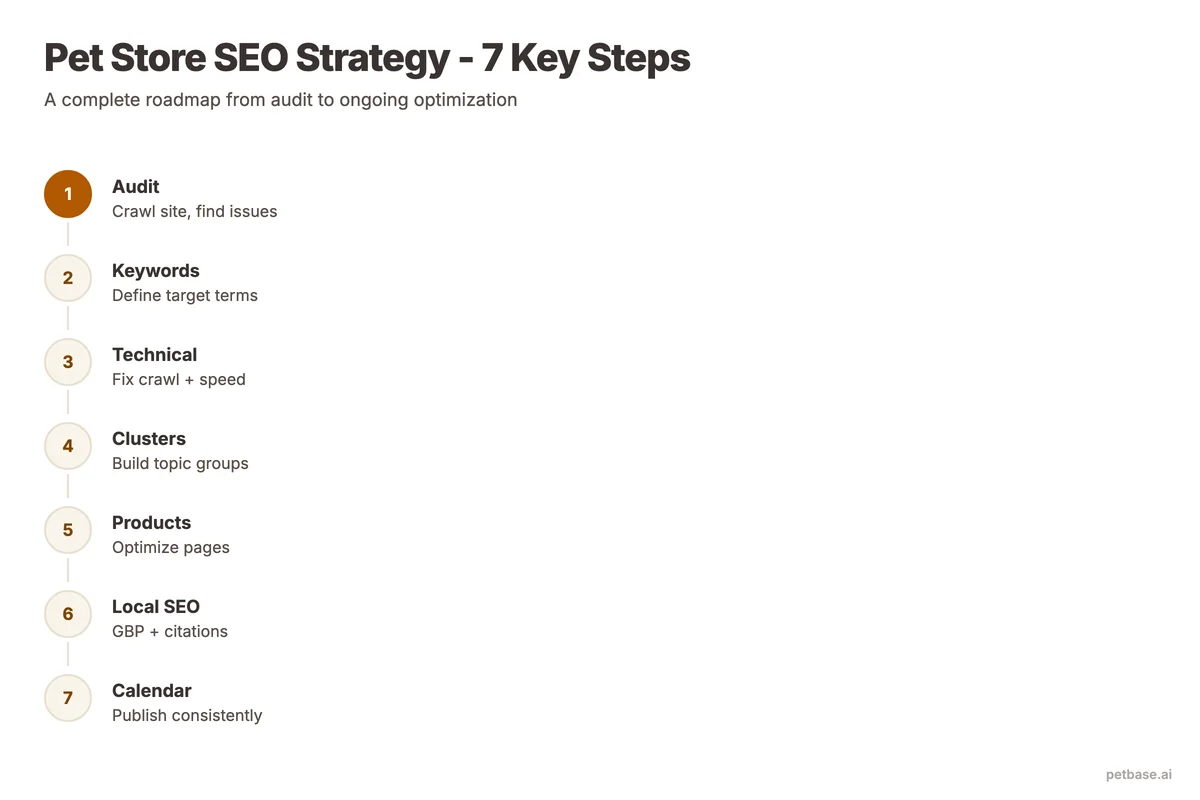
The 7 steps below give you that strategy - from audit to execution.
Petbase automates SEO content for pet stores - publishing 10 optimized articles monthly so you can focus on running your shop - start your free trial.
Step 1: Audit Where You Stand Today
Before building anything, you need a clear picture of your current SEO health. An audit reveals what is working, what is broken, and where the biggest opportunities are hiding.
Here is what to check in your pet store SEO audit:
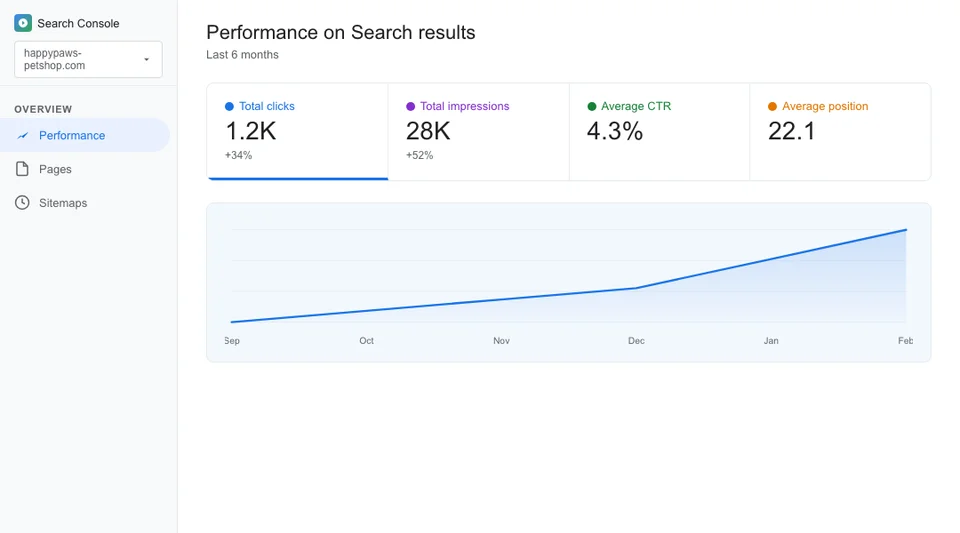
Technical health: Run your site through Google Search Console, Screaming Frog (free for up to 500 URLs), or Sitebulb. Look for crawl errors, broken links, slow pages, missing meta tags, and duplicate content. A pet store with 500+ product pages often has dozens of technical issues that silently hurt rankings.
Current rankings: Use Google Search Console to see which queries your site appears for and where you rank. Sort by impressions to find keywords where you already have visibility but are not yet on page one - these are your quick wins.
Content inventory: List every page on your site - products, categories, blog posts, service pages. Note the word count, last update date, and whether each page ranks for any keywords. Pet stores frequently discover that 40-60% of their blog content generates zero traffic.
Competitor analysis: Pick your top 3 local competitors and 2 national competitors. Check their top-ranking pages, content topics, and backlink profiles using free tools like Ubersuggest or the free tier of Ahrefs Webmaster Tools. Pay attention to backlink counts: the #1 ranking page for any keyword has 3.8x more backlinks on average than pages ranking #2 through #10[4].
Google Business Profile: Review your profile completeness, photo count, review count and average rating, posting frequency, and Q&A section. For physical pet stores, GBP issues often represent the fastest fix-to-traffic improvement.
Document everything in a spreadsheet. You will reference this audit throughout the remaining steps. For a detailed walkthrough, see our pet store website audit guide.
Step 2: Define Your Target Keywords by Pet Niche
Keyword research for pet stores is different from general e-commerce. Your customers search using specific pet terminology - breed names, health conditions, life stages, ingredient preferences, and activity types. Generic keyword tools often miss these nuances.
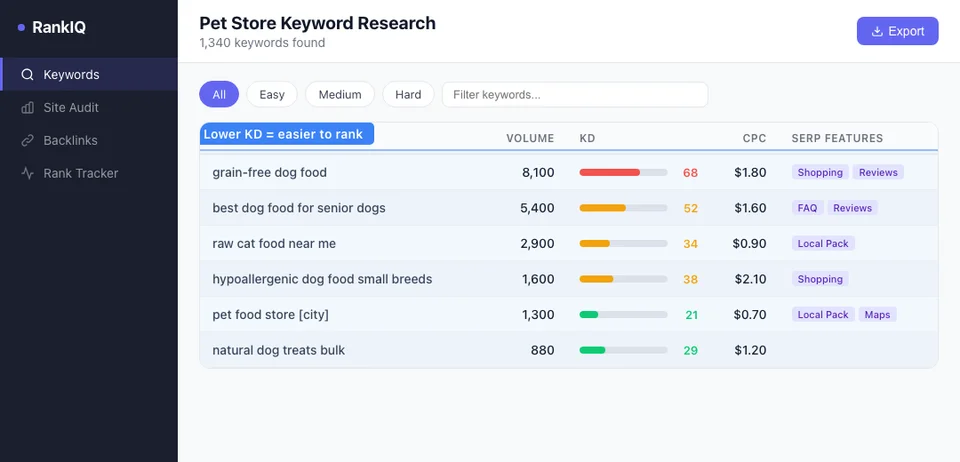
Long-tail keywords (three or more words) account for 70% of all search queries[5]. For pet stores, this means phrases like "best grain-free food for senior Labradors" matter more than just "dog food." These specific queries also convert at 36% - far higher than broad head terms[5].
Start by categorizing your keywords into four intent buckets:
- Informational - "how often to groom a Golden Retriever," "signs of food allergies in cats" (people learning)
- Commercial investigation - "best grain-free dog food 2025," "Orijen vs Acana comparison" (people comparing)
- Transactional - "buy freeze-dried dog treats online," "pet store delivery Munich" (people buying)
- Local - "pet store near me," "dog groomer [city]" (people finding)
For each intent type, identify 10-20 keywords relevant to your specific niche. A pet store specializing in raw dog food should target very different keywords than one focused on reptile supplies.
Group your keywords into clusters. A cluster is a group of related keywords that should be covered by interconnected pages. For example:
- Cluster: Dog Joint Health - "dog joint supplements," "glucosamine for dogs," "best joint support for senior dogs," "signs of arthritis in dogs," "hip dysplasia diet"
- Cluster: Cat Nutrition - "best wet cat food," "grain-free cat food pros cons," "how much to feed an indoor cat," "cat food for urinary health"
This clustering approach is far more effective than targeting isolated keywords. Learn the full method in our keyword research guide for pet businesses.
In Petbase, keyword research happens automatically during your site audit. The platform analyzes your niche, competitors, and existing content to identify the keyword clusters with the highest ranking potential for your specific pet store. No manual spreadsheet work required.
Step 3: Fix Technical Issues First
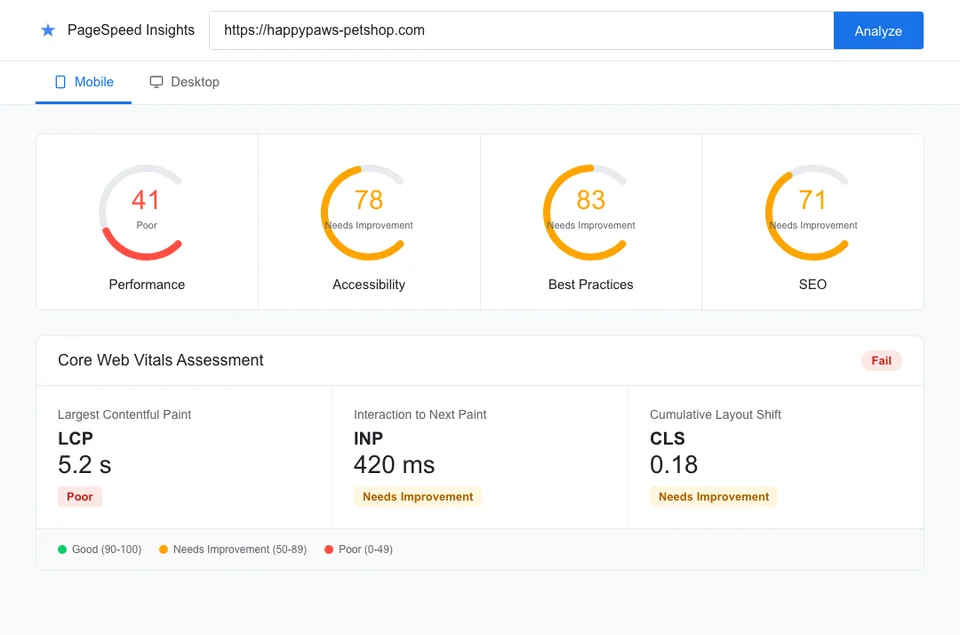
Technical SEO is the foundation. You can create the best pet content in the world, but if Google cannot crawl, index, and render your pages properly, none of it will rank.
Prioritize these technical fixes based on your audit findings:
Critical (fix immediately):
- Pages returning 404 errors - redirect or restore them
- Missing or duplicate title tags on product pages
- Site not mobile-friendly - over 65% of pet product searches happen on mobile
- No HTTPS - Google explicitly penalizes insecure sites
- Robots.txt blocking important pages from crawling
High priority (fix within 2 weeks):
- Slow page load speed (target under 2.5 seconds for Largest Contentful Paint)
- Missing alt text on product images
- Duplicate content across product variations
- Missing structured data (Product, LocalBusiness, FAQ schema)
- Broken internal links
Medium priority (fix within 30 days):
- Thin meta descriptions on category pages
- Missing canonical tags on paginated pages
- Large unoptimized images slowing page load
- Orphaned pages with no internal links pointing to them
For pet stores running on Shopify, WooCommerce, or similar platforms, many technical issues are platform-specific. Shopify generates duplicate URLs for products in collections. WooCommerce can create thousands of thin tag and attribute pages. Know your platform's weaknesses and address them proactively.
Our technical SEO guide for pet websites covers each of these issues in detail with step-by-step fix instructions.
Step 4: Build Your Content Cluster Plan
Content clusters are the backbone of modern pet store SEO. Instead of writing random blog posts, you create interconnected groups of content that demonstrate deep expertise on specific topics.

The data supports this approach: companies that maintain a blog get 55% more website traffic than those that do not[6]. And publishing frequency matters - businesses that publish 16 or more posts per month generate 3.5x more traffic than those publishing four or fewer[7].
A content cluster has three components:
- Pillar page - A comprehensive guide covering the topic broadly (2,500-4,000 words)
- Supporting articles - Detailed posts covering subtopics (1,500-2,500 words each)
- Internal links - Every supporting article links to the pillar and to relevant siblings
For a pet store, your clusters should align with your product categories and customer needs. Here are examples:
Cluster 1: Dog Nutrition
- Pillar: "Complete Guide to Dog Nutrition"
- Supporting: "Raw vs Kibble Comparison," "Best Food for Puppies by Breed Size," "Dog Food Allergies: Symptoms and Solutions," "Senior Dog Nutrition Guide," "Reading Dog Food Labels," "Grain-Free Dog Food: Facts vs Myths"
Cluster 2: Cat Indoor Living
- Pillar: "The Complete Guide to Indoor Cat Care"
- Supporting: "Best Toys for Indoor Cats," "Preventing Obesity in Indoor Cats," "Cat Enrichment Ideas," "Indoor Cat Diet Guide," "Creating a Cat-Friendly Home"
Start with 2-3 clusters. Publish one pillar and 3-4 supporting articles per cluster before moving to the next. This focused approach builds topical authority faster than spreading content across many unrelated topics.
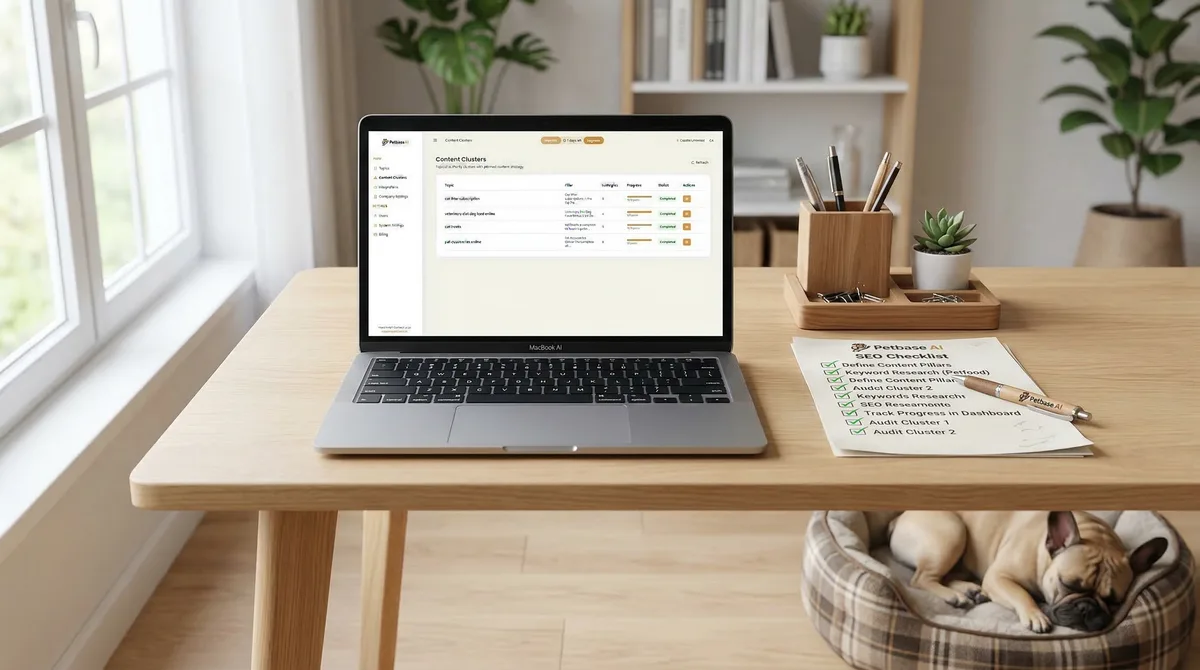
Petbase builds content clusters automatically. After analyzing your site and niche, it creates a 30-day content plan with strategically connected articles that form topic clusters. Each article links to related content, building the hub-and-spoke structure that Google rewards.
For the full breakdown of content clustering strategy, read our guide on content marketing for pet businesses.
Step 5: Optimize Your Product and Category Pages
Product and category pages are where revenue happens, but most pet stores leave them unoptimized. Generic manufacturer descriptions, missing structured data, and weak internal linking leave significant ranking potential on the table.
Product page optimization checklist:
- Unique descriptions (250+ words) that go beyond manufacturer copy
- Include breed, size, age, and condition suitability
- Answer the top 3 buyer questions directly on the page
- Add Product schema markup (price, availability, rating, brand)
- Use descriptive alt text for every product image
- Link to related products and relevant blog content
- Include customer reviews on the page
Category page optimization checklist:
- Write a 150-300 word introduction explaining what the category covers
- Include the primary keyword naturally in the H1 and first paragraph
- Add 2-3 internal links to supporting blog content
- Use breadcrumb navigation with BreadcrumbList schema
- Add filtering options that do not create duplicate URLs
Your blog content and product pages should work together. A blog post about "signs your dog needs joint supplements" should link directly to your joint supplement product category. This sends clear relevance signals to Google and guides readers toward a purchase. Internal linking between content and product pages is what turns informational traffic into revenue.
Step 6: Set Up Local SEO Foundations
If you have a physical pet store, local SEO is your most direct path to new customers. Research shows that 46% of all Google searches have local intent[8]. That means nearly half of all searches are from people looking for something nearby - including pet stores.
Build your local SEO foundation with these actions:
Google Business Profile:
- Complete every field - categories, attributes, services, hours, payment methods
- Select the most specific primary category ("Pet Store" not just "Store")
- Add secondary categories for additional services (grooming, training, etc.)
- Upload 30+ high-quality photos of your store, products, team, and happy customers
- Write a keyword-rich business description (up to 750 characters)
- Post weekly updates about new products, events, or pet care tips
Citations and directories:
- List your business on major directories: Yelp, Bing Places, Apple Maps, Facebook
- Add your store to pet-specific directories: BringFido, PetFriendly, local pet directories
- Ensure NAP (name, address, phone) is identical across all listings
Reviews:
- Ask happy customers for reviews at checkout and via follow-up email
- Respond to every review within 48 hours - positive and negative
- Never buy or incentivize fake reviews - Google penalizes this aggressively
For the complete local SEO playbook, see our guides on local SEO for pet businesses and the latest local search changes in 2025.
Step 7: Create a Publishing Calendar and Stick to It
Consistency matters more than perfection. A pet store that publishes 2-3 quality articles per week for 12 weeks will outrank one that publishes 20 articles in one week and then nothing for three months. The data confirms this: businesses publishing 16+ posts per month see 3.5x more traffic than those publishing four or fewer[7].
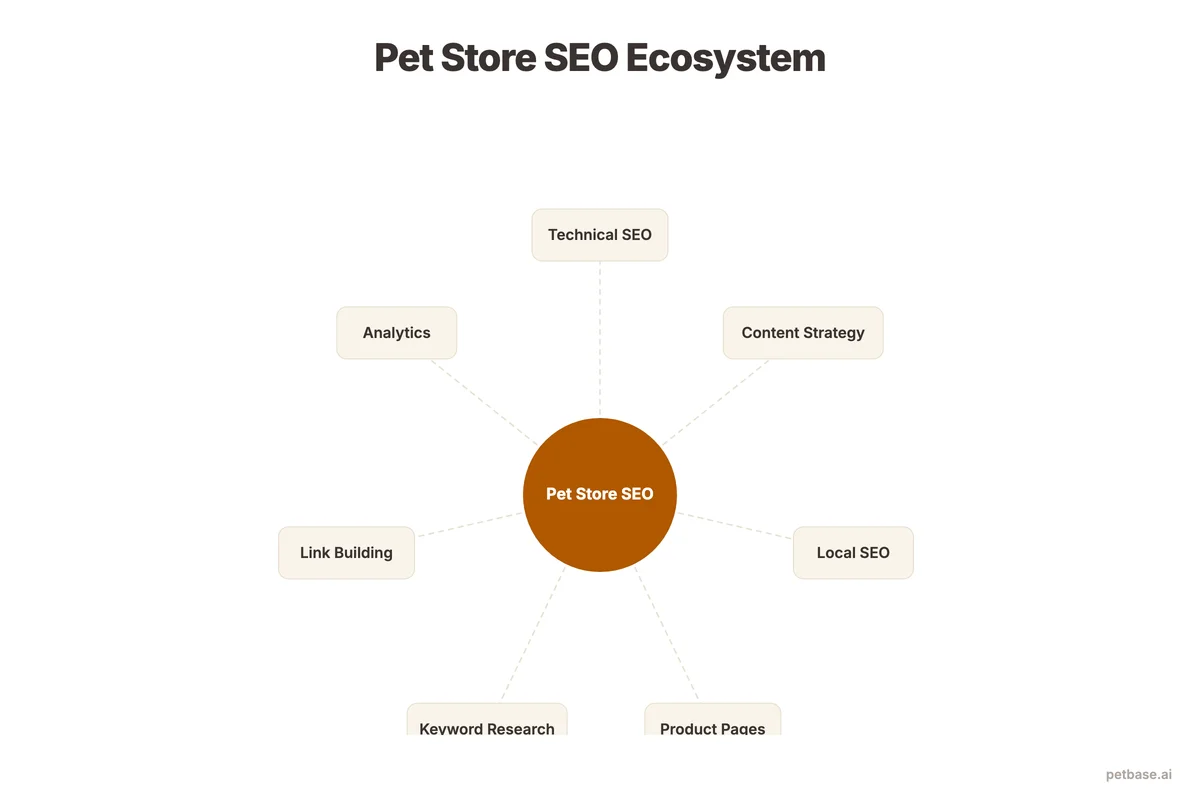
Here is a realistic publishing calendar for a pet store with limited resources:
- Week 1-2: Publish pillar page for Cluster 1
- Week 3-4: Publish 2 supporting articles for Cluster 1
- Week 5-6: Publish 2 more supporting articles for Cluster 1
- Week 7-8: Publish pillar page for Cluster 2
- Week 9-10: Publish 2 supporting articles for Cluster 2
- Week 11-12: Publish 2 more supporting articles for Cluster 2 + refresh Cluster 1 pillar
That is 10-12 articles in 12 weeks - a manageable pace that builds real topical authority.
With Petbase, this calendar runs on autopilot. The platform generates and publishes 10 articles per month to your CMS, following the content cluster plan created during your site audit. Each article is optimized for a specific keyword, interlinked with related content, and written with pet industry expertise. You review and approve - that is it.
Read more about building a sustainable publishing schedule in our guide to building an SEO content calendar for pet businesses.
What Does a 90-Day Pet Store SEO Roadmap Look Like?
Here is a complete week-by-week breakdown of the first 90 days, combining all seven steps into an actionable timeline:
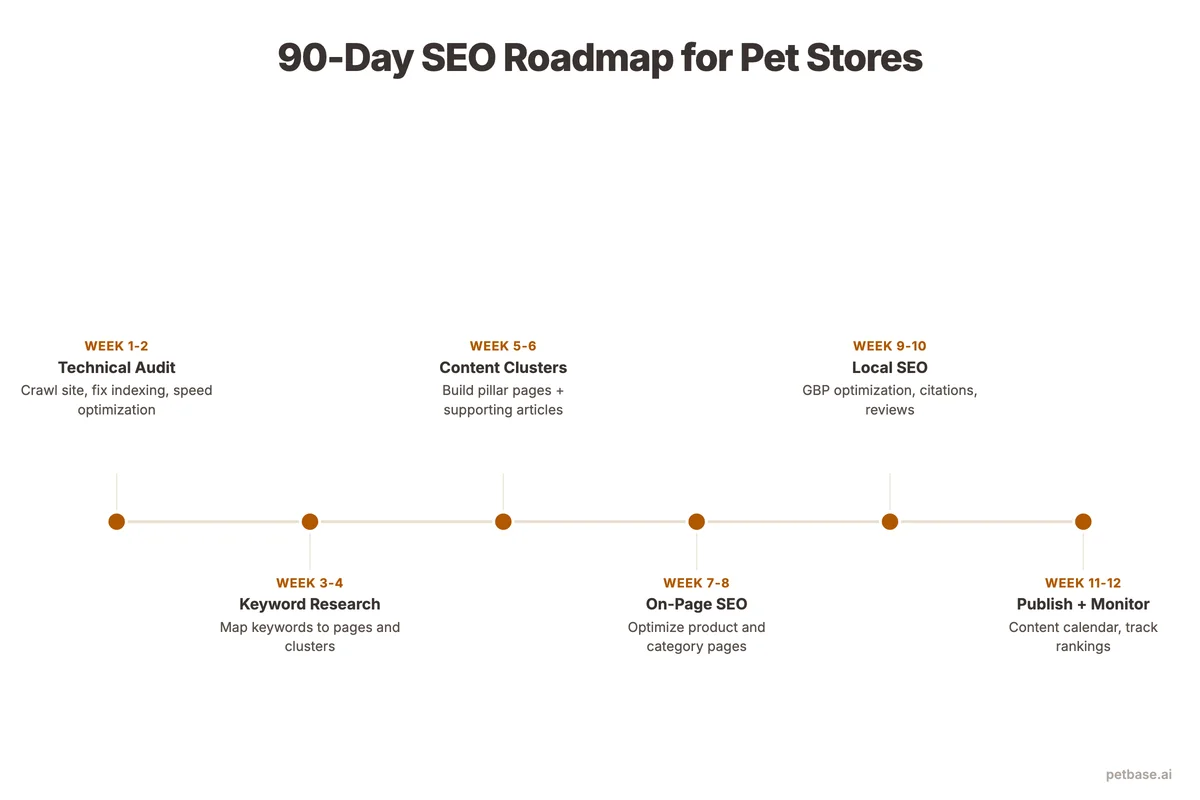
| Week | Focus Area | Key Actions | Expected Outcome |
|---|---|---|---|
| 1 | Audit | Run technical audit, content inventory, competitor analysis | Clear picture of current SEO health |
| 2 | Keywords | Research and cluster target keywords, map to pages | Keyword map with 50-100 target terms grouped into clusters |
| 3 | Technical fixes | Fix critical crawl errors, broken links, missing meta tags | Clean technical foundation for Google to crawl |
| 4 | Technical fixes | Optimize page speed, add structured data, fix mobile issues | Core Web Vitals passing on all key pages |
| 5 | GBP + Local | Complete Google Business Profile, submit to directories | GBP fully optimized, citations consistent |
| 6 | Content: Cluster 1 | Publish pillar page for primary topic cluster | Foundation article live and indexed |
| 7-8 | Content: Cluster 1 | Publish 4 supporting articles, interlink with pillar | First complete cluster taking shape |
| 9 | Product pages | Optimize top 20 product pages with unique descriptions | Product pages competing for transactional keywords |
| 10 | Content: Cluster 2 | Publish pillar page for second topic cluster | Second authority topic initiated |
| 11-12 | Content: Cluster 2 | Publish 4 supporting articles, interlink with pillar | Two complete clusters, early ranking signals |
| 13 (ongoing) | Review + iterate | Analyze rankings, traffic, conversions. Adjust strategy. | Data-driven optimization cycle begins |
By week 12, you should see initial ranking improvements for long-tail keywords and increased impressions in Google Search Console. Long-tail queries make up 70% of all searches and convert at 36%[5], so these early wins translate directly into revenue. Significant traffic growth typically follows in months 3-6 as Google recognizes your growing topical authority.
The timeline is not a guess. Pet stores using Petbase consistently see their first target keywords reach page one within 8-12 weeks of starting their content cluster strategy.
Now compare the three main approaches to executing this roadmap:
| Factor | DIY (Manual) | Petbase | SEO Agency |
|---|---|---|---|
| Monthly cost | EUR 0 (your time) | EUR 199/mo | EUR 2,000-5,000+/mo |
| Time investment | 20-40 hours/month | 2-4 hours/month (review and approve) | 2-3 hours/month (meetings and approvals) |
| Content output | 2-4 articles/month | 10 articles/month | 4-8 articles/month |
| Pet industry expertise | Depends on your knowledge | Built-in pet knowledge model | Varies by agency |
| Strategy included | You build it yourself | Automated keyword research and content planning | Full strategy consultation |
| Speed to results | 6-12 months | 8-12 weeks for initial rankings | 3-6 months |
| Scalability | Limited by your time | Consistent monthly output | Scales with budget |
Each approach has its place. DIY works if you have the time and enjoy learning SEO. An agency makes sense for large multi-location pet chains with complex needs. For most independent pet stores, a specialized tool like Petbase offers the best balance of cost, output, and results.
Ready to start building your roadmap? See Petbase pricing or read our complete pet store SEO guide for additional context on each step.
Frequently Asked Questions
How long does it take for a pet store SEO strategy to show results?
Expect initial ranking improvements for long-tail keywords within 8-12 weeks of consistent effort. Significant traffic growth typically happens in months 3-6. Competitive head terms (like "dog food" or "pet store") take 6-12 months. The timeline depends on your starting position, competition level, and publishing consistency. Pet stores that publish 8-10 articles per month in structured clusters see results faster than those publishing sporadically.
Should I focus on local SEO or content SEO first?
If you have a physical store, start with local SEO - specifically your Google Business Profile. With 46% of all Google searches carrying local intent[8], it delivers the fastest return with the least effort. A fully optimized GBP can increase foot traffic within weeks. Then layer content SEO on top for long-term organic growth. Online-only pet stores should start with content clusters and technical fixes since local SEO does not apply.
How many keywords should a pet store target in the first 90 days?
Focus on 50-100 keywords grouped into 2-3 topic clusters. Trying to target 500+ keywords in the first 90 days spreads your effort too thin. Pick clusters aligned with your highest-margin products or services. A pet store specializing in premium dog food might target 30 keywords in a "dog nutrition" cluster and 20 keywords in a "raw feeding" cluster. Depth beats breadth.
Can I do pet store SEO myself or do I need to hire someone?
You can absolutely do it yourself if you have 20-40 hours per month to dedicate. The 7-step roadmap in this guide gives you everything you need. The bottleneck for most pet store owners is time, not knowledge. If you cannot commit 20+ hours per month, consider using a tool like Petbase (EUR 199/mo for 10 articles, automated keyword research, and auto-publishing) to handle content creation while you focus on running your store. An SEO agency (EUR 2,000-5,000+/mo) makes sense only for large operations with complex multi-location needs.
References
- Fortune Business Insights (2024). Pet Care Market Size, Share & Industry Analysis. fortunebusinessinsights.com
- BrightEdge (2019). How Much Traffic Comes from Organic Search? seoinc.com
- Clutch (2025). SEO Statistics. clutch.co
- BuzzStream (2024). Link Building Statistics. buzzstream.com
- Embryo (2024). 30 Statistics About Long-Tail Keywords. embryo.com
- HubSpot (2024). Marketing Statistics. hubspot.com
- HubSpot (2024). Marketing Statistics: Publishing Frequency and Traffic. hubspot.com
- BrightLocal (2024). Local SEO Statistics. brightlocal.com