Pet Store Website Mistakes That Kill Your Conversions

Table of Contents +
- Why Your Pet Store Website Gets Traffic But Not Sales
- Navigation Mistakes That Confuse Pet Shoppers
- Product Page Mistakes That Kill Conversions
- Checkout and Cart Mistakes
- Page Speed and Mobile Experience Mistakes
- Trust Signal Mistakes
- Meta Tag Mistakes That Waste Your Rankings
- Content Mistakes That Hurt Both SEO and Conversions
- How to Prioritize Which Mistakes to Fix First
- References
Fix the 15 most common pet store website mistakes that kill conversions. Prioritized by impact with a 4-week fix plan to increase sales from existing traffic.
Your pet store website gets visitors. Google Analytics shows real people landing on your pages. But the sales don't follow. Cart abandonment is high. Product pages get views but no clicks on "Add to Cart." Visitors bounce after 20 seconds.
The problem is not your traffic. The problem is your website. Specific design, content, and usability mistakes stop pet shoppers from buying. With pet e-commerce now a $94.89 billion market[1], the stakes are too high to leave conversions on the table.
This guide covers the 15 most common conversion killers on pet store websites, ranked by impact, and gives you a prioritized fix plan you can start this week.
Why Your Pet Store Website Gets Traffic But Not Sales
Traffic and conversions are two different problems. SEO brings people to your site. Conversion is what happens after they arrive. Many pet stores invest in SEO and content marketing but ignore the experience visitors have once they land.
Organic search drives 53% of all website traffic[2], so most of your visitors arrive through Google. The average e-commerce conversion rate is 2-3%. Pet store websites typically convert between 1.5% and 3.5%, depending on whether they sell online, drive in-store visits, or both. If your rate is below 1.5%, you almost certainly have fixable issues.
Here is the full list of 15 mistakes, with impact level and fix difficulty:
| Mistake | Impact on Sales | Fix Difficulty | Estimated Lift |
|---|---|---|---|
| Confusing navigation | High | Medium | 10-25% |
| No search functionality | High | Low | 5-15% |
| Generic product descriptions | High | Medium | 15-30% |
| No product images from multiple angles | Medium | Medium | 5-10% |
| Missing product reviews | High | Low | 10-20% |
| Complicated checkout process | High | Medium | 15-35% |
| No guest checkout option | High | Low | 10-25% |
| Hidden shipping costs | High | Low | 10-20% |
| Not mobile-optimized | High | High | 20-40% |
| Slow page load speed | High | Medium | 10-20% |
| No trust signals | Medium | Low | 5-15% |
| Missing contact information | Medium | Low | 3-8% |
| No clear return policy | Medium | Low | 5-10% |
| Thin category page content | Medium | Medium | 5-15% |
| No content that builds purchase confidence | Medium | Medium | 10-20% |
Let's go through each category in detail.
Petbase automates SEO content for pet stores - publishing 10 optimized articles monthly so you can focus on running your shop - start your free trial.
Navigation Mistakes That Confuse Pet Shoppers
When a visitor can't find what they want within 3-5 seconds, they leave. Pet stores have a unique navigation challenge because you sell products across multiple species, categories, and use cases. A dog food buyer and a cat toy buyer have completely different journeys.
The most common navigation mistakes:
No species-based navigation
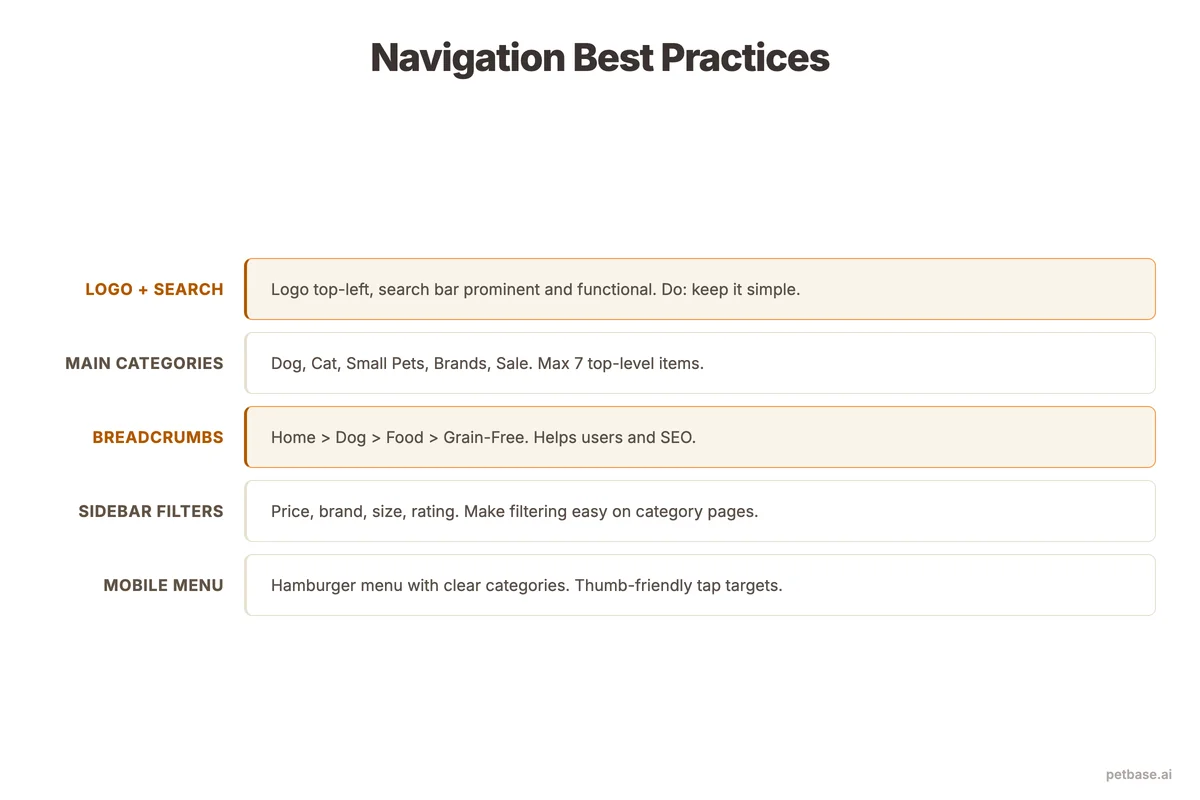
Your top-level navigation should start with species: Dog, Cat, Small Animals, Birds, Fish. This is how pet shoppers think. They don't browse by product type first - they browse by animal first. Yet many pet store websites organize by category (Food, Toys, Accessories) without a species filter, forcing visitors to sort through products for animals they don't own.
Too many menu items
Menus with 15+ top-level items overwhelm visitors. The ideal structure is 5-7 main categories with clear dropdown subcategories. A pet store menu should look like: Dog | Cat | Small Pets | Brands | Blog | About | Contact. Everything else goes in subcategories.
No search bar or poor search functionality
Up to 30% of e-commerce visitors use site search. If your search bar is hidden in the footer, doesn't auto-suggest, or returns poor results for common pet terms ("puppy food" returning zero results because your categories say "junior food"), you lose sales. Add a prominent search bar with autocomplete and synonym support.
Breadcrumbs missing
Breadcrumbs (Home > Dog > Food > Dry Food) help visitors understand where they are and navigate back. They also help Google understand your site structure. Every product and category page needs them.
Product Page Mistakes That Kill Conversions
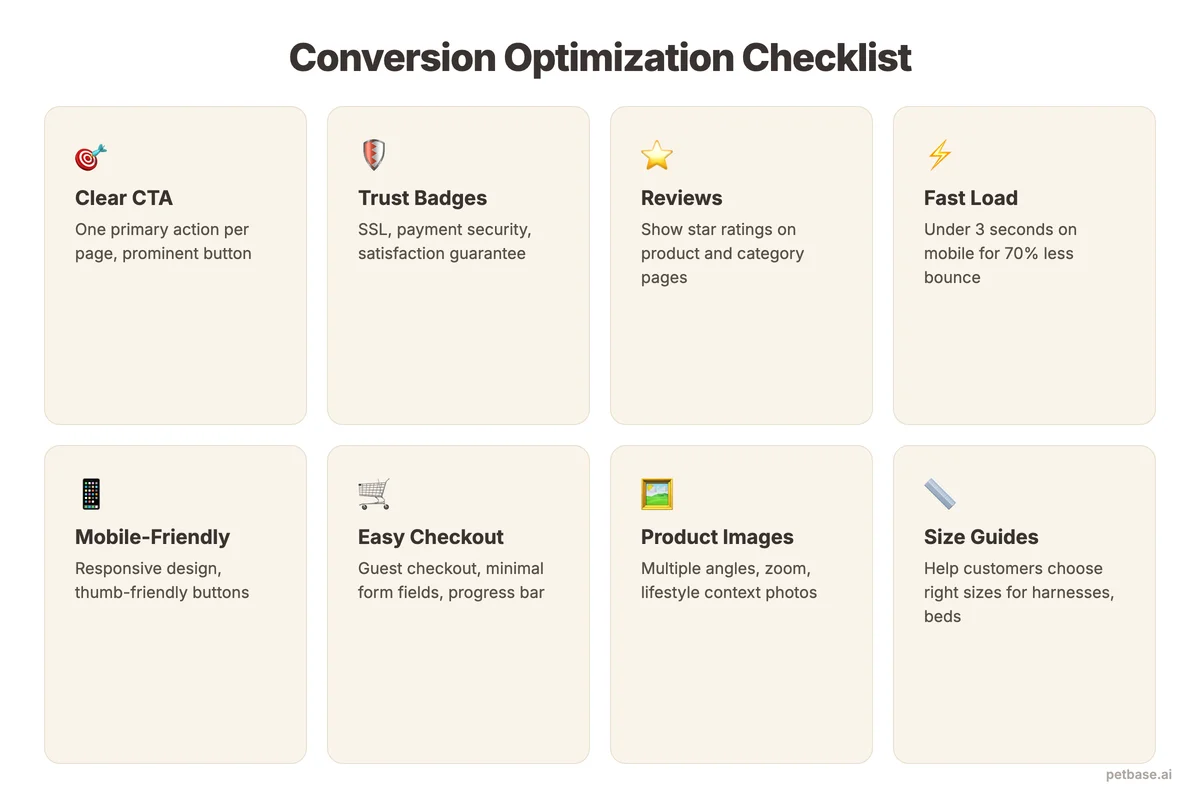
Product pages are where the buying decision happens. Most pet store product pages are surprisingly weak - often just a manufacturer description, one photo, and a price.
Generic manufacturer descriptions
The #1 product page mistake. If your description is the same text that appears on every other retailer's site, you offer no unique value. Worse, Google may see it as duplicate content and rank your competitors instead.
Strong product descriptions for pet stores include:
- Who the product is for (breed size, age, activity level)
- What problem it solves (allergies, destructive chewing, weight management)
- How it compares to alternatives
- Your store's recommendation and why
- Specific ingredients, materials, or features that matter
A German dog food retailer rewrote 200 product descriptions from manufacturer copy to unique, pet-specific descriptions. Their organic product page traffic increased 45% within 4 months, and their add-to-cart rate went up 22%. Read more about this in our guide to writing product descriptions that rank and sell.
Petbase generates unique, SEO-optimized product descriptions for pet stores using its pet industry knowledge model. Each description is tailored to your specific products, addressing the buyer's intent and including relevant details about breeds, health conditions, and use cases. At scale - 10 articles per month plus product descriptions - this is the kind of content that moves both rankings and revenue.
Only one product image
Pet shoppers want to see the product from multiple angles, the ingredient list, the packaging size next to a reference object, and ideally the product in use. A single stock photo from the manufacturer is not enough. Stores that add 3-5 images per product see measurably higher conversion rates.
No customer reviews
Reviews are the single most powerful trust signal on a product page. 93% of shoppers say online reviews influence their purchase decisions[3]. If your product pages have no reviews, visitors assume either nobody buys from you or you are hiding something. Enable reviews and actively request them from customers.
Missing stock and delivery information
"Is it in stock?" and "When will it arrive?" are two questions every online shopper has. If your product page doesn't clearly answer both, you create uncertainty - and uncertainty kills conversions. Show real-time stock status and estimated delivery dates.
Checkout and Cart Mistakes
Cart abandonment in e-commerce averages 70%[4]. For pet stores, the rate is often even higher because many shoppers compare prices across multiple retailers for commodity items like dog food or cat litter.
Hidden shipping costs
The #1 reason for cart abandonment across all e-commerce. If a customer adds EUR 45 worth of dog food to their cart and discovers EUR 8.95 shipping at checkout, they feel tricked. Show shipping costs early - on the product page or at minimum in the cart, before checkout.
Better yet, offer free shipping above a threshold: "Free shipping on orders over EUR 49." This also increases average order value because customers add items to reach the threshold.
Forced account creation
Requiring visitors to create an account before purchasing adds friction. 24% of online shoppers abandon carts when asked to create an account. Always offer guest checkout. You can ask them to create an account after the purchase is complete.
Too many checkout steps
Every additional step in your checkout process loses 5-10% of buyers. The ideal checkout is 2-3 steps: shipping info, payment, confirmation. If your checkout has 5+ pages with unnecessary fields, simplify it. Do you really need their phone number? Their company name? Their date of birth?
Page Speed and Mobile Experience Mistakes
Over 60% of pet-related searches happen on mobile devices. If your pet store website is not fully optimized for mobile, you are losing the majority of your potential customers.
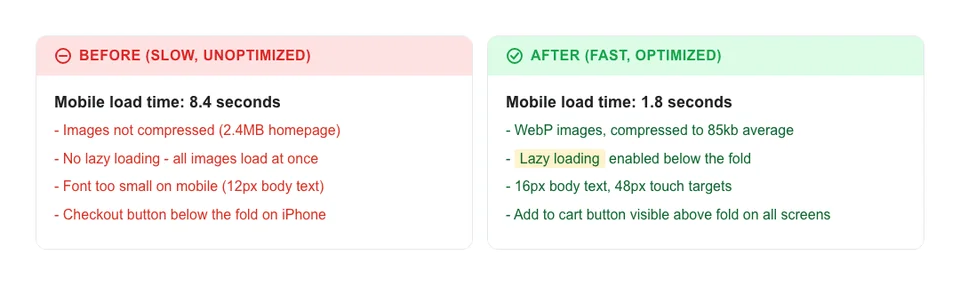
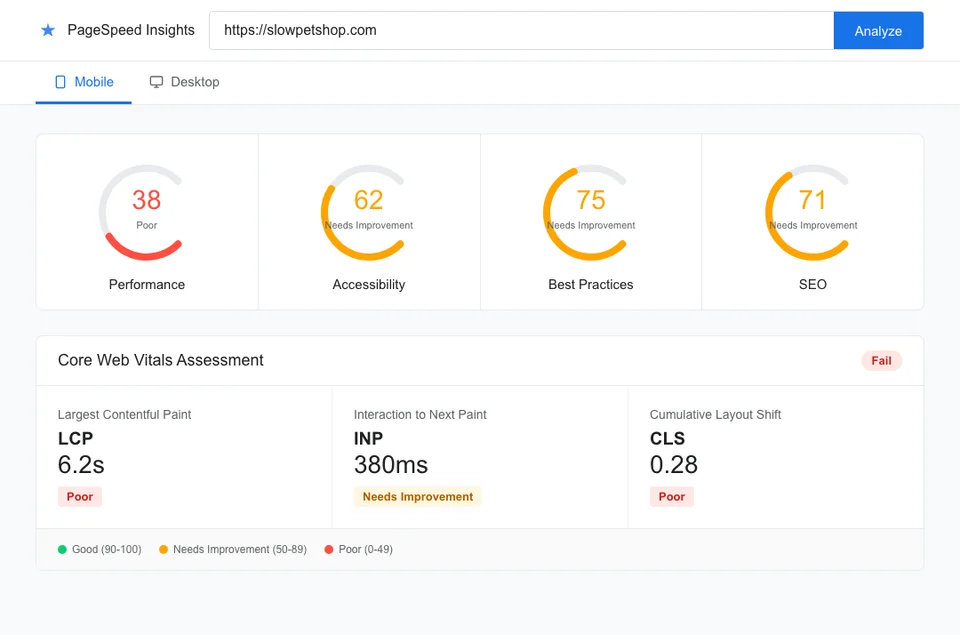
Speed is just as critical. 53% of visitors abandon a site that takes longer than 3 seconds to load, and every 0.1-second improvement in speed increases conversions by 8.4%[5]. Sites that load in 1 second convert at 2.5 times the rate of sites that load in 5 seconds, and 57% of that traffic comes from mobile[6].
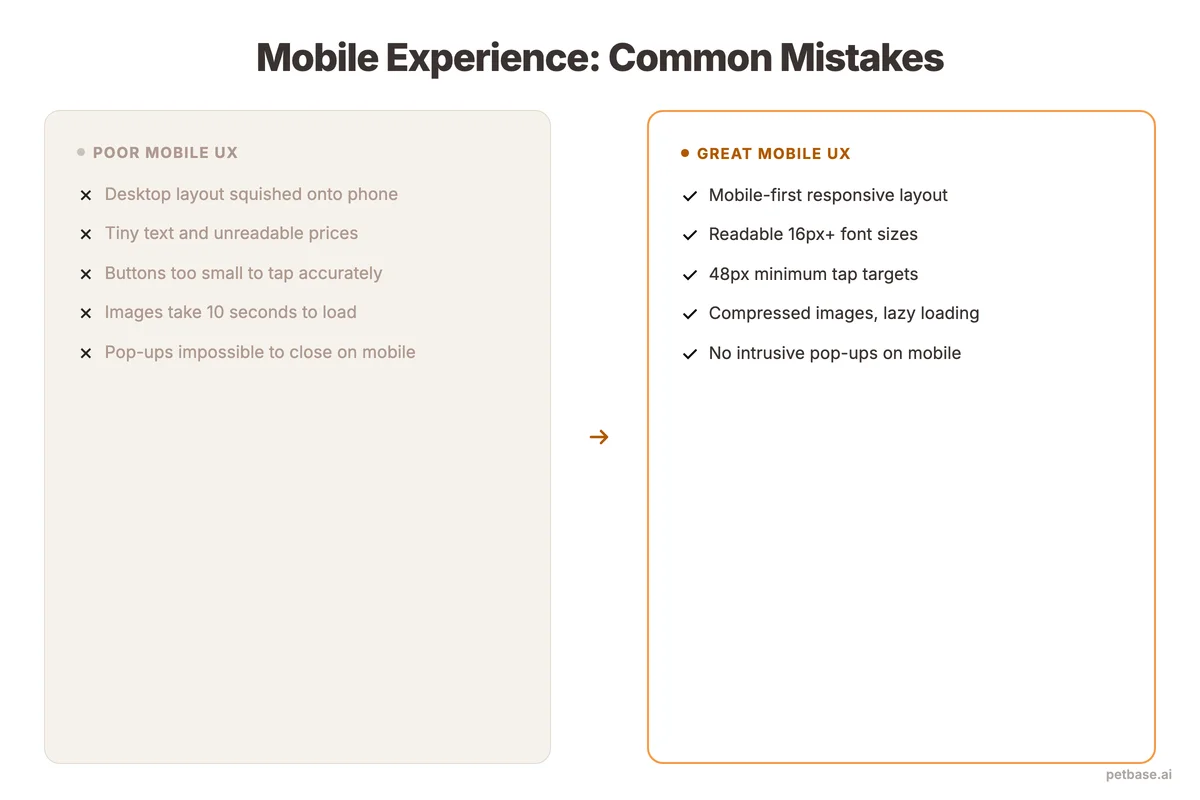
Mobile-optimized pet stores see 32% higher conversion rates than those that are not[7]. Common mobile mistakes:
- Text too small to read: Body text should be at least 16px on mobile
- Buttons too small to tap: Minimum 44x44 pixels for tap targets
- Images not responsive: Product images should resize to fit the screen without horizontal scrolling
- Pop-ups that cover the screen: Google penalizes intrusive interstitials on mobile. A full-screen pop-up asking for email sign-ups on mobile is both a UX failure and an SEO penalty.
- No mobile-specific navigation: A hamburger menu that mirrors your desktop mega-menu is not enough. Mobile navigation needs to be simplified with clear category paths.
Test your site on a real phone - not just a browser's mobile simulator. Open your checkout flow on mobile and try to complete a purchase. If it takes more than 3 minutes or requires pinching and zooming, you need changes. Our technical SEO guide covers the mobile requirements in detail.
Trust Signal Mistakes
Pet shoppers are protective of their animals. They won't buy food, supplements, or health products from a site they don't trust. Trust signals reduce the perceived risk of buying from you.
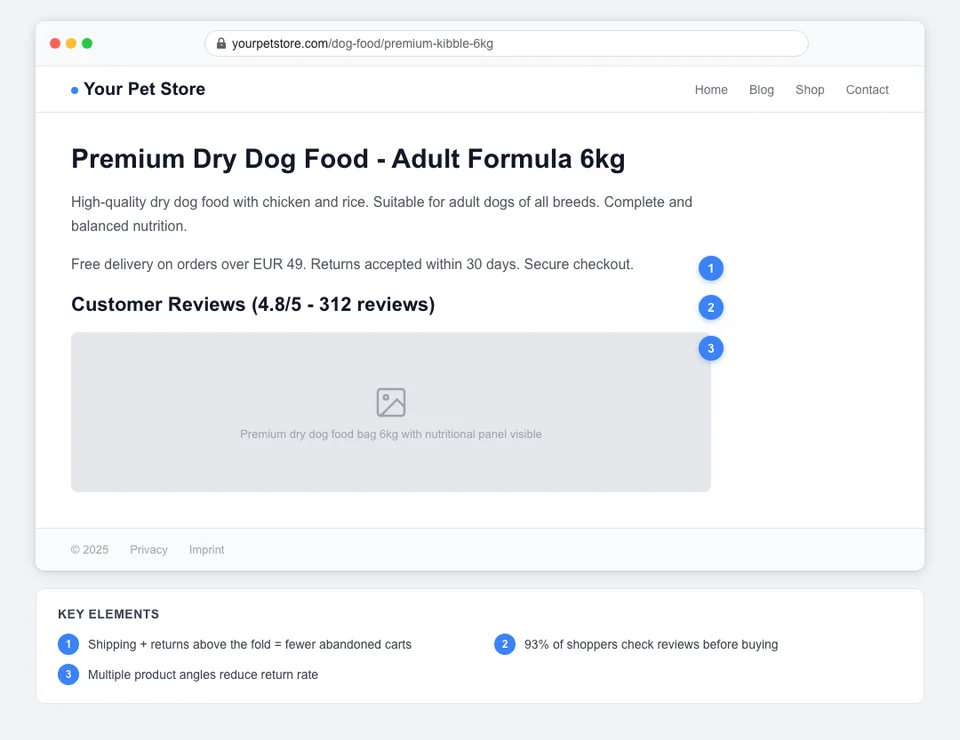
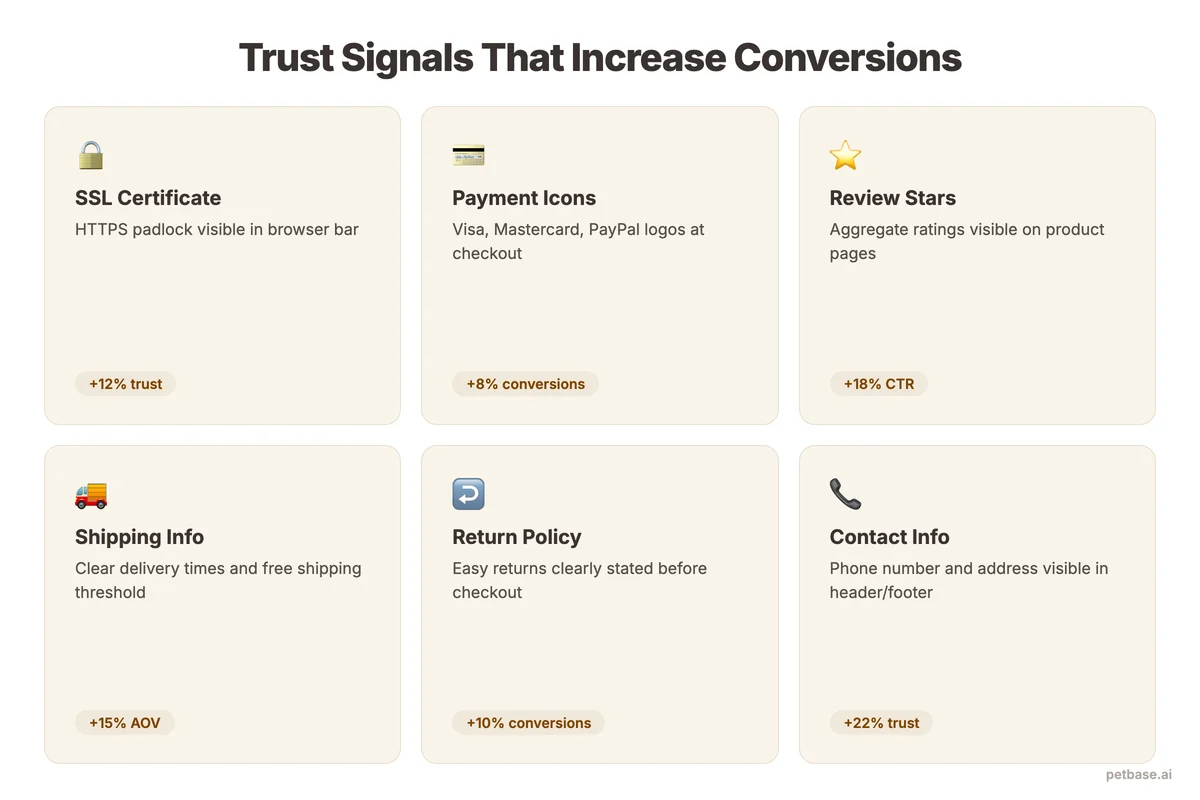
Missing trust signals that cost pet stores sales:
- No physical address: Even online-only stores benefit from showing a physical location. It proves you are a real business.
- No phone number: Visible contact information increases trust, even if most customers never call.
- No return policy: If customers can't find your return policy, they assume you don't have one - or that returns are difficult.
- No security badges: SSL certificate, payment provider logos (Visa, Mastercard, PayPal), and trust seals matter more than you think.
- No "About" page with real people: Show your team. Show your store. Show your pets. Real photos of real people build trust that stock photos never will.
A UK pet supply store added their team photos, a video store tour, and visible phone number to every page. Their conversion rate increased 18% in the first month with no other changes. Trust signals are low-effort, high-impact fixes.
Meta Tag Mistakes That Waste Your Rankings
Even when your pages rank, poor meta tags lose you clicks. The average e-commerce title tag is just 39 characters and the average meta description is just 96 characters[8] - both far shorter than the limits Google allows. That means most pet store websites leave space on the table that could be used to sell the click.
Write title tags up to 55-60 characters that include the product name, a key benefit, and your brand. Write meta descriptions up to 155 characters that give the shopper a reason to click instead of scrolling past. Every page that ranks but doesn't get clicked is wasted potential.
Content Mistakes That Hurt Both SEO and Conversions
Content mistakes sit at the intersection of traffic and conversion problems. Thin or missing content hurts your Google rankings AND makes visitors less likely to buy once they arrive.
Thin category pages
Most pet store category pages show a grid of products with zero explanatory content. Compare this to a category page that includes: a 200-word intro explaining who these products are for, buying guidance, a comparison of subcategories, and links to related blog content. The second page ranks better in Google AND converts better because it helps the shopper make a decision. Learn more about optimizing pet store category pages.
No buying guides or comparison content
Pet shoppers research before buying. If your website has no comparison content ("wet food vs dry food for cats"), no buying guides ("how to choose the right harness for your dog"), and no educational content about the products you sell, visitors will find that information elsewhere - and probably buy there too.
No FAQ content on product pages
Adding 3-5 FAQs to your most popular product pages serves two purposes: it answers pre-purchase questions that would otherwise cause a bounce, and it generates FAQ rich snippets in Google that increase your click-through rate.
Petbase creates buying guides, comparison content, and educational blog posts that naturally support your product pages. Each piece is built around the keywords your customers actually search for, driving both traffic and purchase confidence. At EUR 199/mo for 10 articles, it replaces the content gap that most pet stores struggle with.
How to Prioritize Which Mistakes to Fix First
You can't fix everything at once. Use this priority framework to get the biggest impact first:
| Week | Focus Area | Specific Actions | Expected Impact |
|---|---|---|---|
| Week 1 | Quick wins | Add guest checkout. Show shipping costs on product pages. Add phone number and address to footer. Add return policy link to checkout. | 5-15% conversion lift |
| Week 2 | Product pages | Rewrite top 20 product descriptions. Add 2-3 additional images per product. Enable customer reviews. | 10-25% conversion lift on updated pages |
| Week 3 | Navigation and mobile | Restructure navigation by species. Test and fix mobile experience. Add site search with autocomplete. | 10-20% improvement in engagement metrics |
| Week 4 | Content and trust | Add category page content. Publish 2-3 buying guides. Add team photos and trust badges. Run a website audit. | 5-15% conversion lift + SEO improvement |
The key insight: most conversion improvements come from removing friction, not adding features. Every step you remove from the buying process, every question you answer before it is asked, and every doubt you resolve before it forms - these all add up to more sales from the same traffic.
If your conversion rate moves from 1.5% to 3% - a realistic improvement from fixing these mistakes - you double your revenue without spending a single extra euro on traffic. That is the power of conversion optimization.
For pet stores ready to fix both the traffic and conversion sides of this equation, Petbase handles the content that brings visitors in and builds the purchase confidence that converts them. Optimized product pages, educational blog content, and buying guides - all generated from your product catalog and published automatically. Start your free trial and see the first articles within days.
References
- Grand View Research - Pet Care E-Commerce Market Analysis
- SEO Inc. - How Much Traffic Comes From Organic Search
- BrightLocal - Local SEO Statistics
- Smart Insights - E-Commerce Conversion Rates
- Magnet - Understanding Google's Core Web Vitals
- Smart Insights - E-Commerce Conversion Rates
- Clutch - SEO Statistics 2025
- Taylor Scher SEO - E-Commerce SEO Statistics
What is a good conversion rate for a pet store website?
The average e-commerce conversion rate is 2-3%. Pet store websites typically fall between 1.5% and 3.5%. If you sell specialty or premium products, your rate may be at the higher end because buyers have already done their research. If you sell commodity products (standard dog food, cat litter), expect rates closer to 1.5-2% because shoppers compare prices across multiple sites. Focus on improving your rate relative to your own baseline rather than chasing an industry average.
Should I fix SEO or conversion issues first?
Fix conversion issues first if you already have traffic. There is no point driving more visitors to a site that doesn't convert. If you have fewer than 500 monthly organic visitors, focus on SEO and content first using a solid pet store SEO strategy because you need a baseline of traffic before conversion optimization matters. The ideal approach is to work on both simultaneously.
How much does it cost to fix pet store website conversion issues?
Most of the fixes in this guide are free or low-cost. Adding guest checkout, showing shipping costs, and improving navigation are all changes your web developer can make in a few hours. Product description rewrites are the most time-intensive fix - rewriting 200+ descriptions manually takes 80-100 hours. Petbase automates this at EUR 199/mo, covering both blog content and product descriptions. An agency would charge EUR 5,000+ monthly for the same volume of work.