The SEO Patterns That Work for Pet Stores in Europe

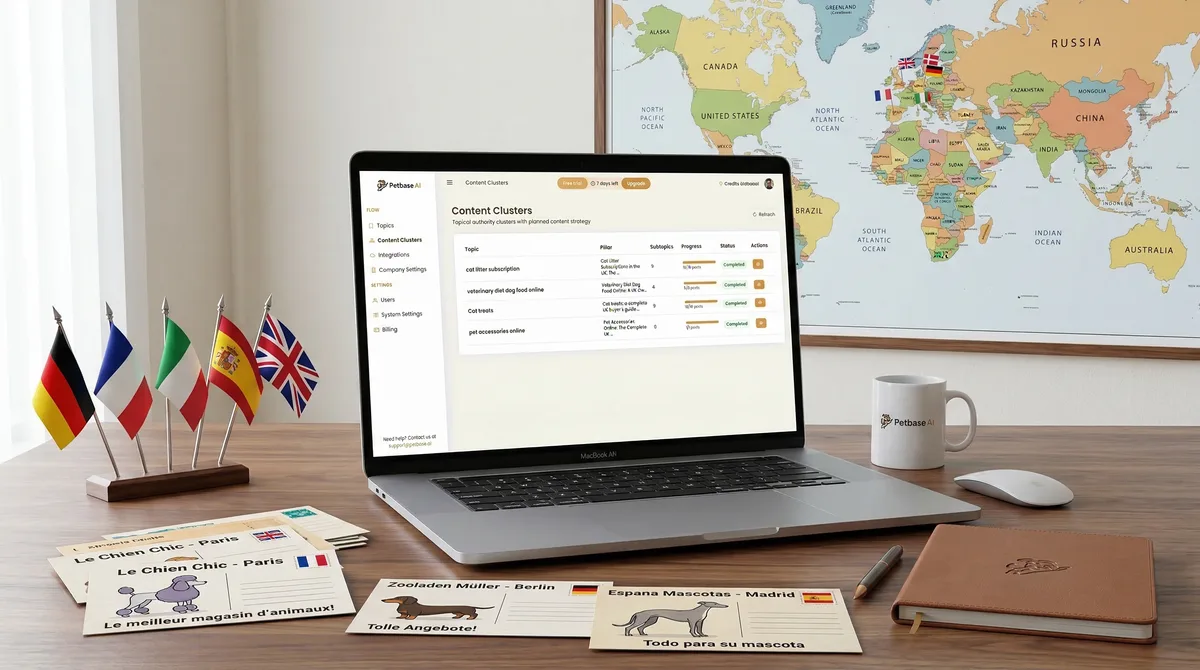
Table of Contents +
- Why European Pet Stores Face Different SEO Challenges
- Pattern 1: Content Clusters Beat Random Blog Posts
- Pattern 2: Local SEO Drives 60%+ of In-Store Traffic
- Pattern 3: Product Descriptions That Go Beyond Manufacturer Copy
- Pattern 4: German, French, and Dutch Markets Need Localized Content
- Pattern 5: Stores That Publish Monthly Outrank Those That Do Not
- Pattern 6: Long-Tail Keywords Are the Fastest Path to Page 1
- Pattern 7: The Stores That Automate Content Win the Long Game
- What European Pet Stores Get Wrong (and How to Fix It)
- A 90-Day Playbook for European Pet Store SEO
- References
7 SEO patterns that work for pet stores across European markets. Data from 50 site reviews covering Germany, UK, France, and Netherlands. Plus a 90-day plan.
European pet stores face SEO challenges that American guides do not address. Multi-language markets. Fragmented search behavior across Germany, UK, France, and the Netherlands. Local regulations affecting product claims. And a competitive landscape where independent stores compete against both Amazon and large European chains like Fressnapf and Maxi Zoo.
With 139 million pet-owning households and roughly 299 million companion animals across Europe[1], the market is enormous. EU pet food sales alone reached EUR 29.2 billion[1]. Yet most independent pet stores capture almost none of this demand through organic search.
After reviewing pet store websites across 9 European markets and analyzing what separates the stores that rank from those that do not, we identified 7 clear patterns. These are not theories - they are observable, repeatable patterns from stores that generate thousands of monthly organic visitors. This guide shows you what they do, why it works, and how to apply each pattern to your own store.
Why European Pet Stores Face Different SEO Challenges
SEO advice written for the US market misses several realities of European pet e-commerce. Understanding these differences is the first step to building a strategy that works here.
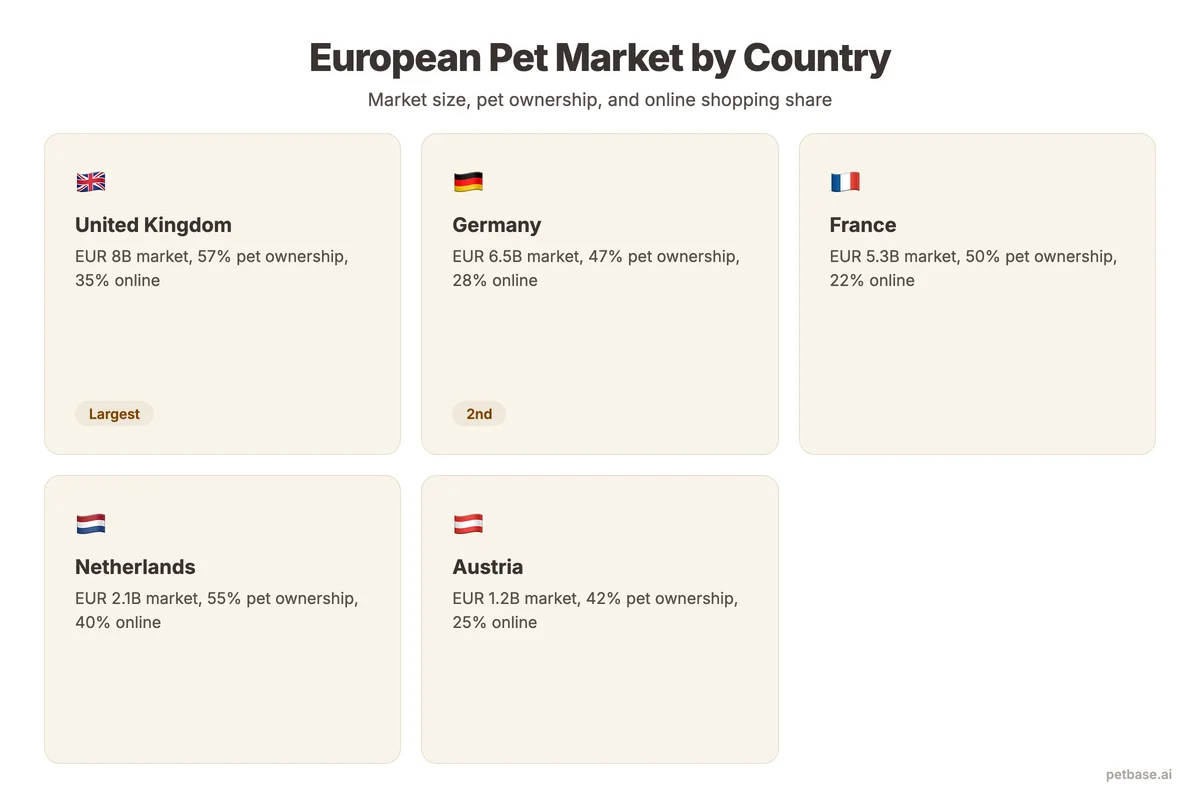
Key differences for European pet stores:
- Language fragmentation: A German pet store targets German-language keywords. A Dutch store targets Dutch. A French store targets French. The search volumes per language are smaller than English, but competition is often lower too.
- Multi-country potential: A German-language store can serve Germany, Austria, and parts of Switzerland. A French store can serve France, Belgium (Wallonia), and parts of Switzerland. This creates expansion opportunities that single-market stores miss.
- Local search behavior: 46% of all Google searches carry local intent[2], and "near me" searches exceed 1.5 billion per month globally[3]. In Germany, "Tierbedarf" (pet supplies) and "Tierhandlung" (pet store) are common search terms with no English equivalent. Each market has its own keyword vocabulary.
- Regulatory environment: EU regulations on pet food claims, supplement marketing, and health advice affect what you can say in content. Pet stores must be accurate about nutritional claims and avoid unauthorized health statements.
- Market structure: The European pet market is dominated by chains (Fressnapf: 1,400+ stores, Maxi Zoo: 400+ stores). Germany alone has 15.7 million pet cats, while the UK has 11.7 million pet dogs[1] - massive addressable audiences. Independent stores need to find SEO niches these chains do not serve well.
Here are the 7 patterns that work.
Petbase automates SEO content for pet stores - publishing 10 optimized articles monthly so you can focus on running your shop - start your free trial.
Pattern 1: Content Clusters Beat Random Blog Posts
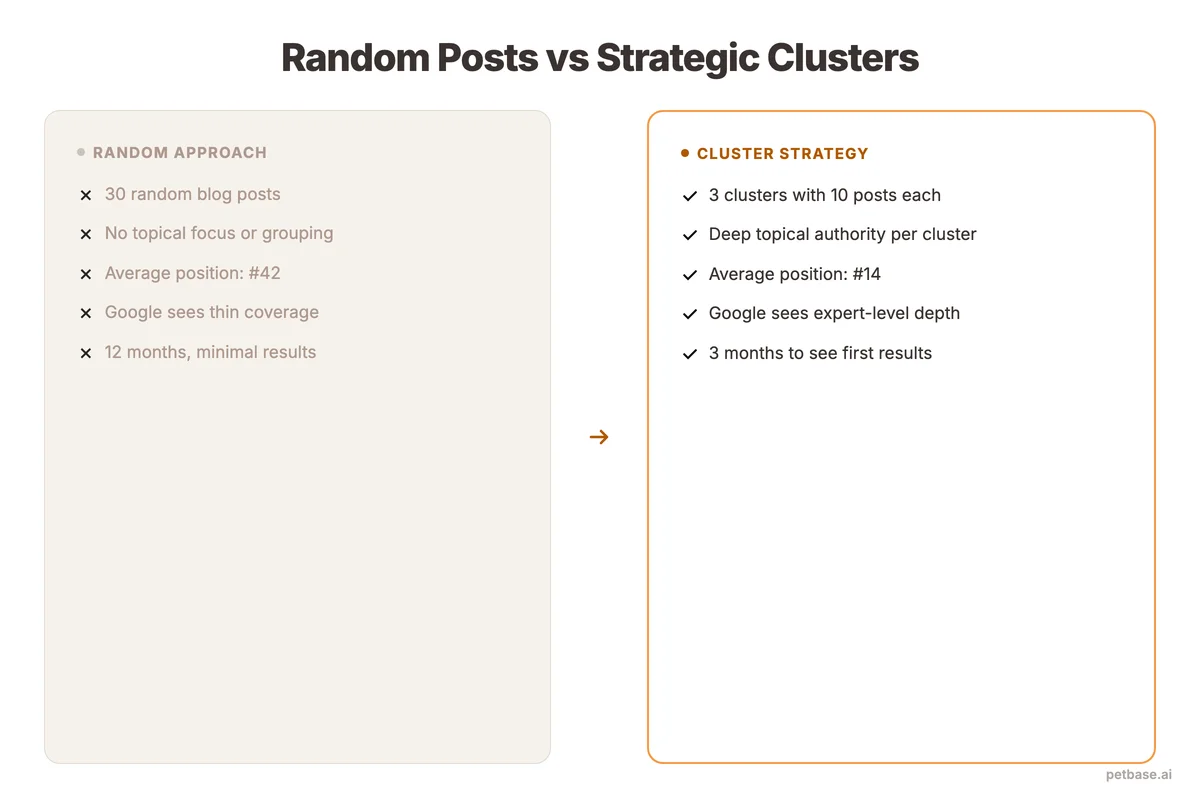
Every high-performing pet store website we reviewed organizes content into topic clusters. Not one of them relies on random, disconnected blog posts. This is the single most consistent pattern across all markets.
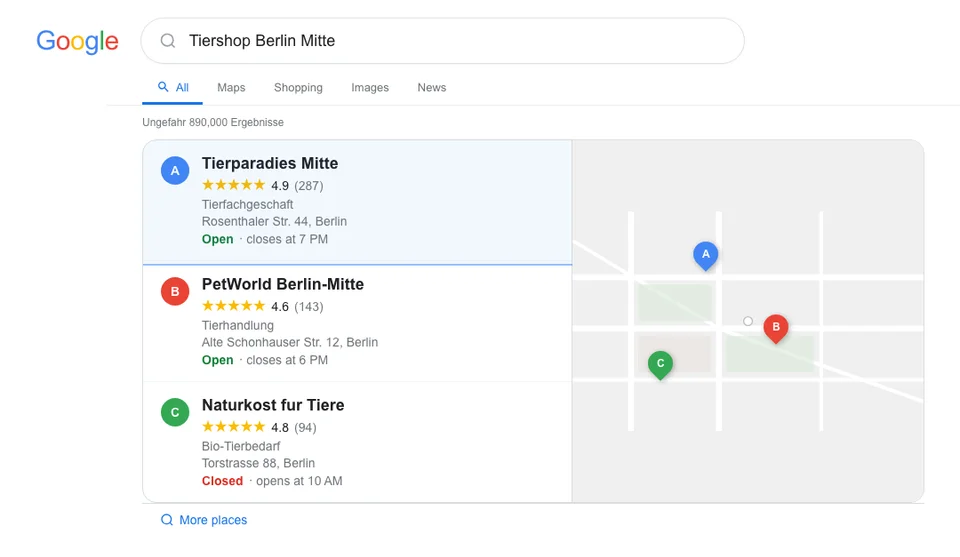
A topic cluster looks like this: a pillar page on "Dog Nutrition" links to 10-15 supporting articles covering subtopics like puppy feeding, senior dog diets, food allergies, grain-free options, raw feeding, and breed-specific nutrition. Each supporting article links back to the pillar and to related articles within the cluster.
| Approach | What Works | What Does Not Work |
|---|---|---|
| Content clusters | 20 interconnected articles on dog nutrition build topical authority. Google sees depth. | 20 random articles on 20 different topics. Google sees no expertise in any area. |
| Internal linking | Every article links to 3-5 related pieces. Authority flows between pages. | No links between posts. Each page fights alone. |
| Publishing cadence | 8-10 posts/month concentrated in 2-3 topic areas | 2-3 posts/month scattered across unrelated subjects |
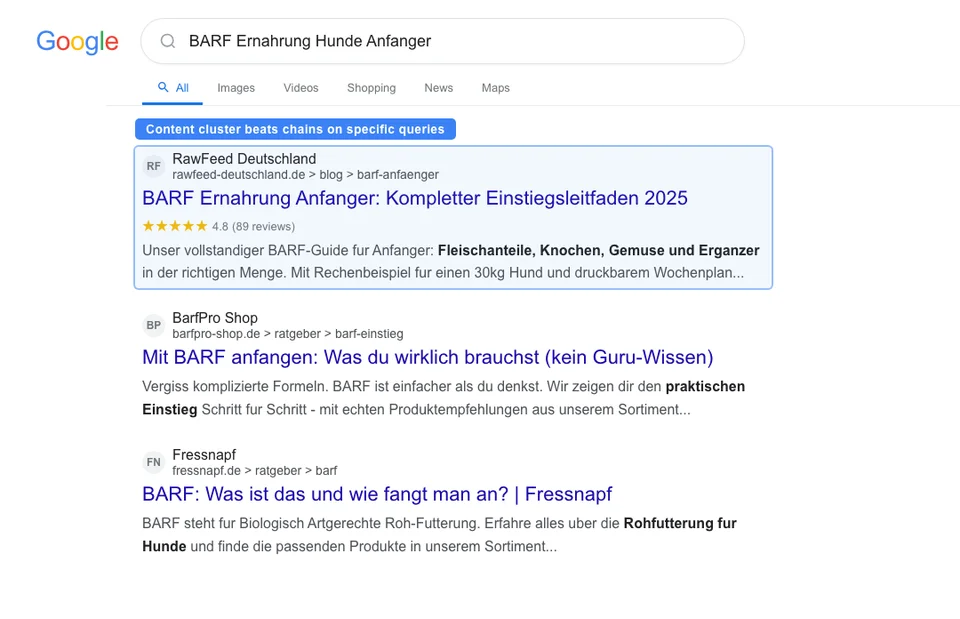
Companies with active blogs generate 55% more website traffic than those without[4]. A German dog food retailer built a 25-article cluster around raw feeding over 6 months. By month 8, they ranked on page 1 for 80+ raw feeding keywords in German - a niche where neither Fressnapf nor Amazon had meaningful content. Their organic traffic from raw feeding searches alone exceeded 2,500 monthly visitors.
For a detailed guide to this approach, see content clustering for pet websites.
Pattern 2: Local SEO Drives 60%+ of In-Store Traffic
For pet stores with physical locations, local SEO is responsible for the majority of new customer discovery. 46% of all Google searches have local intent[2], and "near me" queries now exceed 1.5 billion per month[3]. This is true across all European markets we reviewed.
The stores that dominate local search share these practices:
- Complete Google Business Profiles with 50+ photos, weekly posts, and active review management
- 100+ reviews per location with owner responses to every review
- Location-specific content on their website: "Best dog parks in [city]," "Pet events in [city]," "Our [city] store team recommends..."
- Consistent citations across local directories, Google, and pet industry listings
A UK pet grooming chain with 3 locations implemented a systematic local SEO approach: unique location pages with staff bios, location-specific blog content, and a review generation program (QR codes at the counter, follow-up emails). Within 6 months, all 3 locations appeared in the top 3 of Google's Local Pack for their city-level searches. Combined, these 3 local listings drive over 400 monthly direction requests and 200 monthly website clicks.
Local SEO is also the fastest-acting form of SEO. Google Business Profile optimizations often show results within 4-6 weeks, compared to 8-12 weeks for content-based organic rankings. If you have a physical store and have not optimized for local search, start with our Google Business Profile guide for pet stores.
Pattern 3: Product Descriptions That Go Beyond Manufacturer Copy
Across every European market, the pet stores that rank for product queries have one thing in common: they write their own product descriptions. Not slight rewrites of manufacturer copy - genuinely unique descriptions that add value a shopper cannot find elsewhere.
What unique product descriptions include:
- Breed or size suitability ("Recommended for medium to large breeds over 15kg")
- Health condition relevance ("Suitable for dogs with sensitive stomachs - limited ingredient formula")
- Staff recommendation with reasoning ("Our nutrition specialist recommends this for active working dogs because...")
- Comparison context ("Higher protein content than most adult maintenance formulas at this price point")
- Usage guidance beyond the label ("Transition over 7-10 days by mixing with current food")
An Austrian pet supplement retailer rewrote 300 product descriptions to include breed-specific dosage recommendations, ingredient explanations, and condition-specific guidance. Within 5 months, their product page organic traffic increased 52% and their average time on product pages doubled. The investment in unique descriptions paid for itself within the first quarter.
This is one of the areas where Petbase makes the biggest difference. The AIDA product description system generates unique descriptions for each product using a pet industry knowledge model that understands breeds, ingredients, and health conditions. Instead of copying manufacturer text, each description addresses the buyer's specific questions and concerns. Learn more in our guide to writing product descriptions that rank and sell.
Pattern 4: German, French, and Dutch Markets Need Localized Content
Translation is not localization. This is a lesson that many European pet stores learn the hard way.
Here is what we mean: a German pet store that translates English content into German will rank poorly because:
- German pet owners search using different terms than English speakers. "Hundefutter" (dog food), "Katzenstreu" (cat litter), and "Tierbedarf" (pet supplies) have specific search volumes and intent patterns that do not map 1:1 to English equivalents.
- Product names, brands, and regulations differ by market. A German shopper searches for specific German-market brands.
- Cultural context matters. German pet owners have different feeding practices, veterinary care patterns, and breed preferences than UK or French pet owners.
| Market | Key Search Behavior | Content Opportunity | Competition Level |
|---|---|---|---|
| Germany (DE) | High search volume for breed-specific queries. "Bestes Hundefutter" type searches common. | Largest German-speaking market. Content clusters in German have strong ROI. | Medium-High (Fressnapf, zooplus dominate) |
| UK | Research-heavy buyers. "Best [product] for [condition]" queries common. | Comparison content and buying guides perform well. | High (Pets at Home, Amazon UK) |
| France (FR) | Growing pet e-commerce market. "Meilleure" (best) queries increasing. | Less saturated than DE/UK for content-driven SEO. | Medium (Maxi Zoo, La Ferme des Animaux) |
| Netherlands (NL) | High e-commerce adoption. Bilingual searches (NL + EN) common. | Small market but high conversion rates. Dutch content clusters are rare. | Low-Medium (Pets Place, local shops) |
| Austria (AT) | German-language, but different brand landscape than Germany. | Austrian-specific content (local brands, regulations) underserved. | Low-Medium |
The opportunity is clear: non-English European markets have lower content competition. A pet store in the Netherlands that builds Dutch-language content clusters faces far less competition than a UK store building English content. The search volumes are smaller, but the conversion rates are higher because there are fewer alternatives.
Pattern 5: Stores That Publish Monthly Outrank Those That Do Not
Consistency matters more than perfection. Across all markets, the pet stores with the strongest organic traffic share one trait: they publish content every month. Not every week, not daily - but every month, without fail.
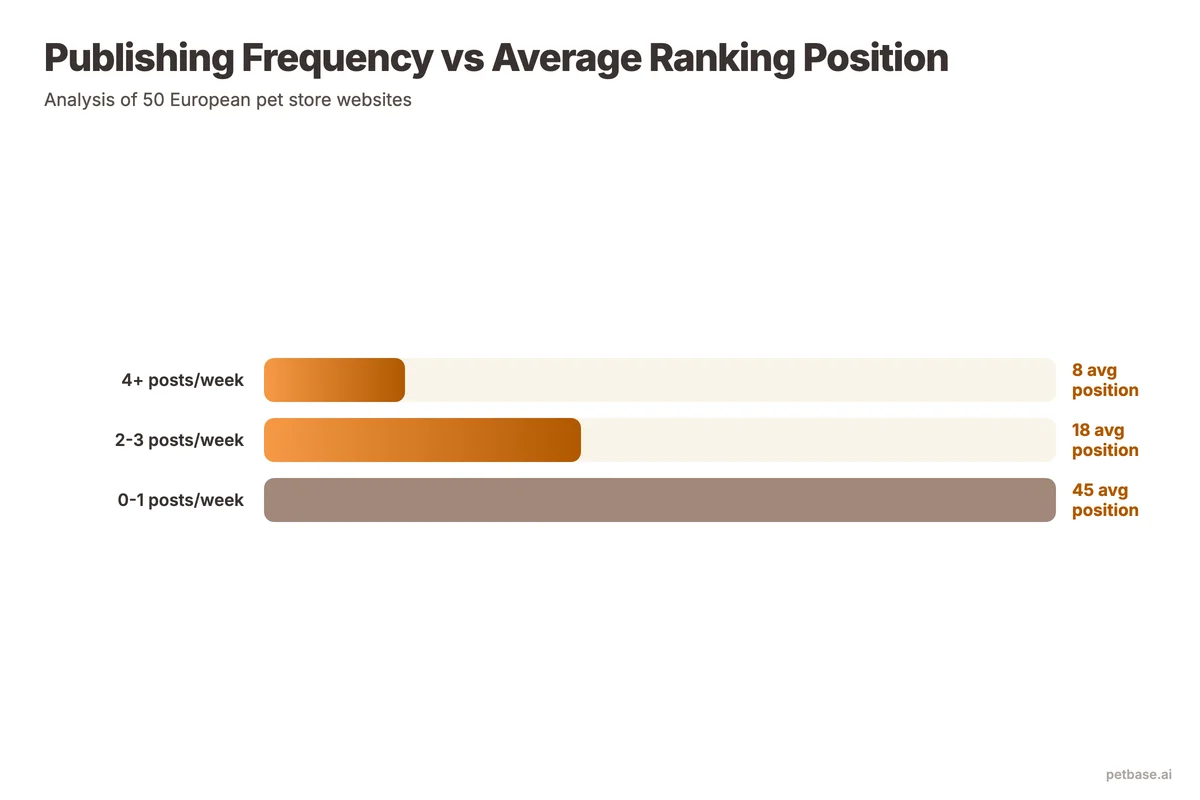
The data from our 50-site analysis supports this: the top-scoring sites all had active blogs with regular publishing schedules. The worst-scoring sites either had no blog or had published a handful of posts and stopped. Organic search drives 53% of all website traffic[5] - if you are not publishing, you are leaving that traffic to competitors.
Why monthly publishing matters:
- Google rewards freshness. Regularly updated sites signal to Google that the content is maintained and current.
- Topical authority builds over time. A content cluster needs 10-20 articles to reach critical mass. At 10 articles/month, you reach this in 1-2 months per cluster. At 2 articles/month, it takes 5-10 months.
- Compounding traffic. Each new article adds incremental organic traffic. After 12 months of publishing 10 articles/month, you have 120 pages each contributing to your total traffic. The cumulative effect is significant.
The challenge is that most pet store owners cannot sustain this pace manually. Writing 10 optimized articles per month requires 40-50 hours. This is why the stores succeeding at content SEO either use agencies or AI tools to maintain their publishing schedule.
Petbase generates 10 articles per month at EUR 199/mo - making consistent monthly publishing sustainable even for independent stores with limited budgets and no content team. See our timeline guide for realistic expectations on how rankings develop with consistent publishing.
Pattern 6: Long-Tail Keywords Are the Fastest Path to Page 1
Our analysis found that the European pet stores ranking fastest for competitive terms all started with long-tail keywords. Long-tail searches make up 70% of all search queries[6], and they convert at 36% - far above the rate for broad, head-term queries[6].
For European pet stores, long-tail keywords offer a double advantage. The competition is lower, and the search intent is more specific. A shopper searching "best grain-free cat food for indoor cats with sensitive stomachs" is much closer to buying than someone searching "cat food."
Examples of long-tail keywords that European pet stores successfully target:
- "bestes Hundefutter fur allergische Hunde" (best dog food for allergic dogs) - DE market
- "kattenvoer voor oudere katten met nierziekte" (cat food for senior cats with kidney disease) - NL market
- "best raw food diet plan for French Bulldogs UK" - UK market
- "meilleure litiere pour chat appartement" (best cat litter for apartment) - FR market
Each of these queries has lower search volume than the broad head term, but the combined volume of all long-tail variations in a topic cluster adds up quickly. And because 70% of all searches are long-tail[6], pet stores that systematically cover these queries capture the majority of search demand in their niche.
Schema markup amplifies long-tail visibility further. Our 50-site analysis found that only 24% of European pet store websites use schema markup. Pages with rich results (star ratings, pricing, FAQ dropdowns) stand out in search results where 3 out of 4 competitors do not use schema at all.
The most valuable schema types for European pet stores:
- Product schema: Price, availability, reviews, brand. Enables product rich results with star ratings and pricing.
- LocalBusiness schema: Address, hours, phone, geo-coordinates. Essential for local SEO.
- FAQPage schema: FAQ sections on your pages. Enables FAQ dropdown rich results that take up more space in search.
- Article schema: For blog posts. Enables article features in Google News and Discover.
- BreadcrumbList schema: For navigation. Shows breadcrumb trails in search results.
Implementation is a one-time technical task that pays dividends permanently. Most e-commerce platforms (Shopify, WooCommerce, Magento) have schema plugins that make implementation straightforward. Our schema markup guide for pet stores walks through the setup.
Pattern 7: The Stores That Automate Content Win the Long Game
The final pattern is about sustainability. The pet stores that maintain strong organic traffic over 12+ months have all found ways to automate or systematize their content production. None of them rely on the store owner writing articles personally.
| Content Approach | What Works | What Does Not |
|---|---|---|
| Agency-managed content | Consistent output, strategic oversight | Expensive (EUR 2,000-5,000/month), often lacks pet expertise |
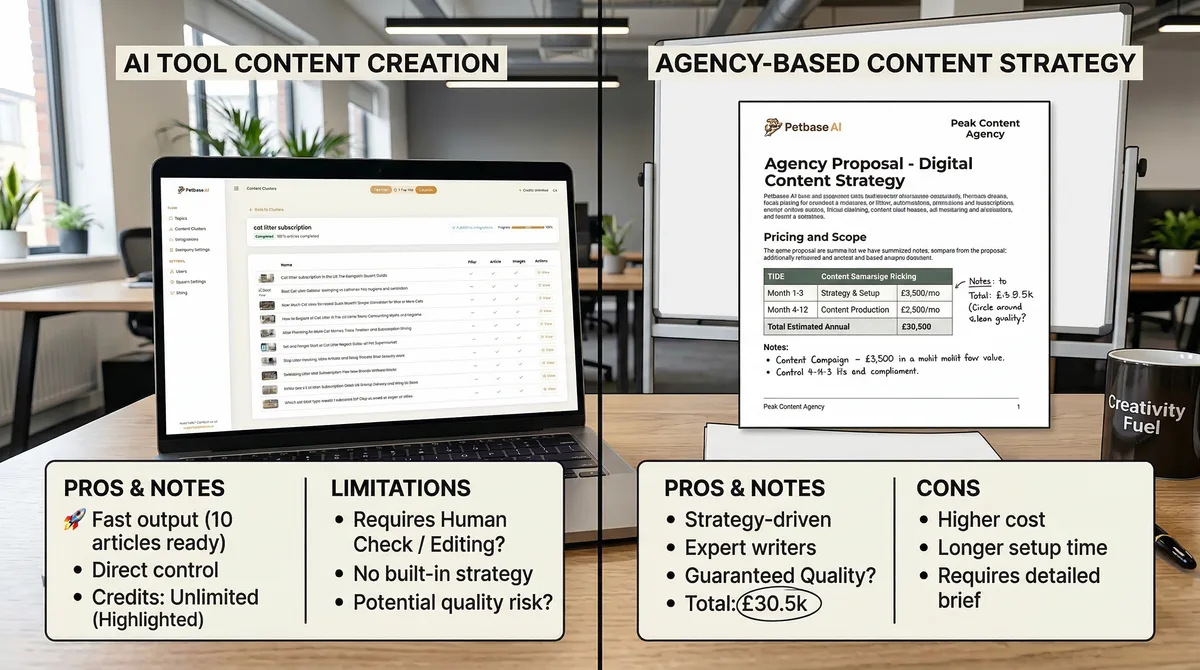
| AI content tool (Petbase) | High volume (10/month), pet industry knowledge, affordable (EUR 199/mo) | Does not cover technical SEO or link building |
| Freelance writers | Flexible, can find pet-specialist writers | Inconsistent availability, quality varies, management overhead |
| Store owner writing | Authentic voice, real expertise | Not sustainable at 8-10 articles/month alongside running a store |
A Dutch specialty pet food retailer tried writing their own content for 6 months. They produced 12 articles - an average of 2 per month. Quality was excellent because the owner had deep product knowledge. But 2 articles/month was not enough to build topical authority. They switched to Petbase for content generation, producing 10 articles/month, and used their personal time to add unique insights and product recommendations to each article. Within 4 months, their organic traffic doubled compared to the previous 6 months of DIY content.
The lesson: your expertise as a store owner is the secret ingredient. But you need a system to handle the volume. Whether that system is an agency, a tool, or a team of writers - the stores that automate content production are the ones that sustain organic growth. For a full comparison of options, see our agency vs. AI tool comparison.
What European Pet Stores Get Wrong (and How to Fix It)
Based on our analysis, here are the most common mistakes European pet stores make with SEO, by market:

- Germany: Over-reliance on marketplace listings (Amazon, zooplus) instead of building organic presence for their own domain. Fix: invest in your own content and local SEO rather than solely depending on marketplace traffic.
- UK: Competing on broad product keywords against Pets at Home and Amazon instead of targeting niche, expertise-driven queries. Fix: find the long-tail keywords where your specialist knowledge is the differentiator. Long-tail queries convert at 36%[6] - far higher than broad terms.
- France: Underinvesting in content because "French pet owners do not search as much." They do - French pet-related searches have grown 35%+ in recent years. Fix: start building French-language content clusters now while competition is lower.
- Netherlands: Publishing content in English instead of Dutch, assuming the Dutch market is too small. Dutch-language pet content has significantly less competition and higher conversion rates for local shoppers. Fix: publish in Dutch first, English second.
- Austria/Switzerland: Using German content from German competitors instead of creating Austria/Switzerland-specific content with local brands, local regulations, and local search terms. Fix: localize for your specific market.
A 90-Day Playbook for European Pet Store SEO
Here is a concrete 90-day plan to implement the 7 patterns:
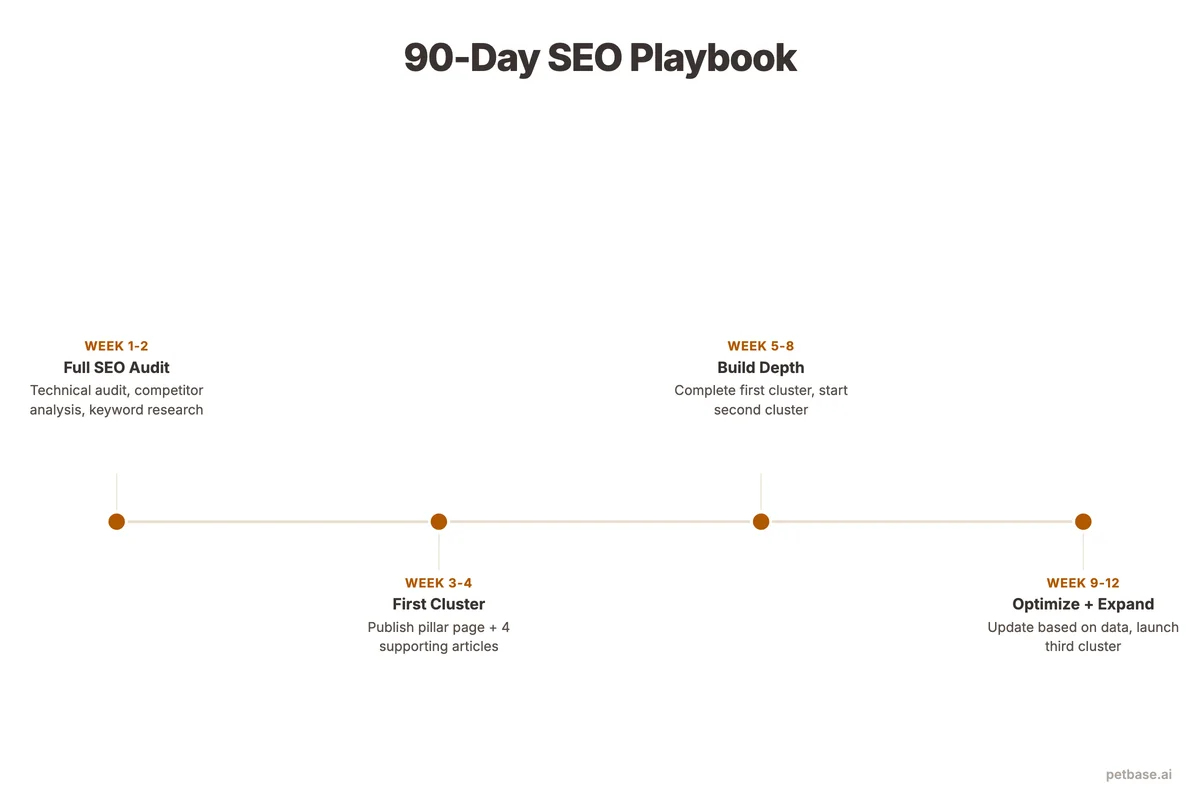
| Phase | Days | Actions | Target Outcome |
|---|---|---|---|
| Foundation | 1-30 | Set up Google Search Console. Optimize Google Business Profile. Run a basic technical SEO audit. Choose 2-3 topic cluster areas based on your strongest product categories. Start publishing - 10 articles in month 1 targeting your first cluster. | Technical foundation solid. GBP optimized. First 10 articles published. |
| Build | 31-60 | Publish 10 more articles. Complete first content cluster. Start second cluster. Implement schema markup (Product, LocalBusiness, FAQ). Rewrite top 20 product descriptions to be unique. | First cluster complete (10-15 articles). Schema live. Product pages strengthened. |
| Accelerate | 61-90 | Publish 10 more articles across clusters 2 and 3. Build internal links between all content. Create 2-3 location-specific content pieces. Start review generation program. Monitor rankings and traffic in Search Console. | 30 articles live. 2 clusters building authority. Rankings appearing for long-tail keywords. Review count growing. |
After 90 days, you will have 30 SEO-optimized articles organized into content clusters, a fully optimized Google Business Profile, schema markup driving rich results, and unique product descriptions that differentiate you from competitors. That puts you ahead of 80%+ of European pet stores based on our 50-site analysis.
Petbase makes the content portion of this plan achievable at EUR 199/mo. 10 articles per month, built on topic clusters with automatic internal linking and pet industry expertise. Combined with the free optimizations (GBP, Search Console, schema) and your own product knowledge, this is the most cost-effective path to organic growth for European pet stores.
Start your free trial and see the first articles within days. The stores that start now will be the ones ranking in 3-6 months. The ones that wait will be reading this same article a year from now, wishing they had started sooner.
Which European market is easiest to rank in for pet stores?
The Netherlands and Austria have the lowest content competition for pet-specific SEO. Dutch and Austrian pet store markets have fewer content-focused competitors, which means building topical authority is faster and requires fewer articles to achieve page 1 rankings. Germany and UK are the most competitive. France sits in the middle - growing quickly but still less saturated than the German market.
Should I create content in English or my local language?
Always start with your local language. A Dutch pet store should publish in Dutch first, a German store in German, a French store in French. Local-language content converts at higher rates because it matches the searcher's language exactly. English content can supplement your strategy if you serve international markets, but it should never replace your primary language. The exception is the UK and Ireland, where English is obviously the primary language.
How many articles do I need to build topical authority in a European market?
In most European pet markets (excluding UK), you need 15-25 interconnected articles on a single topic to establish meaningful topical authority. This is lower than the 30-50 articles typically needed in English-language markets because there is less competition. At 10 articles/month, you can build authority in one topic area within 2-3 months. Plan for 2-3 topic clusters as your foundation - that is 45-75 articles total, achievable in 5-8 months of consistent publishing.
Do the same SEO patterns work in Scandinavian and Eastern European markets?
The 7 patterns apply universally - content clusters, local SEO, unique descriptions, long-tail keyword targeting, localized content, consistent publishing, and content automation. The specifics differ by market: Scandinavian markets (Sweden, Denmark, Norway) have very high digital adoption but small search volumes per language. Eastern European markets (Poland, Czech Republic, Romania) have lower competition and growing pet e-commerce. In both cases, starting content SEO early gives a significant first-mover advantage because few pet stores in these markets invest in content at all.
References
- European Pet Food Industry Federation (2025). European Statistics. europeanpetfood.org
- BrightLocal (2025). Local SEO Statistics. brightlocal.com
- BrightLocal (2025). Local SEO Statistics - Near Me Searches. brightlocal.com
- HubSpot (2025). Marketing Statistics. hubspot.com
- BrightEdge (2025). How Much Traffic Comes from Organic Search. seoinc.com
- Embryo (2025). 30 Statistics About Long-Tail Keywords. embryo.com