How Pet Stores Can Dominate "Near Me" Searches

Table of Contents +
- Why "Near Me" Searches Are the Most Valuable Traffic for Pet Stores
- How Does Google Decide Which Pet Stores Show Up?
- How to Optimize Your Google Business Profile for "Near Me"
- What On-Page Signals Help You Rank Locally?
- How to Create Location-Specific Content
- How Reviews and Ratings Affect "Near Me" Rankings
- How to Track Your "Near Me" Search Performance
- Common Mistakes Pet Stores Make with Local Search
- Scaling Local SEO with Petbase
- Frequently Asked Questions
- References
Learn how to rank in Google's Local Pack for "near me" pet store searches. Covers GBP optimization, reviews, local content, and key ranking factors.
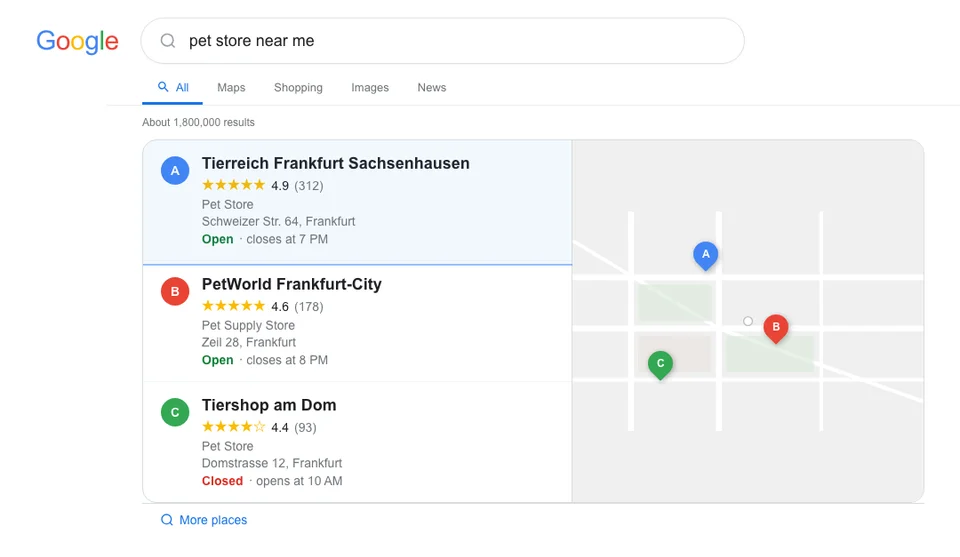
Pet stores that optimize their Google Business Profile, collect reviews consistently, and build location-specific content capture the majority of "near me" search traffic. "Near me" searches now exceed 1.5 billion per month and have grown over 500% in recent years[1]. The three pet stores that appear in Google's Local Pack receive 44% of all clicks[1]. This guide breaks down exactly how Google decides which pet stores show up - and what you can do to rank higher, starting today.
Why "Near Me" Searches Are the Most Valuable Traffic for Pet Stores
"Near me" searches carry the highest purchase intent of any search type. When someone searches "pet store near me," they have already decided to buy - they just need to find where. The U.S. pet industry alone reached $152 billion in spending[2], and a growing share of that spending starts with a local search.
46% of all Google searches have local intent[1], and 98% of consumers search online for nearby businesses before visiting[1]. For pet stores, this means nearly every potential customer checks Google first.
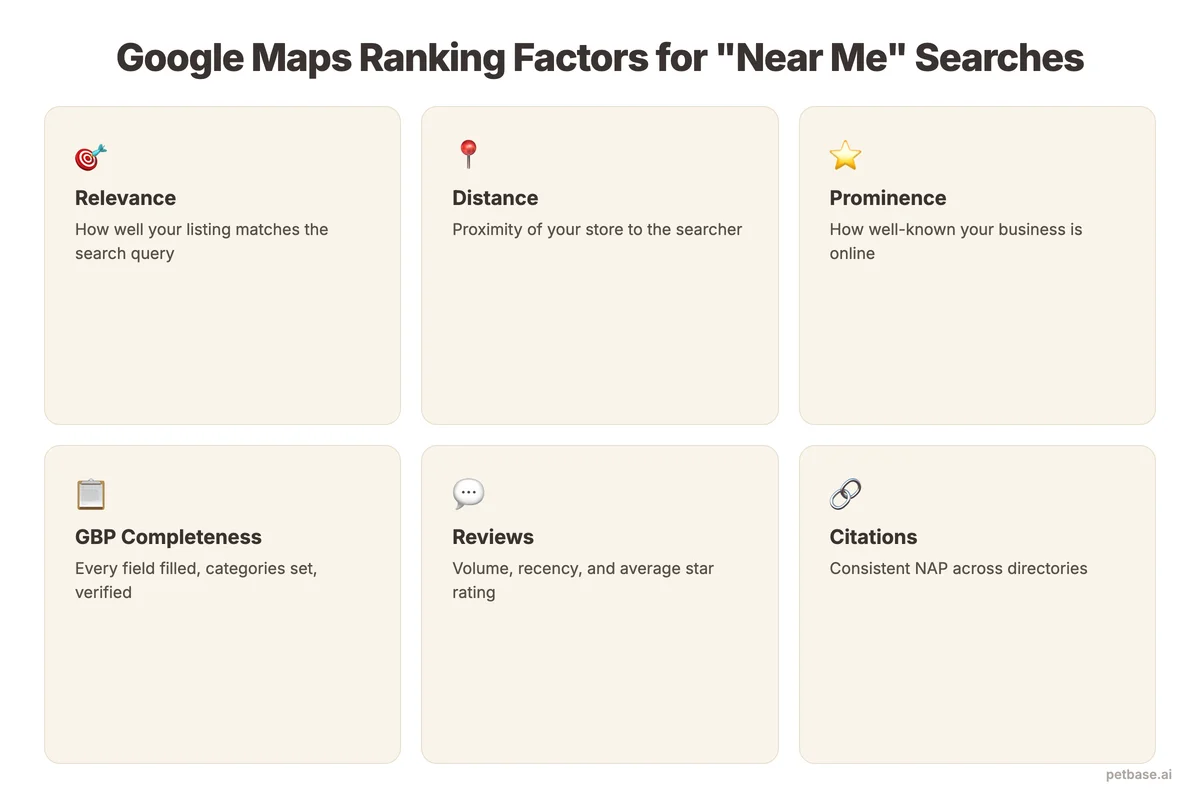
Here is what makes "near me" searches so effective for pet stores:
- High conversion intent: Mobile-friendly local results convert at a 32% higher rate than non-optimized pages[3]. Most "near me" searchers visit a store within hours.
- Mobile dominance: Over 80% of "near me" searches happen on smartphones, often while the person is already out and about.
- Growing specificity: Searches like "raw dog food store near me," "pet groomer near me open now," and "exotic pet store near me" are growing faster than the generic query.
- 93% check reviews first: Consumers say online reviews affect their buying decisions for local businesses[1]. High ratings and recent reviews directly influence whether someone visits your store or a competitor.
A single-location pet store in a mid-size city can realistically capture 200-500 monthly visits from "near me" searches alone - visits from people actively looking to buy. The investment required is primarily time, not money.
Petbase automates SEO content for pet stores - publishing 10 optimized articles monthly so you can focus on running your shop - start your free trial.
How Does Google Decide Which Pet Stores Show Up?
Google uses three primary factors to rank businesses in the Local Pack. Understanding these factors is the foundation of your local SEO strategy.
| Ranking Factor | What It Means | How to Improve |
|---|---|---|
| Relevance | How well your profile matches the search query | Complete GBP categories, detailed description, services listed |
| Distance | How close your store is to the searcher | Cannot change location, but service area settings and local content help |
| Prominence | How well-known and trusted your business is | Reviews, citations, backlinks, website authority, GBP activity |
You cannot control distance - your store is where it is. But you have full control over relevance and prominence, which together determine most of your ranking potential.
Relevance is determined by how completely and accurately your Google Business Profile describes your business. A pet store that lists "Pet Store" as its primary category, adds secondary categories for grooming and training, writes a detailed description mentioning specific products and services, and fills out every attribute field will score higher on relevance than a store with a bare-bones profile.
Prominence is about trust signals. Google measures this through the quantity and quality of reviews, the consistency of your business information across the web (citations), the authority of your website, and your engagement with the GBP platform (posts, photos, Q&A responses).
A common misconception: you do not need to be the closest store to rank first. A pet store 3km from the searcher with a fully optimized profile, 150 reviews, and an active GBP can outrank a store 500m away with a neglected profile and 12 reviews.
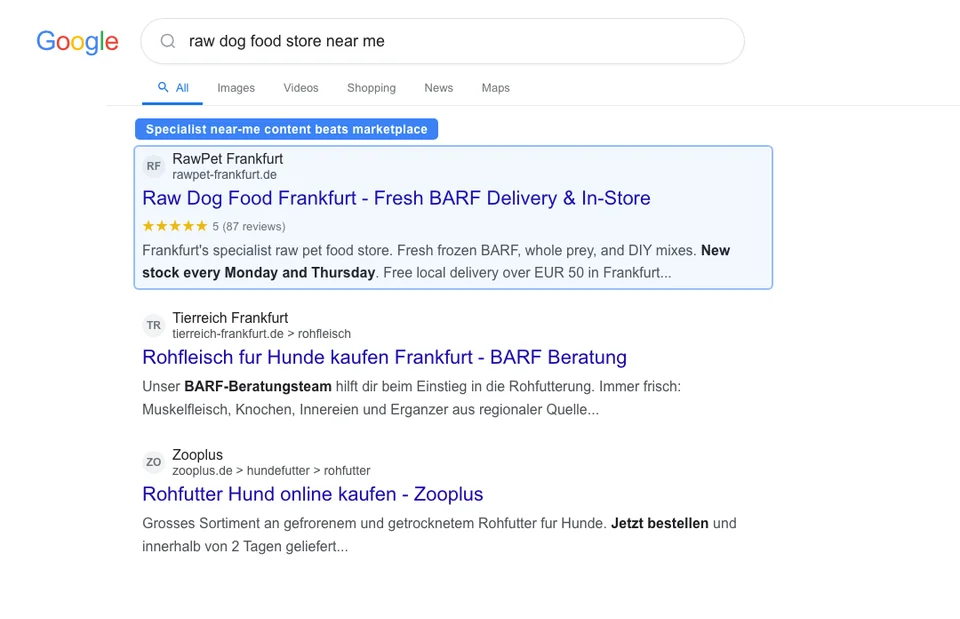
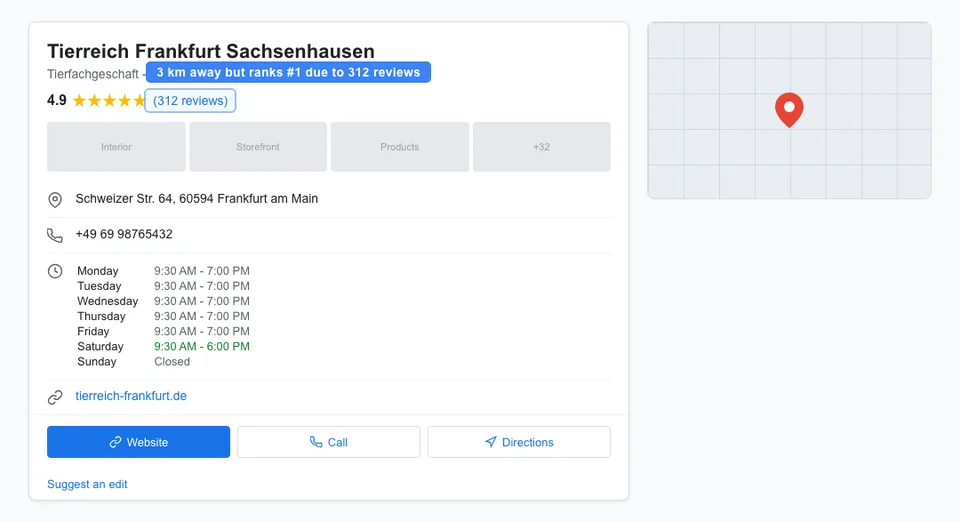
How to Optimize Your Google Business Profile for "Near Me"
Your Google Business Profile (GBP) is the single most important factor in "near me" rankings. Businesses with a complete GBP receive 80% more search appearances and 4x more visits than incomplete profiles[4].
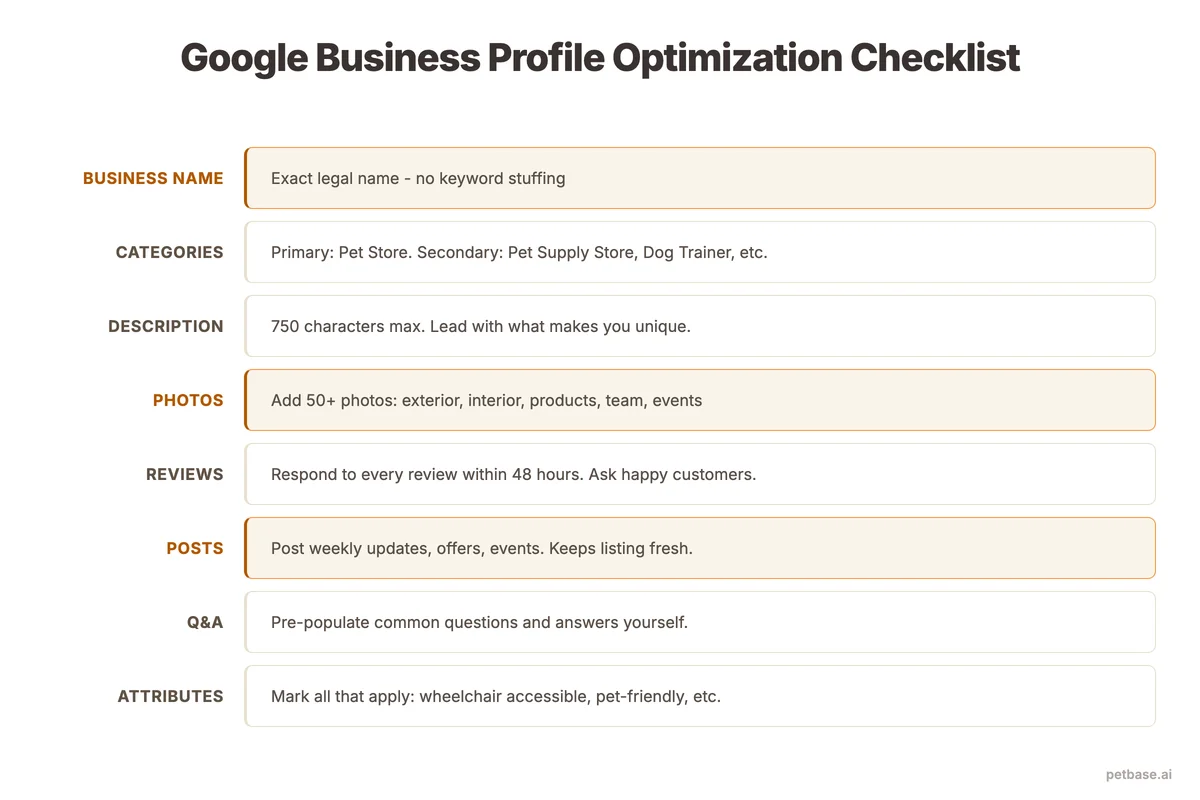
Here is the complete optimization checklist:
Basic information:
- Business name matches your real-world signage exactly (no keyword stuffing)
- Address is accurate and matches your website and all directory listings
- Phone number is local (not toll-free) and matches across all platforms
- Business hours are current, including holiday hours
- Website URL points to your homepage or a dedicated location page
Categories:
- Primary category: "Pet Store" (the most specific option that describes your main business)
- Secondary categories: add all that apply - "Pet Groomer," "Dog Trainer," "Pet Supply Store," "Animal Feed Store"
- Do not add categories that do not match your actual services - Google penalizes this
Description:
- Use all 750 characters
- Include your main products and services naturally: "We carry premium dog and cat food brands including [brands], natural treats, supplements, grooming supplies, and toys"
- Mention your location and service area
- Do not keyword-stuff - write for humans first
Attributes:
- Fill out every applicable attribute: wheelchair accessible, parking available, delivery offered, online appointments, etc.
- These attributes appear in your listing and influence which searches trigger your profile
Photos:
- Upload at least 30 photos - store exterior, interior, products, team members, happy customers (with permission)
- Profiles with photos receive 42% more direction requests and 35% more website clicks[5]
- Add 2-3 new photos weekly - GBP engagement metrics favor active profiles
- Use descriptive file names before uploading: "pet-store-raw-food-section-munich.jpg" not "IMG_4521.jpg"
For the complete Google Business Profile setup guide, read our detailed walkthrough on Google Business Profile for pet stores.
What On-Page Signals Help You Rank Locally?
Your website sends important signals that affect your "near me" rankings. Even though Google Business Profile is the primary factor, your website's local optimization determines how prominently you rank - especially for competitive queries.
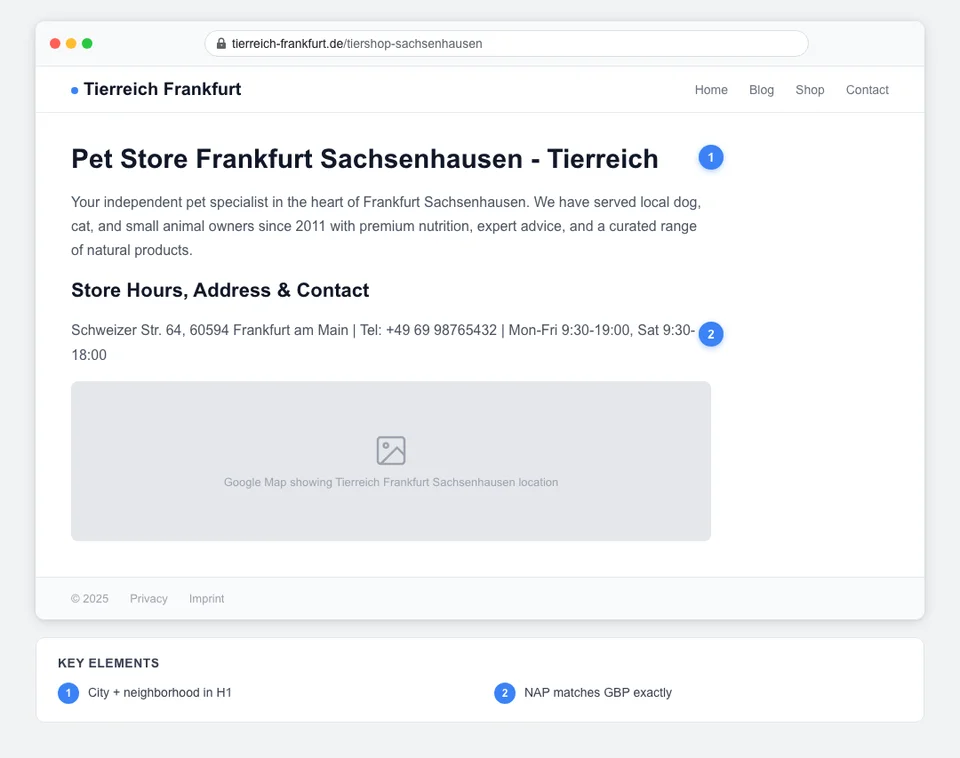
These on-page elements matter most for local pet store rankings:
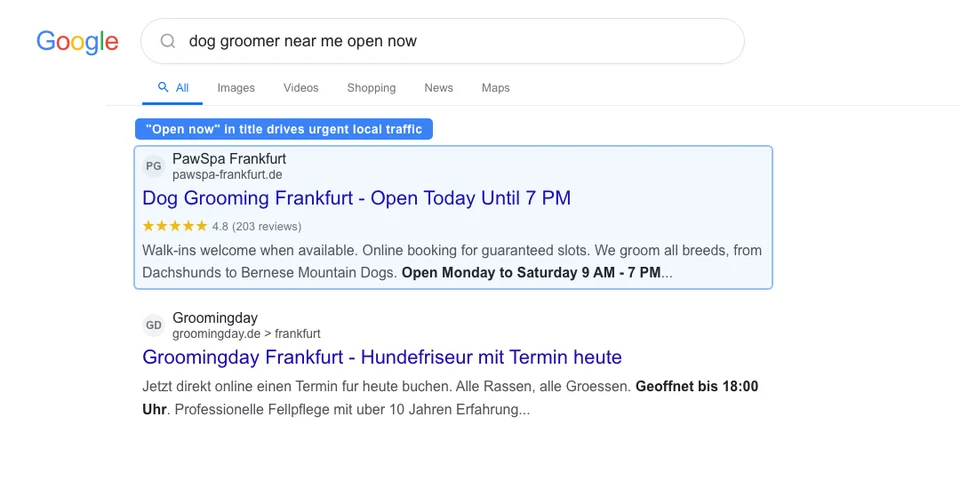
Title tags with location: Your homepage title should include your city. Example: "[Store Name] - Premium Pet Store in Munich" rather than just "[Store Name] - Pet Supplies."
Location pages: If you have multiple locations, create a dedicated page for each with unique content - address, hours, staff profiles, product highlights, driving directions, and neighborhood information. Do not duplicate content across location pages. For multi-location strategies, see our guide on multi-location SEO for pet stores.
LocalBusiness schema markup: Add structured data to your website that tells Google your business type, address, phone number, hours, and geographic coordinates. This helps Google connect your website to your GBP listing. Our schema markup guide for pet stores walks through the setup.
NAP consistency: Your name, address, and phone number must be identical on your website, GBP, and every directory listing. Even small differences ("Street" vs "St.") can weaken your local signals.
Embedded Google Map: Add a Google Map embed to your contact or location page. This reinforces your geographic relevance.
Local content signals: Mention your city, neighborhood, and surrounding areas naturally in your content. A blog post about "best dog parks in [city]" or "pet-friendly restaurants near [neighborhood]" sends strong local relevance signals.
Mobile-friendly websites convert at a 32% higher rate than non-responsive sites[3]. Since the majority of local searches happen on mobile devices, responsive design is not optional - it is a ranking factor and a conversion factor.
For more on optimizing your pet store's web pages, see our pet store SEO guide.
How to Create Location-Specific Content
Location-specific content is one of the most underused local SEO tactics for pet stores. While competitors focus only on their GBP profile, you can build an entire content advantage by creating pages and posts that target local searches.
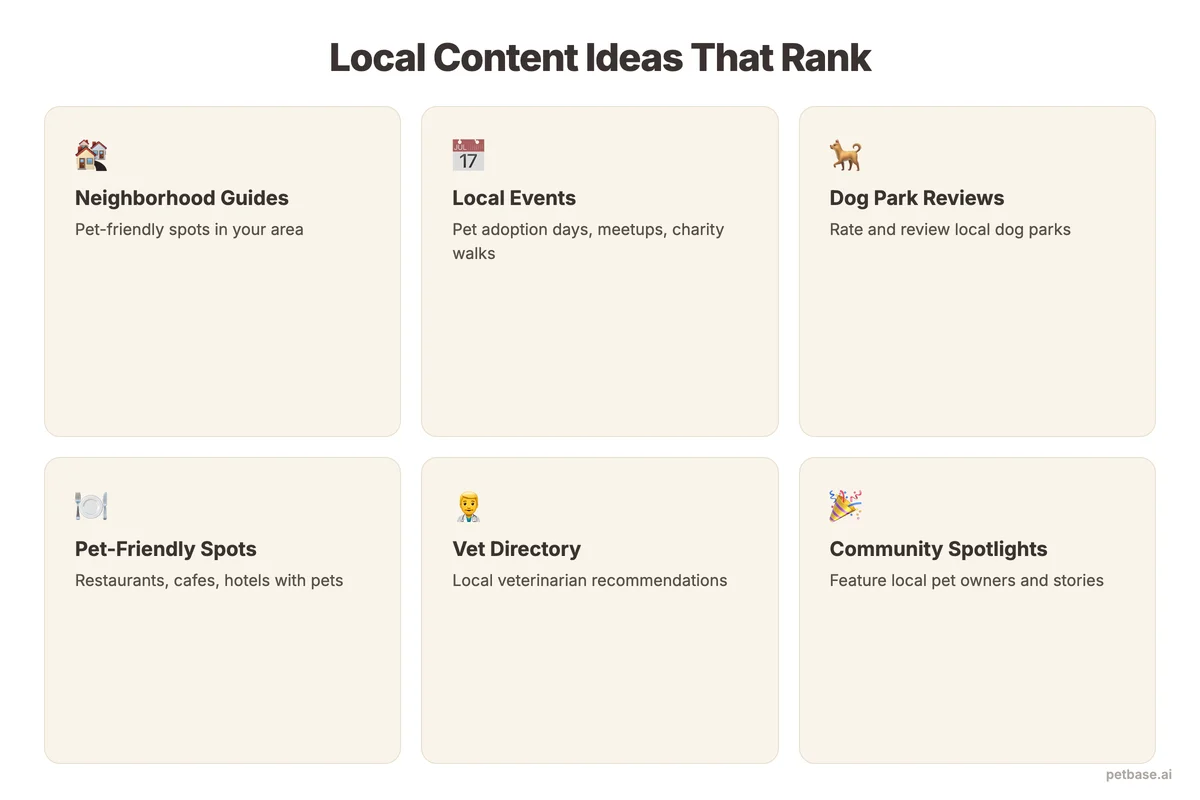
High-performing location content ideas for pet stores:
- "Best Dog Parks in [City]" - Genuinely useful for local dog owners. Include addresses, features, tips, and photos.
- "Pet-Friendly [City]: A Complete Guide" - Cover pet-friendly restaurants, hotels, shops, and services in your area.
- "[City] Pet Events Calendar" - Monthly updates on local pet events, adoption days, and community meetups.
- "Emergency Vet Clinics in [City]" - A public service page that earns links and trust.
- Local pet care guides: "Winter Pet Safety Tips for [City]" covering local climate-specific advice.
Each piece of location content should link to your store's main pages, mention your location naturally, and include your store as a resource where relevant - not in a salesy way, but in a genuinely helpful way.
This type of content also earns natural backlinks from local websites, pet blogs, and community pages - further boosting your prominence signal. Read more about location content in our guide on local content that ranks for pet stores.
How Reviews and Ratings Affect "Near Me" Rankings
Reviews are the most visible prominence signal for "near me" rankings. 93% of consumers say reviews affect their buying decisions[1], and pet stores ranking in the top 3 of the Local Pack consistently have 2-3x more reviews than stores in positions 4-10.
What matters with reviews:
Quantity: More reviews signal a more established, active business. Aim for at least 50 reviews as a baseline. Top-ranking pet stores in competitive markets often have 150-300+.
Quality (star rating): A 4.5+ average is the threshold for trust. Below 4.0, you risk losing clicks even if you appear in the Local Pack.
Recency: Google weighs recent reviews more heavily. A pet store with 100 reviews but none in the last 3 months will rank lower than one with 60 reviews including 10 from the past month.
Content and keywords: Google reads review text. Reviews that mention specific products and services ("great selection of raw dog food," "excellent grooming for my Poodle") help you rank for those specific queries. You cannot ask customers to include specific keywords, but you can guide them with specific questions: "How was your experience with our grooming service?" naturally prompts relevant language.
Response rate: Google tracks whether you respond to reviews. Businesses that respond to 100% of reviews (positive and negative) rank higher than those that ignore reviews. Respond within 48 hours - faster is better.
Here is a simple review generation system for pet stores:
- Train staff to ask happy customers for a review at checkout: "Would you mind leaving us a Google review? It really helps other pet owners find us."
- Send a follow-up email 24 hours after purchase with a direct link to your Google review page
- Place a QR code at your counter and on receipts linking to your review page
- Respond to every review within 48 hours - thank positive reviewers by name and address concerns in negative reviews professionally
For a complete review strategy, see our guide on online reviews for pet stores.
How to Track Your "Near Me" Search Performance
You cannot improve what you do not measure. Tracking local search performance requires specific tools and metrics - standard Google Analytics alone is not enough.
| Metric | Tool | What It Tells You | Check Frequency |
|---|---|---|---|
| GBP impressions (search + maps) | Google Business Profile Insights | How often your listing appears for local searches | Weekly |
| GBP actions (calls, directions, website clicks) | Google Business Profile Insights | How many people take action after seeing your listing | Weekly |
| Search queries triggering your GBP | Google Business Profile Insights | Which "near me" and local queries show your listing | Monthly |
| Local Pack position | BrightLocal, Whitespark, or manual checks | Whether you rank in the top 3 for target queries | Weekly |
| Review count and rating trend | Google Business Profile | Whether your review velocity is maintaining or growing | Weekly |
| Citation accuracy | Moz Local, BrightLocal | Whether your NAP is consistent across directories | Monthly |
| Local organic traffic | Google Analytics + Search Console | Website visits from local search queries | Monthly |
Set up a simple monthly report that tracks these metrics. Look for trends over 3-month periods rather than week-to-week changes. Local SEO improvements are gradual - a 10% increase in GBP impressions month over month compounds into significant growth over a year.
Google Business Profile Insights is free and provides the most important data. For more detailed tracking, tools like BrightLocal (starting at USD 39/month) offer Local Pack position tracking, citation monitoring, and competitor comparisons.
Learn more about tracking your pet store's search performance in our guide on tracking Google rankings for pet stores.
Common Mistakes Pet Stores Make with Local Search
After auditing local SEO for dozens of pet stores, these are the mistakes that cost the most rankings and traffic:
1. Incomplete Google Business Profile. The most common mistake - and the easiest to fix. Businesses with a complete GBP receive 80% more search appearances[4]. Every unfilled field is a missed relevance signal. Complete every section: categories, attributes, description, photos, services, products, hours, and Q&A.
2. Inconsistent NAP across directories. Your store is listed as "Pet Paradise" on Google, "Pet Paradise LLC" on Yelp, and "Pet Paradise GmbH" on your website. These inconsistencies confuse Google and weaken your local signals. Audit every listing and make them identical. Our local citations guide has a complete directory list.
3. Not responding to reviews. Ignoring reviews - especially negative ones - hurts both your ranking and your reputation. Google tracks response rates. A professional response to a negative review often impresses potential customers more than the negative review deters them.
4. Keyword stuffing the business name. Adding keywords to your GBP business name ("Pet Paradise - Best Pet Store Dog Food Grooming Munich") violates Google's guidelines and can get your listing suspended. Use your real business name only.
5. No local content on the website. Your website talks about pet products but never mentions your city, neighborhood, or local community. Add location-specific content - local pet guides, event coverage, neighborhood information - to strengthen your geographic relevance.
6. Ignoring Google Posts. Google Posts appear directly in your GBP listing and signal an active business. Pet stores that post weekly updates about new products, promotions, or pet care tips see higher engagement and better rankings than those with dormant profiles.
7. No photos or outdated photos. A GBP with 5 blurry photos from 2020 does not inspire confidence. Profiles with photos receive 42% more direction requests[5]. Upload fresh, high-quality photos regularly. Show your products, your team, your store, and happy pets.
8. Neglecting citations. Beyond Google, your store should be listed on 20-30 relevant directories with consistent information. Pet-specific directories, local business directories, and review platforms all contribute to your prominence signal.
Fix these eight mistakes and you will outrank most local competitors within 8-12 weeks. The bar is low because most pet stores make at least half of these errors.
Scaling Local SEO with Petbase
Local SEO requires keyword research, fresh content, optimized pages, updated listings, internal linking, metadata, and competitive analysis. That is a lot to manage when you are also running a pet store.
Petbase handles local keyword clustering, content briefs for city and neighborhood pages, optimized metadata, internal link recommendations, and pet-industry content creation. Unlike generic writing tools, Petbase understands pet terminology, care topics, service vocabulary, breed specifics, and pet-owner psychology. 10 articles per month, published directly to your website, for EUR 199/mo.
The U.S. pet industry reached $152 billion in spending[2]. More pet owners are searching online than ever - 98% search for nearby businesses before visiting[1]. The question is whether they find you or your competitor first.
Start your free trial and see what consistent, research-backed content does for your local rankings.
Frequently Asked Questions
How long does it take to start ranking for "near me" searches?
With a fully optimized Google Business Profile, consistent review generation, and accurate citations, most pet stores see Local Pack visibility improvements within 8-12 weeks. The fastest wins come from completing an incomplete GBP - businesses with complete profiles receive 80% more search appearances[4]. Fixing NAP inconsistencies across directories often shows results within 2-3 weeks.
Do I need a website to rank for "near me" searches?
Technically, no - Google can rank your GBP listing without a website. But practically, having a website doubles your chances. Mobile-friendly sites convert at a 32% higher rate[3], and your website sends relevance and authority signals that strengthen your GBP ranking. Even a basic 5-10 page site with your products, services, location information, and a few blog posts makes a significant difference.
Can a small pet store compete with large chains in local search?
Yes, and many do. Large chains have local SEO disadvantages: their GBP profiles are managed centrally with generic descriptions, they rarely respond to individual reviews, and their local content is templated. An independent pet store that fully optimizes its GBP, actively manages reviews, creates location-specific content, and engages with the local community will outrank a chain store in "near me" results more often than you would expect. The Local Pack favors engaged, locally relevant businesses - not just big brands.
References
- BrightLocal (2024). Local SEO Statistics. brightlocal.com
- American Pet Products Association (2024). Industry Trends and Stats. americanpetproducts.org
- Clutch (2025). SEO Statistics. clutch.co
- Birdeye (2024). State of Google Business Profiles. birdeye.com
- Sterling Sky (2024). How to Interpret Google Business Profile Performance. sterlingsky.ca