Product Descriptions: AI vs Templates vs Manual

Table of Contents +
- Why Do Product Descriptions Matter More for Pet Stores?
- What Does Writing Product Descriptions by Hand Actually Cost?
- Do Template-Based Descriptions Actually Work?
- How Does Generic AI Handle Pet Product Descriptions?
- What Makes Pet-Specific AI Different?
- How Should Pet Product Descriptions Be Structured?
- What About Category Page Descriptions?
- How to Choose the Right Approach for Your Store
- Frequently Asked Questions
- References
Compare 4 ways to write pet product descriptions: by hand, templates, generic AI, and pet-specific AI. Costs, quality, and scaling for 50-2000 products.
87% of online shoppers say product content is the most important factor in their purchase decision[1]. Yet 20% of online purchase failures are directly caused by missing or unclear product descriptions[13]. For pet stores carrying hundreds or thousands of products, this creates a painful math problem: every undescribed product is a lost sale, but writing unique descriptions for each one takes time you do not have.
TL;DR
87% of shoppers say product content is their top purchase factor, yet 20% of purchase failures come from missing descriptions. For pet stores, writing by hand does not scale, templates create duplicates, and generic AI misses breed details. Pet-specific AI solves all three problems while cutting production time by 75%.
Three approaches dominate how pet stores handle product descriptions: writing by hand, using templates, and using AI tools. Each has clear strengths and weaknesses. This guide compares all three with real data, then introduces a fourth option - pet-specific AI - that addresses the limitations of the first three.
Why Do Product Descriptions Matter More for Pet Stores?
Product descriptions matter for every online store, but they matter disproportionately for pet stores. Here is why:
Pet owners treat purchases as care decisions. 73% of European pet owners consider their pet's nutrition as important as feeding a family member[4]. They do not just want to know what a product is - they want to know if it is right for their specific pet's breed, age, size, and health conditions. A description that says "premium dog food" tells them nothing. A description that says "grain-free formula with 30% salmon protein, formulated for medium-breed adult dogs with sensitive digestion" tells them everything.
Pet products face regulatory scrutiny. The EU has 31 specific regulations governing pet food labeling and claims (FEDIAF standards)[5]. Product descriptions that make unsupported health claims can create legal liability. Accurate, specific descriptions are not just a marketing advantage - they are a compliance necessity.
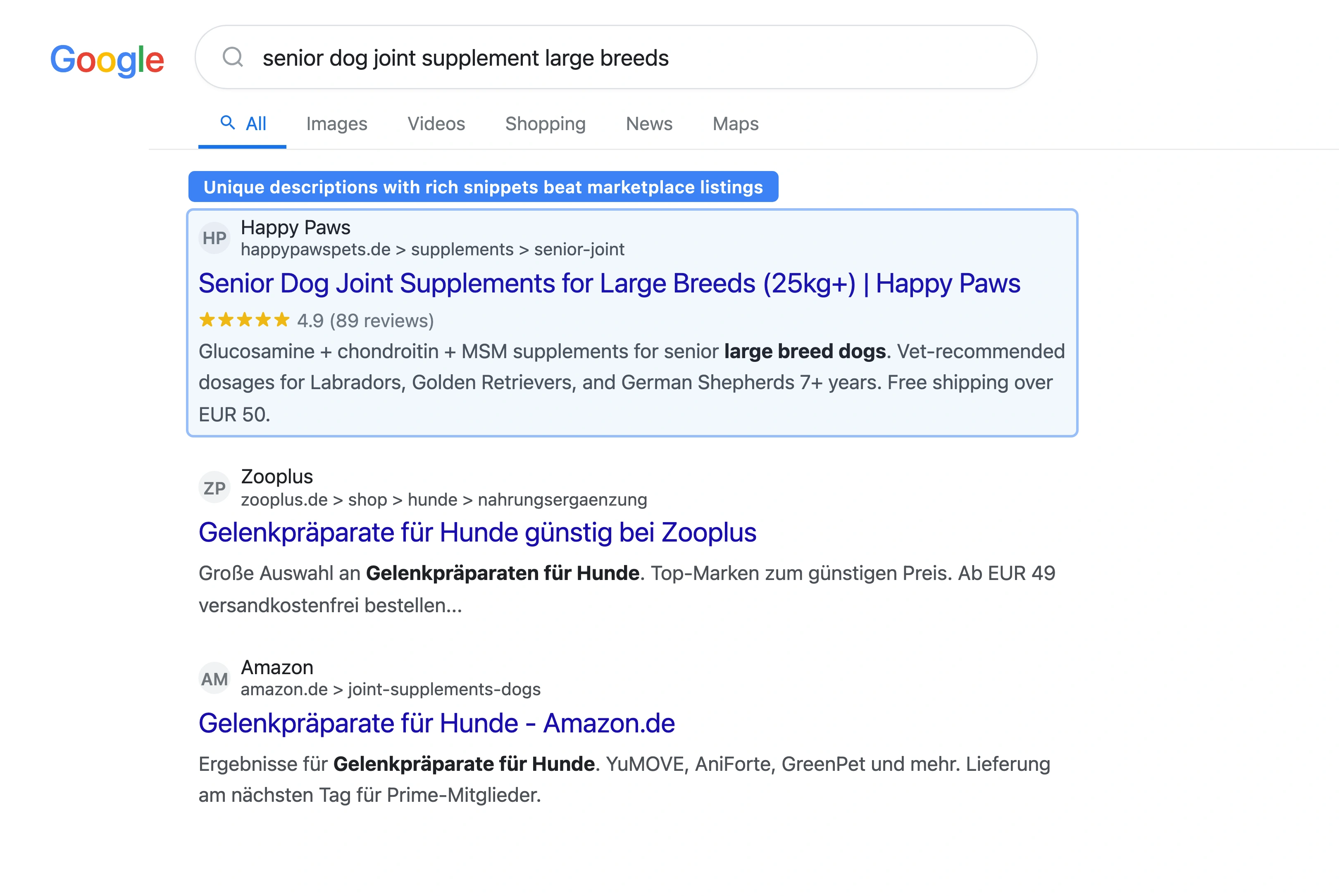
Product overlap creates duplicate content risk. Many pet stores carry products from the same manufacturers with the same specifications. Using manufacturer-provided descriptions means your product pages have identical content to every other store selling the same products. Google penalizes duplicate content by simply not ranking it. 69% of online shoppers leave a product page if the content is subpar[2].
Returns are expensive. 54% of product returns happen because the item did not match the description[3]. For pet food and supplements - products that cannot be resold once opened - every return is a total loss. Better descriptions reduce returns by setting accurate expectations.
Petbase automates SEO content for pet stores - publishing 10 optimized articles monthly so you can focus on running your shop - start your free trial.
What Does Writing Product Descriptions by Hand Actually Cost?
Writing product descriptions manually is the default for most small pet stores. The owner or a team member writes each description individually, incorporating product knowledge, customer insights, and SEO keywords.
The quality ceiling is high. Nobody knows your products better than you. A hand-written description can include your personal experience with the product, customer feedback, and specific recommendations by breed or life stage.
The problem is scale. A well-researched, SEO-optimized product description takes 15-20 minutes to write[6]. For a pet store with 500 products, that is 125-167 hours of writing - more than 3 full work weeks dedicated to nothing but descriptions. And every new product added requires another 15-20 minutes.
Most pet stores carry 200-2,000 products. At the low end, hand-writing every description is feasible but time-consuming. At the high end, it is physically impossible without dedicated staff. The result: most pet stores have detailed descriptions for their top 20-30 products and manufacturer copy (or no description at all) for the rest.
81% of shoppers say content is more important than brand name when making purchase decisions[7]. Every product without a unique, detailed description is a product that undersells itself.
Do Template-Based Descriptions Actually Work?
Template-based descriptions use a standard structure filled in with product-specific details. A typical template:
"[Product Name] is a [product type] designed for [pet type]. Made with [key ingredients/materials], it [primary benefit]. Suitable for [size/breed/age]. [Feature 1]. [Feature 2]. [Feature 3]."
Templates solve the scale problem. Once you create the template, filling in details for each product takes 3-5 minutes instead of 15-20. A store with 500 products can complete descriptions in 25-42 hours instead of 125-167.
But templates create two new problems:
1. Thin, repetitive content. When 500 products follow the same structure with only the specifics changed, Google sees 500 pages of near-identical content. This is the textbook definition of thin content - pages that provide minimal unique value. Google either ignores these pages or actively demotes them.
2. Missing persuasion. Templates describe products but do not sell them. They lack the emotional triggers, use cases, and specific recommendations that convert browsers into buyers. A template tells you what a product is. A persuasive description tells you why you need it for your specific pet.
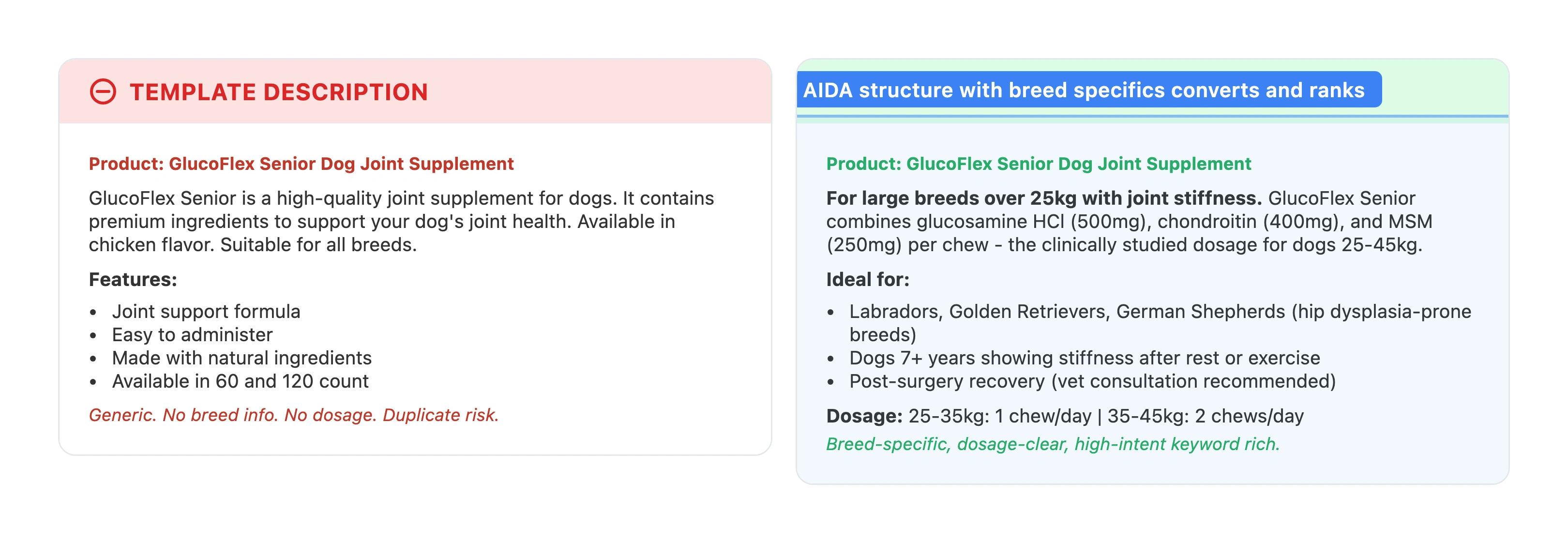
Templates are better than no descriptions. They are worse than unique, persuasive content. For pet stores with large catalogs that need something on every product page quickly, templates serve as a baseline to be improved over time.
How Does Generic AI Handle Pet Product Descriptions?
Generic AI tools (ChatGPT, Jasper, Copy.ai) can generate product descriptions rapidly. Give the tool a product name, key features, and target keyword, and it produces a description in seconds. Some studies show AI can generate 78 descriptions in 2 hours[8].
The speed advantage is real. AI cuts content production effort by up to 75%[11]. For a pet store needing 500 descriptions, that compresses months of work into days. For a broader comparison of AI writing for pet stores, read our AI blog writer guide.
But generic AI has specific weaknesses for pet products:
- Breed knowledge gaps: Generic AI does not know that Brachycephalic breeds (Bulldogs, Pugs, Persian cats) need specific bowl shapes, or that Giant breeds need different joint supplement formulations than small breeds.
- Ingredient accuracy issues: AI may invent ingredient benefits, confuse nutritional values, or make claims that violate EU pet food regulations.
- Generic language: Without pet industry training, AI produces descriptions that could apply to any product. "Premium quality ingredients" and "carefully formulated" appear in every output but tell the customer nothing specific.
- No product relationships: Generic AI writes each description in isolation. It does not know that customers buying senior dog food often also need joint supplements, or that a specific shampoo pairs with a specific conditioner.
A personalized product description can increase conversion rates by 23.7%[9]. Generic AI cannot deliver that personalization for pet products because it lacks the domain knowledge to connect products to specific pet needs.
What Makes Pet-Specific AI Different?
Pet-specific AI tools are trained on pet industry data - breed characteristics, nutritional science, health conditions, product categories, and seasonal needs. The difference shows up in every description produced.
| Factor | Write by Hand | Templates | Generic AI | Pet-Specific AI |
|---|---|---|---|---|
| Time per description | 15-20 minutes | 3-5 minutes | 1-2 minutes | 1-2 minutes |
| Breed-specific detail | High (your knowledge) | None | Often inaccurate | Built into every description |
| SEO optimization | Manual (if you know SEO) | Basic keyword insertion | Moderate | Automatic keyword targeting |
| Scalability (500 products) | 125-167 hours | 25-42 hours | 8-17 hours | 8-17 hours |
| Duplicate content risk | None | High | Low | None |
| Health claim accuracy | Depends on your knowledge | N/A | Unreliable | Veterinary-sourced guidelines |
| Unique per product | Yes | No (same structure) | Yes | Yes |
The quality advantage compounds at scale. One hand-written description might be better than one AI description. But 500 hand-written descriptions take 3+ weeks. 500 pet-specific AI descriptions take days - with breed-specific recommendations, accurate ingredient analysis, and proper keyword targeting on every single one.
How Should Pet Product Descriptions Be Structured?
The most effective product descriptions follow the AIDA framework: Attention, Interest, Desire, Action. Here is how AIDA applies specifically to pet products:
Attention: Lead with the specific pet problem this product solves. Not "premium dog food" but "Formulated for Labrador Retrievers prone to joint issues and weight gain."
Interest: Present the key features with specific, measurable details. Not "high in protein" but "34% chicken protein with added glucosamine (400mg/kg) for joint support."
Desire: Connect features to outcomes the pet owner cares about. "The controlled calorie formula helps maintain a healthy weight of 27-32 kg, reducing strain on hip joints - a common concern for Labradors over 5 years old."
Action: Clear next step. "Available in 2kg and 12kg bags. Most Labrador owners choose the 12kg bag for a 4-6 week supply."
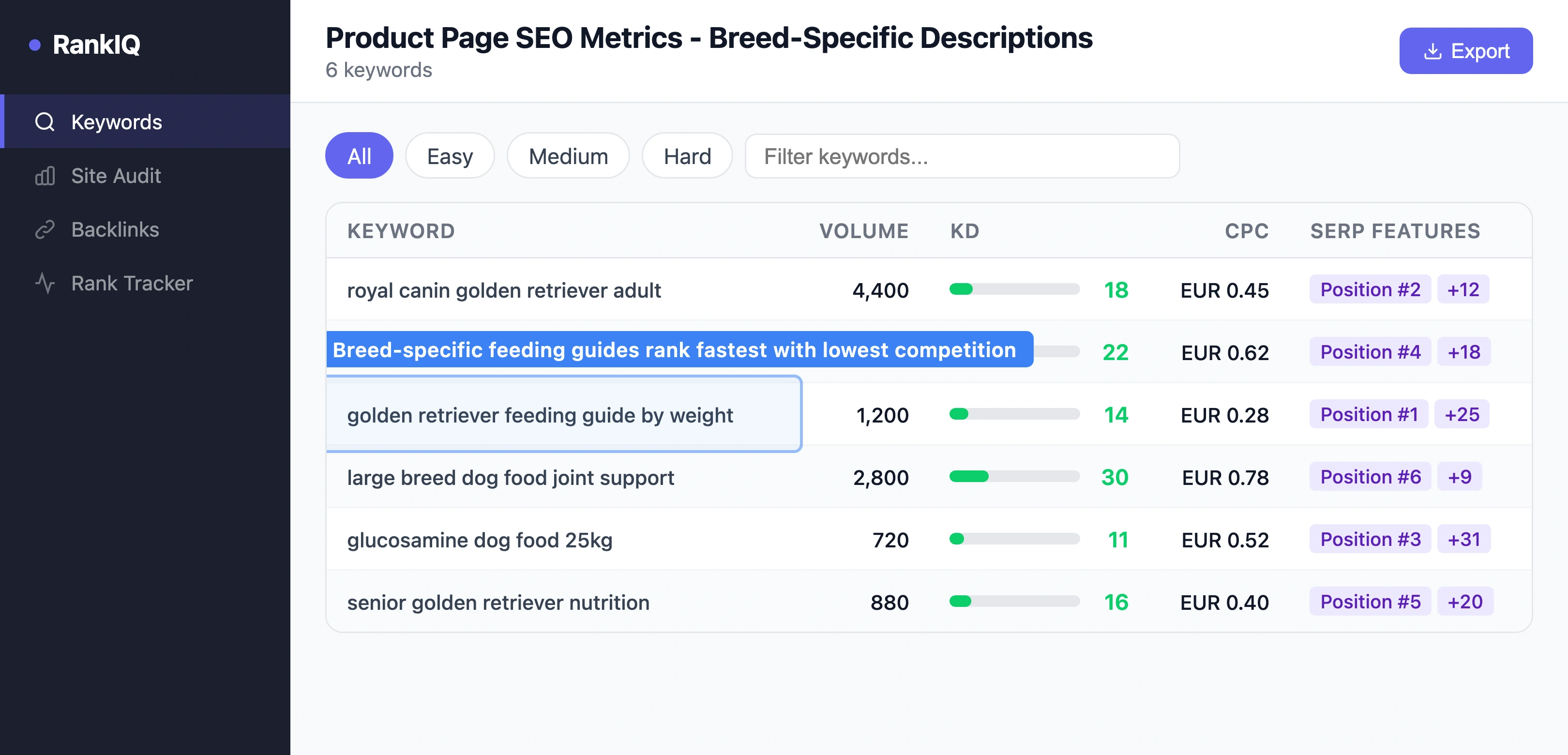
Scannable formatting increases usability by 47%[12]. Use bullet points for feature lists, bold text for key specifications, and short paragraphs (2-3 sentences maximum). Pet owners scanning product pages should find the information relevant to their pet within 5 seconds.
Customer reviews are trusted 12x more than manufacturer descriptions[10]. If your product has customer reviews mentioning specific breed experiences, integrate that feedback into the description: "Popular among German Shepherd owners for its skin-soothing oat formula."
For more on writing descriptions that drive both rankings and sales, see our detailed guide on writing pet product descriptions that rank and sell. For optimizing your product pages holistically, read our product page optimization guide.
What About Category Page Descriptions?
Product descriptions get the most attention, but category page descriptions are equally important for SEO. A category page for "Senior Dog Food" needs a 150-300 word introduction that targets the category keyword, explains what makes senior dog food different, and helps the shopper narrow their choice.
Most pet stores leave category pages as bare product grids with no descriptive content. This is a missed opportunity. Category pages often rank for broader, higher-volume keywords ("senior dog food") while individual product pages rank for specific long-tail terms ("Royal Canin senior medium breed dry food"). Both need unique content to rank.
Our guide on optimizing pet store category pages covers the full process, including how to structure descriptions that help both Google and shoppers.
How to Choose the Right Approach for Your Store
The right approach depends on three factors: catalog size, available time, and budget.
Under 50 products: Write by hand. At 15-20 minutes each, you can complete all descriptions in 12-17 hours. Use the AIDA framework above and include breed-specific recommendations where relevant. This is manageable for a small catalog and produces the highest-quality descriptions.
50-200 products: Hybrid approach. Write your top 20 best-sellers by hand. Use pet-specific AI for the remaining products. Review and customize AI descriptions by adding your personal product experience and customer feedback. Total time: 20-30 hours instead of 50-67 hours.
200+ products: Pet-specific AI is the practical choice. Writing 200+ descriptions by hand is a full-time job for a week or more. AI produces the volume, and you add value by reviewing and enhancing descriptions for top sellers. Focus your manual effort on adding unique insights - staff picks, customer favorites, breed-specific recommendations from your own experience.
Whichever approach you choose, avoid manufacturer descriptions entirely. They create duplicate content across every store that carries the same products, and Google has no reason to rank your version over the competition's identical page.
Frequently Asked Questions
How long should a pet product description be?
150-300 words for standard products. 300-500 words for complex products like specialized pet food, supplements, or medical devices. The key is covering the information pet owners need to make a decision: what pet type and size it is for, key ingredients or materials, specific benefits, and how to use it. Longer is not better - more specific is better. A 200-word description with breed-specific recommendations outperforms a 500-word generic description.
Will Google penalize AI-generated product descriptions?
No. Google evaluates content quality, not the method of production. AI-generated descriptions that are unique, accurate, and useful to shoppers rank just as well as hand-written descriptions. What Google does penalize is duplicate content (manufacturer descriptions used by multiple stores) and thin content (template-based descriptions that provide minimal value). Well-produced AI descriptions avoid both of these problems.
Should I just use the manufacturer's product descriptions?
No. Manufacturer descriptions appear on every store that carries the same product. Google sees this as duplicate content and typically ranks only one version - usually the manufacturer's own website or a major retailer like Amazon. Your product pages become invisible in search results. Write unique descriptions or use AI to generate them. Even adding 2-3 sentences of original insight to a manufacturer description makes a meaningful difference for SEO.
How many product descriptions can I realistically produce per day?
By hand: 20-30 per day (at 15-20 minutes each) if you dedicate a full day to writing. With templates: 50-80 per day. With AI tools: 100-200 per day including review time. The bottleneck with AI is not generation speed - it is your review time. Set aside focused blocks of 2-3 hours for reviewing and approving AI-generated descriptions in batches of 30-50.
References
- 1WorldSync (2024). Product Content Benchmark Report. 1worldsync.com
- Syndigo (2024). Product Content Statistics. syndigo.com
- Salsify (2024). Product Experience Management Statistics. salsify.com
- Market Data Forecast (2024). Europe Pet Food Market. marketdataforecast.com
- FEDIAF (2024). Pet Food Nutrition Guidelines. fediaf.org
- Content Marketing Institute (2024). Product Description Best Practices. contentmarketinginstitute.com
- 1WorldSync (2024). Product Content Benchmark Report. 1worldsync.com
- WorkfxAI (2024). AI Product Description Case Study. workfxai.com
- LinearLoop (2024). AI Product Descriptions Statistics. linearloop.io
- CXL (2024). Social Proof Statistics. cxl.com
- Semrush (2026). AI SEO Statistics. hexaware.com
- Nielsen Norman Group (2024). How Users Read on the Web. nngroup.com
- Baymard Institute (2024). Product Page Usability. baymard.com