The Real Cost of Ignoring SEO for Your Pet Business


Table of Contents +
- What Happens When a Pet Business Ignores SEO?
- How to Calculate Your Lost Traffic Revenue
- The Compounding Problem: Your Competitors Get Stronger Every Month
- How Much Does a Pet Business Lose Per Month Without SEO?
- The Real Cost: SEO vs. Paid Ads Over 12 Months
- What Does SEO Cost for a Pet Business? (Honest Numbers)
- The Pet Industry Opportunity Is Growing
- When Is the Right Time to Start? (It Was Yesterday)
- How to Start With a Minimal Budget
- References
Calculate the real cost of ignoring SEO for your pet business. Lost revenue, compounding competitor advantage, and honest cost comparisons for SEO vs. paid ads.
Every month you delay SEO, your competitors publish more content, earn more backlinks, build more topical authority, and move further ahead in Google rankings. SEO is not like paid ads where you can catch up by spending more next month. It compounds. The gap between you and your competitors grows wider with every month you wait.
This article puts real numbers on what inaction costs. Not vague claims about "missing opportunities" - actual calculations of lost traffic, lost revenue, and the compounding disadvantage of starting late. If you run a pet business and you are not investing in SEO, these numbers show you exactly what it is costing you.
What Happens When a Pet Business Ignores SEO?
When a pet business ignores SEO, it becomes invisible for the searches that matter most. Not immediately - your existing customers still find you by name. But the new customers who search for products, advice, and local businesses? They find your competitors instead.
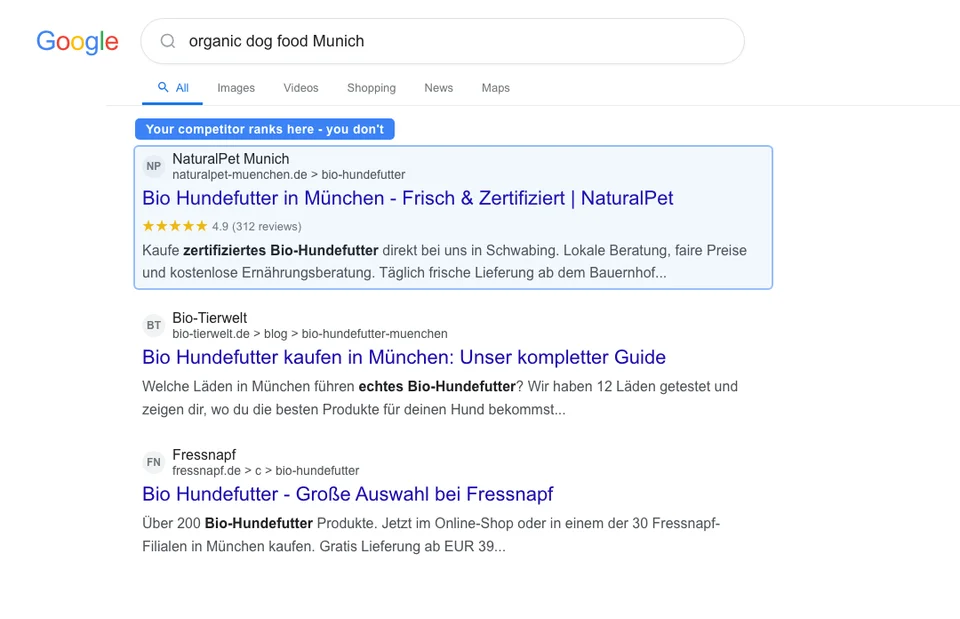
Organic search drives 53% of all website traffic[1]. If your business does not show up in those results, you are missing more than half of the people actively searching for what you sell.
Here is what actually happens over 12 months of no SEO investment:
- Month 1-3: No visible change. You still get the same traffic from existing customers and direct searches. This creates a false sense of security.
- Month 4-6: Competitors who are investing in content start appearing above you for product queries and informational searches. Your organic traffic begins a slow decline.
- Month 7-9: Google notices that your competitors are publishing regularly and you are not. Their topical authority grows. Your older content starts dropping in rankings as fresher, more comprehensive content takes its place.
- Month 10-12: The compounding effect is now visible. Competitors who started publishing 10 articles per month 12 months ago now have 120 articles building topical authority. You have zero. The gap is significant and will take months of sustained effort to close.
61% of small businesses are not investing in SEO at all - yet 71% of those who do invest report satisfaction with the results[2]. The opportunity exists precisely because most of your competitors have not seized it yet. For more on how rankings develop over time, see our guide on Google rankings timeline for pet stores.
Petbase builds this SEO foundation automatically for pet businesses - 10 optimized articles published every month - start your free trial.
How to Calculate Your Lost Traffic Revenue
Lost traffic has a real monetary value. Here is how to calculate it for your pet business.
Start with these numbers:
- Average monthly searches for your target keywords: Use Google Keyword Planner (free with a Google Ads account) or Google Search Console to see what people search for in your product categories. A typical pet business targets 50-200 keywords with a combined monthly search volume of 10,000-50,000 in their local market.
- Estimated click-through rate if you ranked: Position 1 on Google gets approximately 27% of clicks. Position 5 gets about 5%. Position 10 gets about 2.5%. For a reasonable estimate, assume an average of 5% CTR across your target keywords.
- Estimated conversion rate: Pet business websites convert at 1.5-3.5% depending on product type and whether they sell online or drive in-store visits.
- Average order value: For European pet businesses, this typically ranges from EUR 35 to EUR 75.
Now the calculation:
| Metric | Conservative | Moderate | Optimistic |
|---|---|---|---|
| Target keyword search volume/month | 10,000 | 25,000 | 50,000 |
| Average CTR at target positions | 3% | 5% | 8% |
| Monthly organic visitors | 300 | 1,250 | 4,000 |
| Conversion rate | 1.5% | 2.5% | 3.5% |
| Monthly conversions | 5 | 31 | 140 |
| Average order value | EUR 35 | EUR 50 | EUR 75 |
| Monthly lost revenue | EUR 158 | EUR 1,563 | EUR 10,500 |
| Annual lost revenue | EUR 1,890 | EUR 18,750 | EUR 126,000 |
For a mid-size pet business in a moderately competitive European market, the moderate estimate is most realistic: approximately EUR 1,500/month in lost revenue from organic search. That is EUR 18,000+ per year - simply from not showing up when your customers search.
And this calculation only covers direct online sales. It does not account for in-store visits driven by local search, brand awareness from informational content, or the lifetime value of customers who discover you through search and return repeatedly. 46% of all Google searches have local intent[3], which means nearly half the people searching are looking for something nearby - including your physical location.
The Compounding Problem: Your Competitors Get Stronger Every Month
SEO is not a fixed playing field. It shifts every month as competitors publish content, earn links, and build authority. When you stand still, the relative gap between you and active competitors grows exponentially - not linearly.
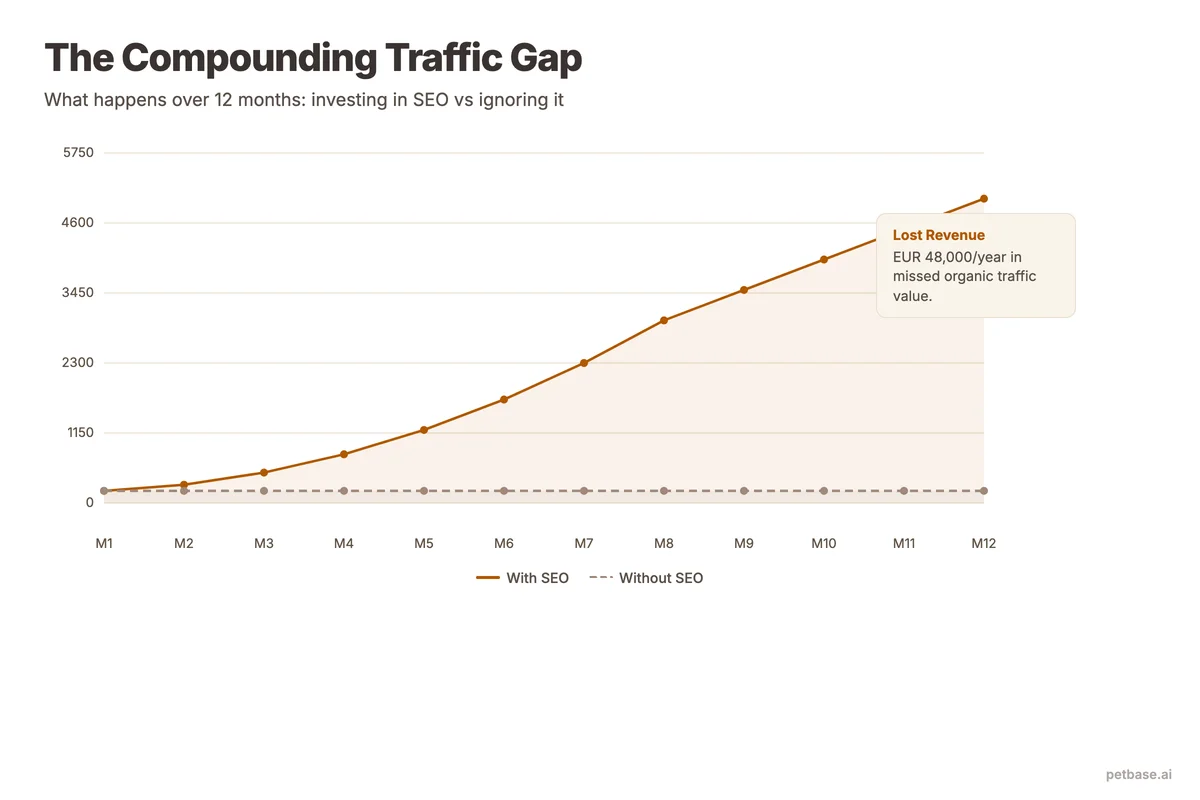
Here is how the compounding effect works:
Imagine two pet businesses in the same city. Business A starts publishing 10 SEO-optimized articles per month. Business B publishes nothing.
- After 3 months: Business A has 30 articles. Some begin ranking for long-tail keywords. Long-tail keywords make up 70% of all search queries and convert at 36% higher rates than short-tail terms[4]. Business B notices nothing.
- After 6 months: Business A has 60 articles organized into content clusters. Topical authority starts building. Several articles reach page 1. Business B's existing rankings begin to slip as Business A's content takes positions.
- After 12 months: Business A has 120 articles, strong topical authority in 3-4 topic areas, and a steady stream of organic traffic growing 15-25% month over month. Companies publishing 16 or more blog posts per month get 3.5x more traffic than those publishing 0-4[5]. Business B has lost positions for keywords it used to rank for and is now almost invisible for informational queries.
If Business B now decides to start investing in SEO, it faces a 12-month content deficit. Even publishing at the same rate as Business A, it takes 12 months just to reach the same content volume - and by then, Business A has a 24-month head start.
This is why the right time to start was yesterday. Every month of delay adds to the eventual cost of catching up. See our analysis of 50 pet store websites for data on how few businesses are actually investing in content.
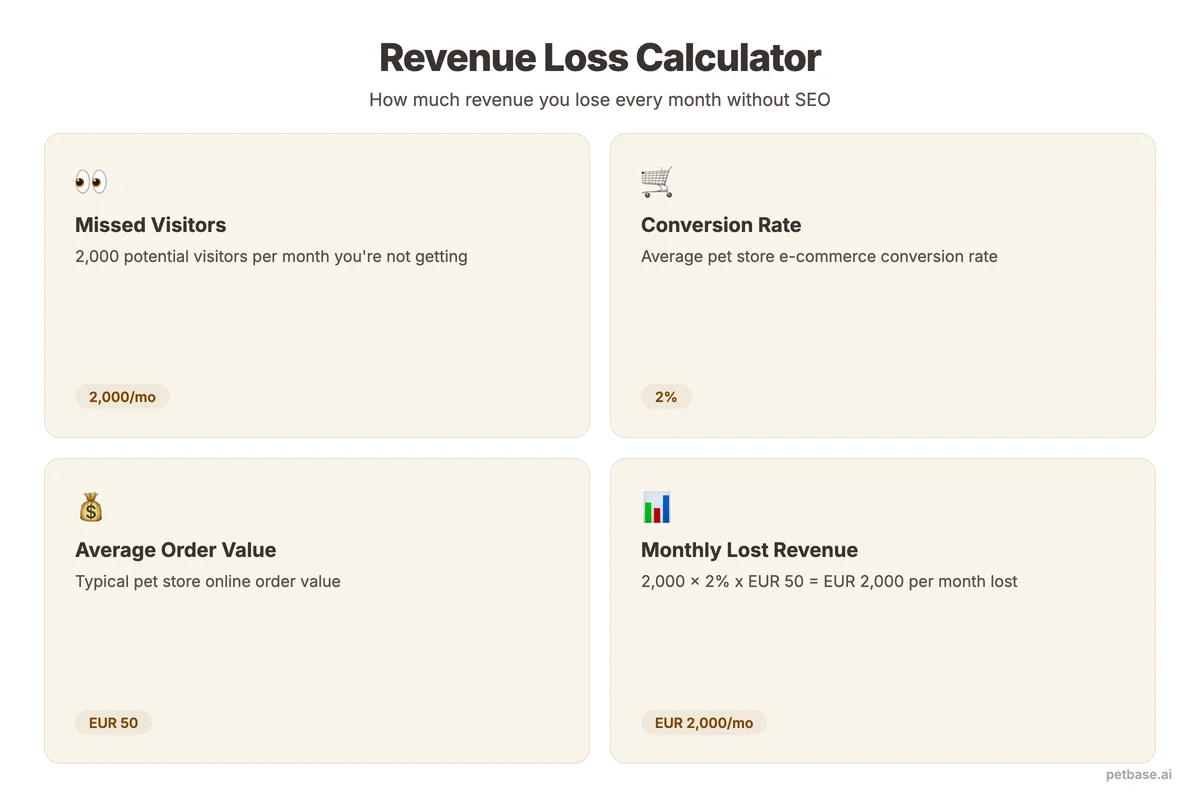
How Much Does a Pet Business Lose Per Month Without SEO?
Here are specific numbers on the total monthly cost of not doing SEO, including both lost revenue and the cost of alternatives you rely on instead.
When you do not have organic traffic, you depend on:
- Paid ads (Google Ads): Average cost-per-click for pet industry keywords in Europe ranges from EUR 0.40 to EUR 2.50. To generate 1,000 monthly visitors through paid ads, you spend EUR 400-2,500/month.
- Social media: Organic reach on Facebook and Instagram has declined to 2-5% of your followers. To reach new customers, you need paid social ads at EUR 0.20-1.00 per click.
- Word of mouth and referrals: Free but not scalable. Growth is slow and unpredictable.
The total monthly cost of not doing SEO includes both the revenue you miss and the higher cost of alternative traffic sources:
- Lost organic revenue: EUR 1,500/month (moderate estimate from above)
- Paid ads to compensate: EUR 500-2,000/month to partially replace organic traffic
- Total effective cost: EUR 2,000-3,500/month
Compare that to the cost of actually doing SEO, and the math is clear. Content marketing costs 62% less than traditional marketing and generates 3x more leads[6].
The Real Cost: SEO vs. Paid Ads Over 12 Months
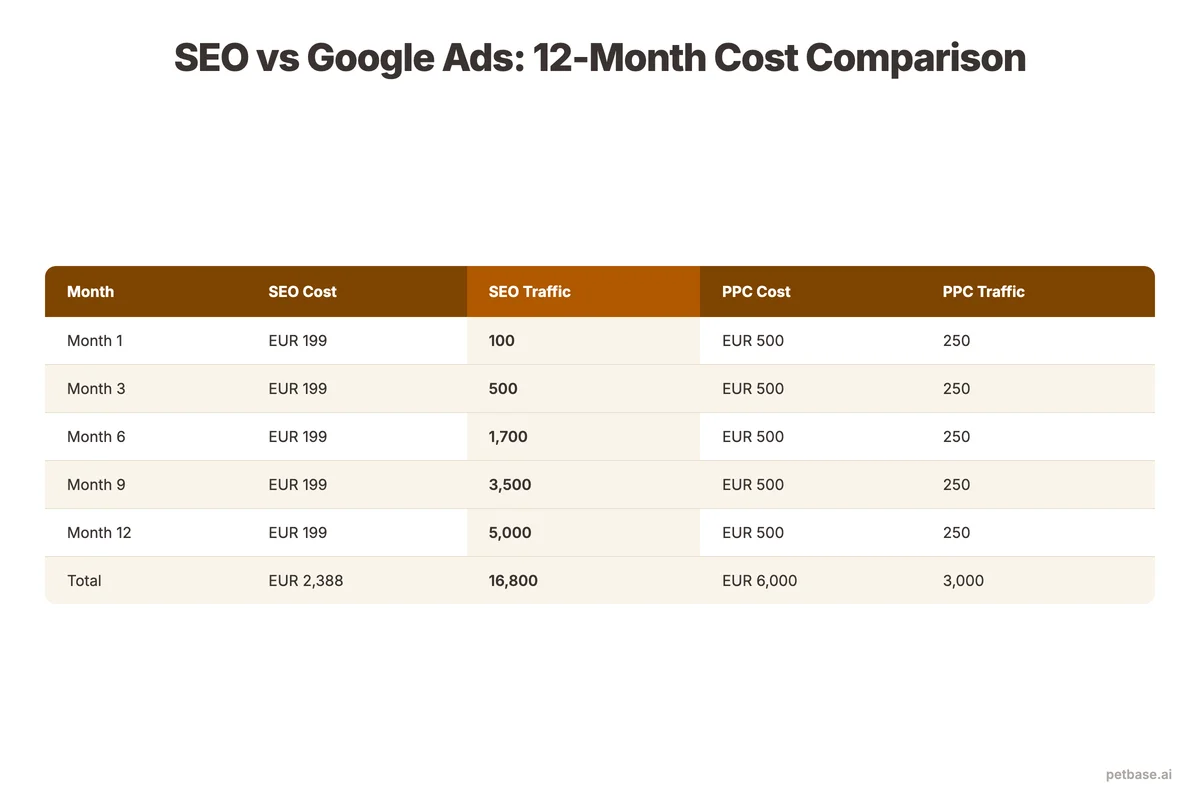
Here is the comparison that makes the decision obvious:
| Metric | SEO (Petbase) | Google Ads | No Investment |
|---|---|---|---|
| Monthly cost | EUR 199 | EUR 1,000-2,500 | EUR 0 |
| 12-month total cost | EUR 2,388 | EUR 12,000-30,000 | EUR 0 |
| Monthly visitors (month 6) | 500-1,500 (growing) | 400-1,000 (fixed) | Declining |
| Monthly visitors (month 12) | 2,000-5,000 (growing) | 400-1,000 (fixed) | Lower than month 1 |
| What happens when you stop paying | Traffic continues (content stays indexed) | Traffic drops to zero immediately | N/A |
| Content assets created | 120 articles (permanent) | 0 | 0 |
| Topical authority built | Yes (compounds over time) | No | Declines |
| Cost per visitor (month 12) | EUR 0.04-0.10 | EUR 1.00-2.50 | N/A |
The difference is stark. After 12 months, SEO delivers 2-5x more traffic at a fraction of the cost. And the traffic does not disappear when you stop paying - your content continues to rank and attract visitors for months or years after publication.
On a per-dollar basis, content marketing returns $7.65 for every $1 spent compared to just $1.80 for paid advertising[7]. Paid ads are like renting traffic. SEO is like owning it. For a deeper comparison, see our guide on pet store marketing channels compared.
What Does SEO Cost for a Pet Business? (Honest Numbers)
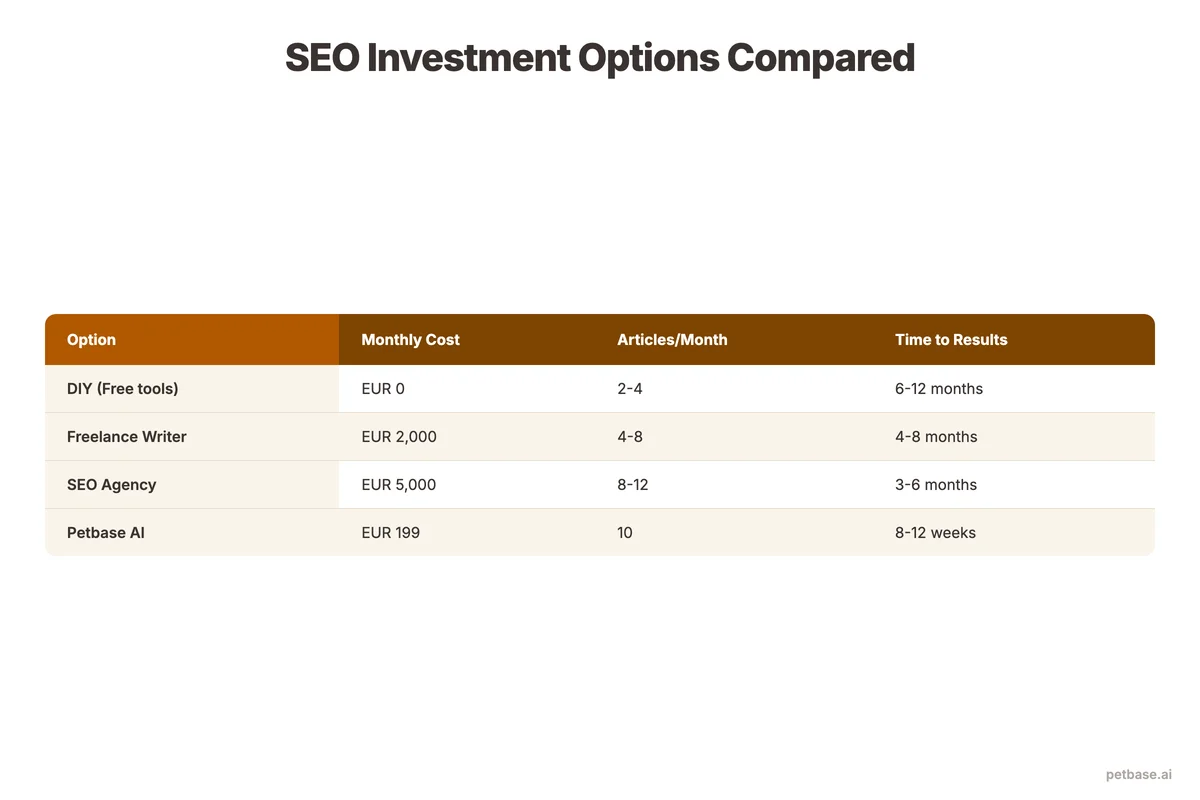
Here is what different levels of SEO investment actually cost:
| Approach | Monthly Cost | What You Get | Best For |
|---|---|---|---|
| DIY (free tools only) | EUR 0 + 20-40 hours/month of your time | 2-4 articles/month, basic optimization | Business owners with writing skills and time |
| Petbase | EUR 199/month | 10 articles/month, topic clusters, internal linking, pet industry knowledge model | Businesses wanting consistent, scalable content without agency costs |
| Freelance SEO writer | EUR 500-1,500/month | 4-8 articles/month, variable quality | Businesses wanting human-written content on a budget |
| SEO agency | EUR 2,000-5,000+/month | Full-service: strategy, content, technical, link building | Businesses with budget for comprehensive management |
| Full-service agency (premium) | EUR 5,000-15,000+/month | Enterprise-level SEO with dedicated strategist | Multi-location chains with significant budgets |
The right choice depends on your budget, your time, and your growth goals. For most independent pet businesses, the question is not whether to invest in SEO - it is which level of investment gives the best return.
At EUR 199/month, Petbase delivers the highest content volume per euro. 10 articles per month with automatic topic clustering and internal linking, built on a pet industry knowledge model co-developed with an award-winning German SEO company. That is more content than most freelancers produce at 3-7x the cost.
Is an agency better? In some ways, yes - a good agency provides strategic oversight, technical audits, and link building that a content tool does not. But for the core problem most pet businesses face - not enough content, published too infrequently, on topics nobody searches for - a specialized content tool solves it at 1/25th the cost. For a detailed comparison, see our SEO agencies vs. AI tools for pet stores guide.
The Pet Industry Opportunity Is Growing
The U.S. pet industry alone reached $152 billion in 2024[8], and the European market follows the same upward trend. More pet owners are spending more money - and they are researching purchases online before they buy.
This growth means more search volume, more competition, and a bigger penalty for businesses that stay invisible in search results. The businesses that build organic visibility now will capture a growing share of this expanding market. The ones that wait will pay more to catch up later.
When Is the Right Time to Start? (It Was Yesterday)
The best time to start SEO was 12 months ago. The second-best time is today. Every month you wait adds to the eventual cost of catching up.
Here are the common reasons pet business owners delay - and why none of them hold up:
- "I will start after the busy season." SEO takes 8-12 weeks to show results. If you wait until after the busy season to start, you will not have results until the next slow period. Start now so you have organic traffic working for you during the next busy season.
- "I do not have the budget right now." You are already paying the cost of not doing SEO - in lost revenue and dependence on paid ads. EUR 199/month for content that builds permanent organic traffic is less than what most businesses spend on a single day of Google Ads.
- "I need to fix my website first." You can publish content while fixing technical issues. In fact, having content live gives you something to optimize during the technical audit. Do not wait for a perfect site before starting content.
- "I am not sure it works for pet businesses." Look at the data. Pet-related searches grow year over year. Pet owners research online before buying. The pet businesses that rank in Google get the traffic and the sales. The ones that do not, do not.
The pet industry SEO trends are clear: organic search is becoming more competitive, not less. The window to build topical authority while most competitors are still doing nothing (90% have no content clusters, per our 50-site analysis) is closing.
How to Start With a Minimal Budget
If budget is your constraint, here is the most efficient path to start building organic traffic:
- Week 1: Set up Google Search Console (free). This tells you which keywords your site already appears for and where you currently rank. It is your baseline measurement.
- Week 2: Optimize your Google Business Profile (free). If you have a physical location, a fully optimized GBP is the single fastest local SEO win. Add 20+ photos, complete every field, and start requesting reviews from customers.
- Week 3: Fix your top 10 meta descriptions (free, 2-3 hours). Write compelling 155-character meta descriptions for your most-visited pages. This can increase click-through rates by 5-10%.
- Week 4: Publish your first content cluster (EUR 199/month with Petbase, or 20-40 hours/month DIY). Start with one topic cluster in your strongest product category. Plan 10-15 articles. Publish the first 4-5 this month.
Total first-month investment: EUR 199 (or EUR 0 + 40 hours of your time). By month 3, you will have 30 articles building topical authority. By month 6, organic traffic starts growing measurably. By month 12, you will have a content library that drives traffic permanently.
The math is simple: EUR 199/month x 12 months = EUR 2,388 invested. The result: 120 SEO-optimized articles, topical authority in 2-3 subject areas, and growing organic traffic that costs less every month on a per-visitor basis.
Compare that to 12 months of doing nothing: EUR 0 invested, EUR 18,000+ in lost revenue, and a growing competitive gap that gets harder to close every month.
Start your free trial and see the first articles within days. Or review our competitor analysis guide to understand where you stand relative to the pet businesses already investing in SEO.
How long before SEO pays for itself for a pet business?
For most pet businesses, SEO becomes ROI-positive within 4-8 months. At EUR 199/month with Petbase, your break-even point is when organic traffic generates more than EUR 199 in revenue per month. With a moderate conversion rate and average order value, this typically happens once you reach 200-400 monthly organic visitors from new content. Businesses publishing 10 articles per month usually hit this traffic level between month 4 and month 8.
Is SEO worth it for a small pet business with only a physical location?
Yes. Local SEO is especially valuable for physical locations. When someone searches "pet store near me" and you appear in the top 3 map results, you get direct foot traffic. 46% of all Google searches have local intent[3], meaning nearly half of searchers are looking for something nearby. Content SEO supports local visibility too - educational blog content builds your domain authority, which strengthens your local rankings. A blog post about "best dog food for German Shepherds" helps your business rank higher for "pet store in [your city]" because Google sees your site as a trusted pet authority.
What if I already tried SEO and it did not work?
"SEO did not work" almost always means one of three things: you did not publish enough content (2-3 posts instead of 30-50), you targeted the wrong keywords (topics nobody searches for), or you did not wait long enough (SEO takes 8-12 weeks minimum). Check our guide on why pet store blogs do not get traffic to diagnose the specific issue. The solution is usually more volume, better keyword targeting, and a content cluster strategy - not abandoning SEO entirely.
Can I do SEO myself or do I need to hire someone?
You can do basic SEO yourself - Google Search Console setup, GBP optimization, and meta description writing require no technical skills. Content creation is where most business owners hit a wall: writing 10 optimized articles per month takes 40-50 hours. That is where tools like Petbase (EUR 199/month for 10 articles) or freelancers (EUR 500-1,500/month for 4-8 articles) make sense. The key is consistent output over time. Sporadic publishing does not build topical authority.
References
- "How Much Traffic Comes From Organic Search" - seoinc.com
- "SEO Statistics 2025" - clutch.co
- "Local SEO Statistics" - brightlocal.com
- "30 Statistics About Long-Tail Keywords" - embryo.com
- "Marketing Statistics" - hubspot.com
- "Content Marketing Statistics" - siegemedia.com
- "Content Marketing ROI Stats" - genesysgrowth.com
- "Industry Trends and Stats" - americanpetproducts.org