How to Respond to Pet Store Reviews: Templates and Best Practices

Table of Contents +
- Why Does Responding to Reviews Matter for Pet Stores?
- How Should You Respond to Positive Pet Store Reviews?
- How Should You Respond to Negative Pet Store Reviews?
- How Should You Respond to Neutral or Mixed Reviews?
- How Should You Handle Fake or Spam Reviews?
- Review Response Comparison: What Works and What Does Not
- How Fast Should You Respond to Reviews?
- What Keywords Should You Include in Review Responses?
- How Do Review Responses Affect Your Google Ranking?
- How Can You Turn Negative Reviews Into Positive Outcomes?
- Frequently Asked Questions
- References
Ready-to-use review response templates for pet stores. Handle positive, negative, neutral, and fake reviews with data-backed best practices.
Most pet stores collect reviews but never respond to them. 75% of businesses do not reply to negative reviews at all[1]. That is a problem, because 97% of consumers who read reviews also read your responses[2]. Every unanswered review is a missed conversation with a future customer. Businesses that respond to at least 25% of their reviews average 35% more revenue than those that stay silent[3]. This guide gives you ready-to-use response templates for every type of pet store review - positive, negative, neutral, and fake - along with the data behind why responding matters.
TL;DR
Responding to reviews is not optional. 89% of consumers expect a response, and 56% change their opinion about a business based on how it replies. This guide provides pet-store-specific templates for positive, negative, neutral, and fake reviews, plus a comparison table and best practices backed by 2026 consumer data.
Why Does Responding to Reviews Matter for Pet Stores?
Review responses are not just polite - they directly affect revenue, ratings, and local search rankings. Here is what the research shows.
Revenue impact. Consumers spend nearly 50% more money with businesses that respond to their online reviews[3]. For a pet store doing EUR 300,000 in annual revenue, that gap between responding and staying silent could represent over EUR 100,000 in lost sales. Responding to all reviews yields a 16.4% conversion improvement[4], meaning more people who visit your Google Business Profile actually walk into your store or click through to your website.
Rating improvement. A Harvard Business Review study found that when businesses started responding to reviews, they received 12% more reviews and their average rating increased[5]. More reviews at a higher average rating compound over time. Harvard Business School research also shows that a one-star increase in rating leads to a 5-9% increase in revenue for independent businesses[6].
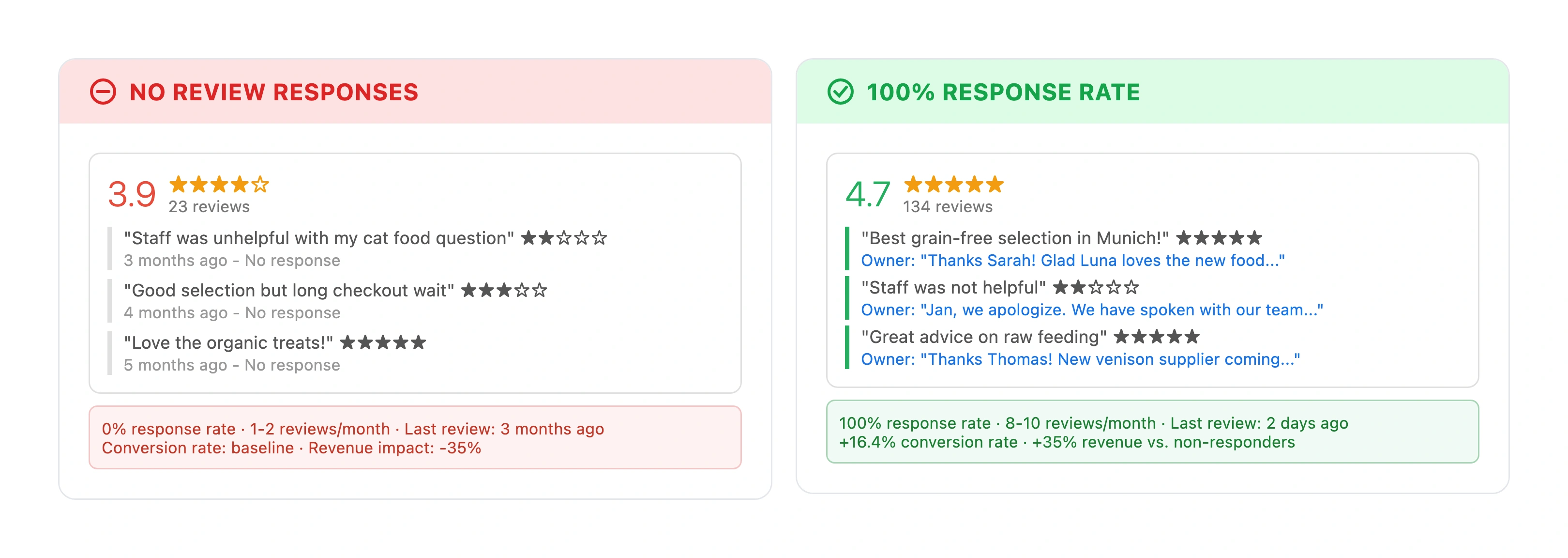
Consumer expectations. 89% of consumers expect businesses to respond to their reviews[2]. 81% expect that response within one week[2]. And 56% of consumers say they have changed their opinion about a business based on how it responded to a review[2]. When you do not respond, you are not neutral - you are telling potential customers that you do not care about feedback.
Local SEO signals. Google considers review response rate as part of your Google Business Profile engagement signals. Active profiles that respond to reviews, post updates, and maintain accurate information rank higher in local search results. Reviews are one of the top three ranking factors for local SEO, and response activity signals to Google that your business is active and engaged.
In my experience building Petbase, the pet stores that respond to every review within 48 hours consistently outperform those that treat reviews as a one-way channel. The response is where you build the relationship.
Petbase automates SEO content for pet stores - publishing 10 optimized articles monthly so you can focus on running your shop - start your free trial.
How Should You Respond to Positive Pet Store Reviews?
Positive reviews are the easiest to respond to, yet many pet stores either ignore them or paste the same generic "Thanks for the review!" on every one. Both approaches waste an opportunity. A good positive review response does three things: thanks the customer, references something specific, and invites them back.
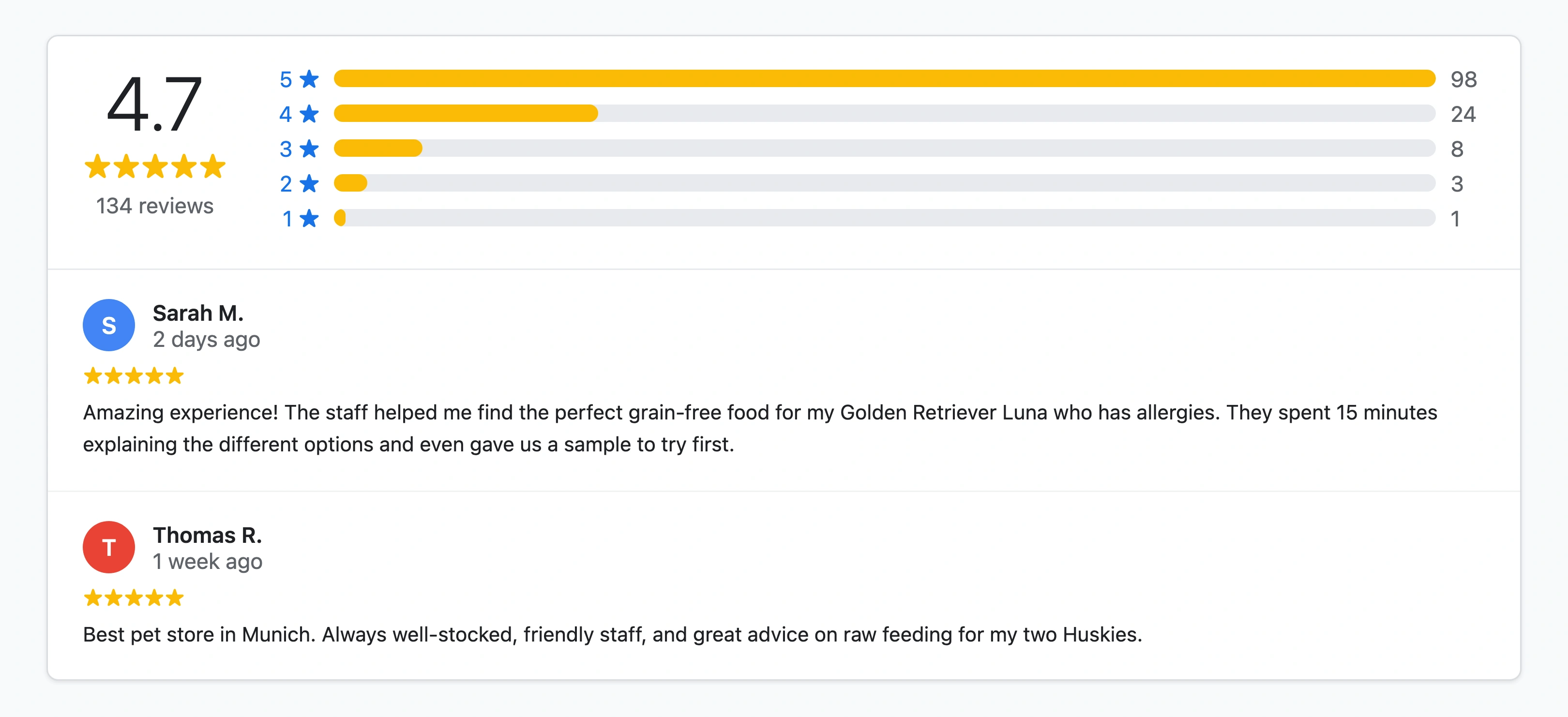
Positive review response principles
- Use the customer's name (and their pet's name if mentioned)
- Reference a specific detail from the review - the product they bought, the service they received, or something they mentioned about their pet
- Keep it to 2-3 sentences
- Do not stuff keywords or turn the response into an advertisement
- Respond within 48 hours
Templates for positive reviews
After a product purchase:
"Thank you so much, [Name]! We are glad [Pet Name] is enjoying the [specific product]. If you ever need advice on [related topic], just ask - we are always happy to help. See you next time!"
After a grooming appointment:
"Thanks for the kind words, [Name]! It was a pleasure working with [Pet Name] - such a well-behaved [breed]. We look forward to the next appointment!"
After a general positive experience:
"Really appreciate you taking the time to write this, [Name]. It means a lot to our team. We will make sure to keep the [specific thing they praised] at the same standard. Hope to see you and [Pet Name] again soon!"
After a first-time visit:
"Welcome to the family, [Name]! We are so happy your first visit was a good one. If you have questions about [product/service they tried], do not hesitate to reach out. We are here to help."
How Should You Respond to Negative Pet Store Reviews?
Negative reviews feel personal, especially when you know the situation was more nuanced than the customer described. But your response is not for that one unhappy customer alone. It is for every potential customer who reads it afterward. 56% of consumers change their opinion about a business based on the response[2], so a well-crafted reply to a negative review can actually build more trust than a positive review.
The 5-step framework for negative reviews
| Step | What to Do | Example Language |
|---|---|---|
| 1. Pause | Wait 1-2 hours. Do not respond while emotional. | - |
| 2. Thank | Thank them for the feedback, even if it stings. | "Thank you for letting us know about this." |
| 3. Acknowledge | Show you understand their frustration. Do not minimize it. | "We understand how frustrating that must have been." |
| 4. Take responsibility | Own what went wrong. No excuses, no deflecting. | "You are right - we should have handled that differently." |
| 5. Move offline | Offer a direct way to resolve the issue privately. | "Please reach out to us at [email] so we can make this right." |
Templates for negative reviews
Product quality complaint:
"Thank you for this feedback, [Name]. We are sorry to hear the [product] did not meet your expectations. We take product quality seriously, and we would like to understand what went wrong. Please contact us at [email/phone] - we want to make this right for you and [Pet Name]."
Customer service complaint:
"[Name], thank you for sharing your experience. This is not the level of service we aim for, and we apologize. We have spoken with our team about your visit. We would appreciate the chance to make it up to you - please reach out to us directly at [email]."
Wait time or availability complaint:
"We appreciate you letting us know, [Name]. We understand that long wait times are frustrating, especially when you are on a tight schedule. We are working on improving our staffing during peak hours. We would love the chance to give you a better experience next time."
Pricing complaint:
"Thank you for the feedback, [Name]. We understand that pricing is an important factor. We source our products carefully to ensure quality and safety for your pet, which does affect pricing. If you would like, we can help you find options that fit your budget - feel free to visit us or call at [phone]."
What NOT to do with negative reviews
- Do not argue publicly. Even if the customer is wrong, a public argument makes you look defensive. Move the conversation offline.
- Do not copy-paste. Identical responses on different negative reviews signal that you do not actually care about individual concerns.
- Do not get personal. Stick to facts and empathy. Never reference private details about the customer or the transaction in a public response.
- Do not ignore them. 75% of businesses do not reply to negative reviews[1]. That silence tells future customers you do not take complaints seriously.
How Should You Respond to Neutral or Mixed Reviews?
Three-star reviews are often the most informative - and the most actionable. These customers liked some things but had specific issues. They are not angry; they are giving you a roadmap for improvement. A strong response here can often convert a lukewarm customer into a loyal one.
Templates for neutral reviews
"Good but not great" review:
"Thank you for the honest feedback, [Name]. We are glad you enjoyed [positive aspect they mentioned]. We hear you on [issue they raised] and are actively working to improve that. We would love to welcome you back and show you the difference."
Mixed product feedback:
"Appreciate the detailed review, [Name]! Glad [Pet Name] took to the [positive product]. We are sorry the [other product] was not the right fit. If you would like, come in and we will help find an alternative that works better for [Pet Name]."
"Decent but expensive" review:
"Thank you for taking the time to share this, [Name]. We appreciate the feedback on pricing. We select our products based on quality and safety standards, but we also carry a range of options at different price points. Next time you visit, ask our team - we are happy to help you find something that fits your needs and budget."
How Should You Handle Fake or Spam Reviews?
Fake reviews are a growing problem. Google removed or blocked more than 240 million policy-violating reviews in 2024 alone - a 40% increase over the previous year[7]. If your pet store receives a review from someone who was never a customer, here is how to handle it.
Step 1: Identify the fake review
Look for these signals:
- The reviewer has no purchase history in your system
- The review describes a product or service you do not offer
- The reviewer profile has no other reviews or only negative reviews across many businesses
- The review is vague with no specific details about your store
- Multiple negative reviews appeared on the same day (coordinated attack)
Step 2: Respond publicly (briefly)
"We appreciate all feedback, but we do not have any record of your visit. We take every review seriously and want to resolve any genuine concerns. If you did visit our store, please contact us at [email] with your purchase details so we can look into this."
This response accomplishes two things: it signals to other readers that the review may not be genuine, and it gives the reviewer an opportunity to clarify if they are a real customer with a legitimate complaint.
Step 3: Flag the review with Google
In your Google Business Profile, click the three dots next to the review and select "Flag as inappropriate." Google typically takes 5-20 business days to review flagged content. If the standard process does not work, escalate through Google Business Profile support with documentation.
Step 4: Build a buffer of genuine reviews
The best defense against fake negative reviews is a strong base of authentic positive reviews. If you have 150 genuine reviews averaging 4.7 stars, one fake 1-star review barely moves the needle. For a complete system to generate more genuine reviews, see the online reviews guide for pet stores.
Review Response Comparison: What Works and What Does Not
Here is a side-by-side comparison of effective versus ineffective review responses for pet stores.
| Scenario | Poor Response | Effective Response |
|---|---|---|
| 5-star review praising staff | "Thanks for the review!" | "Thank you, Sarah! We will pass your kind words to Markus - he really enjoyed helping you find the right harness for Luna. See you both soon!" |
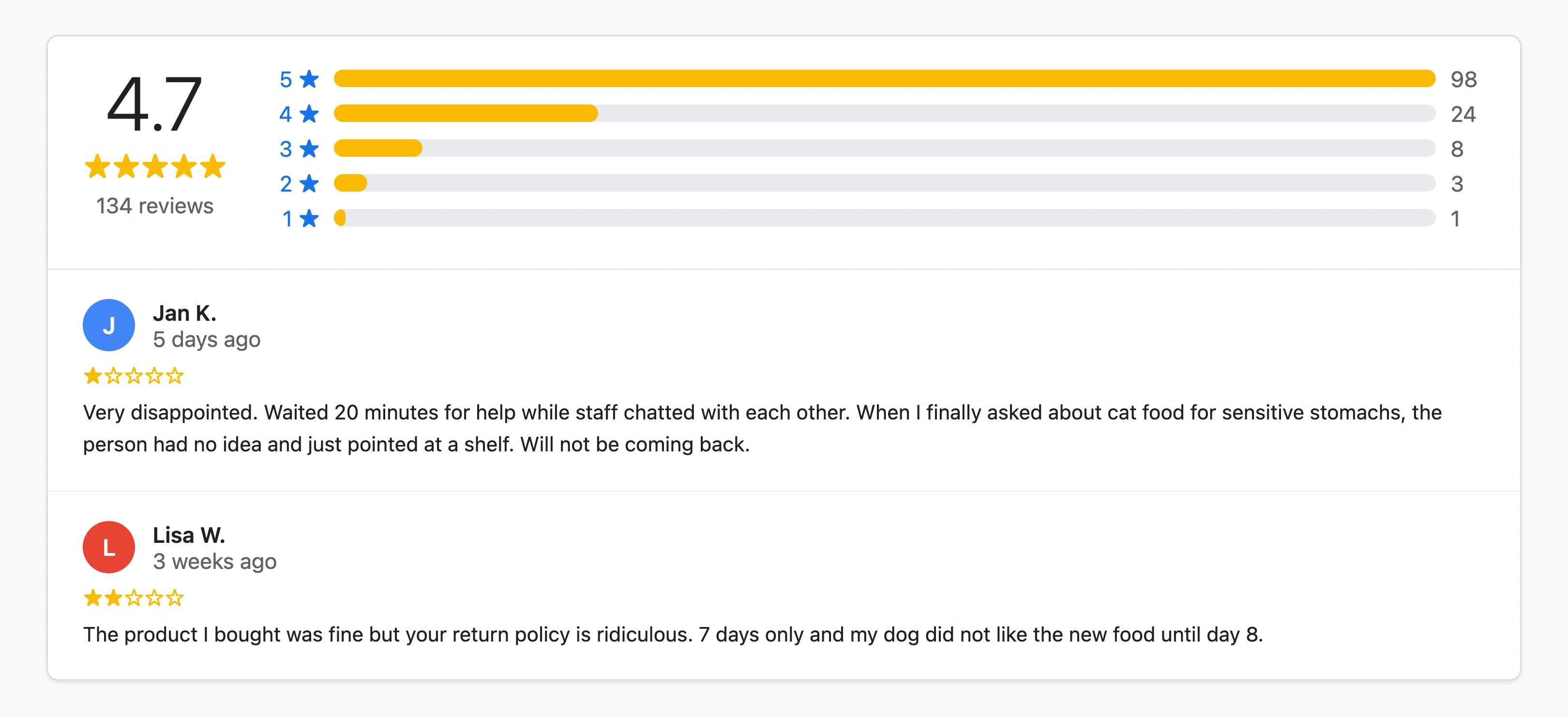
| 1-star review about rude staff | "Sorry you feel that way." | "Thank you for this feedback, Jan. That is not the experience we want anyone to have. We have spoken with our team about this. We would like to make it right - please contact us at [email]." |
| 3-star review about limited selection | "We carry over 2,000 products!" | "Appreciate the feedback, Lisa. We are always expanding our range. What products were you looking for? Let us know and we will see what we can do." |
| Suspected fake review | "This is fake! We have never served you!" | "We do not have a record of your visit, but we take every concern seriously. Please contact us at [email] with your purchase details so we can investigate." |
| 4-star review with minor complaint | (No response) | "Thanks for the detailed review, Michael! Happy to hear Max loves the new food. Sorry about the wait at checkout - we are adding an extra register to speed things up during busy hours." |
How Fast Should You Respond to Reviews?
Consumer expectations for response speed have increased sharply. According to the 2026 BrightLocal Consumer Review Survey[2]:
- 19% expect a same-day response
- 32% expect a response by the next day
- 81% expect a response within one week
For pet stores, the practical target is to respond to every review within 48 hours. Negative reviews deserve even faster attention - aim for same-day when possible. The longer a negative review sits without a response, the more damage it does to your conversion rate.
Here is a simple daily routine that takes 10-15 minutes:
- Check your Google Business Profile for new reviews every morning
- Respond to any negative reviews first
- Respond to positive and neutral reviews
- Flag any suspected fake reviews
- Note any recurring complaints to address operationally
If you receive reviews on multiple platforms, set up notifications for Google, Facebook, and any other platforms where your store has a presence. For more on managing your Google presence, see the Google Business Profile guide for pet stores.
What Keywords Should You Include in Review Responses?
Review responses contribute to your local SEO profile. When you naturally mention your products, services, and location in responses, it reinforces the keywords Google associates with your business. But there is a line between natural and forced.
Natural keyword inclusion (good):
"So glad you found the right grain-free dog food for Bruno at our Munich store! Our team is always happy to help with nutrition advice."
Keyword stuffing (bad):
"Thank you for visiting our pet store in Munich. Our Munich pet store offers the best grain-free dog food, cat food, pet accessories, and pet grooming services in Munich."
The first response sounds human. The second sounds like a robot trying to game an algorithm - and both Google and customers will notice. Mention your city or neighborhood once if it fits naturally. Reference the product or service category the customer mentioned. That is enough.
Review responses are part of a broader local SEO strategy. For the full picture, see the pet store SEO guide and the guide to "near me" searches.
How Do Review Responses Affect Your Google Ranking?
Review signals now account for approximately 20% of local ranking factors[2], and that percentage has been growing. Recency and sentiment now carry more weight than raw review count alone. Active review management - responding, generating fresh reviews, addressing complaints - sends strong engagement signals to Google.
41% of consumers now always read reviews when browsing for businesses, up from 29% just a year earlier[2]. And 75% of consumers only care about reviews from the last three months[2]. This means that a pet store with 200 reviews but no activity in the last quarter is less attractive to both Google and customers than a store with 80 reviews that has fresh responses from this week.
68% of consumers will only use a business with a 4+ star rating[2]. When you respond to reviews thoughtfully, you encourage more customers to leave reviews (12% increase per the Harvard Business Review study[5]), which helps maintain a higher average. For pet stores working on their broader review strategy, see the complete guide to online reviews for pet stores.
How Can You Turn Negative Reviews Into Positive Outcomes?
A negative review does not have to stay negative. When you resolve a customer's issue, it is perfectly appropriate to ask them to update their review. Many customers will revise a 1-star review to a 4- or 5-star review after a genuine resolution.
The recovery process
- Respond publicly with empathy and an invitation to connect offline
- Reach out privately via the channel they prefer (email, phone, in-store)
- Resolve the issue with a concrete action - replacement, refund, or specific improvement
- Follow up to confirm they are satisfied
- Ask politely if they would consider updating their review: "We are glad we could resolve this. If you feel our response changed your experience, we would appreciate it if you updated your review. No pressure at all."
One pattern I have seen across pet stores we work with: the businesses that treat negative reviews as customer service opportunities rather than reputation threats are the ones with the highest ratings over time. A well-resolved complaint often creates a more loyal customer than a smooth transaction that was never tested.
Customer reviews also double as a source of user-generated content for your marketing. Positive review quotes, customer stories, and testimonials from review responses can be repurposed across your website and social channels.
Frequently Asked Questions
Should I respond to every single review?
Yes. Responding to all reviews yields a 16.4% conversion improvement[4]. Even a short, personalized response to a 5-star review takes 30 seconds and shows future customers that you value feedback. Prioritize negative reviews (respond within 24 hours), then positive and neutral reviews (within 48 hours). The total time investment is typically 10-15 minutes per day for most pet stores.
What if a negative review contains false information?
Respond calmly and factually. Do not accuse the reviewer of lying, but do correct the record: "We appreciate your feedback. To clarify, our return policy covers [specific policy], and we would be happy to assist you with a return. Please contact us at [email] so we can help." If the review violates Google's policies (spam, conflicts of interest, off-topic content), flag it for removal. Google removed 240 million policy-violating reviews in 2024[7], so the enforcement system is active.
Can review responses hurt my business?
Poor responses can. Defensive, sarcastic, or dismissive responses damage trust more than the original negative review. A well-known study found that 56% of consumers changed their opinion about a business based on its response[2] - and that change can go in either direction. Stick to the principles in this guide: thank, acknowledge, take responsibility, and move offline for resolution.
How do I handle a review that mixes praise with criticism?
Acknowledge both. Thank them for the positive feedback, then address the criticism directly. Example: "Thank you for the kind words about our staff, Maria! We are glad the team was helpful. We hear your feedback on our product selection for exotic birds - it is something we are actively expanding. We would love to show you the new range next time you visit." Mixed reviews are opportunities to demonstrate that you listen and act on feedback.
Is it worth responding to old reviews I have never replied to?
Yes, but prioritize recent reviews first. Start responding to every new review going forward. Then work backward through your most recent unanswered reviews - especially negative ones. Going back and responding to a 6-month-old negative review still shows future customers that you eventually addressed the concern. It also signals to Google that your profile is now actively managed.
References
- ReviewTrackers (2025). Examples of Responding to Reviews. reviewtrackers.com
- BrightLocal (2026). Local Consumer Review Survey 2026. brightlocal.com
- Womply / WiserReview (2025). Online Review Statistics. wiserreview.com
- SOCi Research / ReplyOnTheFly (2025). Google Review Response Statistics. replyonthefly.com
- Proserpio, D. & Zervas, G. (2018). Study: Replying to Customer Reviews Results in Better Ratings. Harvard Business Review. hbr.org
- Luca, M. (2016). Reviews, Reputation, and Revenue: The Case of Yelp.com. Harvard Business School. hbs.edu
- ALM Corp (2025). The Global Wave of Google Reviews Being Deleted: AI Detection, Legal Takedowns. almcorp.com