Review Schema for Pet Products: Get Star Ratings


Table of Contents +
- Why Does Review Schema Matter for Pet Products?
- What Types of Review Schema Apply to Pet Products?
- How Do You Implement Review Schema on Pet Product Pages?
- What Are Google's Review Schema Rules?
- How Do You Collect Reviews for Pet Products?
- What Pet-Specific Trust Signals Complement Review Schema?
- How Do You Monitor and Maintain Review Rich Snippets?
- How Does Petbase Help Pet Stores Build Review-Ready Content?
- Frequently Asked Questions
- References
Add review schema to pet product pages. Get star ratings in Google, boost CTR by 35%, and build a review collection pipeline that converts.
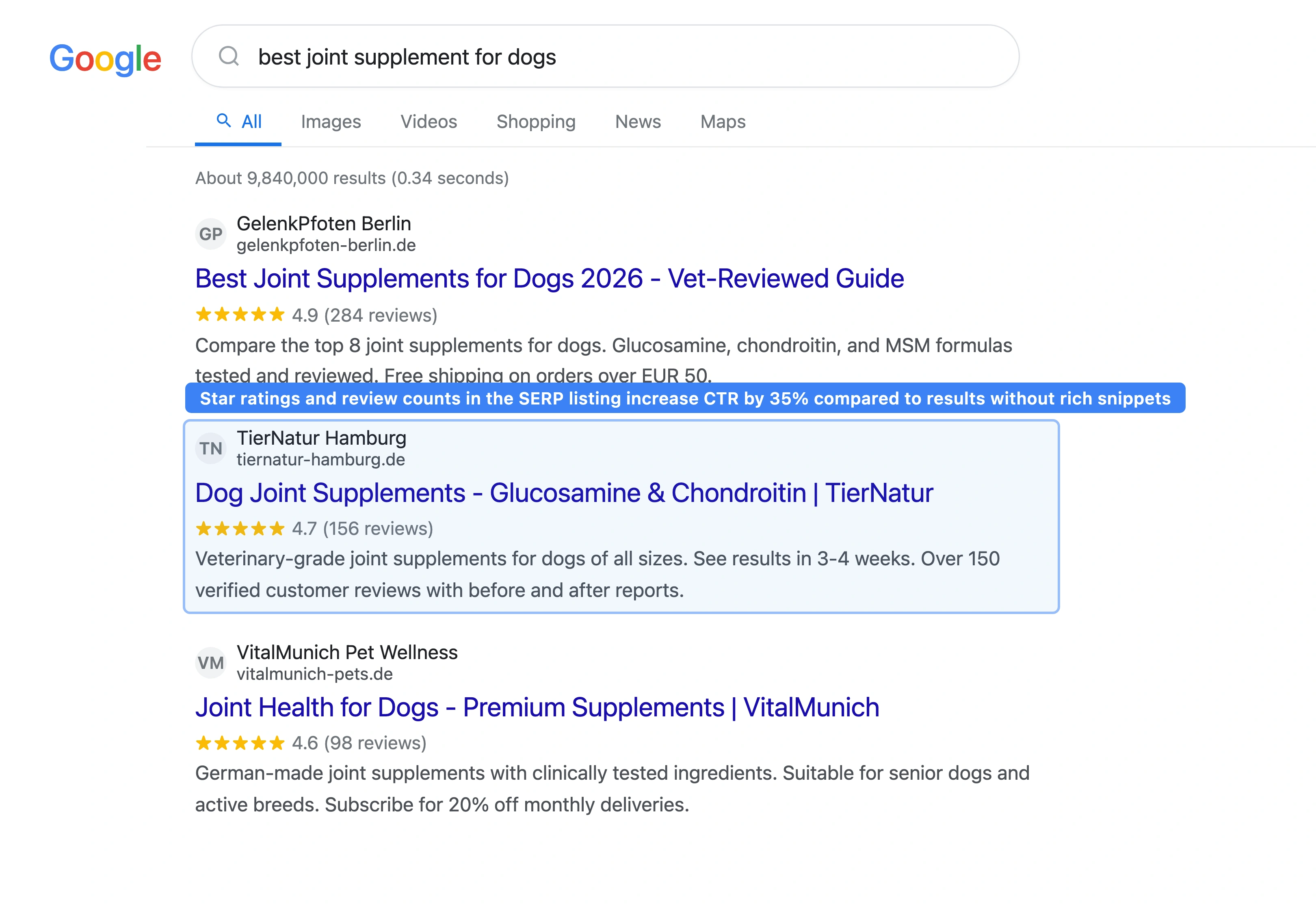
Star ratings in Google search results increase click-through rates by 35% on average[1]. Product schema with review data delivers 4.2x higher Google Shopping visibility[2]. And consumer reviews drive a 120.3% lift in conversion once visitors land on your page[3]. Yet most pet product stores either skip review schema entirely or implement it incorrectly, leaving stars, prices, and availability out of their search listings.
This guide covers exactly how pet product stores implement review schema correctly - from the JSON-LD structure Google requires to the review collection strategies that build the data your schema needs.
TL;DR
Review schema markup unlocks star ratings, price, and availability in Google search results - boosting CTR by 35% and conversions by 120%. Pet products especially benefit because buyers rely on reviews for health-adjacent purchasing decisions. This guide covers the exact JSON-LD implementation, review collection workflows, and pet-specific trust signals needed to earn and keep rich snippets.
Why Does Review Schema Matter for Pet Products?
Pet products sit in a trust-sensitive space. Pet food, supplements, health products, and grooming tools all affect animal wellbeing. 93% of consumers say reviews affect their buying decisions[4], and for pet parents, that number is effectively 100% when it comes to products they feed to or put on their animals.
Review schema does two things: it makes your reviews visible in Google before the click (star ratings, review count, price), and it gives Google structured data about product quality and customer satisfaction. Both signals help you rank higher and convert more visitors.
A controlled test by Search Pilot found that adding review schema alone increased organic traffic by 20%[5]. For a pet store doing USD 15,000/month from organic traffic, that is USD 3,000 in additional monthly revenue from a one-time technical implementation.
For broader schema strategy, see our pet store schema markup guide.
Petbase automates SEO content for pet stores - publishing 10 optimized articles monthly so you can focus on running your shop - start your free trial.
What Types of Review Schema Apply to Pet Products?
Google supports several related schema types for reviews. Pet stores typically need three:
1. Product Schema with AggregateRating
The most important. Adds star rating, review count, price, and availability to your SERP listing. Required fields:
@type: Productname- the exact product nameimage- product photo URLbrand- manufacturer or your store brandoffers- price, currency, availability, URLaggregateRating- ratingValue, reviewCount
2. Individual Review Schema
Nests inside Product or appears standalone. Includes reviewer name, rating value, date, and review body. Google can display individual review snippets in addition to aggregate ratings. For pet products, detailed reviews mentioning breed, age, and results ("My senior lab's joints improved in 3 weeks") build both trust and keyword relevance.
3. LocalBusiness with AggregateRating
For physical pet stores, add AggregateRating to your LocalBusiness schema. This shows your store's star rating in Google Maps and local search results, separate from individual product ratings.
How Do You Implement Review Schema on Pet Product Pages?
Add JSON-LD structured data in the <head> or <body> of each product page. The script should be generated dynamically from your product and review data. Here is the complete structure:
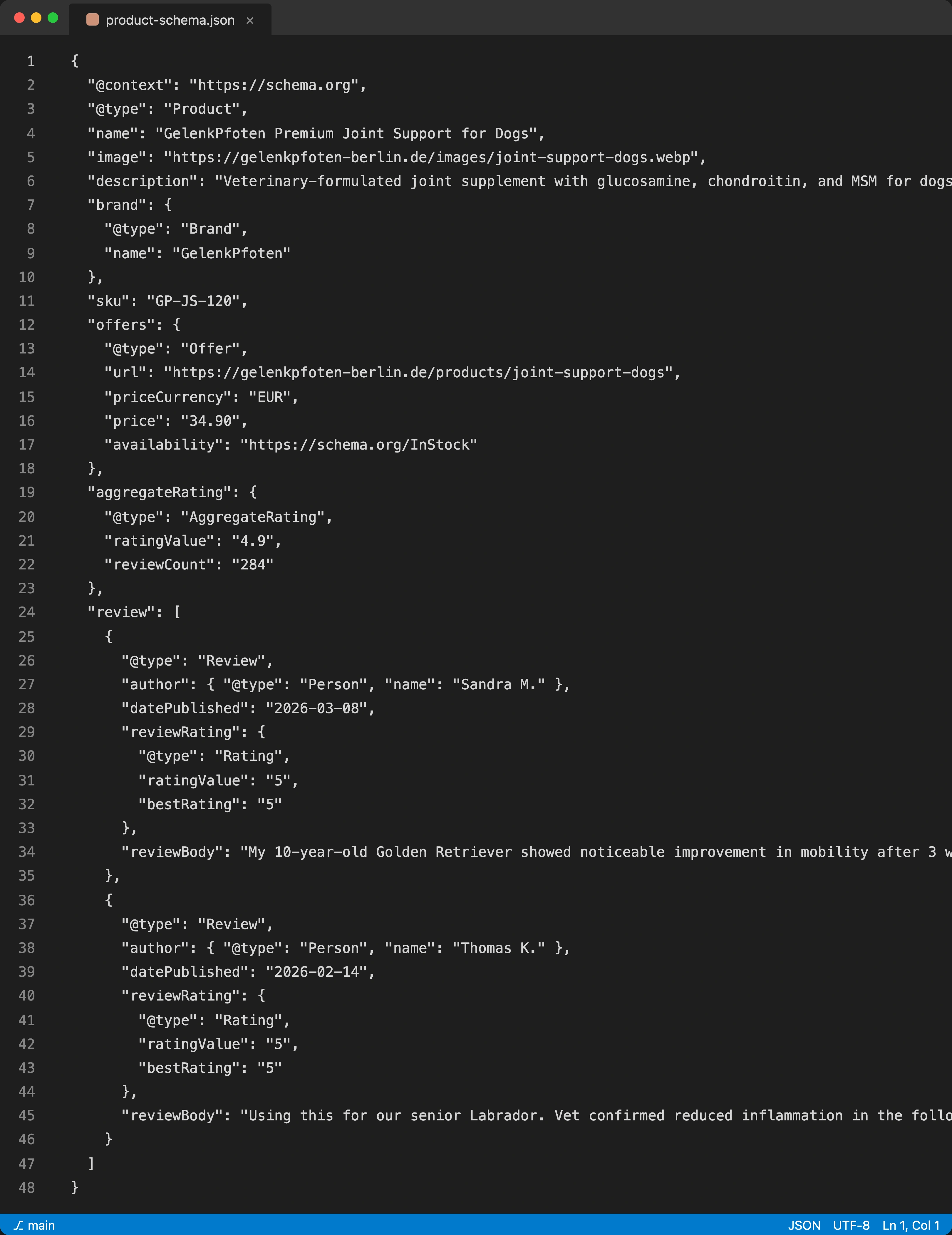
Key implementation details:
ratingValuemust reflect your actual aggregate score - do not fabricate or round upreviewCountmust match the actual number of reviews on the page- individual
Reviewobjects should include the reviewer's name and the review date offersmust includepriceCurrency,price, andavailability(InStock, OutOfStock, PreOrder)- validate your markup with Google's Rich Results Test after every implementation change
What Are Google's Review Schema Rules?
Google has strict rules for review rich results. Violating them causes your rich snippets to disappear:
- Reviews must be about a specific product. You cannot aggregate store-wide reviews into individual product schema. Each product must have its own reviews.
- Self-serving reviews are not eligible. Reviews written by the store owner or manufacturer do not qualify.
- Review data must match visible content. The aggregate rating and review count in your schema must match what is visible on the page. Google will penalize mismatches.
- No schema on category pages. AggregateRating schema belongs on product pages, not on category or collection pages that list multiple products.
- Keep reviews fresh. Google may stop showing rich snippets for products with only old reviews. Maintain a steady flow of new reviews.
How Do You Collect Reviews for Pet Products?
Schema is only as good as the review data behind it. Here is how to build a steady review pipeline:
- send automated review requests 7 to 14 days after delivery (pet owners need time to observe results)
- for supplements and food, wait 14 to 21 days - buyers need to see effects
- prompt specific details: "Mention your pet's breed, age, and any changes you noticed"
- offer photo review incentives (small discount on next order) - photo reviews boost conversion 3x more than text-only
- respond to every review publicly, especially negative ones - response quality signals trust
- syndicate reviews across platforms: collect on your site, display on Google Shopping
One pattern I have seen repeatedly with pet supplement brands: stores that time review requests to the product's expected result window (2 to 3 weeks for joint supplements, 4 to 6 weeks for skin and coat) get 40% higher review completion rates and significantly more detailed responses.
What Pet-Specific Trust Signals Complement Review Schema?
Pet products are YMYL-adjacent. Google rewards additional trust signals beyond reviews:
- veterinary endorsement badges with the vet's real name and credentials
- third-party certifications (NASC, GMP, organic, human-grade) displayed and marked up
- ingredient transparency pages linked from product pages
- clinical study references for supplements and therapeutic foods
- recall history and safety testing disclosure
These signals do not directly affect review schema, but they improve E-E-A-T scores for the pages where review schema appears. Google is more likely to display rich snippets from pages that demonstrate overall trustworthiness.
For broader E-E-A-T strategy, see our pet business E-E-A-T guide.
How Do You Monitor and Maintain Review Rich Snippets?
After implementation, ongoing maintenance ensures your rich snippets stay active:
| Task | Frequency | Tool |
|---|---|---|
| Validate schema on new/updated products | Weekly | Google Rich Results Test |
| Check rich result status | Monthly | Google Search Console > Enhancements > Product |
| Monitor review count freshness | Monthly | Review app dashboard |
| Audit schema-visible data vs page content match | Quarterly | Manual spot-check + Screaming Frog |
| Check for Google penalties or manual actions | Monthly | Google Search Console > Manual Actions |
| Update review request timing for new product categories | As needed | Email automation platform |
How Does Petbase Help Pet Stores Build Review-Ready Content?
Review schema works best on pages with strong unique product descriptions, ingredient details, and supporting content. Thin product pages with manufacturer copy rarely earn rich snippets because Google does not see enough unique value to highlight them.
Petbase generates optimized product descriptions, ingredient explainers, and educational content that builds the page-level quality Google looks for when deciding whether to award rich snippets. 10 articles per month, published directly to your website, for USD 199/month.
Star ratings increase CTR by 35%[1] and reviews drive 120% more conversions[3]. The combination of strong schema, real reviews, and quality content is what separates pet stores that dominate search from those that blend into the page-two crowd.
Start your 7-day free trial and build the content foundation your review schema needs.
Frequently Asked Questions
How long does it take for review rich snippets to appear in Google?
After implementing valid schema, Google typically displays rich snippets within 2 to 4 weeks. Some pages see results faster if Google recrawls them sooner. You can request indexing via Google Search Console to speed up the process. Rich snippets are not guaranteed for every page - Google decides which results show rich snippets based on overall page quality, review authenticity, and competitive factors.
Can you use third-party review aggregators for schema?
Yes, if the reviews are about your specific products and the review data is syndicated to your product pages. Platforms like Judge.me, Yotpo, and Stamped output valid schema automatically. The key requirement is that the reviews shown in your schema match the reviews visible on the page. Do not import reviews from other sites or products.
Does review schema help with Google Shopping?
Yes. Product schema with AggregateRating increases Google Shopping visibility by up to 4.2x. Star ratings in Shopping results increase click-through rates and reduce cost per acquisition for paid Shopping campaigns. Even if you are not running Google Shopping ads, having valid product schema makes your products eligible for free Google Shopping listings.
What happens if your star rating drops?
Google displays whatever your actual aggregate rating is. A 4.2 rating is better than no rating at all - most consumers consider anything above 4.0 trustworthy. If your rating drops below 3.5, focus on customer service improvements and review response quality before worrying about schema. Never manipulate ratings through fake reviews - Google detects patterns and will remove your rich snippets permanently.
References
- Yotpo (2025). Review Rich Snippets: A Guide to Boosting CTR. yotpo.com
- Taylor Scher SEO (2025). E-commerce SEO Statistics. taylorscherseo.com
- CXL / PowerReviews (2024). User-Generated Reviews and Conversion. cxl.com
- BrightLocal (2024). Local SEO Statistics. brightlocal.com
- Spring2Digital (2025). Rich Snippets, Microdata and SEO Impact. spring2digital.com